
Unit 5 Sheet Metal Working Syllabus Types of

Unit 5 Sheet Metal Working Syllabus § Types of sheet metal operations, types of dies and punches, Material for dies and punches § Die design for blanking, piercing, bending and drawing, clearance analysis, center of pressure, blank size determination (numerical) § Strip layout, sheet utilization ratio (numerical), method of reducing forces
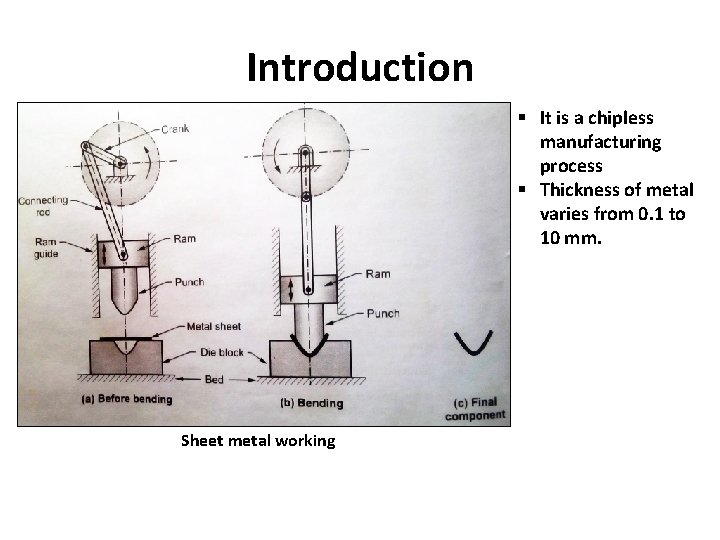
Introduction § It is a chipless manufacturing process § Thickness of metal varies from 0. 1 to 10 mm. Sheet metal working
q Advantages Sheet metal working § It is associated with press machine on which number of operations can be performed. § Metal sheets of less thickness can be formed into various shapes. § Low cost components § High production rate § It does not require skilled labour. q Disadvantages § § § Only used for mass production Cost of die is high. High initial cost Metals of thickness more than 10 mm are difficult to form. Operation produces more noise and vibrations. q Applications § Press parts used in automobile industry § Vehicle parts like doors, roofs, fuel tanks, front guards, etc. § Aircraft industry, radio and telephone industry, electrical parts, etc.
Metals used in sheet metal working Material Applications 1. Black iron Pans, tanks, cabinets, almirahs, stove pipes, etc. 2. Galvanized Storage tanks, buckets, heating ducts, furnces, pans, iron trunks, etc. 3. Aluminium Aeroplane bodies, kitchenware and cabinets, doors, windows and building work, electrical appliances, etc. 4. Copper 5. Stainless 6. Tin Radiators of an automobile, heating appliances, hoods and components in chemical plants Food storage equipments, dairy equipments, food processing plant, chemical plant Food containers, cooking oil containers, cans, etc.

1. 2. 3. 4. Classification of Press machine According to power source a) b) Manually operated Power press- Hydraulic, mechanical press a) b) c) d) e) Inclinable frame Group frame Straight side frame Horning press Adjustable bed type press a) b) c) Single action Double action Tripple action a) b) c) d) e) f) Crank press Eccentric press Toggle press Knuckle press Rack and pinion press Hydraulic press According to type and design of the frame According to actions According to the ram driving mechanism

Classification of Press machine 5. According to the number of drive gears a) Single drive press b) Twin drive press c) Quadruple press 6. According to number of crankshafts a) Single crank b) Double crank 7. According to the power transmission method a) b) c) d) Direct drive press Non geared or flywheel driven press Single drive gear press Double geared drive press
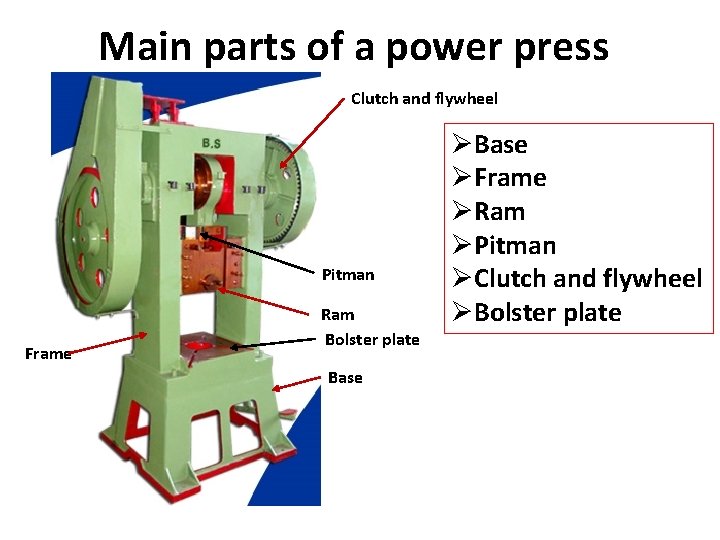
Main parts of a power press Clutch and flywheel Pitman Frame Ram Bolster plate Base ØFrame ØRam ØPitman ØClutch and flywheel ØBolster plate
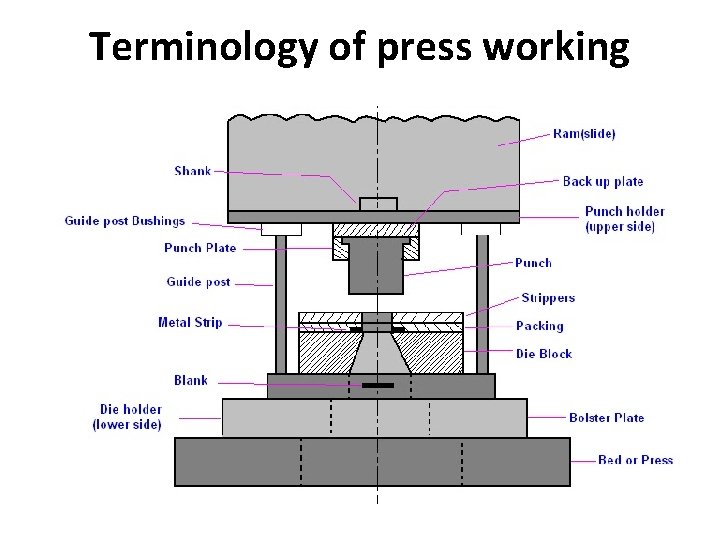
Terminology of press working
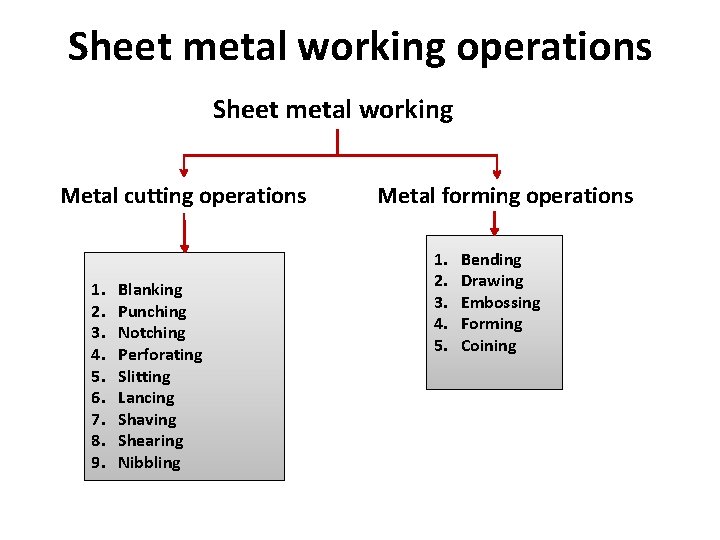
Sheet metal working operations Sheet metal working Metal cutting operations 1. 2. 3. 4. 5. 6. 7. 8. 9. Blanking Punching Notching Perforating Slitting Lancing Shaving Shearing Nibbling Metal forming operations 1. 2. 3. 4. 5. Bending Drawing Embossing Forming Coining
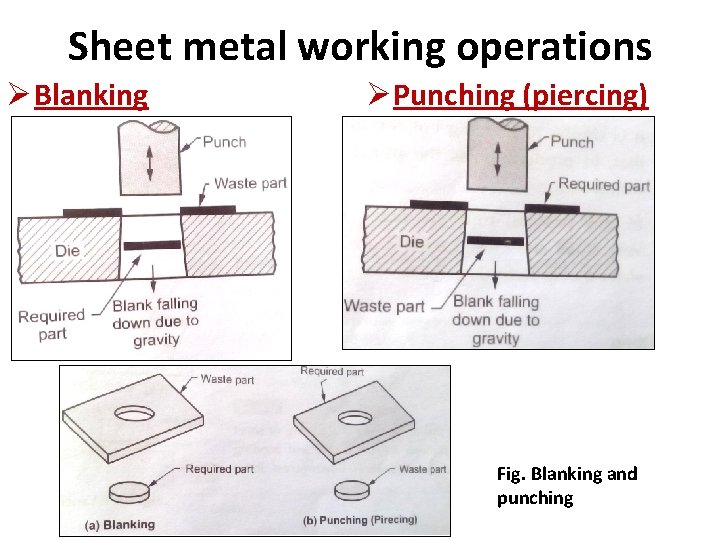
Sheet metal working operations Ø Blanking ØPunching (piercing) Fig. Blanking and punching
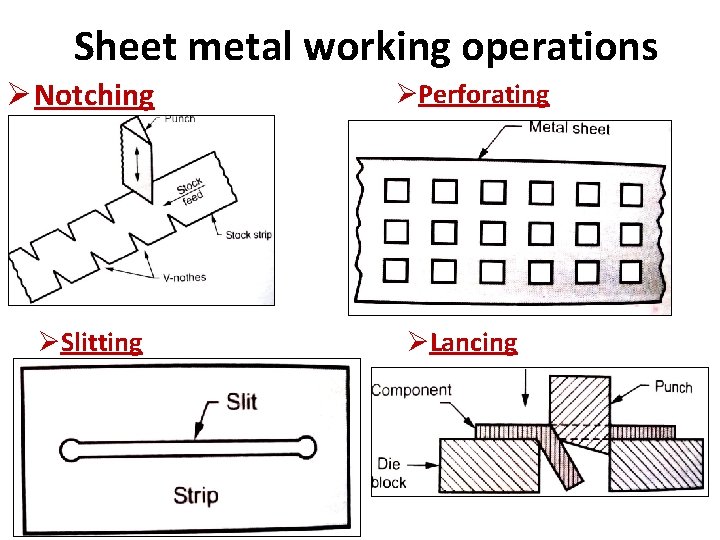
Sheet metal working operations Ø Notching ØSlitting ØPerforating ØLancing

Sheet metal working operations Ø Shaving Ø Shearing
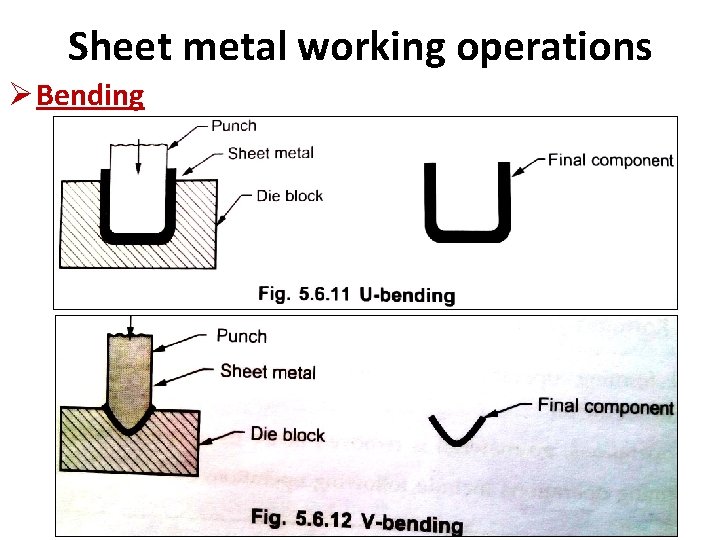
Sheet metal working operations Ø Bending
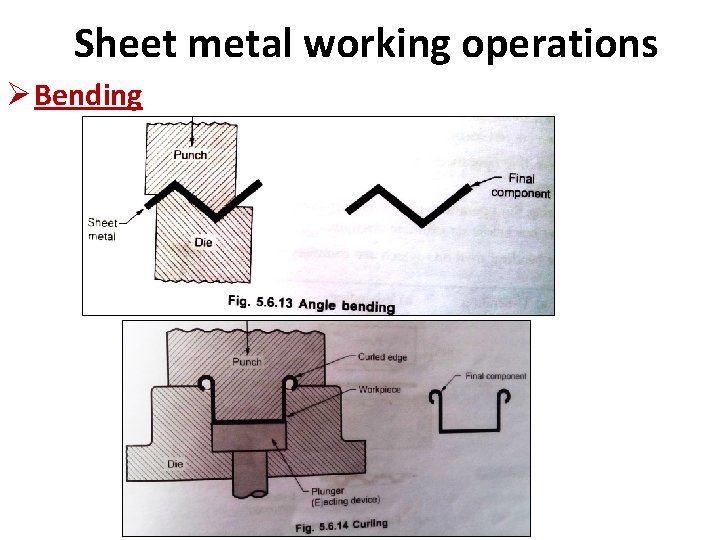
Sheet metal working operations Ø Bending
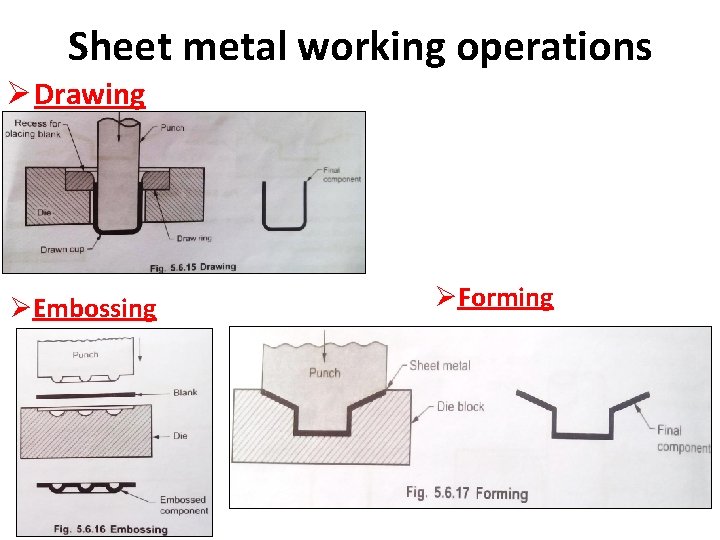
Sheet metal working operations Ø Drawing ØEmbossing ØForming
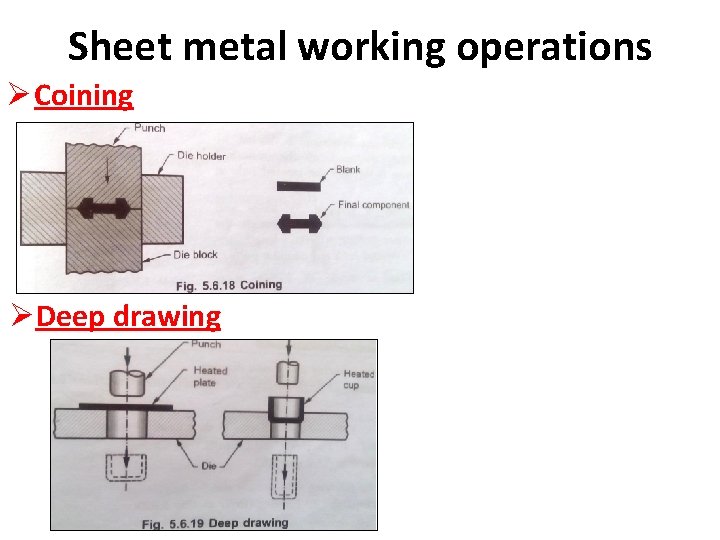
Sheet metal working operations Ø Coining ØDeep drawing
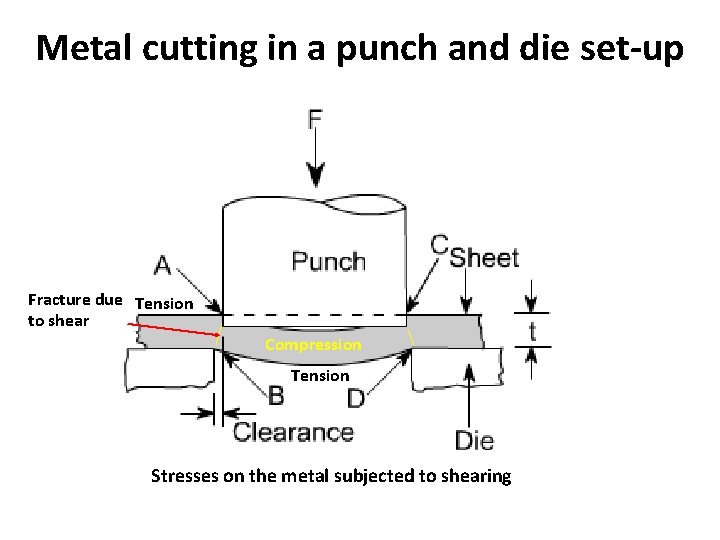
Metal cutting in a punch and die set-up Fracture due Tension to shear Compression Tension Stresses on the metal subjected to shearing
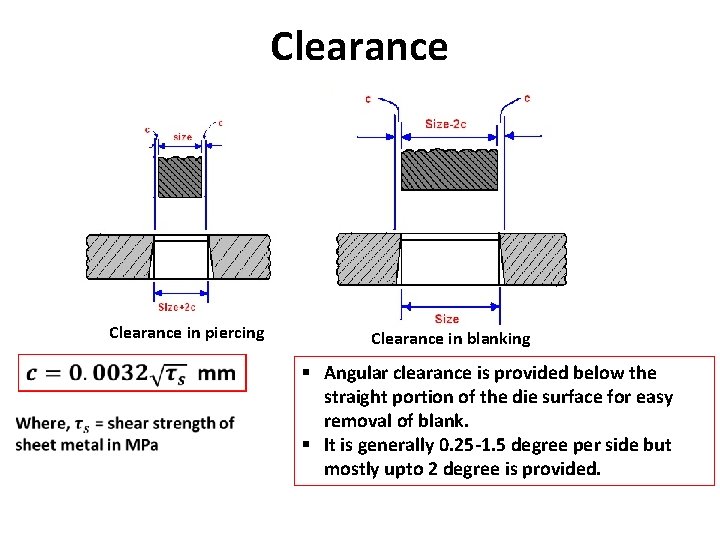
Clearance in piercing Clearance in blanking § Angular clearance is provided below the straight portion of the die surface for easy removal of blank. § It is generally 0. 25 -1. 5 degree per side but mostly upto 2 degree is provided.
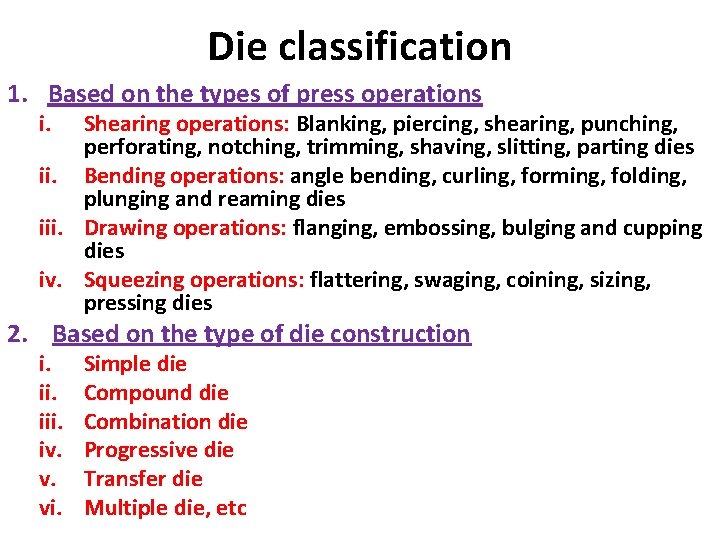
Die classification 1. Based on the types of press operations i. Shearing operations: Blanking, piercing, shearing, punching, perforating, notching, trimming, shaving, slitting, parting dies ii. Bending operations: angle bending, curling, forming, folding, plunging and reaming dies iii. Drawing operations: flanging, embossing, bulging and cupping dies iv. Squeezing operations: flattering, swaging, coining, sizing, pressing dies 2. Based on the type of die construction i. iii. iv. v. vi. Simple die Compound die Combination die Progressive die Transfer die Multiple die, etc
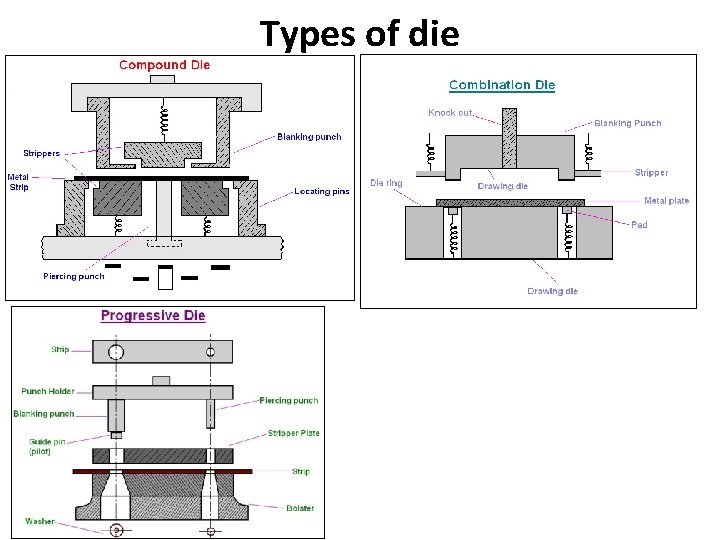
Types of die
Strip layout q. Factors affecting strip or stock layout 1. 2. 3. 4. 5. 6. Economy of material Direction of material grain Burr direction Press used Die cost Production required
Strip layout Ø Front scrap, a= t + 0. 015 h Ø Distance between successive blanks is b (if t=0. 8 then b= 0. 8; if t = 0. 8 to 3. 2 then b=t; if t is above 3. 2 then b = 3. 2) Ø The feed or advance, f= w+b Ø No. of blanks produced per length of stock, N = (L-b)/f
Size and specifications of a press q. Size of press § It is expressed in terms of maximum force that can be exerted on the workpiece by the ram of press. § Generally it is expressed in tonnage or tonnes. § Size of mechanical presses vary from 5 to 4000 tonnes and that for hydraulic presses from 5 to 50000 tonnes. § Tonnage capacity = shear strength of crankshaft material * area of crankshaft bearing (mechanical press) § Tonnage capacity = piston area * oil pressure in the cylinder (hydraulic press)
Size and specifications of a press q. Specifications of a press § Press stroke § Die space § Press tonnage § Number of strokes per minute § Shut height § Press adjustment
Requirements of press tool design Ø Dimensional accuracy and surface finish of components should be as per specifications. Ø The parts of a press tool must be strong, durable in operation and easily replaceable when required. Ø There should be easy maintenance, safe operation and reliable fastenings in the press tool. Ø It should be manufactured by using standard components. Ø The scrap in the press operation should be minimum by suitable designing the strip layout.
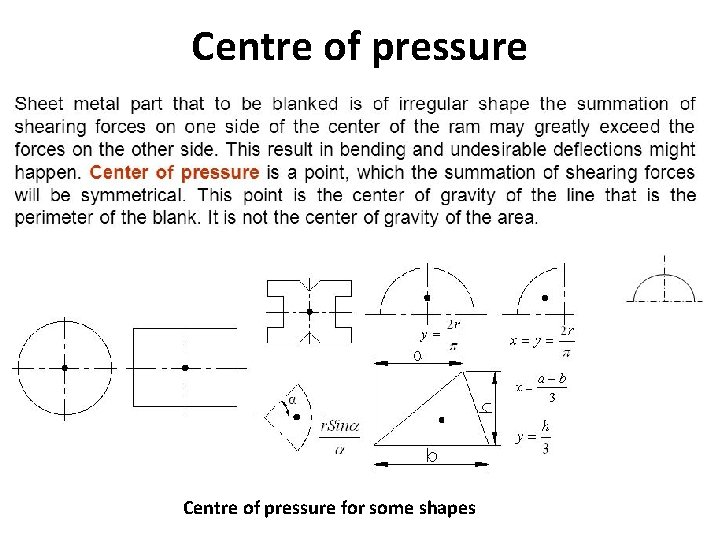
Centre of pressure for some shapes
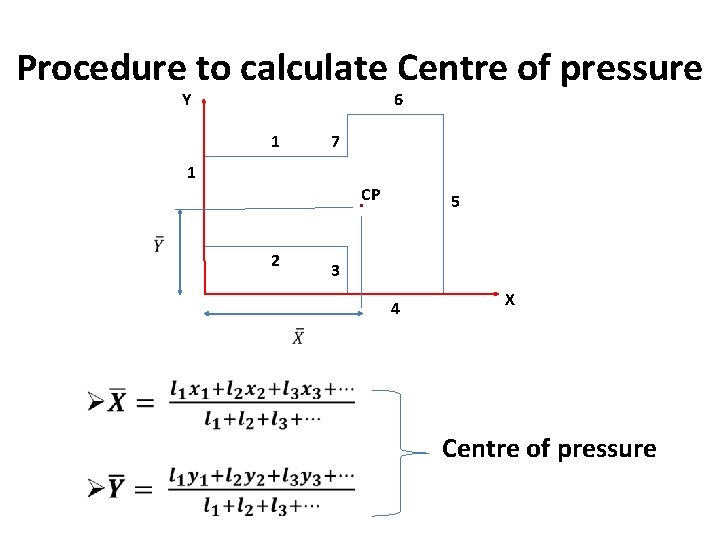
Procedure to calculate Centre of pressure Y 6 1 7 1. CP 2 5 3 4 X Centre of pressure
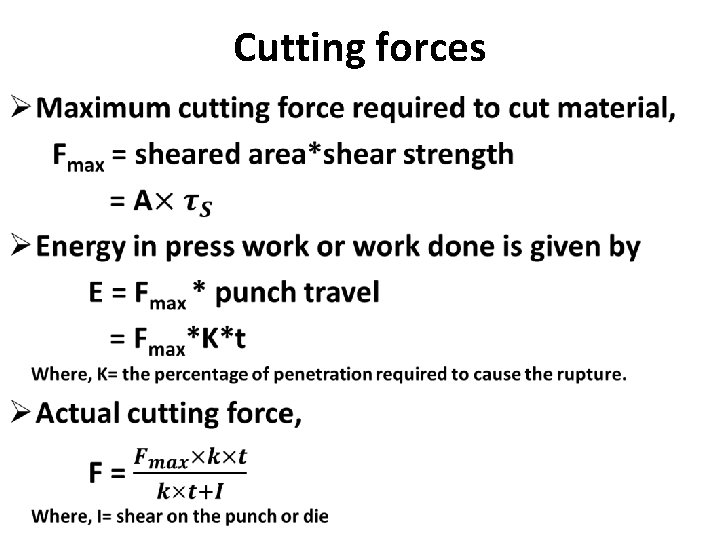
Cutting forces •
Methods of reducing cutting forces


- Slides: 31