
Unit 5 Representing and Comparing Fractions I can
- Slides: 4
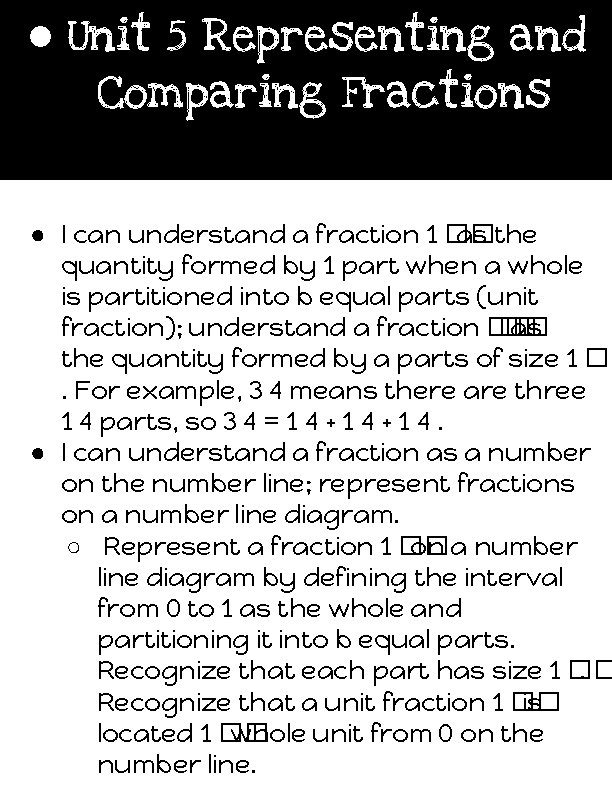
● Unit 5 Representing and Comparing Fractions ● I can understand a fraction 1 �� as the quantity formed by 1 part when a whole is partitioned into b equal parts (unit fraction); understand a fraction �� �� as the quantity formed by a parts of size 1 ��. For example, 3 4 means there are three 1 4 parts, so 3 4 = 1 4 + 1 4. ● I can understand a fraction as a number on the number line; represent fractions on a number line diagram. ○ Represent a fraction 1 �� on a number line diagram by defining the interval from 0 to 1 as the whole and partitioning it into b equal parts. Recognize that each part has size 1 ��. Recognize that a unit fraction 1 �� is located 1 �� whole unit from 0 on the number line.
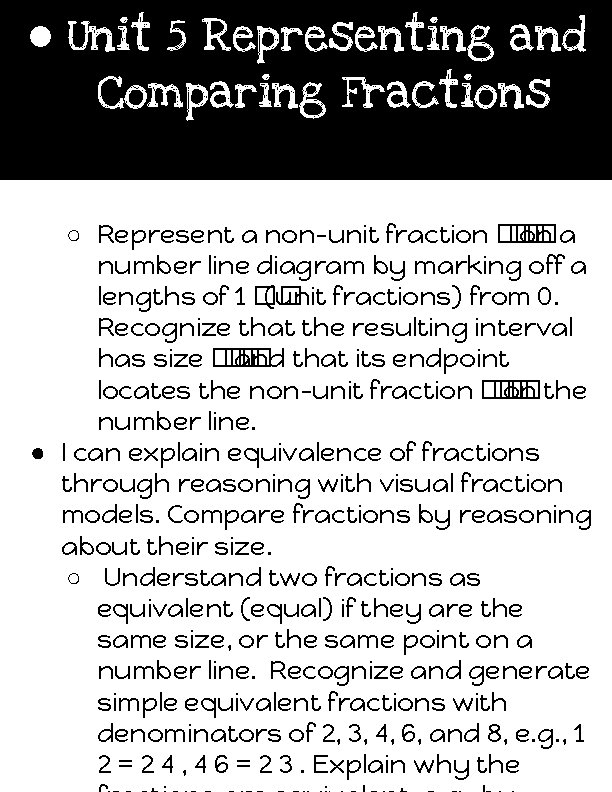
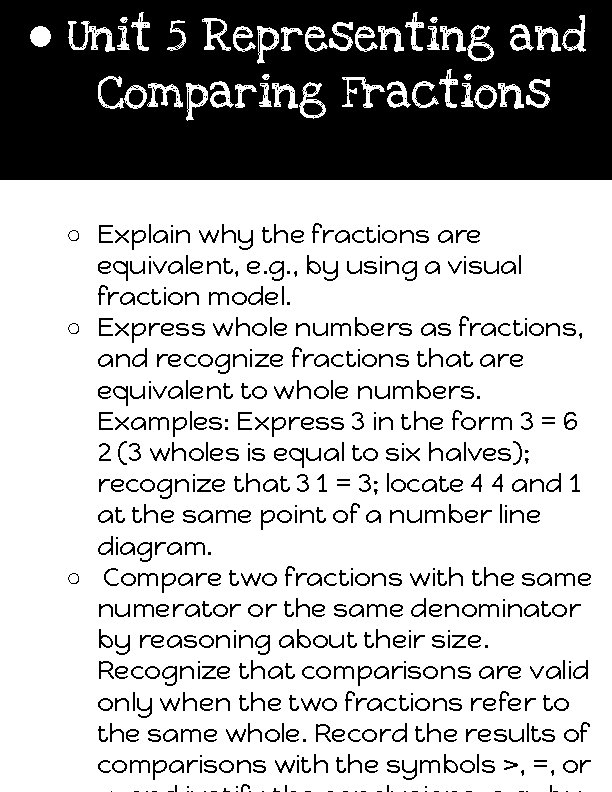
● Unit 5 Representing and Comparing Fractions ○ Represent a non-unit fraction �� �� on a number line diagram by marking off a lengths of 1 �� (unit fractions) from 0. Recognize that the resulting interval has size �� �� and that its endpoint locates the non-unit fraction �� �� on the number line. ● I can explain equivalence of fractions through reasoning with visual fraction models. Compare fractions by reasoning about their size. ○ Understand two fractions as equivalent (equal) if they are the same size, or the same point on a number line. Recognize and generate simple equivalent fractions with denominators of 2, 3, 4, 6, and 8, e. g. , 1 2 = 2 4 , 4 6 = 2 3. Explain why the
● Unit 5 Representing and Comparing Fractions ○ Explain why the fractions are equivalent, e. g. , by using a visual fraction model. ○ Express whole numbers as fractions, and recognize fractions that are equivalent to whole numbers. Examples: Express 3 in the form 3 = 6 2 (3 wholes is equal to six halves); recognize that 3 1 = 3; locate 4 4 and 1 at the same point of a number line diagram. ○ Compare two fractions with the same numerator or the same denominator by reasoning about their size. Recognize that comparisons are valid only when the two fractions refer to the same whole. Record the results of comparisons with the symbols >, =, or
● Unit 5 Representing and Comparing Fractions ○ Compare two fractions with the same numerator or the same denominator by reasoning about their size. Recognize that comparisons are valid only when the two fractions refer to the same whole. Record the results of comparisons with the symbols >, =, or <, and justify the conclusions, e. g. , by using a visual fraction model.