
Unit 5 Reinforcement A Definition B Schedules of
Unit 5: Reinforcement
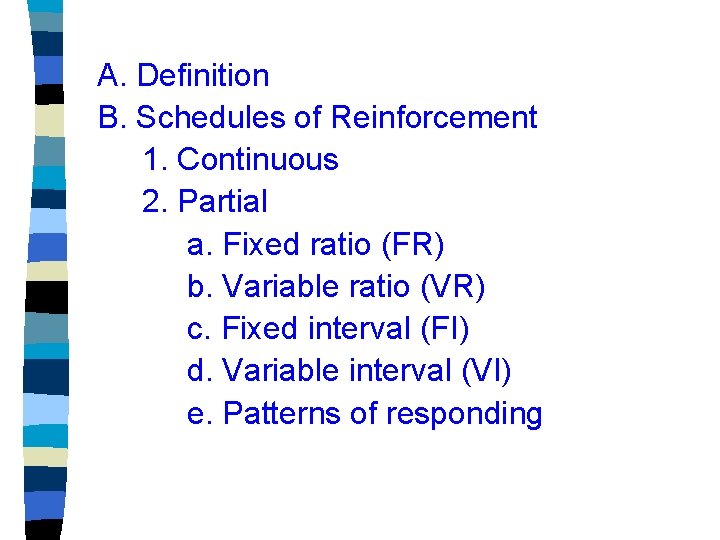
A. Definition B. Schedules of Reinforcement 1. Continuous 2. Partial a. Fixed ratio (FR) b. Variable ratio (VR) c. Fixed interval (FI) d. Variable interval (VI) e. Patterns of responding
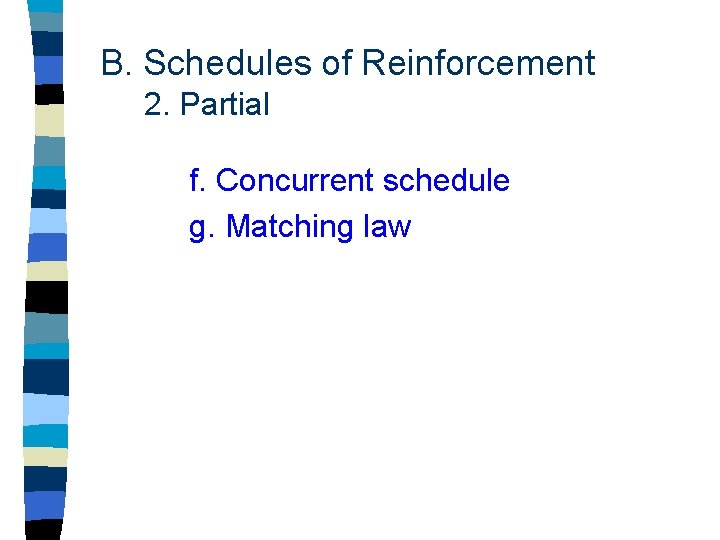
B. Schedules of Reinforcement 2. Partial f. Concurrent schedule g. Matching law
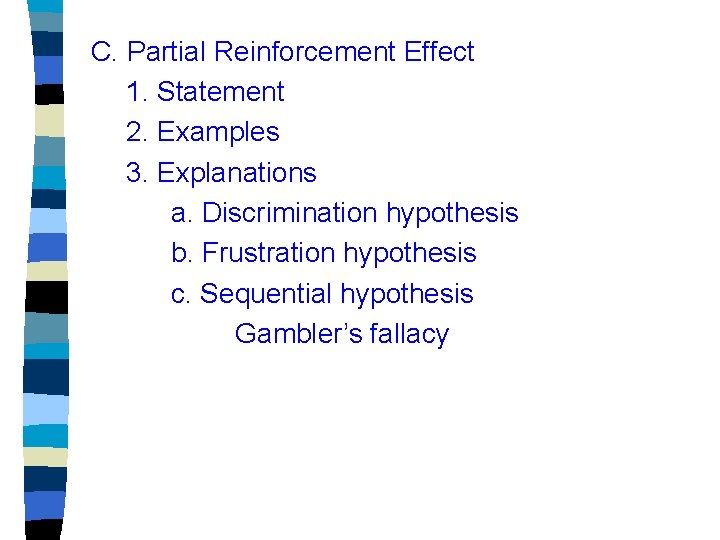
C. Partial Reinforcement Effect 1. Statement 2. Examples 3. Explanations a. Discrimination hypothesis b. Frustration hypothesis c. Sequential hypothesis Gambler’s fallacy
D. Secondary Reinforcement 1. Definition 2. Demonstration a. Choice test b. Extinction test
D. Secondary Reinforcement 3. Strength parameters a. Amount of primary reinforcer b. Number of pairings c. Drive level d. Schedule of pairings
D. Secondary Reinforcement 4. Theoretical Issues a. Role of classical conditioning b. Informational theory (Egger and Miller study) c. Secondary reinforcers as motivators (Williams study) d. Primary reinforcing properties of stimuli 5. Tokens as secondary reinforcers 6. Social reinforcers
E. Delay of Reinforcement 1. Definition and effect 2. Early study by Wolfe 3. Later study by Perkins 4. Role of secondary reinforcement 5. Delay of reinforcement in humans
F. Amount of Reinforcement 1. Role in learning vs. performance 2. Components a. Mass/volume b. Amount of consuming activity c. Confounding of components d. Separation of components e. Number of units f. Quality
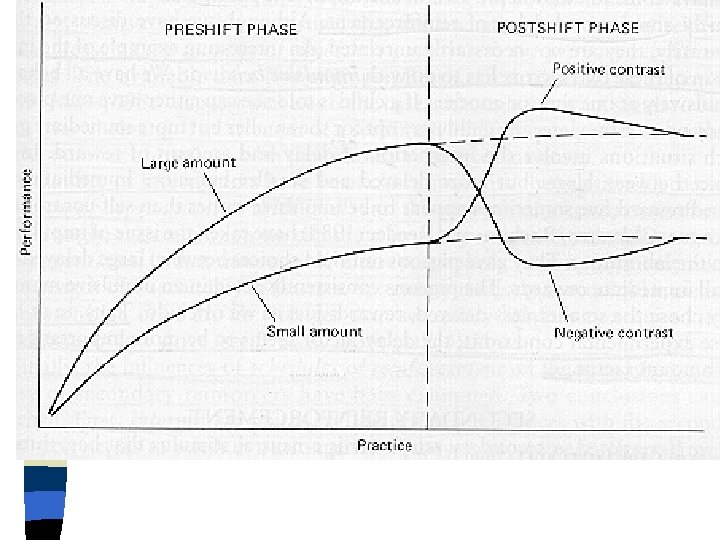
F. Amount of Reinforcement 3. Reinforcement contrast a. Negative contrast effect b. Positive contrast effect
G. Interaction of Amount and Delay of Reinforcement: Impulsive Behavior
H. Theories of Reinforcement 1. Drive reduction theory 2. Optimal arousal level theory 3. Stimulus theories a. preferred level b. stimulus change c. stimulus quality
H. Theories of Reinforcement 4. Response theories a. Premack principle b. Response deprivation 5. Which theory is correct?
- Slides: 14