
Unit 5 Reading Longer passages Effectively The topic


- Slides: 16
Unit : 5 Reading Longer passages Effectively
The topic : The topic of a longer passage is � usually repeated many times to focus the reader’s attention and to reinforce connections between the topic and the supporting ideas.
It is generally mentioned in : The title; The topic sentence of each paragraph; At least one other sentence in each paragraph.
*The thesis Statement : Identifying the Thesis Statement. The thesis statement in English: Includes the topic. Is usually found in the first paragraph. Is always a complete sentence. Often indicates how the ideas will be developed in the passage Is supported by the ideas and information found in all of the paragrapgs of the passage -
Exercise 1: Read the passage page 158 and answer the questions : - Topic : - Thesis statement :
the thesis statement , pattern of organization, and supporting points : thesis statement will help you determine the overall pattern of organization of the whole passage and what kind of supporting points to look for. In each of the paragraphs after thesis statement, the main idea supports thesis statement and often includes a signal word for the overall pattern of the passage.
Example: Read the informatiom about the example passage on pages 155 -156. Then turn back to the passage and underline the supporting points. Thesis statement: it could also be argued that they (cell phones) have had a significant impact on how we communicate and on social relation in general.
Supporting points(main ideas): Paragraph 2 The fact that cell phones allow us to stay in touch at all time has clearly had an impact on the way we work. Paragraph 3 In daily life cell phones have also brought about some changes in our habits Paragraph 4 Furthermore, apart from the users , cell phones can also have an impact on others who happen to be neaby.
Exercise 7 page 165 : A. Check your understanding of the following target words. Read each word aloud and then write S, M, or N beside it. S = you are sure of the meaning of the word M = you think you might know the meaning of the word N = you don't know the meaning of the word at all involve aware collaborate _involve _aware _collaborate _ undergo _function _consequences _circumstances_ phase _abandon _ ethics _focus on _adapt to _volunteer _coordinate _community
A. These sentences are taken from the passage in Exercise 7. Working with another student, read each sentence aloud. Then circle the best meaning or synonym for the underlined word as it is used in the sentence. :
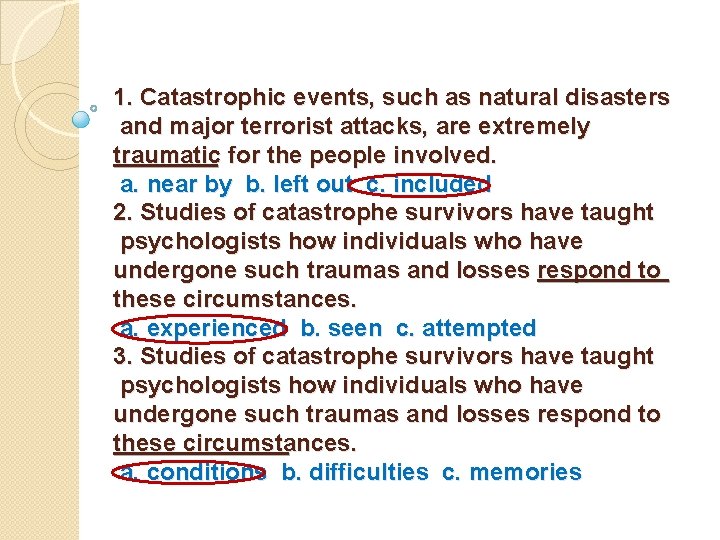
1. Catastrophic events, such as natural disasters and major terrorist attacks, are extremely traumatic for the people involved. a. near by b. left out c. included 2. Studies of catastrophe survivors have taught psychologists how individuals who have undergone such traumas and losses respond to these circumstances. a. experienced b. seen c. attempted 3. Studies of catastrophe survivors have taught psychologists how individuals who have undergone such traumas and losses respond to these circumstances. a. conditions b. difficulties c. memories
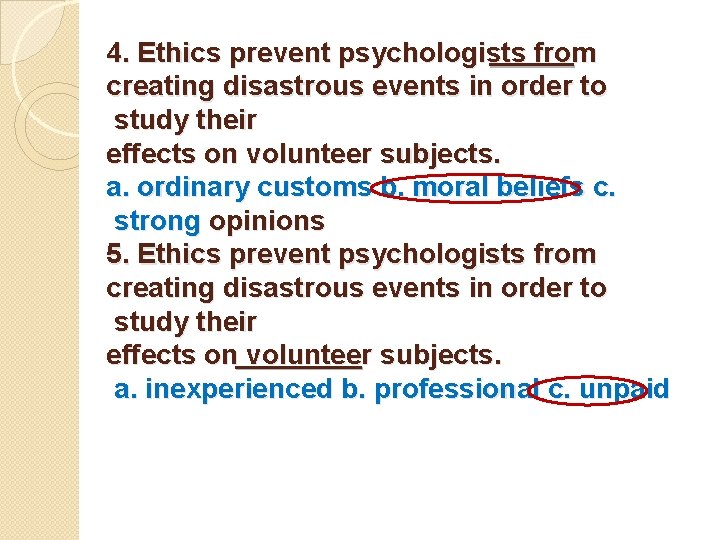
4. Ethics prevent psychologists from creating disastrous events in order to study their effects on volunteer subjects. a. ordinary customs b. moral beliefs c. strong opinions 5. Ethics prevent psychologists from creating disastrous events in order to study their effects on volunteer subjects. a. inexperienced b. professional c. unpaid
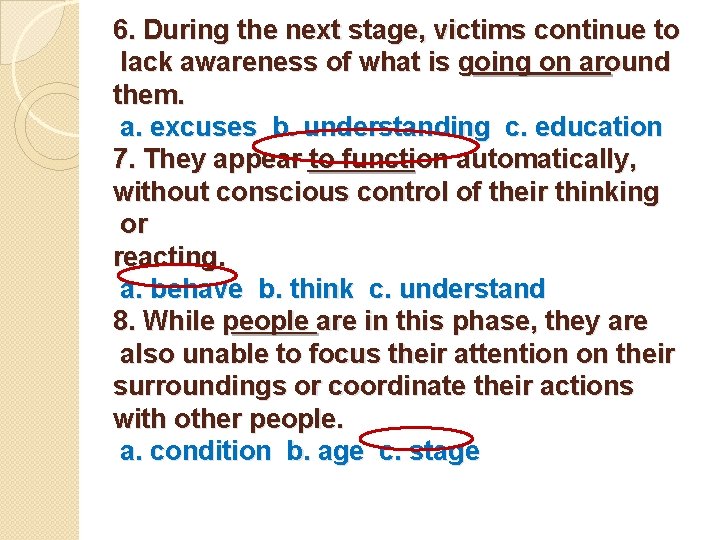
6. During the next stage, victims continue to lack awareness of what is going on around them. a. excuses b. understanding c. education 7. They appear to function automatically, without conscious control of their thinking or reacting. a. behave b. think c. understand 8. While people are in this phase, they are also unable to focus their attention on their surroundings or coordinate their actions with other people. a. condition b. age c. stage
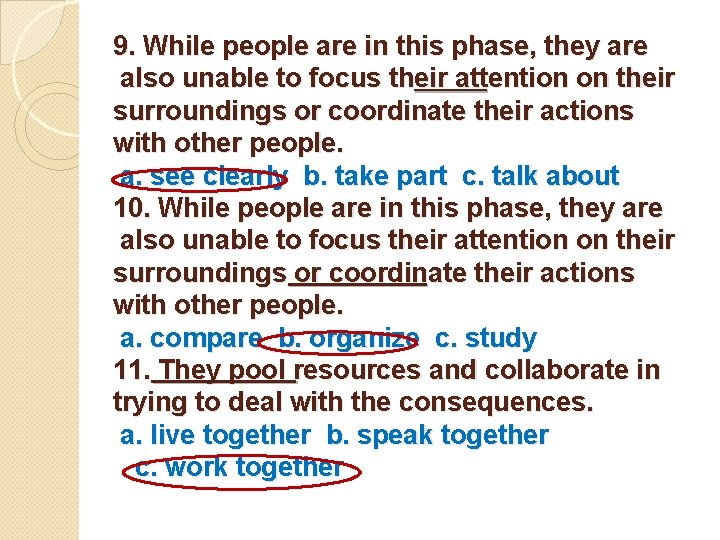
9. While people are in this phase, they are also unable to focus their attention on their surroundings or coordinate their actions with other people. a. see clearly b. take part c. talk about 10. While people are in this phase, they are also unable to focus their attention on their surroundings or coordinate their actions with other people. a. compare b. organize c. study 11. They pool resources and collaborate in trying to deal with the consequences. a. live together b. speak together c. work together
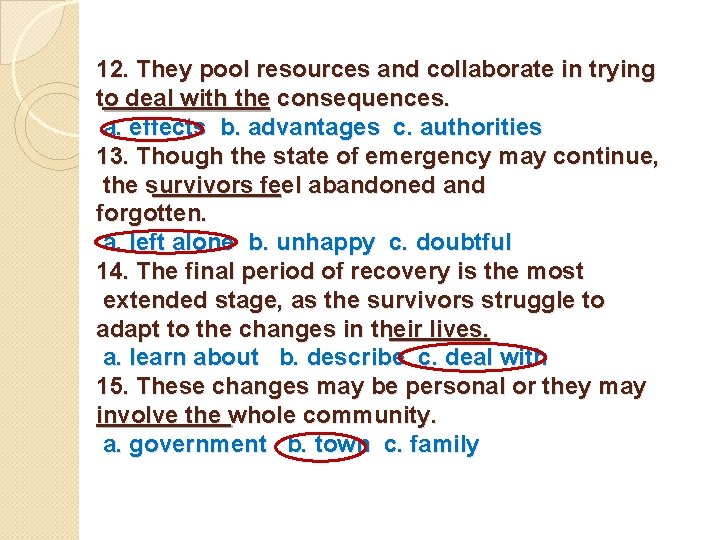
12. They pool resources and collaborate in trying to deal with the consequences. a. effects b. advantages c. authorities 13. Though the state of emergency may continue, the survivors feel abandoned and forgotten. a. left alone b. unhappy c. doubtful 14. The final period of recovery is the most extended stage, as the survivors struggle to adapt to the changes in their lives. a. learn about b. describe c. deal with 15. These changes may be personal or they may involve the whole community. a. government b. town c. family