
Unit 5 Plate Tectonics Part 3 Plate Interactions

- Slides: 24
Unit 5: Plate Tectonics Part 3: Plate Interactions
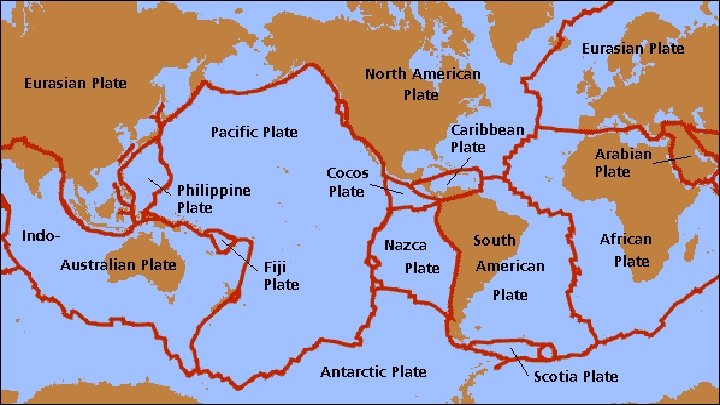
Tectonic Plates, Revisited. ● Earth’s surface is divided into about 12 large slabs of rock known as lithospheric plates (tectonic plates). ● Each plate is composed of crust and rigid mantle rock. ● While some plates contain only oceanic crust, others contain both oceanic and continental crust. ● Each plate moves slowly (a couple of centimeters per year) over the asthenosphere below. ● Plate motion is described relative to a fixed point or relative to another point. ● The relative motion of a plate depends on its motion and the motion of the surrounding plates.
Plate Boundaries ● Plates can be compared to other plates based on velocity-the speed and direction of the motion. ● Whether two plates are colliding, moving apart, or grinding past each other depends on the relative velocities at the plate boundaries. ● Relative motion at the plates can broadly be classified as convergent, divergent, or transform.
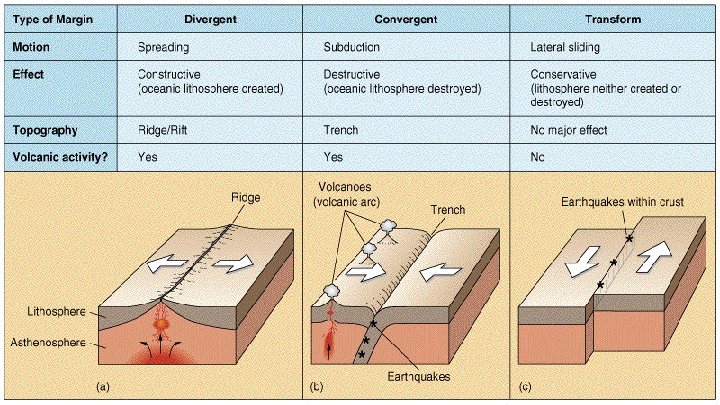
Divergent Boundaries ● Divergent boundaries are boundaries where plates move away from each other ● Form great valleys called rifts, volcanic activity, and shallow earthquakes ● Can occur in places such as the North Atlantic Ocean, where two plates are moving in opposite directions, or when two plates are moving in the same direction, but at different speeds. ● The majority of divergent boundaries occur on the ocean floor between two plates of oceanic lithosphere, generally close to the center of the ocean. ● Divergent boundaries can exist on land with two pieces of continental lithosphere moving apart. ● There are no divergent boundaries at the oceanic-continental boundaries.
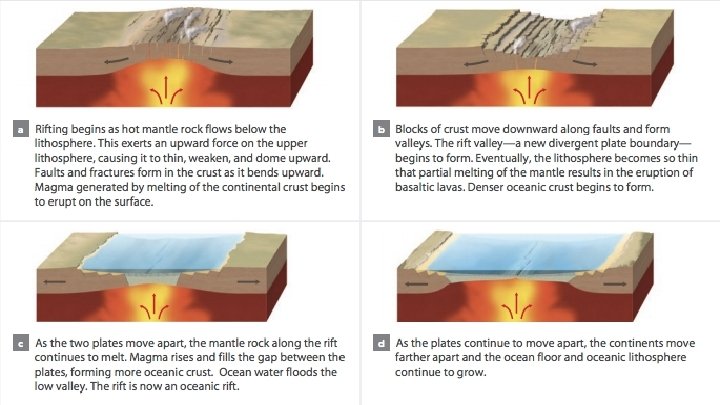
Features at Divergent Boundaries ● Rift valleys are valleys that form when two continental tectonic plates move away from each other. ● Many rift valleys include normal faults, valleys that form when blocks of crust drop down along normal faults, long narrow lakes filling the valleys, volcanoes, and broad, uplifted regions of Earth called domes. ● Weak, shallow earthquakes can also occur along rifts. ● This process occurs over millions of years. ● Because of the length of time that it takes, scientists are not completely sure how rifting begins.
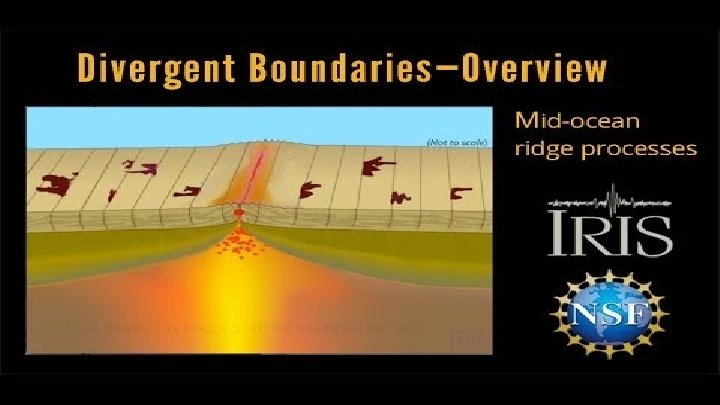
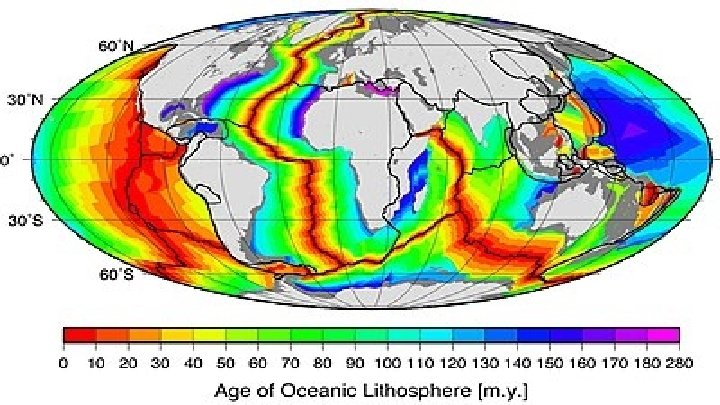
Sea-Floor Spreading ● Divergent boundaries are also called constructive plate boundaries, because new crust forms at these boundaries. ● On the ocean floor, divergent boundaries are marked by long, volcanic ridges called mid-ocean ridges. ● As plates move away from each other, magma fills the gap and cools to become part of each plate. ● The new ocean crust that forms moves off to either side of the ridge as part of each plate. ● The newer crust is found closest to the mid-ocean ridge.
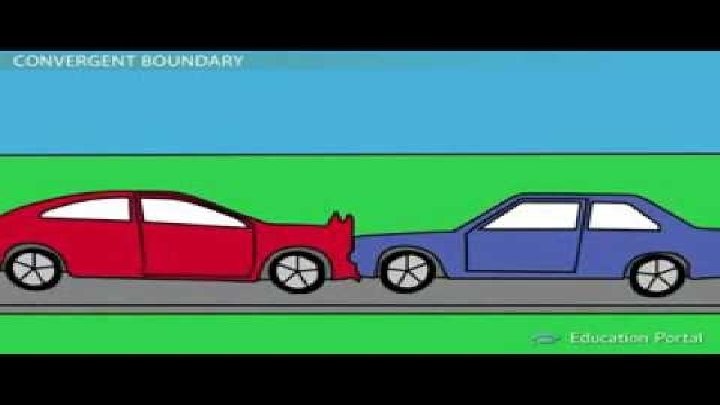
Convergent Boundaries ● At convergent boundaries, plates move toward each other, causing the lithosphere to bend or crumple. ● The folding of rock, volcanism, mountain building, and deep earthquakes occur at convergent boundaries. ● There are three types of convergent plate boundaries: ○ ○ ○ Continental-Continental: both plates consist of continental lithosphere. Oceanic-Oceanic: both plates consist of oceanic lithosphere. Continental-Oceanic: one plate consists of continental lithosphere, the other oceanic lithosphere. ● At convergent boundaries, you have one of two possibilities: ○ ○ The two plates are moving in opposite directions and toward each other. The two plates are moving in the same direction, but at different speeds.
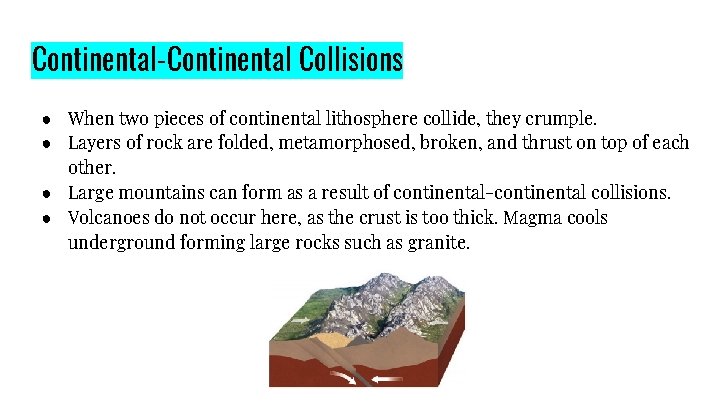
Continental-Continental Collisions ● When two pieces of continental lithosphere collide, they crumple. ● Layers of rock are folded, metamorphosed, broken, and thrust on top of each other. ● Large mountains can form as a result of continental-continental collisions. ● Volcanoes do not occur here, as the crust is too thick. Magma cools underground forming large rocks such as granite.
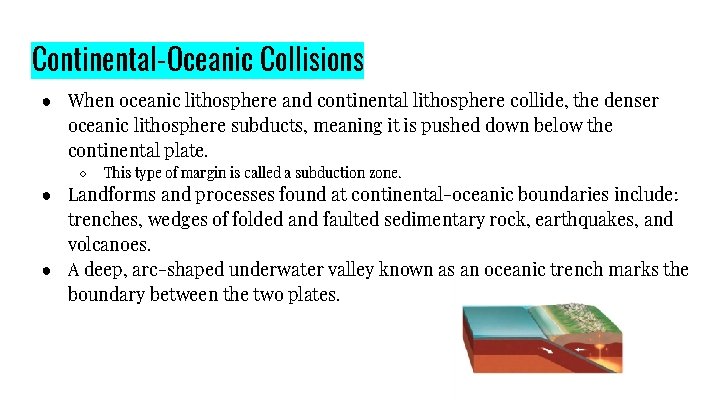
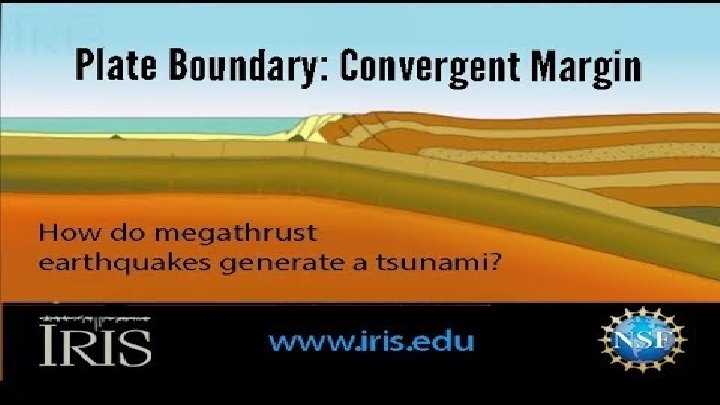
Continental-Oceanic Collisions ● When oceanic lithosphere and continental lithosphere collide, the denser oceanic lithosphere subducts, meaning it is pushed down below the continental plate. ○ This type of margin is called a subduction zone. ● Landforms and processes found at continental-oceanic boundaries include: trenches, wedges of folded and faulted sedimentary rock, earthquakes, and volcanoes. ● A deep, arc-shaped underwater valley known as an oceanic trench marks the boundary between the two plates.
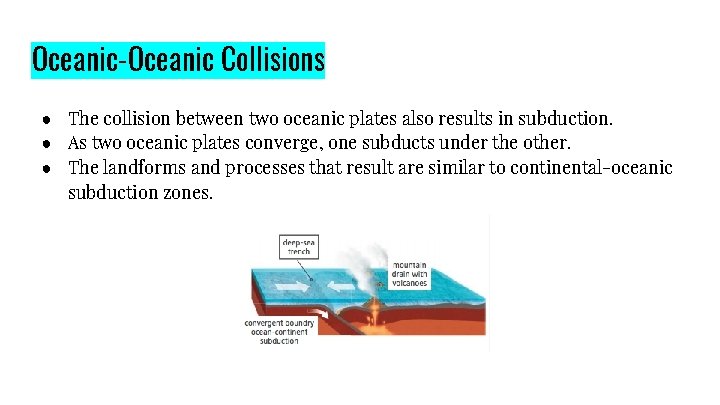
Oceanic-Oceanic Collisions ● The collision between two oceanic plates also results in subduction. ● As two oceanic plates converge, one subducts under the other. ● The landforms and processes that result are similar to continental-oceanic subduction zones.
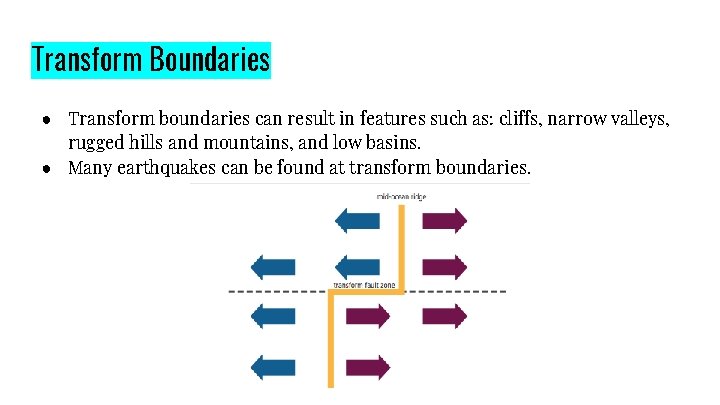
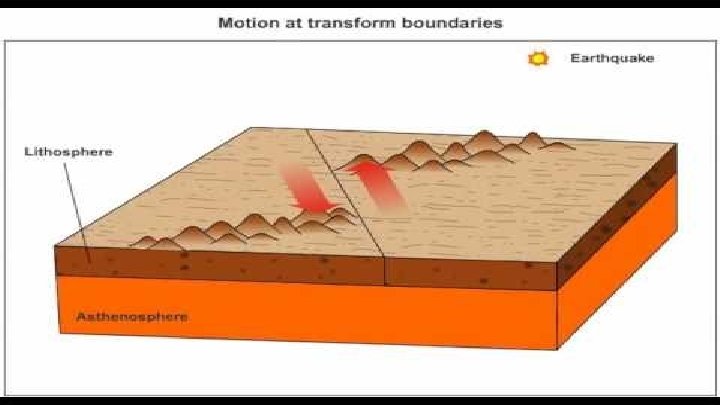
Transform Boundaries ● At transform boundaries, plates move past one another. ● Strike-slip faulting and shallow earthquakes occur along transform boundaries, but no volcanism occurs there. ● Transform boundaries allow for motion between two convergent boundaries, two divergent boundaries, or a convergent and divergent boundary. ● The general direction of a transform boundary is parallel to the fault. ● Along some transform boundaries, plates are moving in opposite directions. Along others, they are moving in the same directions, but at different speeds.
Transform Boundaries ● Transform boundaries can result in features such as: cliffs, narrow valleys, rugged hills and mountains, and low basins. ● Many earthquakes can be found at transform boundaries.
Causes of Plate Motion ● Mantle convection-variations within temperature and density of rocks in the mantle. ○ Cool, dense material sinks, while warmer, less dense materials are pushed upward. ● Slab Pull-when the weight of the subducting edge of the plate produces a force, pulling the rest of the plate along over the mantle. ● Ridge Push-when gravity pulls the ridges downhill, causing an outward force on the rest of the plate.