
Unit 5 Major Pests of Coffee Introduction Coffee
- Slides: 9
Unit 5: Major Pests of Coffee
Introduction Coffee is an important commodity worldwide. This unit will introduce the main pests that a coffee producer is likely to encounter. The main categories are: • Pests that damage the plant to render it less productive (e. g. coffee berry borer); • Pests that transmit viruses; • Pests that attack the berry (coffee berry borer) Major pests of coffee • • • include: Coffee Berry Borer, CBB (Hypothenemus hampei) Coffee Bug (Antestia species) Scales (Coccus spp. ) Mealybugs (Planococcus kenyae) Leaf Miners (Leucoptera spp. ) Coffee Stem borers (Xylotrechus quadripes) https: //www. plantwise. org/Knowledge. Bank/Search. Results. aspx? q=coffee%20 leaf%20 miner&cb=31 http: //www. cabi-bioscience. org/
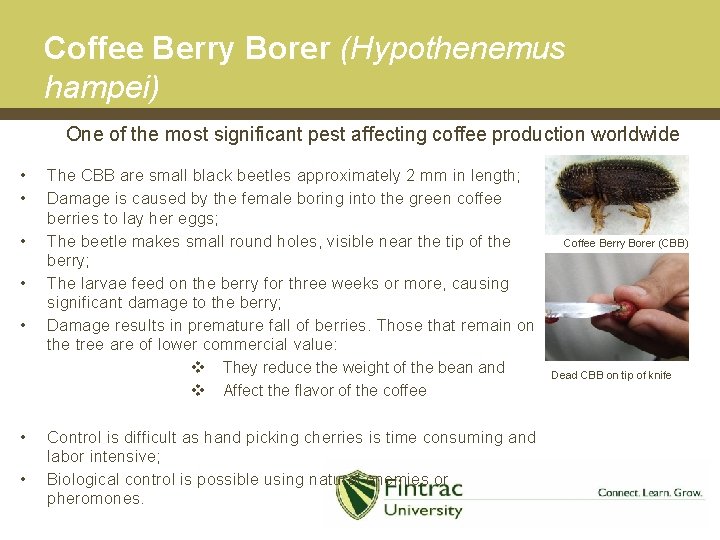
Coffee Berry Borer (Hypothenemus hampei) One of the most significant pest affecting coffee production worldwide • • The CBB are small black beetles approximately 2 mm in length; Damage is caused by the female boring into the green coffee berries to lay her eggs; The beetle makes small round holes, visible near the tip of the berry; The larvae feed on the berry for three weeks or more, causing significant damage to the berry; Damage results in premature fall of berries. Those that remain on the tree are of lower commercial value: v They reduce the weight of the bean and v Affect the flavor of the coffee Control is difficult as hand picking cherries is time consuming and labor intensive; Biological control is possible using natural enemies or pheromones. Coffee Berry Borer (CBB) Dead CBB on tip of knife
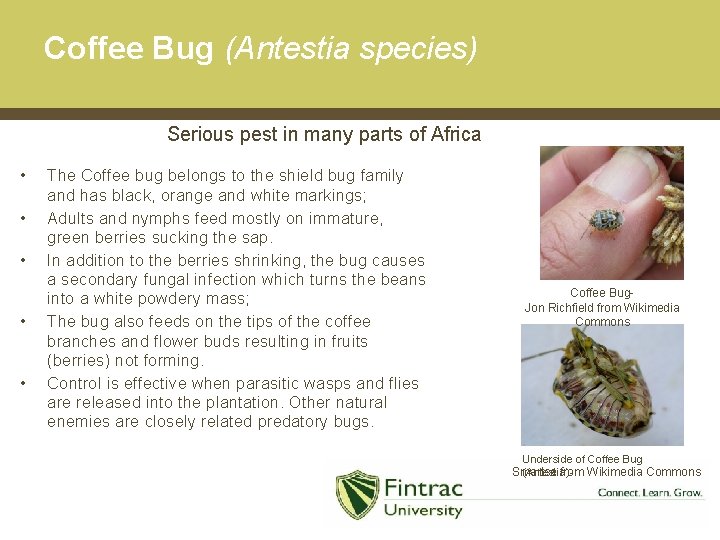
Coffee Bug (Antestia species) Serious pest in many parts of Africa • • • The Coffee bug belongs to the shield bug family and has black, orange and white markings; Adults and nymphs feed mostly on immature, green berries sucking the sap. In addition to the berries shrinking, the bug causes a secondary fungal infection which turns the beans into a white powdery mass; The bug also feeds on the tips of the coffee branches and flower buds resulting in fruits (berries) not forming. Control is effective when parasitic wasps and flies are released into the plantation. Other natural enemies are closely related predatory bugs. Coffee Bug. Jon Richfield from Wikimedia Commons Underside of Coffee Bug Smartse from Wikimedia Commons (Antestia)-
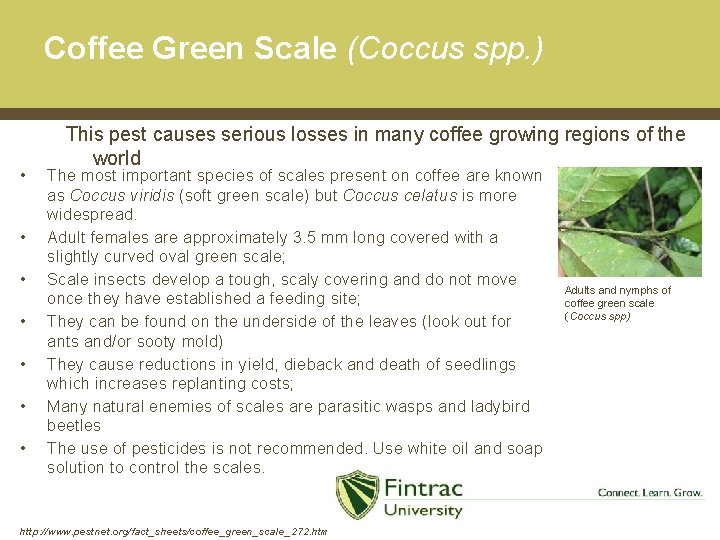
Coffee Green Scale (Coccus spp. ) • • This pest causes serious losses in many coffee growing regions of the world The most important species of scales present on coffee are known as Coccus viridis (soft green scale) but Coccus celatus is more widespread. Adult females are approximately 3. 5 mm long covered with a slightly curved oval green scale; Scale insects develop a tough, scaly covering and do not move once they have established a feeding site; They can be found on the underside of the leaves (look out for ants and/or sooty mold) They cause reductions in yield, dieback and death of seedlings which increases replanting costs; Many natural enemies of scales are parasitic wasps and ladybird beetles The use of pesticides is not recommended. Use white oil and soap solution to control the scales. http: //www. pestnet. org/fact_sheets/coffee_green_scale_272. htm Adults and nymphs of coffee green scale (Coccus spp)
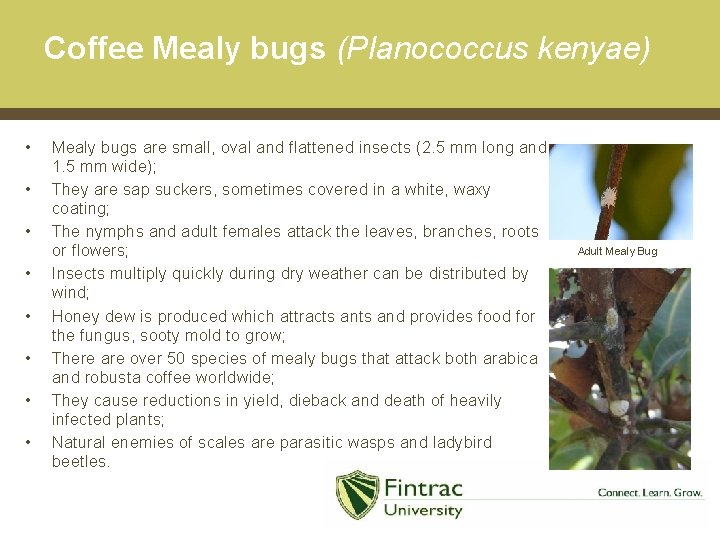
Coffee Mealy bugs (Planococcus kenyae) • • Mealy bugs are small, oval and flattened insects (2. 5 mm long and 1. 5 mm wide); They are sap suckers, sometimes covered in a white, waxy coating; The nymphs and adult females attack the leaves, branches, roots or flowers; Insects multiply quickly during dry weather can be distributed by wind; Honey dew is produced which attracts and provides food for the fungus, sooty mold to grow; There are over 50 species of mealy bugs that attack both arabica and robusta coffee worldwide; They cause reductions in yield, dieback and death of heavily infected plants; Natural enemies of scales are parasitic wasps and ladybird beetles. Adult Mealy Bug
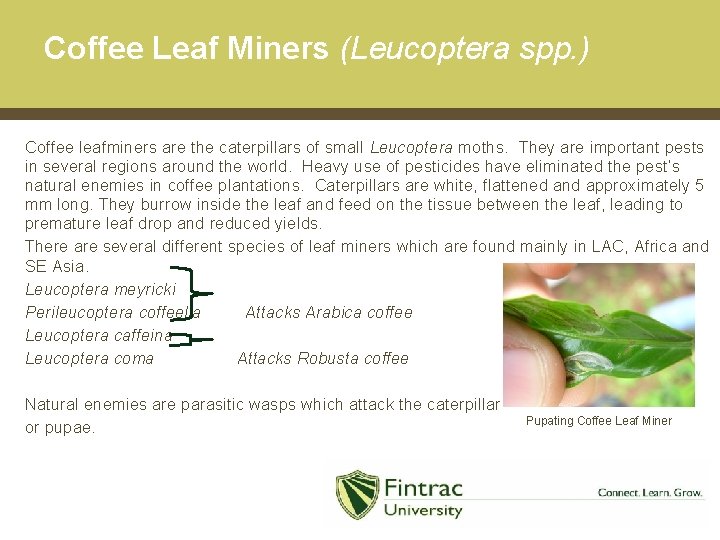
Coffee Leaf Miners (Leucoptera spp. ) Coffee leafminers are the caterpillars of small Leucoptera moths. They are important pests in several regions around the world. Heavy use of pesticides have eliminated the pest’s natural enemies in coffee plantations. Caterpillars are white, flattened and approximately 5 mm long. They burrow inside the leaf and feed on the tissue between the leaf, leading to premature leaf drop and reduced yields. There are several different species of leaf miners which are found mainly in LAC, Africa and SE Asia. Leucoptera meyricki Perileucoptera coffeella Attacks Arabica coffee Leucoptera caffeina Leucoptera coma Attacks Robusta coffee Natural enemies are parasitic wasps which attack the caterpillar or pupae. Pupating Coffee Leaf Miner
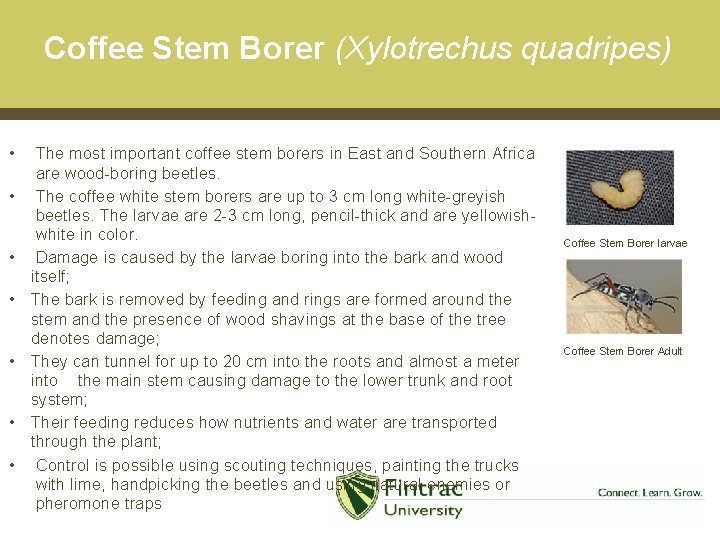
Coffee Stem Borer (Xylotrechus quadripes) • • The most important coffee stem borers in East and Southern Africa are wood-boring beetles. The coffee white stem borers are up to 3 cm long white-greyish beetles. The larvae are 2 -3 cm long, pencil-thick and are yellowishwhite in color. Damage is caused by the larvae boring into the bark and wood itself; The bark is removed by feeding and rings are formed around the stem and the presence of wood shavings at the base of the tree denotes damage; They can tunnel for up to 20 cm into the roots and almost a meter into the main stem causing damage to the lower trunk and root system; Their feeding reduces how nutrients and water are transported through the plant; Control is possible using scouting techniques, painting the trucks with lime, handpicking the beetles and using natural enemies or pheromone traps Coffee Stem Borer larvae Coffee Stem Borer Adult
Summary In this unit we covered six major pests of economic importance that affects coffee, how to recognize and control them • • • Coffee Berry Borer, CBB (Hypothenemus hampei) Coffee Bug (Antestia species) Scales (Coccus spp. ) Mealybugs (Planococcus kenyae) Leaf Miners (Leucoptera spp. ) Coffee Stem borers (Xylotrechus quadripes) Now go to the next unit…