
UNIT 5 ENVIRONMENTAL FACTORS What are 3 things




- Slides: 60
UNIT 5 ENVIRONMENTAL FACTORS
What are 3 things you know about environmental factors, regarding athlete health & safety?
Environmental stress can adversely affect performance & in instances can pose a serious health threat
HYPERTHER MIA
HYPERTHER MIA A condition in which, for one reason or another, body temperature is elevated.
Heat Stress
HYPERTHER Heat stress can be gained or lost through. MIA 5 different m Metabolic Heat Production Conductive Heat Exchange Convective Heat Exchange Radiant Heat Exchange Evaporative Heat Loss
Metabolic Heat Production HYPERTHER MIA Normal metabolic function results in the production & radiation of heat. Consequently, metabolism will always cause an increase in body heat that depends on the intensity of the physical activity.
Metabolic Heat Production HYPERTHER MIA The higher the metabolic rate, the more heat is produced.
Conductive Heat Exchange HYPERTHER MIA Physical contact w/ other objects can result in either a heat loss or a heat gain. A football player competing on artificial turf on a sunny August afternoon will experience an increase in body temp simply by standing on synthetic turf.
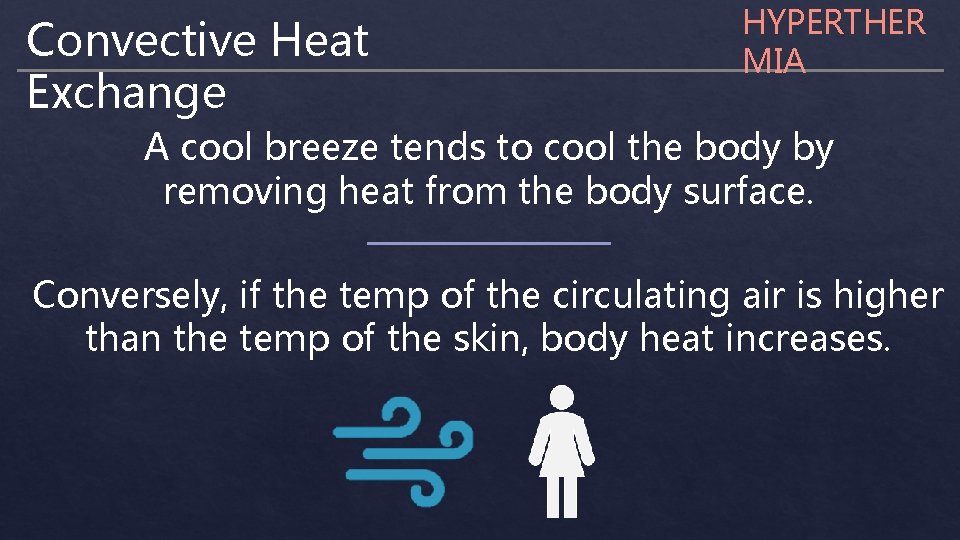
Convective Heat Exchange HYPERTHER MIA Convection occurs when a mass of either air or water moves around an individual. Body heat can be either lost or gained, depending on the temperature of the circulating medium.
Convective Heat Exchange HYPERTHER MIA A cool breeze tends to cool the body by removing heat from the body surface. Conversely, if the temp of the circulating air is higher than the temp of the skin, body heat increases.
Radiant Heat Exchange HYPERTHER MIA Radiant heat from sunshine causes an increase in body temp. The body can also emit radiant heat energy; thus, radiation may result in either heat loss or heat gain.
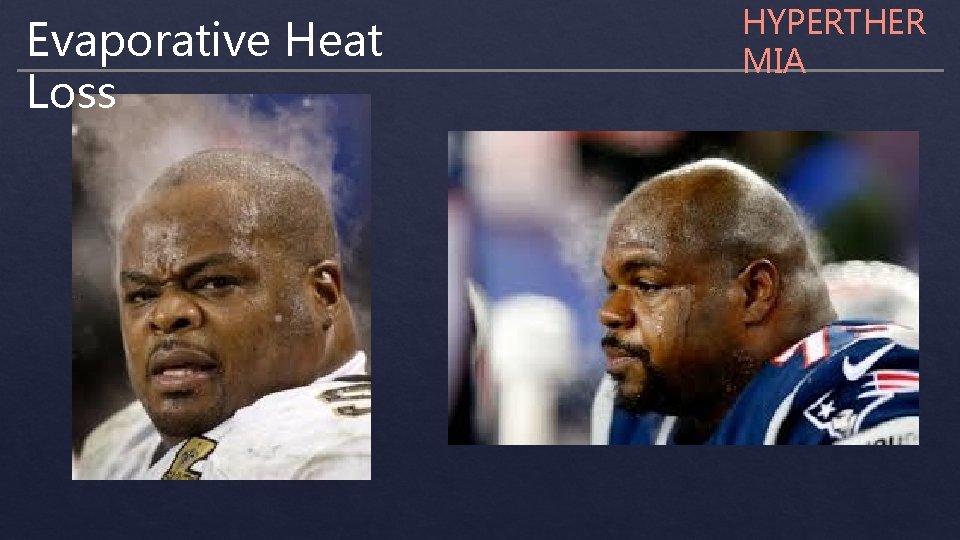
HYPERTHER MIA Evaporative Heat Loss Sweat glands in the skin allow water to be transported to the surface, where it evaporates, taking large quantities of heat with it. When the temp & radiant heat of the environment become > body temp, the loss of body heat becomes highly dependent on the process of sweat evaporation.
Evaporative Heat Loss HYPERTHER MIA
Preventing Heat Illnesses
HYPERTHER MIA Preventing heat illnesses should include the following p Appropriate Hydration Unrestricted Fluid & Electrolyte Replacement Gradual Acclimatization Identification of Susceptible Individuals Appropriate Uniforms Weight Records Monitoring of the Heat
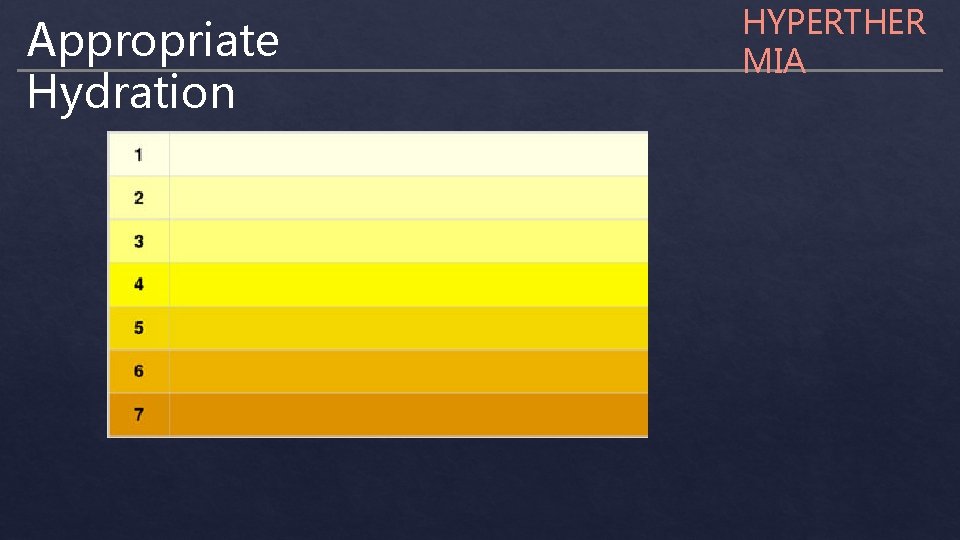
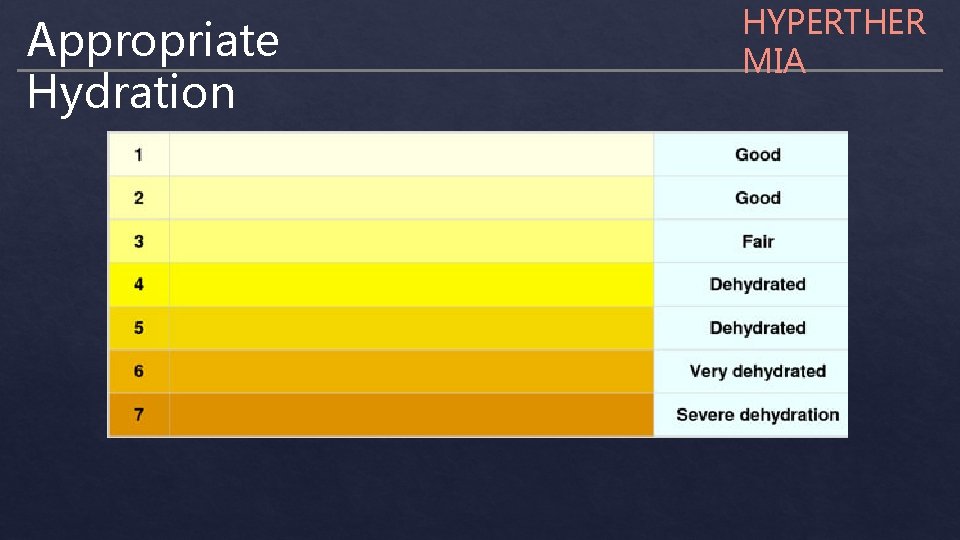
HYPERTHER MIA Appropriate Hydration Athletes should always begin activities in a well-hydrated state, beginning as early as 24 hours before their exertion. The best way to check this is to monitor the color of the urine. The urine should appear to be light yellow; if it is completely clear, this may indicate overhydration. Dark urine indicates dehydration.
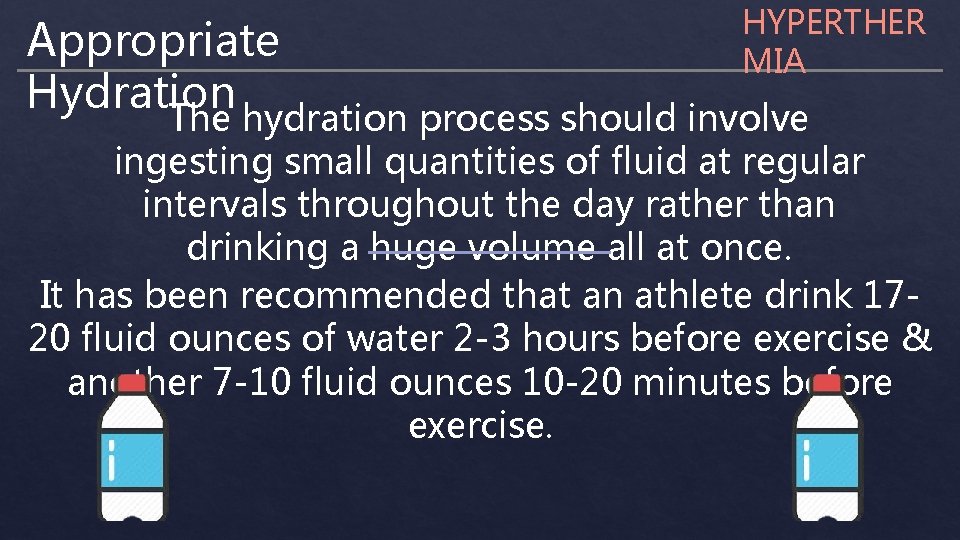
Appropriate Hydration HYPERTHER MIA The hydration process should involve ingesting small quantities of fluid at regular intervals throughout the day rather than drinking a huge volume all at once. It has been recommended that an athlete drink 1720 fluid ounces of water 2 -3 hours before exercise & another 7 -10 fluid ounces 10 -20 minutes before exercise.
Appropriate Hydration HYPERTHER MIA
Appropriate Hydration HYPERTHER MIA
Fluid & Electrolyte Replacement HYPERTHER MIA During hot weather, it is essential that athletes continually replace fluids lost through evaporation by drinking large quantities of water or other beverages throughout the day. The average adult doing minimal physical activity requires at least 2. 5 liters, or about 10 glasses, of water a day.
HYPERTHER MIA Fluid & Electrolyte Replacement A # of adverse physiological & potentially pathological effects can be caused by not hydrating enough, including: • reduced muscular strength & endurance • decreased blood & plasma volume • altered cardiac function • impaired • thermoregulation decreased kidney
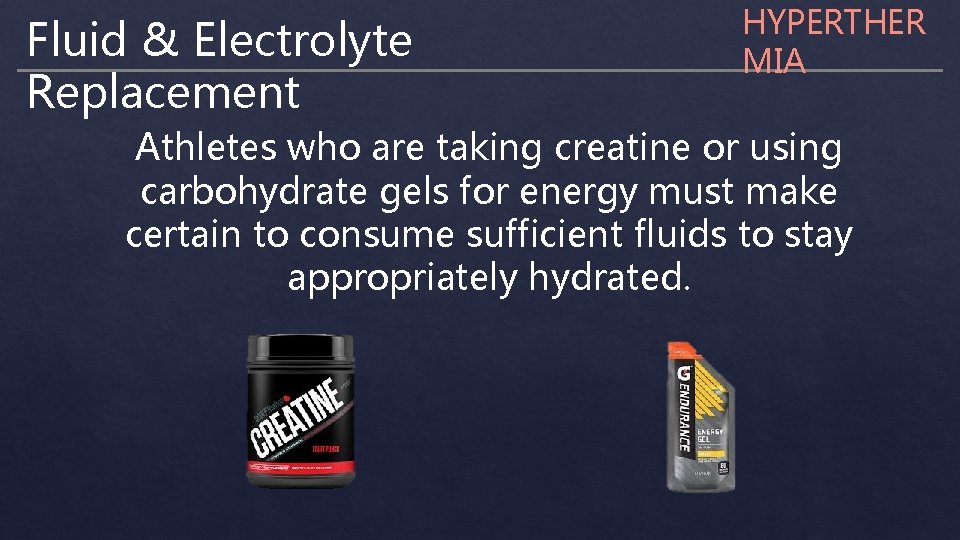
Fluid & Electrolyte Replacement HYPERTHER MIA Athletes who are taking creatine or using carbohydrate gels for energy must make certain to consume sufficient fluids to stay appropriately hydrated.
HYPERTHER MIA Fluid & Electrolyte Replacement It has been shown that replacing lost fluids with an appropriately formulated sports drink is more effective than using water alone. Water “turns on” the kidneys prematurely, so a person loses fluid through urine faster than when drinking a sports drink. The small amount of sodium in sports drinks allows the body to hold on to the fluid consumed rather than losing it through urine.
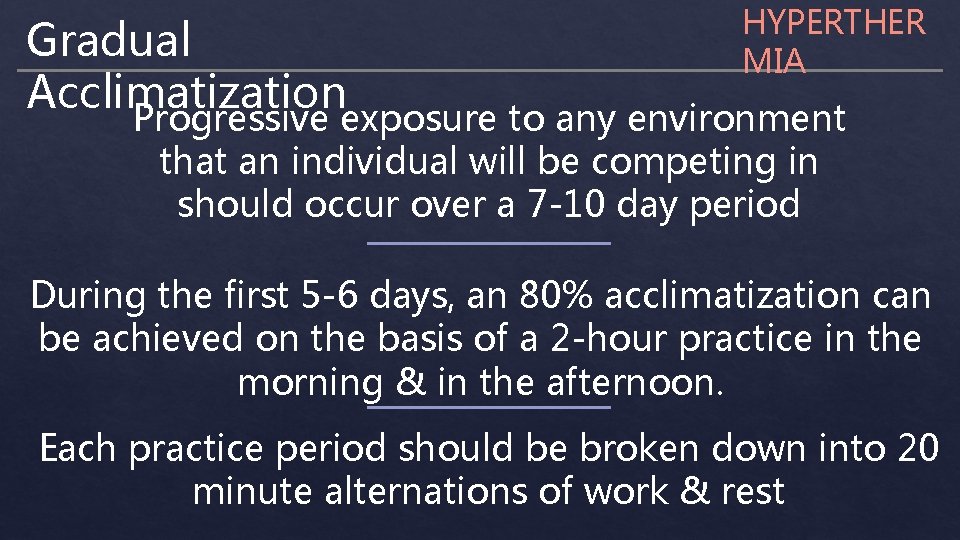
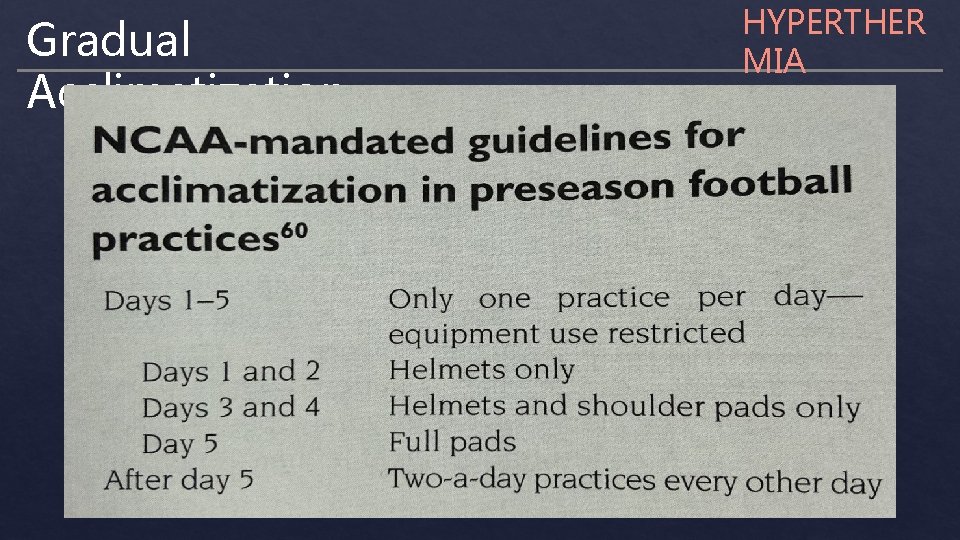
Gradual Acclimatization HYPERTHER MIA Progressive exposure to any environment that an individual will be competing in should occur over a 7 -10 day period During the first 5 -6 days, an 80% acclimatization can be achieved on the basis of a 2 -hour practice in the morning & in the afternoon. Each practice period should be broken down into 20 minute alternations of work & rest
Gradual Acclimatization HYPERTHER MIA
Identifying Susceptible Individuals HYPERTHER MIA Athletes with a large muscle mass are particularly prone to heat illness. Overweight individuals may have as much as 18% greater heat production than underweight individuals because metabolic heat is produced proportionately to surface area.
Identifying Susceptible Individuals HYPERTHER MIA Other individuals who are susceptible to heat stress include the young, elderly, those with relatively poor fitness levels, those with a history of heat illness, & anyone with a febrile condition.
Selecting Appropriate Uniforms HYPERTHER MIA Uniforms should be selected on the basis of temperature and humidity. All (football) early-season practices and games should be conducted in lightweight uniforms with short-sleeved net jerseys and socks.
HYPERTHER MIA Maintaining Weight Records Weights should be measured both before & after practice for at least the first 2 weeks of practice or as long as hot, humid conditions persist. A loss of greater than 2% of body weight indicates that the athlete is severely dehydrated and should be held out of practice until normal body weight has returned.
Monitoring the Heat Index HYPERTHER MIA The Wet Bulb Globe Temperature index incorporates readings form several different thermometers, including Dry Bulb, Wet Bulb, & Globe Temp.
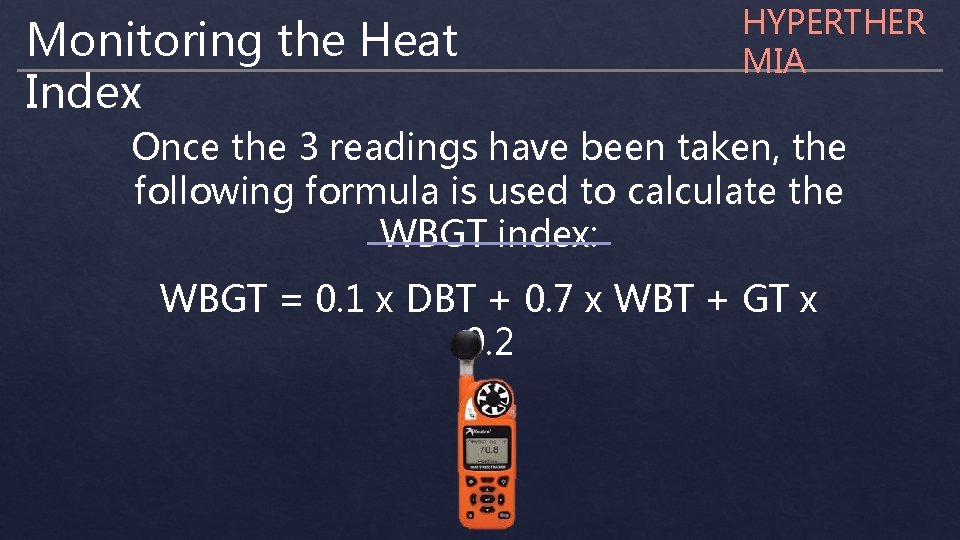
Monitoring the Heat Index HYPERTHER MIA Once the 3 readings have been taken, the following formula is used to calculate the WBGT index: WBGT = 0. 1 x DBT + 0. 7 x WBT + GT x 0. 2
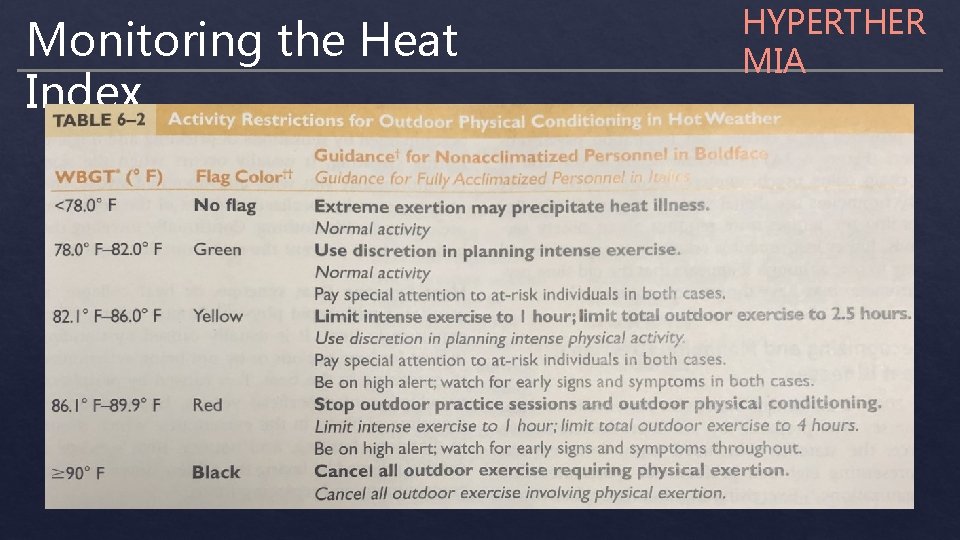
Monitoring the Heat Index HYPERTHER MIA
Recognizing & Managing Exertional Heat Illnesses
HYPERTHER MIA There are several heat illness to be aware of, some of them including: Heat Rash Heat Syncope Exertional Heat Cramps Heat Exertional Exhaustion Exertional Heat Stroke Exertional
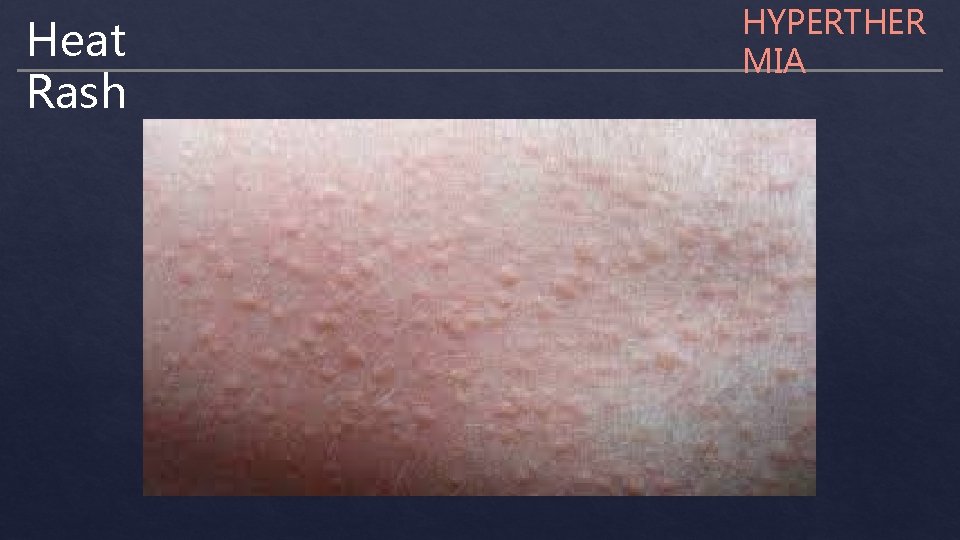
Heat Rash HYPERTHER MIA A benign condition associated with red, raised rash accompanied by sensations of prickling and tingling during sweating. It usually occurs when the skin is continuously wet w/ unevaporated sweat.
Heat Rash HYPERTHER MIA
Heat Syncope Caus e HYPERTHER MIA Rapid physical fatigue during overexposure to heat
Heat Syncope Clinical Features & Diagnosis HYPERTHER MIA Pooling of blood in extremities, leading to dizziness, fainting, & nausea
Heat Syncope Preventi on HYPERTHER MIA Gradually acclimatize to exercising in a hot, humid environment
Heat Syncope Treatme nt HYPERTHER MIA Lying down in a cool environment, replenishing fluids
Exertional Heat Cramps Caus e HYPERTHER MIA Hard work in heat, sweating heavily, imbalance between water and electrolytes (sodium)
Exertional Heat Cramps Clinical Features & Diagnosis HYPERTHER MIA Muscle twitching and cramps, usually after midday; spasms in arms, legs, and abdomen
Exertional Heat Cramps Prevention HYPERTHER MIA Acclimatize athlete properly; provide large quantities of fluids; increase intake of calcium, sodium, and potassium slightly
Exertional Heat Cramps Treatment HYPERTHER MIA Ingesting large amounts of fluid, mild stretching, ice massage of affected muscle
Exertional Heat Exhaustion Caus e HYPERTHER MIA Prolonged sweating leading to dehydration and an inability to sustain adequate cardiac output
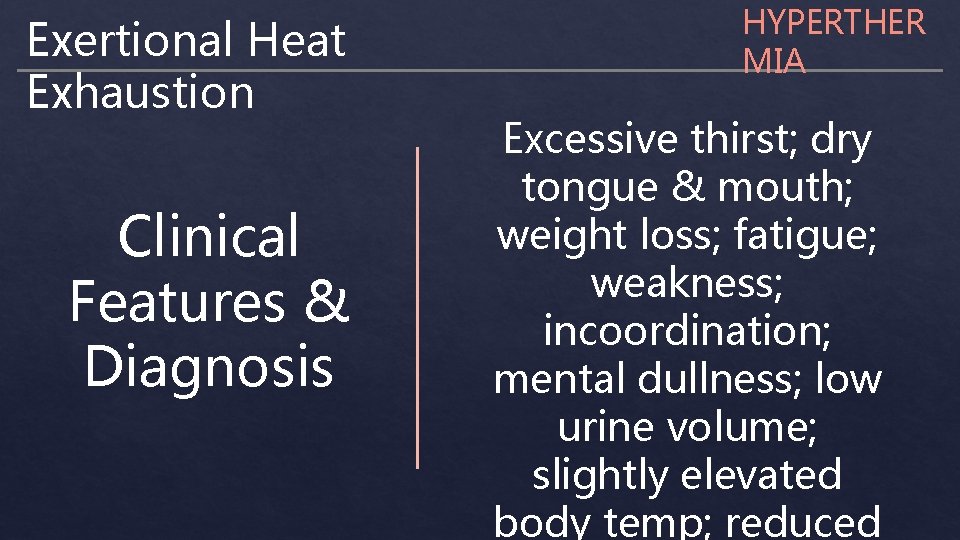
Exertional Heat Exhaustion Clinical Features & Diagnosis HYPERTHER MIA Excessive thirst; dry tongue & mouth; weight loss; fatigue; weakness; incoordination; mental dullness; low urine volume; slightly elevated body temp; reduced
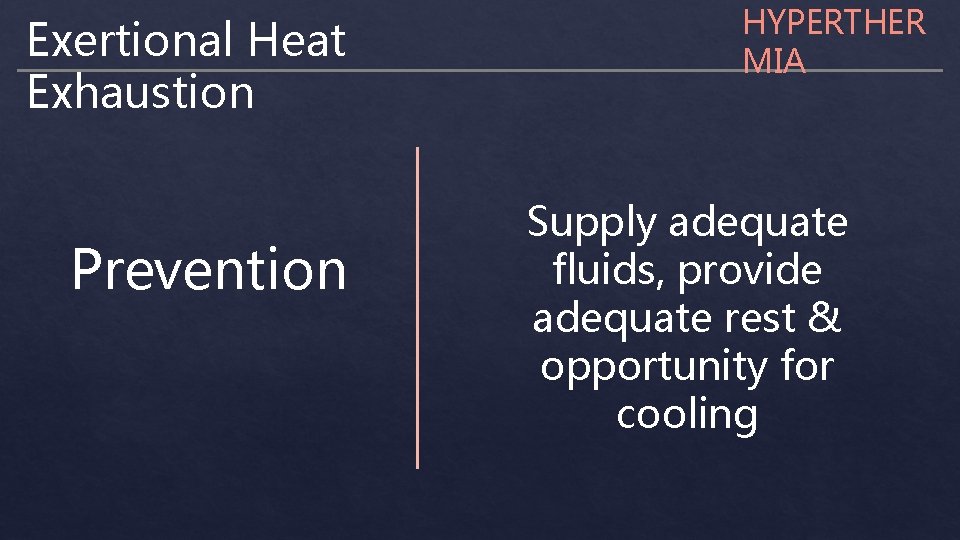
Exertional Heat Exhaustion Prevention HYPERTHER MIA Supply adequate fluids, provide adequate rest & opportunity for cooling
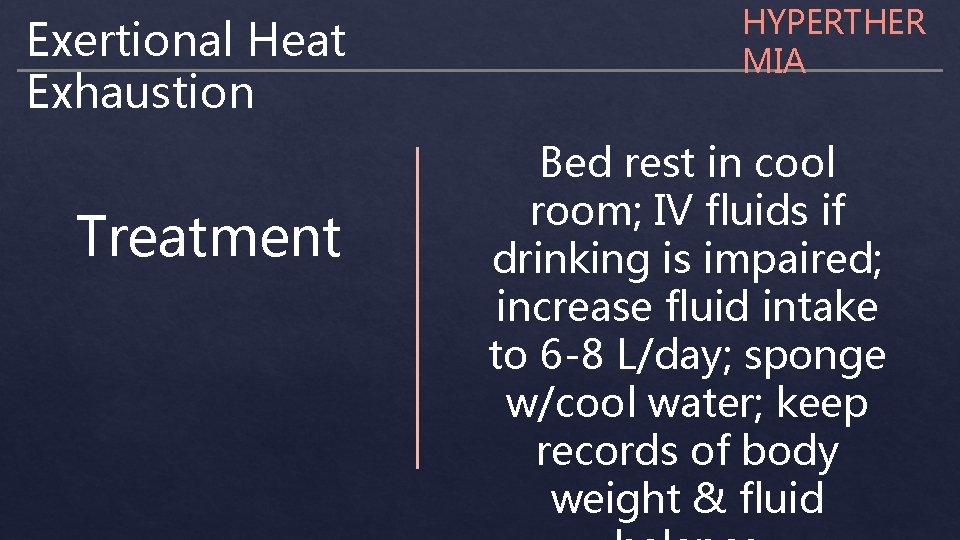
Exertional Heat Exhaustion Treatment HYPERTHER MIA Bed rest in cool room; IV fluids if drinking is impaired; increase fluid intake to 6 -8 L/day; sponge w/cool water; keep records of body weight & fluid
Exertional Heatstroke Caus e HYPERTHER MIA Thermoregulatory failure of sudden onset
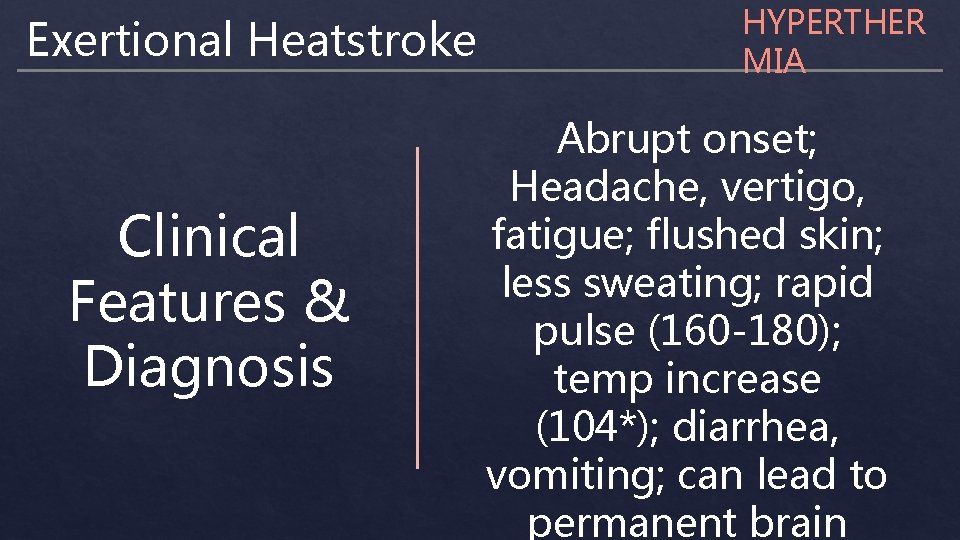
Exertional Heatstroke Clinical Features & Diagnosis HYPERTHER MIA Abrupt onset; Headache, vertigo, fatigue; flushed skin; less sweating; rapid pulse (160 -180); temp increase (104*); diarrhea, vomiting; can lead to permanent brain
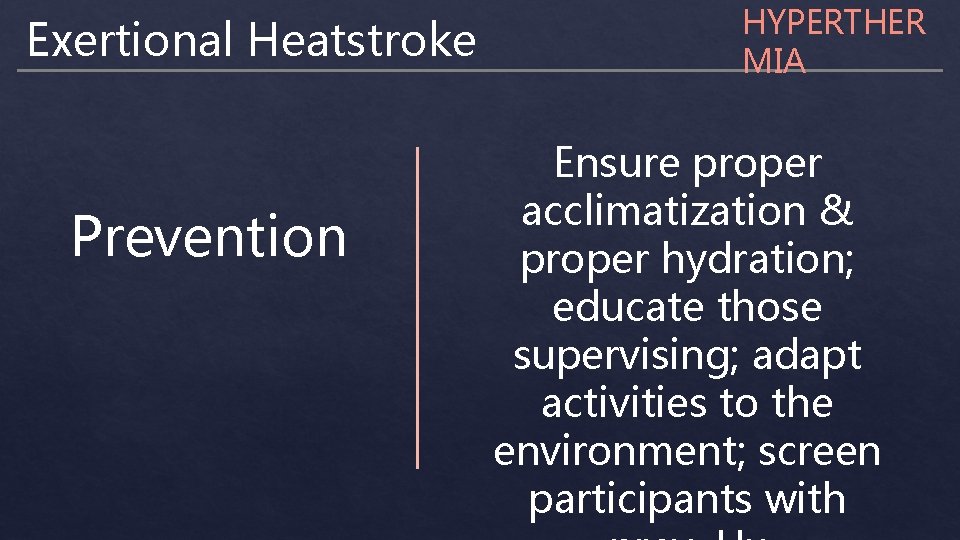
Exertional Heatstroke Prevention HYPERTHER MIA Ensure proper acclimatization & proper hydration; educate those supervising; adapt activities to the environment; screen participants with
Exertional Heatstroke Treatment HYPERTHER MIA Take immediate measures to reduce temp (ice water immersion, cool water sponge, air fan, massage limbs); refer to hospital ASAP
Exertional Hyponatremia Caus e HYPERTHER MIA Fluid/electrolyte disorder resulting in low concentration of sodium in the blood
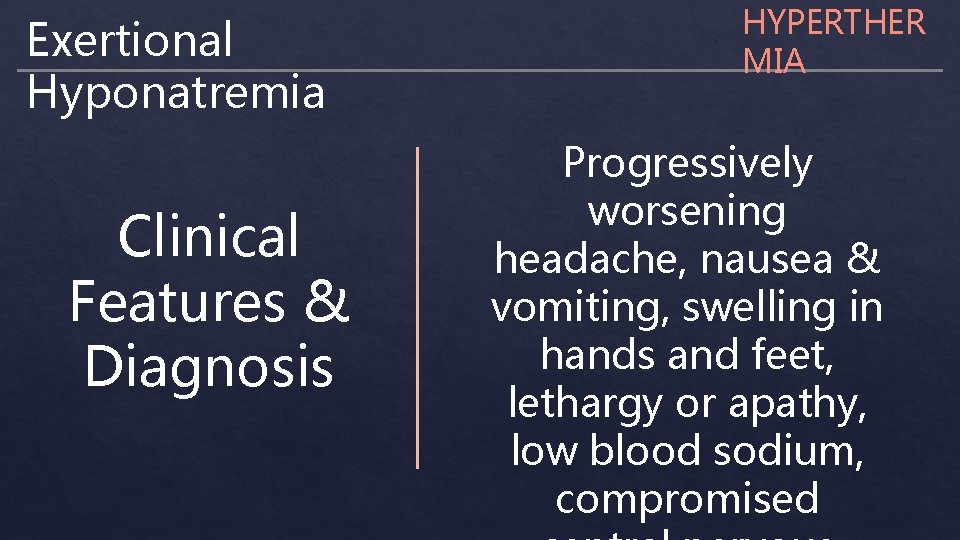
Exertional Hyponatremia Clinical Features & Diagnosis HYPERTHER MIA Progressively worsening headache, nausea & vomiting, swelling in hands and feet, lethargy or apathy, low blood sodium, compromised
Exertional Hyponatremia Prevention HYPERTHER MIA Hydrate with sports drinks, increase sodium intake, make sure fluid intake equals fluid loss
Exertional Hyponatremia Treatment HYPERTHER MIA Do NOT try to rehydrate, transport to medical facility, sodium levels must be increased and fluid levels decreased
HYPERTHER MIA who Guidelines for athletes intentionally lose weight Wrestlers or other athletes who purposely dehydrate themselves are predisposing themselves to heat-related illness and may be creating a potentially life-threatening situation.
HYPERTHER MIA Weight loss to make a predetermined weight limit should not be accomplished through dehydration.