
Unit 5 DNA RNA Replication Transcription Translation What


- Slides: 23
Unit 5 DNA, RNA Replication, Transcription, Translation
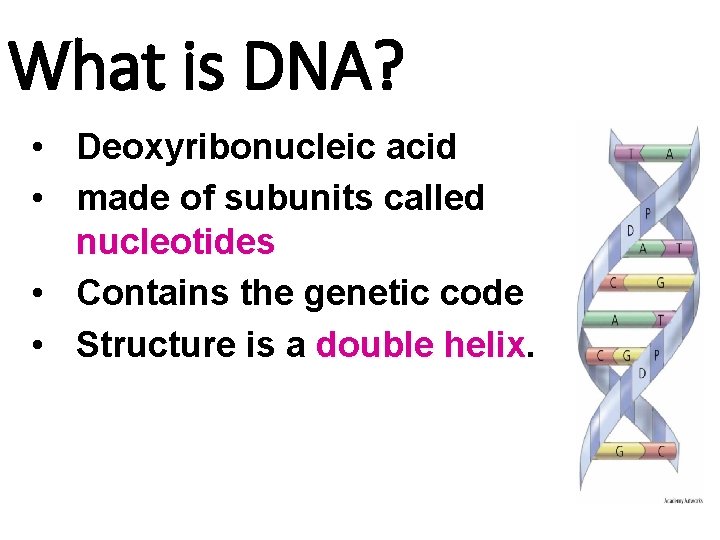
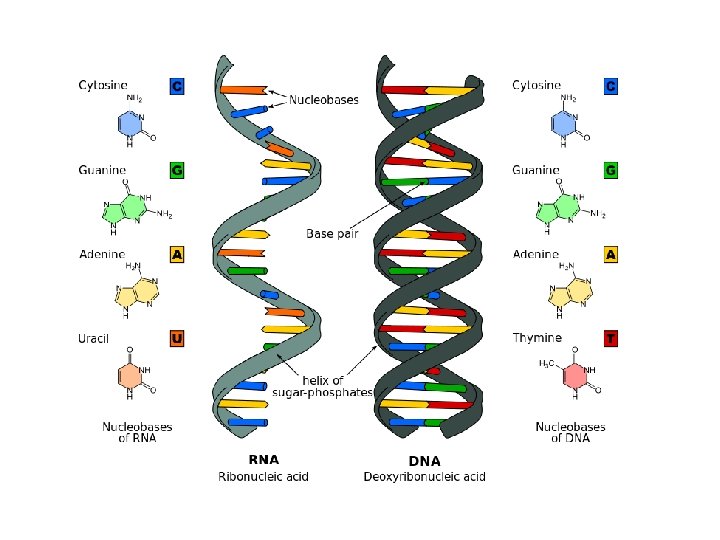
What is DNA? • Deoxyribonucleic acid • made of subunits called nucleotides • Contains the genetic code • Structure is a double helix
NUCLEOTIDES - the subunits of DNA Parts of a nucleotide: Phosphate group ribose Nitrogen base
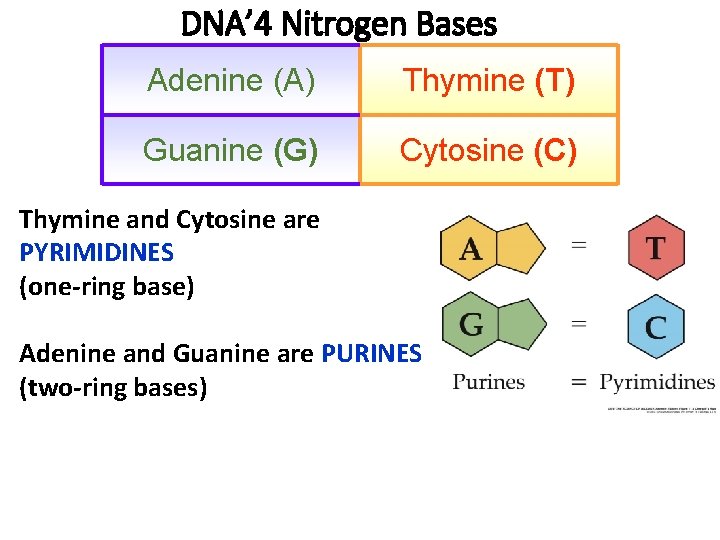
DNA’ 4 Nitrogen Bases Adenine (A) Thymine (T) Guanine (G) Cytosine (C) Thymine and Cytosine are PYRIMIDINES (one-ring base) Adenine and Guanine are PURINES (two-ring bases)
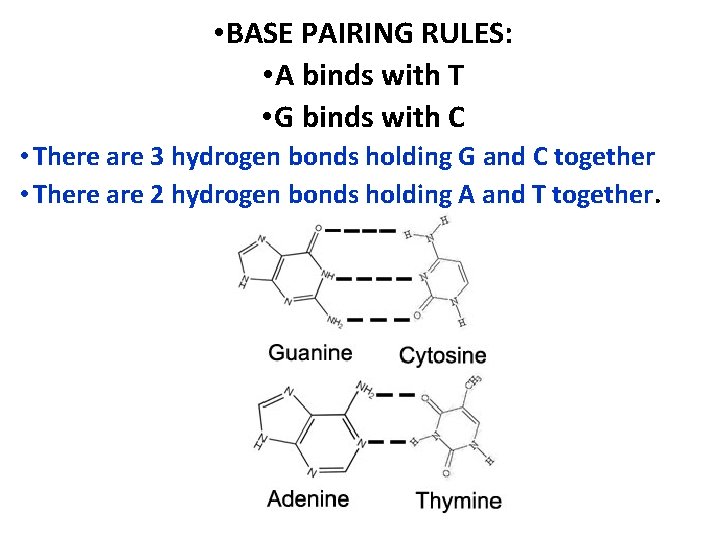
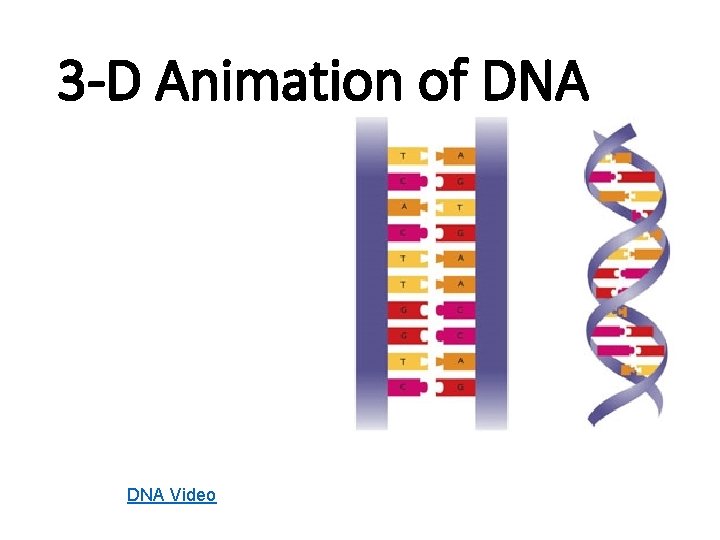
• BASE PAIRING RULES: • A binds with T • G binds with C • There are 3 hydrogen bonds holding G and C together • There are 2 hydrogen bonds holding A and T together.
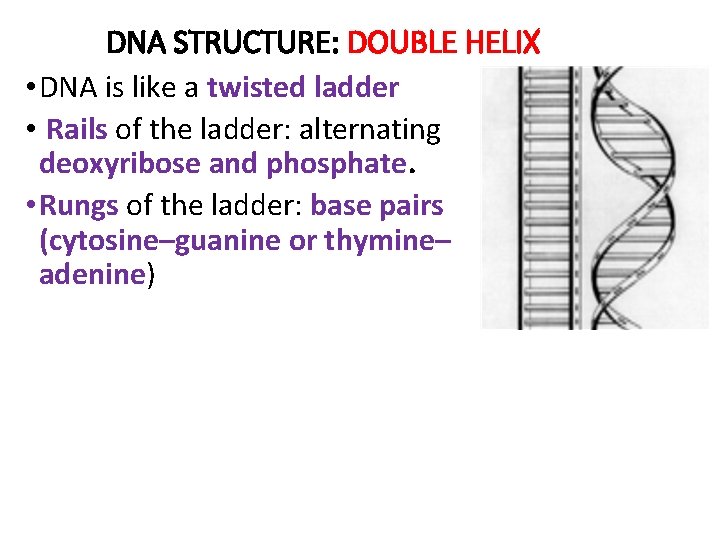
DNA STRUCTURE: DOUBLE HELIX • DNA is like a twisted ladder • Rails of the ladder: alternating deoxyribose and phosphate. • Rungs of the ladder: base pairs (cytosine–guanine or thymine– adenine)
3 -D Animation of DNA Video
Stop & Review 1. 2. 3. 4. 5. 6. What is the smallest subunit of DNA? List 3 parts to #1? What are the side chains of DNA made of? What are the “rungs” of DNA made of? What are the base pairing rules of DNA? Describe the structure of DNA in 2 words.
ANSWERS 1. Nucleotide 2. Sugar, phosphate and a nitrogen base 3. Sugar and phosphate 4. Nitrogen base 5. A-T, C-G 6. Double Helix
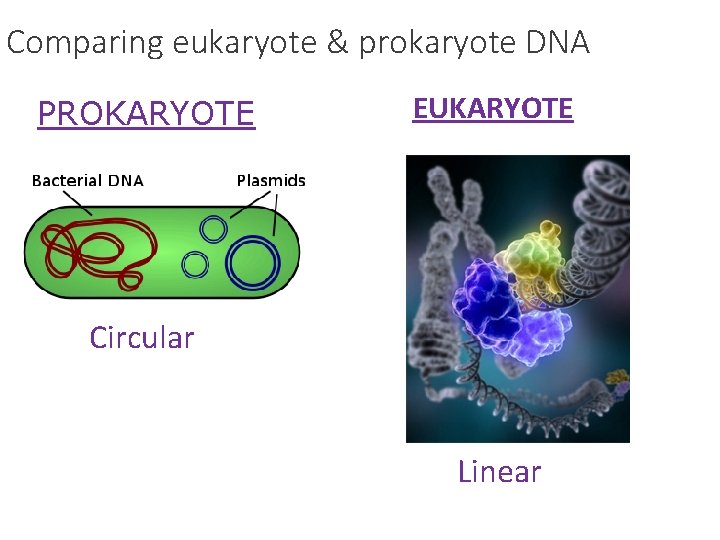
Comparing eukaryote & prokaryote DNA PROKARYOTE EUKARYOTE Circular Linear
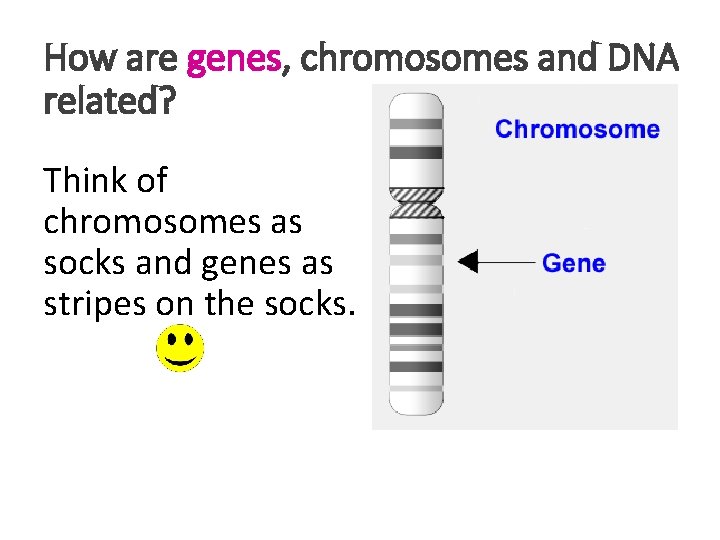
How are genes, chromosomes and DNA related? Genes (trait): portions of DNA that code for proteins. DNA: Contains the genetic code, tightly packed into chromosomes
How are genes, chromosomes and DNA related? Think of chromosomes as socks and genes as stripes on the socks.
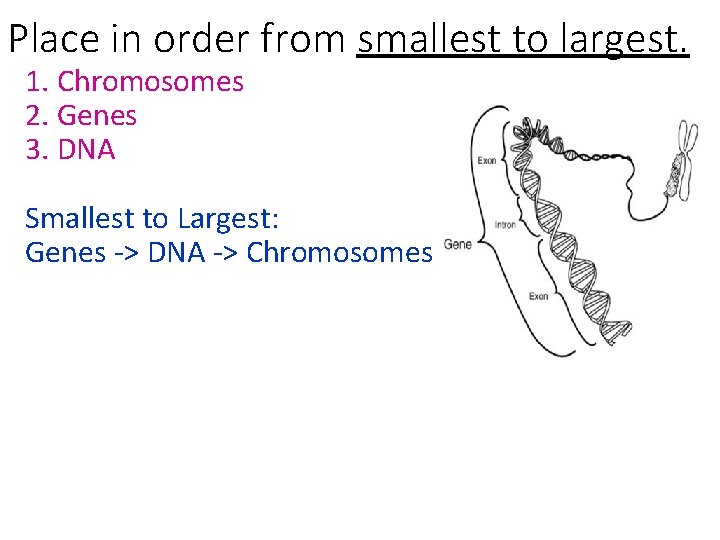
Place in order from smallest to largest. 1. Chromosomes 2. Genes 3. DNA Smallest to Largest: Genes -> DNA -> Chromosomes
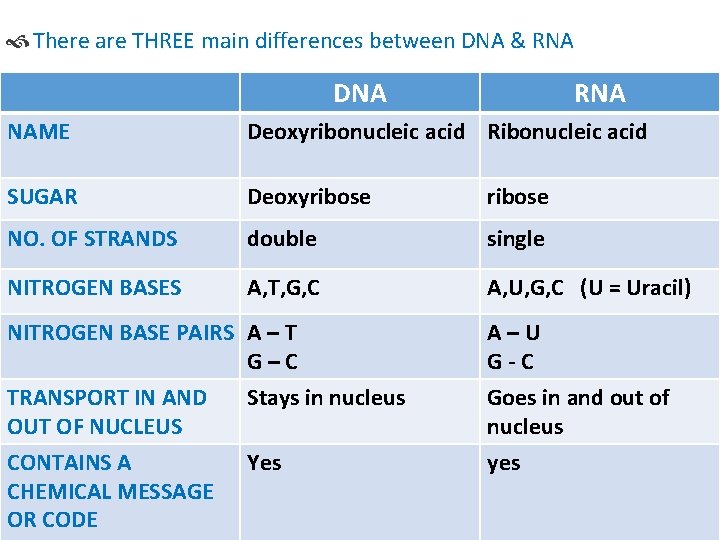
There are THREE main differences between DNA & RNA DNA RNA NAME Deoxyribonucleic acid Ribonucleic acid SUGAR Deoxyribose NO. OF STRANDS double single NITROGEN BASES A, T, G, C A, U, G, C (U = Uracil) NITROGEN BASE PAIRS A – T G–C TRANSPORT IN AND Stays in nucleus OUT OF NUCLEUS CONTAINS A Yes CHEMICAL MESSAGE OR CODE A–U G-C Goes in and out of nucleus yes
Semi-conservative replication Part 2
DNA Replication • Duplication of DNA: DNA copies itself! • Happens during the S-phase of Interphase, before cell division.
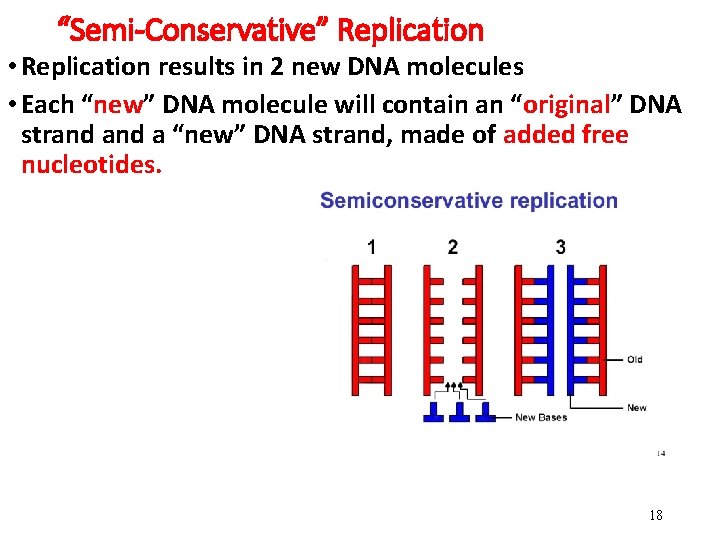
“Semi-Conservative” Replication • Replication results in 2 new DNA molecules • Each “new” DNA molecule will contain an “original” DNA strand a “new” DNA strand, made of added free nucleotides. 18
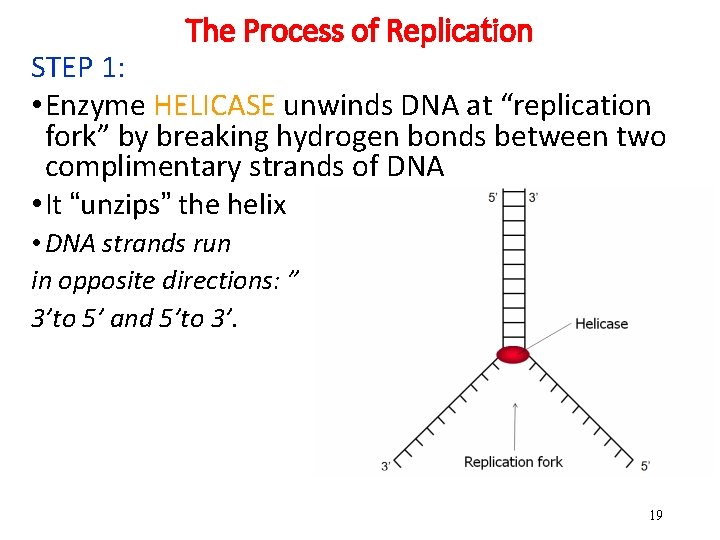
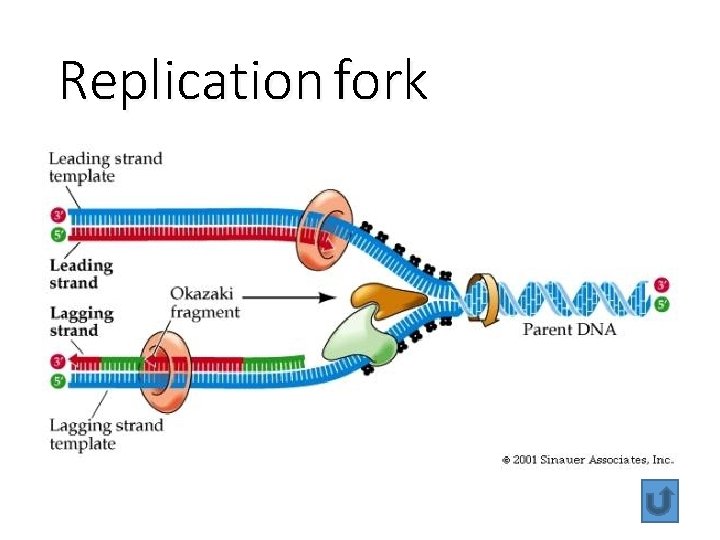
The Process of Replication STEP 1: • Enzyme HELICASE unwinds DNA at “replication fork” by breaking hydrogen bonds between two complimentary strands of DNA • It “unzips” the helix • DNA strands run in opposite directions: ” 3’to 5’ and 5’to 3’. 19
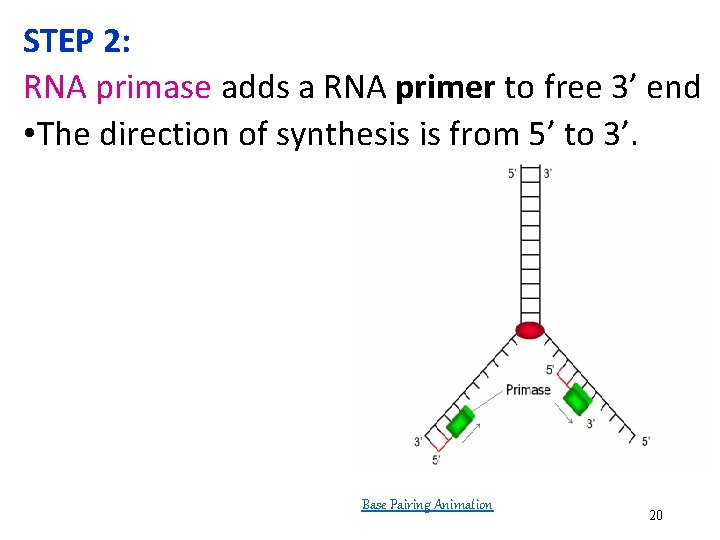
STEP 2: RNA primase adds a RNA primer to free 3’ end • The direction of synthesis is from 5’ to 3’. Base Pairing Animation 20
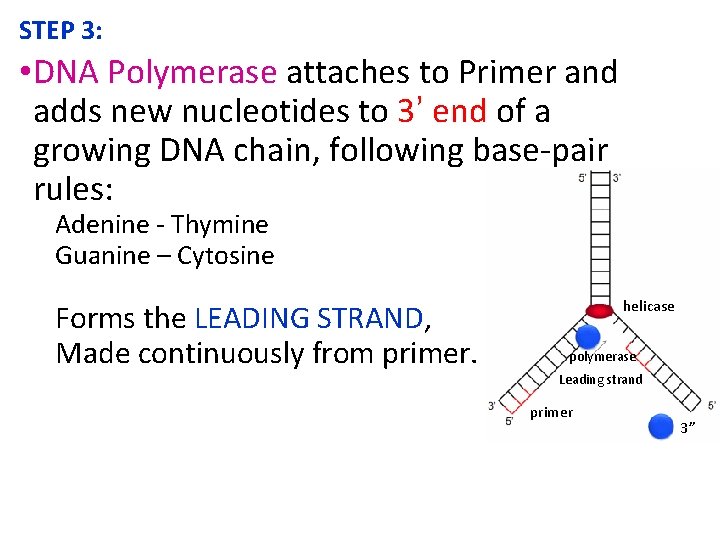
STEP 3: • DNA Polymerase attaches to Primer and adds new nucleotides to 3’ end of a growing DNA chain, following base-pair rules: Adenine - Thymine Guanine – Cytosine Forms the LEADING STRAND, Made continuously from primer. helicase polymerase Leading strand primer 3”
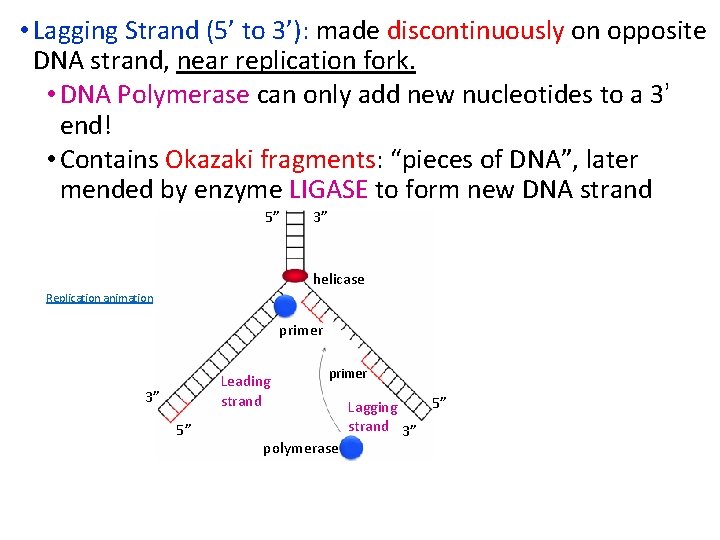
• Lagging Strand (5’ to 3’): made discontinuously on opposite DNA strand, near replication fork. • DNA Polymerase can only add new nucleotides to a 3’ end! • Contains Okazaki fragments: “pieces of DNA”, later mended by enzyme LIGASE to form new DNA strand 5” 3” helicase Replication animation primer Leading strand 3” 5” primer polymerase 5” Lagging strand 3”
Replication fork