
Unit 5 Chinese Cuisine LOGO Contents Teaching Objectives
Unit 5 Chinese Cuisine LOGO

Contents Teaching Objectives Teaching Approaches Teaching Focus Time Allocations Teaching Difficulties Teaching Methods Teaching Procedures
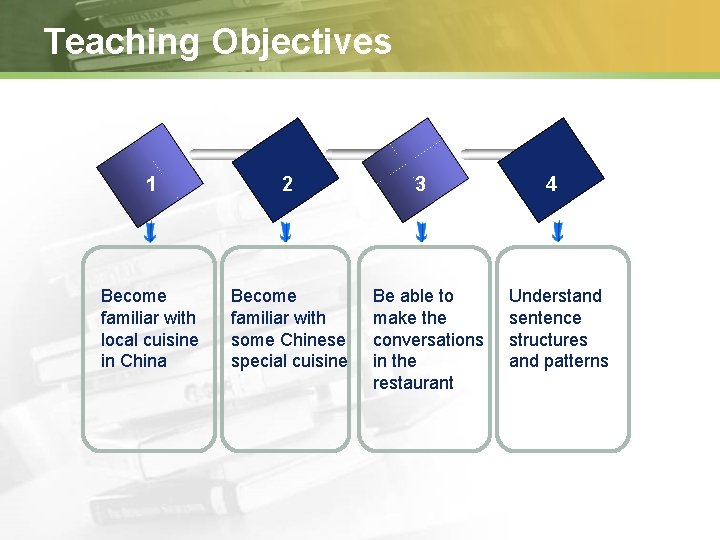
Teaching Objectives 1 2 Become familiar with local cuisine in China Become familiar with some Chinese special cuisine 3 Be able to make the conversations in the restaurant 4 Understand sentence structures and patterns
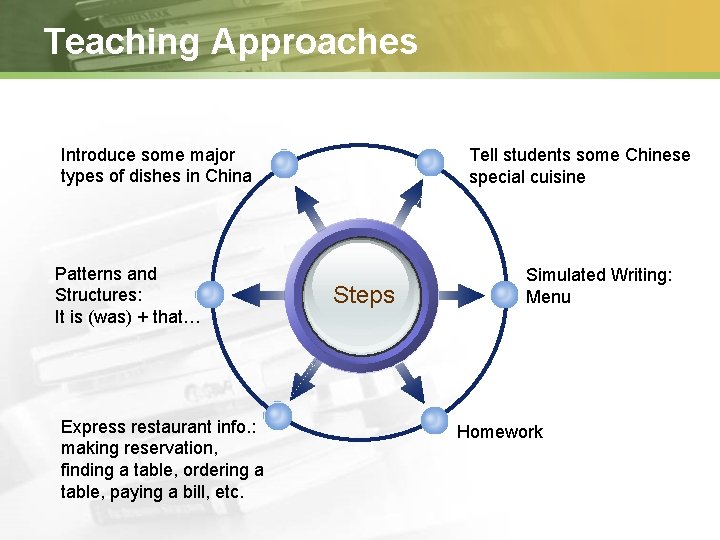
Teaching Approaches Introduce some major types of dishes in China Patterns and Structures: It is (was) + that… Express restaurant info. : making reservation, finding a table, ordering a table, paying a bill, etc. Tell students some Chinese special cuisine Steps Simulated Writing: Menu Homework
Focus on 2 Passages e: n i s i u se C e n i h C uisine C l a Loc Specia l Cuisin e
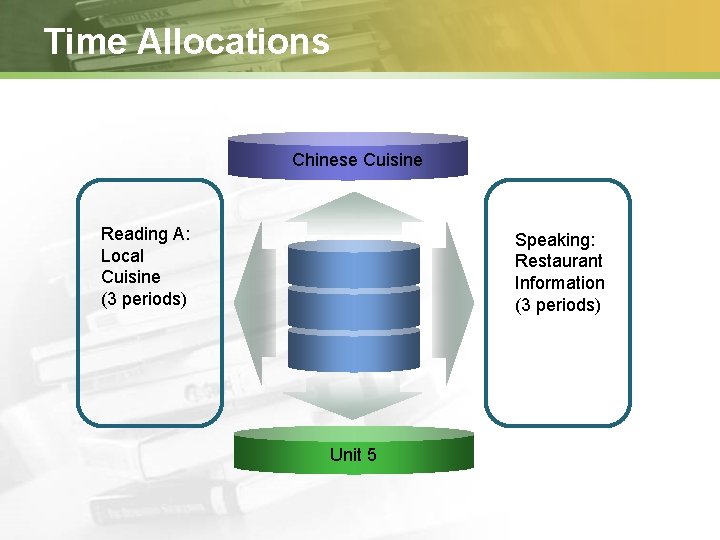
Time Allocations Chinese Cuisine Reading A: Local Cuisine (3 periods) Speaking: Restaurant Information (3 periods) Unit 5

Teaching Difficulties The New Some Usages Useful Expressions Words Difficulties

Teaching Methods Exercises Discussing Methods Questions Teacher’s Explanations
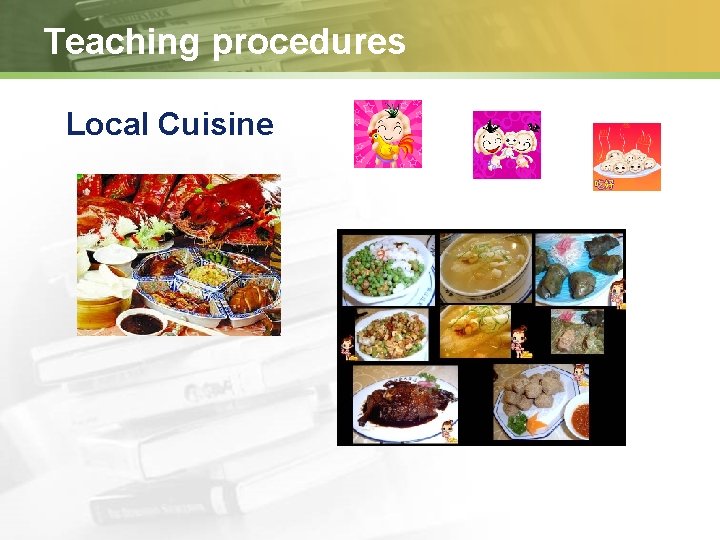
Teaching procedures Local Cuisine
Step 1 Leading in v What have learned about WTO? Hint: Both Reading And Reading B are concerned with WTO. v How many benefits of tourism are known to the governments and people? WTO’s aim is to stimulate economic growth and job creation, provide incentive for protecting the environment and heritage of destination, and promote peace and understanding among all the nations of the world.
Step 1 Leading in v. What have you learnt about Chinese cuisine from this passage? 1. Chinese cooking has a long history and is famous all over the world for its rich flavor and delightful colorings. 2. It was the Chinese who invented the technique of making and using soy sauce, vinegar, wine, jams, and spices during the Yin-Zhou period, some 3000 years ago. 3. Every Chinese local dish, special cuisine, and local snack has its own characteristics.
v What do you think are the four most famous dishes in China? Cantonese dishes, Hunan dishes, Sichuan dishes, and Huaiyang dishes. v What do you think that the Chinese cooking is famous for? Chinese cooking has a long history and is famous all over the world for its rich flavor and delightful colorings.
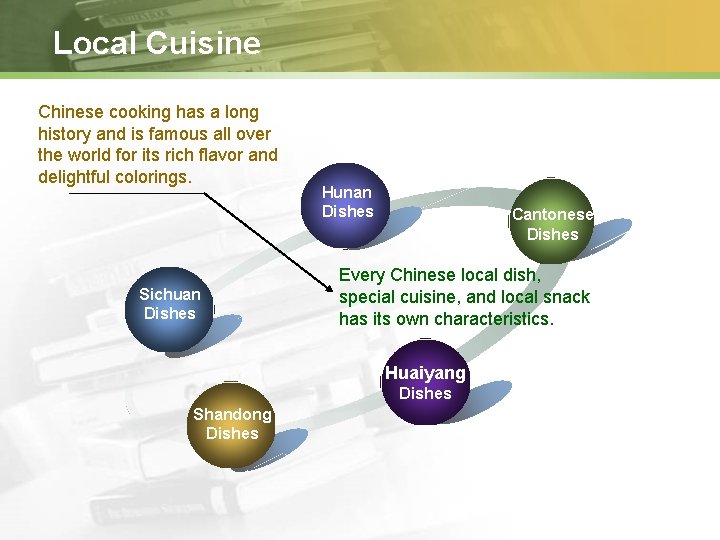
Local Cuisine Chinese cooking has a long history and is famous all over the world for its rich flavor and delightful colorings. Sichuan Dishes Hunan Dishes Cantonese Dishes Every Chinese local dish, special cuisine, and local snack has its own characteristics. Huaiyang Dishes Shandong Dishes
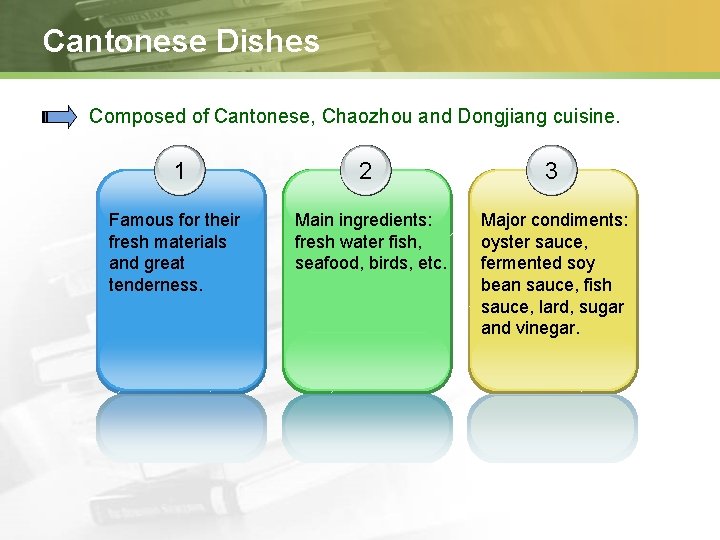
Cantonese Dishes Composed of Cantonese, Chaozhou and Dongjiang cuisine. 1 Famous for their fresh materials and great tenderness. 2 Main ingredients: fresh water fish, seafood, birds, etc. 3 Major condiments: oyster sauce, fermented soy bean sauce, fish sauce, lard, sugar and vinegar.
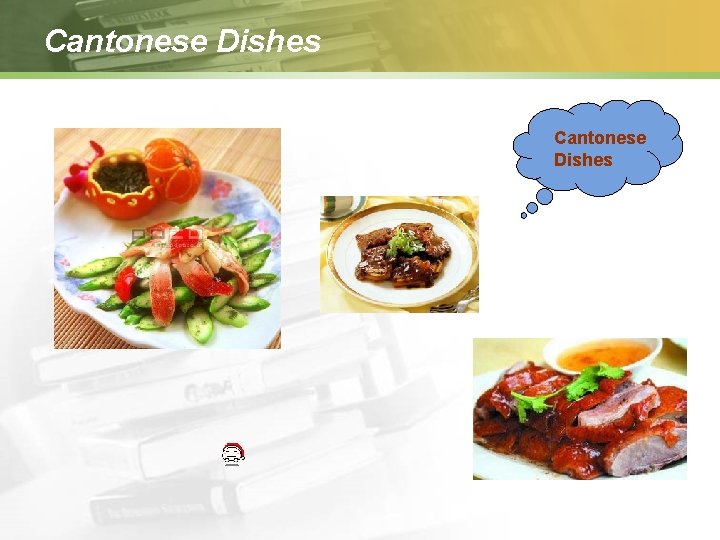
Cantonese Dishes
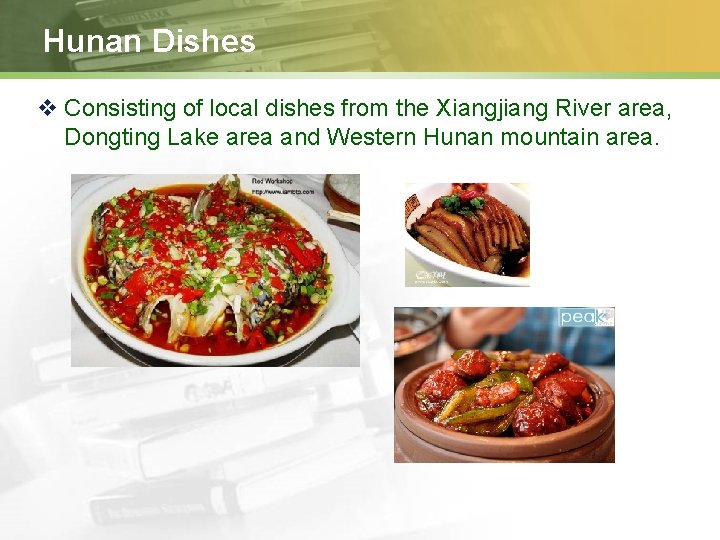
Hunan Dishes v Consisting of local dishes from the Xiangjiang River area, Dongting Lake area and Western Hunan mountain area.
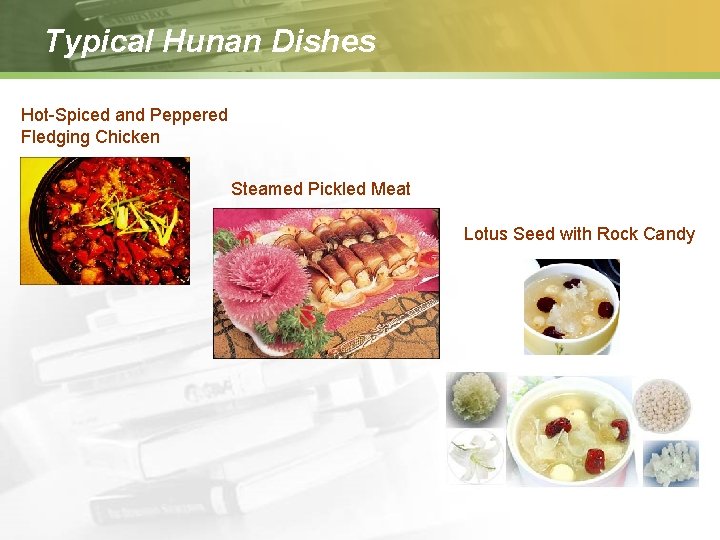
Typical Hunan Dishes Hot-Spiced and Peppered Fledging Chicken Steamed Pickled Meat Lotus Seed with Rock Candy
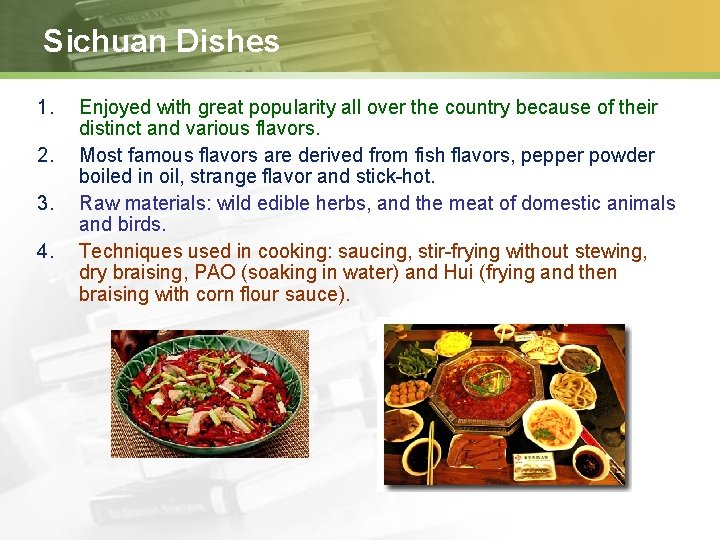
Sichuan Dishes 1. 2. 3. 4. Enjoyed with great popularity all over the country because of their distinct and various flavors. Most famous flavors are derived from fish flavors, pepper powder boiled in oil, strange flavor and stick-hot. Raw materials: wild edible herbs, and the meat of domestic animals and birds. Techniques used in cooking: saucing, stir-frying without stewing, dry braising, PAO (soaking in water) and Hui (frying and then braising with corn flour sauce).
Sichuan Dishes Enjoyed with great popularity all over the country because of their distinct and various flavors. 1 2 3 Most famous flavors are derived from fish flavors, pepper powder boiled in oil, strange flavor and stick-hot. Raw materials: wild edible herbs, and the meat of domestic animals and birds. Techniques used: sauting, stir-frying without stewing, dry braising, PAO (soaking in water) and Hui (frying and braising with corn flour sauce).
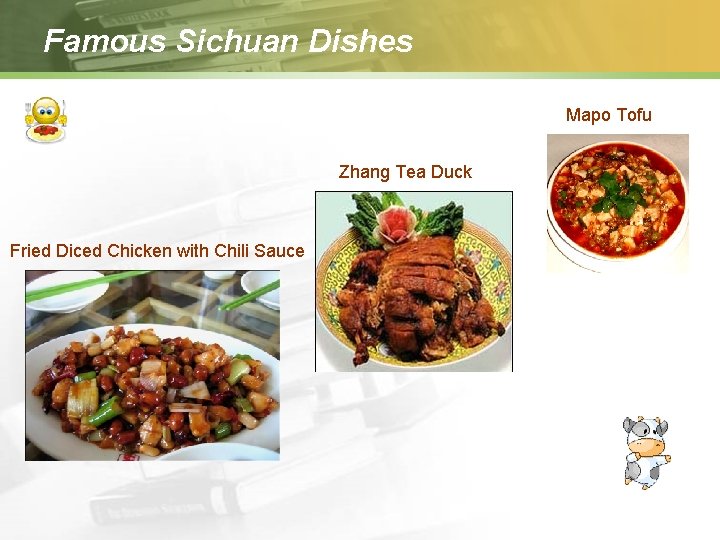
Famous Sichuan Dishes Mapo Tofu Zhang Tea Duck Fried Diced Chicken with Chili Sauce
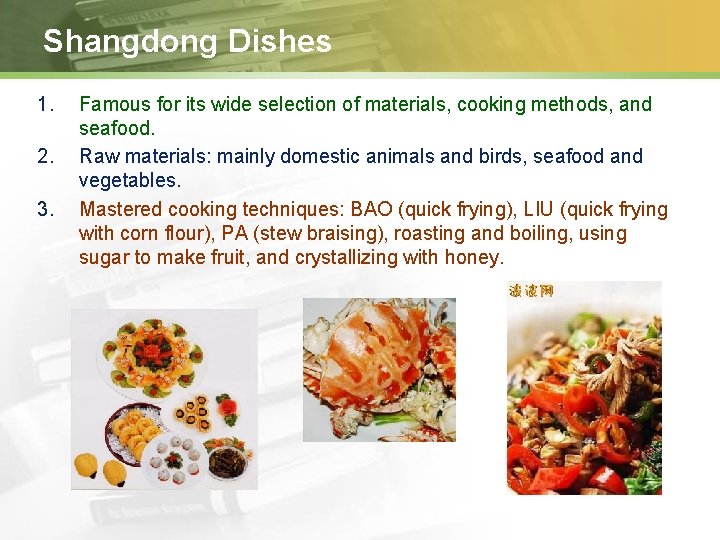
Shangdong Dishes 1. 2. 3. Famous for its wide selection of materials, cooking methods, and seafood. Raw materials: mainly domestic animals and birds, seafood and vegetables. Mastered cooking techniques: BAO (quick frying), LIU (quick frying with corn flour), PA (stew braising), roasting and boiling, using sugar to make fruit, and crystallizing with honey.
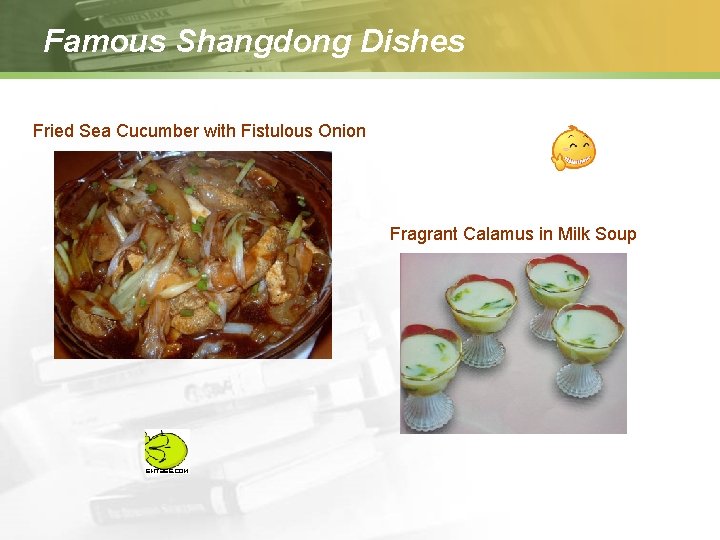
Famous Shangdong Dishes Fried Sea Cucumber with Fistulous Onion Fragrant Calamus in Milk Soup
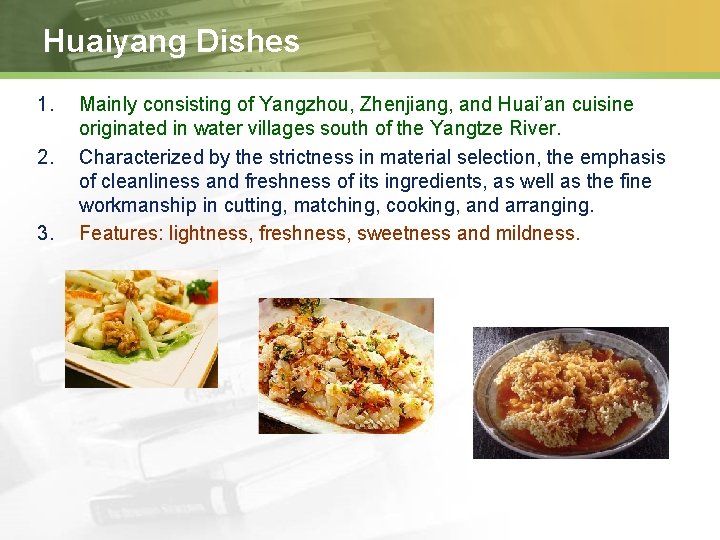
Huaiyang Dishes 1. 2. 3. Mainly consisting of Yangzhou, Zhenjiang, and Huai’an cuisine originated in water villages south of the Yangtze River. Characterized by the strictness in material selection, the emphasis of cleanliness and freshness of its ingredients, as well as the fine workmanship in cutting, matching, cooking, and arranging. Features: lightness, freshness, sweetness and mildness.
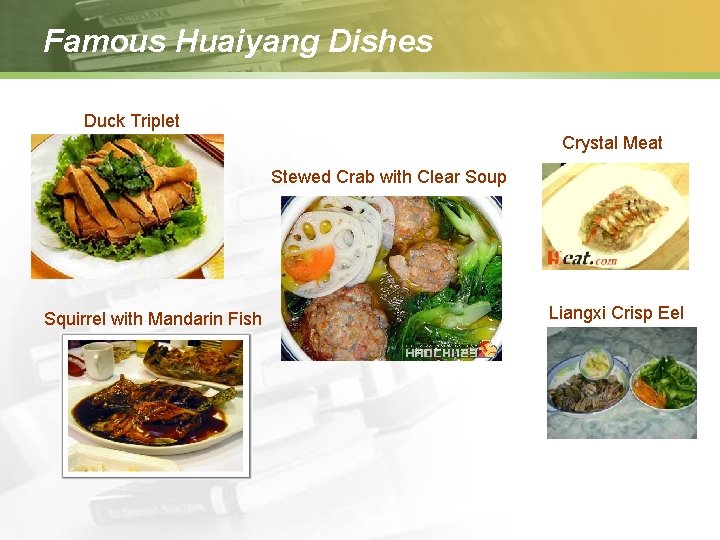
Famous Huaiyang Dishes Duck Triplet Crystal Meat Stewed Crab with Clear Soup Squirrel with Mandarin Fish Liangxi Crisp Eel
v v v v v v match v. mildness n. oyster sauce pickled a. pickled meat retain v. rock candy sauce n. sea cucumber shred v. soy n. soy sauce spice n. squirrel n. stew v. stir-fry v. tender a. tortoise n. triplet n. vinegar n. workmanship n. be composed of be consisted of be derived from 配,搭配 淡的 蚝油 腌制的 腊肉 保持 冰糖 调味汁,酱汁 海参 切碎 酱油;大豆,黄豆 酱油 香料 松鼠 用文火煮、炖、煨、焖 (用旺火)快炒 嫩的 龟(陆龟) 三个一组,三件一套 醋 艺 由…组成 来源于,源于
Step 3 Read the Passage and Discuss v What are the main condiments of the Chinese local cuisine? The major condiments used are oyster sauce, fermented soy bean sauce, fish sauce, lard, sugar and vinegar. v Why the lotus seed is one of the typical materials of Hunan dishes? It is because Hunan dishes consist of local dishes from the Xiangjiang River area, Dongting Lake area and the other. v What are the characteristics of Cantonese Dishes? Cantonese dishes, composed of Cantonese, Chaozhou and Dongjiang cuisine, are famous for their fresh materials and great tenderness.
v What special attention should be paid to in cooking Huaiyang dishes? The special attention is paid to retaining the ingredient of natural juices and flavors v What condiment is special in Shangdong dishes? Honey. v Who were the first people that cooked with jams? The Chinese people.
Step 4 Learn the patterns and structures v It is (was) …who (that)… v 强调句结构 当我们要强调句子中的某一部分时,常用“It is (was) + 被强调部分 + who (that)…”。被强调部分指人时用who,其他情况用that。 如:课文中第 1段第 2句:It was Chinese who invented the technique if making and using soy sauce, vinegar, wine, . . . v 又如: v It was Tom and his friends who had a party in the club yesterday. v It was because the book is so useful for my work that I bought it.
Step 5 Exercises v CHECK YOUR UNDERSTANDING v Mark the following statements with “T” for true and “F” for false according to the passage. v ( T ) 1. Chinese food is famous for its rich tastes and delightful colors. v ( T ) 2. The Chinese people invented soy sauce and oyster sauce before Qin Dynasty. v ( F ) 3. Cantonese dishes are often cooked with edible herbs. v ( F ) 4. The Cantonese usually eat seafood with condiments such as oyster sauce and chili sauce. v ( T ) 5. The raw materials of both Hunan and Sichuan Dishes are often fish and the meat of domestic animals and fowls. v ( T ) 6. Shangdong Dishes are wider in the selection of materials than Hunan Dishes. v ( T ) 7. Sweetness and mildness are the typical features of Huaiyang Dishes.
Listening and Speaking: Restaurant v Step 1 Leading in When you are entering into a restaurant, you are asking the attendant to make a reservation, find a table, order a table, pay a bill, etc. .
Step 2 Learn New Words and Expressions v v v v v private room 包厢 Mudan 牡丹 Yueji 月季 to care for 喜欢 dance floor 舞池 a heavy sauce, a thick stock, natural flavor酱油重,汤浓,味甜和味道天然 freshness, tenderness and smoothness 鲜、嫩、滑 in season 时令 quick-frying 快炒 What are the specialties of the restaurant? 酒店的特色菜是什么?
v v v v v abalone slice with oyster sauce chicken of Wenchang style roast goose of Chaozhou style shrimps with crispy fried rice crust Chinese cabbage with sweet and sour sauce home-style bean curd thick soup with minced beef and egg color, flavor and taste the service charge 蚝油鲍鱼片 文昌鸡 潮州烧鹅 虾仁锅巴 酸溜白菜 家常豆腐 西湖牛肉羹 色、香、味 服务费
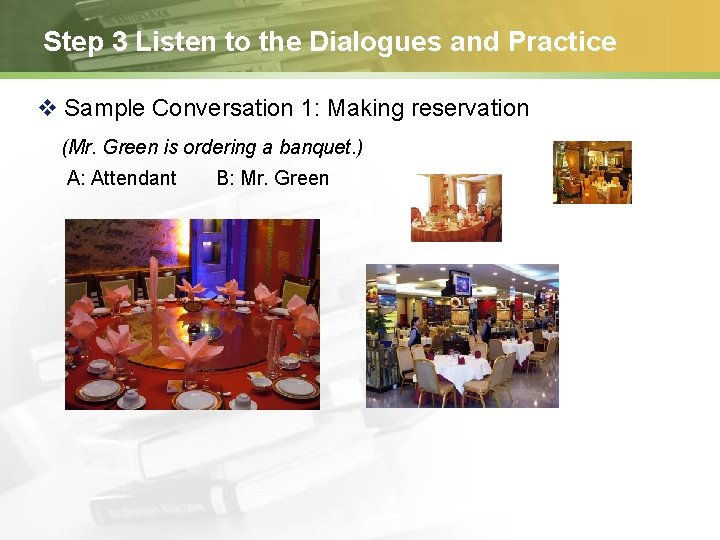
Step 3 Listen to the Dialogues and Practice v Sample Conversation 1: Making reservation (Mr. Green is ordering a banquet. ) A: Attendant B: Mr. Green
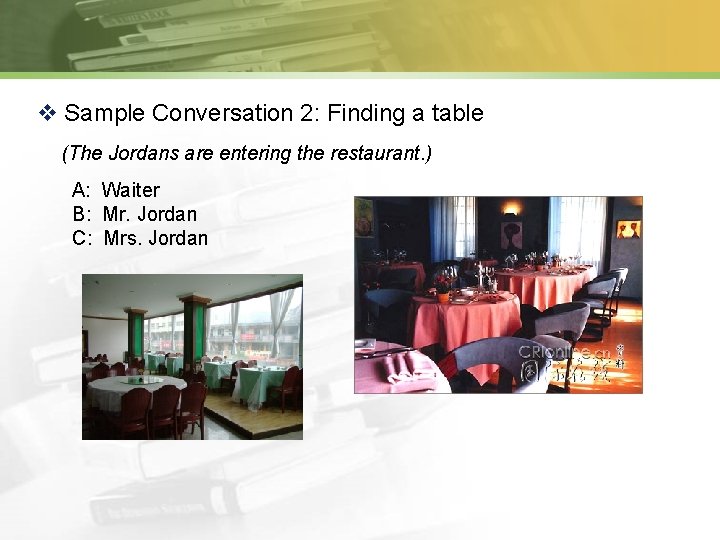
v Sample Conversation 2: Finding a table (The Jordans are entering the restaurant. ) A: Waiter B: Mr. Jordan C: Mrs. Jordan
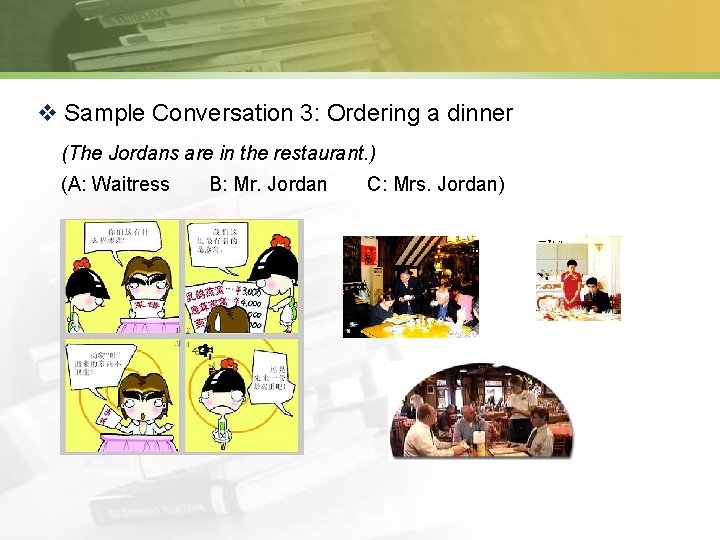
v Sample Conversation 3: Ordering a dinner (The Jordans are in the restaurant. ) (A: Waitress B: Mr. Jordan C: Mrs. Jordan)
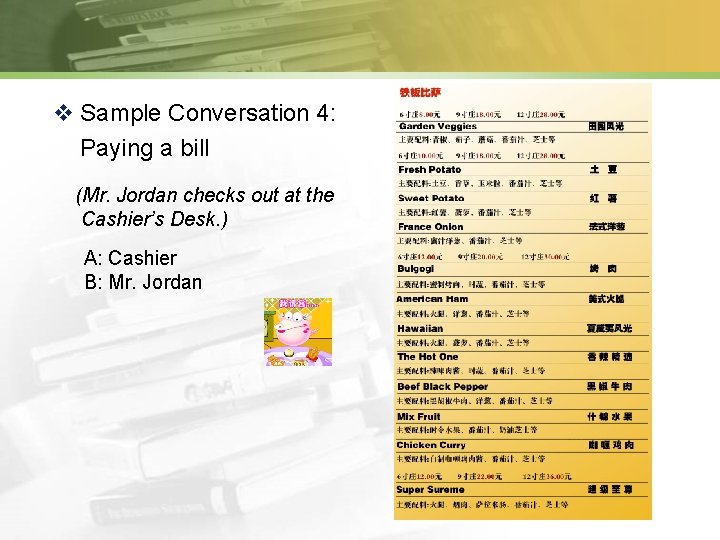
v Sample Conversation 4: Paying a bill (Mr. Jordan checks out at the Cashier’s Desk. ) A: Cashier B: Mr. Jordan
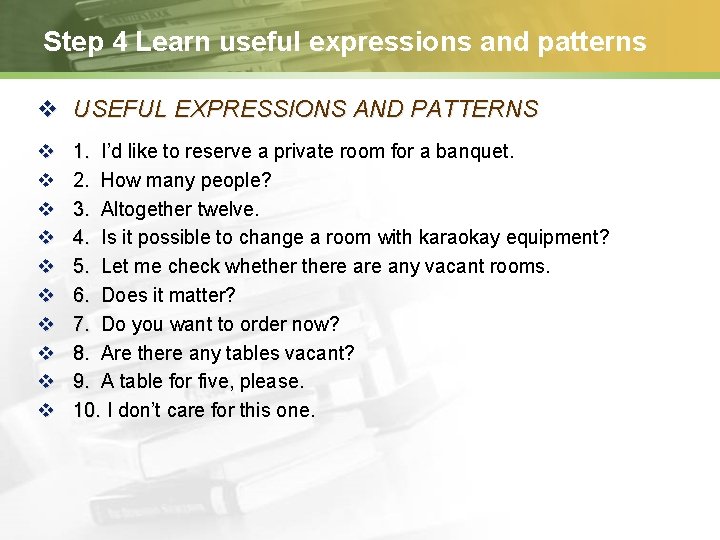
Step 4 Learn useful expressions and patterns v USEFUL EXPRESSIONS AND PATTERNS v v v v v 1. I’d like to reserve a private room for a banquet. 2. How many people? 3. Altogether twelve. 4. Is it possible to change a room with karaokay equipment? 5. Let me check whethere any vacant rooms. 6. Does it matter? 7. Do you want to order now? 8. Are there any tables vacant? 9. A table for five, please. 10. I don’t care for this one.
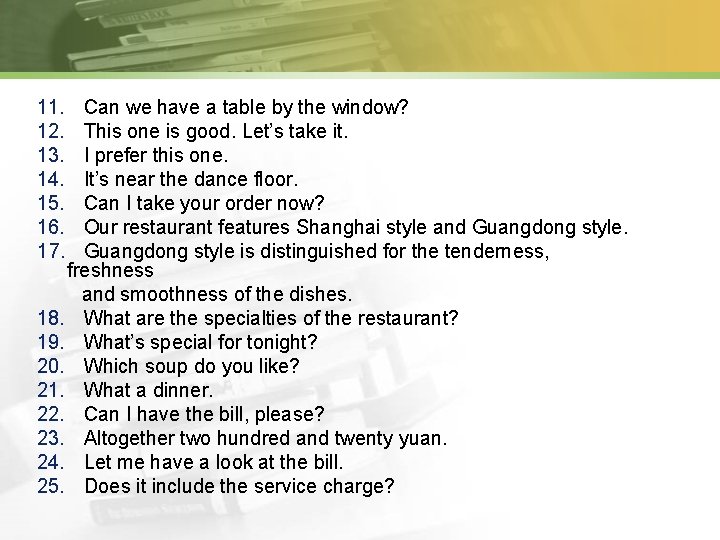
11. 12. 13. 14. 15. 16. 17. Can we have a table by the window? This one is good. Let’s take it. I prefer this one. It’s near the dance floor. Can I take your order now? Our restaurant features Shanghai style and Guangdong style is distinguished for the tenderness, freshness and smoothness of the dishes. 18. What are the specialties of the restaurant? 19. What’s special for tonight? 20. Which soup do you like? 21. What a dinner. 22. Can I have the bill, please? 23. Altogether two hundred and twenty yuan. 24. Let me have a look at the bill. 25. Does it include the service charge?
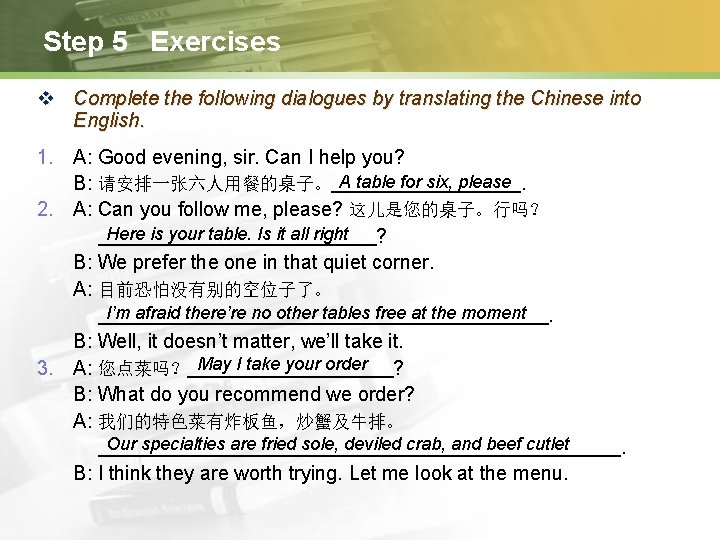
Step 5 Exercises v Complete the following dialogues by translating the Chinese into English. 1. A: Good evening, sir. Can I help you? B: 请安排一张六人用餐的桌子。 A table for six, please. 2. A: Can you follow me, please? 这儿是您的桌子。行吗? Here is your table. Is it all right ? B: We prefer the one in that quiet corner. A: 目前恐怕没有别的空位子了。 I’m afraid there’re no other tables free at the moment . B: Well, it doesn’t matter, we’ll take it. 3. A: 您点菜吗? May I take your order ? B: What do you recommend we order? A: 我们的特色菜有炸板鱼,炒蟹及牛排。 Our specialties are fried sole, deviled crab, and beef cutlet B: I think they are worth trying. Let me look at the menu. .
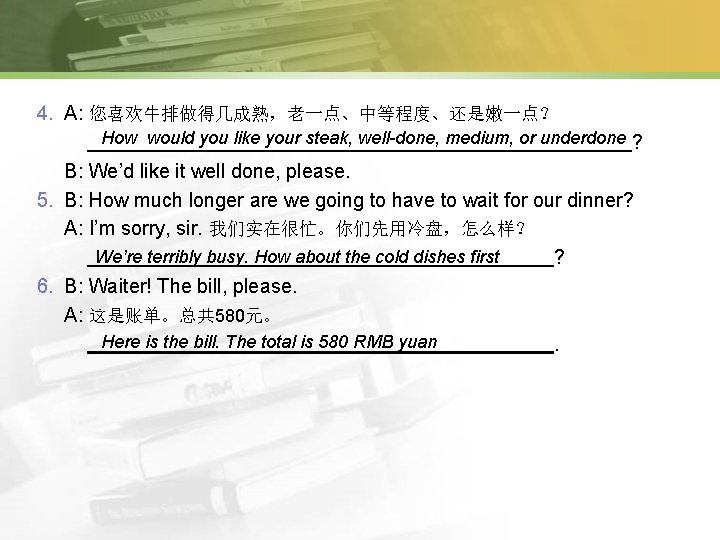
4. A: 您喜欢牛排做得几成熟,老一点、中等程度、还是嫩一点? How would you like your steak, well-done, medium, or underdone ? B: We’d like it well done, please. 5. B: How much longer are we going to have to wait for our dinner? A: I’m sorry, sir. 我们实在很忙。你们先用冷盘,怎么样? We’re terribly busy. How about the cold dishes first ? 6. B: Waiter! The bill, please. A: 这是账单。总共 580元。 Here is the bill. The total is 580 RMB yuan.
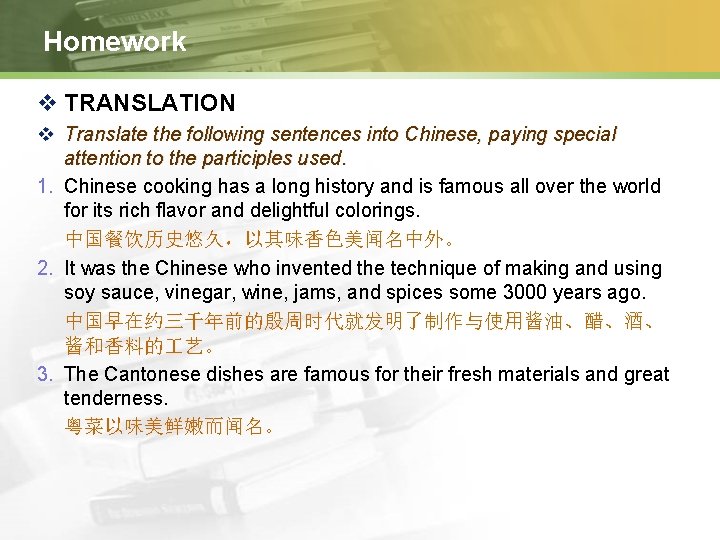
Homework v TRANSLATION v Translate the following sentences into Chinese, paying special attention to the participles used. 1. Chinese cooking has a long history and is famous all over the world for its rich flavor and delightful colorings. 中国餐饮历史悠久,以其味香色美闻名中外。 2. It was the Chinese who invented the technique of making and using soy sauce, vinegar, wine, jams, and spices some 3000 years ago. 中国早在约三千年前的殷周时代就发明了制作与使用酱油、醋、酒、 酱和香料的 艺。 3. The Cantonese dishes are famous for their fresh materials and great tenderness. 粤菜以味美鲜嫩而闻名。
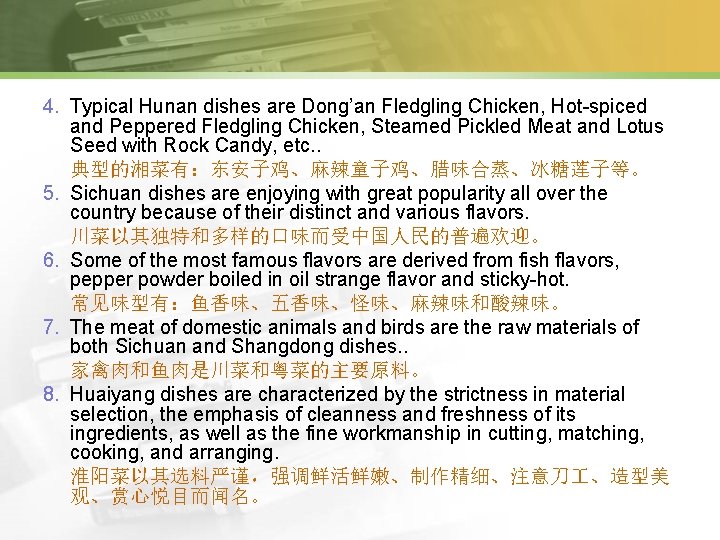
4. Typical Hunan dishes are Dong’an Fledgling Chicken, Hot-spiced and Peppered Fledgling Chicken, Steamed Pickled Meat and Lotus Seed with Rock Candy, etc. . 典型的湘菜有:东安子鸡、麻辣童子鸡、腊味合蒸、冰糖莲子等。 5. Sichuan dishes are enjoying with great popularity all over the country because of their distinct and various flavors. 川菜以其独特和多样的口味而受中国人民的普遍欢迎。 6. Some of the most famous flavors are derived from fish flavors, pepper powder boiled in oil strange flavor and sticky-hot. 常见味型有:鱼香味、五香味、怪味、麻辣味和酸辣味。 7. The meat of domestic animals and birds are the raw materials of both Sichuan and Shangdong dishes. . 家禽肉和鱼肉是川菜和粤菜的主要原料。 8. Huaiyang dishes are characterized by the strictness in material selection, the emphasis of cleanness and freshness of its ingredients, as well as the fine workmanship in cutting, matching, cooking, and arranging. 淮阳菜以其选料严谨,强调鲜活鲜嫩、制作精细、注意刀 、造型美 观、赏心悦目而闻名。
Learn to communicate in the given situation A: Captain A foreign group comes to your restaurant to have Chinese food. As a captain(领班) , you are asked to give a brief introduction of Chinese food. Tell them the different features of the main cuisines. And never miss the chance to recommend some of your typical dishes. B: Head of the group
The following expressions may be used in your conversations: 1 Have you decided what you’d like? 2 Abalone slices with oyster sauce is the best of our kitchen. 3 Braised chicken with chili pepper is always a favorite. 4 I think our fish cutlet will be to your taste. 5 Perhaps you’d like fish soup. 6 We’ve got a choice of vegetables. 7 Crab soup is being served today.

LOGO
- Slides: 46