
Unit 5 Behaviorism 5 Behaviorism A Antecedent Influences
Unit 5. Behaviorism
5. Behaviorism A. Antecedent Influences I. Philosophy: Positivism II. Functionalism III. Animal Studies
5. Behaviorism B. Founding of Behaviorism by John B. Watson (1878 -1958) “Psychology as the Behaviorist Views It” (excerpts in textbook)
5. Behaviorism C. Behaviorism according to Watson I. Definitions a. Psychology: that division of natural science which takes human behavior as its subject matter
5. Behaviorism C. Behaviorism according to Watson I. Definitions b. Stimulus: any object in the general environment or any change in the tissues themselves due to the physiological condition of the organism
5. Behaviorism C. Behaviorism according to Watson I. Definitions c. Response: anything the organism does
5. Behaviorism C. Behaviorism according to Watson II. Assumptions a. Behavior: response elements
5. Behaviorism C. Behaviorism according to Watson II. Assumptions b. Behavior: glandular secretions and muscular movements
5. Behaviorism C. Behaviorism according to Watson II. Assumptions c. Stimulus-Response Determinism
5. Behaviorism C. Behaviorism according to Watson II. Assumptions d. Conscious Processes
5. Behaviorism C. Behaviorism according to Watson III. Nature of data in psychology IV. Principles of connection V. Principles of selection
5. Behaviorism C. Behaviorism according to Watson VI. Mind-Body Issue a. Epiphenomenalism b. Interactionism
5. Behaviorism C. Behaviorism according to Watson VI. Mind-Body Issue c. Psychophysical Parallelism d. Materialism
5. Behaviorism C. Behaviorism according to Watson VI. Mind-Body Issue e. Radical/Metaphysical Behaviorism f. Methodological/Empirical Behaviorism
5. Behaviorism C. Behaviorism according to Watson VII. Research Methods a. Observation b. Conditioning c. Verbal Report d. Tests
5. Behaviorism C. Behaviorism according to Watson VIII. Research Program a. Conditioning of emotional responses (Little Albert) b. Reconditioning
5. Behaviorism C. Behaviorism according to Watson IX. Other Aspects of Watson’s Behaviorism a. Language/thinking b. Environment
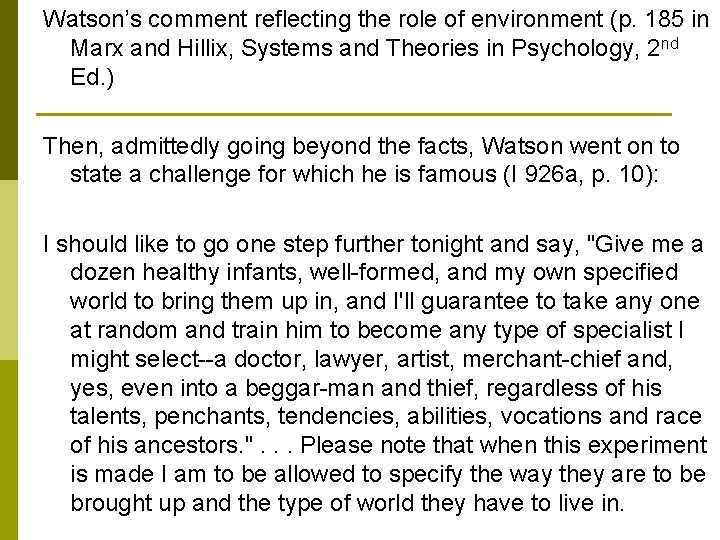
Watson’s comment reflecting the role of environment (p. 185 in Marx and Hillix, Systems and Theories in Psychology, 2 nd Ed. ) Then, admittedly going beyond the facts, Watson went on to state a challenge for which he is famous (I 926 a, p. 10): I should like to go one step further tonight and say, "Give me a dozen healthy infants, well-formed, and my own specified world to bring them up in, and I'll guarantee to take any one at random and train him to become any type of specialist I might select--a doctor, lawyer, artist, merchant-chief and, yes, even into a beggar-man and thief, regardless of his talents, penchants, tendencies, abilities, vocations and race of his ancestors. ". . . Please note that when this experiment is made I am to be allowed to specify the way they are to be brought up and the type of world they have to live in.
5. Behaviorism C. Behaviorism according to Watson IX. Other Aspects of Watson’s Behaviorism a. Language/thinking b. Environment c. Personal responsibility
- Slides: 19