
Unit 5 3 Meiosis What we need to
- Slides: 24
Unit 5. 3 Meiosis
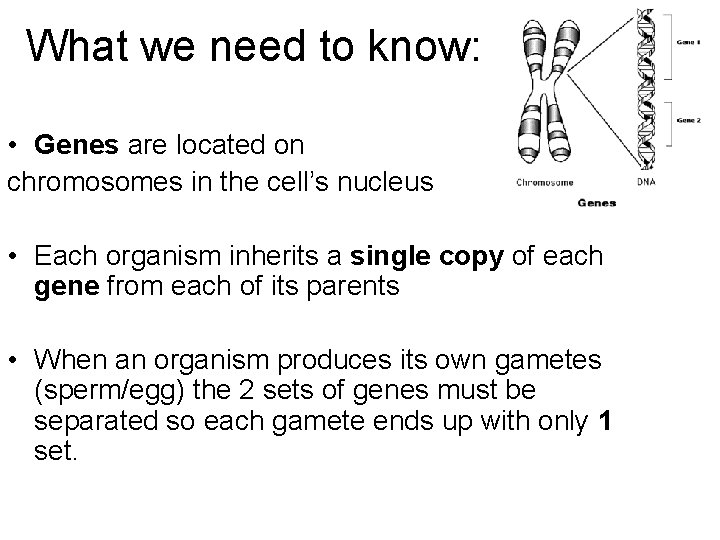
What we need to know: • Genes are located on chromosomes in the cell’s nucleus • Each organism inherits a single copy of each gene from each of its parents • When an organism produces its own gametes (sperm/egg) the 2 sets of genes must be separated so each gamete ends up with only 1 set.
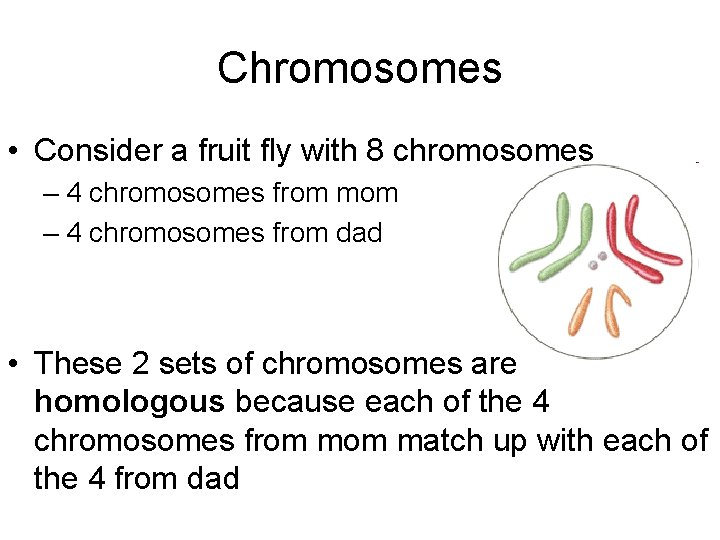
Chromosomes • Consider a fruit fly with 8 chromosomes – 4 chromosomes from mom – 4 chromosomes from dad • These 2 sets of chromosomes are homologous because each of the 4 chromosomes from match up with each of the 4 from dad
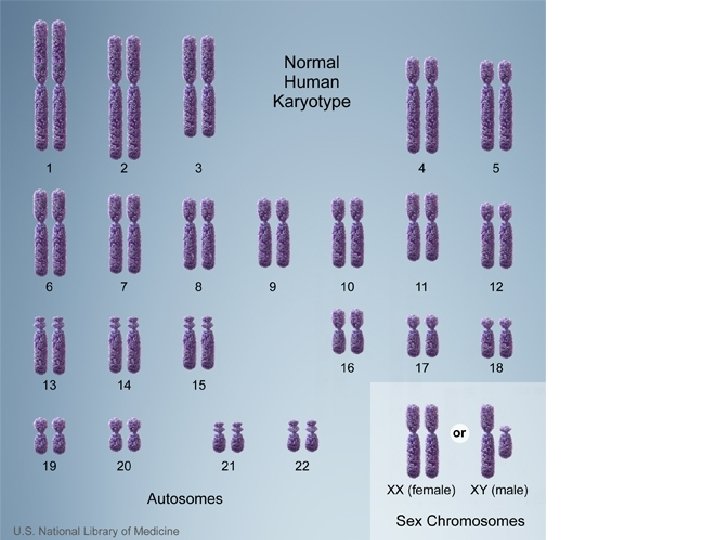
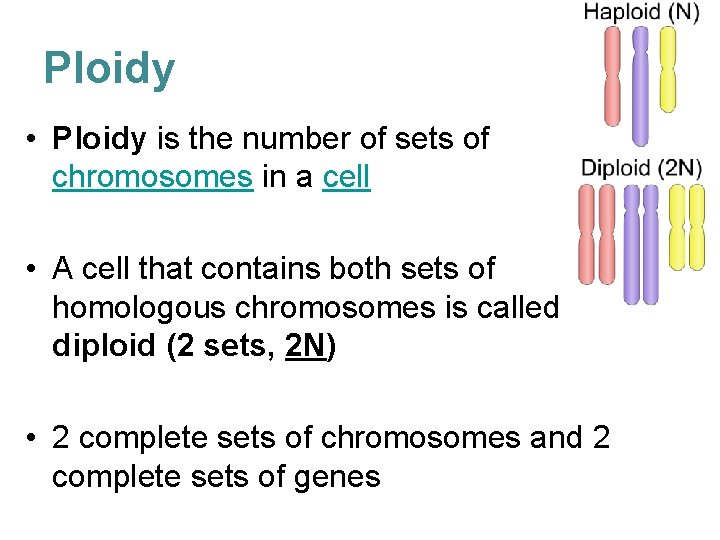
Ploidy • Ploidy is the number of sets of chromosomes in a cell • A cell that contains both sets of homologous chromosomes is called diploid (2 sets, 2 N) • 2 complete sets of chromosomes and 2 complete sets of genes
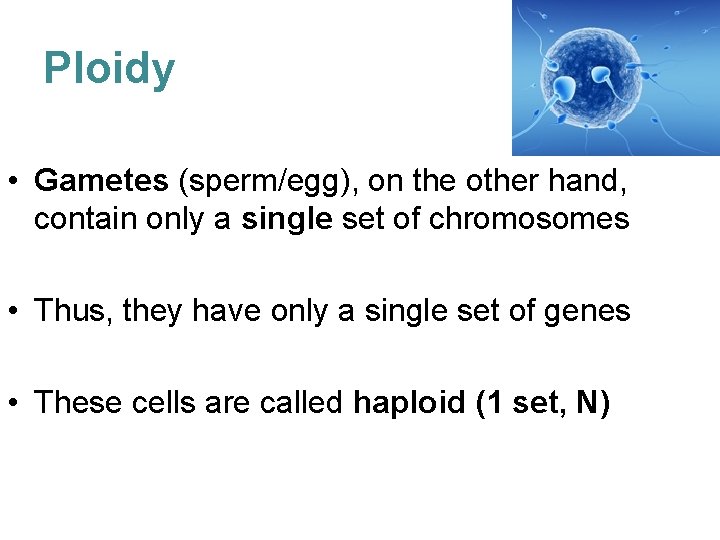
Ploidy • Gametes (sperm/egg), on the other hand, contain only a single set of chromosomes • Thus, they have only a single set of genes • These cells are called haploid (1 set, N)
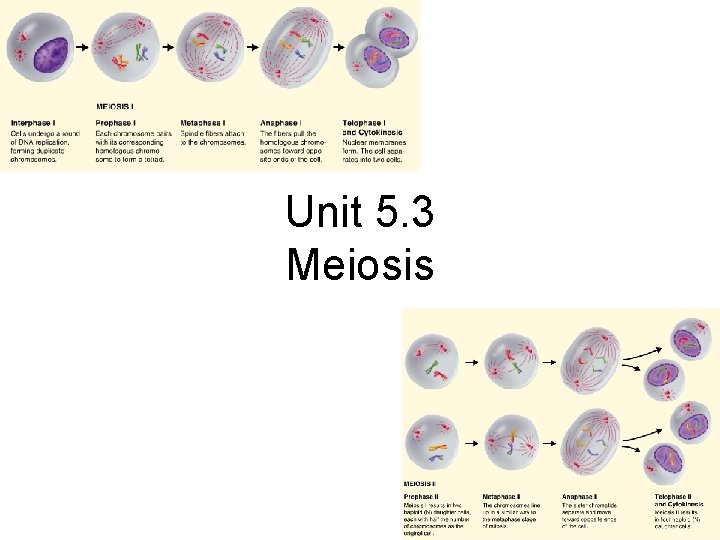
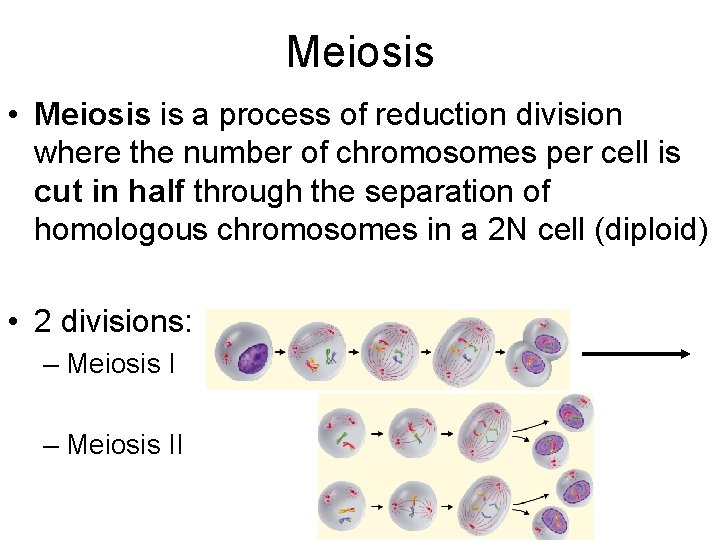
Meiosis • Meiosis is a process of reduction division where the number of chromosomes per cell is cut in half through the separation of homologous chromosomes in a 2 N cell (diploid) • 2 divisions: – Meiosis II
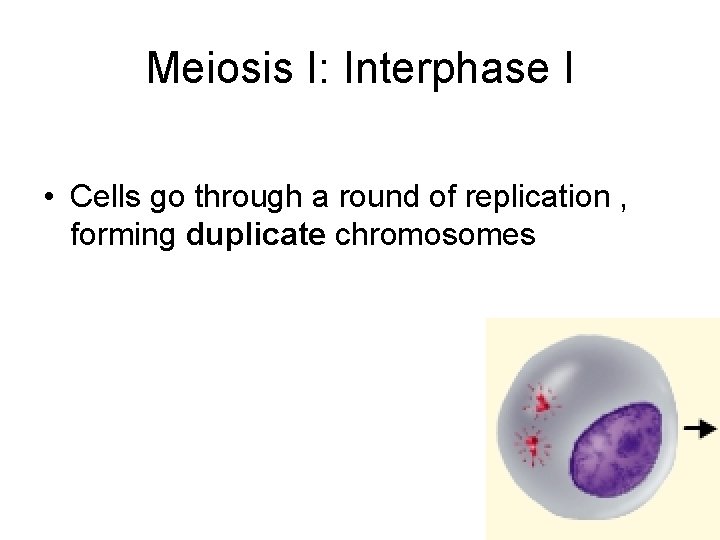
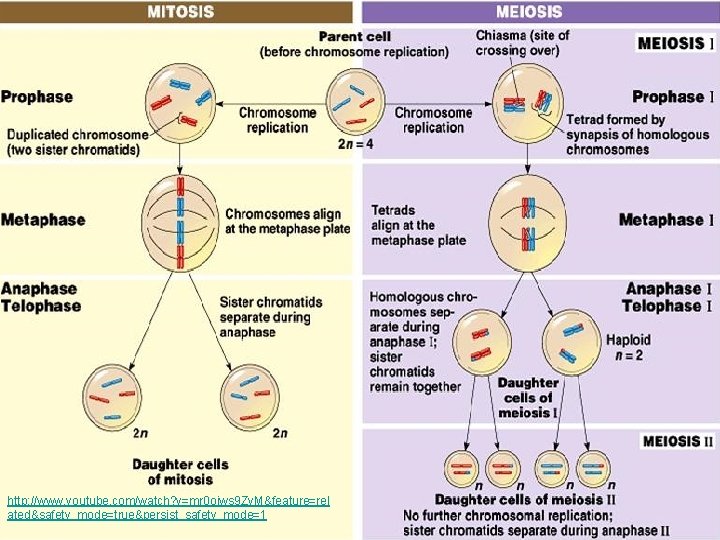
Meiosis I: Interphase I • Cells go through a round of replication , forming duplicate chromosomes
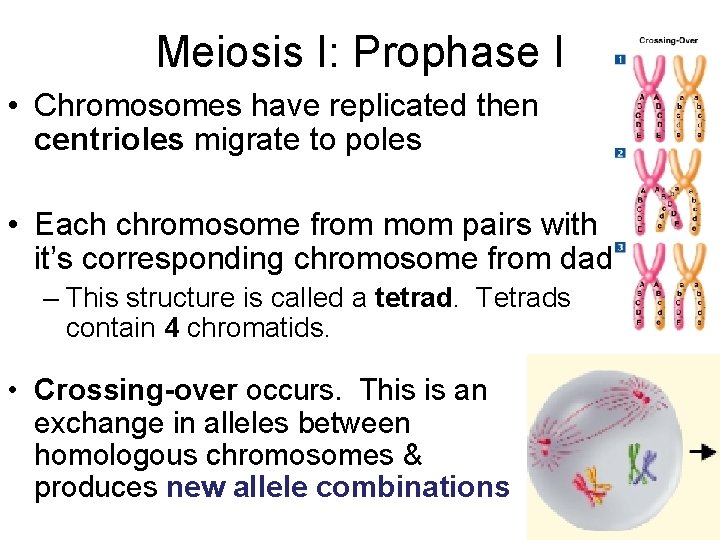
Meiosis I: Prophase I • Chromosomes have replicated then centrioles migrate to poles • Each chromosome from mom pairs with it’s corresponding chromosome from dad – This structure is called a tetrad. Tetrads contain 4 chromatids. • Crossing-over occurs. This is an exchange in alleles between homologous chromosomes & produces new allele combinations
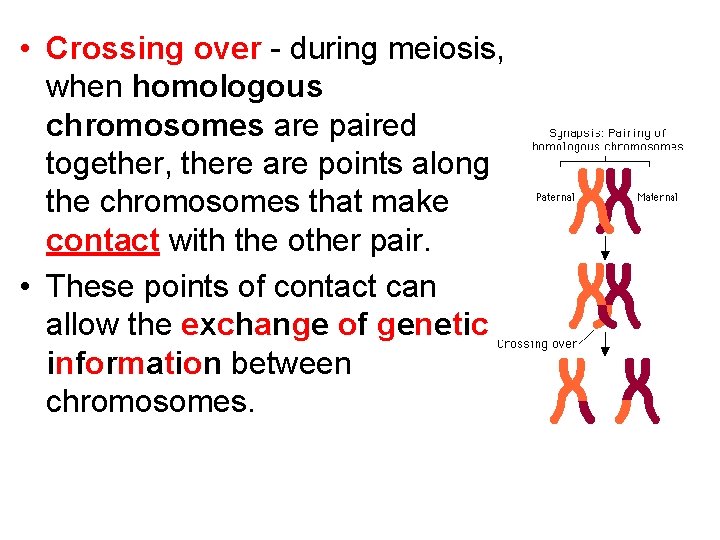
• Crossing over - during meiosis, when homologous chromosomes are paired together, there are points along the chromosomes that make contact with the other pair. • These points of contact can allow the exchange of genetic information between chromosomes.
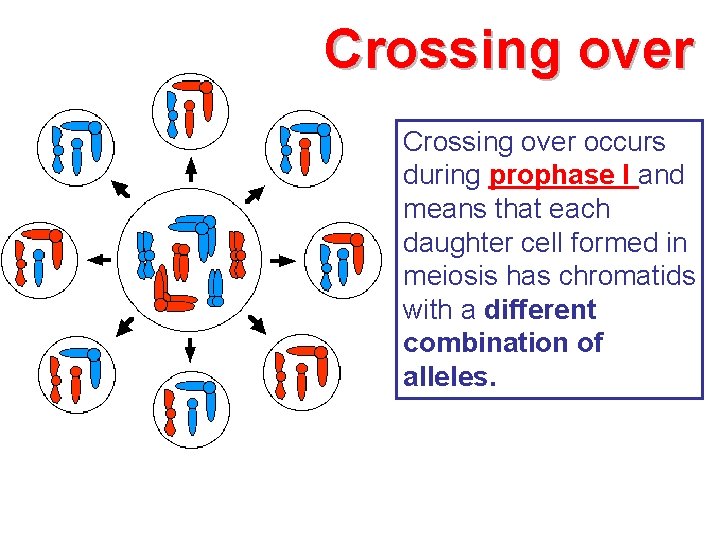
Crossing over occurs during prophase I and means that each daughter cell formed in meiosis has chromatids with a different combination of alleles.
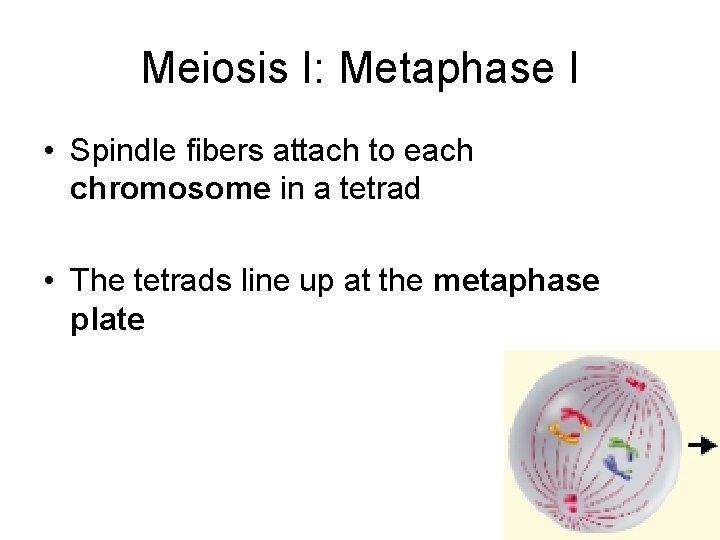
Meiosis I: Metaphase I • Spindle fibers attach to each chromosome in a tetrad • The tetrads line up at the metaphase plate
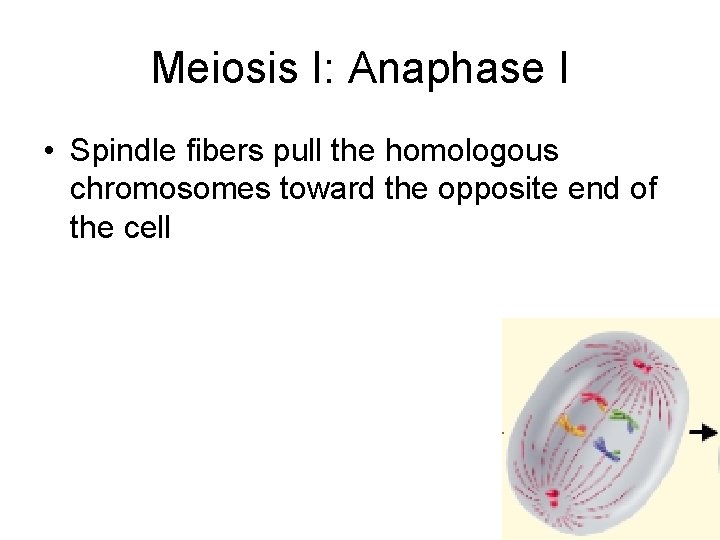
Meiosis I: Anaphase I • Spindle fibers pull the homologous chromosomes toward the opposite end of the cell
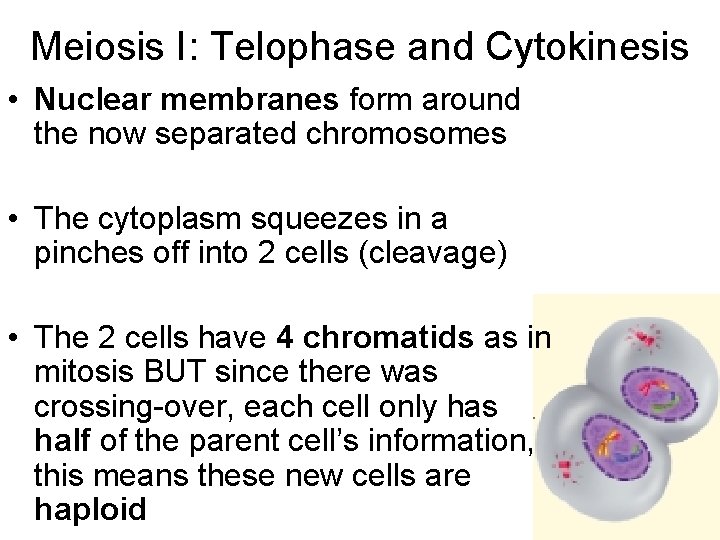
Meiosis I: Telophase and Cytokinesis • Nuclear membranes form around the now separated chromosomes • The cytoplasm squeezes in a pinches off into 2 cells (cleavage) • The 2 cells have 4 chromatids as in mitosis BUT since there was crossing-over, each cell only has half of the parent cell’s information, this means these new cells are haploid
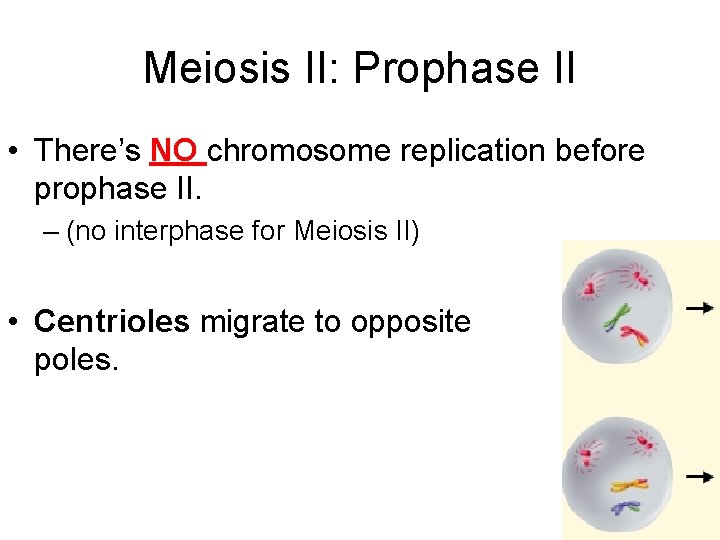
Meiosis II: Prophase II • There’s NO chromosome replication before prophase II. – (no interphase for Meiosis II) • Centrioles migrate to opposite poles.
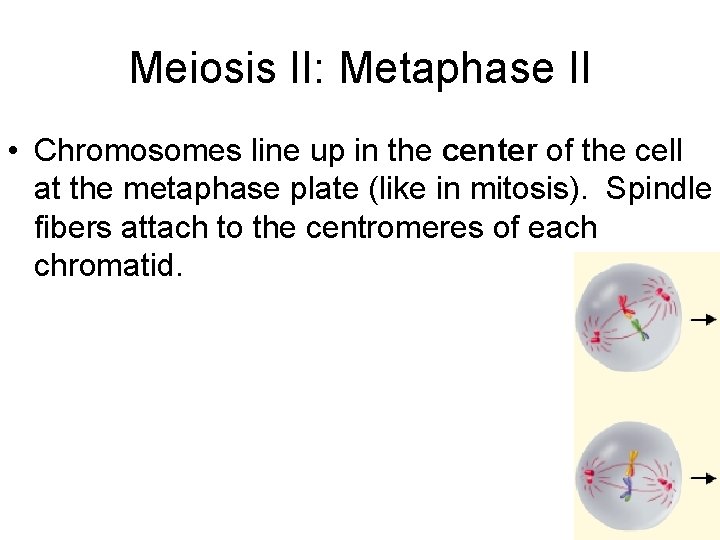
Meiosis II: Metaphase II • Chromosomes line up in the center of the cell at the metaphase plate (like in mitosis). Spindle fibers attach to the centromeres of each chromatid.
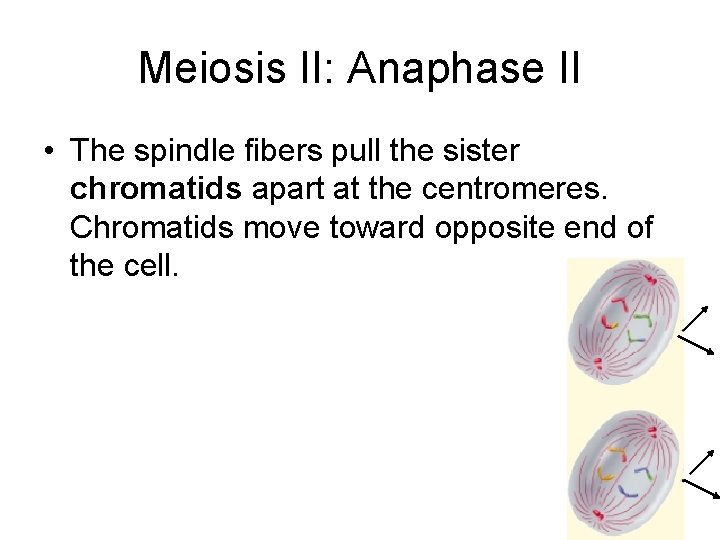
Meiosis II: Anaphase II • The spindle fibers pull the sister chromatids apart at the centromeres. Chromatids move toward opposite end of the cell.
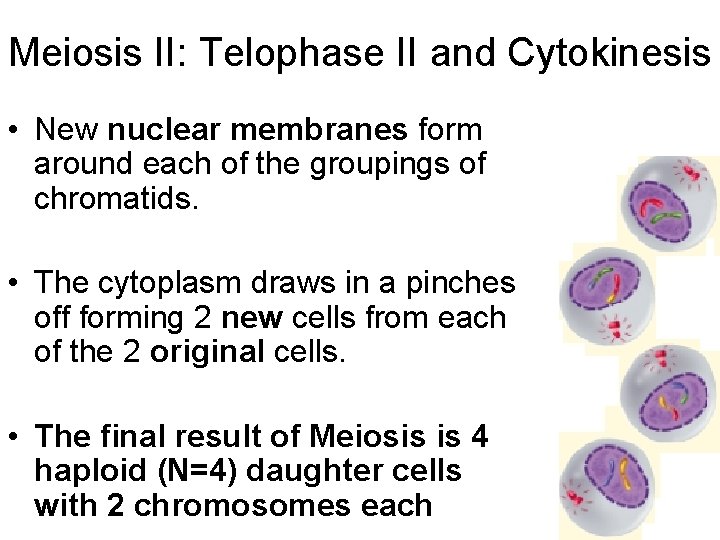
Meiosis II: Telophase II and Cytokinesis • New nuclear membranes form around each of the groupings of chromatids. • The cytoplasm draws in a pinches off forming 2 new cells from each of the 2 original cells. • The final result of Meiosis is 4 haploid (N=4) daughter cells with 2 chromosomes each
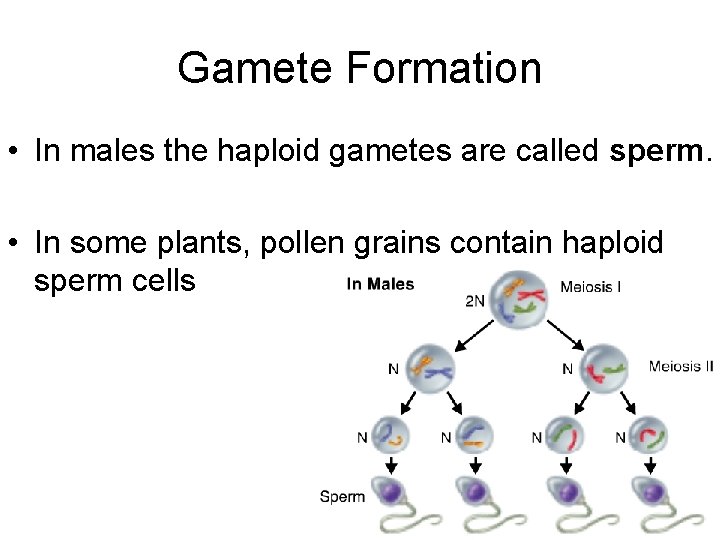
Gamete Formation • In males the haploid gametes are called sperm. • In some plants, pollen grains contain haploid sperm cells
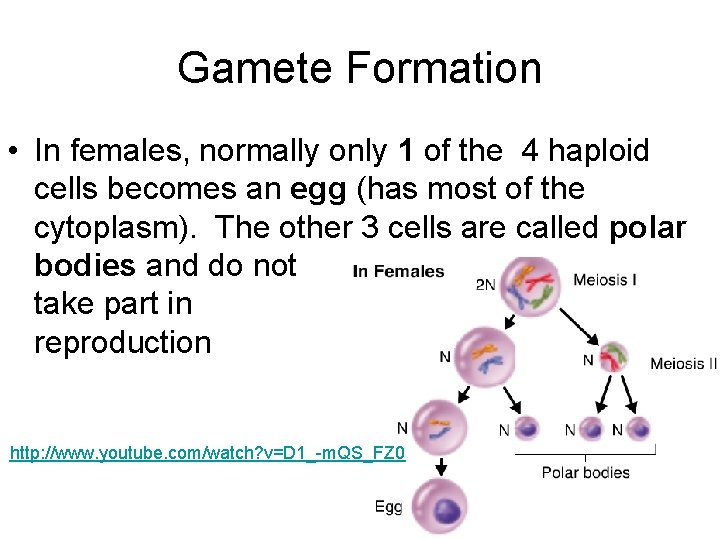
Gamete Formation • In females, normally only 1 of the 4 haploid cells becomes an egg (has most of the cytoplasm). The other 3 cells are called polar bodies and do not take part in reproduction http: //www. youtube. com/watch? v=D 1_-m. QS_FZ 0
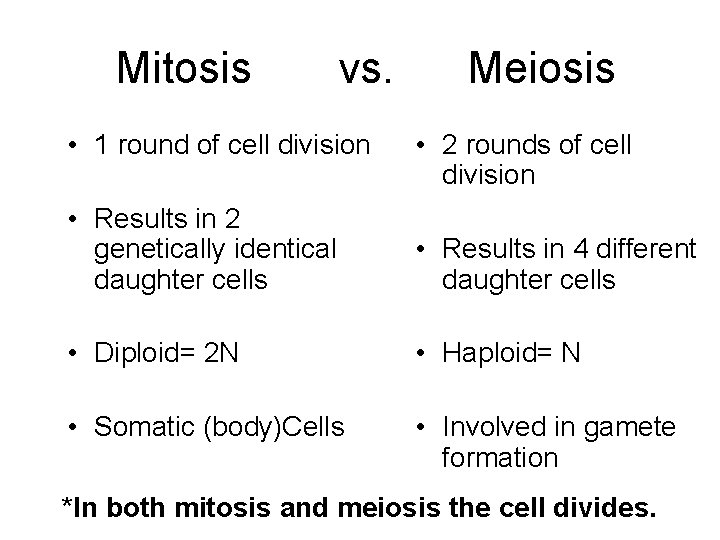
Mitosis vs. • 1 round of cell division Meiosis • 2 rounds of cell division • Results in 2 genetically identical daughter cells • Results in 4 different daughter cells • Diploid= 2 N • Haploid= N • Somatic (body)Cells • Involved in gamete formation *In both mitosis and meiosis the cell divides.
http: //www. youtube. com/watch? v=mr 0 oiws 9 Zv. M&feature=rel ated&safety_mode=true&persist_safety_mode=1
Additional videos Meiosis vs. Mitosis http: //www. youtube. com/watch? v=Ba 9 LXKH 2 zt. U&feature=related Overview http: //www. youtube. com/watch? v=k. VMb 4 Js 99 t. A Square Dance! http: //www. youtube. com/watch? v=i. CL 6 d 0 O w. Kt 8&feature=related
https: //www. 23 andme. com/gen 101/genes/ Inheritance http: //www. youtube. com/watch? v=l. Jz. Z 7 p 47 P 8&feature=related Phenotype: http: //www. youtube. com/watch? v=j. HWJqzl Hl 3 w&feature=related