
Unit 5 3 Lean Production Quality Management HL
- Slides: 15
Unit 5. 3 Lean Production Quality Management (HL)
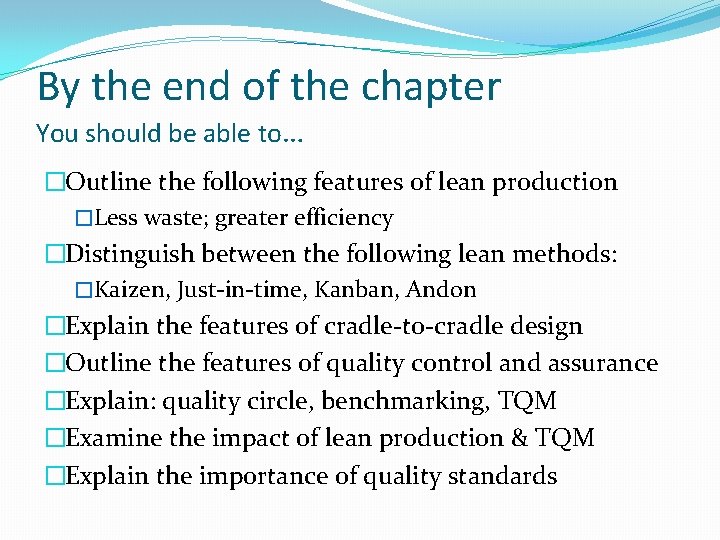
By the end of the chapter You should be able to… �Outline the following features of lean production �Less waste; greater efficiency �Distinguish between the following lean methods: �Kaizen, Just-in-time, Kanban, Andon �Explain the features of cradle-to-cradle design �Outline the features of quality control and assurance �Explain: quality circle, benchmarking, TQM �Examine the impact of lean production & TQM �Explain the importance of quality standards
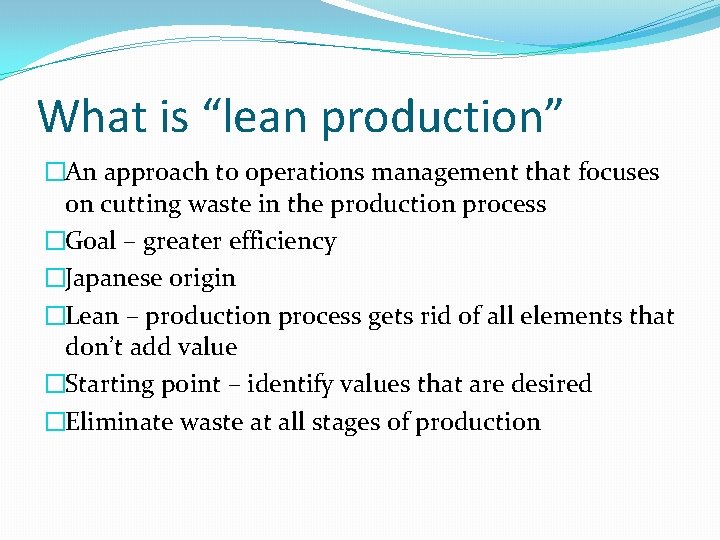
What is “lean production” �An approach to operations management that focuses on cutting waste in the production process �Goal – greater efficiency �Japanese origin �Lean – production process gets rid of all elements that don’t add value �Starting point – identify values that are desired �Eliminate waste at all stages of production
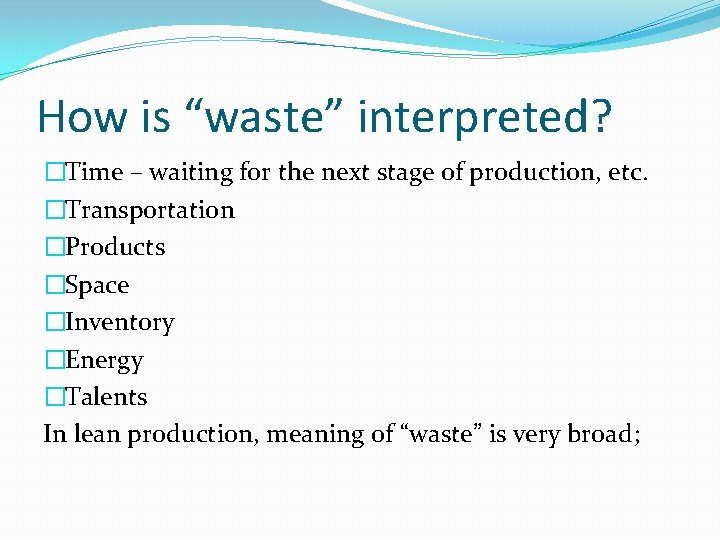
How is “waste” interpreted? �Time – waiting for the next stage of production, etc. �Transportation �Products �Space �Inventory �Energy �Talents In lean production, meaning of “waste” is very broad;
Methods of Lean Production �Continuous Improvement (kaizen) �Seeks suggestion for improvement from workers �Certain key principles: �Philosophy must be adopted by the entire organization �No blame attached to any problem or issues raised �Systematic thinking needed to consider whole production process �Kaizen focuses on the process, not on end product
Just-in-time (JIT) �Involves amount of inventory a business has �Extra inventory (buffer stock) can result in extra costs: �Storage, insurance, staff �Stock Control – a fine balance between: �Just-in-Case �Holding reserves in case of an increase in demand �Traditional method of stock control �Just-in-Time �Getting supplies only when needed; producing only what is ordered �No buffer stock is held
Kanban �Japanese word – supports Just-in-time �A tool to facilitate lean production �Uses a kanban card �A message telling workers what to do next �Aim – to ensure a steady flow without waste of time or resources �Modern kanban cards are computerized, electronic bar codes �Kanban originates in automotive industry, can be transferred to other areas
Andon �A signal which informs workers of a problem �Advantages: �Workers at all levels are immediately notified �Supervisors able to spend time problem solving rather than monitoring �Feedback provided to all teams �Whole organization learns from problems and mistakes – enables continuous improvement
Cradle-to-Cradle Design & Manufacturing �Approach to design & manufacturing based on principles of sustainable development �Suggests that products once used, should be recycled. �Current trend toward environmental sustainability puts pressure on companies to recycle in the manufacturing process �C 2 C certification requires criteria be met – p. 358 �Cradle-to-cradle still in infancy
Quality control & quality assurance �Quality control has moved toward Quality Assurance �Change attributed to the work of W. Edwards Deming �Quality Control v. Quality Assurance – p. 360 �The whole business must embrace quality in order for it to be successful. � 3 methods are possible to manage quality:
Quality Circles �A formal group of volunteers who meet regularly to discuss & suggest ways of improving quality �Meetings facilitated by a team leader �Comparable to a focus group �Suggest solutions to problems �Established in Japan, 1962; used mainly in Japan and China
Benchmarking �A tool used by businesses to compare yourself to your competition �Benchmarks established as a point of reference; businesses can compare their practices and standards �Example – hotel ratings �Benchmarking can be done in various ways
TQM �An approach to quality enhancement �Table 5. 3. 2 – Features of TQM �Page 363 – National and International Quality Control Standards
Key Terms �Lean Production �Kaizen �JIT �JIC �Kanban �Andon �Cradle-to-cradle design �Quality Circle �Benchmarking �TQM Student Workpoint 5. 10 Student Workpoint 5. 11
Revision Checklist �Read through checklist – page 364.