
Unit 4 Thermodynamics Lecture 1 What is Energy
- Slides: 10
Unit 4 Thermodynamics- Lecture 1: What is Energy? With your table group come up with a definition and examples of energy. Record on your group’s whiteboard
Unit 4 Thermodynamics- Lecture 1: PS 3 -3 Design, build, and refine a device that works within given constraints to convert one form of energy into another form of energy. a. Students know that energy can be characterized as potential or kinetic. b. Students know the law of conservation of energy and that energy can be converted from one form to another.
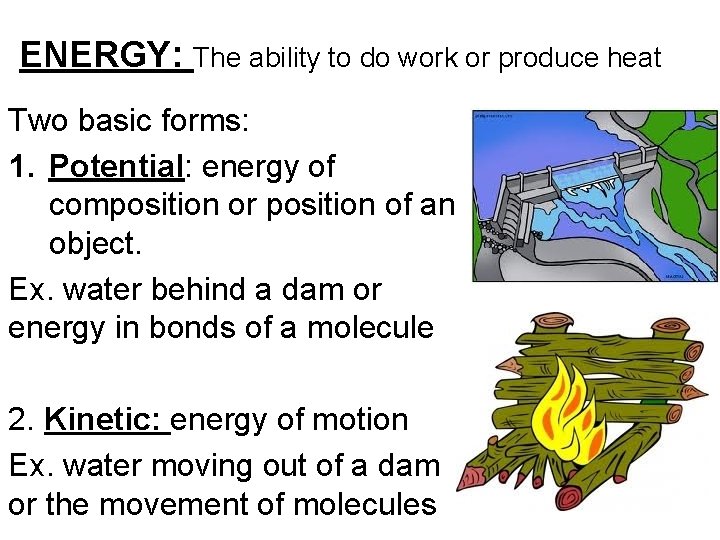
ENERGY: The ability to do work or produce heat Two basic forms: 1. Potential: energy of composition or position of an object. Ex. water behind a dam or energy in bonds of a molecule 2. Kinetic: energy of motion Ex. water moving out of a dam or the movement of molecules
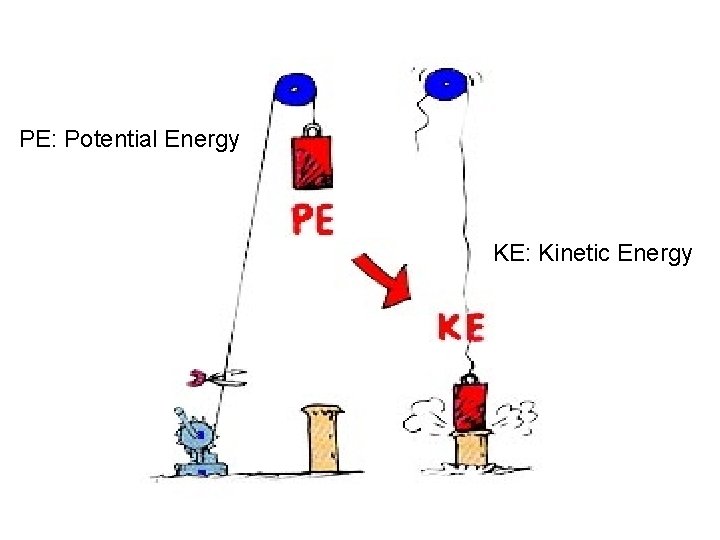
PE: Potential Energy KE: Kinetic Energy
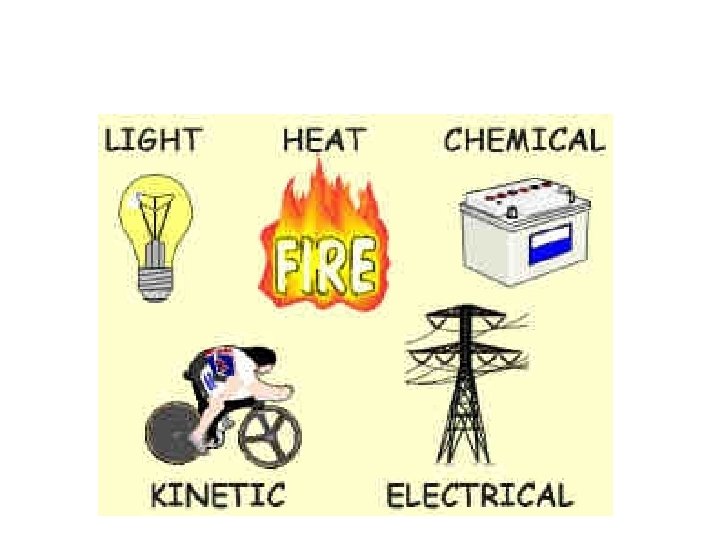
Six Forms of Energy • Chemical: potential energy stored in bonds – For example coal, glucose, and petroleum • Mechanical (work): energy of a moving object – For example wind, and a car crash • Thermal (heat): energy of the motion of molecules (friction) – Example a cup of hot water
Six Forms of Energy • Radiation (light): energy related to movement of light, electromagnetic waves, or particles – For example visible light, x-rays, and sunshine. • Electrical: energy of the movement of electrons – For example a circuit, and lightning. • Nuclear: energy stored inside the nucleus of an atom. – For example fusion occurring in the sun
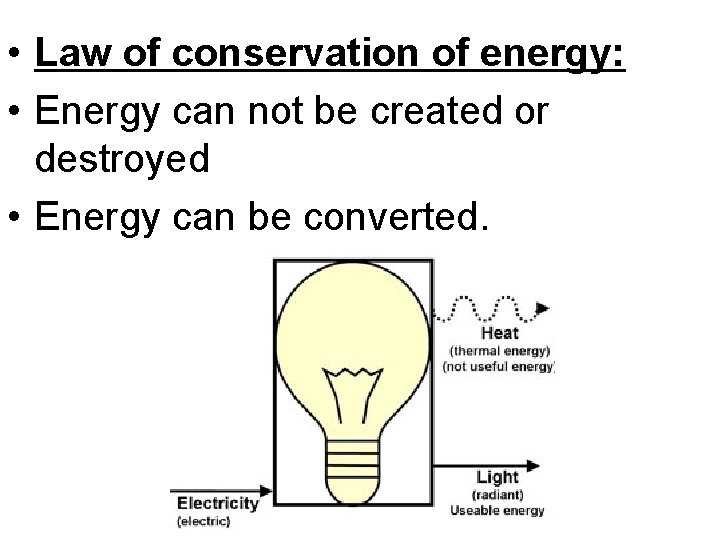
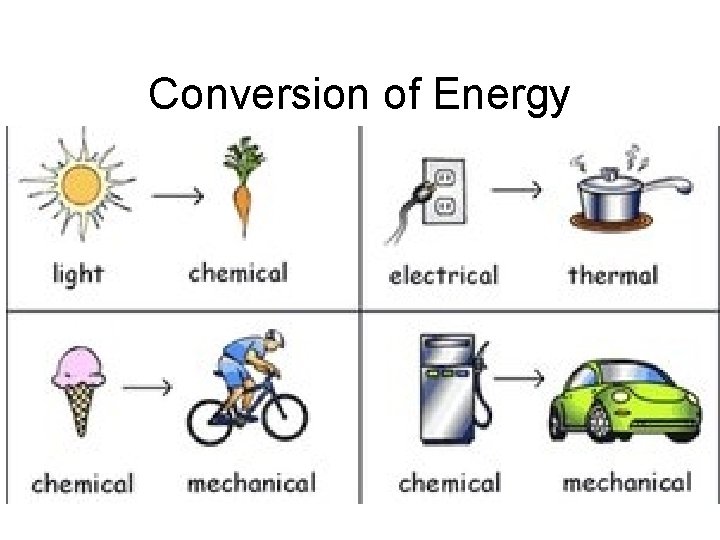
• Law of conservation of energy: • Energy can not be created or destroyed • Energy can be converted.
Conversion of Energy
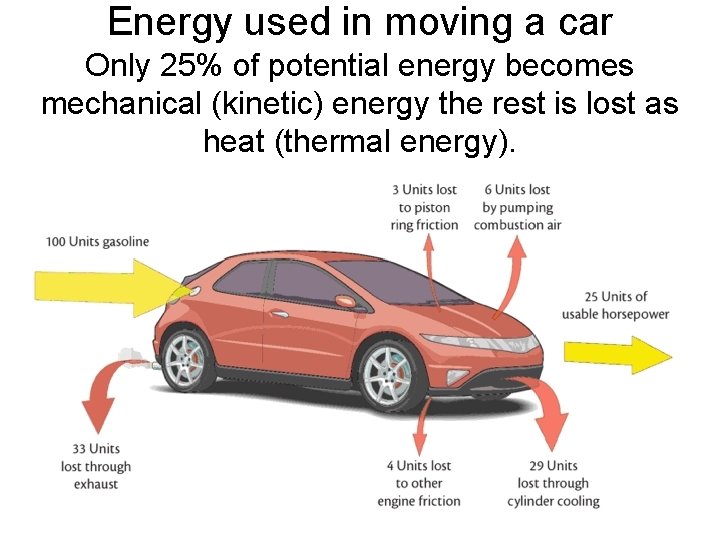
Energy used in moving a car Only 25% of potential energy becomes mechanical (kinetic) energy the rest is lost as heat (thermal energy).