
Unit 4 Therapeutic Relationship INFORMATION FROM DUNCAN B
Unit 4: Therapeutic Relationship INFORMATION FROM DUNCAN, B. L. , MILLER, S. D. , WAMPOLD, B. E. , & HUBBLE, M. A. (EDS). (2010). THE HEART & SOUL OF CHANGE: DELIVERING WHAT WORKS IN THERAPY (2 ND ED. ). WASHINGTON, DC: AMERICAN PSYCHOLOGICAL ASSOCIATION.
The Therapeutic Relationship “Listening creates a holy silence. When you listen generously to people, they can hear the truth in themselves, often for the first time. And when you listen deeply, you can know yourself in everyone” (p. 113). Rachel Remen, Kitchen Table Wisdom, as cited in Duncan, Miller, Wampold, and Hubble (2010).
The Therapist Client Relationship �Defined as the feelings and attitudes that therapist and client have toward one another and how they are expressed �A large common factor of all therapies
Research on the Therapist Client Relationship �The research shows that therapeutic relationships are important for change �Implications for practice are many
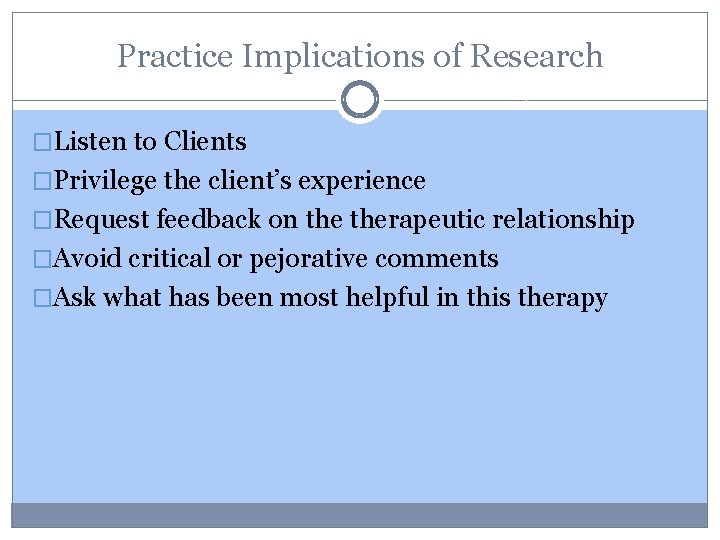
Practice Implications of Research �Listen to Clients �Privilege the client’s experience �Request feedback on therapeutic relationship �Avoid critical or pejorative comments �Ask what has been most helpful in this therapy
What Works in General
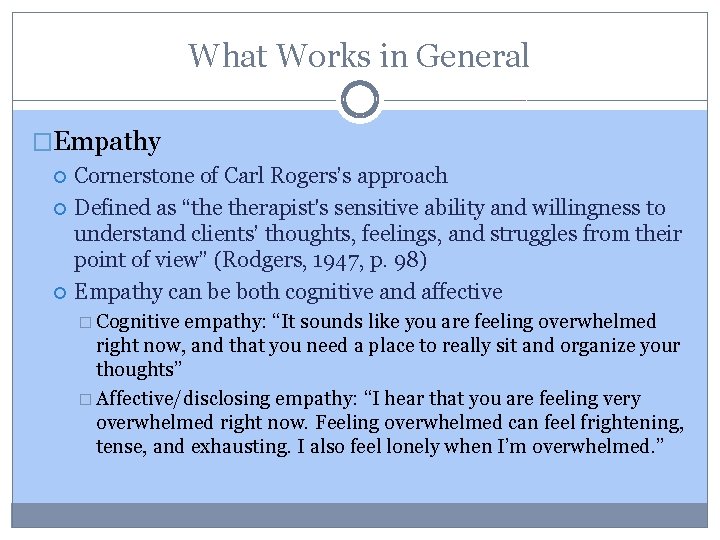
What Works in General �Empathy Cornerstone of Carl Rogers’s approach Defined as “the therapist's sensitive ability and willingness to understand clients’ thoughts, feelings, and struggles from their point of view” (Rodgers, 1947, p. 98) Empathy can be both cognitive and affective � Cognitive empathy: “It sounds like you are feeling overwhelmed right now, and that you need a place to really sit and organize your thoughts” � Affective/disclosing empathy: “I hear that you are feeling very overwhelmed right now. Feeling overwhelmed can feel frightening, tense, and exhausting. I also feel lonely when I’m overwhelmed. ”
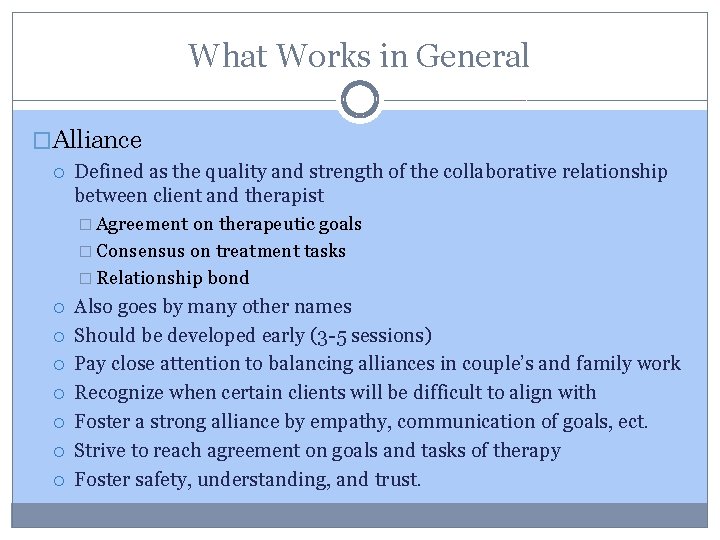
What Works in General �Alliance Defined as the quality and strength of the collaborative relationship between client and therapist � Agreement on therapeutic goals � Consensus on treatment tasks � Relationship bond Also goes by many other names Should be developed early (3 -5 sessions) Pay close attention to balancing alliances in couple’s and family work Recognize when certain clients will be difficult to align with Foster a strong alliance by empathy, communication of goals, ect. Strive to reach agreement on goals and tasks of therapy Foster safety, understanding, and trust.
What Works in General �Cohesion The forces that cause members to remain in a group – a parallel to alliance, but in a group setting among all members. To help with cohesion: � Prepare group members before group starts � Clarify group processes early � Actively guide conversation with cohesion as a goal � Start with positive feedback early � Manage your own emotional presence in group � Facilitate emotional expression and responsiveness
What Works in General �Goal Consensus and Collaboration Goal consensus – therapist-client agreement on treatment goals and expectations Collaboration – mutual involvement of therapist and client Ways to increase goal consensus and collaboration: � Consider collaborating for treatment planning � Therapeutic decision making should be shared when possible � Consider mutually creating homework assignments
What Works in General �Positive Regard Warm acceptance of the client’s experience without conditions � Prizing � Affirmation � Deep non-possessive caring Client’s perception of positive regard is more important than therapist’s perception Should convey a caring, respectful attitude that affirms the client’s basic sense of worth � Not an endless outpouring of love or compliments � Not a denial of client’s negative traits Must be communicated to clients � Non-verbal � Verbal Should also be communicated about those who client discusses, even when client discusses others in a negative light
What Works in General �Congruence/genuineness personal integration in the relationship and the capacity to communicate therapist’s personhood to the client as appropriate Carl Rodgers spoke about being the same person on the inside and the outside during therapy. There is no façade, but you are truly yourself with the client To have more congruence: � Higher confidence � Good mood � Increased involvement or activity in therapy � Responsiveness to the client � Smooth exchanges with the client
What Works in General �Feedback The information you give to the client about the client’s behavior or the effects of the client’s behavior The assessment of the client and his or her situation that you share with the client Should provide insight or help client make change To provide effective feedback: � Be credible � Prepare client for feedback � Give positive feedback early in therapy � Communicate goal of feedback � Discuss what to do with feedback � Give positive feedback before and after negative feedback � Watch out for client’s perception of feedback
What Works in General �Repair of Alliance Ruptures Rupture- a tension or breakdown in the collaborative relationship Clients often have negative feelings about therapist or therapy � Many do not voice these concerns � Often leads to clients who don’t come back Strive to be aware of subtle reactions of clients that indicate a rupture � Non-verbal changes in tone, posture, or eye-contact. � Verbal but slight disagreements, or agreements that are not genuine Take initiative to address ruptures as soon as possible
What Works in General �Therapist Self-Disclosure – statements that reveal something personal about therapist Disclose infrequently. Think about reason for disclosure. When disclosing… � Validate reality � Normalize experiences � Strengthen the alliance � Offer alternative ways to think or act Avoid self-disclosing for personal need as this can blur appropriate boundaries
What Works in General �Management of Countertransference – a therapist’s thoughts about or feelings toward a client that are exaggerated in some way because of therapist’s personal issues Can be positive or negative feelings More information on countertransference: http: //www. psychologytoday. com/blog/sacramento-streetpsychiatry/201003/countertransference-overview To manage countertransference, strengthen these skills: � Self-insight � Self-integration � Anxiety management � Empathy � Conceptualizing ability
What Works for Particular Clients
What Can Work for Particular Clients �The following attributes of the client can help you decide how to tailor therapy: Reactance (resistance) Functional Impairment Stages of Change �Assessing in these three areas can help you plan how to meet particular client needs
Reactance (Resistance) �Reactance – being easily provoked and responding with opposition to external demands High reactance � marked by refusal to participate, negative judgments of therapy or therapist, indifference to therapy. � Respond to self-control methods, minimal directiveness, and paradoxical interventions Low reactance � Marked by easygoing attitude, enthusiasm for therapist’s input, dedication to the change making process, completion of homework. � Respond to directiveness and explicit guidance �Therapists can cause reactance – be self aware
Functional Impairment �The severity of the client’s subjective distress and reduced behavioral functioning �Measure in DSM-IV as Global Assessment of Functioning (GAF) �Highly distressed clients benefit from more therapy More frequent More types (i. e. group & family) More therapeutic living environments
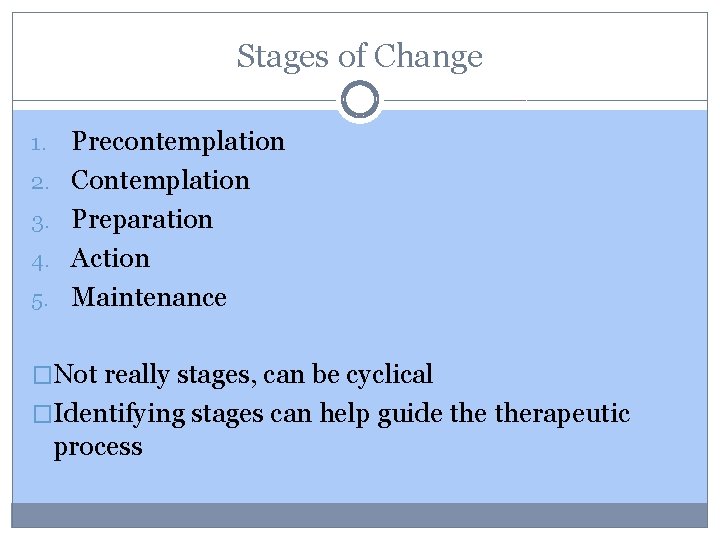
Stages of Change 1. 2. 3. 4. 5. Precontemplation Contemplation Preparation Action Maintenance �Not really stages, can be cyclical �Identifying stages can help guide therapeutic process
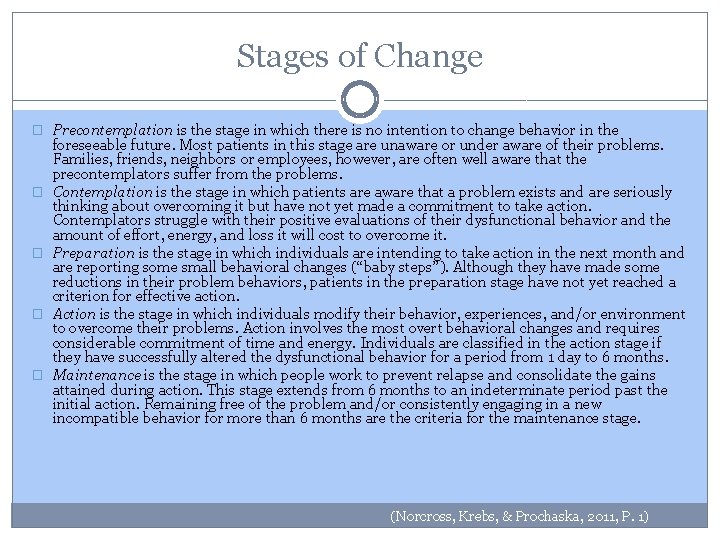
Stages of Change � Precontemplation is the stage in which there is no intention to change behavior in the � � foreseeable future. Most patients in this stage are unaware or under aware of their problems. Families, friends, neighbors or employees, however, are often well aware that the precontemplators suffer from the problems. Contemplation is the stage in which patients are aware that a problem exists and are seriously thinking about overcoming it but have not yet made a commitment to take action. Contemplators struggle with their positive evaluations of their dysfunctional behavior and the amount of effort, energy, and loss it will cost to overcome it. Preparation is the stage in which individuals are intending to take action in the next month and are reporting some small behavioral changes (‘‘baby steps’’). Although they have made some reductions in their problem behaviors, patients in the preparation stage have not yet reached a criterion for effective action. Action is the stage in which individuals modify their behavior, experiences, and/or environment to overcome their problems. Action involves the most overt behavioral changes and requires considerable commitment of time and energy. Individuals are classified in the action stage if they have successfully altered the dysfunctional behavior for a period from 1 day to 6 months. Maintenance is the stage in which people work to prevent relapse and consolidate the gains attained during action. This stage extends from 6 months to an indeterminate period past the initial action. Remaining free of the problem and/or consistently engaging in a new incompatible behavior for more than 6 months are the criteria for the maintenance stage. (Norcross, Krebs, & Prochaska, 2011, P. 1)
What Doesn’t Work
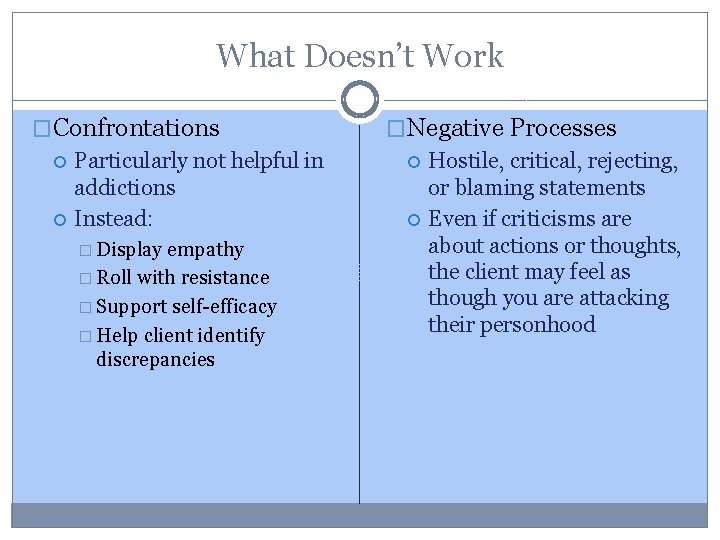
What Doesn’t Work �Confrontations Particularly not helpful in addictions Instead: � Display empathy � Roll with resistance � Support self-efficacy � Help client identify discrepancies �Negative Processes Hostile, critical, rejecting, or blaming statements Even if criticisms are about actions or thoughts, the client may feel as though you are attacking their personhood
What Doesn’t Work �Assumptions Counselors should not assume they know how their client is responding to therapy Instead, ask about your client’s experience of therapy �Therapist Centricity Counselors should not rely fully on their own perspective of the client or therapy process Research supports that clients’ perspectives more closely relate to outcome than therapists’ perspectives Counselors should ask the client about their own selfperceptions
What Doesn’t Work �Rigidity Inflexibility and rigidly structured therapies can result in negative outcomes � Failure to fully understand clients � Failures to fully empathize with clients � Failures to provide attention to what the client needs at that moment �Ostrich Behavior Ignoring early signs of ruptures with clients Not addressing ruptures Addressing ruptures can be difficult, but is essential for an effective working alliance
What Doesn’t Work �Procrustean Bed Using identical treatment approaches for all clients is now seen as inappropriate Name refers to a story in Greek mythology.
References Duncan, B. L. , Miller, S. D. , Wampold, B. E. , & Hubble, M. A. (Eds). (2010). The heart & soul of change: Delivering what works in therapy (2 nd ed. ). Washington, DC: American Psychological Association. Norcross, J. , Krebs, P. , & Prochaska, J. (2011). Stages of change. Journal Of Clinical Psychology, 67(2), 143 -154. doi: 10. 1002/jclp. 20758
- Slides: 28