
Unit 4 The Language of Chemistry Part Deux
- Slides: 29
Unit 4 – The Language of Chemistry: Part Deux
Amadeo Avogadro II. B. 2(f) – Describe Avogadro’s hypothesis and use it to solve stoichiometric problems III. A. 2(a) – Explain the meaning of mole and Avogadro’s number
Avogadro’s Hypothesis l l Equal amounts of gases at the same temperature contain equal numbers of molecules Leads to definition of the “mole” Mole Def: the number equal to the number of atoms in 12. 01 grams of carbon We will return to this idea later
Atomic Mass Units (amu) l l l Since the mass of one atom is so tiny, it is more practical to use relative atomic masses Carbon has been arbitrarily assigned a mass of exactly 12 atomic mass units One atomic mass unit is defined as exactly 1/12 the mass of a carbon-12 atom
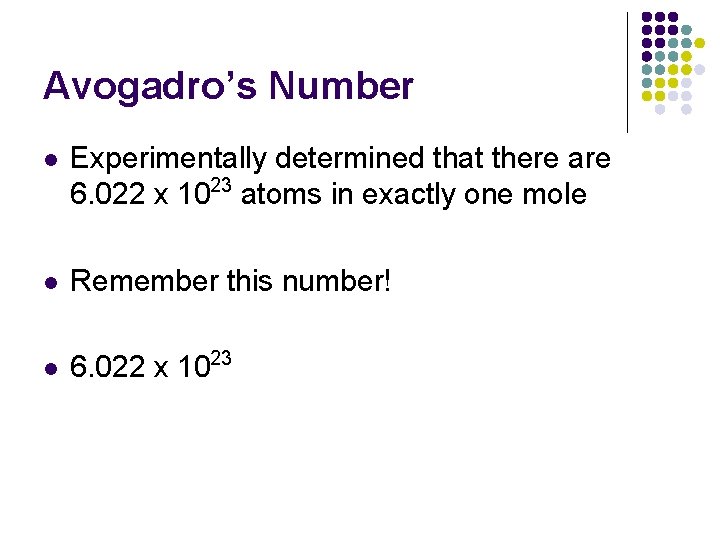
Avogadro’s Number l Experimentally determined that there are 6. 022 x 1023 atoms in exactly one mole l Remember this number! l 6. 022 x 1023
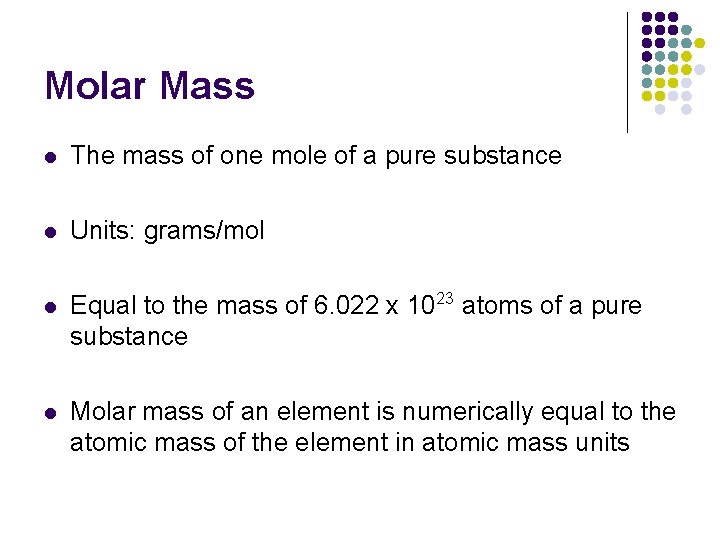
Molar Mass l The mass of one mole of a pure substance l Units: grams/mol l Equal to the mass of 6. 022 x 1023 atoms of a pure substance l Molar mass of an element is numerically equal to the atomic mass of the element in atomic mass units
Converting Mass, Moles, & Atoms/Molecules/Ions III. A. 2(b) -Interconvert between mass, moles, and number of particles
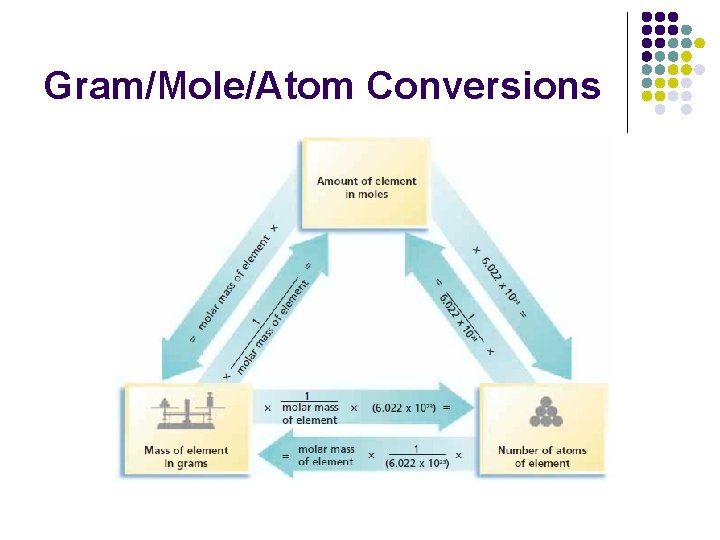
Gram/Mole/Atom Conversions
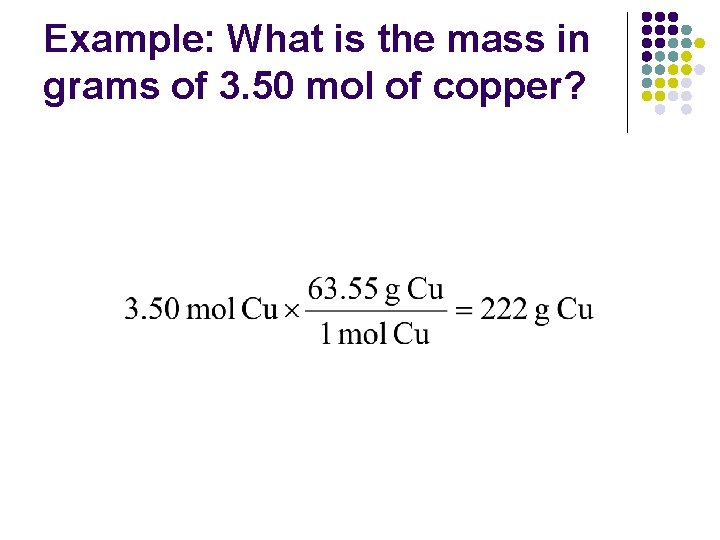
Example: What is the mass in grams of 3. 50 mol of copper?
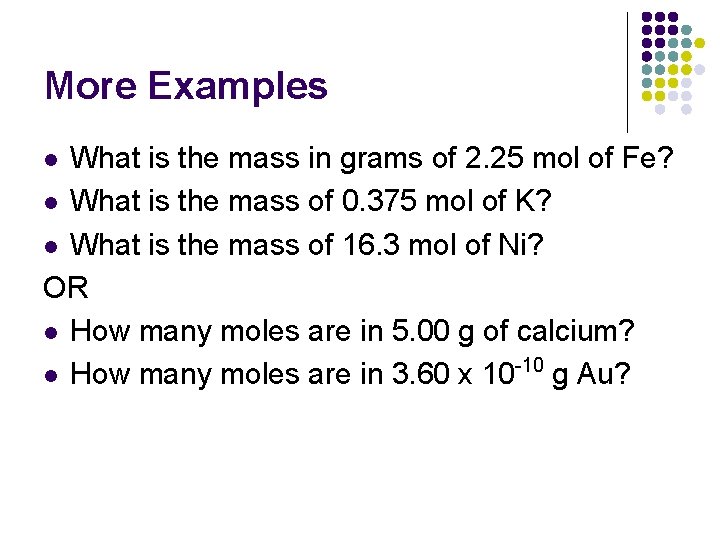
More Examples What is the mass in grams of 2. 25 mol of Fe? l What is the mass of 0. 375 mol of K? l What is the mass of 16. 3 mol of Ni? OR l How many moles are in 5. 00 g of calcium? -10 l How many moles are in 3. 60 x 10 g Au? l
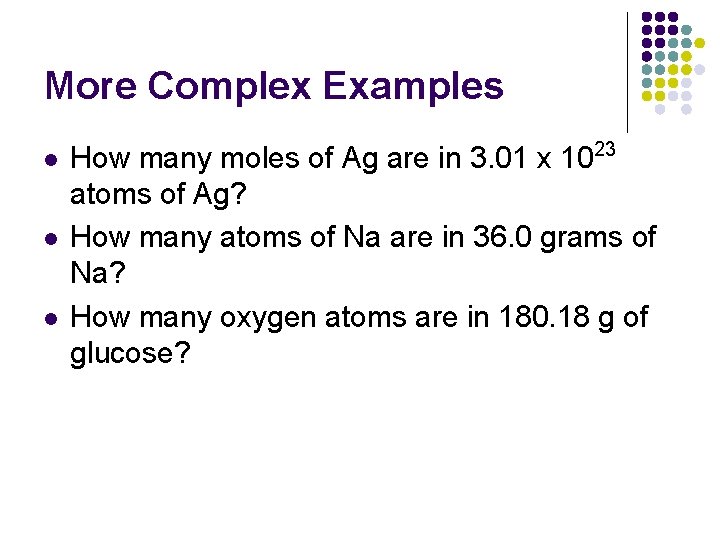
More Complex Examples l l l How many moles of Ag are in 3. 01 x 1023 atoms of Ag? How many atoms of Na are in 36. 0 grams of Na? How many oxygen atoms are in 180. 18 g of glucose?
Determining Chemical Formulas III. A. 1(e) - Calculate the percent composition of a substance, given its formula or masses of each component element in a sample III. A. 1(f) - Determine the empirical formulas and molecular formulas of compounds, given percent composition data or mass composition data III. A. 2(c) - Distinguish between formula mass, empirical mass, molecular mass, gram molecular mass, and gram formula mass
Empirical Formulas III. A. 1(f) - Determine the empirical formulas and molecular formulas of compounds, given percent composition data or mass composition data
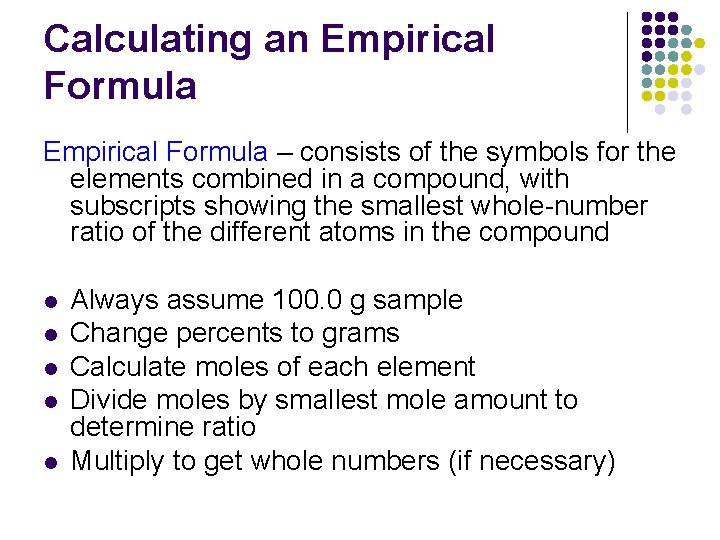
Calculating an Empirical Formula – consists of the symbols for the elements combined in a compound, with subscripts showing the smallest whole-number ratio of the different atoms in the compound l l l Always assume 100. 0 g sample Change percents to grams Calculate moles of each element Divide moles by smallest mole amount to determine ratio Multiply to get whole numbers (if necessary)
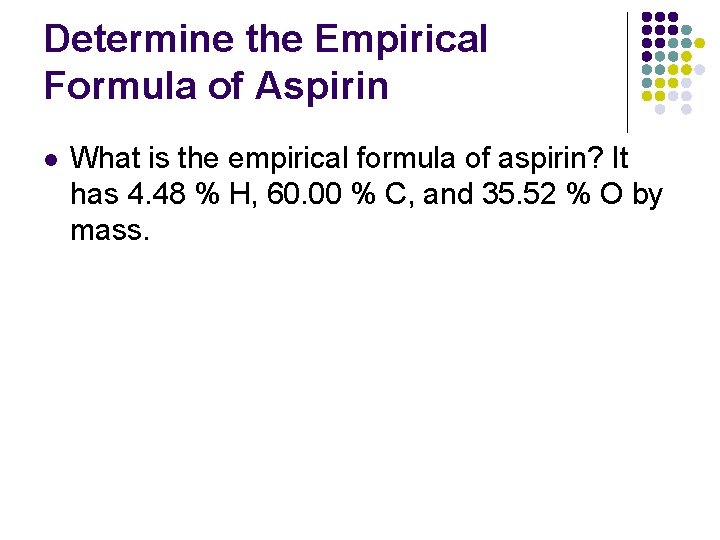
Determine the Empirical Formula of Aspirin l What is the empirical formula of aspirin? It has 4. 48 % H, 60. 00 % C, and 35. 52 % O by mass.
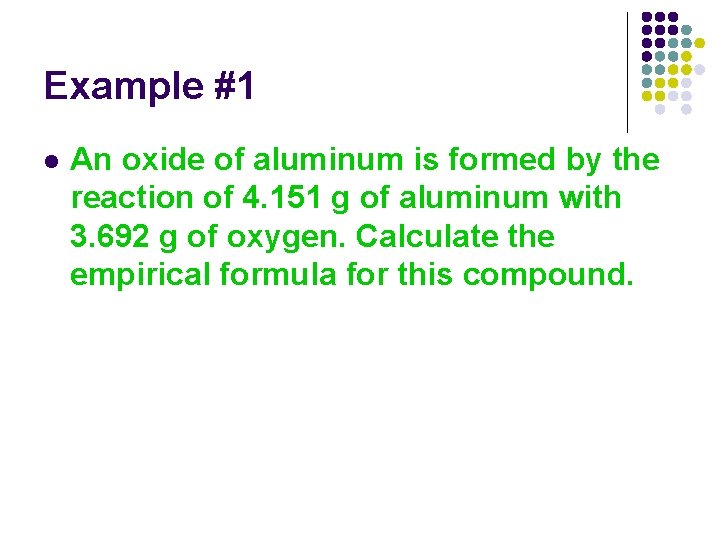
Example #1 l An oxide of aluminum is formed by the reaction of 4. 151 g of aluminum with 3. 692 g of oxygen. Calculate the empirical formula for this compound.
Example #2 l When a 0. 3546 g sample of vanadium metal is heated in air, it reacts with oxygen to achieve a final mass of 0. 6330 g. Calculate the empirical formula of this vanadium oxide.
Example #3 l A sample of lead arsenate, an insecticide used against the potato beetle, contains 1. 3813 g of lead, 0. 00672 g of hydrogen, 0. 4995 g arsenic, and 0. 4267 g of oxygen. Calculate the empirical formula for lead arsenate
Molecular Formulas III. A. 1(f) - Determine the empirical formulas and molecular formulas of compounds, given percent composition data or mass composition data III. A. 2(c) - Distinguish between formula mass, empirical mass, molecular mass, gram molecular mass, and gram formula mass
Calculating a Molecular Formula – the actual formula of a molecular compound Example: C 2 H 4 – ethylene C 3 H 6 – cyclopropane Both have a 2 H: 1 C ratio
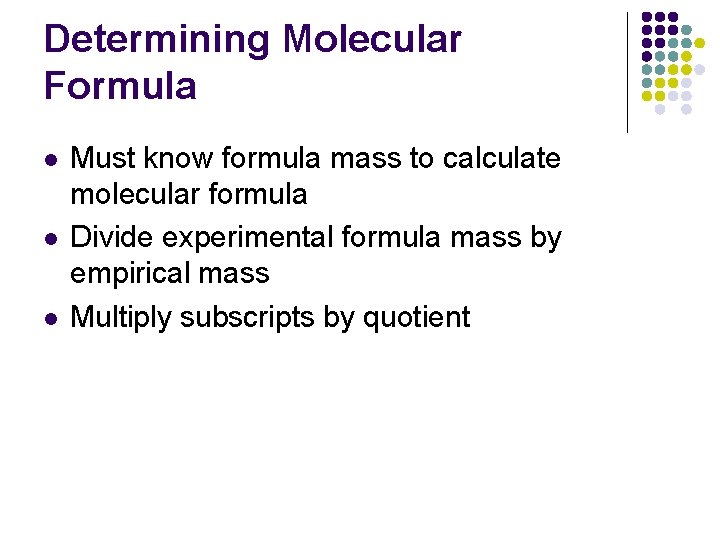
Determining Molecular Formula l l l Must know formula mass to calculate molecular formula Divide experimental formula mass by empirical mass Multiply subscripts by quotient
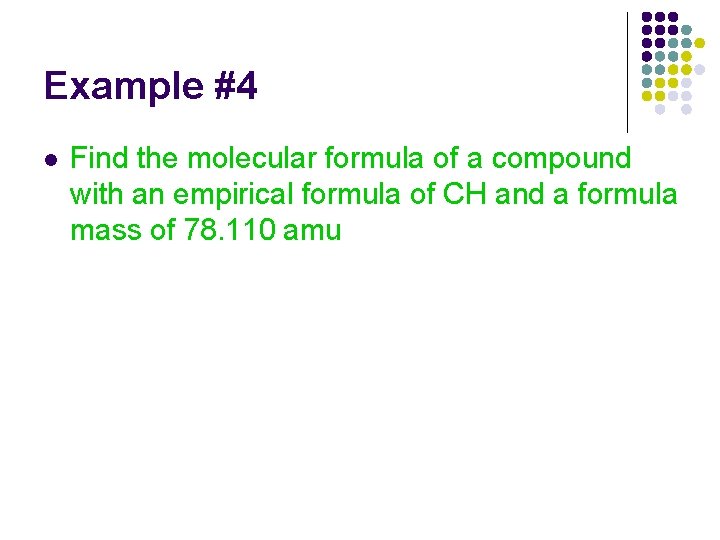
Example #4 l Find the molecular formula of a compound with an empirical formula of CH and a formula mass of 78. 110 amu
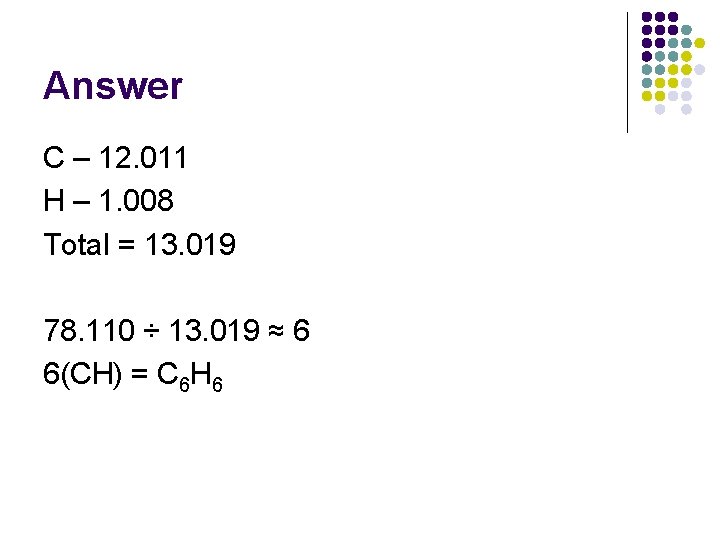
Answer C – 12. 011 H – 1. 008 Total = 13. 019 78. 110 ÷ 13. 019 ≈ 6 6(CH) = C 6 H 6
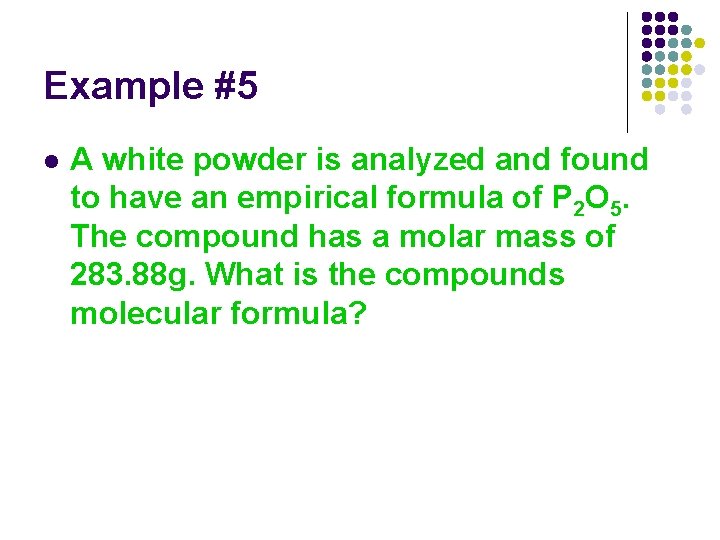
Example #5 l A white powder is analyzed and found to have an empirical formula of P 2 O 5. The compound has a molar mass of 283. 88 g. What is the compounds molecular formula?
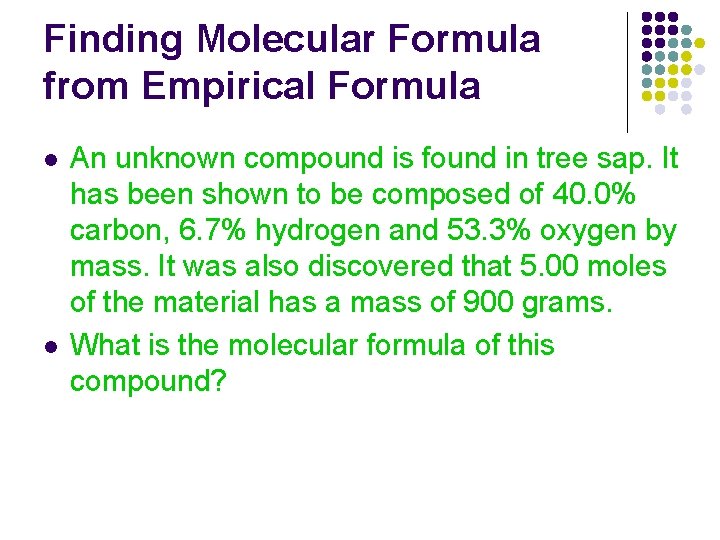
Finding Molecular Formula from Empirical Formula l l An unknown compound is found in tree sap. It has been shown to be composed of 40. 0% carbon, 6. 7% hydrogen and 53. 3% oxygen by mass. It was also discovered that 5. 00 moles of the material has a mass of 900 grams. What is the molecular formula of this compound?
Combustion Analysis
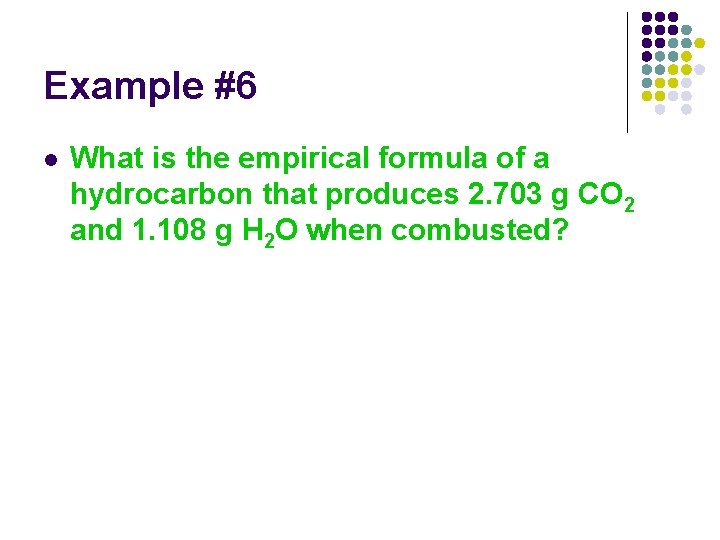
Example #6 l What is the empirical formula of a hydrocarbon that produces 2. 703 g CO 2 and 1. 108 g H 2 O when combusted?
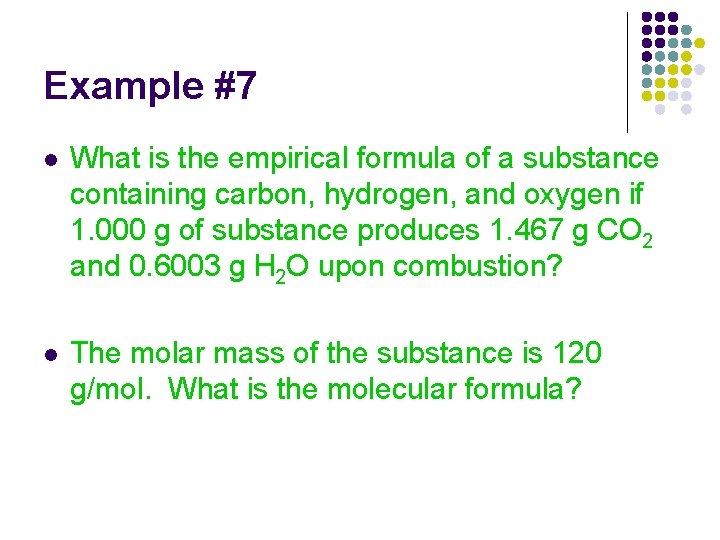
Example #7 l What is the empirical formula of a substance containing carbon, hydrogen, and oxygen if 1. 000 g of substance produces 1. 467 g CO 2 and 0. 6003 g H 2 O upon combustion? l The molar mass of the substance is 120 g/mol. What is the molecular formula?
Example #8 l What is the molecular formula of a substance containing carbon, hydrogen, and oxygen if it has a molar mass of 234 g/mol and 0. 360 g of substance produces 0. 406 g CO 2 and 0. 250 g H 2 O upon combustion?