
UNIT 4 THE HISTORICAL DEVELOPMENT OF LAW Read


- Slides: 8
UNIT 4 THE HISTORICAL DEVELOPMENT OF LAW
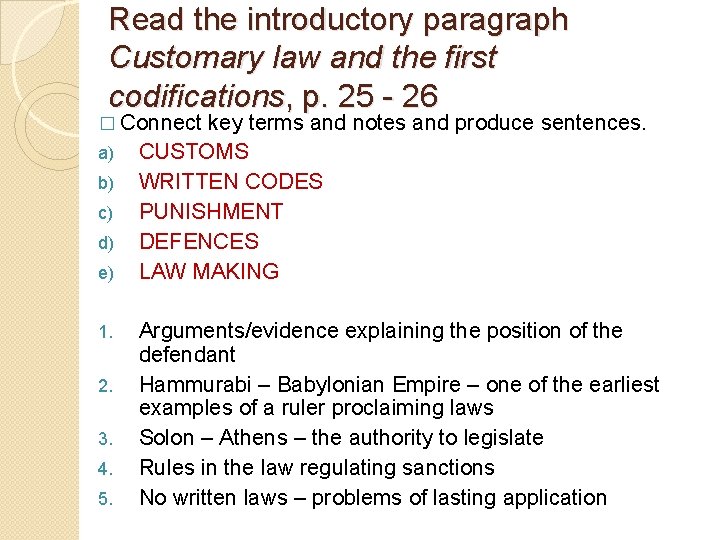
Read the introductory paragraph Customary law and the first codifications, p. 25 - 26 � Connect a) b) c) d) e) 1. 2. 3. 4. 5. key terms and notes and produce sentences. CUSTOMS WRITTEN CODES PUNISHMENT DEFENCES LAW MAKING Arguments/evidence explaining the position of the defendant Hammurabi – Babylonian Empire – one of the earliest examples of a ruler proclaiming laws Solon – Athens – the authority to legislate Rules in the law regulating sanctions No written laws – problems of lasting application
The Roman law in Europe after c. 1088 AD, p. 26 - 27 Explain the role of the Roman law at European universities. What was the position of the canon law at European universities? What was the task of glossators / commentators?
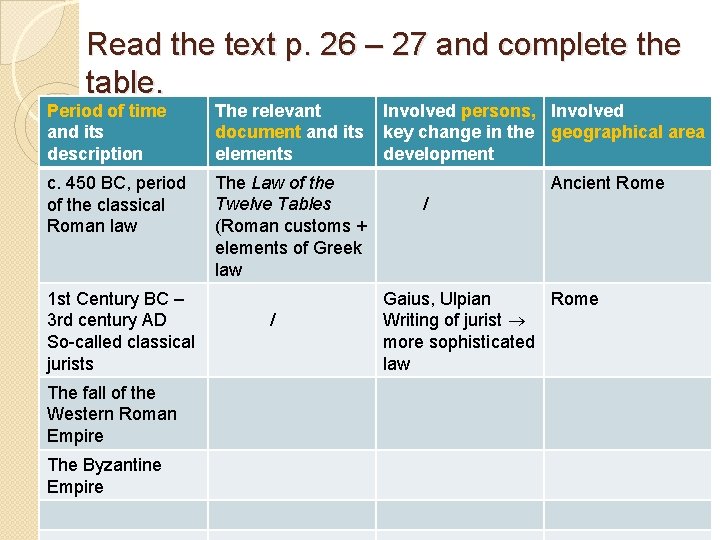
Read the text p. 26 – 27 and complete the table. Period of time and its description The relevant document and its elements c. 450 BC, period of the classical Roman law The Law of the Twelve Tables (Roman customs + elements of Greek law 1 st Century BC – 3 rd century AD So-called classical jurists The fall of the Western Roman Empire The Byzantine Empire / Involved persons, Involved key change in the geographical area development Ancient Rome / Gaius, Ulpian Rome Writing of jurist more sophisticated law
National codifications, p. 27 Supply the features of the given examples of national codes. The Napoleonic Code of 1804 - clear - for an average citizen - German example – BGB, 1900 - not for a layperson - THE CONTEXT for the development of these codes: -Nation states and their own natinal codes - Codification of Justinian was replaced by several codes
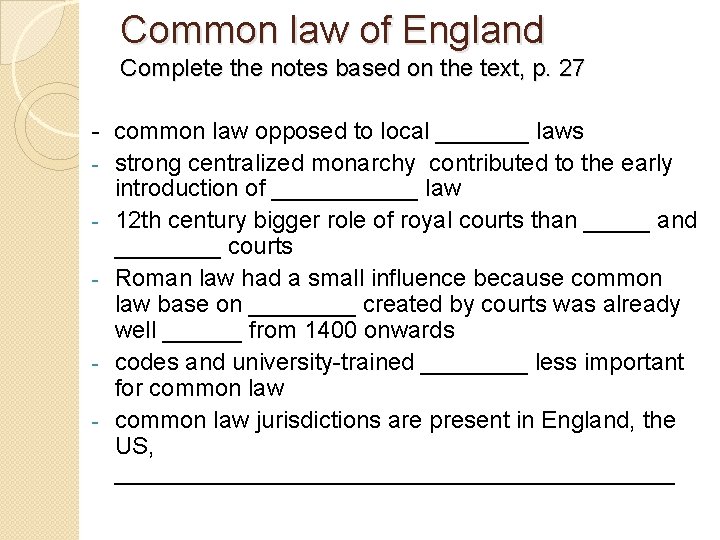
Common law of England Complete the notes based on the text, p. 27 - common law opposed to local _______ laws - strong centralized monarchy contributed to the early introduction of ______ law - 12 th century bigger role of royal courts than _____ and ____ courts - Roman law had a small influence because common law base on ____ created by courts was already well ______ from 1400 onwards - codes and university-trained ____ less important for common law - common law jurisdictions are present in England, the US, _____________________
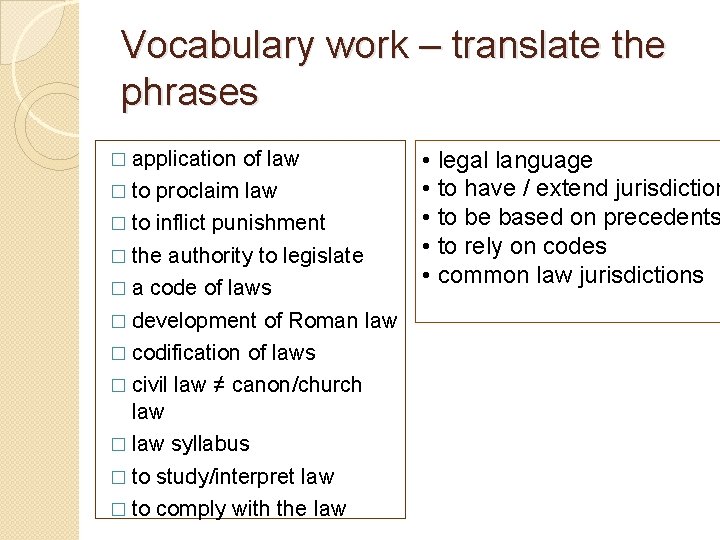
Vocabulary work – translate the phrases � application of law � to proclaim law � to inflict punishment � the authority to legislate � a code of laws � development of Roman law � codification of laws � civil law ≠ canon/church law � law syllabus � to study/interpret law � to comply with the law • legal language • to have / extend jurisdiction • to be based on precedents • to rely on codes • common law jurisdictions
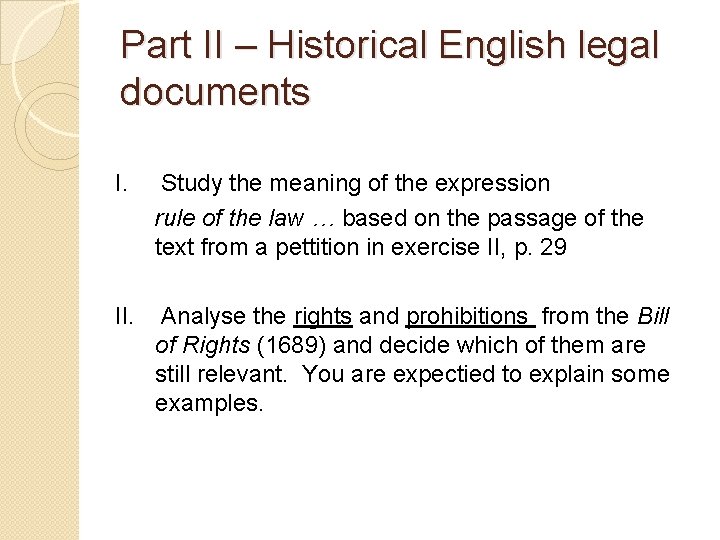
Part II – Historical English legal documents I. Study the meaning of the expression rule of the law … based on the passage of the text from a pettition in exercise II, p. 29 II. Analyse the rights and prohibitions from the Bill of Rights (1689) and decide which of them are still relevant. You are expectied to explain some examples.