
Unit 4 The Hierarchical Model q 4 1

- Slides: 14
Unit 4 The Hierarchical Model q 4. 1 The Hierarchical Model q 4. 2 IMS
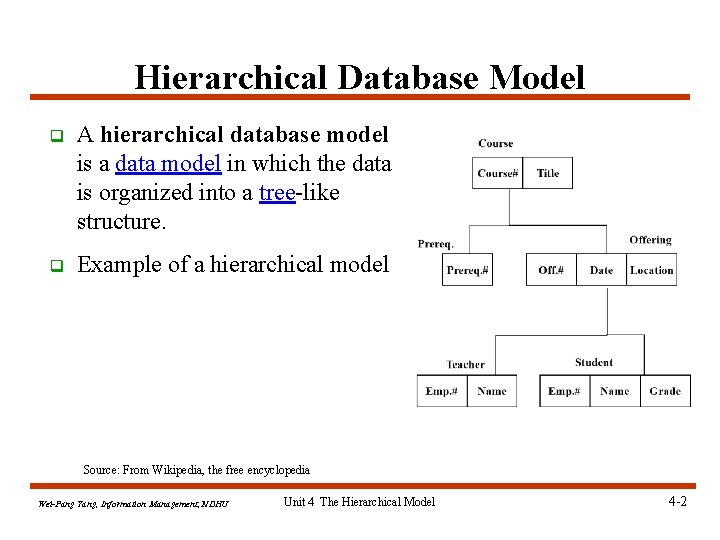
Hierarchical Database Model q A hierarchical database model is a data model in which the data is organized into a tree-like structure. q Example of a hierarchical model Source: From Wikipedia, the free encyclopedia Wei-Pang Yang, Information Management, NDHU Unit 4 The Hierarchical Model 4 -2
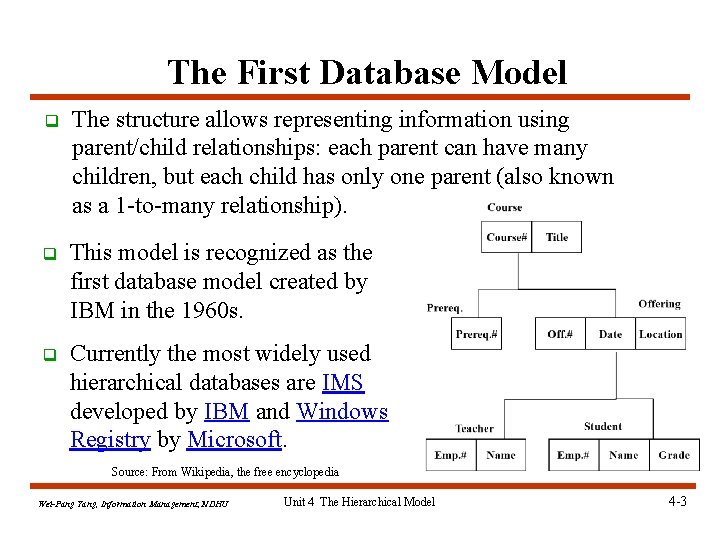
The First Database Model q The structure allows representing information using parent/child relationships: each parent can have many children, but each child has only one parent (also known as a 1 -to-many relationship). q This model is recognized as the first database model created by IBM in the 1960 s. q Currently the most widely used hierarchical databases are IMS developed by IBM and Windows Registry by Microsoft. Source: From Wikipedia, the free encyclopedia Wei-Pang Yang, Information Management, NDHU Unit 4 The Hierarchical Model 4 -3
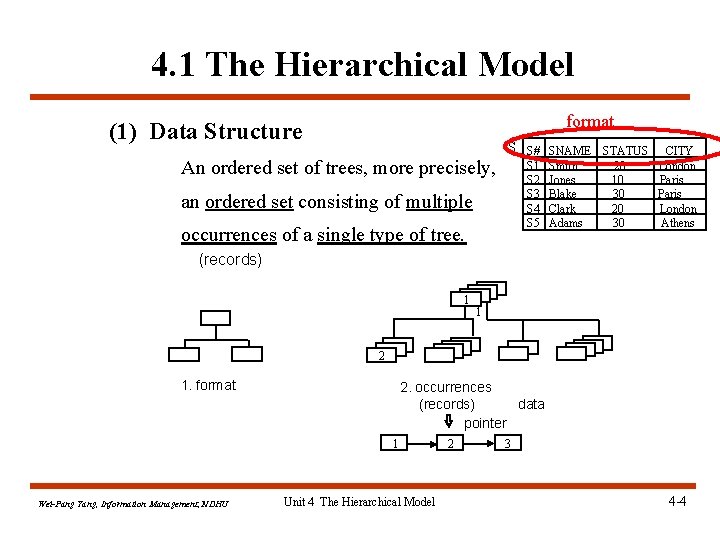
4. 1 The Hierarchical Model format (1) Data Structure An ordered set of trees, more precisely, S S# SNAME STATUS S 1 S 2 S 3 S 4 S 5 an ordered set consisting of multiple occurrences of a single type of tree. Smith Jones Blake Clark Adams 20 10 30 20 30 CITY London Paris London Athens (records) 1 2 3 1. format 5 4 2. occurrences (records) data pointer 1 Wei-Pang Yang, Information Management, NDHU 1 Unit 4 The Hierarchical Model 2 3 4 -4
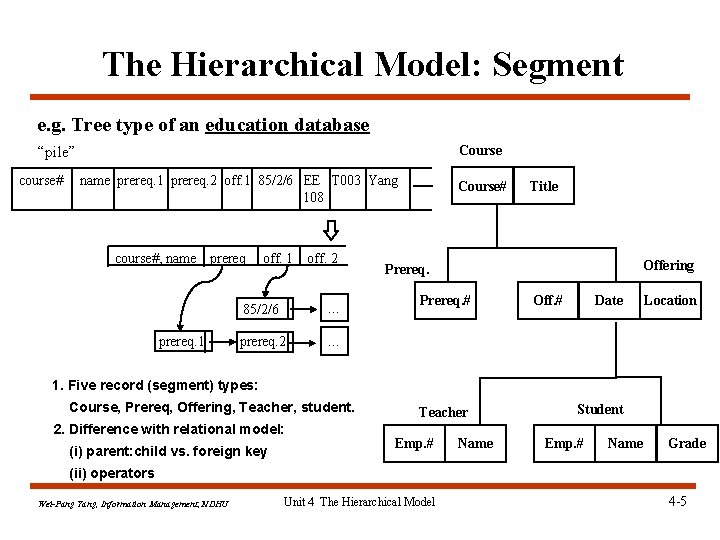
The Hierarchical Model: Segment e. g. Tree type of an education database Course “pile” course# name prereq. 1 prereq. 2 off. 1 85/2/6 EE T 003 Yang 108 course#, name prereq. 1 off. 2 85/2/6 . . . prereq. 2 . . . Course# Title Offering Prereq. # Off. # Date Location 1. Five record (segment) types: Course, Prereq, Offering, Teacher, student. 2. Difference with relational model: (i) parent: child vs. foreign key Teacher Emp. # Name Student Emp. # Name Grade (ii) operators Wei-Pang Yang, Information Management, NDHU Unit 4 The Hierarchical Model 4 -5
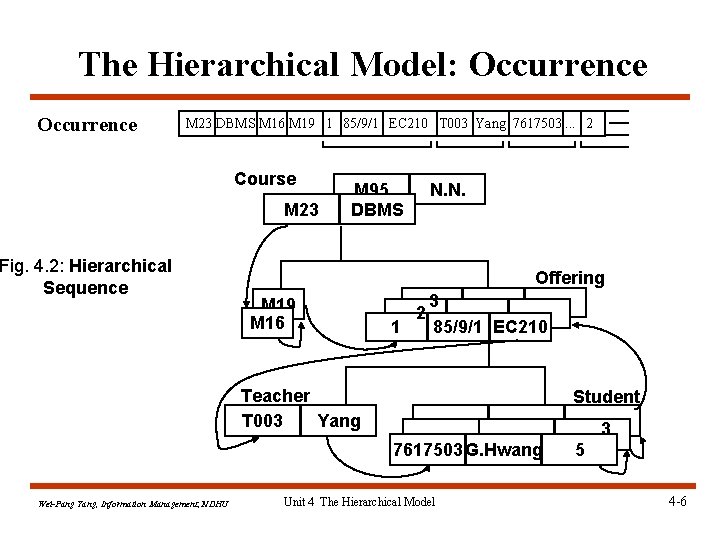
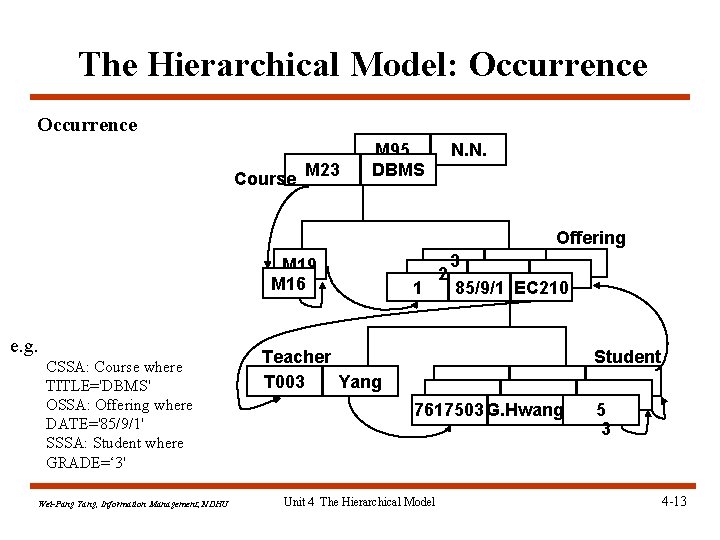
The Hierarchical Model: Occurrence M 23 DBMS M 16 M 19 1 85/9/1 EC 210 T 003 Yang 7617503. . . 2 Course M 23 Fig. 4. 2: Hierarchical Sequence M 95 DBMS N. N. Offering M 19 M 16 1 2 3 85/9/1 EC 210 Teacher T 003 Yang Student 3 7617503 G. Hwang Wei-Pang Yang, Information Management, NDHU Unit 4 The Hierarchical Model 5 4 -6
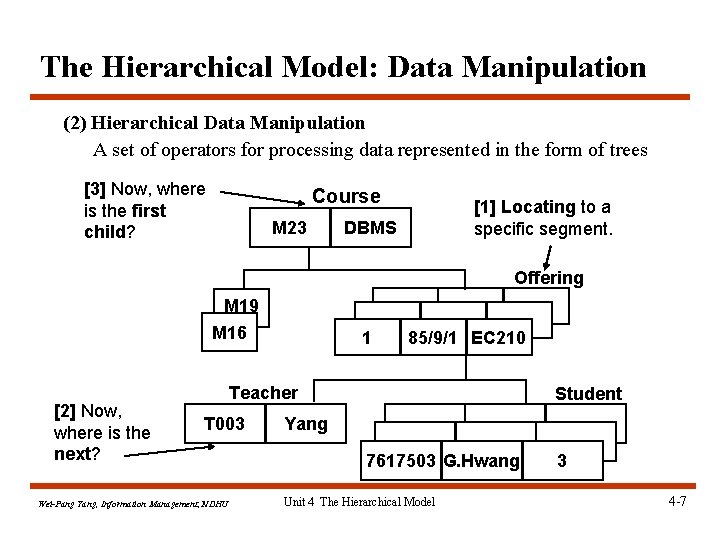
The Hierarchical Model: Data Manipulation (2) Hierarchical Data Manipulation A set of operators for processing data represented in the form of trees [3] Now, where is the first child? Course M 23 [1] Locating to a specific segment. DBMS Offering M 19 M 16 [2] Now, where is the next? 1 85/9/1 EC 210 Teacher T 003 Wei-Pang Yang, Information Management, NDHU Student Yang 7617503 G. Hwang Unit 4 The Hierarchical Model 3 4 -7
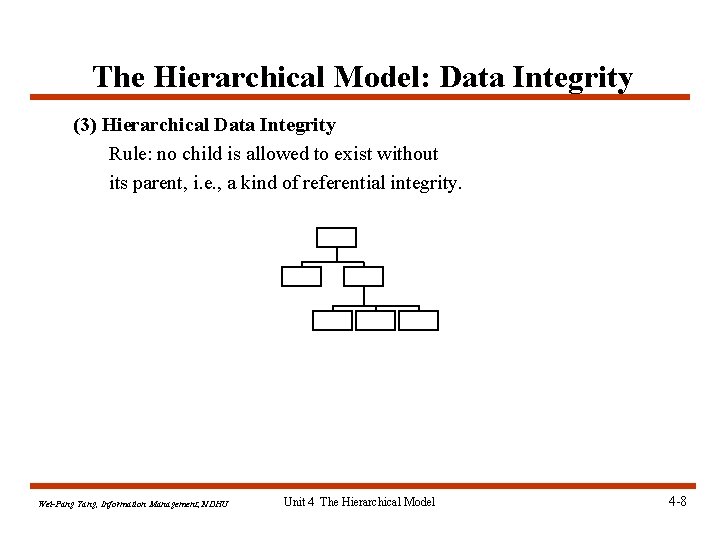
The Hierarchical Model: Data Integrity (3) Hierarchical Data Integrity Rule: no child is allowed to exist without its parent, i. e. , a kind of referential integrity. Wei-Pang Yang, Information Management, NDHU Unit 4 The Hierarchical Model 4 -8
4. 2 IMS § Overview • • IMS (Information Management System) An IBM product One of the first DBMS to be commercially Available in 1968 Wei-Pang Yang, Information Management, NDHU Unit 4 The Hierarchical Model 4 -9
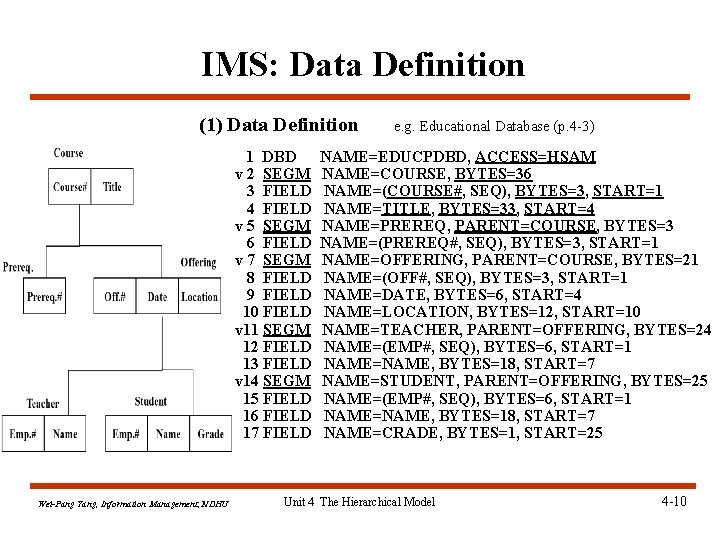
IMS: Data Definition (1) Data Definition 1 DBD v 2 SEGM 3 FIELD 4 FIELD v 5 SEGM 6 FIELD v 7 SEGM 8 FIELD 9 FIELD 10 FIELD v 11 SEGM 12 FIELD 13 FIELD v 14 SEGM 15 FIELD 16 FIELD 17 FIELD Wei-Pang Yang, Information Management, NDHU e. g. Educational Database (p. 4 -3) NAME=EDUCPDBD, ACCESS=HSAM NAME=COURSE, BYTES=36 NAME=(COURSE#, SEQ), BYTES=3, START=1 NAME=TITLE, BYTES=33, START=4 NAME=PREREQ, PARENT=COURSE, BYTES=3 NAME=(PREREQ#, SEQ), BYTES=3, START=1 NAME=OFFERING, PARENT=COURSE, BYTES=21 NAME=(OFF#, SEQ), BYTES=3, START=1 NAME=DATE, BYTES=6, START=4 NAME=LOCATION, BYTES=12, START=10 NAME=TEACHER, PARENT=OFFERING, BYTES=24 NAME=(EMP#, SEQ), BYTES=6, START=1 NAME=NAME, BYTES=18, START=7 NAME=STUDENT, PARENT=OFFERING, BYTES=25 NAME=(EMP#, SEQ), BYTES=6, START=1 NAME=NAME, BYTES=18, START=7 NAME=CRADE, BYTES=1, START=25 Unit 4 The Hierarchical Model 4 -10
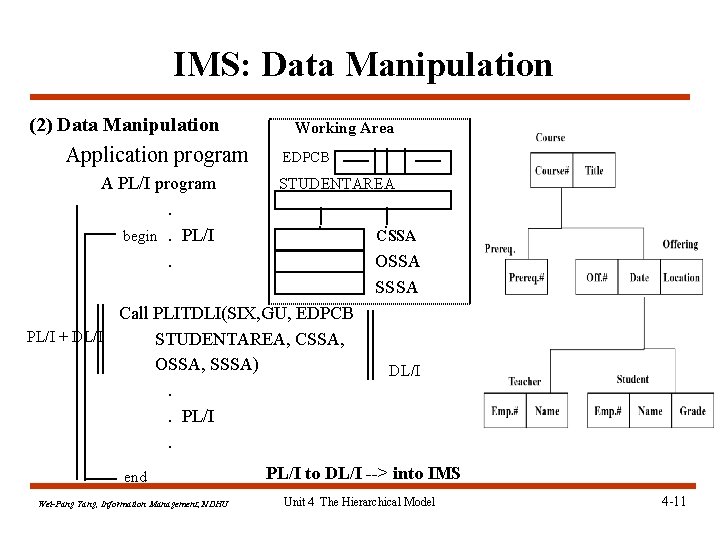
IMS: Data Manipulation (2) Data Manipulation Application program A PL/I program. begin. PL/I. Working Area EDPCB STUDENTAREA CSSA OSSA SSSA Call PLITDLI(SIX, GU, EDPCB PL/I + DL/I STUDENTAREA, CSSA, OSSA, SSSA). . PL/I. end Wei-Pang Yang, Information Management, NDHU DL/I PL/I to DL/I --> into IMS Unit 4 The Hierarchical Model 4 -11
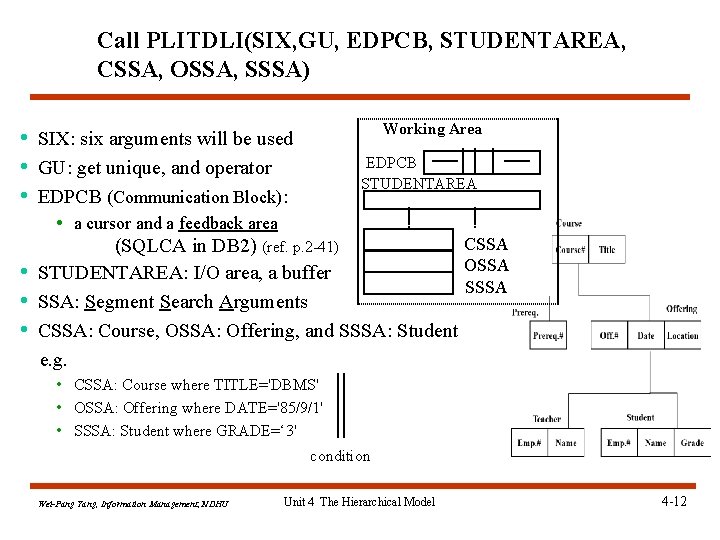
Call PLITDLI(SIX, GU, EDPCB, STUDENTAREA, CSSA, OSSA, SSSA) Working Area • SIX: six arguments will be used • GU: get unique, and operator • EDPCB (Communication Block): • • • EDPCB STUDENTAREA • a cursor and a feedback area CSSA (SQLCA in DB 2) (ref. p. 2 -41) OSSA STUDENTAREA: I/O area, a buffer SSSA SSA: Segment Search Arguments CSSA: Course, OSSA: Offering, and SSSA: Student e. g. • CSSA: Course where TITLE='DBMS' • OSSA: Offering where DATE='85/9/1' • SSSA: Student where GRADE=‘ 3' condition Wei-Pang Yang, Information Management, NDHU Unit 4 The Hierarchical Model 4 -12
The Hierarchical Model: Occurrence Course M 23 M 95 DBMS N. N. Offering M 19 M 16 e. g. CSSA: Course where TITLE='DBMS' OSSA: Offering where DATE='85/9/1' SSSA: Student where GRADE=‘ 3' Wei-Pang Yang, Information Management, NDHU 1 2 3 85/9/1 EC 210 Teacher T 003 Yang Student 7617503 G. Hwang Unit 4 The Hierarchical Model 5 3 4 -13
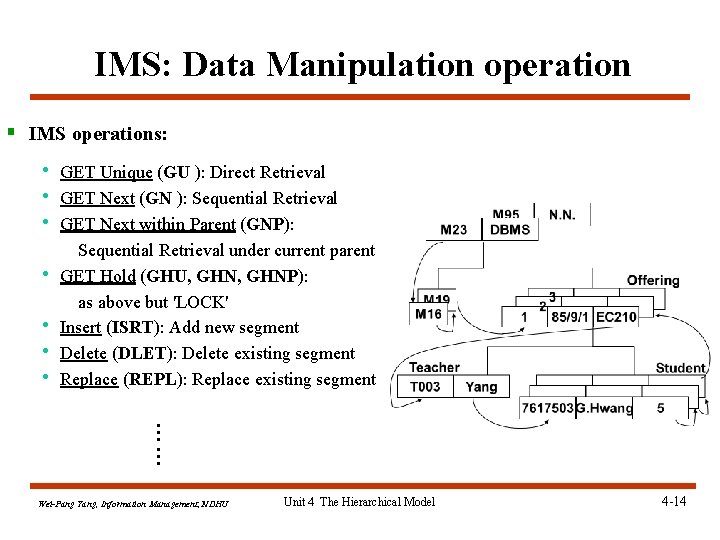
IMS: Data Manipulation operation § IMS operations: • GET Unique (GU ): Direct Retrieval • GET Next (GN ): Sequential Retrieval • GET Next within Parent (GNP): • • Sequential Retrieval under current parent GET Hold (GHU, GHNP): as above but 'LOCK' Insert (ISRT): Add new segment Delete (DLET): Delete existing segment Replace (REPL): Replace existing segment …… Wei-Pang Yang, Information Management, NDHU Unit 4 The Hierarchical Model 4 -14