
UNIT 4 SOLUTIONS AND SOLUBILITY Section 8 2
UNIT 4: SOLUTIONS AND SOLUBILITY
Section (8. 2 & 8. 3) CHARACTERISTICS OF SOLUTIONS & THE DISSOLVING PROCESS
What is a Solution? • Solutions are homogeneous mixtures of two or more pure substances. • Substances can be dissolved into one another, resulting is a uniform distribution
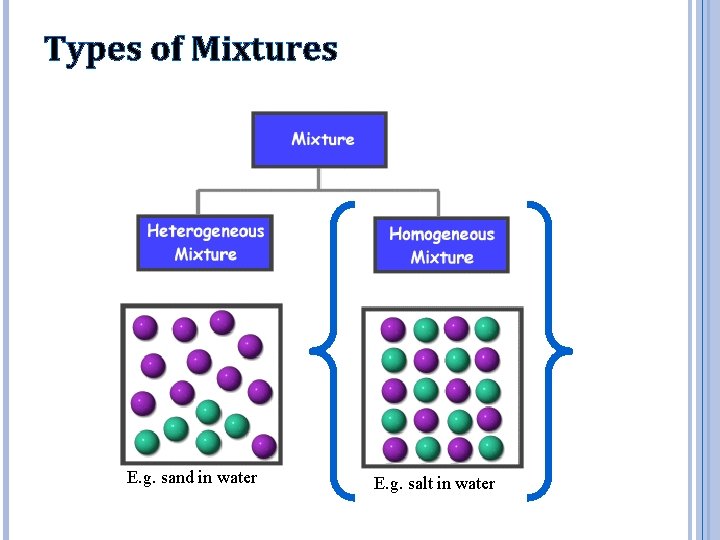
Types of Mixtures E. g. sand in water E. g. salt in water
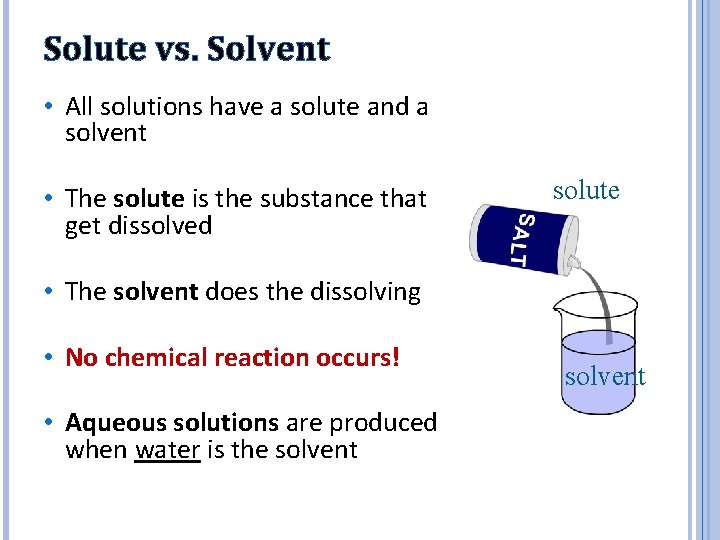
Solute vs. Solvent • All solutions have a solute and a solvent • The solute is the substance that get dissolved solute • The solvent does the dissolving • No chemical reaction occurs! • Aqueous solutions are produced when water is the solvent
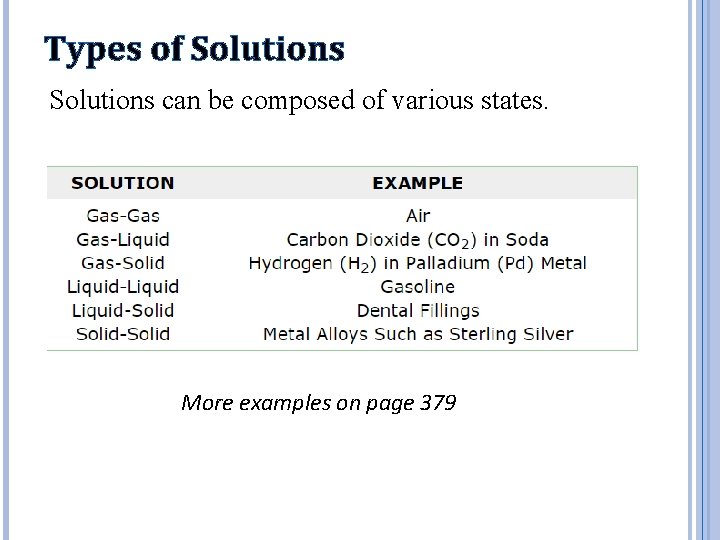
Types of Solutions can be composed of various states. More examples on page 379
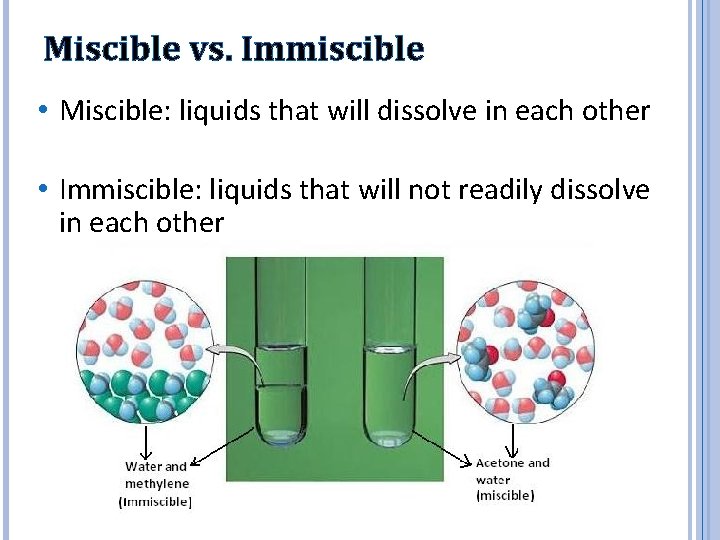
Miscible vs. Immiscible • Miscible: liquids that will dissolve in each other • Immiscible: liquids that will not readily dissolve in each other

Immiscible Mixtures
The Process of Dissolving At the molecular Level: Step 1: The forces between the particles in the solid (solute) must be broken. Step 2: Some of the intermolecular forces between the particles of the liquid (solvent) must be broken. Step 3: There is an attraction between the particles of the solute and the particles of the solvent. Step 4: Particles are rearranged to form a homogeneous solution
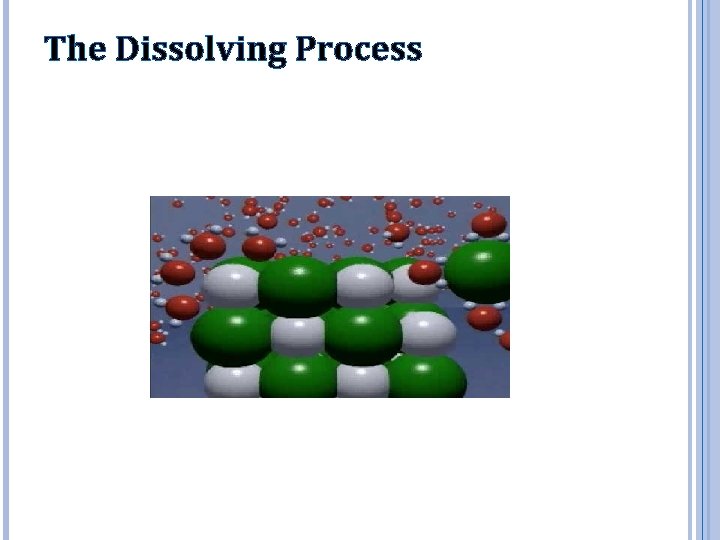
The Dissolving Process
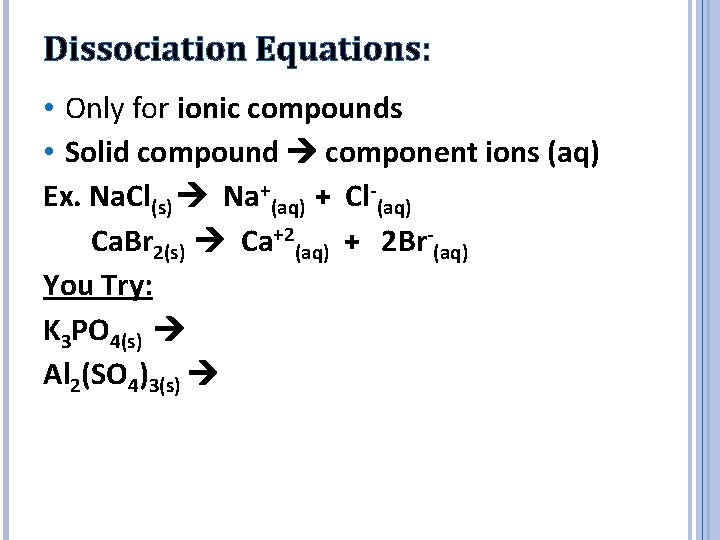
Dissociation Equations: • Only for ionic compounds • Solid compound component ions (aq) Ex. Na. Cl(s) Na+(aq) + Cl-(aq) Ca. Br 2(s) Ca+2(aq) + 2 Br-(aq) You Try: K 3 PO 4(s) Al 2(SO 4)3(s)
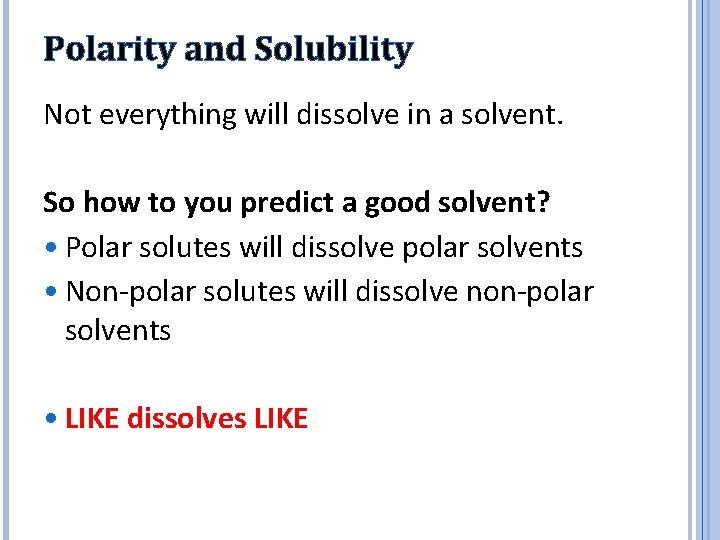
Polarity and Solubility Not everything will dissolve in a solvent. So how to you predict a good solvent? • Polar solutes will dissolve polar solvents • Non-polar solutes will dissolve non-polar solvents • LIKE dissolves LIKE
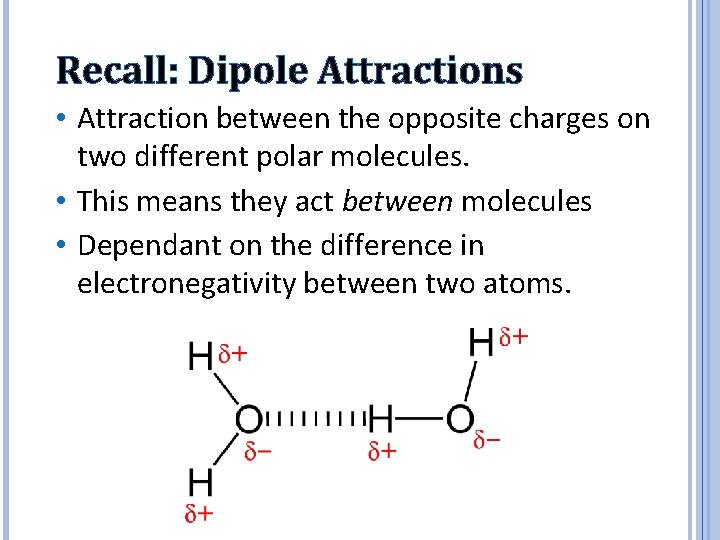
Recall: Dipole Attractions • Attraction between the opposite charges on two different polar molecules. • This means they act between molecules • Dependant on the difference in electronegativity between two atoms.
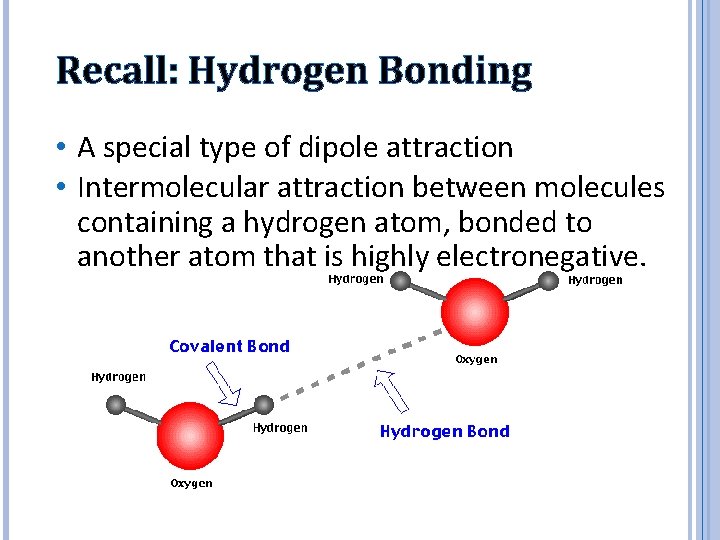
Recall: Hydrogen Bonding • A special type of dipole attraction • Intermolecular attraction between molecules containing a hydrogen atom, bonded to another atom that is highly electronegative.
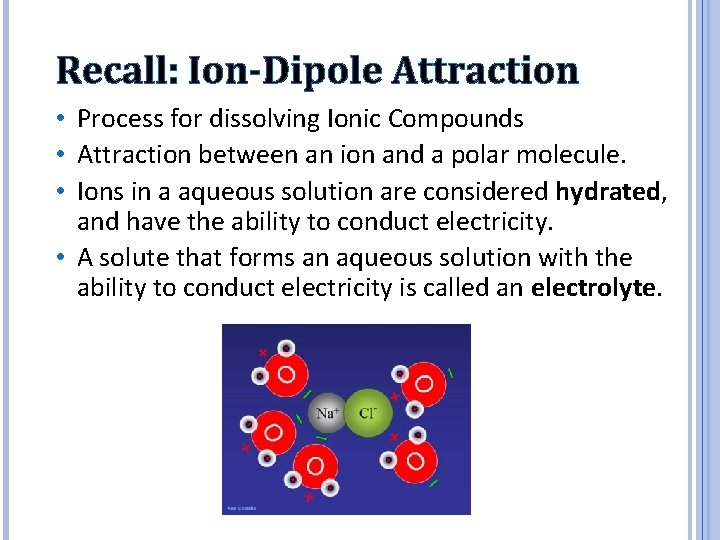
Recall: Ion-Dipole Attraction • Process for dissolving Ionic Compounds • Attraction between an ion and a polar molecule. • Ions in a aqueous solution are considered hydrated, and have the ability to conduct electricity. • A solute that forms an aqueous solution with the ability to conduct electricity is called an electrolyte.
Section (8. 5) Solubility & Saturation
Saturation of a Solution • A saturated solution is formed when no more solute will dissolve in a solution, and excess solute is present o It has the maximum amount of solute it can hold • An unsaturated solution is a solution that is not yet saturated. It can still dissolve more solute
Solubility is defined as: The amount of solute that dissolves in a given quantity of solvent, at a certain temperature, to form a saturated solution o Usually stated in grams of solute per 100 g of water at a given temperature. o E. g. the solubility of sodium chloride in water at 20°C is 36 g per 100 m. L of water Insoluble if solubility < 0. 1 g per 100 m. L solvent
Solubility Recall, solubility defined as: The amount of solute that dissolves in a given volume of solvent, at a specific temperature, to form a saturated solution. For most solids: as T increases, solubility increases For most gases: as T increases, solubility decreases as P decreases, solubility decreases
Factors that Affect Rate of Dissolving 1. Particle size: Finely divided substances have more surface area and dissolve more rapidly 2. Motion: Stirring or shaking brings more solvent in contact with more solute particles, increasing solubility 3. Temperature: The solubility of most solids increases with temperature. The solubility of gases decreases with temperature.
Summary of Factors that Affect Solubility 1. The polarity of the substances: LIKE dissolves LIKE 2. The nature of the substances: Intermolecular bonds 3. The temperature: Some substances only dissolve above certain temperatures 4. The pressure: Some substances only dissolve under pressure
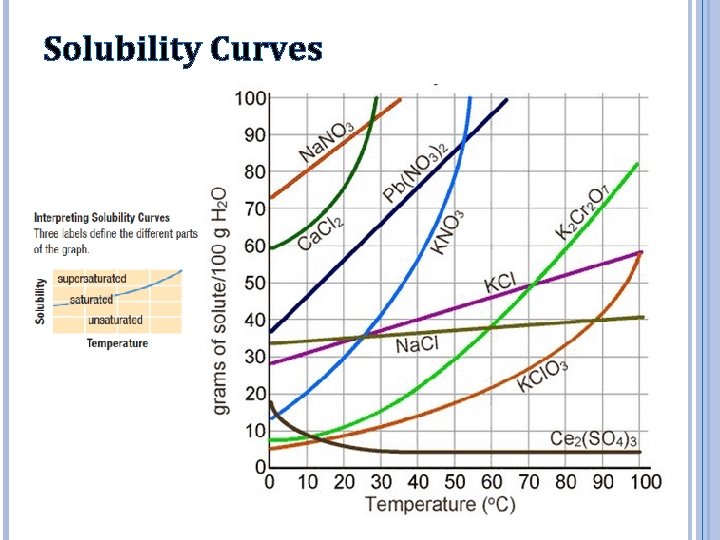
Solubility Curves
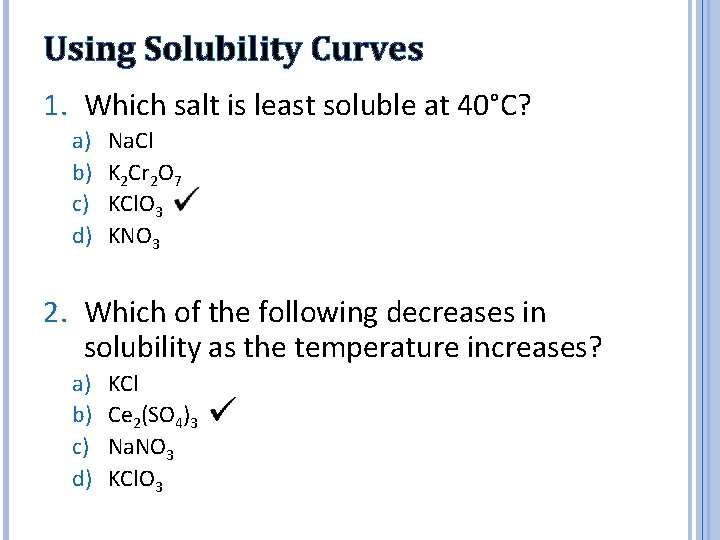
Using Solubility Curves 1. Which salt is least soluble at 40°C? a) b) c) d) Na. Cl K 2 Cr 2 O 7 KCl. O 3 KNO 3 2. Which of the following decreases in solubility as the temperature increases? a) b) c) d) KCl Ce 2(SO 4)3 Na. NO 3 KCl. O 3
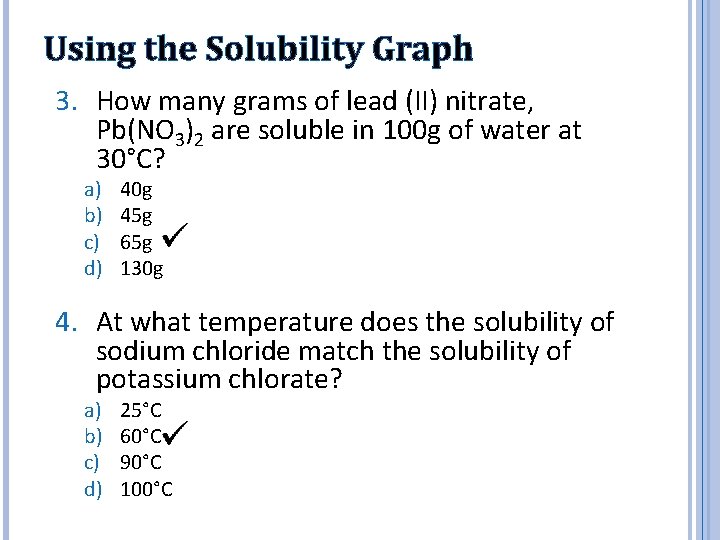
Using the Solubility Graph 3. How many grams of lead (II) nitrate, Pb(NO 3)2 are soluble in 100 g of water at 30°C? a) b) c) d) 40 g 45 g 65 g 130 g 4. At what temperature does the solubility of sodium chloride match the solubility of potassium chlorate? a) b) c) d) 25°C 60°C 90°C 100°C
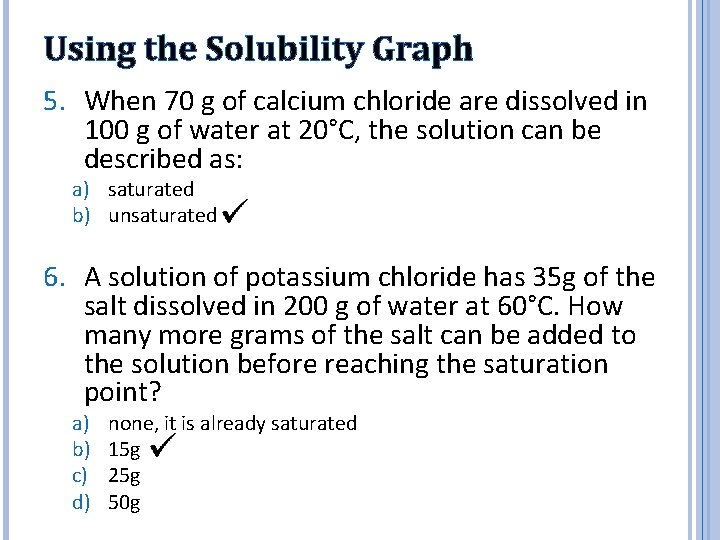
Using the Solubility Graph 5. When 70 g of calcium chloride are dissolved in 100 g of water at 20°C, the solution can be described as: a) saturated b) unsaturated 6. A solution of potassium chloride has 35 g of the salt dissolved in 200 g of water at 60°C. How many more grams of the salt can be added to the solution before reaching the saturation point? a) b) c) d) none, it is already saturated 15 g 25 g 50 g
- Slides: 25