
Unit 4 sensation and Perception Created By Blaze
Unit 4: sensation and Perception Created By: Blaze S. & Monica R
Basic principles (Duh…. ) Selective Attention Talking on the phone while driving (shift back and forth) Vehicle Crashes Cocktail Party Effect Thresholds Absolute Threshold Difference Threshold Subliminal Stimulation
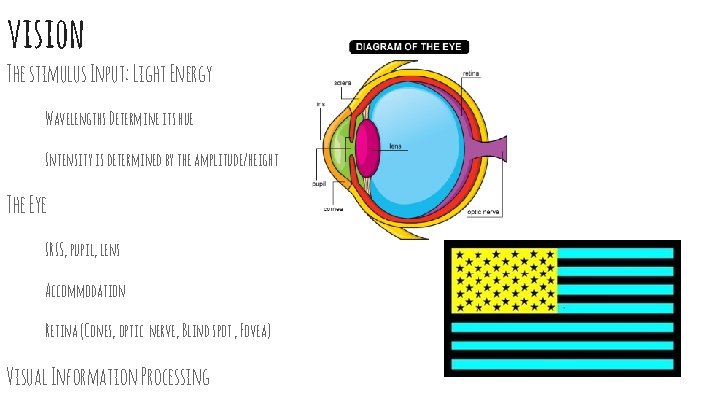
vision The stimulus Input: Light Energy Wavelengths Determine its hue Intensity is determined by the amplitude/height The Eye IRIS, pupil, lens Accommodation Retina (Cones, optic nerve, Blind spot , Fovea) Visual Information Processing
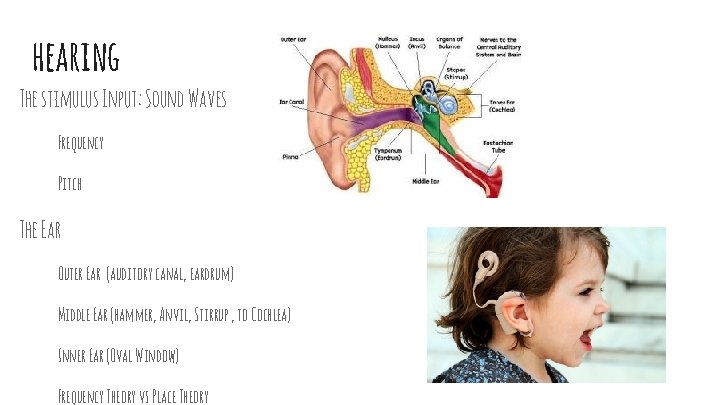
hearing The stimulus Input: Sound Waves Frequency Pitch The Ear Outer Ear (auditory canal, eardrum) Middle Ear (hammer, Anvil, Stirrup , to Cochlea) Inner Ear (Oval Window) Frequency Theory vs Place Theory
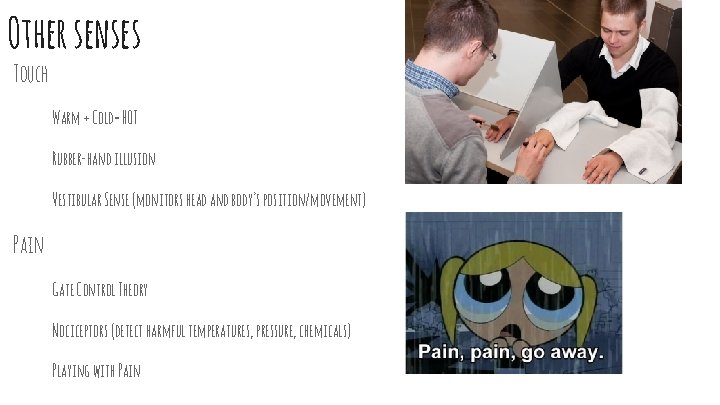
Other senses Touch Warm + Cold= HOT Rubber-hand illusion Vestibular Sense (monitors head and body’s position/movement) Pain Gate Control Theory Nociceptors (detect harmful temperatures, pressure, chemicals) Playing with Pain
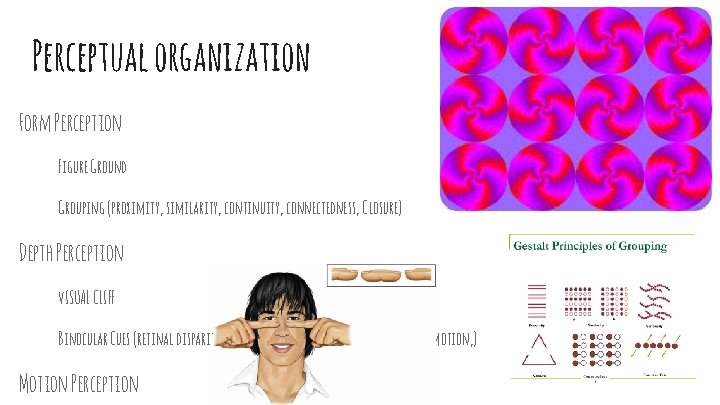
Perceptual organization Form Perception Figure Ground Grouping (proximity, similarity, continuity, connectedness, Closure) Depth Perception v. ISUAL CLIFF Binocular Cues (retinal disparity) vs monocular Cues (height, light/shadow, motion, ) Motion Perception
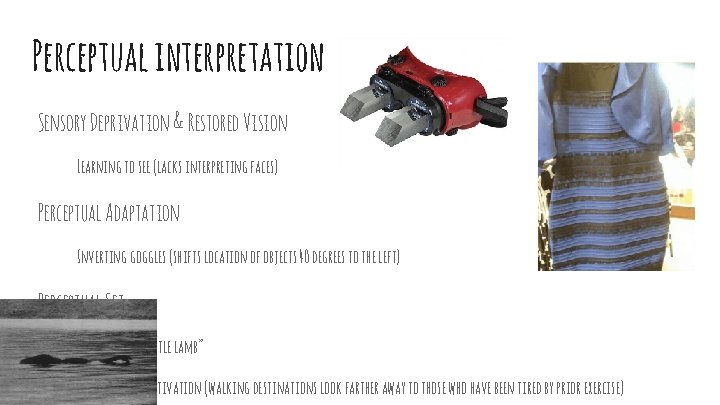
Perceptual interpretation Sensory Deprivation & Restored Vision Learning to see (lacks interpreting faces) Perceptual Adaptation Inverting goggles (shifts location of objects 40 degrees to the left) Perceptual Set “Mary had a a little lamb” Emotion and Motivation (walking destinations look farther away to those who have been tired by prior exercise)
Extrasensory perception Claims of ESP Telepathy (mind-to-mind communication) Clairvoyance (sensing friend’s house is on fire) Precognition (perceiving future events) Premonitions or Pretensions? Can psychics see into the future? Putting ESP to Experimental Test
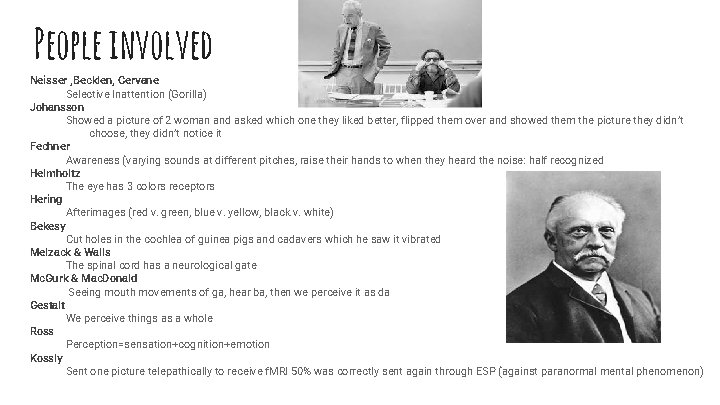
People involved Neisser , Becklen, Cervane Selective Inattention (Gorilla) Johansson Showed a picture of 2 woman and asked which one they liked better, flipped them over and showed them the picture they didn’t choose, they didn’t notice it Fechner Awareness (varying sounds at different pitches, raise their hands to when they heard the noise: half recognized Helmholtz The eye has 3 colors receptors Hering Afterimages (red v. green, blue v. yellow, black v. white) Bekesy Cut holes in the cochlea of guinea pigs and cadavers which he saw it vibrated Melzack & Walls The spinal cord has a neurological gate Mc. Gurk & Mac. Donald Seeing mouth movements of ga, hear ba, then we perceive it as da Gestalt We perceive things as a whole Ross Perception=sensation+cognition+emotion Kossly Sent one picture telepathically to receive f. MRI 50% was correctly sent again through ESP (against paranormal mental phenomenon)
Vocab ❖ ❖ ❖ Sensation-sensory receptors atha receives stimuli from environment Perception-organizing and interpreting meaningful objects Bottom-up processing-sensory receptors to higher levels of processing Top-down processing-sensations from bottom up processing, experience and expectations Selective Attention- focuses on a specific stimulus ~Selective Attention focuses like a flashlight beam. ❖ Inattentional Blindness-fails to see things when attention is somewhere else ❖ Change Blindness-fails to see changes ❖ Psychophysics-study of relationship between physical and psychological experience ❖ Absolute Threshold- minimum stimulation to detect stimuli (50%) ~You’re driving a bus with 12 passengers. At your first stop, 6 passengers get off. At the second stop 3 get off. At the third stop 2 more people get off. What color are the bus driver’s eyes? ❖ Signal Detection Theory-how and when we detect stimulus and background stimulus ~How you soon you answer to a text message ❖ Subliminal-below threshold ~Entrepreneurs offer recordings with ocean sounds, and unheard message such as “I will be skinny, or “Smoking tastes bad”. ❖ Priming-activates certain associations ❖ Difference Threshold- just noticeable difference ❖ Weber’s Law-differ by constant percentage ❖ Sensory Adaptation-diminished sensitivity by constant stimulation ~The feeling of socks on your feet ❖ Transduction-one form of energy to the other ❖ Wavelength-distance from one peak to the other ❖ Hue-color determined by the wavelength ❖ Intensity-amount of energy in wave determined by amplitude ❖ Pupil-light enters ❖ Iris-colored portion which controls the size of pupil opening ❖ Lens-accommodates images ❖ Accommodation- focuses on objects ❖ Rods-detects color such as black, white and gray ~Nocturnal animals such as bats, have retinas made only of rods (meaning they only see black and white. ❖ Cones-at the center of retina: works with light and detects details ❖ Optic Nerve-nerves that carry light from eye to brain ❖ Blind Spot-optic nerve leaves eye: no receptor cells ❖ Fovea-central focal point: contains cones ❖ Feature Detectors-responds to features: shape, angle and movement ❖ Parallel Processing-processes problems simultaneously ~Recognizing a person’s face. ❖ Young Helmholtz trichromatic-retina contains 3 colors, combined creates multiple colors ❖ Opponent process theory-red-green/white-black/blue-yellow ❖ Audition-hearing
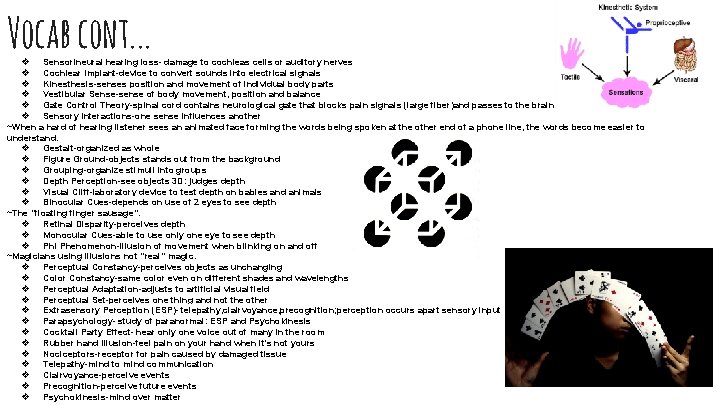
Vocab cont. . . ❖ ❖ ❖ Sensorineural hearing loss- damage to cochleas cells or auditory nerves Cochlear Implant-device to convert sounds into electrical signals Kinesthesis-senses position and movement of individual body parts Vestibular Sense-sense of body movement, position and balance Gate Control Theory-spinal cord contains neurological gate that blocks pain signals (large fiber)and passes to the brain Sensory Interactions-one sense influences another ~When a hard of hearing listener sees an animated face forming the words being spoken at the other end of a phone line, the words become easier to understand. ❖ Gestalt-organized as whole ❖ Figure Ground-objects stands out from the background ❖ Grouping-organize stimuli into groups ❖ Depth Perception-see objects 3 D: judges depth ❖ Visual Cliff-laboratory device to test depth on babies and animals ❖ Binocular Cues-depends on use of 2 eyes to see depth ~The “floating finger sausage”. ❖ Retinal Disparity-perceives depth ❖ Monocular Cues-able to use only one eye to see depth ❖ Phi Phenomenon-illusion of movement when blinking on and off ~Magicians using illusions not “real” magic. ❖ Perceptual Constancy-perceives objects as unchanging ❖ Color Constancy-same color even on different shades and wavelengths ❖ Perceptual Adaptation-adjusts to artificial visual field ❖ Perceptual Set-perceives one thing and not the other ❖ Extrasensory Perception (ESP)- telepathy, clairvoyance, precognition; perception occurs apart sensory input ❖ Parapsychology- study of paranormal: ESP and Psychokinesis ❖ Cocktail Party Effect- hear only one voice out of many in the room ❖ Rubber hand Illusion-feel pain on your hand when it's not yours ❖ Nociceptors-receptor for pain caused by damaged tissue ❖ Telepathy-mind to mind communication ❖ Clairvoyance-perceive events ❖ Precognition-perceive future events ❖ Psychokinesis-mind over matter
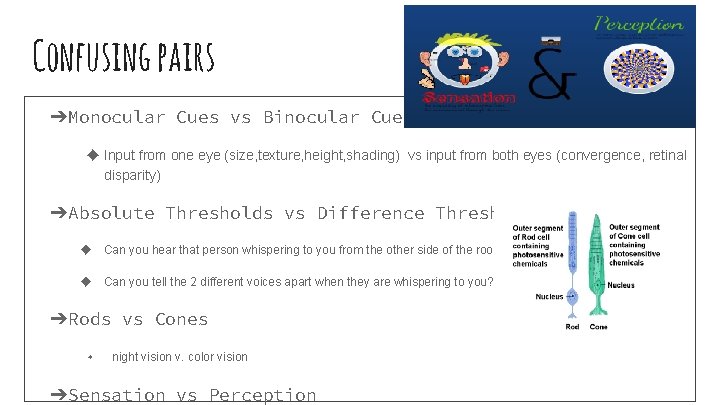
Confusing pairs ➔Monocular Cues vs Binocular Cues ◆ Input from one eye (size, texture, height, shading) vs input from both eyes (convergence, retinal disparity) ➔Absolute Thresholds vs Difference Thresholds ◆ Can you hear that person whispering to you from the other side of the room? ◆ Can you tell the 2 different voices apart when they are whispering to you? ➔Rods vs Cones ◆ night vision v. color vision ➔Sensation vs Perception
mnemonics 1. Feature Detectors: "Specialized nerve cells in the brain respond to specific features such as shapes, angles, and movement" SAM i am 2. Red/Green (Christmas) opponent colors in ganglion cells Blue/Gold (Comets) opponent colors in ganglion cells Black/White (Chess) colors in ganglion cells Penn Manor 3. GATE CONTROL THEORY OF PAIN (rhyme - "When your body's in a painful state, just stimulate to close the gate!") , 4. "Rude Babies Giggle Obnoxiously Throughout Oxford" (retina, bi-polar, ganglion, optic nerve, thalamus, occipital lobe) 5. TOP-DOWN (convertible with top down) - allows person to see BIG PICTURE/WHOLE - interpret, organize whole event 6. BOTTOM-UP (shut car) - only see smaller details 7. Phi Phenomenon (song- "Oh, Christmas "Phi" oh Christmas "Phi" - pronounced fee), 8. Acrostic - Four Purple Crazy Cows Can Count Seven Stars Figure ground - visual selective attention Proximity - group by how close together Closure - group by filling in the gaps Continuity - break down into smooth patterns Common Fate - group by objects that move together Connectedness - group by attachment Simplicity (Pragnanz) - break down complex objects into simple overlapping images Similarity - group by color, size, shape, etc.
quiz…. . YOU CAN DO IT!!! 1. 2. 3. 4. What vocab word explains why it’s difficult to do two things at once? a. Bottom up processing b. Selective Attention d. Perception Informational processing happens a. Automatic b. Unconsciously c. Consciously d. Planned The taste umami indicates what? a. Toxic/Poison c. Acidity b. Growth for muscles d. Proteins to grow & tissue repair Our inner ears enables our brains to monitor our bodies position expertly. a. 5. c. Priming True b. False What produces electrical signals in the ear? a. Cochlea c. Middle Ear
RIGHT…. . . ANSWERS 1. Selective Attention 2. Automatic 3. Proteins to grow & tissue repair 4. True 5. Hair cells 6. Hot 7. Yes
- Slides: 16