
Unit 4 Section 1 Notes What is Matter



- Slides: 19
Unit 4 Section 1 Notes What is Matter?
Chemistry l Chemistry: The study of matter and how it changes l Examples of how we use chemistry everyday: ¡ Cell phones ¡ soap ¡ food ¡ clothes
Matter l Matter: anything that has mass and takes up space l Examples of matter: ¡ people ¡ rocks ¡ air l The following are NOT matter because: they have no mass & don’t take up space ¡ light ¡ sound ¡ electricity ¡ time
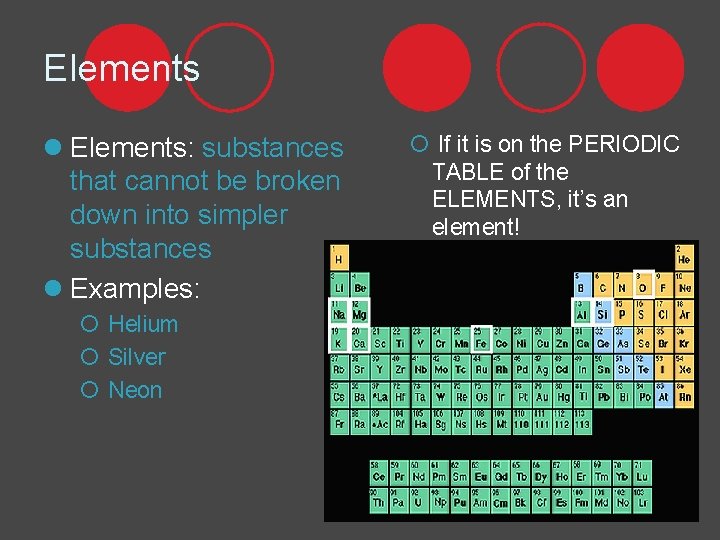
Elements l Elements: substances that cannot be broken down into simpler substances l Examples: ¡ Helium ¡ Silver ¡ Neon ¡ If it is on the PERIODIC TABLE of the ELEMENTS, it’s an element!
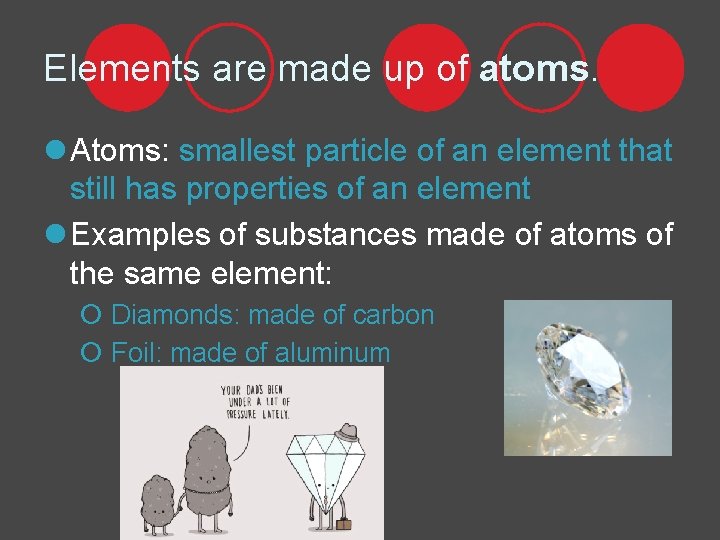
Elements are made up of atoms. l Atoms: smallest particle of an element that still has properties of an element l Examples of substances made of atoms of the same element: ¡ Diamonds: made of carbon ¡ Foil: made of aluminum
Elements on the Periodic Table: l In 1760, there were only 16 known elements because scientists at the time weren’t clear of the nature of gases. Each element has its own symbol, made up on one or two letters. If there are 2 letters, the first one is ALWAYS capital and the second is ALWAYS lowercase. The current standard table contains 118 confirmed elements. Each element behaves differently & uniquely from each other.
Examples: l Hydrogen: H l Carbon: C l Oxygen: O l Sodium: Na l Gold: Au
Compounds l Compounds: substances made of atoms of more than 1 element joined together. l Examples: l Sugar: C 12 H 22 O 11: Made of the elements carbon, hydrogen, and oxygen. l Human Body: contains oxygen, nitrogen, sulfur, phosphorus, hydrogen, etc. (Most of the elements exist as compounds instead of as free elements floating in the body. )
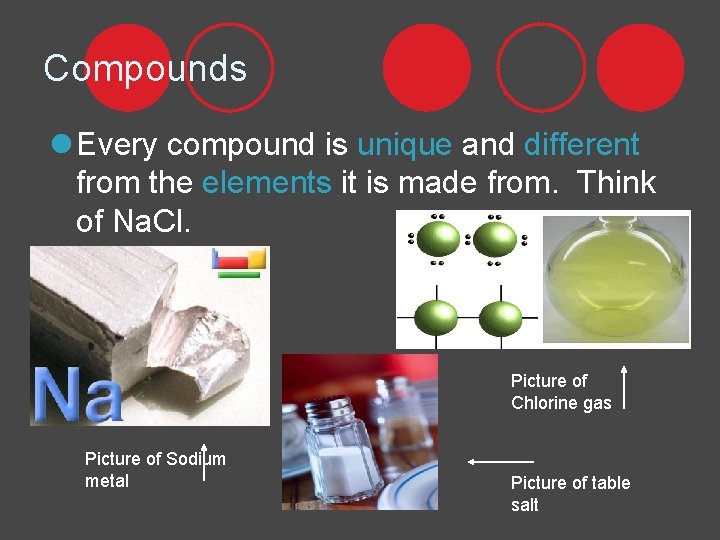
Compounds l Every compound is unique and different from the elements it is made from. Think of Na. Cl. Picture of Chlorine gas Picture of Sodium metal Picture of table salt
Video of Sodium in Water l https: //www. youtube. com/watch? v=NTFB XJ 3 Zd_4 l https: //www. youtube. com/watch? v=RAFc. Z o 8 d. Tc. U l https: //www. youtube. com/watch? v=MTcgo 46 nx. NE
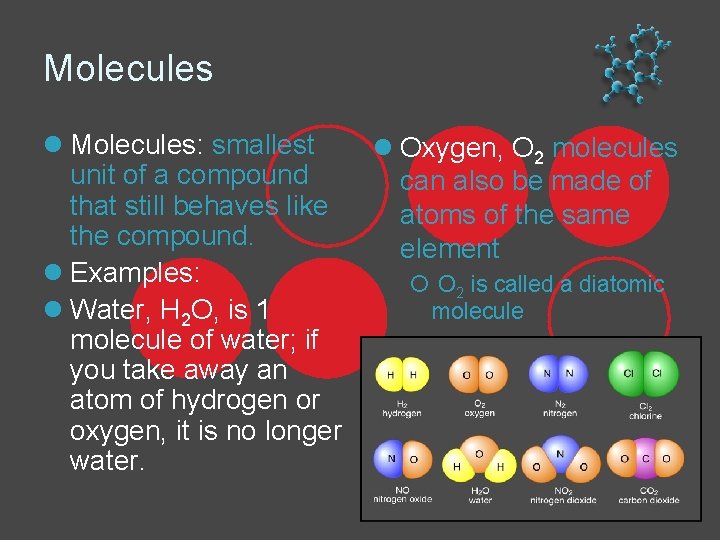
Molecules l Molecules: smallest unit of a compound that still behaves like the compound. l Examples: l Water, H 2 O, is 1 molecule of water; if you take away an atom of hydrogen or oxygen, it is no longer water. l Oxygen, O 2 molecules can also be made of atoms of the same element ¡ O 2 is called a diatomic molecule
Chemical Formula l Chemical Formula: the chemical symbols and numbers indicating the atoms contained in the basic unit of a substance.
Subscripts l Subscripts: tells the number of atoms of each element in a compound. l Examples: l H 2 O water, contains 2 hydrogen atoms and 1 oxygen atom l CO 2 carbon dioxide, contains 1 carbon atoms and 2 oxygen atoms l C 3 H 8 O rubbing alcohol, contains 3 carbon atoms, 8 hydrogen atoms, and 1 oxygen atom. l 3 CO 2: the number in front is called a coefficient and tells how many molecules there are of that compound.
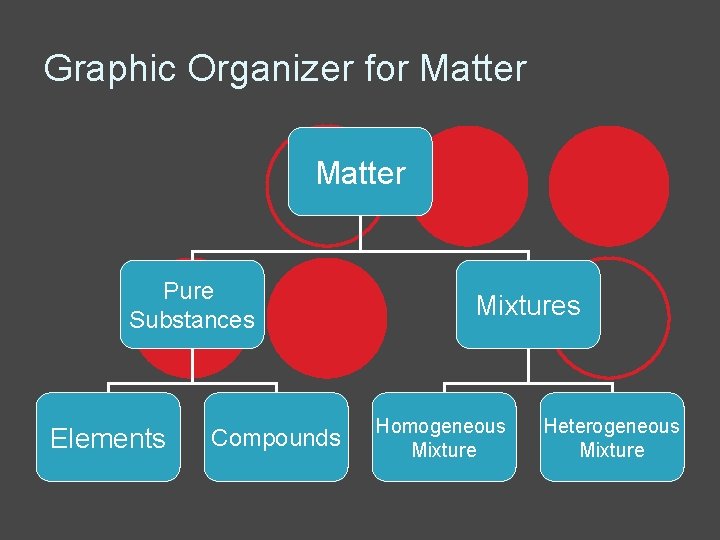
Pure Substances l Pure substance: any matter that has a fixed composition and definite properties l There are 2 types of pure substances: 1. Elements 2. Compounds
Pure Substances l Examples of pure substances: ¡ Carbon – element ¡ Methane, CH 4 – compound ¡ Silver – element ¡ Neon – element ¡ Carbon dioxide, CO 2 – compound ¡ Water, H 2 O - compound
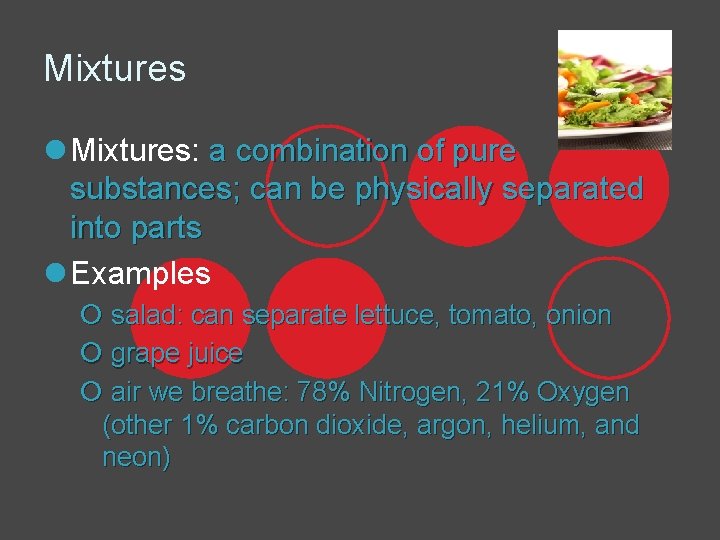
Mixtures l Mixtures: a combination of pure substances; can be physically separated into parts l Examples ¡ salad: can separate lettuce, tomato, onion ¡ grape juice ¡ air we breathe: 78% Nitrogen, 21% Oxygen (other 1% carbon dioxide, argon, helium, and neon)
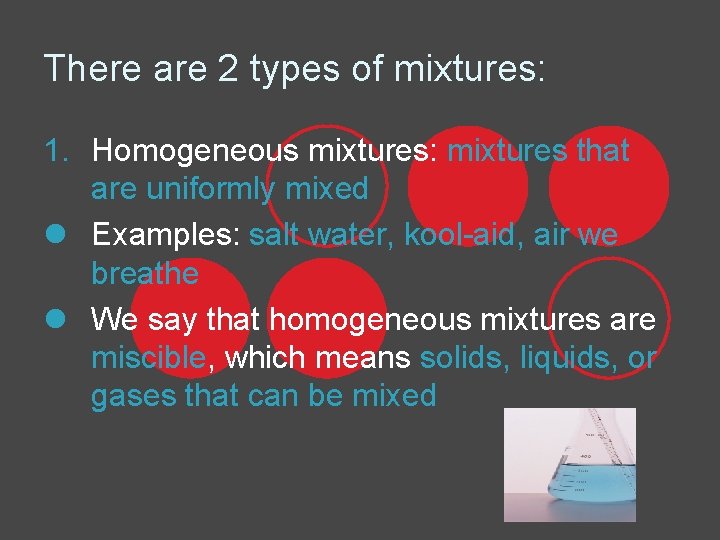
There are 2 types of mixtures: 1. Homogeneous mixtures: mixtures that are uniformly mixed l Examples: salt water, kool-aid, air we breathe l We say that homogeneous mixtures are miscible, which means solids, liquids, or gases that can be mixed
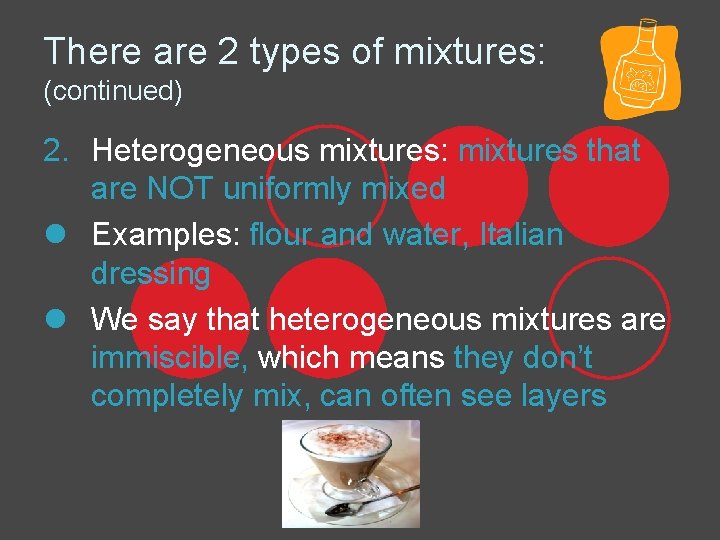
There are 2 types of mixtures: (continued) 2. Heterogeneous mixtures: mixtures that are NOT uniformly mixed l Examples: flour and water, Italian dressing l We say that heterogeneous mixtures are immiscible, which means they don’t completely mix, can often see layers
Graphic Organizer for Matter Pure Substances Elements Compounds Mixtures Homogeneous Mixture Heterogeneous Mixture