
UNIT 4 POLITICAL ORGANIZATION OF SPACE Session 1
- Slides: 41
UNIT 4: POLITICAL ORGANIZATION OF SPACE Session 1 Advanced Placement Human Geography
ADVANCED PLACEMENT HUMAN GEOGRAPHY REVIEW SESSIONS: UNIT FOUR By Geri Flanary To accompany AP Human Geography: A Study Guide 3 rd edition By Ethel Wood
POLITICAL GEOGRAPHY Political geography is the study of the political organization of the planet, a constantly changing collage of countries that once were kingdoms or parts of empires, or perhaps scatterings of independent tribes.
POLITICAL GEOGRAPHY One thing to remember: § Almost from the beginning of history, humans have divided their living space into political units or territories.
TERRITORIAL DIMENSIONS OF POLITICS
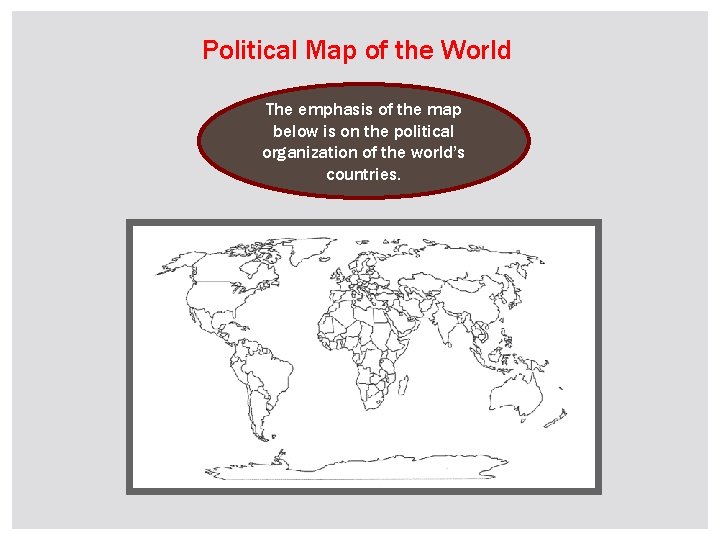
Political Map of the World The emphasis of the map below is on the political organization of the world’s countries.
POLITICAL ORGANIZATION OF THE WORLD MAP The modern state system reflected on the world map is the product of a political-territory order with European roots. At the core of the system are the concepts of: § territoriality § sovereignty § the “nation-state”
THE CONCEPT OF TERRITORIALITY What EXACTLY is politics? Politics is basically all about power. § Who has the power to make decisions? § How did they get the power? § What challenges do leaders face from others?
THE CONCEPT OF TERRITORIALITY What interests geographers? Geographers are interested in the politics of place—how land space is organized according to who asserts power over what areas.
THE CONCEPT OF TERRITORIALITY What is territoriality? It involves efforts to control pieces of the earth’s surface for political and social ends. The rules of territoriality reflect attitudes toward land territory as defined by the political culture of a place.
THE CONCEPT OF TERRITORIALITY Political culture is the collection of political beliefs, values, practices and institutions that serves as the basis of government.
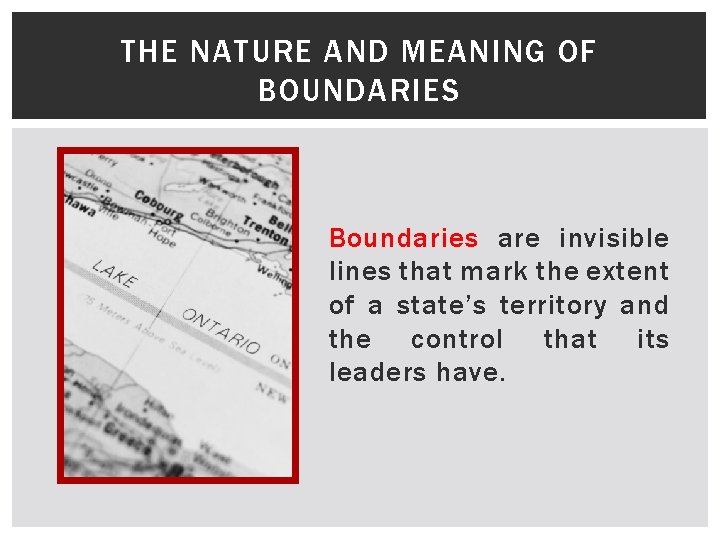
THE NATURE AND MEANING OF BOUNDARIES Boundaries are invisible lines that mark the extent of a state’s territory and the control that its leaders have.
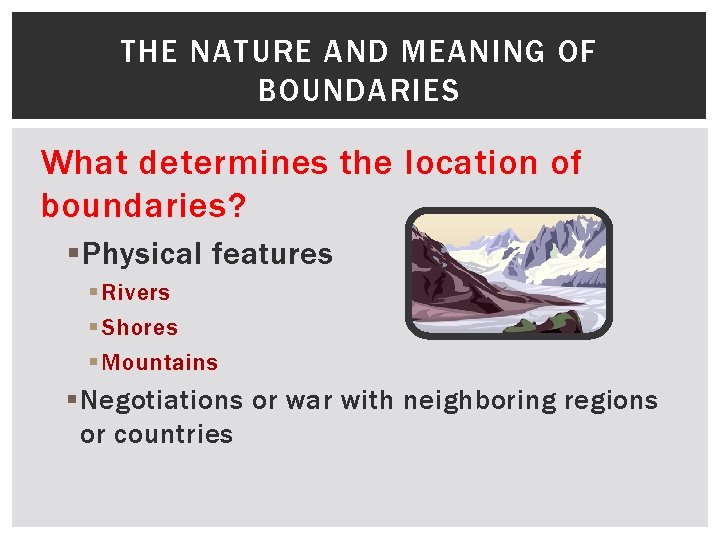
THE NATURE AND MEANING OF BOUNDARIES What determines the location of boundaries? § Physical features § Rivers § Shores § Mountains § Negotiations or war with neighboring regions or countries
THE NATURE AND MEANING OF BOUNDARIES Boundaries completely surround an individual state to mark its outer limits, giving it a distinctive shape.
THE NATURE AND MEANING OF BOUNDARIES Because boundary lines mark the place where two or more states come into direct contact, they have the potential to create conflict among them.
Historically, frontiers rather than boundaries separated states. A frontier is a geographic zone where no state exercises power. A boundary is a thin, imaginary line. ABOUT FRONTIERS… Frontiers
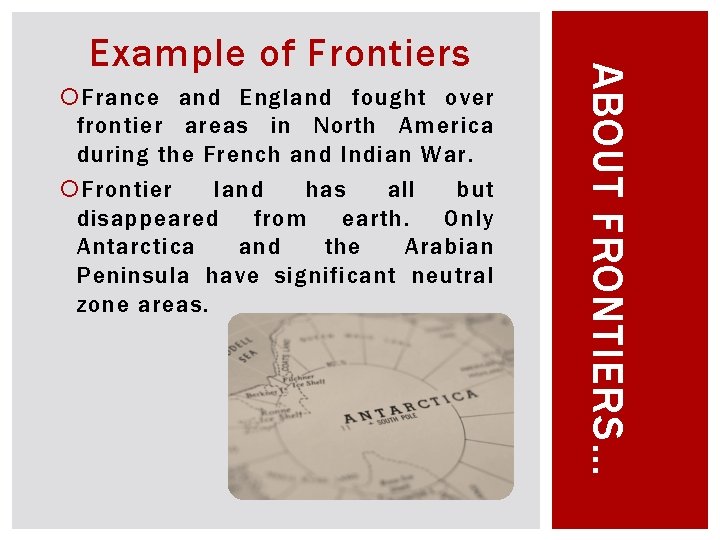
France and England fought over frontier areas in North America during the French and Indian War. Frontier land has all but disappeared from earth. Only Antarctica and the Arabian Peninsula have significant neutral zone areas. ABOUT FRONTIERS… Example of Frontiers
Physical Boundaries TYPES OF BOUNDARIES Physical features are easy to see so they often make good boundaries. However, they are not always permanent or reliable.
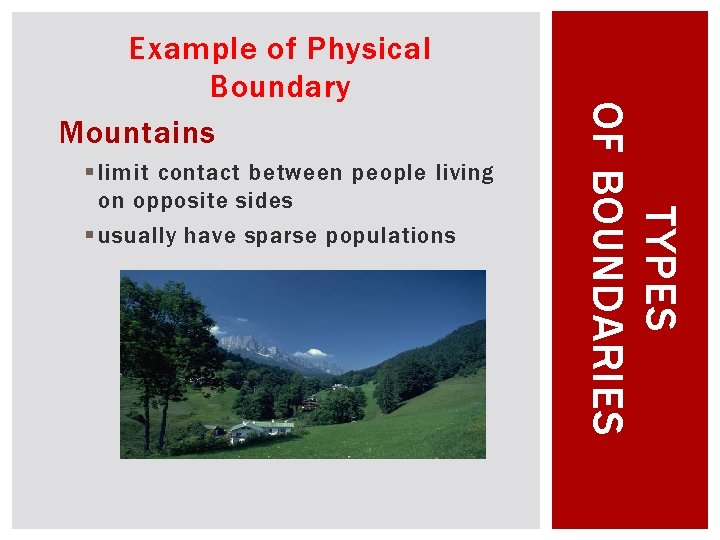
§ limit contact between people living on opposite sides § usually have sparse populations TYPES OF BOUNDARIES Example of Physical Boundary Mountains
Example of Physical Boundary § Generally prove to be reliable and relatively permanent § Common in Africa and Asia § Often have boundaries that are difficult to spot in reality TYPES OF BOUNDARIES Deserts
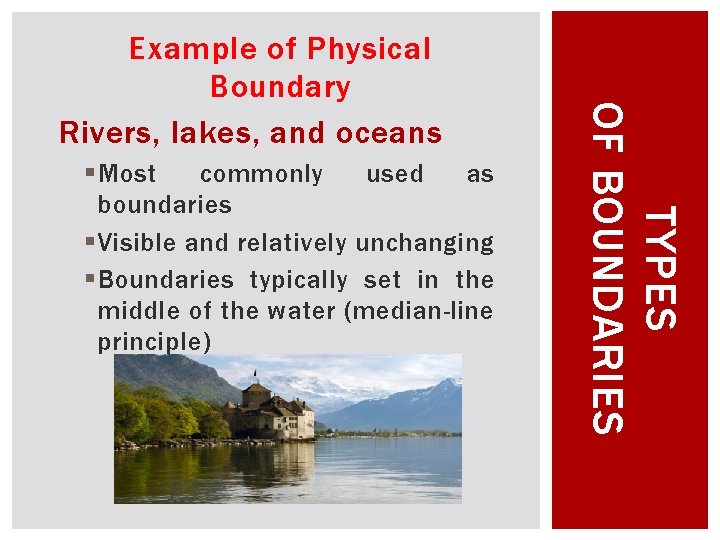
§ Most commonly used as boundaries § Visible and relatively unchanging § Boundaries typically set in the middle of the water (median-line principle) TYPES OF BOUNDARIES Example of Physical Boundary Rivers, lakes, and oceans
TYPES OF BOUNDARIES Example of Physical Boundary Ocean boundaries cause problems because states generally claim that the boundary lies not at the coastline but out at sea.
The U. N. Law of the Sea standardized territorial limits for most countries at 12 nautical miles and gave rights to fish and other marine life within 200 miles. TYPES OF BOUNDARIES Example of Physical Boundary
Water boundaries are typically set in the middle of the water since they are visible and relatively unchanging. This follows the practice known as the median-line principle. TYPES OF BOUNDARIES Example of Physical Boundary
§ Religion § Language § Ethnicity TYPES OF BOUNDARIES Cultural Boundaries Cultural boundaries are also called consequent boundaries. Cultural boundaries can be based on:
Cultural Boundaries § The borders for Pakistan were drawn around Muslim portions of the subcontinent, in an effort to separate Muslim from Hindus. Conflicts between the two groups persist today. TYPES OF BOUNDARIES Example of religious boundary: The Partition of Pakistan from India in 1947
Cultural Boundaries in Europe have been historically important since cultural identities are often based on language. TYPES OF BOUNDARIES Example of language boundary:
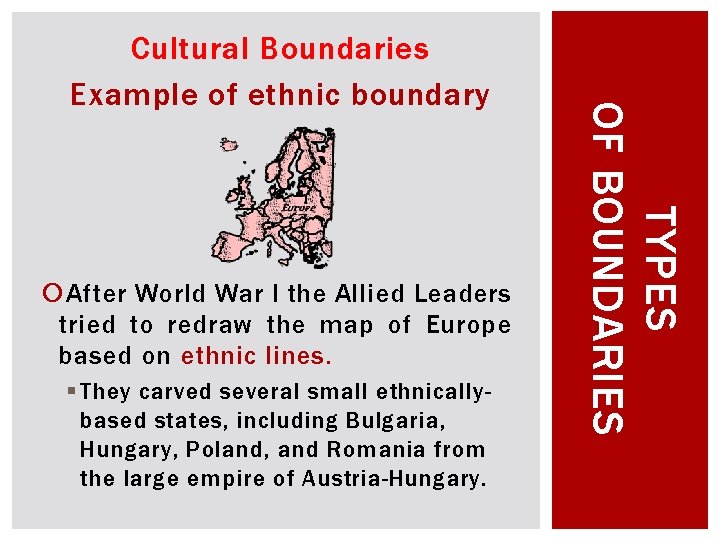
After World War I the Allied Leaders tried to redraw the map of Europe based on ethnic lines. § They carved several small ethnicallybased states, including Bulgaria, Hungary, Poland, and Romania from the large empire of Austria-Hungary. TYPES OF BOUNDARIES Cultural Boundaries Example of ethnic boundary
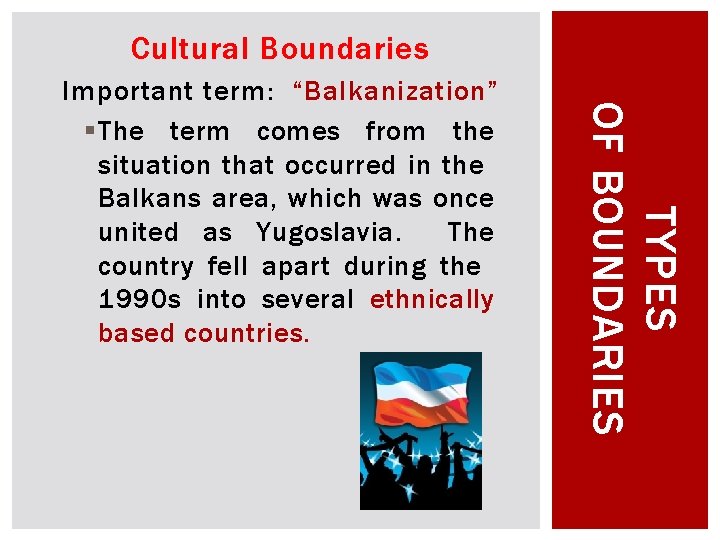
Cultural Boundaries TYPES OF BOUNDARIES Important term: “Balkanization” § The term comes from the situation that occurred in the Balkans area, which was once united as Yugoslavia. The country fell apart during the 1990 s into several ethnically based countries.
Cultural Boundaries § Shatter belts (defined) are zones of great cultural complexity containing many small cultural groups who find refuge in the isolation created by rough terrain. § Shatter belts are often areas of cultural tension that spread to other areas. TYPES OF BOUNDARIES The Balkans are also an example of a region that formed a shatter belt.
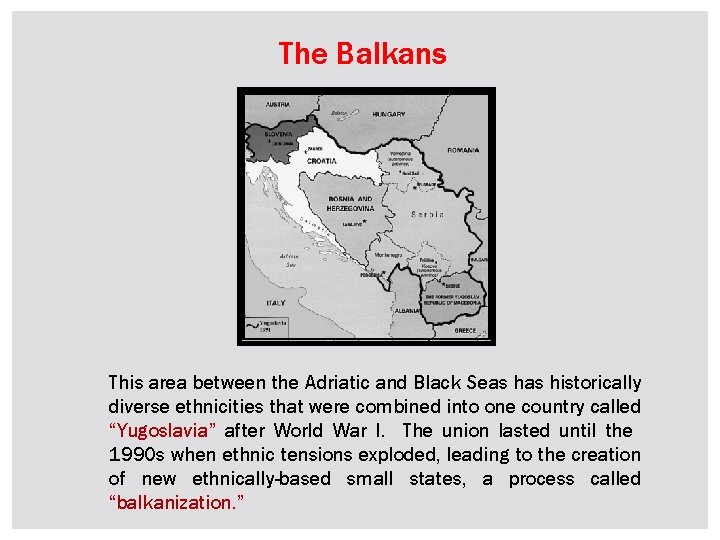
The Balkans This area between the Adriatic and Black Seas historically diverse ethnicities that were combined into one country called “Yugoslavia” after World War I. The union lasted until the 1990 s when ethnic tensions exploded, leading to the creation of new ethnically-based small states, a process called “balkanization. ”
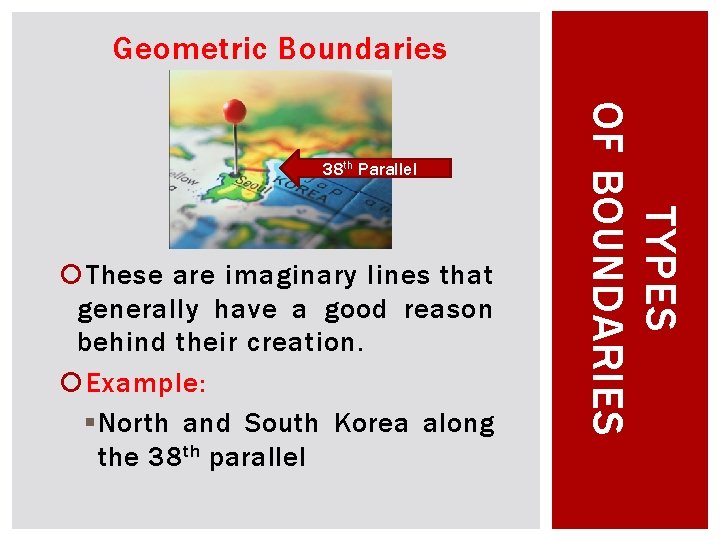
Geometric Boundaries These are imaginary lines that generally have a good reason behind their creation. Example: § North and South Korea along the 38 th parallel TYPES OF BOUNDARIES 38 th Parallel
SHAPES, SIZE, AND RELATION LOCATIONS OF STATES Territorial Morphology Describes the following about states: § shapes § sizes § relative locations Helps to determine opportunities and challenges faced by a country
SHAPES, SIZE, AND RELATION LOCATIONS OF STATES Shape affects: §cultural identity §social unity §the ease or difficulty that government has in ruling its subjects
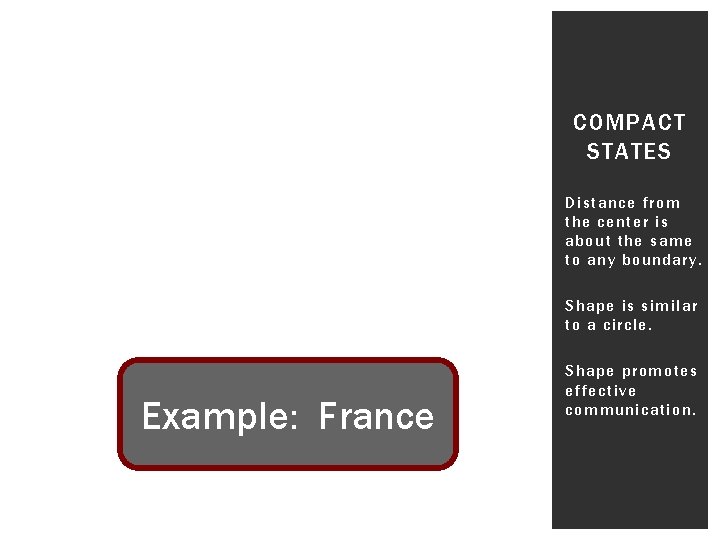
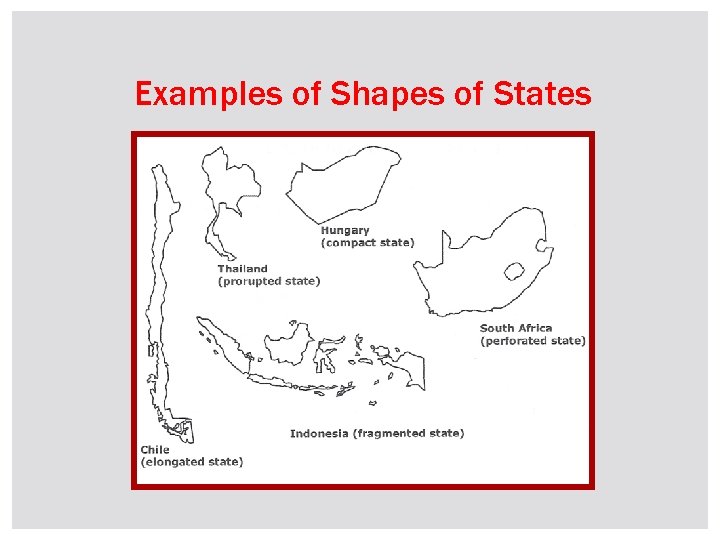
COMPACT STATES Distance from the center is about the same to any boundary. Shape is similar to a circle. Example: France Shape promotes effective communication.
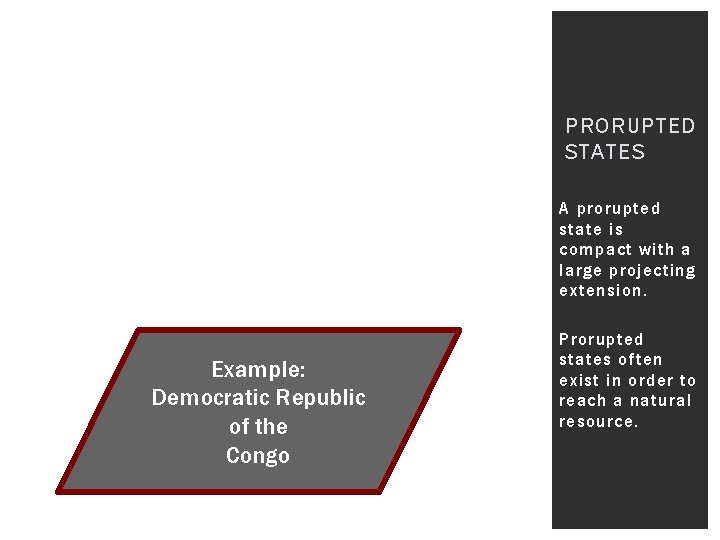
PRORUPTED STATES A prorupted state is compact with a large projecting extension. Example: Democratic Republic of the Congo Prorupted states often exist in order to reach a natural resource.
ELONGATED STATE An elongated state has a long and narrow shape. Example: Chile These states tend to have communication and transportation problems. This is especially a problem if the capital city is not centralized.
FRAGMENTED STATES A fragmented state has several discontinuous pieces of territory. Example: Indonesia Any state composed of islands is fragmented. A state is also fragmented if a piece of the territory is separated by another state.
PERFORATED STATES A stated that completely surrounds another state is a perforated state. Example: South Africa
Examples of Shapes of States
KEY TERMS TO REVIEW FROM THIS SESSION Political geography Politics of place Territoriality Political culture Boundaries Frontier Physical boundaries Cultural boundaries Geometric boundaries Balkanization Shatter belt Territorial morphology Compact state Prorupted state Elongated state Fragmented state Perforated state