
Unit 4 Plant AnatomyI Topic Simple Tissues Parenchyma
- Slides: 10
Unit 4: Plant Anatomy-I Topic: Simple Tissues (Parenchyma Tissues) B. Ed (Hons) Secondary Semester III Subject: Advance Biology I Course Title: Plant Systematics and Anatomy Represented By: Ms Sidra Younis Department of Education (Planning and Development) Lahore College for Women University, Lahore
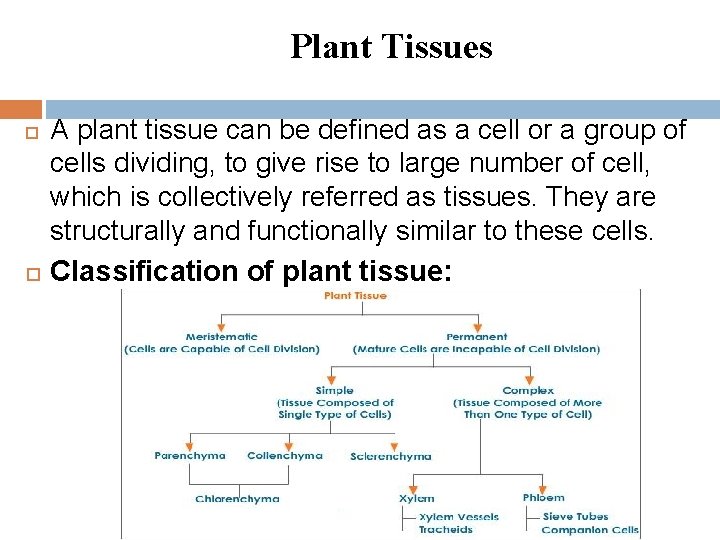
Plant Tissues A plant tissue can be defined as a cell or a group of cells dividing, to give rise to large number of cell, which is collectively referred as tissues. They are structurally and functionally similar to these cells. Classification of plant tissue:
Simple Tissues Simple tissues are of three types namely parenchyma, collenchyma and sclerenchyma. Parenchyma Tissues: The main characteristics of parenchyma are: They are living permanent tissues that have the ability to divide at maturity and help in the regeneration and healing of wounds Parenchyma cells are the foundation of a plant as reproductive cells (spores, gametes) are parenchymatous in nature Single parenchyma cell of a zygote has an ability to develop into an entire plant. These cells are called “totipotent” cells.
CONT…. Parenchyma cells occur in the form of continuous masses as homogeneous parenchyma tissues e. g. in pith and cortex of stems and roots, mesophyll of leaves, the flesh of succulent fruits and in the endosperm of seeds Parenchyma cells may be associated with other types of cells to form heterogeneous complex tissues such as parenchyma of xylem and phloem Parenchyma cells are essential for activities like photosynthesis, storage, secretion, assimilation, respiration, excretion and radial transport of water and solute Structure of Parenchyma Cells It is a living cell
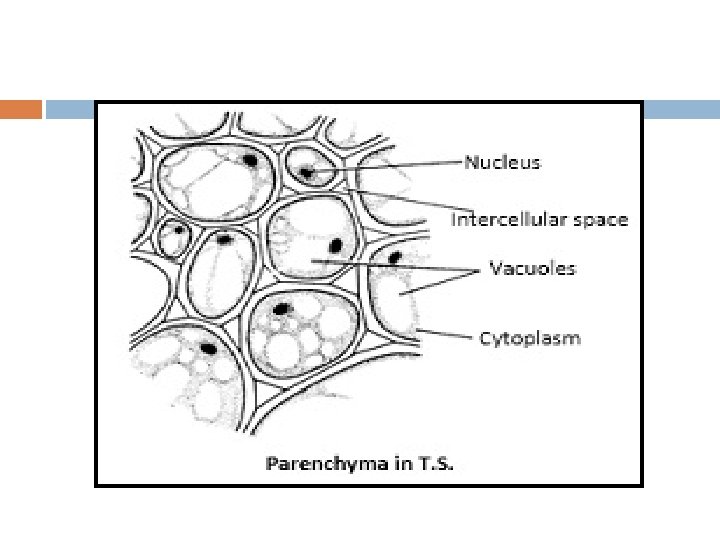
CONT…. These cells are closely packed or may have small intercellular space They are made up of thin cell wall made up of cellulose, hemicellulose Plasmodesmata join the cells of the parenchyma tissue They have several small vacuoles. In the older parenchyma, smaller vacuoles merge to become a large central vacuole, which may accumulate anthocyanin or tannins Water is abundant in the vacuoles of the parenchyma cells that act as a water reservoir Storage parenchyma cells may have thick xyloglucan walls e. g. in the endosperm of the date palm. The
CONT… The parenchyma cells of flowers and fruits contain chromoplasts Parenchyma cells may have a thick lignified wall that makes it difficult to differentiate it from sclerenchyma Hydraulic property of cells gives the parenchyma its mechanical strength Chloroplasts are present in the parenchyma cells that are specified to perform photosynthesis The parenchyma cells which perform a secretory function, have dense protoplasm that is rich in ribosomes, Golgi bodies and a highly developed endoplasmic reticulum
CONT… The parenchyma cells of flowers and fruits contain chromoplasts Parenchyma cells may have a thick lignified wall that makes it difficult to differentiate it from sclerenchyma Hydraulic property of cells gives the parenchyma its mechanical strength Chloroplasts are present in the parenchyma cells that are specified to perform photosynthesis The parenchyma cells which perform a secretory function, have dense protoplasm that is rich in ribosomes, Golgi bodies and a highly developed endoplasmic reticulum
Functions of Parenchyma Tissues Parenchyma cells form the ground tissue of plants. Parenchyma tissues perform various important functions: Storage: Parenchyma cells have large intercellular space which is ideal for storage � High amount of starch is present in the tubers of potato and cassava � These can store water, fats, oil droplets, and ergastic substances � Store water and act as a water reservoir Transport: Parenchyma cells transport nutrients and other chemicals � Transfer cells have outgrowth for increasing absorption surface � The xylem parenchyma helps in radial transportation of
Functions of Parenchyma Tissues Photosynthesis: Chlorenchyma present in the mesophyll and the other green parts of the plant, have chloroplasts and perform photosynthesis Gas Exchange: Aerenchyma cells help in the gas exchange Protection: In gymnosperms, the parenchymatous cell have spiny projections that help in the protection from predators Totipotent: Parenchyma cells have an ability to transform to the other types of cells and act as a precursor for other types of cells Healing and regeneration: Parenchyma cells which retain their ability to divide even on maturity help in regeneration and wound healing. Tyloses present in the xylem parenchyma help in preventing damage to