
Unit 4 Memory Remembering Forgetting Dr Ayesha Batool
Unit: 4 Memory- Remembering & Forgetting Dr. Ayesha Batool S (Education) ession: 2019 -2023
It refers to the process of remembering and association ex. cool we associate with a pleasant feeling and distinguish it from hot.
� � � Drever- “Memory is that characteristic which underlines all learning, the essential feature of which is reflection. In narrow sense it is recall and recognition. ” Woodworth and Marquis- “Memory is mental power which consists in learning, retaining and remembering what has previously been learnt. ” Ryburn- “The power that we have to store our experiences, and to bring them into the field of consciousness sometime after the experiences have occurred, is termed as memory. ”
Memory involves four basic components or factors a) learning b) retention c) recall or retrieval c) recognition
It is the process of registering impressions or acquiring new knowledge, skills, attitudes, and so on. Meaningful learning: paying attention to the meaning of whole material the relationship among the different parts. relate the meaning and significance of the material with other things that previously learnt.
• After the active learning process the retention will take place which is comparatively passive. This is ability to keep things in mind and remember.
� This is the act of remembering something. Recall is greatly affected by emotions and motivation both at the time of learning and subsequently
�Recognition is awareness of previous experience, It is complete familiarity without any mistake.
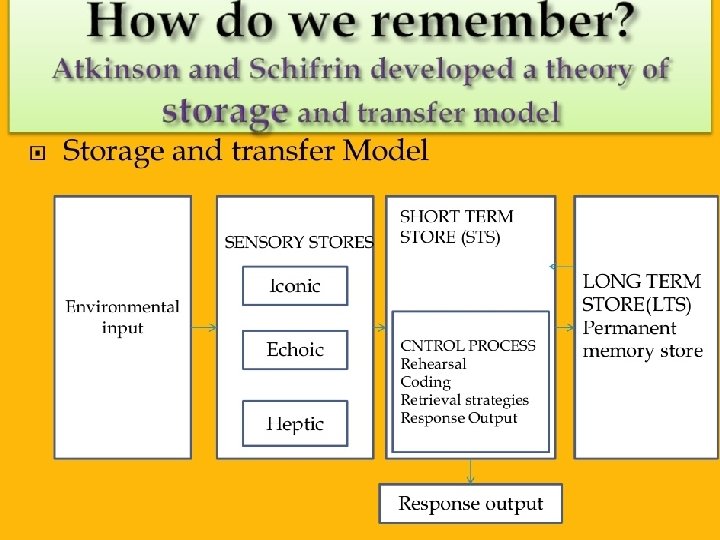
� Short term Memory: It is a working memory no more than few seconds long. � Long term Memory: It represents our knowledge about the working of the world. The memory of words, symbol, corporate trademarks are unforgettable though not used for years but not fade away.
�Habit Memory or implicit Memory: Habit memory is the function of the body and is related with motor mechanism. Ex. Riding bicycle. �Remote Memory: It is life time accumulation of data about a wide variety of topics. It seems to diminish with age. �Rote Memory: Result of rote learning by children they remember without understanding. �Episodic Memory: This is the memory of specific personal experiences.
� Sensory Memory: Sensory impressions retain that knowledge. i. Auditory Memory - Memory of auditory impressions. ii. Visual memory –Memory of visual impressions. iii. Tactual Memory –Memory of touch is rich in blind. iv. Olfactory Memory-Memory of smell v. Gustatory Memory- Memory of taste

1. 2. 3. 4. Recall Relearning Recognition Reproduction
1. Will to learn 2. Interest and Attention 3. Over learning 4. Meaningfulness 5. Following the Principle of association 6. Grouping and rhythm
7. Using as many sense as possible 8. Learner’s internal 9. Provisions for change and Proper rest 10. Repetition and recitation 11. Making use of SQ 4 R Techniques: Thomas Robinson developed this strategy for effective learning and memorization. Survey
Question Read Reflect Recite and Recall. 12. Making use of mnemonics: This system makes use of the use of visual imagery to provide useful association and connections for remembering the required materials. Ex. Peg word method
Forgetting It is opposite of remembering Munn- “Forgetting is the loss , permanent or temporary, of the ability to recall or recognize something learned earlier. ” Drever: “ Forgetting means failure at any time to recall an experiences, when attempting to do so, or to perform an action previously learned. ” This is inability to recall the previously learnt material.
Types of Forgetting There are two types of forgetting 1. Normal Forgetting 2. Abnormal Forgetting
Causes of Normal Forgetting a) Entropy through disuse: Older experience the weaker its memory. b) Interference: Forgetting by interference is a case of retention amnesia, here stability and existence of memory traces are disturbed Ex. Crowded learning, Unspaced learning.
Conti. . c) Retroactive and Proactive inhibition: Inhibition means checking of causing to withhold. It has been found that if one period of learning is ‘A’ is immediately followed by the another effort of learning ‘B’ which is similar material when any one of them has to be recalled.
Conti. . If the learning is not meaningful forgetting occurs as it does not give scope for the development of relationship. e) Inadequate impressions at the time of learning leads to forgetting. f) Lack of interest in the learning material leads to forgetting. d)
g) Mental or physical ill health sets in physical and mental fatigue and affects learning. h) Motivated forgetting: Unpleasant events are to be forgotten soon to participate in the present.
Abnormal Forgetting This happens because of some unusual conditions when recall is completely blocked. � It may result due to severe injury. � Repression of experiences having guilt shame or frustration.

- Slides: 24