
Unit 4 lesson 1 Weather and Climate https


- Slides: 28
Unit 4 lesson 1 Weather and Climate https: //youtu. be/Utg. FHHhm 1 x. U
I. Elements of Weather A. Weather 1. Weather= condition of the atmosphere at a certain time in a certain place a. Short term b. Temp, humidity, precipitation, wind & visibility 2. Temperature= measure of how hot or cold something is a. thermometers are filled with a liquid (mercury or alcohol) that will expand when heated or contract when cooled b. measured in either Fahrenheit °F or Celsius °C
B. Humidity 1. Humidity= the amount of water vapor in the air a. In the water cycle, water evaporates from ocean, lakes, & plants b. Air’s ability to hold water vapor changes with temperature Temperature is the measure of how fast the molecules of air are moving (kinetic energy) More energy (higher temp) the more water that can be evaporated 2. Relative Humidity= amount of water vapor in the air compared with the maximum amount of water vapor that the air can hold at a certain temp. a. Given as a percentage b. Air is saturated when it hold all of the water it can possibly hold at a given temp= relative humidity 100%
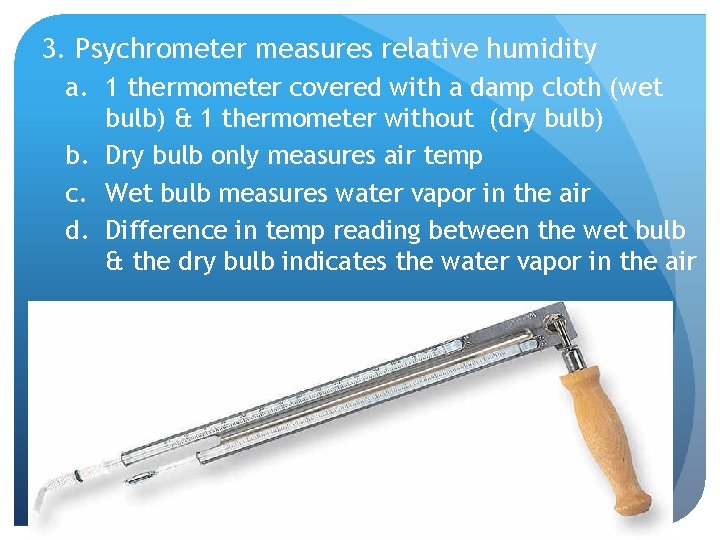
3. Psychrometer measures relative humidity a. 1 thermometer covered with a damp cloth (wet bulb) & 1 thermometer without (dry bulb) b. Dry bulb only measures air temp c. Wet bulb measures water vapor in the air d. Difference in temp reading between the wet bulb & the dry bulb indicates the water vapor in the air
Make a psychrometer: 1. Get 2 thermometers, cloth, tape, water, rubber band 2. Wrap the cloth around the end of one thermometer and secure it with the rubber band 3. Wet the gauze with room temp water 4. Tape the 2 thermometers side by side and fan both watching the change in temp on the wet bulb 5. When the wet bulb temp stabilizes record the temps on both thermometers and find the difference 6. The photocopied chart to find the relative humidity % of the room
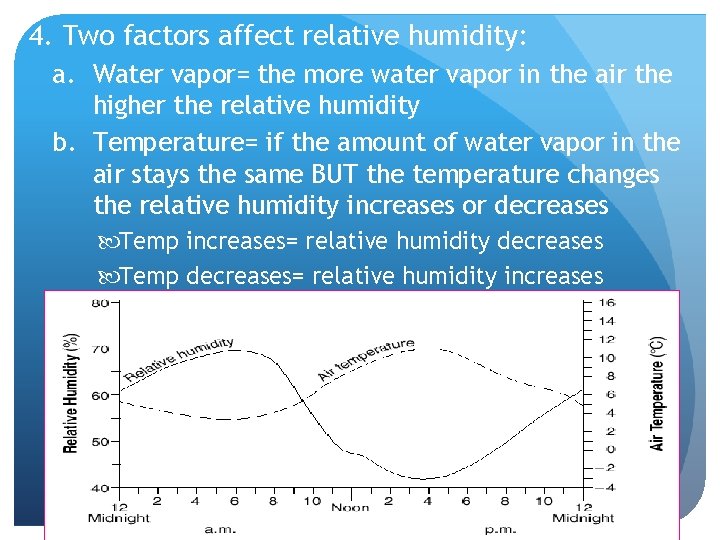
4. Two factors affect relative humidity: a. Water vapor= the more water vapor in the air the higher the relative humidity b. Temperature= if the amount of water vapor in the air stays the same BUT the temperature changes the relative humidity increases or decreases Temp increases= relative humidity decreases Temp decreases= relative humidity increases
B. Condensation https: //youtu. be/Oiej. HVHrd. Oo 1. Condensation= the process by which gas is changed into a liquid Occurs when saturated air cools 2. Dew point: the temperature at which a gas condenses into a liquid (more condensation occurs than evaporation) Condensation needs a surface for the water vapor to condense on Better guide to how it “feels” outside Can form fog & clouds
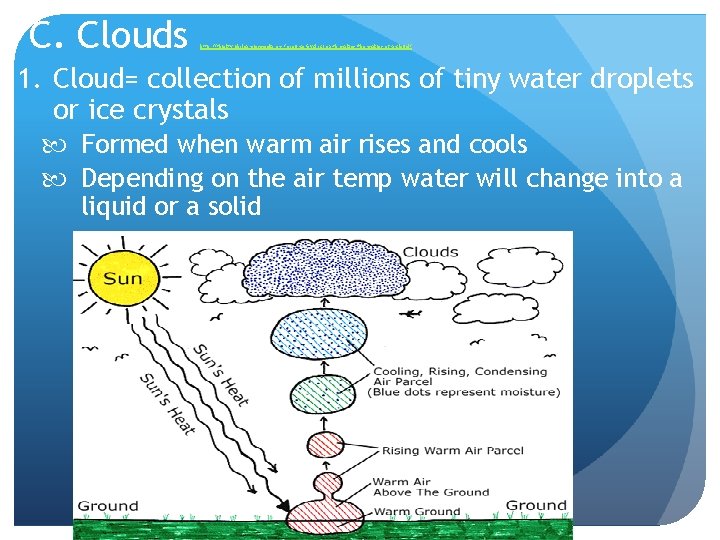
C. Clouds http: //thinktv. pbslearningmedia. org/resource/nvcl. sci. earth. making/the-making-of-a-cloud / 1. Cloud= collection of millions of tiny water droplets or ice crystals Formed when warm air rises and cools Depending on the air temp water will change into a liquid or a solid
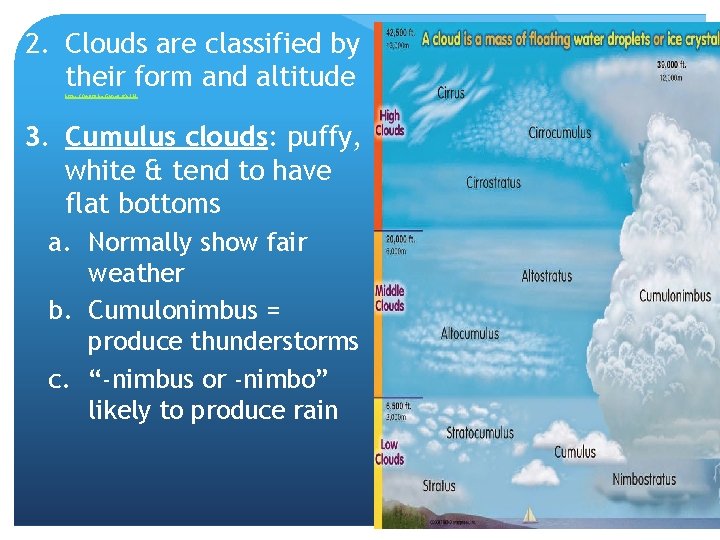
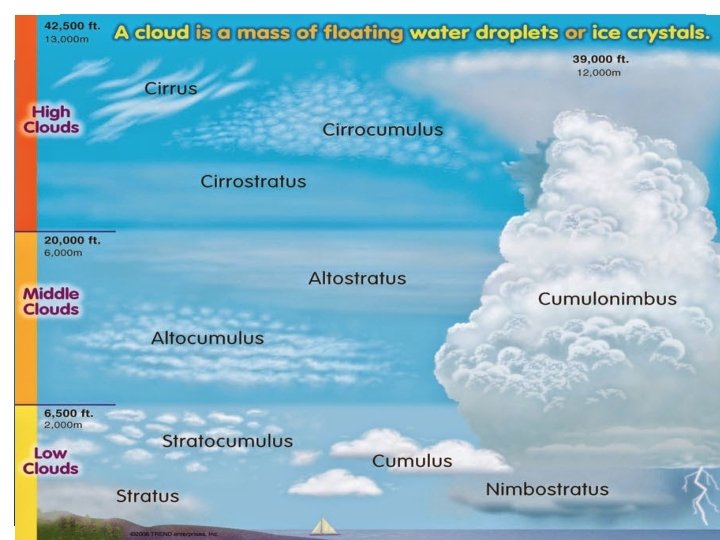
2. Clouds are classified by their form and altitude https: //youtu. be/FMag. DRCp. J 14 3. Cumulus clouds: puffy, white & tend to have flat bottoms a. Normally show fair weather b. Cumulonimbus = produce thunderstorms c. “-nimbus or -nimbo” likely to produce rain
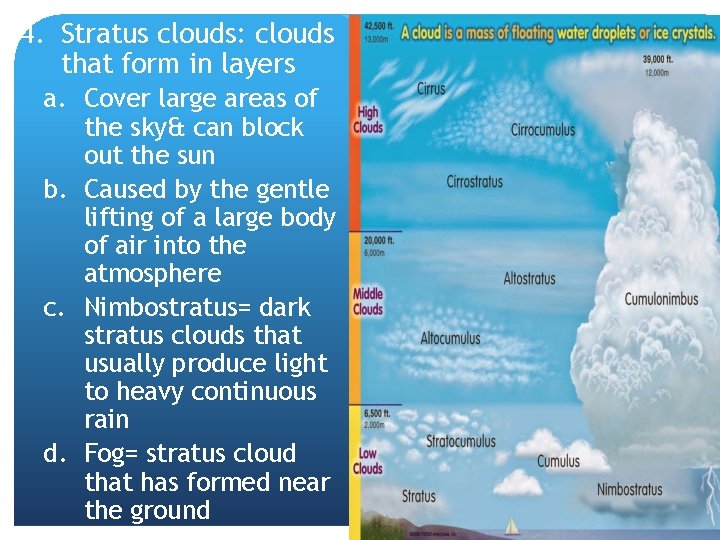
4. Stratus clouds: clouds that form in layers a. Cover large areas of the sky& can block out the sun b. Caused by the gentle lifting of a large body of air into the atmosphere c. Nimbostratus= dark stratus clouds that usually produce light to heavy continuous rain d. Fog= stratus cloud that has formed near the ground
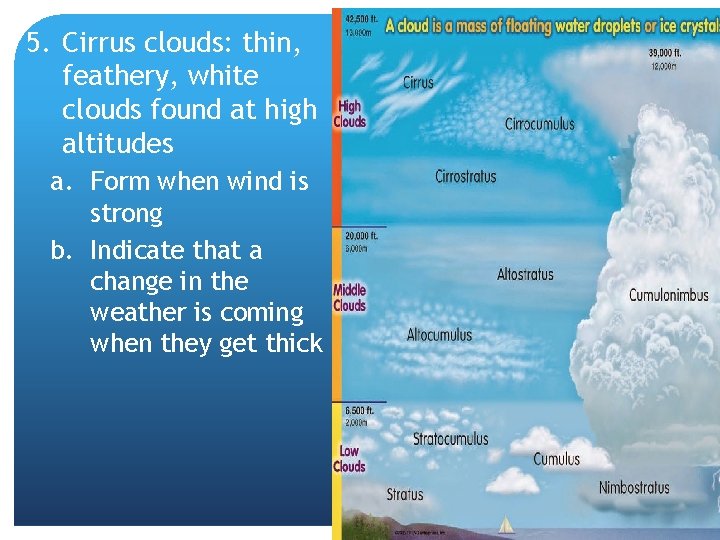
5. Cirrus clouds: thin, feathery, white clouds found at high altitudes a. Form when wind is strong b. Indicate that a change in the weather is coming when they get thick
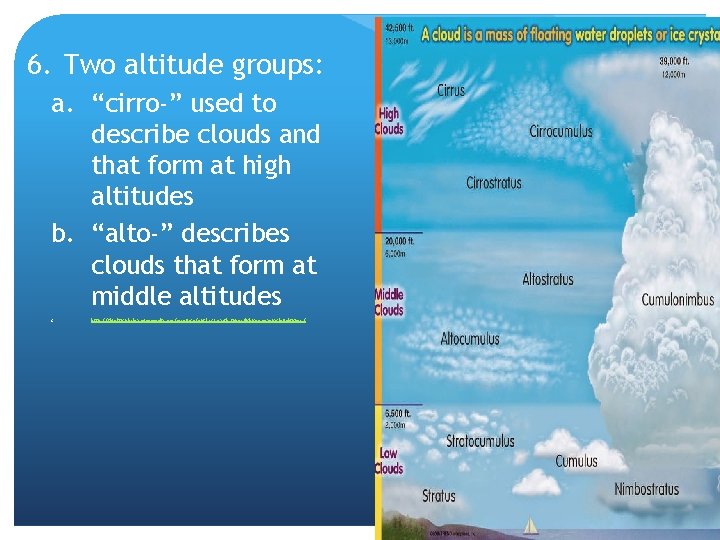
6. Two altitude groups: a. “cirro-” used to describe clouds and that form at high altitudes b. “alto-” describes clouds that form at middle altitudes c. http: //thinktv. pbslearningmedia. org/resource/nvcl. sci. earth. types/why-so-many-cloud-types /
With a partner & chalk 1. Draw & label the following clouds ; cumulus stratus nimbostratus altocumulus cirrus cumulonimbus 2. Label the altitude in km & miles where the cloud is found
Do you know your clouds? http: //thinktv. pbslearningmedia. org/resource/nvcl. sci. i nt. clotyp/cloud-lab-typing-interactive/ try to get the cloud type correct!
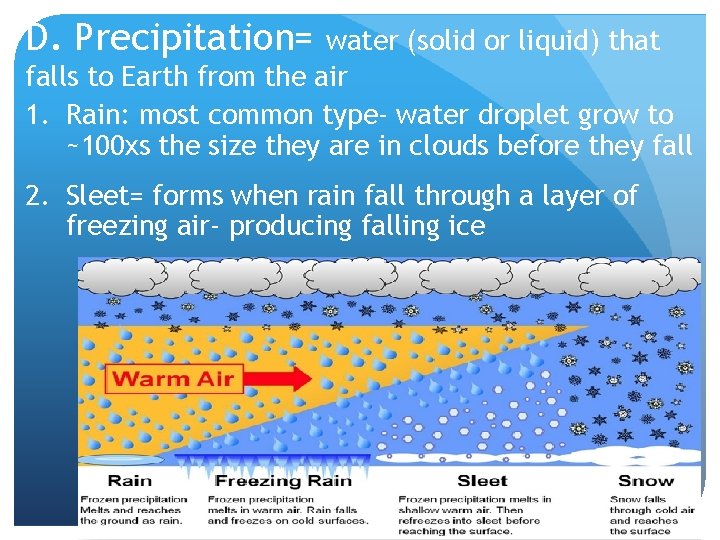
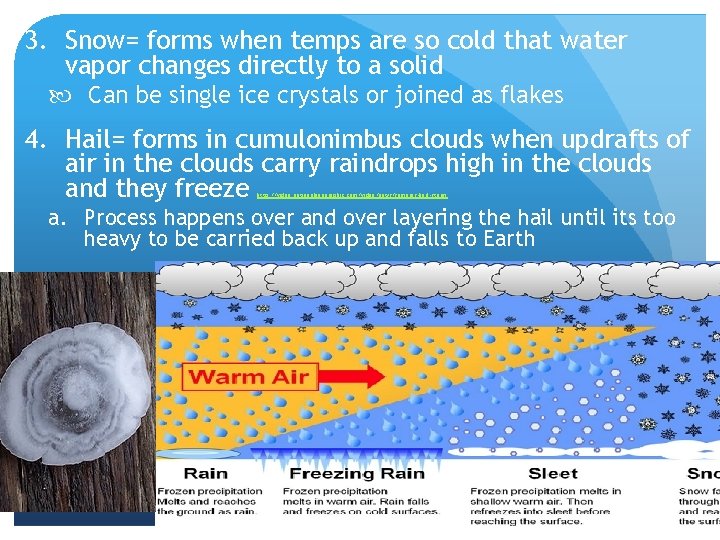
D. Precipitation= water (solid or liquid) that falls to Earth from the air 1. Rain: most common type- water droplet grow to ~100 xs the size they are in clouds before they fall 2. Sleet= forms when rain fall through a layer of freezing air- producing falling ice
3. Snow= forms when temps are so cold that water vapor changes directly to a solid Can be single ice crystals or joined as flakes 4. Hail= forms in cumulonimbus clouds when updrafts of air in the clouds carry raindrops high in the clouds and they freeze http: //video. nationalgeographic. com/video/news/samaras-hail-storm a. Process happens over and over layering the hail until its too heavy to be carried back up and falls to Earth
II. Influences of Weather A. Water Cycle 1. weather= short term state of the atmosphere 2. water cycle is the movement of water between the atmosphere and the land 3. water evaporates & put more water vapor in the air allowing for condensation =fog & decreased visibility
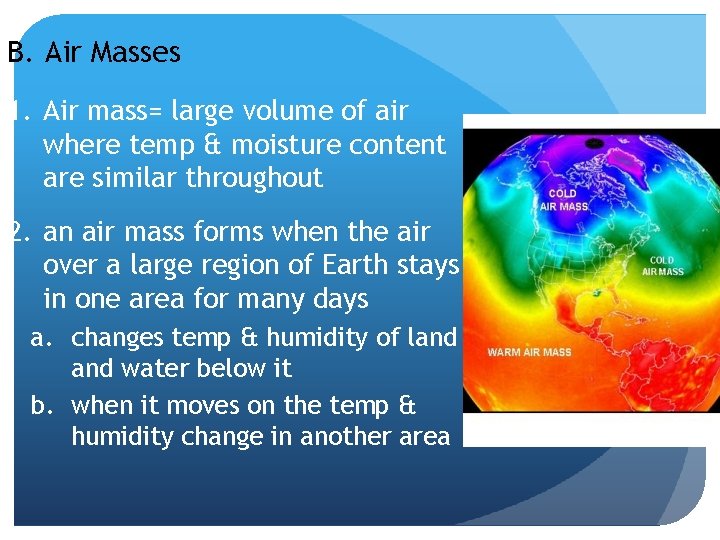
B. Air Masses 1. Air mass= large volume of air where temp & moisture content are similar throughout 2. an air mass forms when the air over a large region of Earth stays in one area for many days a. changes temp & humidity of land water below it b. when it moves on the temp & humidity change in another area
C. Fronts- boundary between air masses of different densities & usually different temperatures https: //youtu. be/G 7 Ewqm 0 YHUI 1. Cold air moves under less dense warm air & pushed it up a. Move quickly b. Brings thunderstorms, heavy rain or snow c. Brings cooler dryer weather
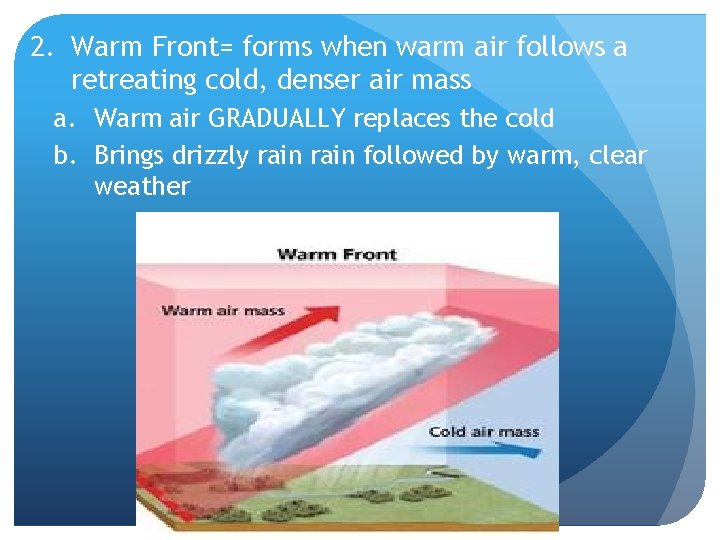
2. Warm Front= forms when warm air follows a retreating cold, denser air mass a. Warm air GRADUALLY replaces the cold b. Brings drizzly rain followed by warm, clear weather
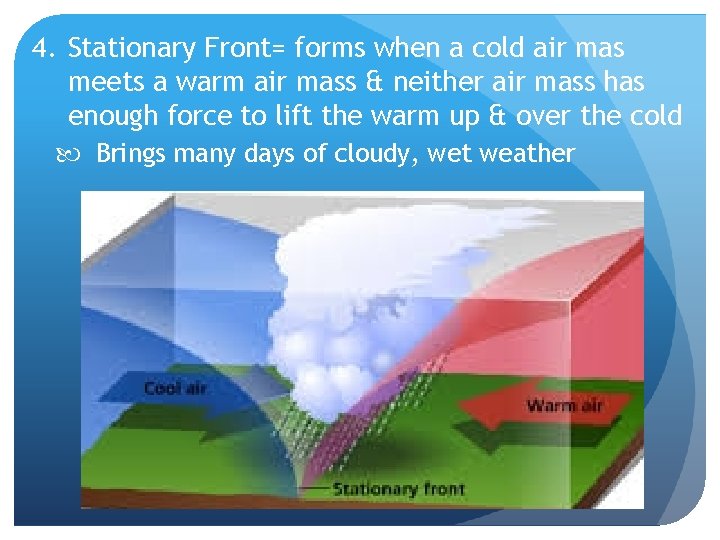
4. Stationary Front= forms when a cold air mas meets a warm air mass & neither air mass has enough force to lift the warm up & over the cold Brings many days of cloudy, wet weather
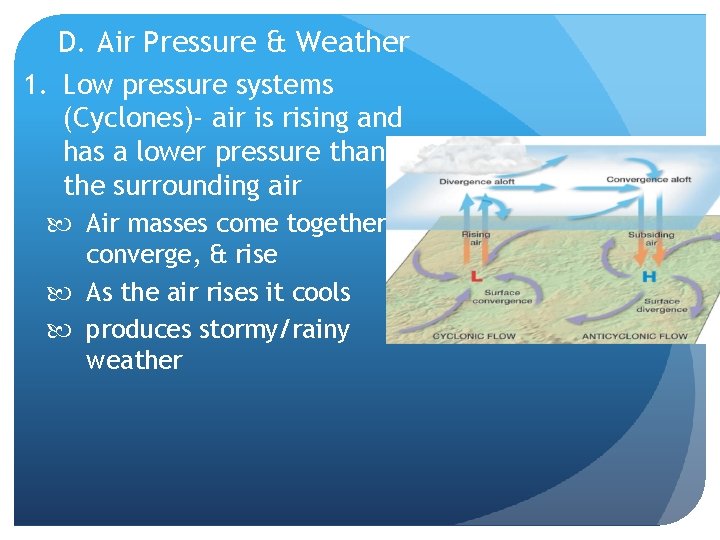
D. Air Pressure & Weather 1. Low pressure systems (Cyclones)- air is rising and has a lower pressure than the surrounding air Air masses come together, converge, & rise As the air rises it cools produces stormy/rainy weather
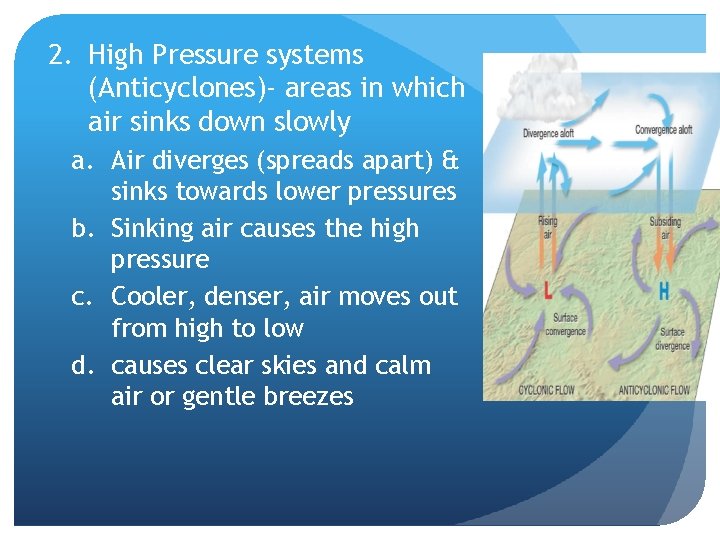
2. High Pressure systems (Anticyclones)- areas in which air sinks down slowly a. Air diverges (spreads apart) & sinks towards lower pressures b. Sinking air causes the high pressure c. Cooler, denser, air moves out from high to low d. causes clear skies and calm air or gentle breezes
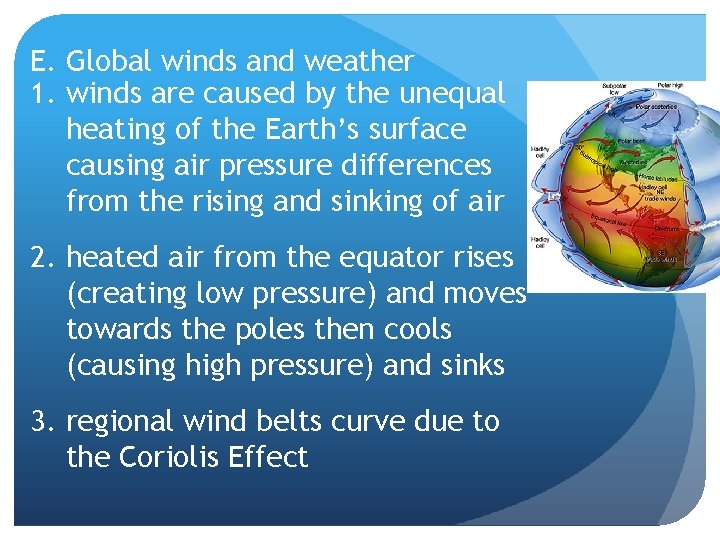
E. Global winds and weather 1. winds are caused by the unequal heating of the Earth’s surface causing air pressure differences from the rising and sinking of air 2. heated air from the equator rises (creating low pressure) and moves towards the poles then cools (causing high pressure) and sinks 3. regional wind belts curve due to the Coriolis Effect
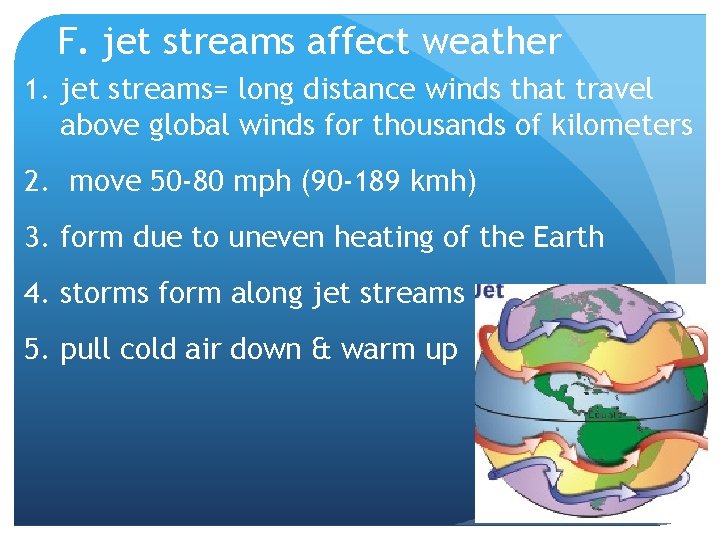
F. jet streams affect weather 1. jet streams= long distance winds that travel above global winds for thousands of kilometers 2. move 50 -80 mph (90 -189 kmh) 3. form due to uneven heating of the Earth 4. storms form along jet streams 5. pull cold air down & warm up
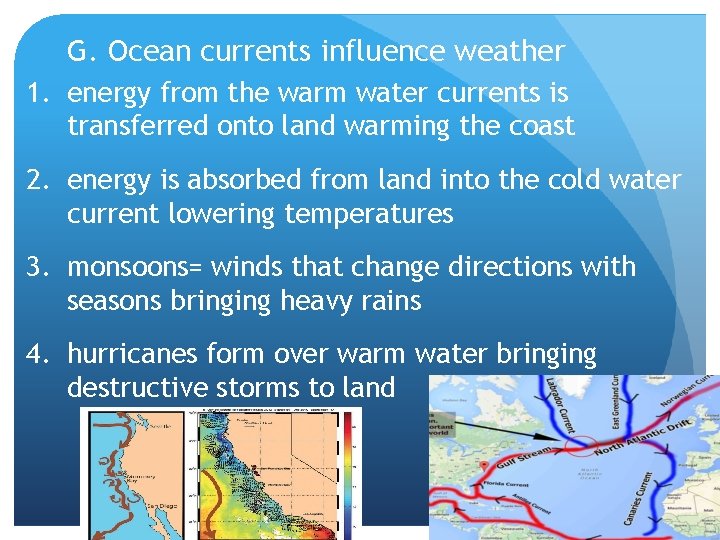
G. Ocean currents influence weather 1. energy from the warm water currents is transferred onto land warming the coast 2. energy is absorbed from land into the cold water current lowering temperatures 3. monsoons= winds that change directions with seasons bringing heavy rains 4. hurricanes form over warm water bringing destructive storms to land