
Unit 4 LEGISLATIVE BRANCH Structure of the Legislature

Unit 4 LEGISLATIVE BRANCH
Structure of the Legislature Established by Article I of the Constitution The legislative branch of the federal level is Congress is bicameral House Senate of Representatives
Overview of the House and Senate House of Representatives 435 2 members year terms 25 years old Representation based on population Senate 100 6 members year terms 30 years old Equal Representation
More differences! Originally, the House of Representatives were elected by the public The elected members of the state legislature would elect Senators Until the 17 th Amendment
Compensation $174, 000 Ability a year to collect pension after as little as 5 years $3, 000 state tax credit for costs of living away from

Leadership of the House and Senate
Please Note: The positions that we are about to talk about will change in January when the new Congress meets. Because of this, we will wait until then to "meet the Congressional Leaders"
Speaker of the House Presiding Assigns officer and most powerful member bills to committees Controls the debate on the House floor Appoints party members to committees Usually chosen from political party with the majority of members
House Leadership Majority Leader Is from the political party that has the most members in the House Represent the members of the political party on the floor Majority Helps Whip to ensure that members of their political party vote according to the party’s guidelines
House Leadership, Cont’d Minority Leader Represents Minority Democrats on the House floor Whip Ensures that Democrats vote according to party guidelines
Senate Leadership In accordance to the Constitution, the Vice President serves as the president of the Senate Performs Mike The acts similar to the Speaker of the House Pence President Pro Tempore acts as the president of the senate when the vice president is unavailable
Senate Leadership The Senate also has a Majority/Minority Leader and Whips
OBJECTIVE 3 How are Congressional districts established?
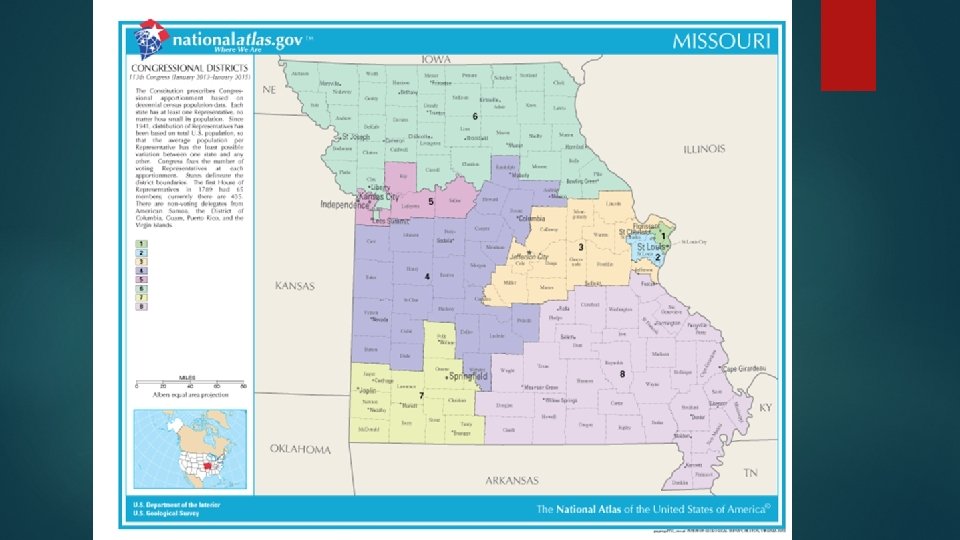
One Person, One Vote In order to fairly distribute representatives, Congress conducts a Census every 10 years Depending on if a state's population goes up or down, a state may lose or gain representatives Reapportionment
District Boundaries The state legislature has the job of dividing the state up into legislative districts Each district must be approximately equal in population If a state legislature doesn't equally divide up the population, citizens may sue Wesberry V. Sanders The Supreme Court ruled that if states have districts with lopsided populations, then that violated the citizens rights. "Equal representation for equal numbers of people"
Requirements when Redistricting Compactness Having a minimum distance between all parts of a district Contiguity All parts of a district must be connected at some point Preservation Not of counties and other political subdivisions crossing county, city, or town boundaries
Requirements when Redistricting, Cont’d Preservation of communities of interest Regions of a state should be kept together whether or not they fall in the same political subdivisions Avoiding pairing incumbents
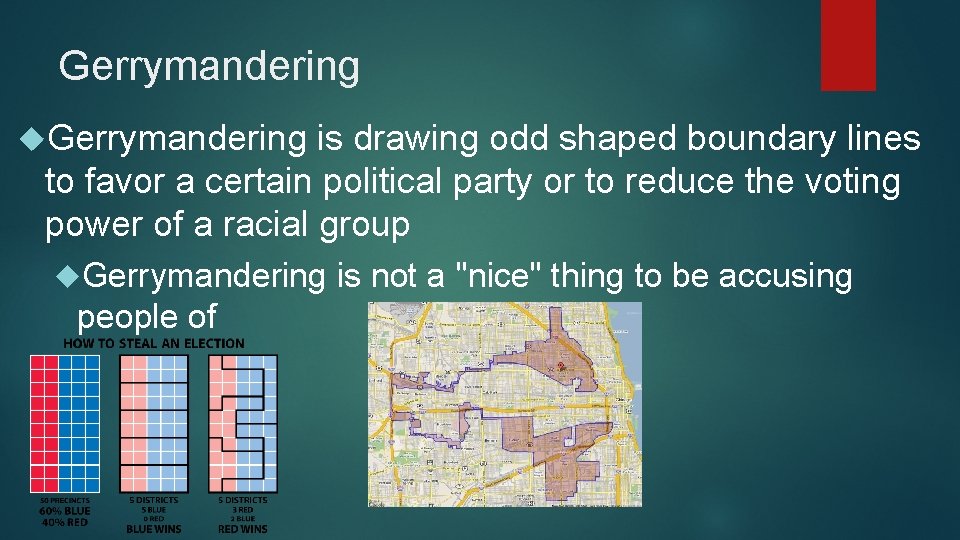
Gerrymandering is drawing odd shaped boundary lines to favor a certain political party or to reduce the voting power of a racial group Gerrymandering people of is not a "nice" thing to be accusing
Interacting with and Represent Constituents OBJECTIVE 4
Representative’s Dilemma Members of Congress must constantly balance their personal views with what their constituents want Someone who authorizes another to act in her or her behalf as a voter in a district represented by an elected official
Roles of Representatives Delegate Feel like they are compelled to follow the desires of their constituents, believe they should vote for the “folks back home” Trustee Voters have entrusted them with the job of making independent judgements Politico A mixture of the two
Ways that Congress can work with Constituents Voting Members of Congress can vote for issues that their constituents believe in Meetings Congress members often hold meetings to learn what issues are important to their Constituents Pork Barrel Legislation Use of government funds for projects in a state For example, a new military base

Powers of Congress OBJECTIVE 5
Legislative Powers The Legislative Powers of Congress are the powers that deal with lawmaking There are two types of legislative powers Congress has Expressed Implied Powers
Expressed Powers listed directly in Article I section 8 Provide for the common defense Borrow Money Regulate commerce with foreign nations, among states Establish rule of naturalization Coining money Establish courts under the Supreme Court Declare War
Implied Powers not listed in the Constitution, but are needed to perform the expressed powers Granted to Congress by the elastic clause Gives Congress the right to pass any laws that are “necessary & proper” to perform duties Establishing a federal minimum wage The military draft
How a Bill becomes a Law
Step 1: A bill is introduced A bill can only be introduced by a member of Congress Bill is given a number, it either will start with H. R. or S. depending on where it starts
Step 2: Referral to Committee The bill is passed on to a committee that covers whatever the bill deals with The committee may refer the bill to a subcommittee or work on it as a whole The committee then looks over the bill and make changes to the bill “Marking up” The bill is then voted on to determine if it will be passed on to the full chamber
Committees Standing Committee Permanent Each Select is broken up into subcommittees Committee Conference Made created for a specific purpose Committee Joint committees that deal with laws made up by members of both houses to iron out differences in bills made by houses or senate Committee Made by members of both houses, usually to conduct studies
Floor Debate If the committee recommends the bill, it goes to the whole House or Senate After the positives and negatives of the bill are discussed, the bill is up for vote There are four major voting styles that Congress can use
Congressional Voting Styles Voice Vote Congress members answer the call to vote with either “aye” or “nay” Standing Vote Members Roll are asked to stand when their voting option is red Call Vote Members Electronic answer with their vote after their name is read Vote
Referral to the Other Chamber When a bill is passed by either the House or the Senate, it is then given to the other chamber The Whole Process is repeated again in that chamber Once the other chamber passes the bill, the bills are sent to a conference committee The Conference committee works out the differences between the bills After both chambers approve the revised bill, it goes to the President
Options for the President The president can sign the bill The president can veto the bill Congress The can override a veto with a 2/3 rd vote in both houses President can do nothing with the bill If congress is still in session after the 10 days, then the bill becomes law If congress adjourns during those 10 days, then the bill dies Pocket Veto
A Rider? A Rider simply is an addition to a bill Usually put in after the bill was drawn up
Filibuster Intended to block a measure by preventing a vote Senate rules do not allow the Presiding Officer to use the power of recognition to control business Rules Senators can only have water or milk, not allowed to use restroom though
- Slides: 37