
Unit 4 Imperialism Bell Ringer Take out a
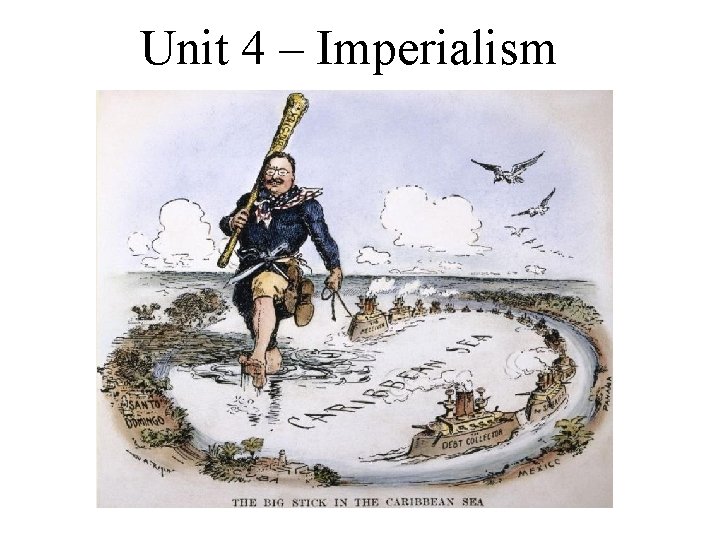
Unit 4 – Imperialism
Bell Ringer • Take out a sheet of paper for your quiz! 1) Identify and explain two justifications for American Imperialism. 2) Identify and explain one argument against American Imperialism.
What is Imperialism? • Imperialism – when one country rules over another country for political or economic gain. – What benefits might a country gain from ruling over another country? – Name some historical or current examples of imperialism. • Great Britain ruling over the United States • United States ruling over Puerto Rico
Manifest Destiny • Before the late 1800’s and early 1900’s the United States was primarily concerned with taking territory out west. • This was based on the belief that America was destined to spread from “sea to shining sea. ” This belief was called Manifest Destiny.

How was manifest destiny imperialistic?
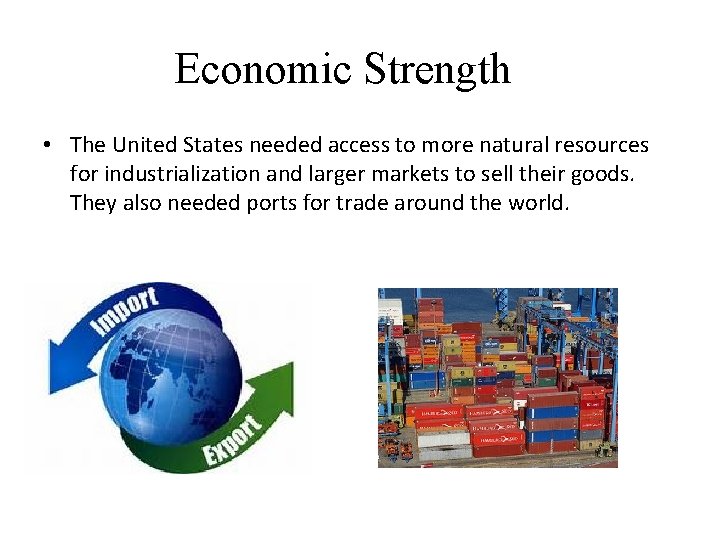
Economic Strength • The United States needed access to more natural resources for industrialization and larger markets to sell their goods. They also needed ports for trade around the world.
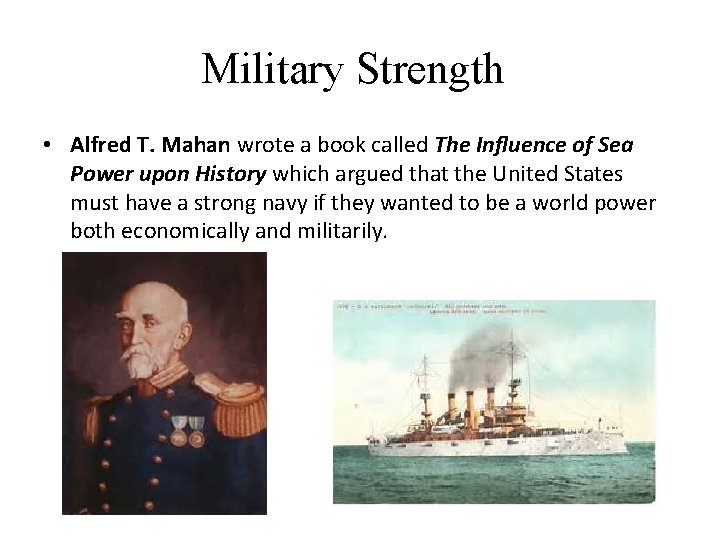
Military Strength • Alfred T. Mahan wrote a book called The Influence of Sea Power upon History which argued that the United States must have a strong navy if they wanted to be a world power both economically and militarily.
Social Darwinism • Remember, Social Darwinism is the belief that some races are better than other races. • This idea was furthered when Rudyard Kipling wrote a poem called, “The White Man’s Burden. ” • This poem promoted the idea that the Anglo. Saxon (white) race was the best and should spread their culture around the world through imperialism.
Arguments Against Imperialism • The idea that it was undemocratic and unconstitutional. • The idea that it was racist and immoral. • The idea that it was expensive and an economic burden.
This is an excerpt from the Platform of the American Anti-Imperialist League. We regret that it has become necessary in the land of Washington and Lincoln to reaffirm that all men, of whatever race or color, are entitled to life, liberty, and the pursuit of happiness. We maintain that governments derive their just powers from the consent of the governed. We insist that the subjugation of any people is "criminal aggression" and open disloyalty to the distinctive principles of our government. What were the reasons that the American Anti-Imperialist League was against Imperialism? Use text evidence. 1. All men are entitled to. . . __________ 2. Government derive (get). . . powers from. . . _____ 3. Subjugation (controlling). . . any people is “_______ aggression and. . . disloyalty to the. . . principles of our ______.
I wanted the American eagle to go screaming into the Pacific. Here a people who have suffered for three centuries. We can make them as free as ourselves, give them a government and a constitution. But I have seen that we do not intend to free, but to subjugate (control) the people of the Philippines. We have gone there to conquer, not to redeem. It should be our duty to make those people free, and let them deal with their own domestic questions in their own way. And so I am an anti-imperialist. I am opposed to having the eagle put its talons on any other land. Source: From Mark Twain's Weapons of Satire: Anti-Imperialist Writings on the Philippine-American War, Jim Zwick, ed. , (Syracuse: Syracuse University Press, 1992). Why was Mark Twain an Anti-Imperialist? Provide text evidence.
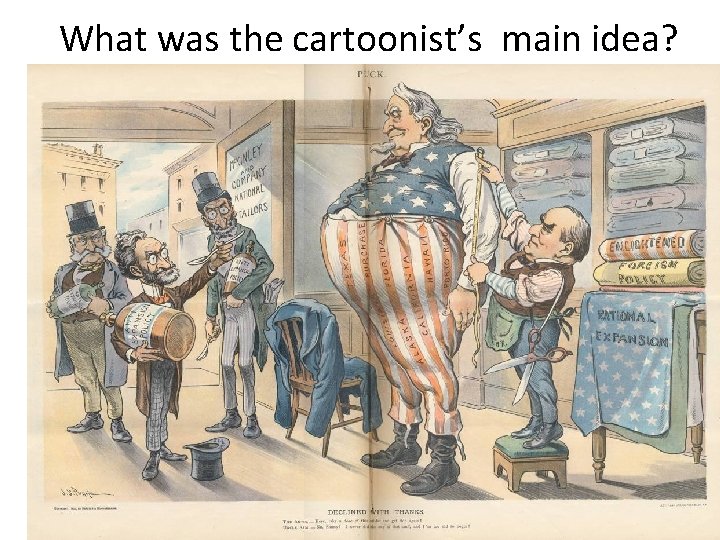
What was the cartoonist’s main idea?
Seward’s Folly • Right after the Civil War, the United States purchased Alaska from Russia. • This purchase was made by Secretary of State William Seward. Many people thought he was making a mistake because they believed Alaska to be useless. • They made fun of the deal calling it Seward’s Folly or Seward’s Icebox. • However, Alaska turned out to be rich in natural resources, especially oil.
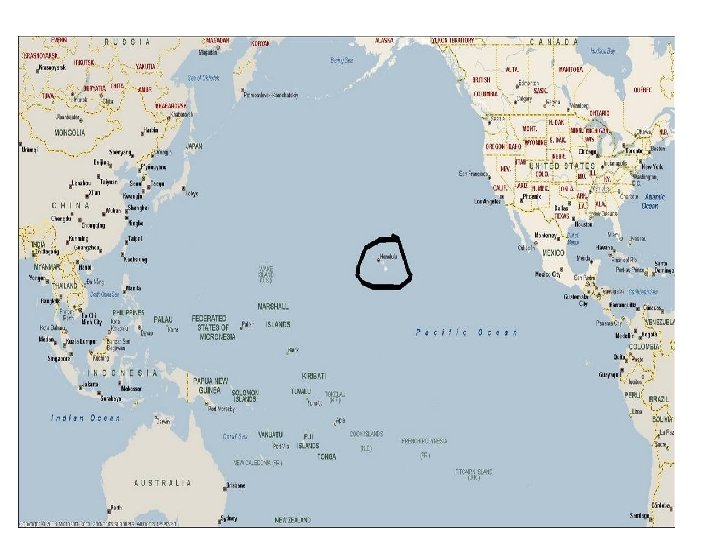
Hawaii • Throughout the nineteenth century, America kept its eye on Hawaii. • The United States wanted Hawaii for two primary reasons: – Economic interests (sugar, pineapples, etc…) – Most importantly, the United States wanted Hawaii because of its strategic location. It was a halfway point between the United States and important trading partners like the Philippines, China, and Japan.
Hawaii • In 1890, an American businessman named Sanford Dole led a rebellion against the queen of Hawaii, Liliuokalani. • While this action was not supported by the United State government at the time, they also did not stop it. • Sanford Dole began ruling over the island eventually the United States annexed Hawaii in 1898 because of the Spanish-American War.
Impacts of Imperialism • https: //www. greatbigstory. com/stories/todance-like-warriors-these-hula-dancers-trainlike-warriors. • How does Imperialism affect the people that are subjugated? • Exit Ticket: Write a short paragraph answering the question, “Is Imperialism immoral? ” Use evidence from class.
The Cuban rebellion • Cuba had been a colony of Spain since Christopher Columbus sailed to the New World in 1492. • For many years, the Cubans had been fighting Spain to gain their independence. • The war was brutal and many people in the United States were horrified at how the Spanish were treating the Cuban people.
The United States becomes involved with Cuba • Because Cuba was so close to the United States, many people were concerned about what was happening on the island. • Furthermore, many people saw the Cuban Revolution as a chance to get Spain out of the region and for the United States to become a world power.
The United States becomes involved with Cuba Ultimately, the United States became involved for three reasons: Yellow Journalism- Joseph Pulitzer and William Randolph Hearst ran sensational headlines that exaggerated what was going on in Cuba. They made the Spanish look really bad and the Cubans look really good.
The United States becomes involved with Cuba & Philippines Desire for World Power: many imperialists saw this as the perfect opportunity to take Spain’s colonies away from them and make them part of the United States. This would make the United States a world power like all the other European countries.
The United States becomes involved with Cuba & Philippines • “Remember the U. S. S. Maine”-in January of 1898, an American boat that was anchored in Havana Harbor exploded. The Spanish were quickly blamed by the Cubans and Americans (especially the yellow journalists), and this gave the powerhungry imperialists an excuse to get involved.
how the Spanish American war was fought • The Spanish-American War was primarily fought in Cuba and the Philippines. • The tropical climate made fighting conditions terrible. It was hot and humid and the vast majority of deaths were a result of malaria and other diseases. • The heroes of the war were Admiral George Dewey and Theodore Roosevelt who led the “Rough. Riders. ” • However, the war was short, only lasting a couple of months. It quickly earned the nickname, “The Splendid Little War” because the United States won easily.
the end of the Spanish American war • The war ended with the signing of the Treaty of Paris • The treaty did two things: • Cuba became an independent nation • It forced Spain to give Guam, Puerto Rico and the Philippines to the United States. • The Spanish-American War officially made the United States a world power and an empire. .
the Aftermath of the war: Cuba • Remember, the Spanish-American War had begun as a result of Cubans fighting for their independence. • While Cuba did indeed gain its independence, the United States forced them to add the Platt Amendment to their constitution. • The Platt Amendment said the following things: – Cuba could not make any treaty with another nation that would weaken its independence. – Cuba had to allow the United States to build naval stations in Cuba. – The United States could intervene to protect Cuban independence and keep order. • This amendment soured the relationship between the United States and Cuba.
the Aftermath of the war: Philippines • The Filipinos, led by Emilio Aguinaldo, had helped the Americans fight the Spanish believing they would be given their independence. • However, after the Spanish-American War, the United States annexed ($20 million) the Philippines. (and what other two countries were ceded by Spain? ) • Consequently, Aguinaldo ordered his troops to fight the Americans. • This came to be known as the Philippine insurrection in America. However, Filipinos saw it as a war for independence.
the Aftermath of the war: Philippines • The war was brutal and the United States used many of the same tactics that they had blamed the Spanish for using in Cuba. • Tens of thousands of Filipinos were sent to reconcentration camps where they died of disease and starvation. Furthermore, both sides used brutal tactics in an attempt to win the war. • Ironically, the war ended on July 4, 1902. • The United States declared victory, and while they allowed for limited self-rule the Philippines basically became a colony of the United States until 1946.
the Aftermath of the war: Philippines • Identify and explain two arguments FOR imperialism • Identify and explain ONE Anti-Imperialist argument against imperialism
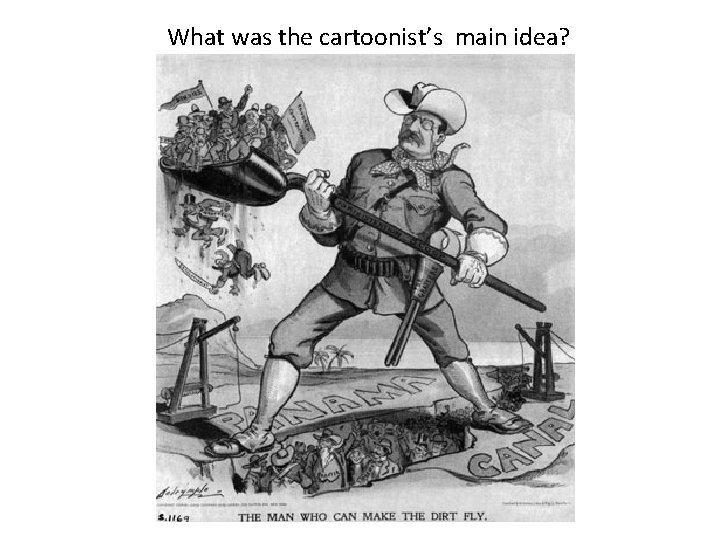
What was the cartoonist’s main idea?
- Slides: 29