
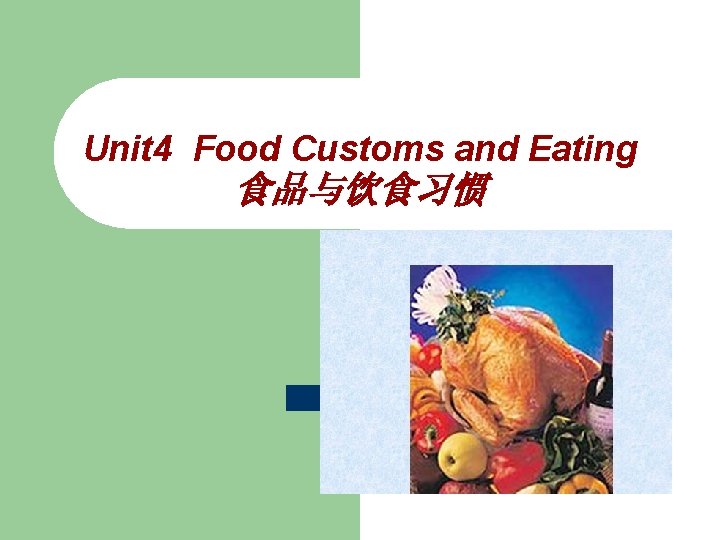
Unit 4 Food Customs and Eating 1Food Customs
![l Like other northern European cuisines( [kwɪ'zin] 烹� ),it majors heavily on meats, dairy](https://slidetodoc.com/presentation_image_h/1e44b427bbd92f1f6c7a3cbec6e73fda/image-6.jpg "l Like other northern European cuisines( [kwɪ'zin] 烹� ),it majors heavily on meats, dairy")
![l For instance, India provided the English language with curry,chutney( ['tʃʌtni] (印度的)酸辣 � (由](https://slidetodoc.com/presentation_image_h/1e44b427bbd92f1f6c7a3cbec6e73fda/image-7.jpg "l For instance, India provided the English language with curry,chutney( ['tʃʌtni] (印度的)酸辣 � (由")
- Slides: 38
Unit 4 Food Customs and Eating 食品与饮食习惯
1.Food Customs(食物�俗 ) l Hotel((大)旅�,�店 ) l Restaurants(��,餐�, 菜�,酒楼,餐� ) l Reservations(�� ) l. Informal Eating(便餐) l American Food Habits l Ordering Food
l l 1.How do Chinese food customs differ from the Americans? 2.Where do you usually go for a quick meal when you are out for business? 3.What is the big difference between Chinese and Americans in taking drinks? 4.What are the most popular fast food in China? Where can you get them?
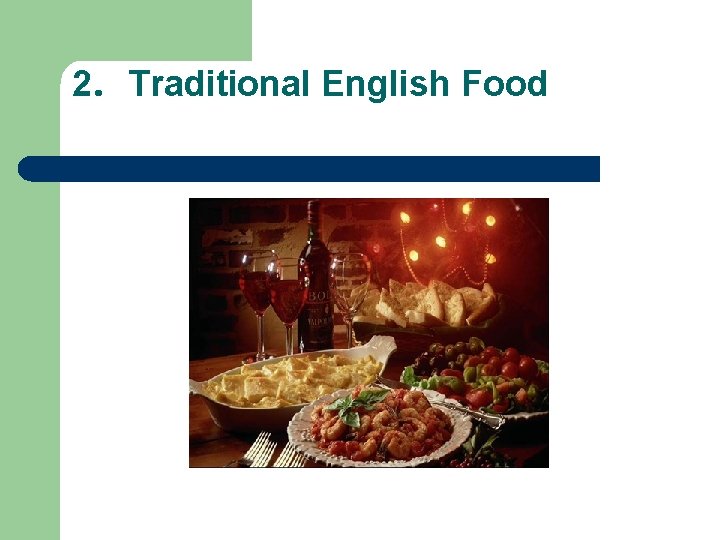
2.Traditional English Food
l Like other northern European cuisines( [kwɪ'zin] 烹� ),it majors heavily on meats, dairy products(乳制品,奶制品),wheat and root vegetables(根茎� 蔬菜) and a diet conducive to(有助于 ; 有益于) manual labor( 体力�� )and red—faced citizens.The nineteenth century idea of a varied diet was one with different sorts of meat in it.Milk and vegetables were regarded as not only uneatable raw(生的,未煮�的 ),but highly
l For instance, India provided the English language with curry,chutney( ['tʃʌtni] (印度的)酸辣 � (由 水 果 、 葡 萄 干 、 � 、 洋 葱 、 香 料 配 制 而 成 )) and kedgeree( [, kedʒə'ri: ] (印 度 )� 蛋 洋 葱 青 豆 � � ) while ketchup came from Indonesia.The aristocratic(贵族的) European tour also gave us the omelette( 煎 蛋 卷 ) , blancmange(blə'mɔnʒ] 牛奶�;牛奶杏仁�糕;英式布丁) ,marmalade(橘子酱 ),mayonnaise([meɪə'neɪz] 蛋黄酱(美乃滋)) and macaroni([, mækə'rəuni] 通心
l In England we tend to underrate(低估;看 � )our own food,slighting(�� )our cookery(烹��) because it is homely and familiar.We no longer recognize the traditional food we still eat as a cuisine or celebrate(歌�,�美 )it and our food manufacturers make the great traditional dishes with microwave(微波炉) —ready(�成的;迅速的) imitations.
l In fact,a visitor can try a traditional English meal with a family.This may consist of roast lamb,roast potatoes, peas(豌豆), carrots and gravy(胡�卜炖肉 ),the puddings and cakes are things “that a foreigner will remember the most.
l l l 1.What does English food usually major on? 2.Why were raw milk and vegetables considered uneatable in the 1 9 th century? 3.What helped the English to add a number of colorful foreign words to the vocabulary and foreign dishes to the table in the Victorian time?
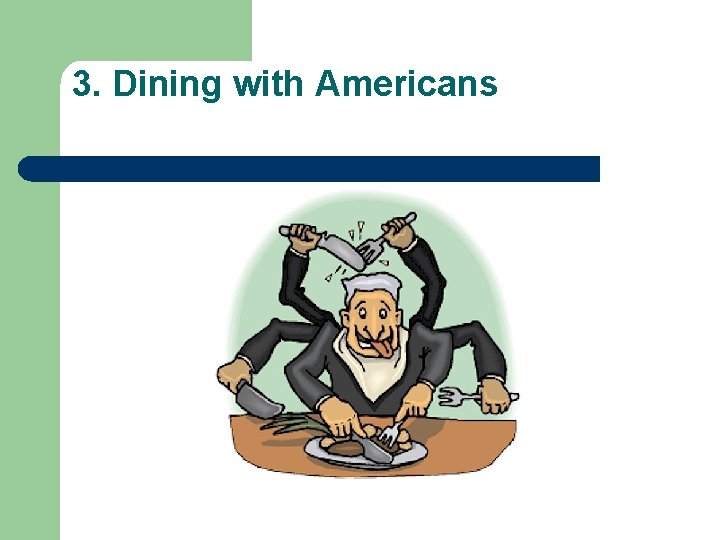
3. Dining with Americans
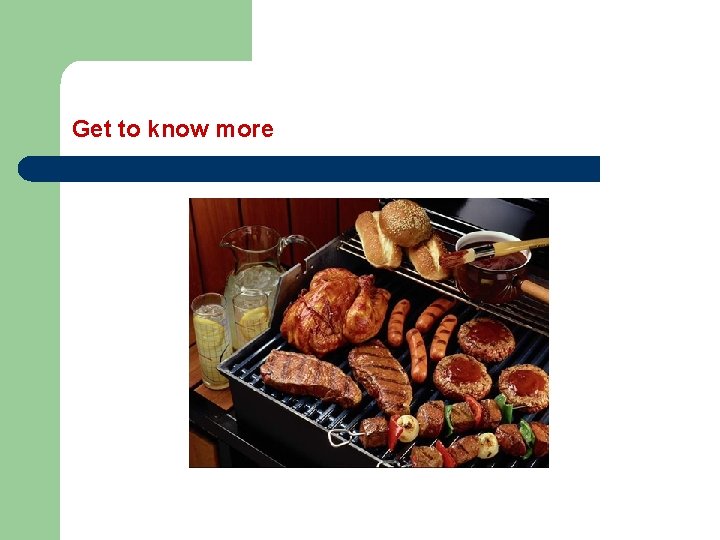
l American restaurants are all the same. They prepare food in only three ways:boiled in water,grilled(�,烤 ),and deep— fried(油炸);,apart from these there is no other variety.Then,on the table a lot of “condiments(�味品,香辛料 (如胡椒粉、芥末、香料等)) ” are served,so that customers can make things as sweet,salty,sour or spicy as they like.
l Especially for someone who has just arrived in America,the sight of a hot dog dripping with red tomato sauce and yellow mustard is enough to take your appetite away(� 你倒胃口).But when you are hungry, there is nothing to do but close your eyes and swallow it.
Hamburgers are even worse, semi— raw beef with a slice of raw onion and a slice of raw tomato,and then some hamburger sauce one dares not try it.Sandwiches sound good,but are in fact tasteless(无味的;不好吃的).So eating is the most troubling(烦恼,困难 ) aspect of living in America. l
l Being invited to dinner is a big treat for Americans, but I find it a painful assignment( 痛苦的任务 ).First,I cannot get used to eating sweet and salty things together. Second, terrible—tasting( 味 道 糟 糕 ) food must be praised to the skies(被 捧 上 天 ). Third,it is not filling( 装满 ;填满 ;吃饱 ), and you have to make yourself another meal after going home.
l One time,a colleague said to my husband, “My father is a good cook and invites you two to have a taste of his culinary skill(厨� ) this weekend."It would have been embarrassing to refuse,so we had to accept .The meal turned out to be canned chicken with vegetables and rice,which tasted funny .Following this dish was a dessert of cored apples(去核的苹果),stuffed with plum jam(李 子果� )and coated in sugar.
l Often when we were invited to dinner by Americans,I felt that they were not inviting us to eat but to look at the tableware([�称 ]餐 具).They do not use rice bowls.At the beginning of the meal the table is set with three plates,for each person,three glasses, a knife,a fork,a big spoon and a little spoon.
l The big spoon is seldom used,however, for they do not drink soup but lots of cold water,so the glasses see much service. The first course is usually raw salad(生菜沙拉) or fruit salad, followed by bread and butter.
l After that some strange—-looking and odd---tasting little dishes are served while people eat and talk.Then comes the main course, usually a piece of chicken or steak or a slice of ham,with a few fried potatoes and some peas,or whatever, boiled to a pulp(�;糊状 ).When this is finished,dessert is served,fruit pie or ice cream,and cake,which is murder to eat, for it is tasteless.
l l 1.What are three ways that the American people prepare l their food? 2.What are the author’S comments on the American fast food? 3.Why does the author dare not try the semi —raw beef? 4. Why does the author hate beinginvited to dinner by Americans?
Get to know more
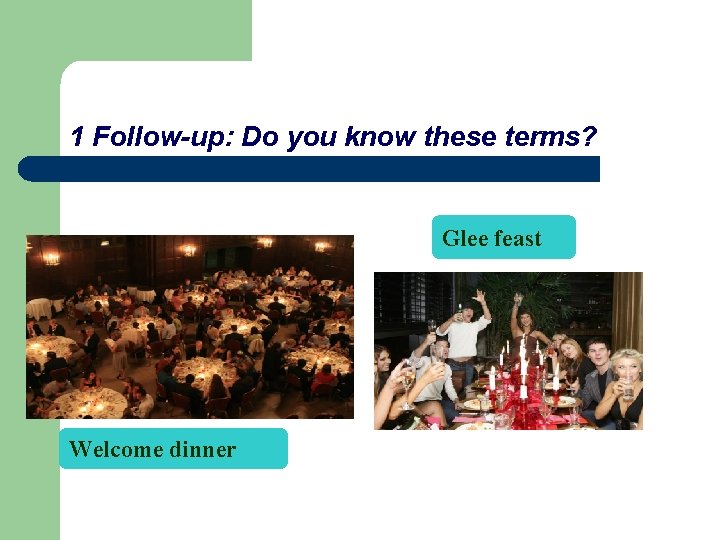
1 Follow-up: Do you know these terms? Glee feast Welcome dinner
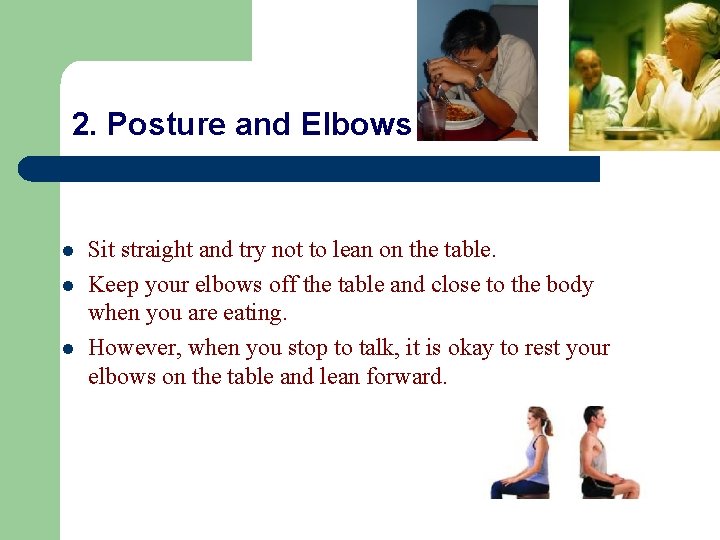
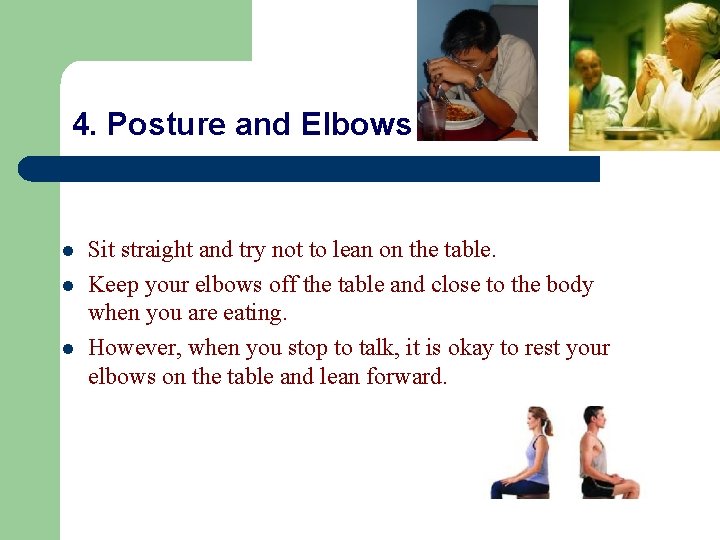
2. Posture and Elbows l l l Sit straight and try not to lean on the table. Keep your elbows off the table and close to the body when you are eating. However, when you stop to talk, it is okay to rest your elbows on the table and lean forward.
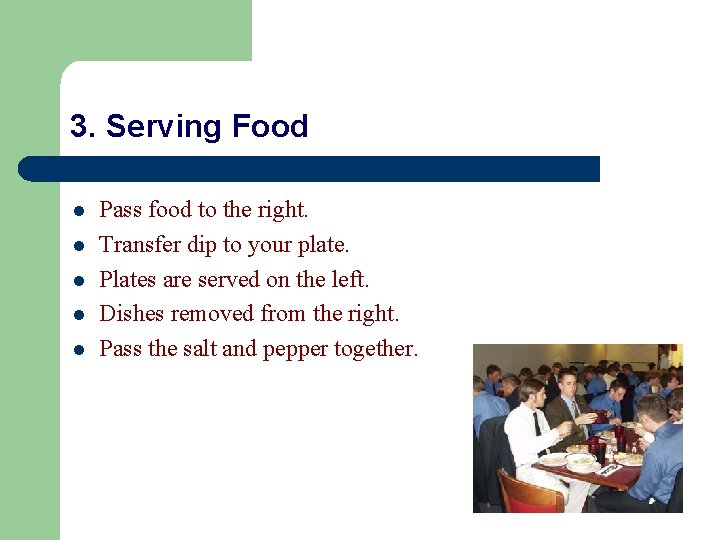
3. Serving Food l l l Pass food to the right. Transfer dip to your plate. Plates are served on the left. Dishes removed from the right. Pass the salt and pepper together.
4. Posture and Elbows l l l Sit straight and try not to lean on the table. Keep your elbows off the table and close to the body when you are eating. However, when you stop to talk, it is okay to rest your elbows on the table and lean forward.
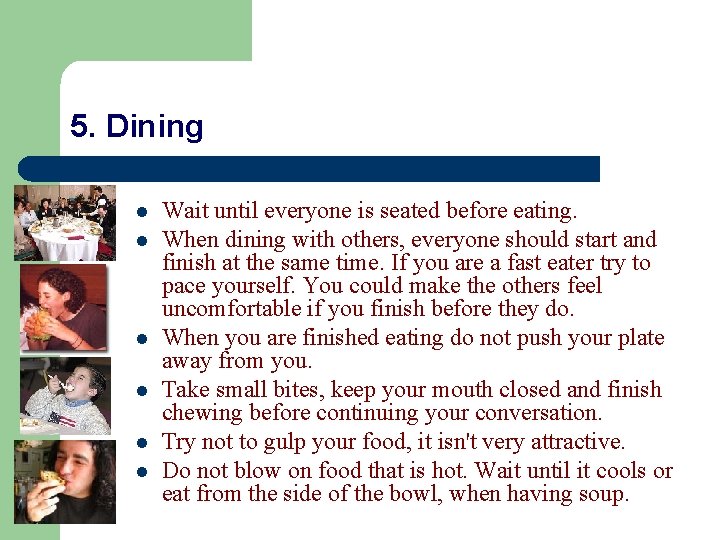
5. Dining l l l Wait until everyone is seated before eating. When dining with others, everyone should start and finish at the same time. If you are a fast eater try to pace yourself. You could make the others feel uncomfortable if you finish before they do. When you are finished eating do not push your plate away from you. Take small bites, keep your mouth closed and finish chewing before continuing your conversation. Try not to gulp your food, it isn't very attractive. Do not blow on food that is hot. Wait until it cools or eat from the side of the bowl, when having soup.
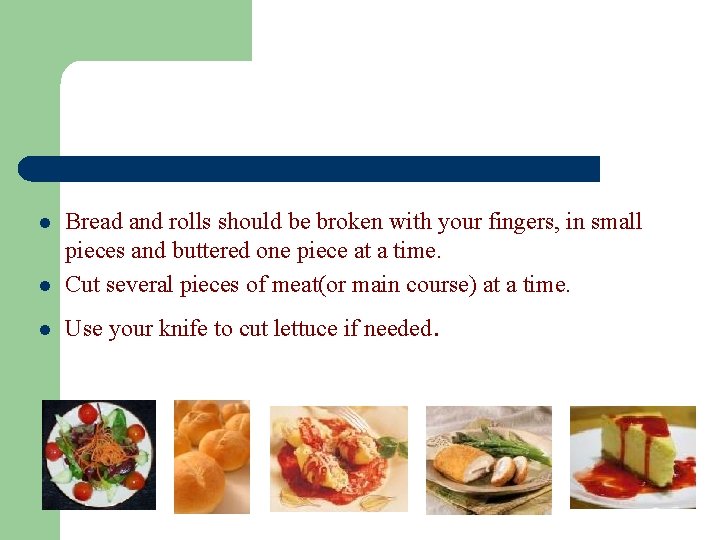
l Bread and rolls should be broken with your fingers, in small pieces and buttered one piece at a time. Cut several pieces of meat(or main course) at a time. l Use your knife to cut lettuce if needed. l
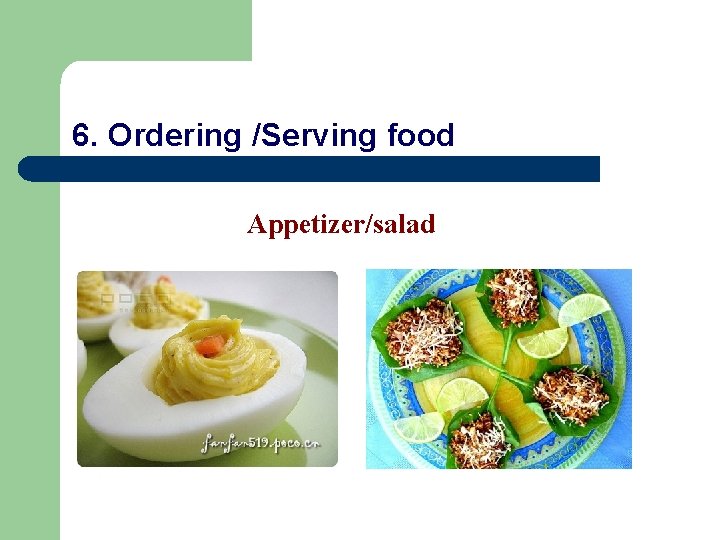
6. Ordering /Serving food Appetizer/salad
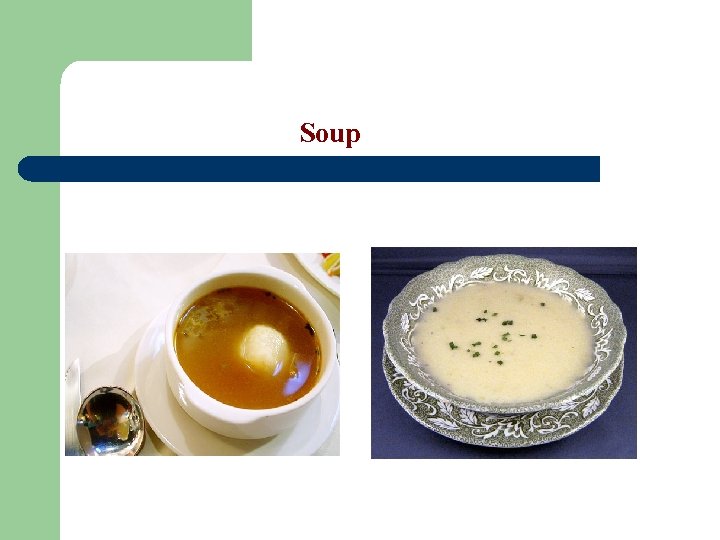
Soup
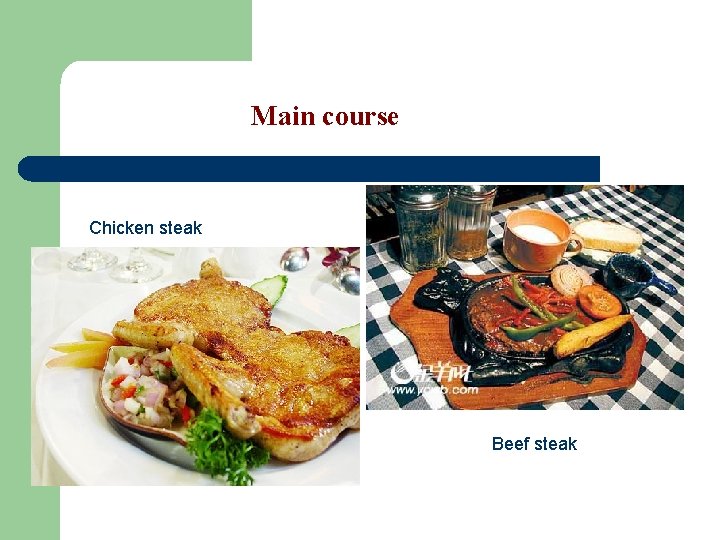
Main course Chicken steak Beef steak
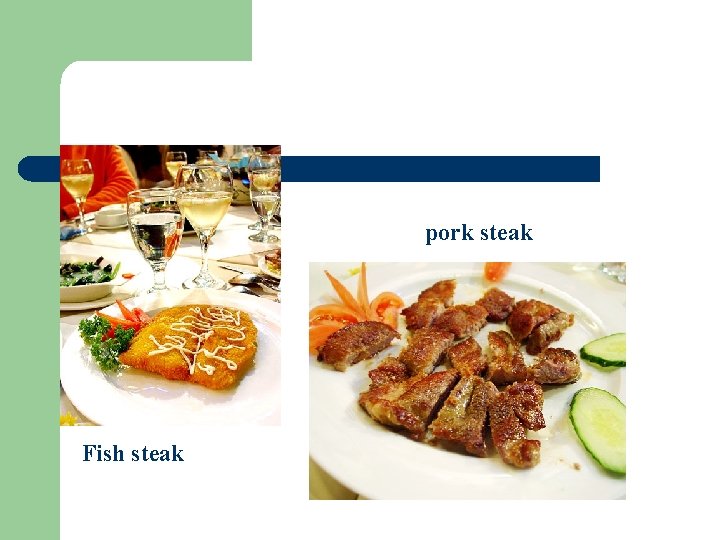
pork steak Fish steak
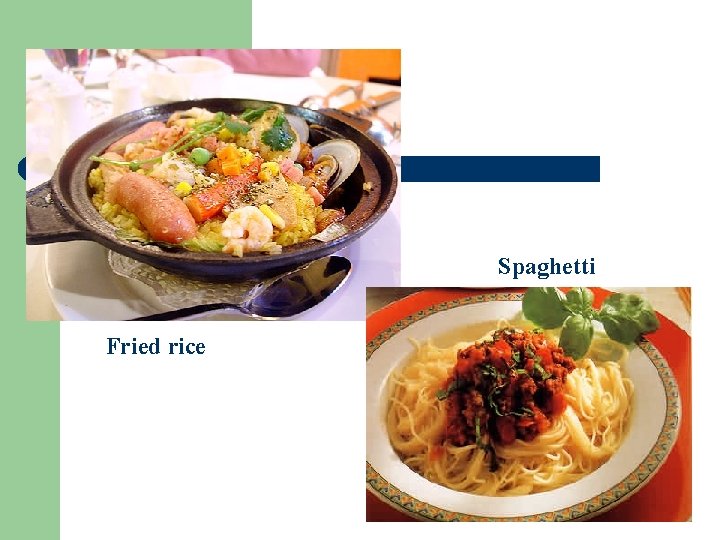
Spaghetti Fried rice
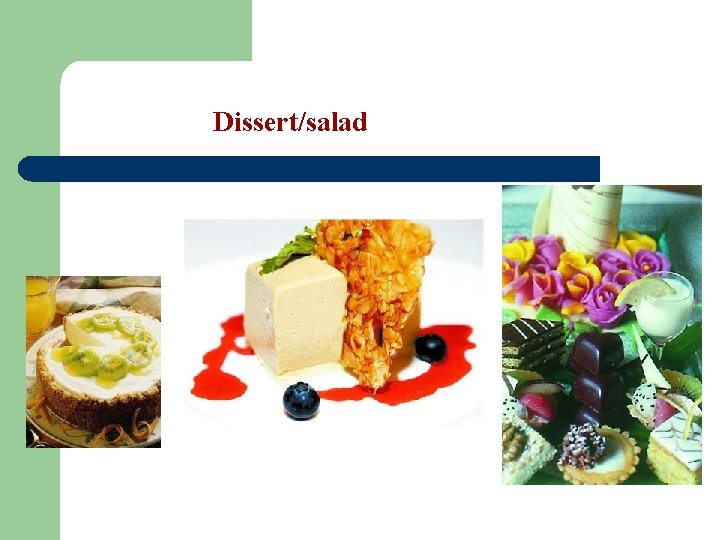
Dissert/salad
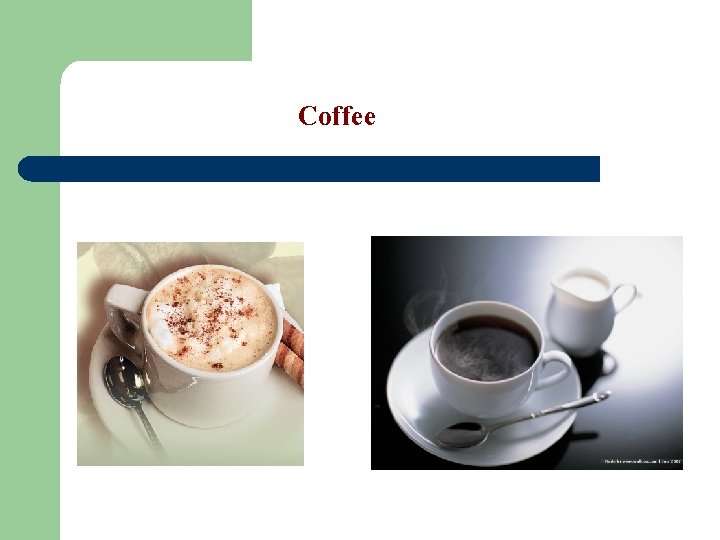
Coffee
Some general rules in your mind when sitting at table
7. General table manners • Chew with your mouth closed. • Do not talk at an excessively loud volume and do not make loud or unusual noises while eating. • Refrain from burping, coughing, sneezing or blowing nose at the table. If you must do so, you may request that your action be excused.
• Never tilt back your chair while at the table. Sit in a relaxed and comfortable position, but do not "slouch. " • Always ask the host or hostess to be excused before leaving the table. • Do not stare at anyone while he or she is eating. It is considered rude. • Never talk on your phone or text a friend at the table. If an urgent matter arises, ask host or hostess to be excused, and step away from the table.
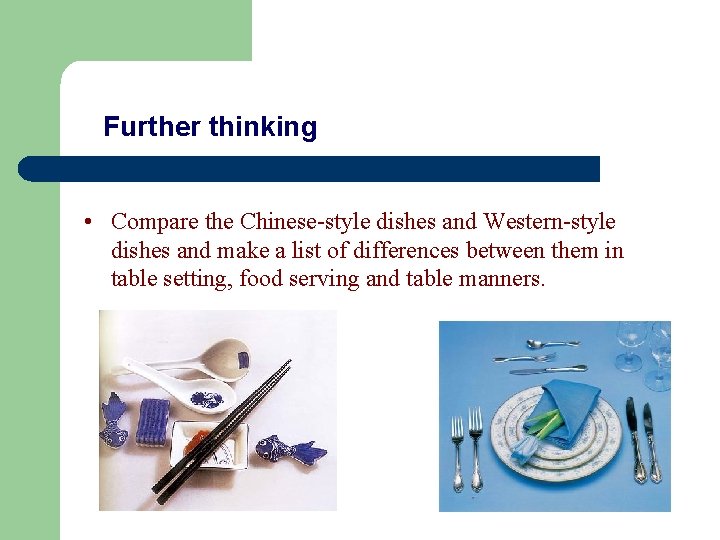
Further thinking • Compare the Chinese-style dishes and Western-style dishes and make a list of differences between them in table setting, food serving and table manners.