
Unit 4 Engineering Design Discussing Dimensions and Precision

- Slides: 24
Unit 4: Engineering Design Discussing Dimensions and Precision Dr. Hatem Elaydi Engineering Technical English Islamic University of Gaza March 12, 2016
Outline �Working with Drawings �Discussing Dimensions and Precision �Describing Design Phases and Procedures �Resolving Design Problems Dr. Hatem Elaydi, IUG, Spring 2016, ENGG 1305 2
II. Discussing Dimensions and Precision 6 a. Discuss what is meant by precision and accuracy Answers The words mean how exact something is, for example how closely the sizes of manufactured items match their designed size. Dr. Hatem Elaydi, IUG, Spring 2016, ENGG 1305 3
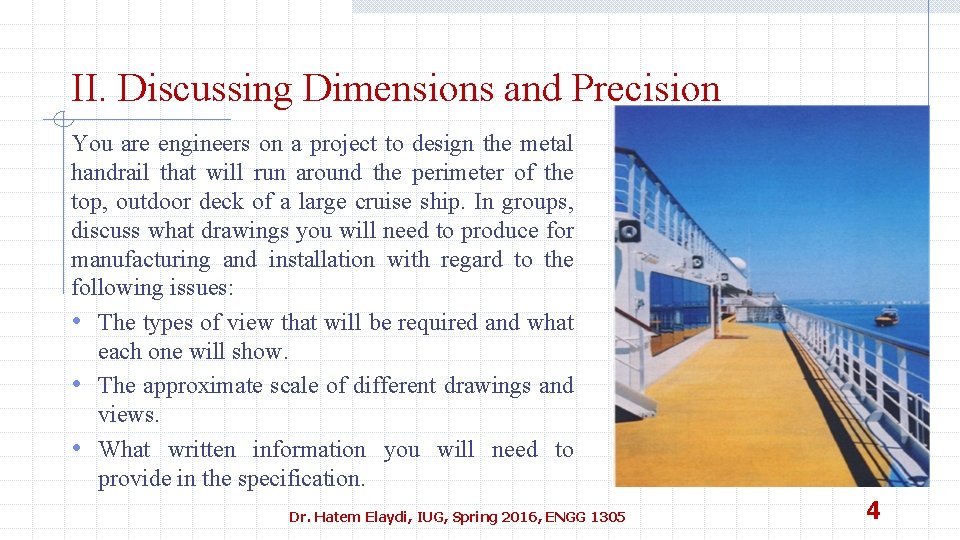
II. Discussing Dimensions and Precision You are engineers on a project to design the metal handrail that will run around the perimeter of the top, outdoor deck of a large cruise ship. In groups, discuss what drawings you will need to produce for manufacturing and installation with regard to the following issues: • The types of view that will be required and what each one will show. • The approximate scale of different drawings and views. • What written information you will need to provide in the specification. Dr. Hatem Elaydi, IUG, Spring 2016, ENGG 1305 4
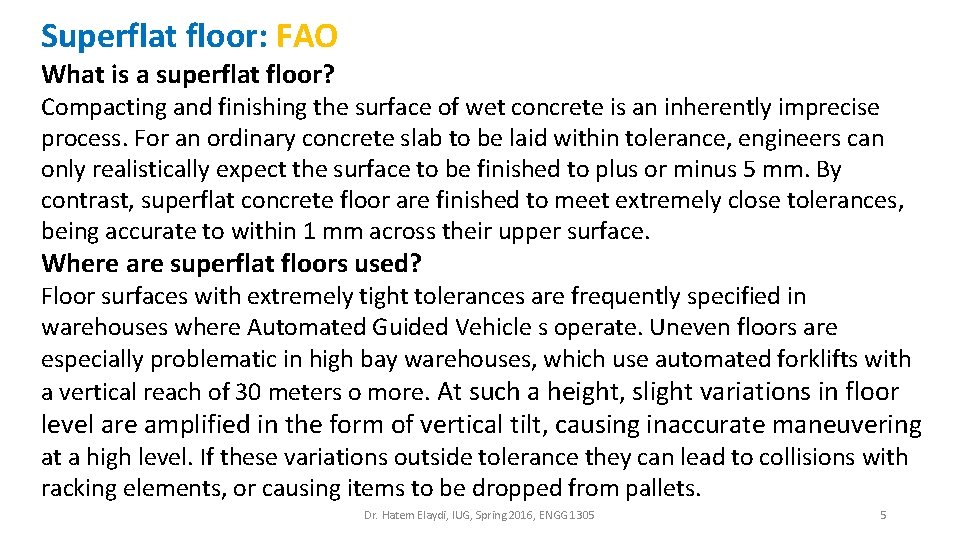
Superflat floor: FAO What is a superflat floor? Compacting and finishing the surface of wet concrete is an inherently imprecise process. For an ordinary concrete slab to be laid within tolerance, engineers can only realistically expect the surface to be finished to plus or minus 5 mm. By contrast, superflat concrete floor are finished to meet extremely close tolerances, being accurate to within 1 mm across their upper surface. Where are superflat floors used? Floor surfaces with extremely tight tolerances are frequently specified in warehouses where Automated Guided Vehicle s operate. Uneven floors are especially problematic in high bay warehouses, which use automated forklifts with a vertical reach of 30 meters o more. At such a height, slight variations in floor level are amplified in the form of vertical tilt, causing inaccurate maneuvering at a high level. If these variations outside tolerance they can lead to collisions with racking elements, or causing items to be dropped from pallets. Dr. Hatem Elaydi, IUG, Spring 2016, ENGG 1305 5
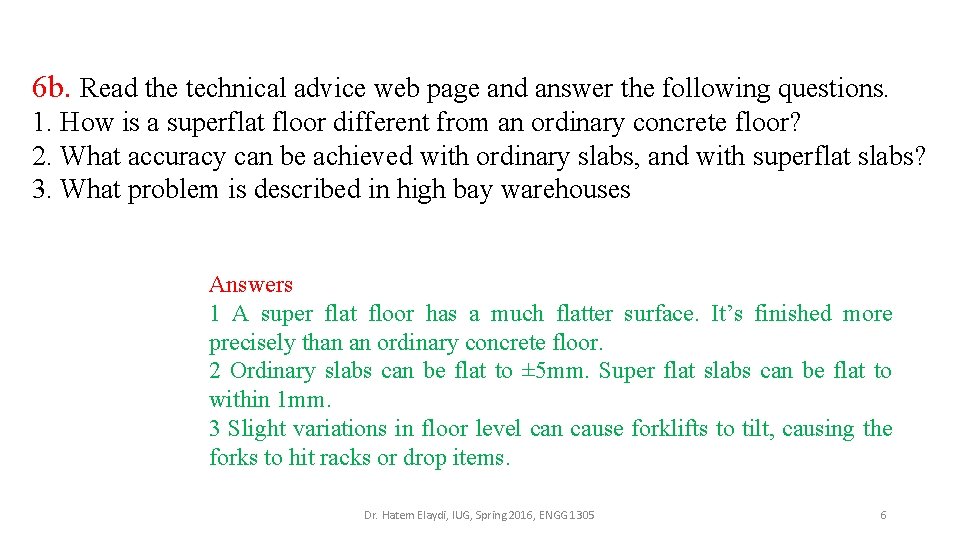
6 b. Read the technical advice web page and answer the following questions. 1. How is a superflat floor different from an ordinary concrete floor? 2. What accuracy can be achieved with ordinary slabs, and with superflat slabs? 3. What problem is described in high bay warehouses Answers 1 A super flat floor has a much flatter surface. It’s finished more precisely than an ordinary concrete floor. 2 Ordinary slabs can be flat to ± 5 mm. Super flat slabs can be flat to within 1 mm. 3 Slight variations in floor level can cause forklifts to tilt, causing the forks to hit racks or drop items. Dr. Hatem Elaydi, IUG, Spring 2016, ENGG 1305 6
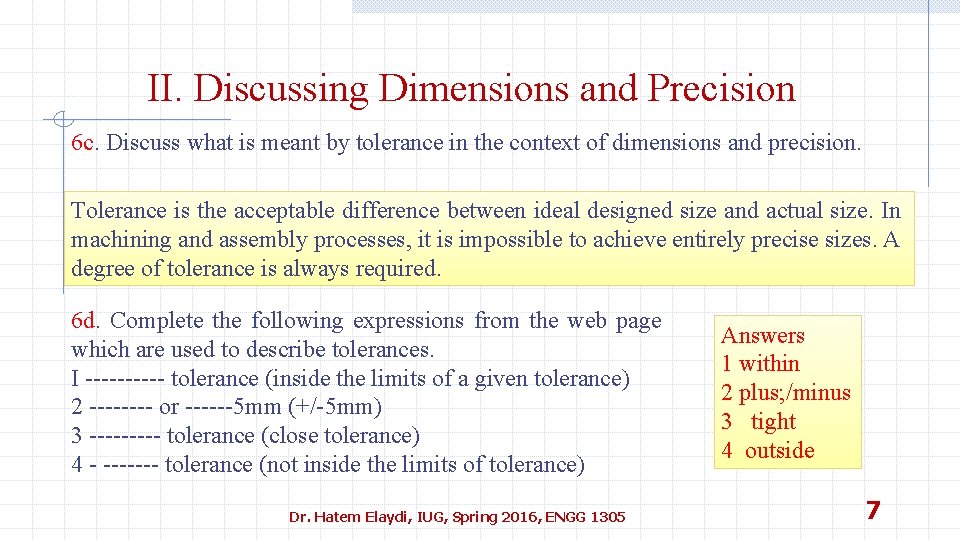
II. Discussing Dimensions and Precision 6 c. Discuss what is meant by tolerance in the context of dimensions and precision. Tolerance is the acceptable difference between ideal designed size and actual size. In machining and assembly processes, it is impossible to achieve entirely precise sizes. A degree of tolerance is always required. 6 d. Complete the following expressions from the web page which are used to describe tolerances. I ----- tolerance (inside the limits of a given tolerance) 2 ---- or ------5 mm (+/-5 mm) 3 ----- tolerance (close tolerance) 4 - ------- tolerance (not inside the limits of tolerance) Dr. Hatem Elaydi, IUG, Spring 2016, ENGG 1305 Answers 1 within 2 plus; /minus 3 tight 4 outside 7
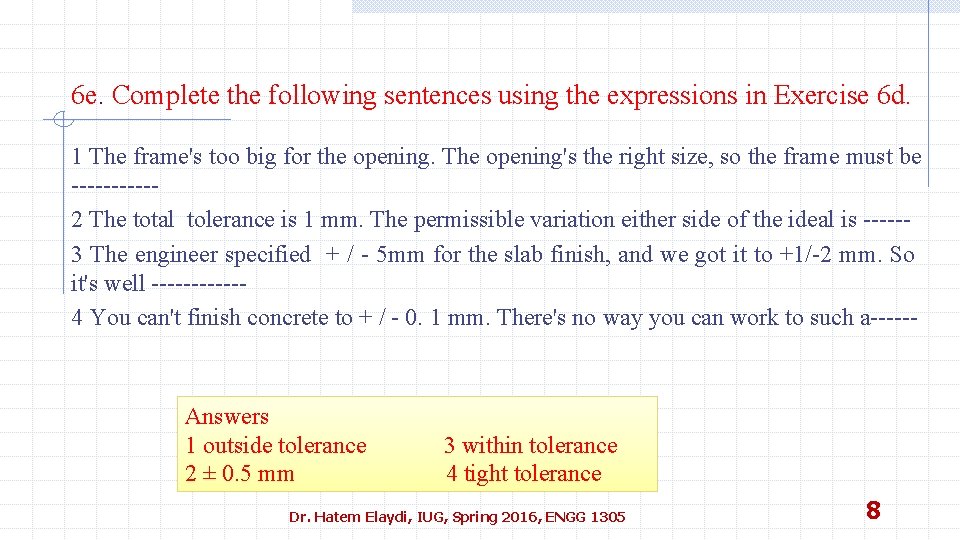
6 e. Complete the following sentences using the expressions in Exercise 6 d. 1 The frame's too big for the opening. The opening's the right size, so the frame must be -----2 The total tolerance is 1 mm. The permissible variation either side of the ideal is -----3 The engineer specified + / - 5 mm for the slab finish, and we got it to +1/-2 mm. So it's well ------4 You can't finish concrete to + / - 0. 1 mm. There's no way you can work to such a------ Answers 1 outside tolerance 2 ± 0. 5 mm 3 within tolerance 4 tight tolerance Dr. Hatem Elaydi, IUG, Spring 2016, ENGG 1305 8
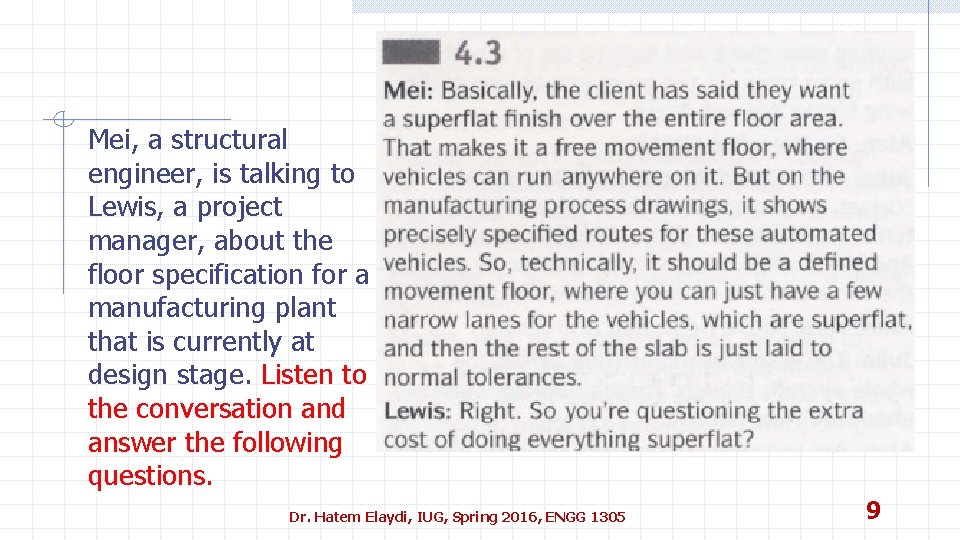
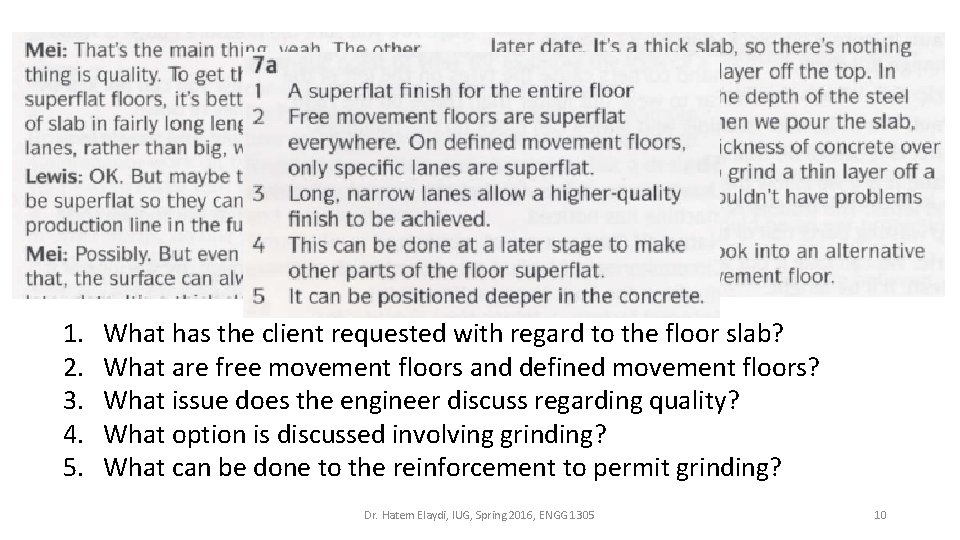
Mei, a structural engineer, is talking to Lewis, a project manager, about the floor specification for a manufacturing plant that is currently at design stage. Listen to the conversation and answer the following questions. Dr. Hatem Elaydi, IUG, Spring 2016, ENGG 1305 9
1. 2. 3. 4. 5. What has the client requested with regard to the floor slab? What are free movement floors and defined movement floors? What issue does the engineer discuss regarding quality? What option is discussed involving grinding? What can be done to the reinforcement to permit grinding? Dr. Hatem Elaydi, IUG, Spring 2016, ENGG 1305 10
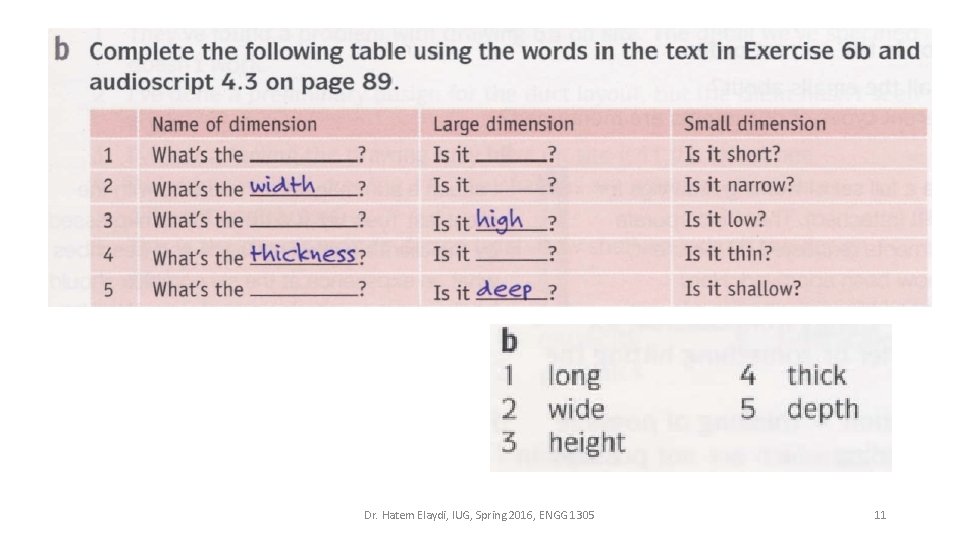
Dr. Hatem Elaydi, IUG, Spring 2016, ENGG 1305 11
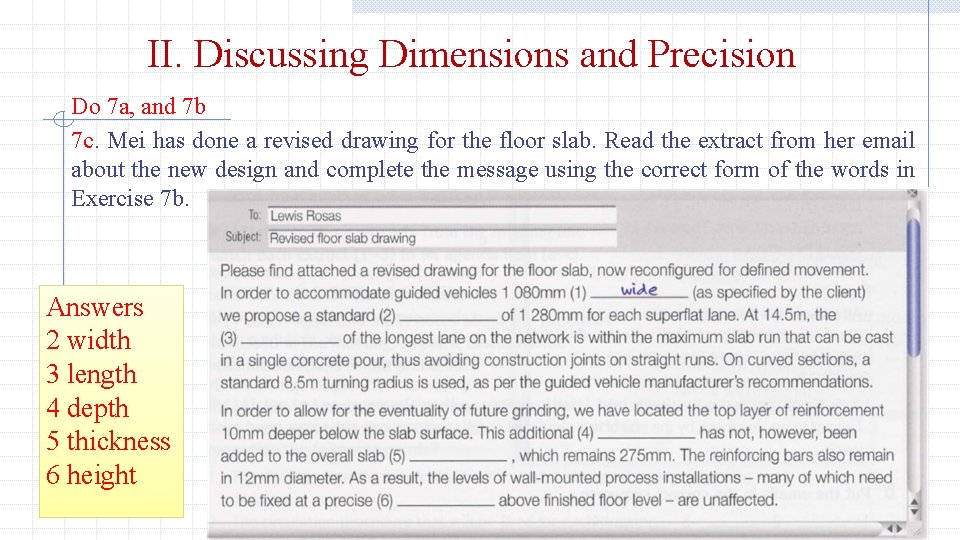
II. Discussing Dimensions and Precision Do 7 a, and 7 b 7 c. Mei has done a revised drawing for the floor slab. Read the extract from her email about the new design and complete the message using the correct form of the words in Exercise 7 b. Answers 2 width 3 length 4 depth 5 thickness 6 height Dr. Hatem Elaydi, IUG, Spring 2016, ENGG 1305 12
Types of drawing required: a plan showing the perimeter of the handrail (possible scale 1: 100); an elevation of a short length of the handrail (possible scale 1: 10); a section of the handrail (possible scale 1: 10); details showing key connections, such as those between handrail posts and deck, and top rail and posts (possible scale-actual size). Specification type of steel, types of welded joint, types of bolt, type and color of paint/coating other materials such as Plastic surround to top rail Dr. Hatem Elaydi, IUG, Spring 2016, ENGG 1305 13
HW Do Q 8 Dr. Hatem Elaydi, IUG, Spring 2016, ENGG 1305 14
III. Describing Design Phases and Procedures Language note You will find the following vocabulary useful in this section. design brief, preliminary drawing, working drawing, (rough) sketch amend, amendment, approve, approval, circulate, comment on, issue, resolve, revision, specify, supersede Dr. Hatem Elaydi, IUG, Spring 2016, ENGG 1305 15
III. Describing Design Phases and Procedures 9. Discuss what is meant by a design process. In engineering, what are the stages in the development of designs? Answers A design process is the development of a design. A typical design starts with a design brief, which states the design objectives. Initial ideas are then put together as rough sketches. These are then developed into preliminary drawings, which are more detailed and are often drawn to scale. The preliminary drawings are then developed, incorporating comments from different members of the design team, consultants and the client. Once the design has been sufficiently developed, working drawings are produced. These are then used for manufacturing/assembly/construction. Frequently, working drawings are revised (changed) during this latter phase, in order to resolve technical problems encountered during manufacturing/assembly/construction. 16 Dr. Hatem Elaydi, IUG, Spring 2016, ENGG 1305
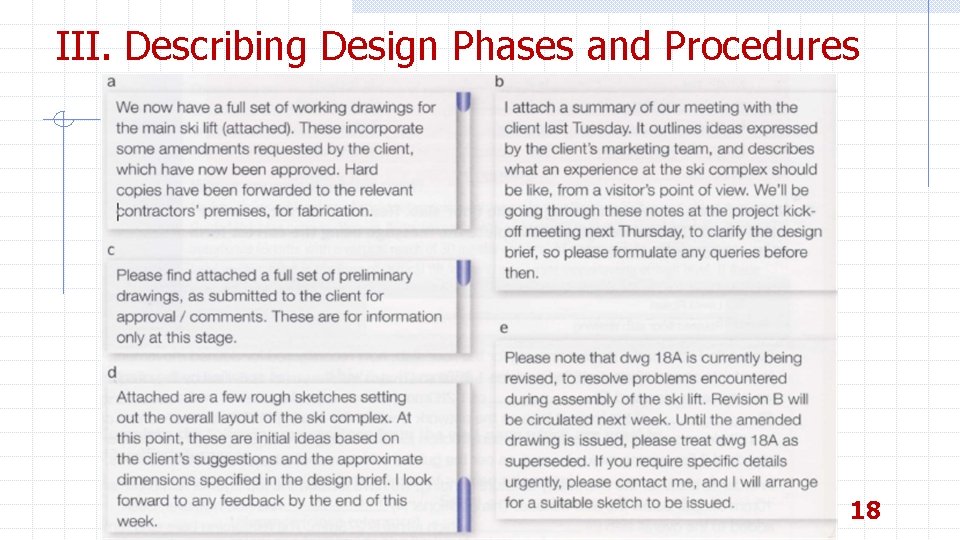
III. Describing Design Phases and Procedures The following extracts from emails relate to a project to build an indoor ski complex in Australia, using artificial snow. The messages were circulated by an engineer to members of the design team, and to a specialist contractor. Read the emails and answer the following questions. Note that the emails are not in the correct order. 1 What are all the emails about? 2 What different types of document are mentioned? Dr. Hatem Elaydi, IUG, Spring 2016, ENGG 1305 17
III. Describing Design Phases and Procedures Dr. Hatem Elaydi, IUG, Spring 2016, ENGG 1305 18
III. Describing Design Phases and Procedures Answers 1 design information (at different stages of the design process) 2 sketches, design brief, revised/amended drawing, superseded drawing, preliminary drawing, working drawing, summary/notes 10 b. Put the emails in the correct sequence 1……… 2……… 3……… 4……… Answers 1 b 2 d 3 c 4 a 5……… 5 e Dr. Hatem Elaydi, IUG, Spring 2016, ENGG 1305 19
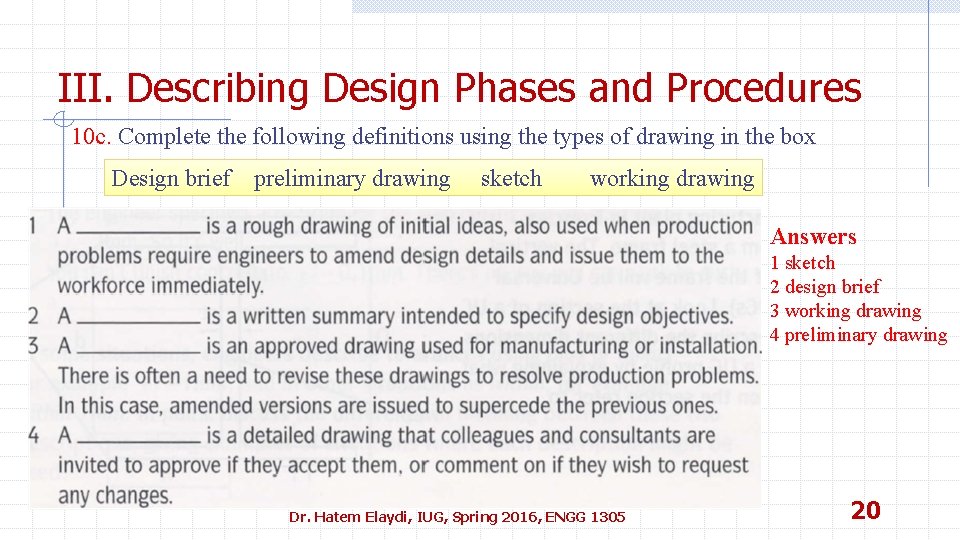
III. Describing Design Phases and Procedures 10 c. Complete the following definitions using the types of drawing in the box Design brief preliminary drawing sketch working drawing Answers 1 sketch 2 design brief 3 working drawing 4 preliminary drawing Dr. Hatem Elaydi, IUG, Spring 2016, ENGG 1305 20
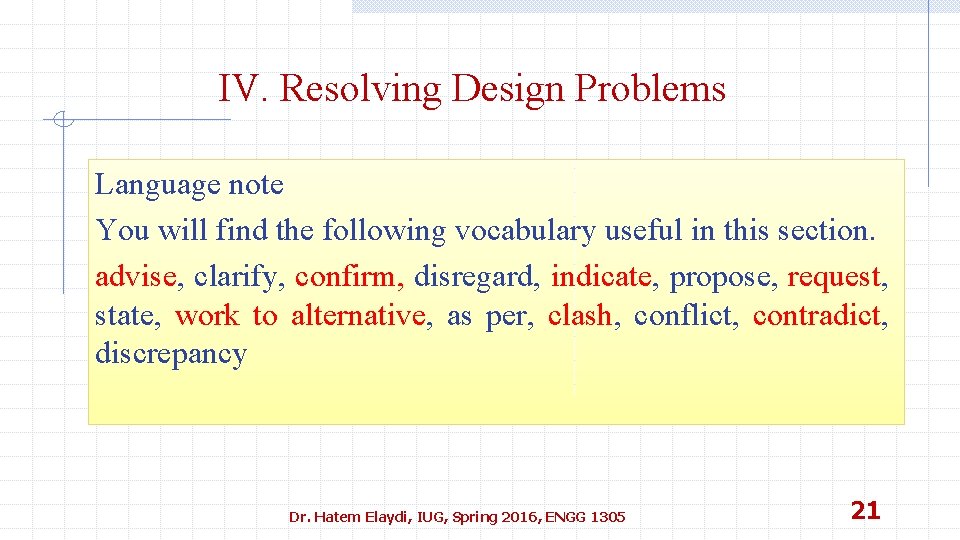
IV. Resolving Design Problems Language note You will find the following vocabulary useful in this section. advise, clarify, confirm, disregard, indicate, propose, request, state, work to alternative, as per, clash, conflict, contradict, discrepancy Dr. Hatem Elaydi, IUG, Spring 2016, ENGG 1305 21
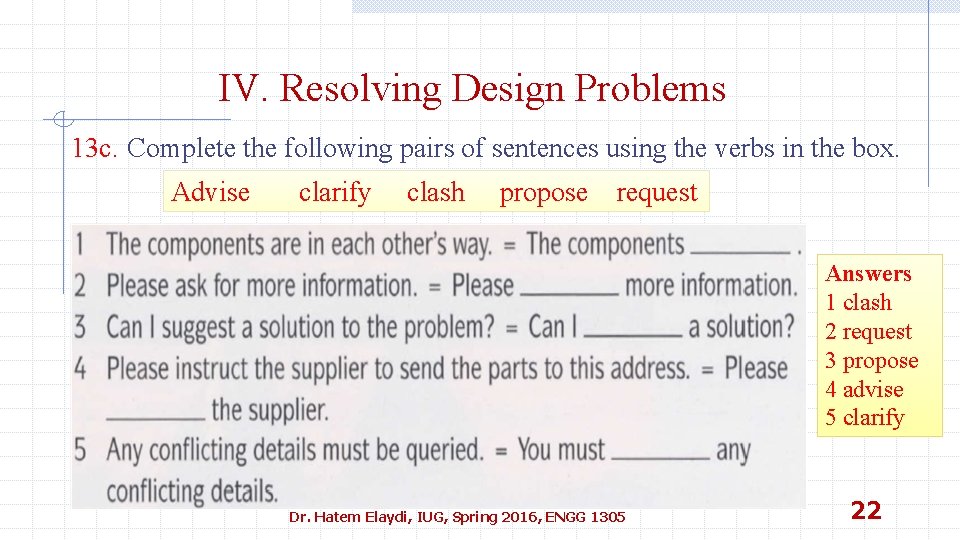
IV. Resolving Design Problems 13 c. Complete the following pairs of sentences using the verbs in the box. Advise clarify clash propose request Answers 1 clash 2 request 3 propose 4 advise 5 clarify Dr. Hatem Elaydi, IUG, Spring 2016, ENGG 1305 22
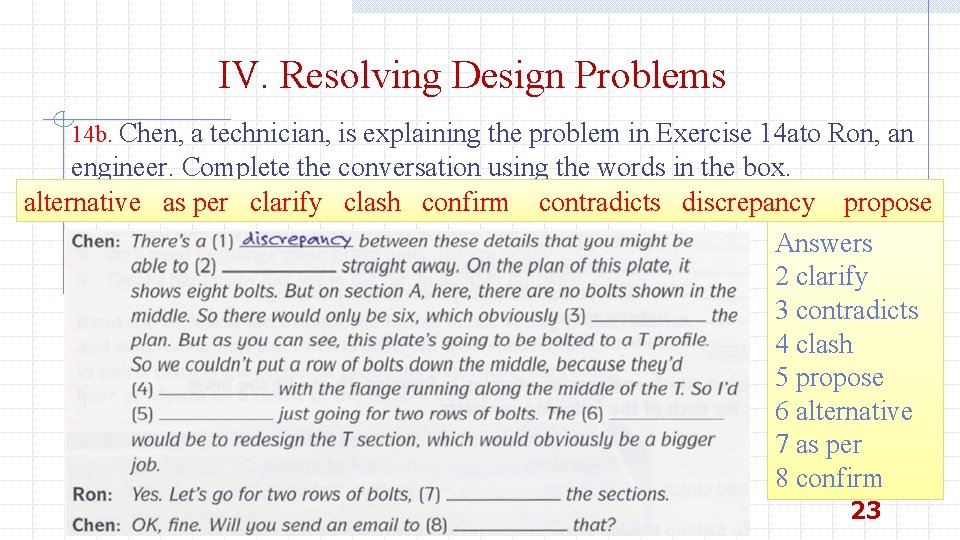
IV. Resolving Design Problems 14 b. Chen, a technician, is explaining the problem in Exercise 14 ato Ron, an engineer. Complete the conversation using the words in the box. alternative as per clarify clash confirm contradicts discrepancy propose Answers 2 clarify 3 contradicts 4 clash 5 propose 6 alternative 7 as per 8 confirm Dr. Hatem Elaydi, IUG, Spring 2016, ENGG 1305 23
Dr. Hatem Elaydi, IUG, Spring 2016, ENGG 1305 24