
Unit 4 Electronic Information sources use and user

- Slides: 48
Unit 4: Electronic Information sources use and user studies By Dr. Gururaj S. Hadagali 2/13/2022 Dr. Gururaj S. Hadagali 1
User Studies �Libraries and information systems are designed & built with the primary objective of the meeting the information needs of a group of people who: constitute their clientele. �Today, all services of the libraries are centred around the user. �In other words, today customer is the king. And all the products are brought keeping customers needs and requirements in mind. 2/13/2022 Dr. Gururaj S. Hadagali 2
User studies: Definition The term ‘user studies` has been identified variously by different information scientists. According to Wyoski user studies or use studies could be concerned with studying information processing activities of the users. Empirical studies related to the use of, the demand or need for information are usually called user studies. In fact a study which is focused on user to understand directly or indirectly their information needs, user behavior and use pattern is often called user study. 2/13/2022 Dr. Gururaj S. Hadagali 3
�Identifying definite user groups to which information is to be provided involves number of complex, costly, and demanding processes. User studies are necessary in all phases of information activities from design to evaluation. Therefore it is very essential to understand the question: * What useful information is about the users or uses should be collected. 2/13/2022 Dr. Gururaj S. Hadagali 4
The need for user studies User studies are potentially useful in bridging the gap between the kind of information service needed and kind of services in existence. However there had been certain doubts regarding the point whether information needs could really be established through user studies or surveys. For instance, it has been stated that information needs as distinct from wants, cannot be determined through opinion poll type surveys. 2/13/2022 Dr. Gururaj S. Hadagali 5
�The situation led to the efforts for development of reliable methodologies for conducting user studies and further emphasized the need for conducting user studies as necessary requirement for the design and operation of effective and efficient information systems, services and products. 2/13/2022 Dr. Gururaj S. Hadagali 6
Information Literacy 2/13/2022 Dr. Gururaj S. Hadagali 7
What is Information? Case (2002) provides a broader definition. Here the term is synonymous with: Encapsulated knowledge Packaged human experience A source that can provide a myriad of data A resource that takes different formats, packaging, transfer media, and varied methods of delivery. People: Family, Tutors, fellow students 2/13/2022 Dr. Gururaj S. Hadagali 8
The need for effective use of information Information has become a vital source for world economics and is certainly the basic component of education. Information is a vital element to technological and scientific change. It poses several challenges to individuals of all walks of life: students, workers, and citizens of all types. The current information overload requires people to validate and assess information to verify its reliability. Information by itself does not make people information literate. 2/13/2022 Dr. Gururaj S. Hadagali 9
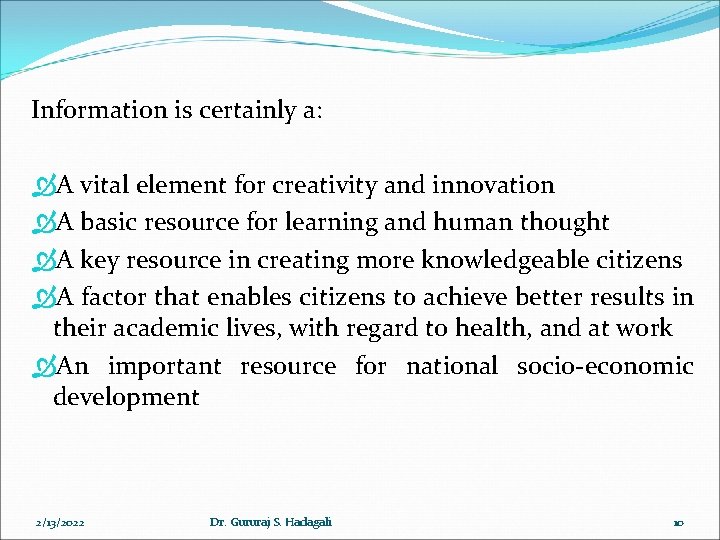
Information is certainly a: A vital element for creativity and innovation A basic resource for learning and human thought A key resource in creating more knowledgeable citizens A factor that enables citizens to achieve better results in their academic lives, with regard to health, and at work An important resource for national socio-economic development 2/13/2022 Dr. Gururaj S. Hadagali 10
What is Literacy? The basic definition of literacy is “the condition of being literate” according to the Chambers English Dictionary (2003). This reference work, on the other hand, defines literate as “… learned; able to read and write; having a competence in or with’. In education parlance, “Basic Literacy” means the classic or traditional literacies of learning how to read, to write, and to perform numeric calculations and operations; basic literacies in almost all societies are learned in basic and secondary formal education settings, primarily public or private schools, but sometimes basic literacies are learned at home or in community centres. 2/13/2022 Dr. Gururaj S. Hadagali 11
DEFINITIONS The most commonly cited and used Information Literacy definition is the one adopted by the American Library Association (ALA), 1998: “To be information literate, a person must be able to recognize when information is needed and have the ability to locate, evaluate, and use effectively the needed information. The information literate individuals are those who have learned how to learn”. 2/13/2022 Dr. Gururaj S. Hadagali 12
Doyle (1992) defined an information literate person as one who: “recognizes the need for information; recognizes that accurate and complete information is the basis for intelligent decision making; identifies potential sources of information; develops successful search strategies; accesses sources of information, including computer-based and other technologies; evaluates information; organizes information for practical application; integrates new information into an existing body of knowledge, and; uses information in critical thinking and problem solving”. 2/13/2022 Dr. Gururaj S. Hadagali 13
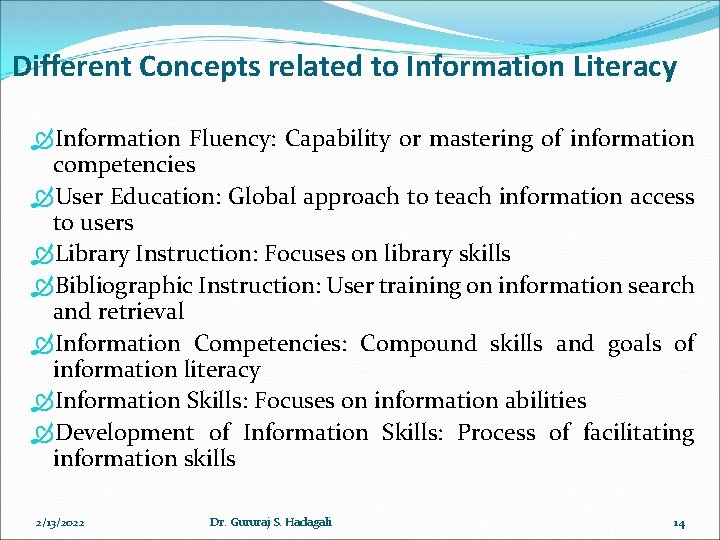
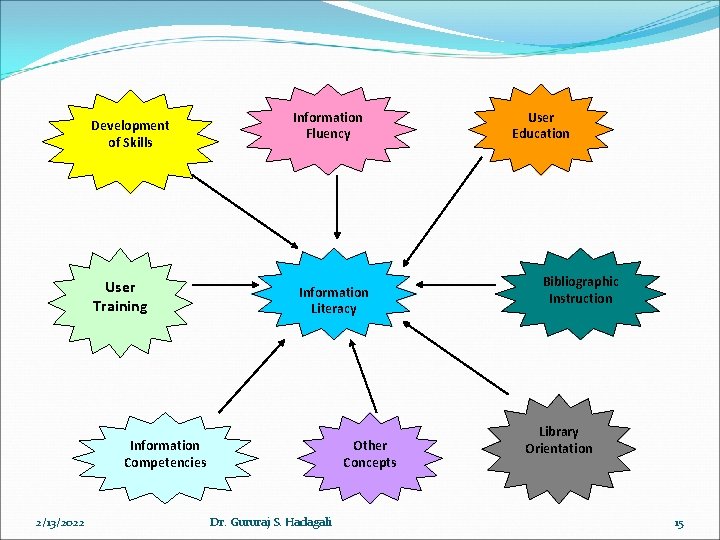
Different Concepts related to Information Literacy Information Fluency: Capability or mastering of information competencies User Education: Global approach to teach information access to users Library Instruction: Focuses on library skills Bibliographic Instruction: User training on information search and retrieval Information Competencies: Compound skills and goals of information literacy Information Skills: Focuses on information abilities Development of Information Skills: Process of facilitating information skills 2/13/2022 Dr. Gururaj S. Hadagali 14
Development of Skills User Training Information Fluency Information Literacy Information Competencies 2/13/2022 Other Concepts Dr. Gururaj S. Hadagali User Education Bibliographic Instruction Library Orientation 15
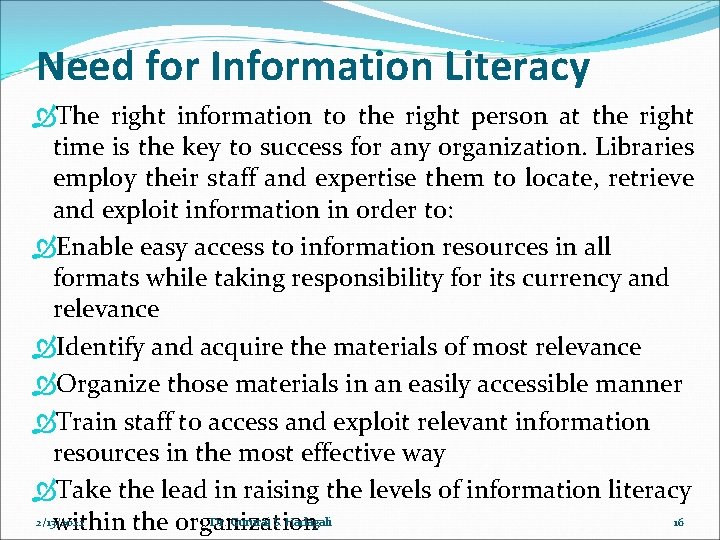
Need for Information Literacy The right information to the right person at the right time is the key to success for any organization. Libraries employ their staff and expertise them to locate, retrieve and exploit information in order to: Enable easy access to information resources in all formats while taking responsibility for its currency and relevance Identify and acquire the materials of most relevance Organize those materials in an easily accessible manner Train staff to access and exploit relevant information resources in the most effective way Take the lead in raising the levels of information literacy 2/13/2022 Dr. Gururaj S. Hadagali 16 within the organization
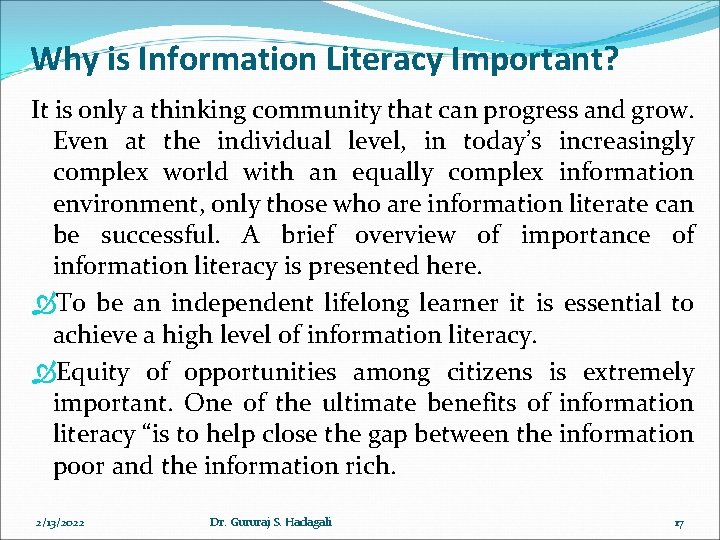
Why is Information Literacy Important? It is only a thinking community that can progress and grow. Even at the individual level, in today’s increasingly complex world with an equally complex information environment, only those who are information literate can be successful. A brief overview of importance of information literacy is presented here. To be an independent lifelong learner it is essential to achieve a high level of information literacy. Equity of opportunities among citizens is extremely important. One of the ultimate benefits of information literacy “is to help close the gap between the information poor and the information rich. 2/13/2022 Dr. Gururaj S. Hadagali 17
Contd… Information literacy is required to have a critical thinking approach. An approach that would lead to economic and cultural progress of a nation. A sheer abundance of information in electronic format has made information literacy increasingly important. Information Literacy is also important to understand the difficult questions of ownership of information and copyright. Students should learn to respect the author’s rights. The cutting and pasting culture that is widespread among the students can be addressed with the help of information literacy programmes. 2/13/2022 Dr. Gururaj S. Hadagali 18
Evolution of Information Literacy In 1974, Paul Zurkowski, president of the Information Industry Association, introduced the concept of “Information Literacy” in a proposal submitted to the National Commission on Libraries and Information Science (NCLIS). According to Zurkowski, “People trained in the application of information resources to their work can be called information literates. They have learned techniques and skills for utilizing the wide range of information tools as well as primary sources in molding information solutions to their problems”. 2/13/2022 Dr. Gururaj S. Hadagali 19
In 1987, Kuhlthau advanced the concept of information literacy further when she included library skills and computer literacy in the definition. Kuhlathau’s work pointed the way toward the integration of information literacy with curriculum and presages the current development of the concept of information literacy with the library media center as the starting platform. 2/13/2022 Dr. Gururaj S. Hadagali 20
Society for College, National and University Libraries (SCONUL’s) 7 Pillars of Information Literacy 1. The ability to recognize a need for information. 2. The ability to distinguish ways in which the information ‘gap’ may be addressed. Knowledge of appropriate kinds of resources, both print and nonprint; Selection of resources with ‘best fit’ for task at hand; The ability to understand the issues affecting accessibility of sources. 3. The ability to construct strategies for locating information To articulate information need to match against resources; To develop a systematic method appropriate for the need; To understand the principles of construction and generation of databases. 2/13/2022 Dr. Gururaj S. Hadagali 21
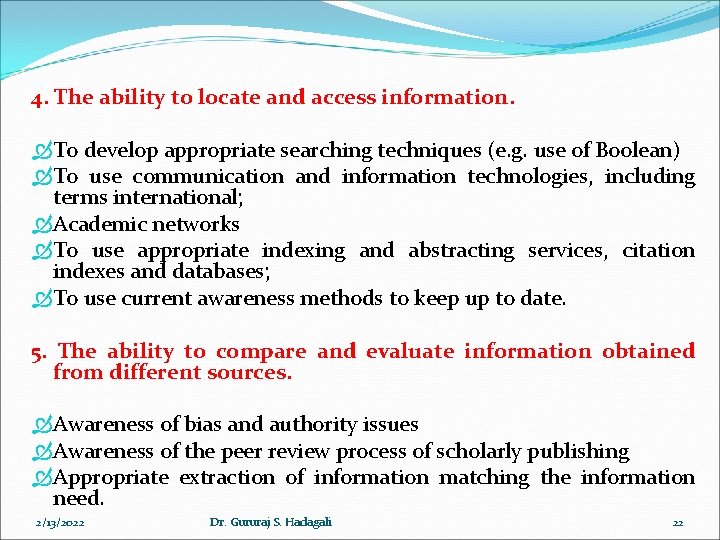
4. The ability to locate and access information. To develop appropriate searching techniques (e. g. use of Boolean) To use communication and information technologies, including terms international; Academic networks To use appropriate indexing and abstracting services, citation indexes and databases; To use current awareness methods to keep up to date. 5. The ability to compare and evaluate information obtained from different sources. Awareness of bias and authority issues Awareness of the peer review process of scholarly publishing Appropriate extraction of information matching the information need. 2/13/2022 Dr. Gururaj S. Hadagali 22
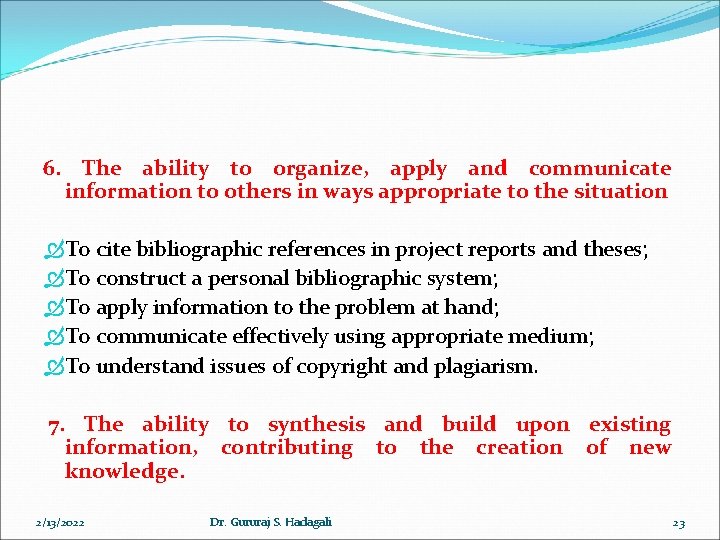
6. The ability to organize, apply and communicate information to others in ways appropriate to the situation To cite bibliographic references in project reports and theses; To construct a personal bibliographic system; To apply information to the problem at hand; To communicate effectively using appropriate medium; To understand issues of copyright and plagiarism. 7. The ability to synthesis and build upon existing information, contributing to the creation of new knowledge. 2/13/2022 Dr. Gururaj S. Hadagali 23
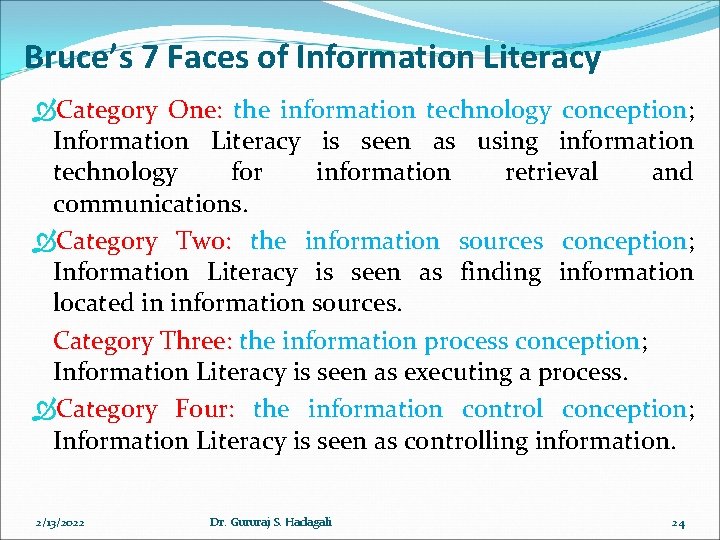
Bruce’s 7 Faces of Information Literacy Category One: the information technology conception; Information Literacy is seen as using information technology for information retrieval and communications. Category Two: the information sources conception; Information Literacy is seen as finding information located in information sources. Category Three: the information process conception; Information Literacy is seen as executing a process. Category Four: the information control conception; Information Literacy is seen as controlling information. 2/13/2022 Dr. Gururaj S. Hadagali 24
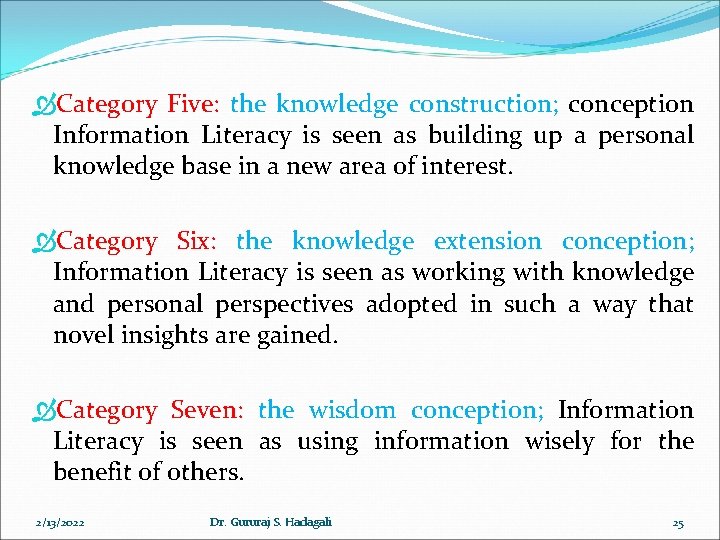
Category Five: the knowledge construction; conception Information Literacy is seen as building up a personal knowledge base in a new area of interest. Category Six: the knowledge extension conception; Information Literacy is seen as working with knowledge and personal perspectives adopted in such a way that novel insights are gained. Category Seven: the wisdom conception; Information Literacy is seen as using information wisely for the benefit of others. 2/13/2022 Dr. Gururaj S. Hadagali 25
Processes involved in Information Literacy The first step in the Information Literacy strategy is to clarify and understand the requirements of the problem or task for which information is sought. Basic question asked at this stage: What is known about the topic? What information is needed? Where can the information be found? Locating: The second step is to identify sources of information and to find those resources. Depending upon the task, sources that will be helpful may vary. Sources may include: books, encyclopedias; maps; almanacs; etc. sources may be in electronic, print, social bookmaking tools, or other formats. 2/13/2022 Dr. Gururaj S. Hadagali 26
Selecting / Analyzing: Step three involves examining the resources that were found. The information must be determined to be useful or not useful in solving the problem. The useful resources are selected and the inappropriate resources are rejected. Organizing / Synthesizing: it is in the fourth step this information which has been selected is organized and processed so that knowledge and solutions are developed. Examples of basic steps in this stage are: Discriminating between fact and opinion Basing comparisons on similar characteristics Noticing various interpretations of data Finding more information if needed Organizing ideas and information logically 2/13/2022 Dr. Gururaj S. Hadagali 27
Creating / Presenting: In step five the information or solution is presented to the appropriate audience in an appropriate format. A paper is written. A presentation is made. Drawings, illustrations and graphs are presented. Evaluating: The final step in the information literacy strategy involves the critical evaluation of the completion of the task or the new understanding of the concept. Was the problem solved? Was new knowledge found? What could have been done differently? What was done well? 2/13/2022 Dr. Gururaj S. Hadagali 28
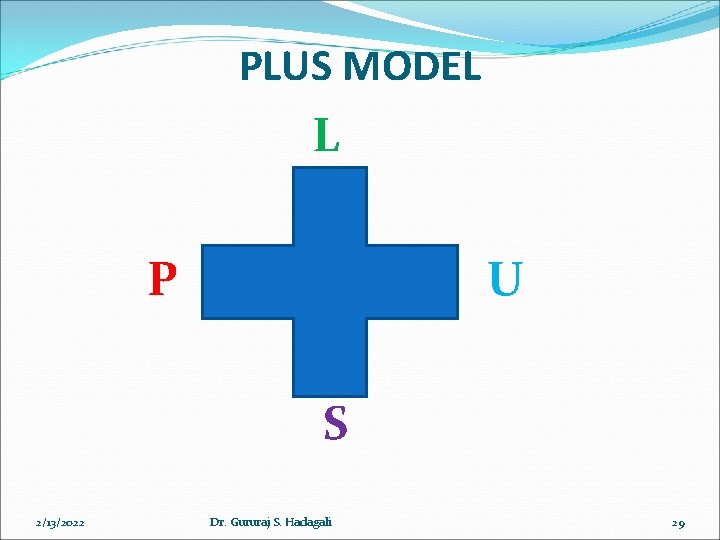
PLUS MODEL L P U S 2/13/2022 Dr. Gururaj S. Hadagali 29
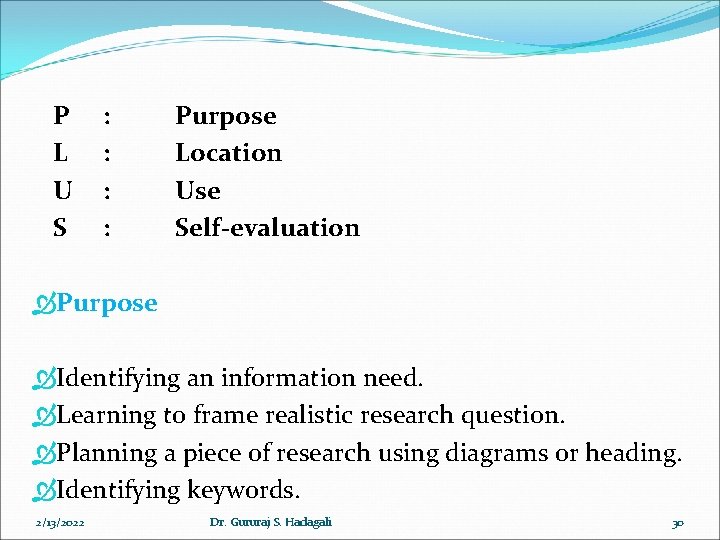
P L U S : : Purpose Location Use Self-evaluation Purpose Identifying an information need. Learning to frame realistic research question. Planning a piece of research using diagrams or heading. Identifying keywords. 2/13/2022 Dr. Gururaj S. Hadagali 30
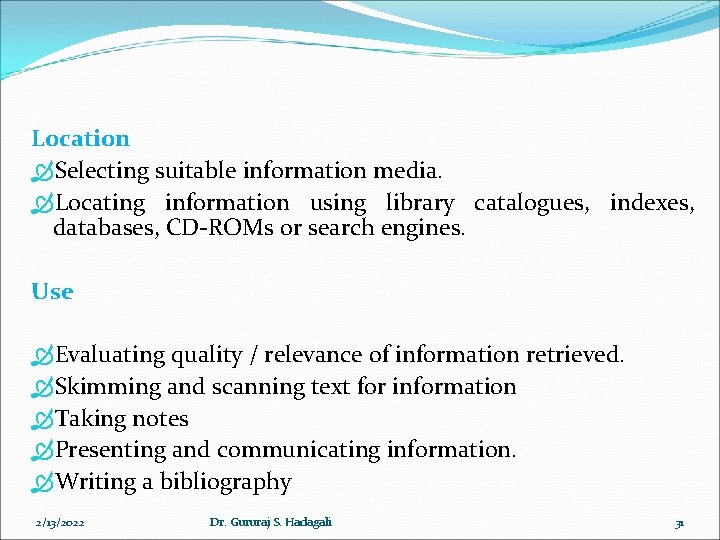
Location Selecting suitable information media. Locating information using library catalogues, indexes, databases, CD-ROMs or search engines. Use Evaluating quality / relevance of information retrieved. Skimming and scanning text for information Taking notes Presenting and communicating information. Writing a bibliography 2/13/2022 Dr. Gururaj S. Hadagali 31
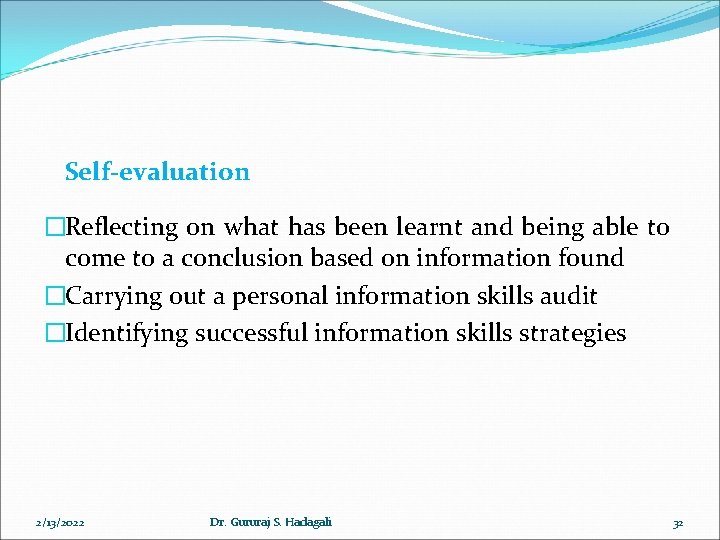
Self-evaluation �Reflecting on what has been learnt and being able to come to a conclusion based on information found �Carrying out a personal information skills audit �Identifying successful information skills strategies 2/13/2022 Dr. Gururaj S. Hadagali 32
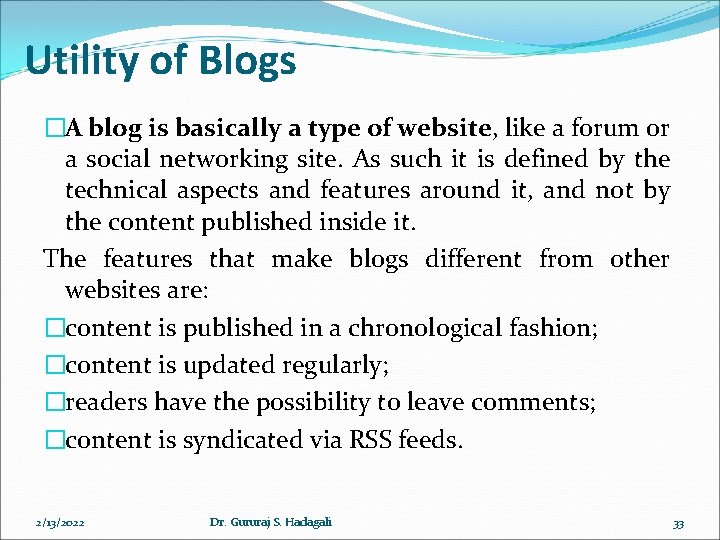
Utility of Blogs �A blog is basically a type of website, like a forum or a social networking site. As such it is defined by the technical aspects and features around it, and not by the content published inside it. The features that make blogs different from other websites are: �content is published in a chronological fashion; �content is updated regularly; �readers have the possibility to leave comments; �content is syndicated via RSS feeds. 2/13/2022 Dr. Gururaj S. Hadagali 33
�A blog is often a mixture of what is happening in a person’s life and what is happening on the Web, a kind of hybrid diary/guide site, although there as many unique types of blogs as there are people. �A blog (web log) is a personal journal published on the World Wide Web consisting of discrete entries ("posts") typically displayed in reverse chronological order so the most recent post appears first. �Blogs are usually the work of a single individual, occasionally of a small group, and often are themed on a single subject. 2/13/2022 Dr. Gururaj S. Hadagali 34
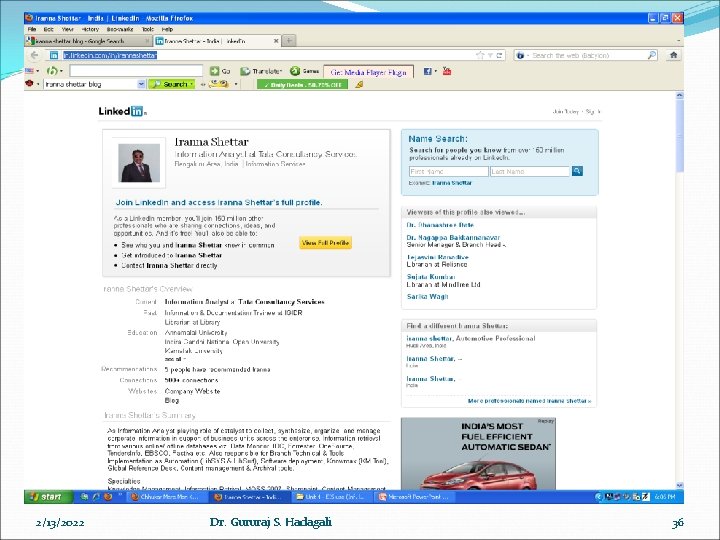
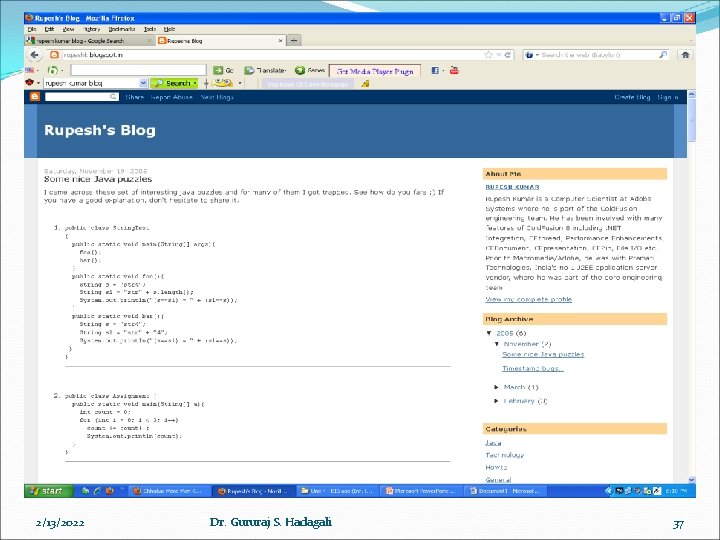
Types of Blogs Personal Blogs �The personal blog, an ongoing diary or commentary by an individual, is the traditional, most common blog. �Personal bloggers usually take pride in their blog posts, even if their blog is never read. �Blogs often become more than a way to just communicate; they become a way to reflect on life, or works of art. 2/13/2022 Dr. Gururaj S. Hadagali 35
2/13/2022 Dr. Gururaj S. Hadagali 36
2/13/2022 Dr. Gururaj S. Hadagali 37
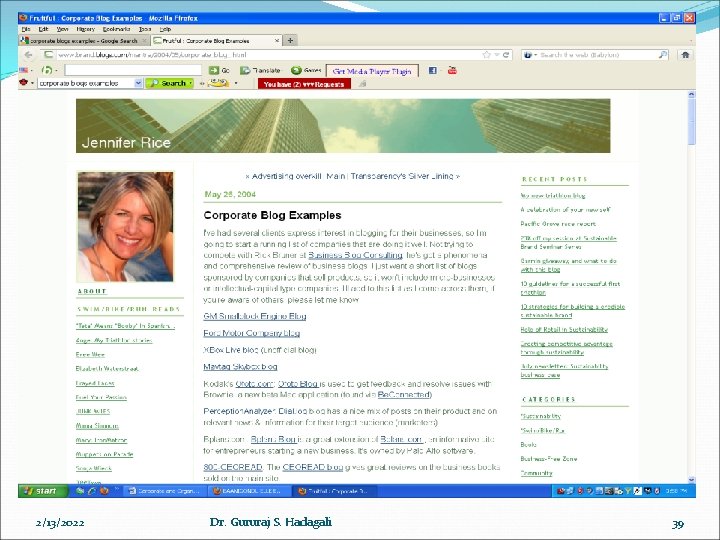
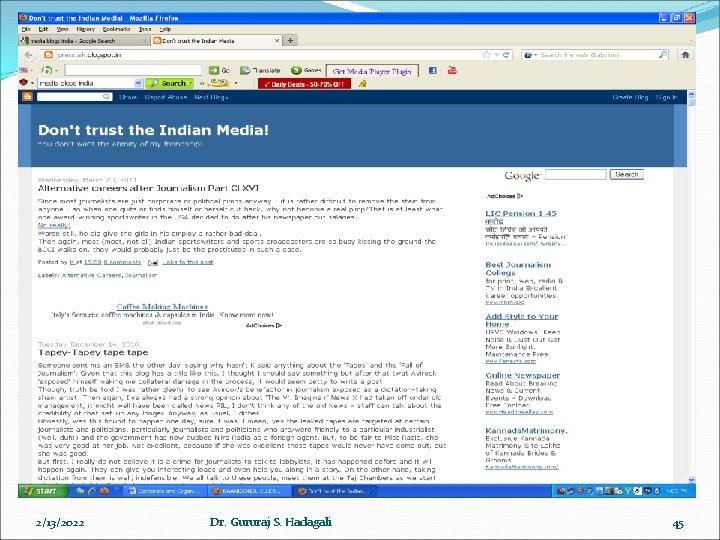
Corporate and organizational blogs �A blog can be private, as in most cases, or it can be for business purposes. �Blogs used internally to enhance the communication and culture in a corporation or externally for marketing, branding or public relations purposes are called corporate blogs. 2/13/2022 Dr. Gururaj S. Hadagali 38
2/13/2022 Dr. Gururaj S. Hadagali 39
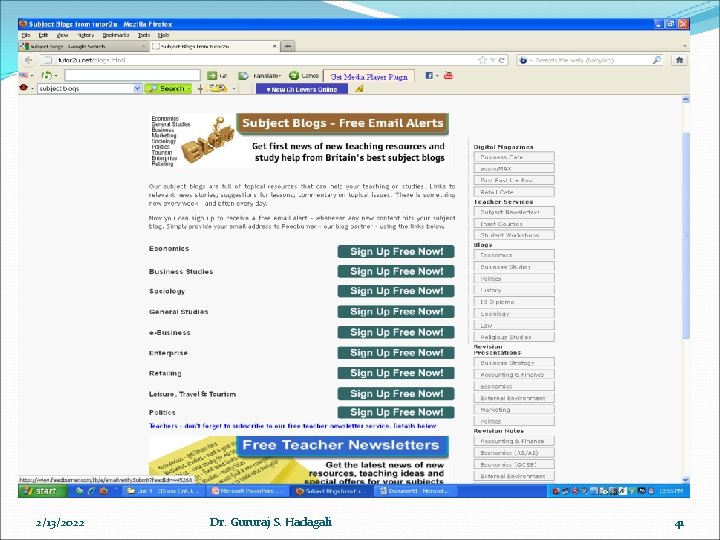
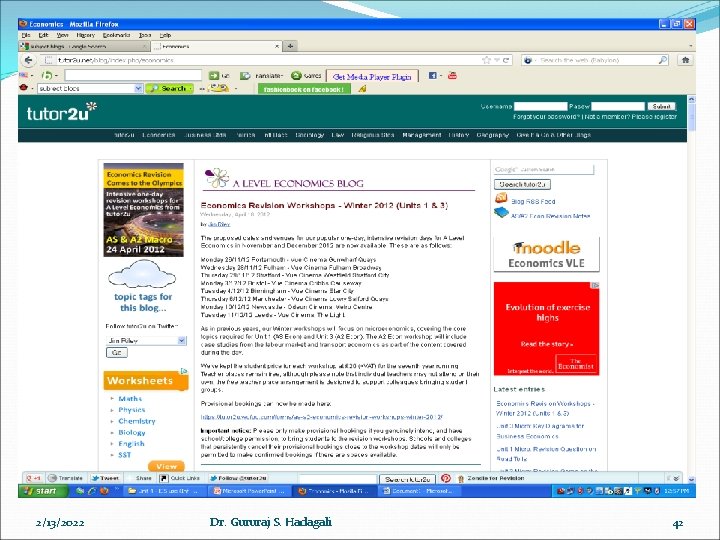
By genre (Subject / Common Interest) � Some blogs focus on a particular subject, such as political blogs, health blogs, travel blogs (also known as travelogs), gardening blogs. 2/13/2022 Dr. Gururaj S. Hadagali 40
2/13/2022 Dr. Gururaj S. Hadagali 41
2/13/2022 Dr. Gururaj S. Hadagali 42
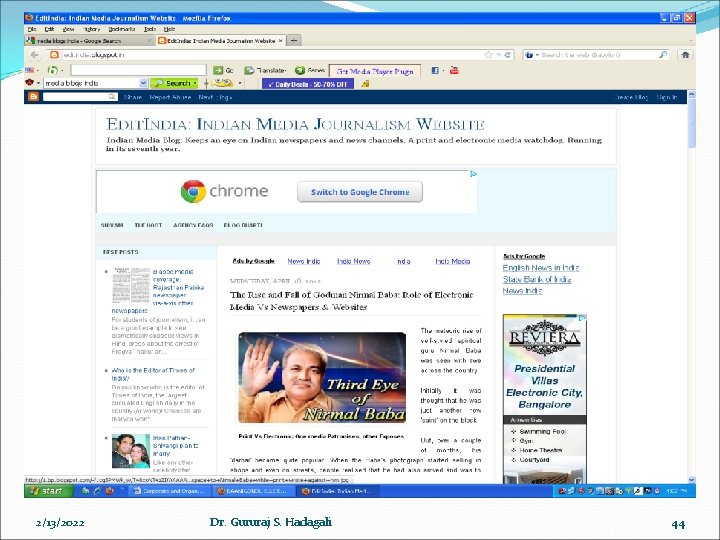
By media type � A blog comprising videos is called a vlog, one comprising links is called a linklog, a site containing a portfolio of sketches is called a sketchblog or one comprising photos is called a photoblog. 2/13/2022 Dr. Gururaj S. Hadagali 43
2/13/2022 Dr. Gururaj S. Hadagali 44
2/13/2022 Dr. Gururaj S. Hadagali 45
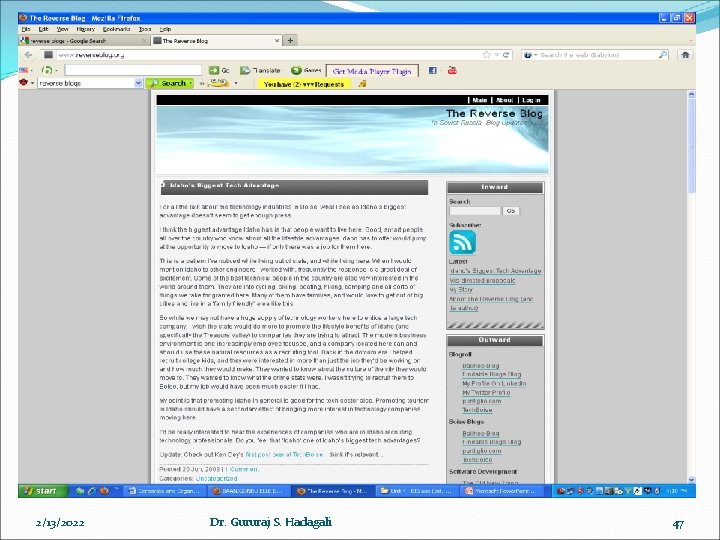
Reverse blog � A Reverse Blog is composed by its users rather than a single blogger. �This system has the characteristics of a blog, and the writing of several authors. �These can be written by several contributing authors on a topic, or opened up for anyone to write. 2/13/2022 Dr. Gururaj S. Hadagali 46
2/13/2022 Dr. Gururaj S. Hadagali 47
Thank you 2/13/2022 Dr. Gururaj S. Hadagali 48