
Unit 4 Diogenes and Alexander By Group Three
Unit 4 Diogenes and Alexander By Group Three Members: 王月 王秋晓 张智乐 殷芳玲 李乃娣 程媛媛
1:Diogenes
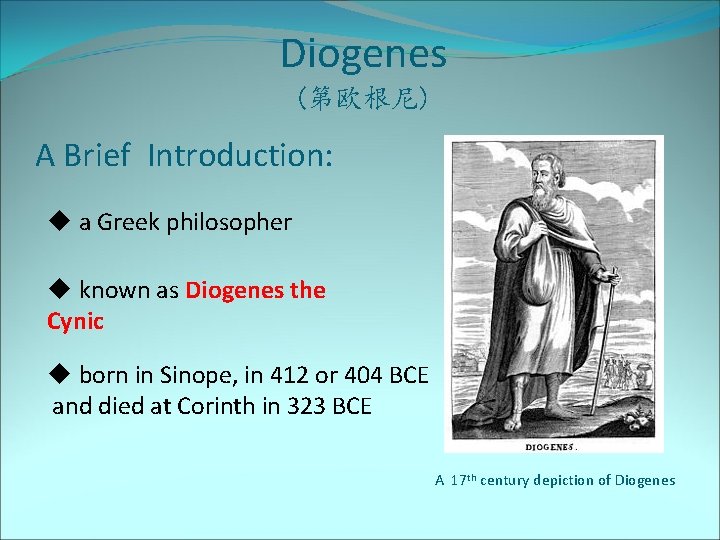
Diogenes (第欧根尼) A Brief Introduction: u a Greek philosopher u known as Diogenes the Cynic u born in Sinope, in 412 or 404 BCE and died at Corinth in 323 BCE A 17 th century depiction of Diogenes
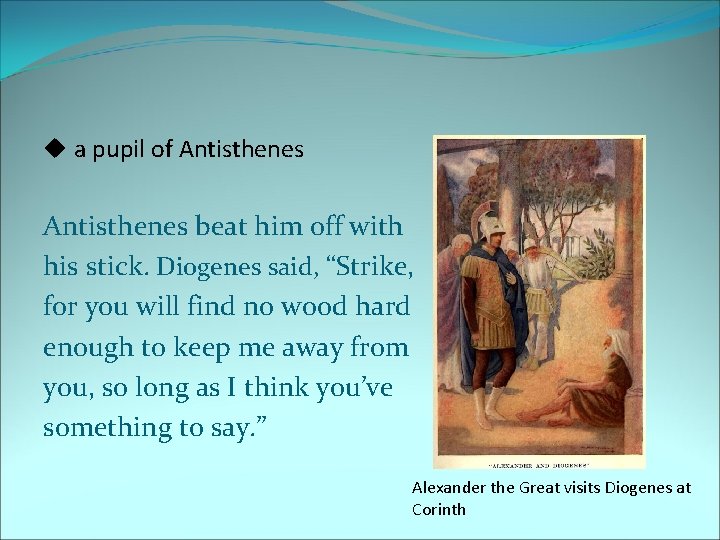
u a pupil of Antisthenes beat him off with his stick. Diogenes said, “Strike, for you will find no wood hard enough to keep me away from you, so long as I think you’ve something to say. ” Alexander the Great visits Diogenes at Corinth
A: I’m Alexander the great. D: well, I’m Diogenes the dog. … A: I shall dearly like to know if there’s any favor I might do for you , sir D: Yes , stand out of my sunlight
Achievements Ø one of the founders of Cynic(犬儒主义) philosophy The ideas of Diogenes, like those of most other Cynics, must be arrived at indirectly. Ø After being exiled, he moved to Athens and criticized many cultural conventions of the city. Diogenes modelled himself on the example of Heracles. He believed that virtue was better revealed in action than in theory.
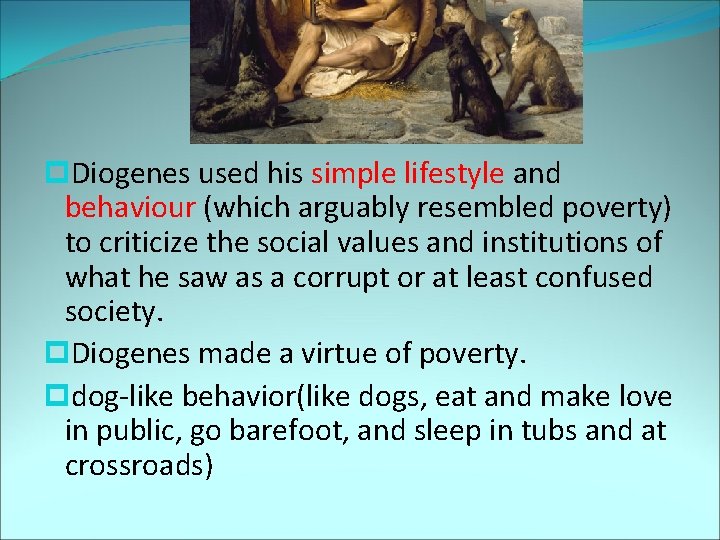
Influences p. Diogenes used his simple lifestyle and behaviour (which arguably resembled poverty) to criticize the social values and institutions of what he saw as a corrupt or at least confused society. p. Diogenes made a virtue of poverty. pdog-like behavior(like dogs, eat and make love in public, go barefoot, and sleep in tubs and at crossroads)

For his vagrant lifestyle, Diogenes was nicknamed “the dog” (from which the name "cynic" is derived”); (Why was he called a dog? Diogenes: "Because I fawn on those who give me anything, I yelp at those who refuse, and I set my teeth in rascals. " )
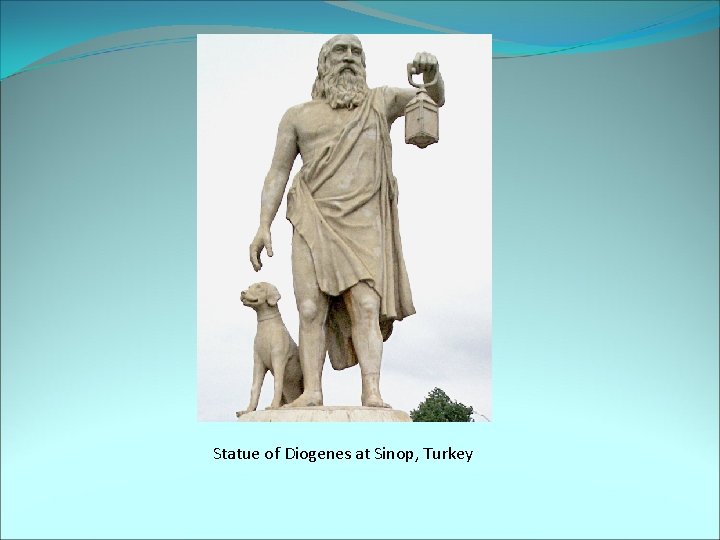
Statue of Diogenes at Sinop, Turkey
2:Alexander
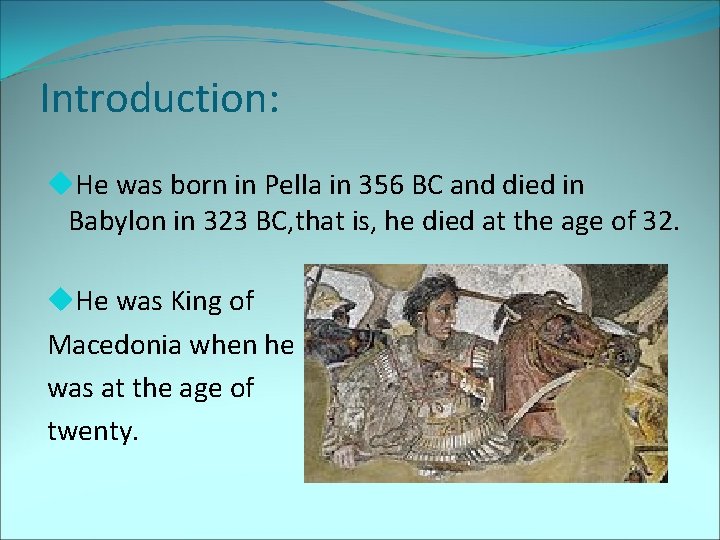
Introduction: u. He was born in Pella in 356 BC and died in Babylon in 323 BC, that is, he died at the age of 32. u. He was King of Macedonia when he was at the age of twenty.
ØHe was undefeated in battle. ØHe is considered a brilliant strategist and one of the greatest military leaders in the world history. ØHe is often referred to as Alexander the Great.
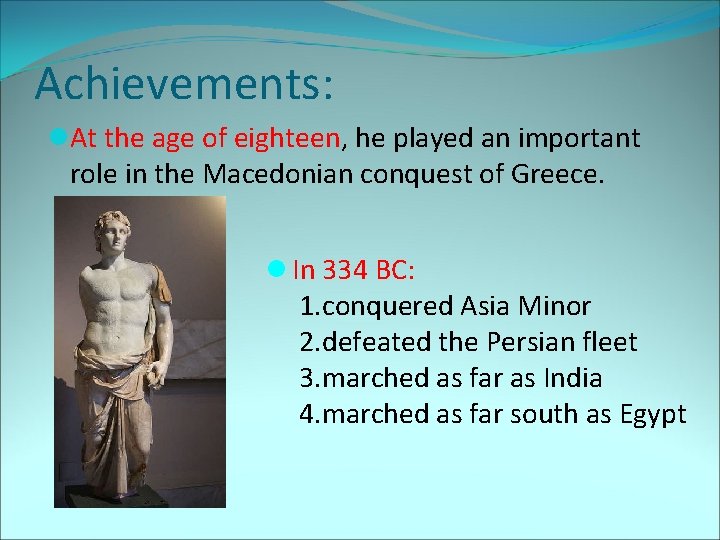
Achievements: l. At the age of eighteen, he played an important role in the Macedonian conquest of Greece. l In 334 BC: 1. conquered Asia Minor 2. defeated the Persian fleet 3. marched as far as India 4. marched as far south as Egypt
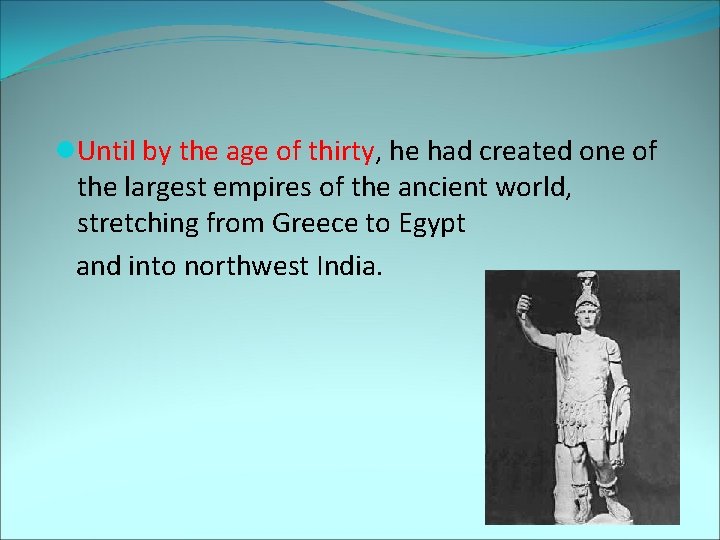
l. Until by the age of thirty, he had created one of the largest empires of the ancient world, stretching from Greece to Egypt and into northwest India.
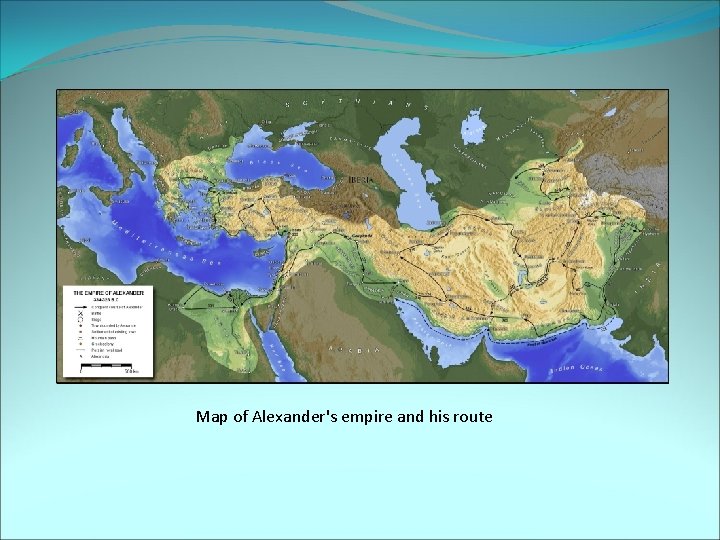
Map of Alexander's empire and his route
Influence: ØHis campaigns greatly increased contacts and trade between East and West. ØHis conquests contribute cultural spread, such as Greco-Buddhism(希腊式佛教). ØHe changed the history of the world by making Hellenic Greek civilization dominant in the Near East for about a thousand years.
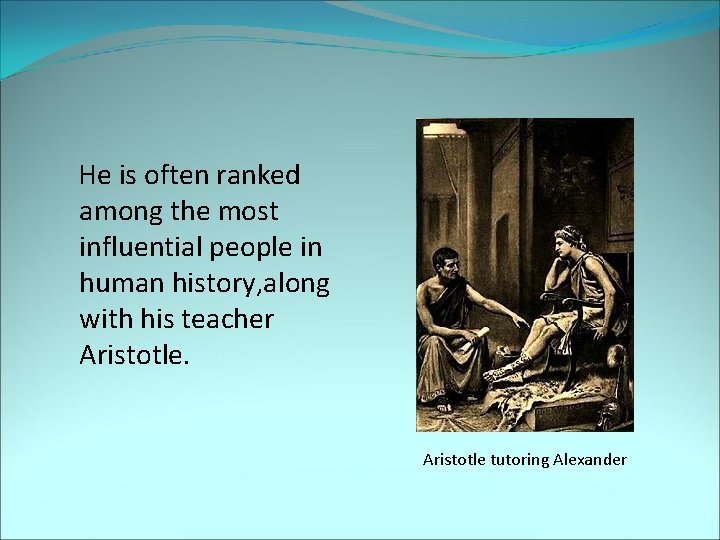
He is often ranked among the most influential people in human history, along with his teacher Aristotle tutoring Alexander
3:Plato and Aristotle
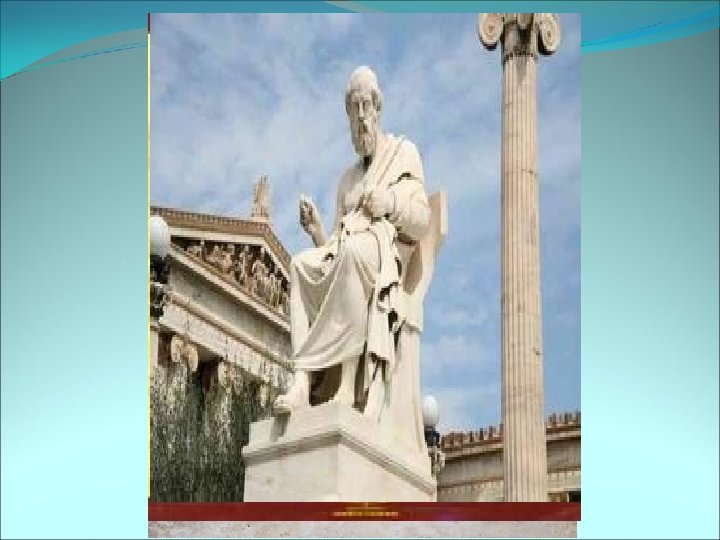
Plato A brief introduction Ø philosopher , mathematician Ø the founder of the Academy Ø the first institution of higher learning Ø the most pivotal figure in the development of philosophy
School establish the first institution of higher learning Work 35 pieces of writing to posterity Law Symposium Republic Political philosopher the quality of good leadership importance of virtue and transcendence(超越) for politics Critical thinking to perceive what is invisible but intelligible, the soul the key values (Friendship, freedom, justice, wisdom, courage, and moderation) to enjoy true happiness remain virtuous and remember God
The academy -- the school he founded in 385 B. C. E. , became the model for other schools of higher learning and later for European universities The philosophy--the usage of dialectic(�� 主� ), a method of discussion , cognitive optimism(� 知�� 主 � ), a belief to attain the truth and to use this truth for the rational and virtuous ordering of human affairs Unity of society--The best, rational and righteous, political order, leads to a harmonious unity of society and allows each of its parts to flourish, but not at the expense of others
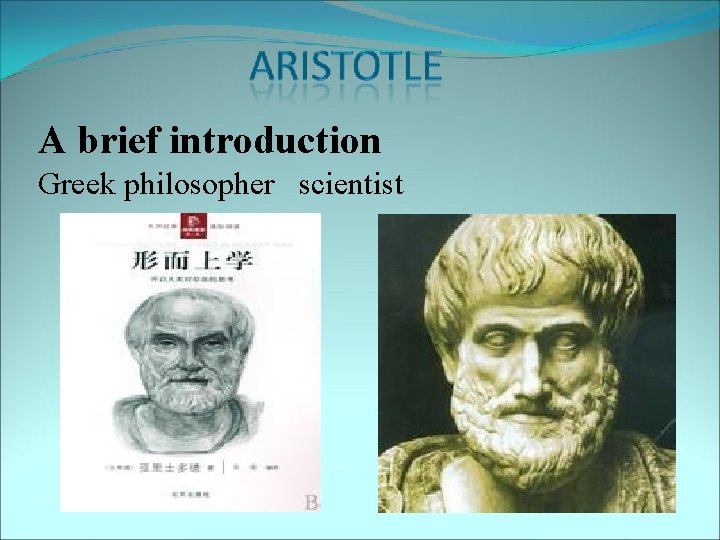
A brief introduction Greek philosopher scientist
Library--established a library in the Lyceum Empiricism(��� )--all peoples' concepts and all of their knowledge was ultimately based on perception Physical science—medieval(中世� 的) scholarship Metaphysics(形而上学)--Judeo-Islamic philosophical and theological thought and Christian theology Work--physics, biology, zoology, metaphysics, logic, ethics, aesthetics, poetry, theater, music, rhetoric, linguistics, politics and government
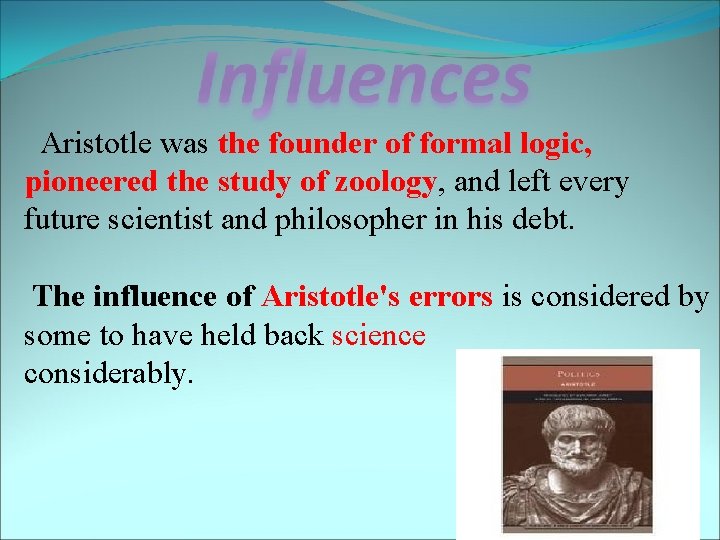
Aristotle was the founder of formal logic, pioneered the study of zoology, and left every future scientist and philosopher in his debt. The influence of Aristotle's errors is considered by some to have held back science considerably.
Aristotle's influence over Alexander the Great is seen in the latter's bringing with him on his expedition a host of zoologists, botanists, and researchers. Influence on Byzantine scholars Influence on Islamic theologians Aristotle was one of the most revered Western thinkers in early Islamic theology. Influence on Western Christian theologians These thinkers blended Aristotelian philosophy with Christianity, bringing the thought of Ancient Greece into the Middle Ages. It required a repudiation of some Aristotelian principles for the sciences and the arts to free themselves for the discovery of modern scientific laws and empirical methods.
4:Hercules and his labors
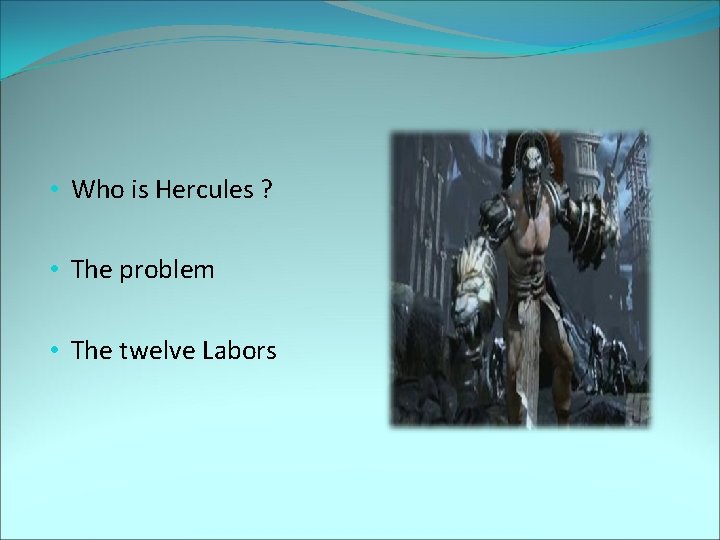
• Who is Hercules ? • The problem • The twelve Labors
Who is Hercules ? • Hercules is a Greek divine hero. • His parents was Zeus and Alcmene. • In classical mythology, he is famous for his strength and for his numerous far-ranging adventures. • Megara-first wife • Deianira-second wife
The problem • Hera was determined to make problems for Hercules and made him lose his mind. • In a confused angry state; he killed his wife and children. • He prayed to Apollo forgiveness. • The god’s oracle told him he would have to serve Eurystheus, he king of Tiryns and Mycenae, for twelve years, in punishment for the murders.
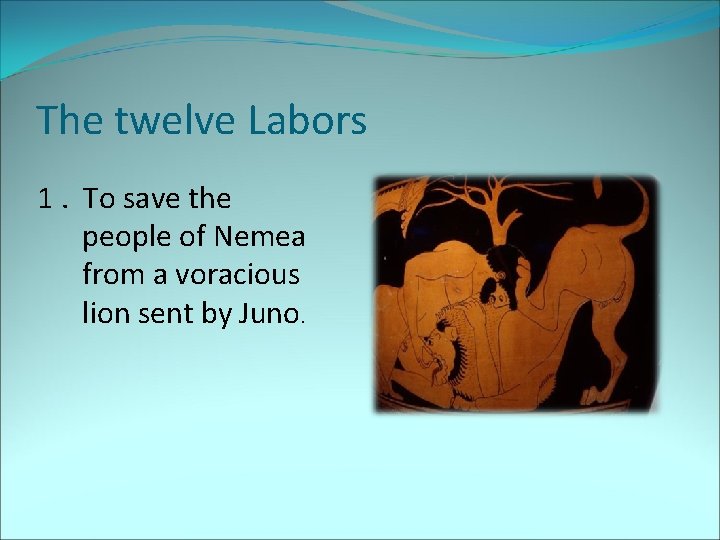
The twelve Labors 1. To save the people of Nemea from a voracious lion sent by Juno.
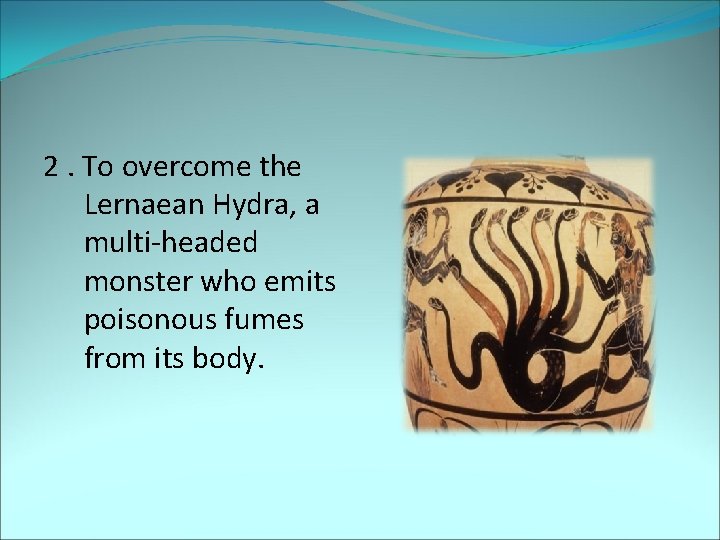
2. To overcome the Lernaean Hydra, a multi-headed monster who emits poisonous fumes from its body.
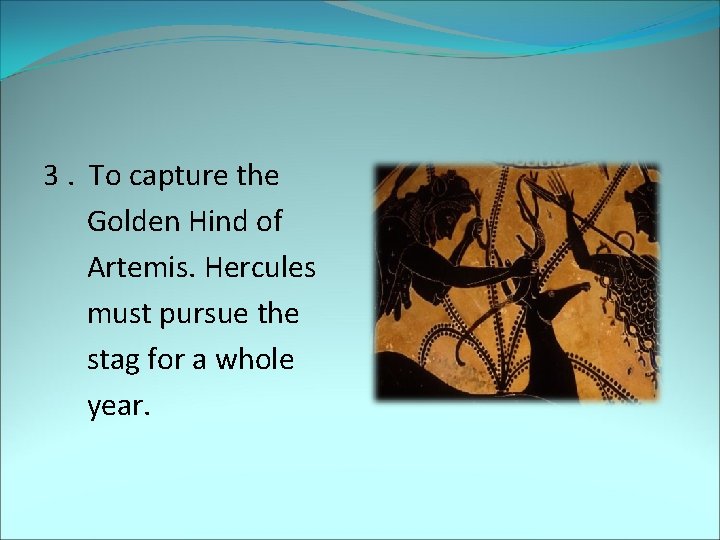
3. To capture the Golden Hind of Artemis. Hercules must pursue the stag for a whole year.
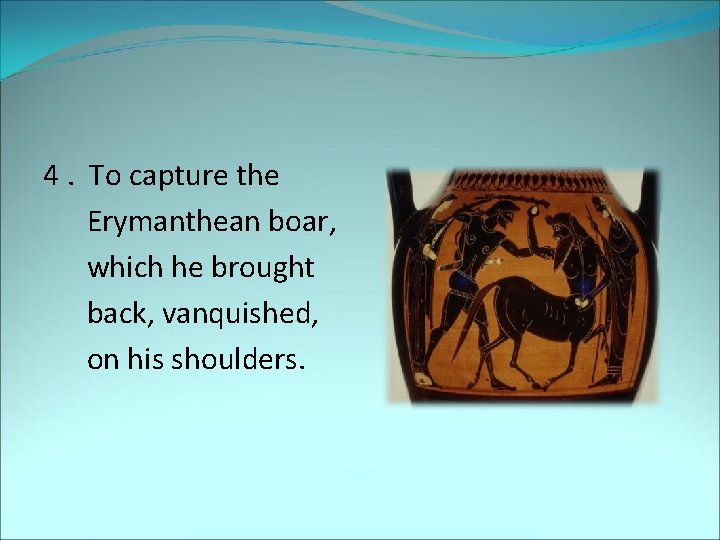
4. To capture the Erymanthean boar, which he brought back, vanquished, on his shoulders.
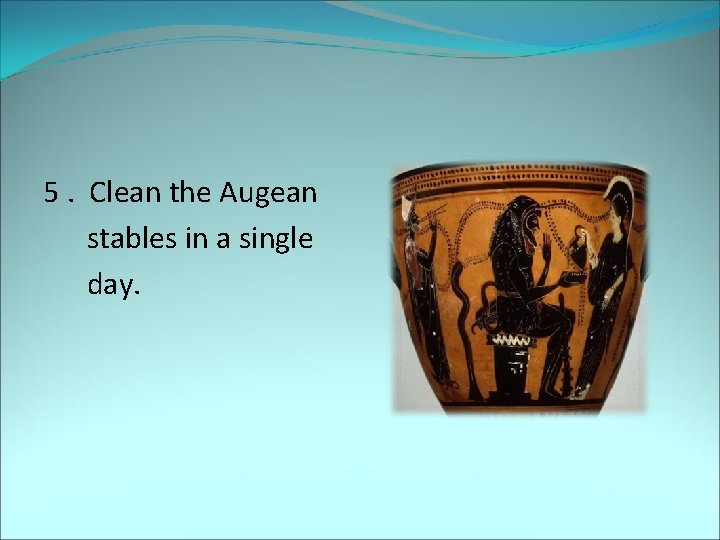
5. Clean the Augean stables in a single day.
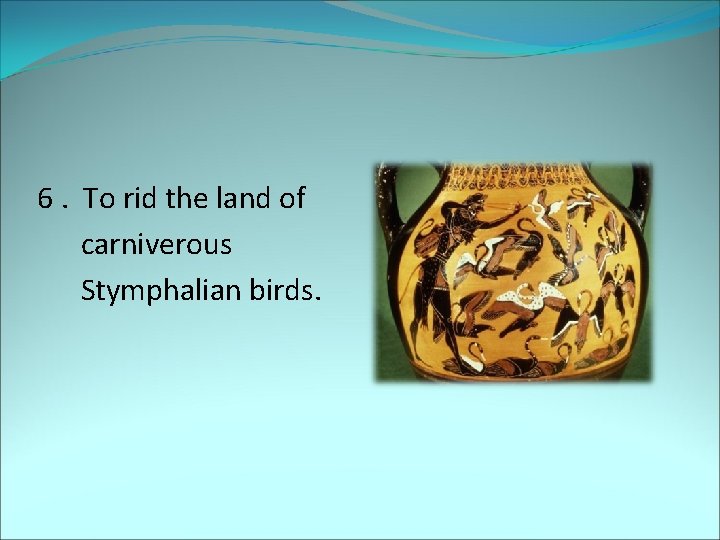
6. To rid the land of carniverous Stymphalian birds.
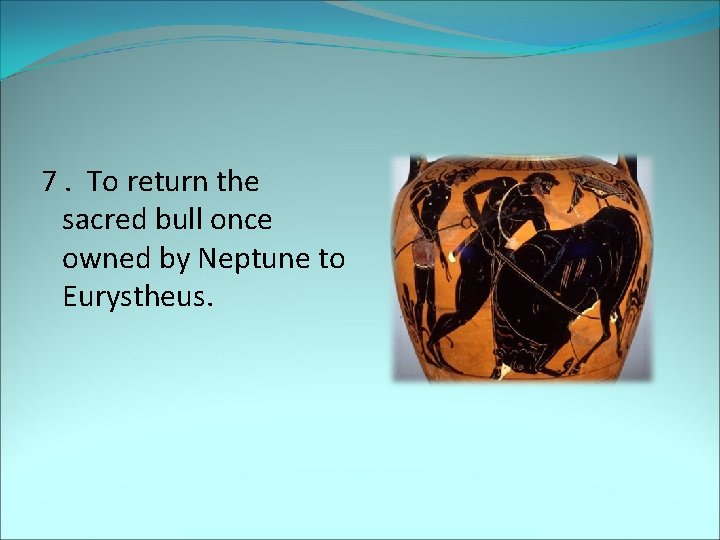
7. To return the sacred bull once owned by Neptune to Eurystheus.
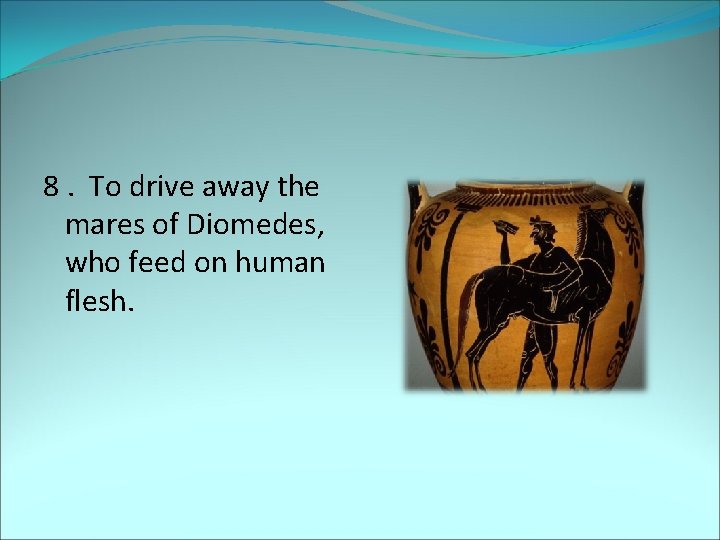
8. To drive away the mares of Diomedes, who feed on human flesh.

9. To obtain the girdle of the Amazon Queen Hippolyta for Admeta, Eurystheus's daughter.
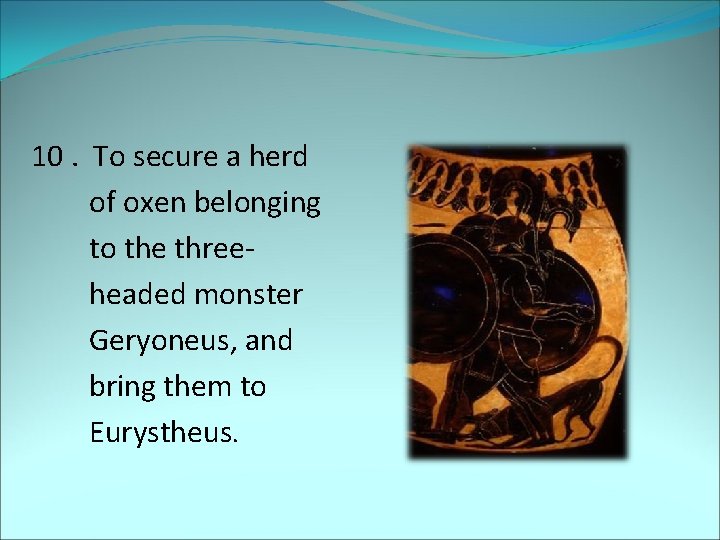
10. To secure a herd of oxen belonging to the three headed monster Geryoneus, and bring them to Eurystheus.
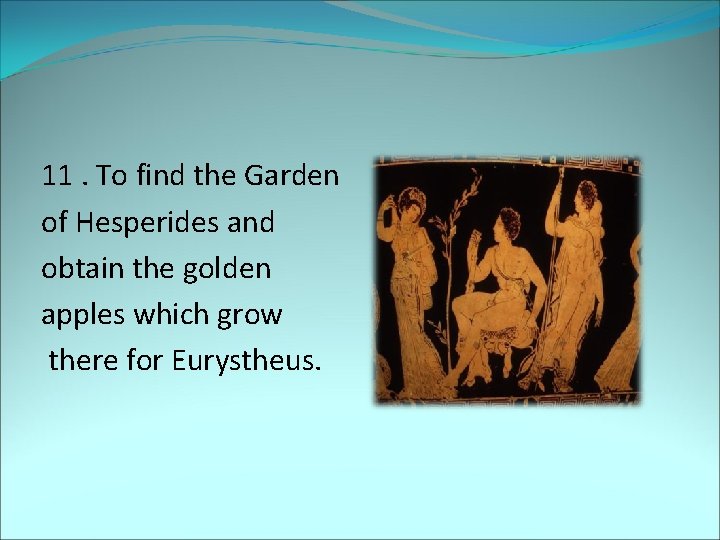
11. To find the Garden of Hesperides and obtain the golden apples which grow there for Eurystheus.
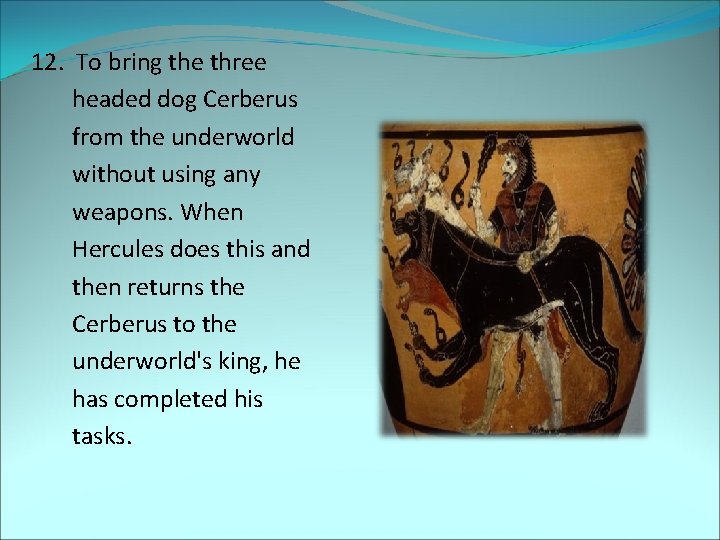
12. To bring the three headed dog Cerberus from the underworld without using any weapons. When Hercules does this and then returns the Cerberus to the underworld's king, he has completed his tasks.
5:Cynicism
Content ØGeneral idea ØPhilosophers ØPrinciples
General Idea Cynicism is a school of Ancient Greek philosophy as practiced by the cynics. For the cynics, the purpose of life was to live in virtue, in agreement with nature. As reasoning creatures, people could gain happiness by rigorous training and by living in a way which was natural for themselves, rejecting all conventional desires for wealth, power, sex, and fame. Instead, they were to lead a simple life free from all possessions. They also believed that the world belonged to everyone, and that suffering was caused by false judgments of what was valuable and by the worthless customs and conventions which surrounded society.
Philosophers l Antisthenes, who had been a pupil of Socrates in the late 5 th century BC. l Diogenes , who lived in a tub on the streets of Athens. Diogenes took cynicism to its logical extremes, and came to be seen as the archetypal cynic philosopher.
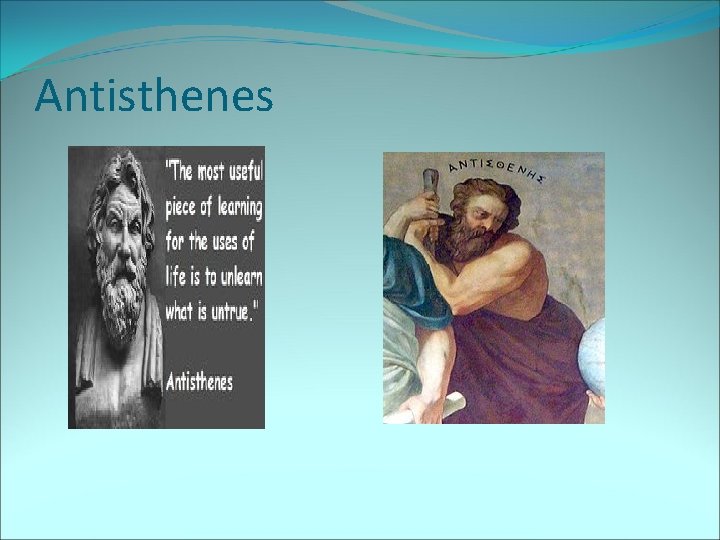
Antisthenes
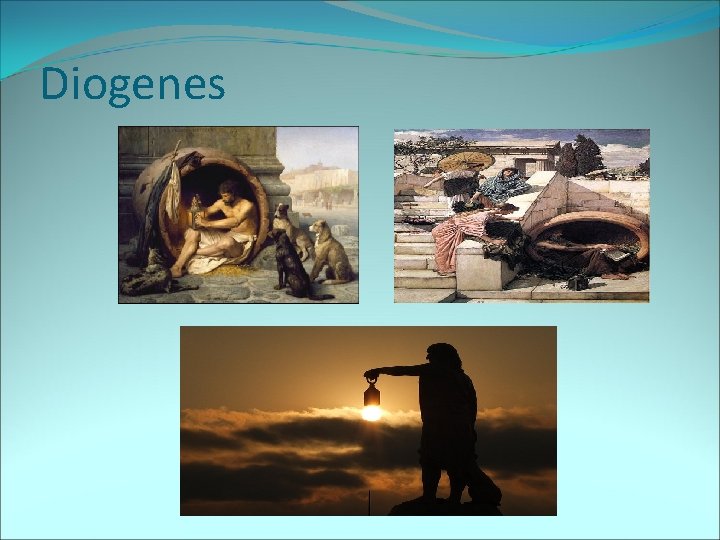
Diogenes
Principles Ø 1. The goal of life is eudemonia and mental clarity or lucidity , freedom from smoke which signified ignorance, mindlessness, folly, and conceit. Ø 2. Eudaimonia is achieved by living in accord with Nature as understood by human reason.
Ø 3. Arrogance is caused by false judgments of value, which cause negative emotions, unnatural desires, and a vicious character. Ø 4. Eudaimonia, or human flourishing, depends on self-sufficiency, equanimity, love of humanity and indifference to the vicissitudes of life.
Ø 5. One progresses towards flourishing and clarity through ascetic practices which help one become free from influences such as wealth, fame, and power that have no value in Nature. Examples include Diogenes' practice of living in a tub and walking barefoot in winter. Ø 6. A cynic practices shamelessness or impudence and defaces the inner rule of society, the laws, customs, and social conventions which people take for granted.
6:Contrast and Comparison (a writing technique)
The focus of contrast and comparison: Contrast: focuses on differences Comparison: focuses on similarities
The purposes of Comparison and Contrast lpresent information about something unfamiliar by comparing it with something familiar lshow the superiority of one thing by contrasting it with another lshow the similarities or differences of two things
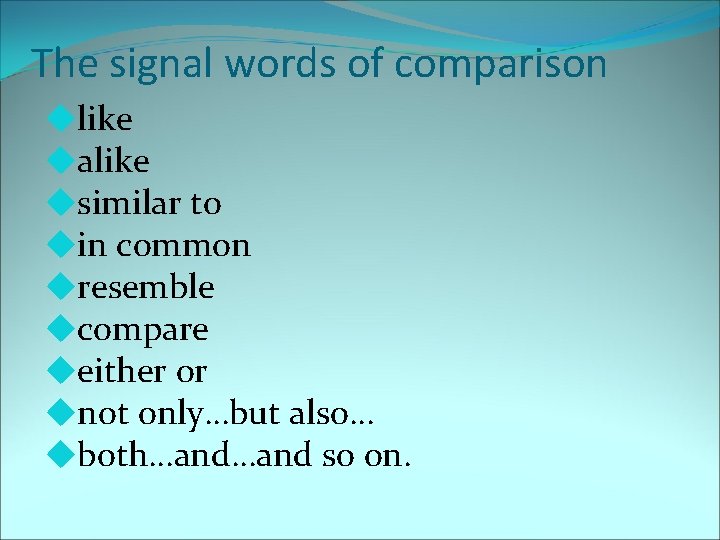
The signal words of comparison ulike ualike usimilar to uin common uresemble ucompare ueither or unot only…but also… uboth…and so on.
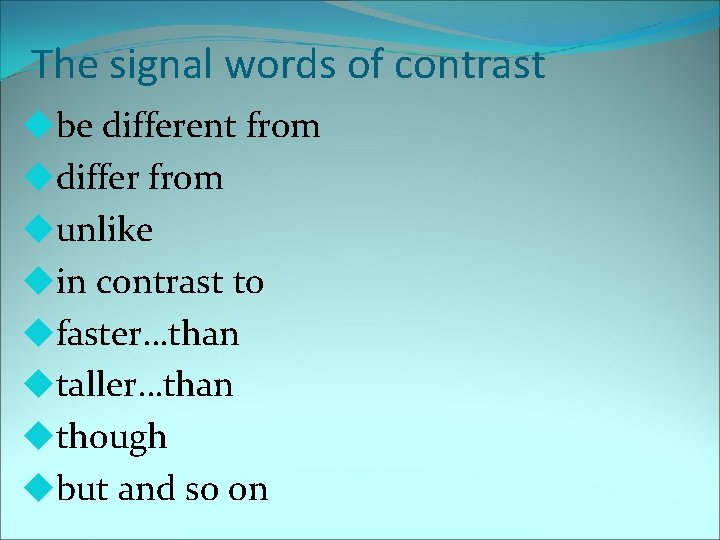
The signal words of contrast ube different from udiffer from uunlike uin contrast to ufaster…than utaller…than uthough ubut and so on
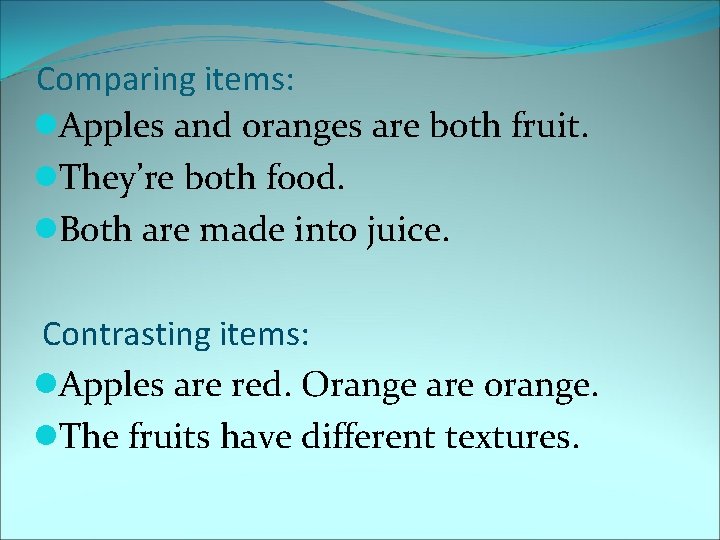
Comparing items: l. Apples and oranges are both fruit. l. They’re both food. l. Both are made into juice. Contrasting items: l. Apples are red. Orange are orange. l. The fruits have different textures.
Pattern of organization A comparison/contrast essay usually follows one of the two patterns: üthe subject-by-subject pattern üthe point-by-point pattern.
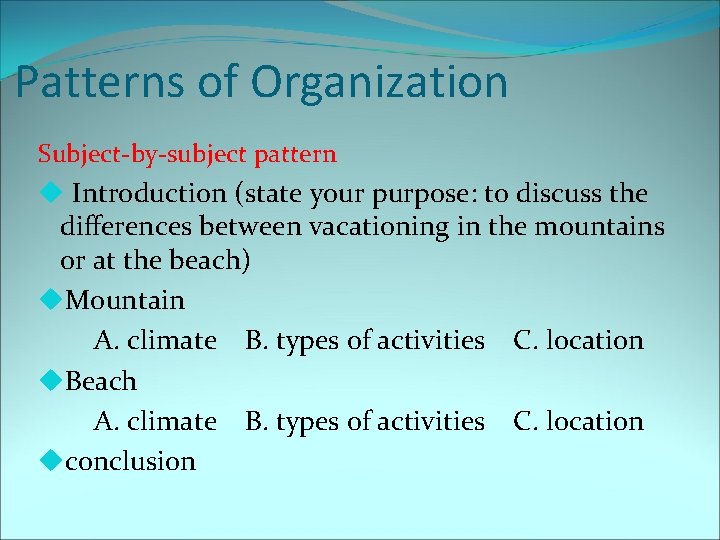
Patterns of Organization Subject-by-subject pattern u Introduction (state your purpose: to discuss the differences between vacationing in the mountains or at the beach) u. Mountain A. climate B. types of activities C. location u. Beach A. climate B. types of activities C. location uconclusion
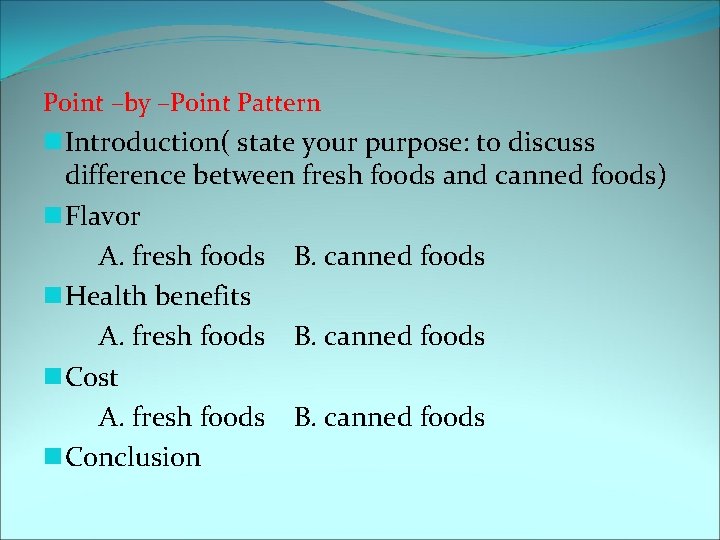
Point –by –Point Pattern n Introduction( state your purpose: to discuss difference between fresh foods and canned foods) n Flavor A. fresh foods B. canned foods n Health benefits A. fresh foods B. canned foods n Cost A. fresh foods B. canned foods n Conclusion
Keep in mind the following points ØOnly subjects of the same general class can be compared/contrasted. ØThe comparison/contrast should be supported by concrete and relevant facts. ØDon’t pay equal to comparison and contrast.
Keep in mind the following points ØThe comparison and contrast should be balanced. ØThe two items being compared and contrasted are to be given equally. ØThe two show similarities/differences should make a particular point.

Thank you!
- Slides: 63