
Unit 4 Data analytics Delivering the outcomes 2020

- Slides: 20
Unit 4 Data analytics Delivering the outcomes 2020– 2024
Copyright © Victorian Curriculum and Assessment Authority (VCAA) 2019. VCAA presentations may be reproduced in accordance with the VCAA’s Copyright and Intellectual Property Policy, and as permitted under the Copyright Act 1968. VCE is a registered trademark of the VCAA.
Unit 4 Data analytics
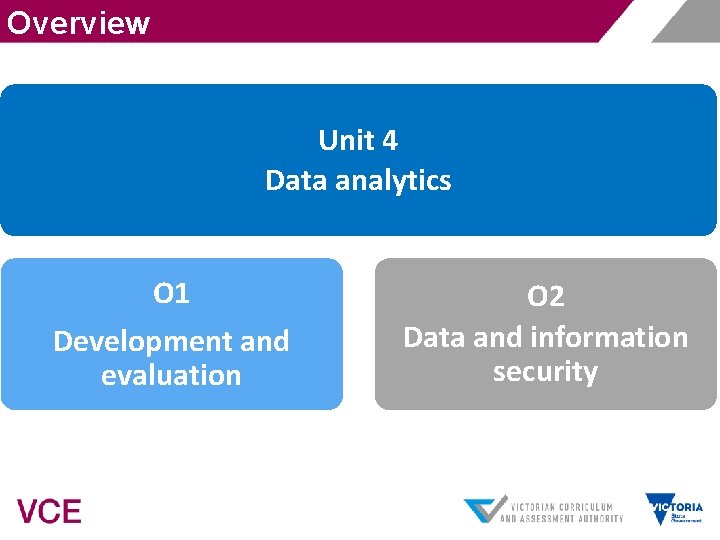
Overview Unit 4 Data analytics O 1 Development and evaluation O 2 Data and information security
Delivering Unit 4 Outcome 1 Development and evaluation
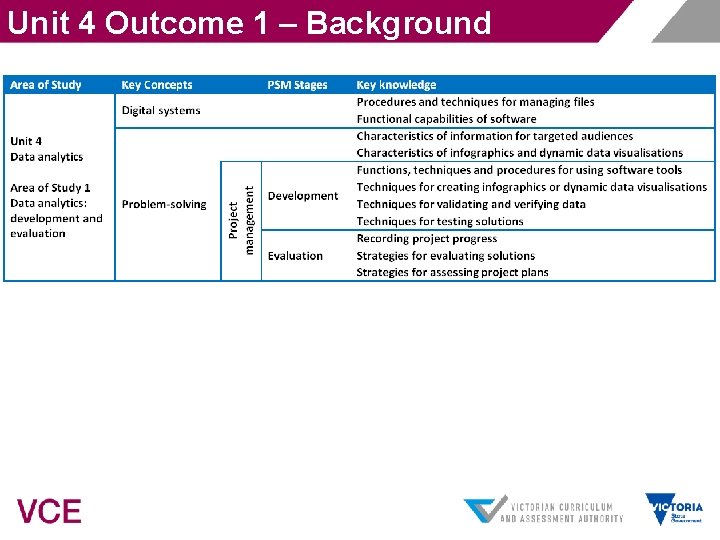
Unit 4 Outcome 1 – Background
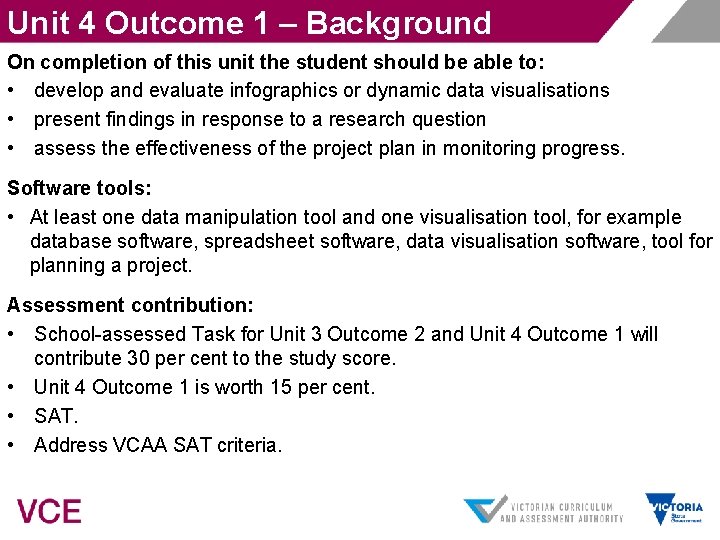
Unit 4 Outcome 1 – Background On completion of this unit the student should be able to: • develop and evaluate infographics or dynamic data visualisations • present findings in response to a research question • assess the effectiveness of the project plan in monitoring progress. Software tools: • At least one data manipulation tool and one visualisation tool, for example database software, spreadsheet software, data visualisation software, tool for planning a project. Assessment contribution: • School-assessed Task for Unit 3 Outcome 2 and Unit 4 Outcome 1 will contribute 30 per cent to the study score. • Unit 4 Outcome 1 is worth 15 per cent. • SAT. • Address VCAA SAT criteria.
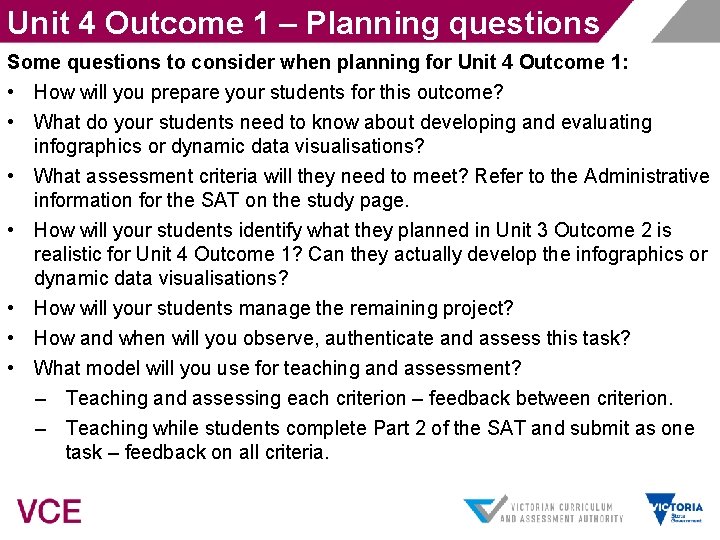
Unit 4 Outcome 1 – Planning questions Some questions to consider when planning for Unit 4 Outcome 1: • How will you prepare your students for this outcome? • What do your students need to know about developing and evaluating infographics or dynamic data visualisations? • What assessment criteria will they need to meet? Refer to the Administrative information for the SAT on the study page. • How will your students identify what they planned in Unit 3 Outcome 2 is realistic for Unit 4 Outcome 1? Can they actually develop the infographics or dynamic data visualisations? • How will your students manage the remaining project? • How and when will you observe, authenticate and assess this task? • What model will you use for teaching and assessment? – Teaching and assessing each criterion – feedback between criterion. – Teaching while students complete Part 2 of the SAT and submit as one task – feedback on all criteria.
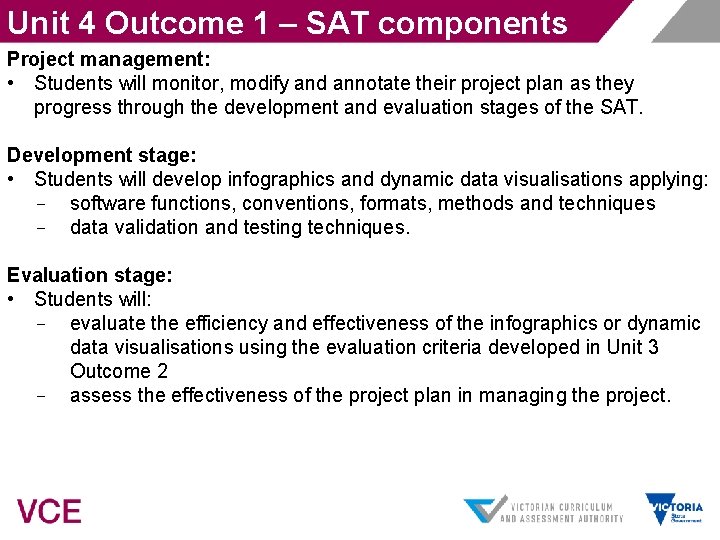
Unit 4 Outcome 1 – SAT components Project management: • Students will monitor, modify and annotate their project plan as they progress through the development and evaluation stages of the SAT. Development stage: • Students will develop infographics and dynamic data visualisations applying: software functions, conventions, formats, methods and techniques data validation and testing techniques. Evaluation stage: • Students will: evaluate the efficiency and effectiveness of the infographics or dynamic data visualisations using the evaluation criteria developed in Unit 3 Outcome 2 assess the effectiveness of the project plan in managing the project.
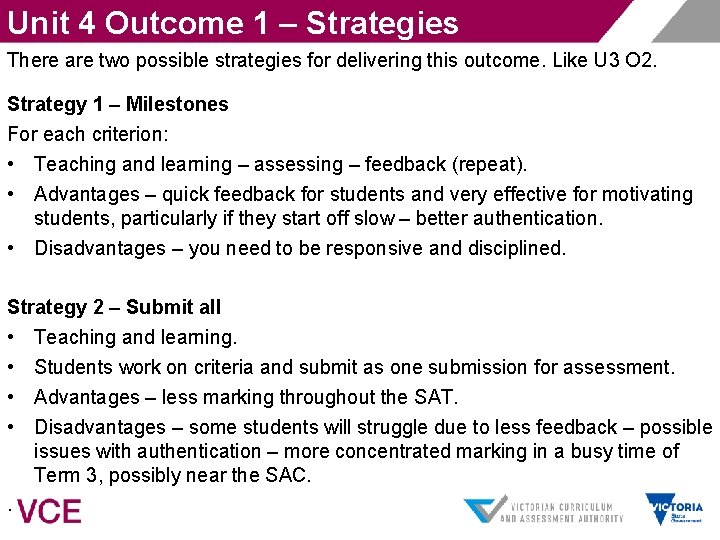
Unit 4 Outcome 1 – Strategies There are two possible strategies for delivering this outcome. Like U 3 O 2. Strategy 1 – Milestones For each criterion: • Teaching and learning – assessing – feedback (repeat). • Advantages – quick feedback for students and very effective for motivating students, particularly if they start off slow – better authentication. • Disadvantages – you need to be responsive and disciplined. Strategy 2 – Submit all • Teaching and learning. • Students work on criteria and submit as one submission for assessment. • Advantages – less marking throughout the SAT. • Disadvantages – some students will struggle due to less feedback – possible issues with authentication – more concentrated marking in a busy time of Term 3, possibly near the SAC. .
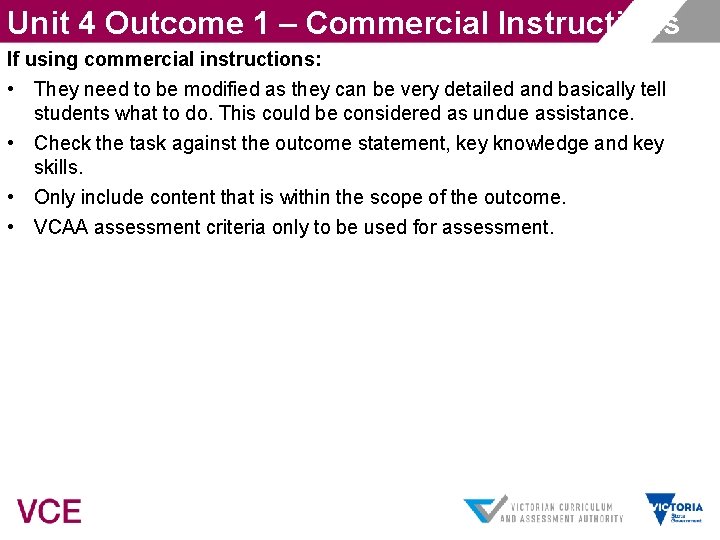
Unit 4 Outcome 1 – Commercial Instructions If using commercial instructions: • They need to be modified as they can be very detailed and basically tell students what to do. This could be considered as undue assistance. • Check the task against the outcome statement, key knowledge and key skills. • Only include content that is within the scope of the outcome. • VCAA assessment criteria only to be used for assessment.
Delivering Unit 4 Outcome 2 Data and information security
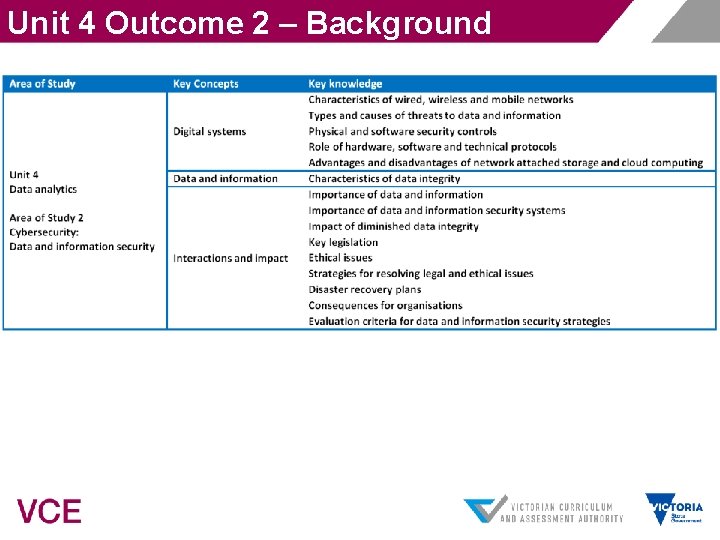
Unit 4 Outcome 2 – Background
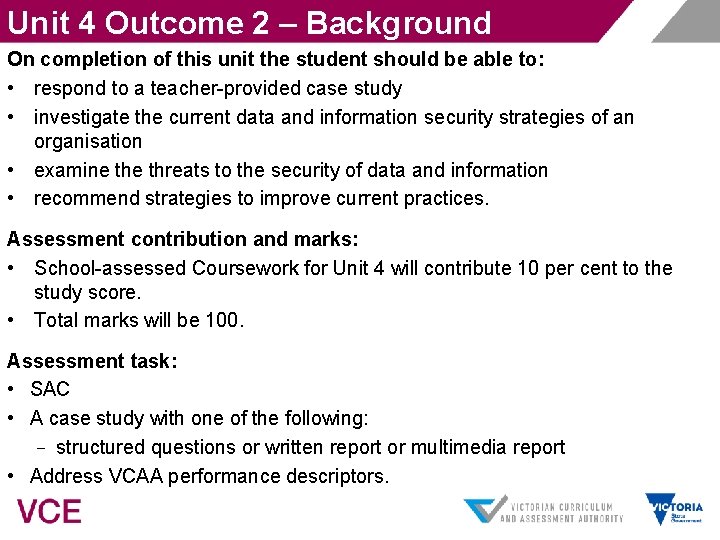
Unit 4 Outcome 2 – Background On completion of this unit the student should be able to: • respond to a teacher-provided case study • investigate the current data and information security strategies of an organisation • examine threats to the security of data and information • recommend strategies to improve current practices. Assessment contribution and marks: • School-assessed Coursework for Unit 4 will contribute 10 per cent to the study score. • Total marks will be 100. Assessment task: • SAC • A case study with one of the following: structured questions or written report or multimedia report • Address VCAA performance descriptors.
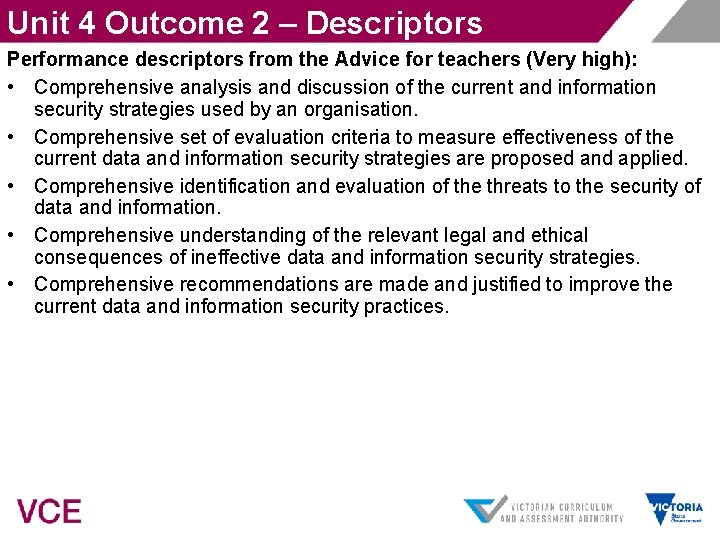
Unit 4 Outcome 2 – Descriptors Performance descriptors from the Advice for teachers (Very high): • Comprehensive analysis and discussion of the current and information security strategies used by an organisation. • Comprehensive set of evaluation criteria to measure effectiveness of the current data and information security strategies are proposed and applied. • Comprehensive identification and evaluation of the threats to the security of data and information. • Comprehensive understanding of the relevant legal and ethical consequences of ineffective data and information security strategies. • Comprehensive recommendations are made and justified to improve the current data and information security practices.
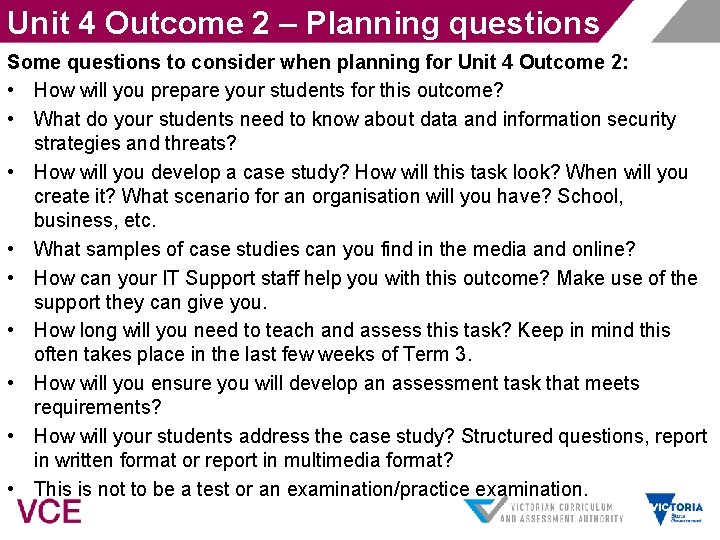
Unit 4 Outcome 2 – Planning questions Some questions to consider when planning for Unit 4 Outcome 2: • How will you prepare your students for this outcome? • What do your students need to know about data and information security strategies and threats? • How will you develop a case study? How will this task look? When will you create it? What scenario for an organisation will you have? School, business, etc. • What samples of case studies can you find in the media and online? • How can your IT Support staff help you with this outcome? Make use of the support they can give you. • How long will you need to teach and assess this task? Keep in mind this often takes place in the last few weeks of Term 3. • How will you ensure you will develop an assessment task that meets requirements? • How will your students address the case study? Structured questions, report in written format or report in multimedia format? • This is not to be a test or an examination/practice examination.
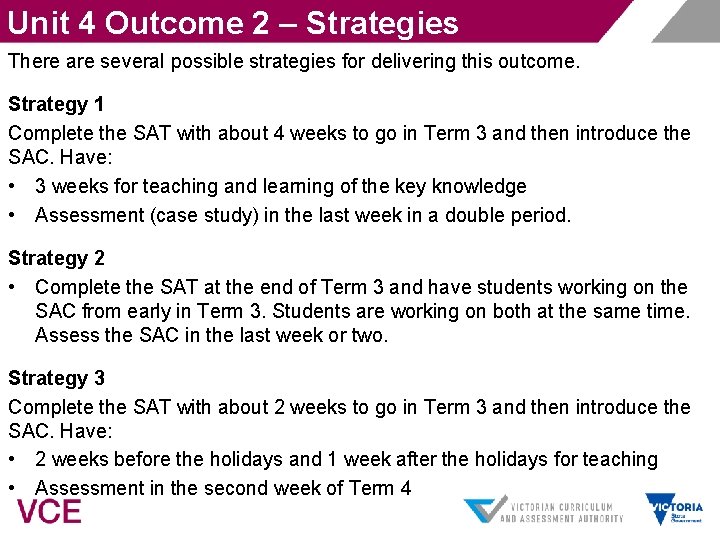
Unit 4 Outcome 2 – Strategies There are several possible strategies for delivering this outcome. Strategy 1 Complete the SAT with about 4 weeks to go in Term 3 and then introduce the SAC. Have: • 3 weeks for teaching and learning of the key knowledge • Assessment (case study) in the last week in a double period. Strategy 2 • Complete the SAT at the end of Term 3 and have students working on the SAC from early in Term 3. Students are working on both at the same time. Assess the SAC in the last week or two. Strategy 3 Complete the SAT with about 2 weeks to go in Term 3 and then introduce the SAC. Have: • 2 weeks before the holidays and 1 week after the holidays for teaching • Assessment in the second week of Term 4
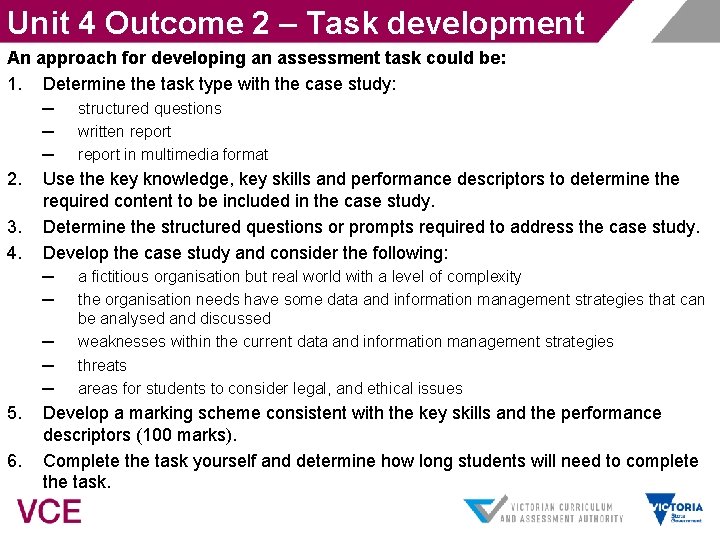
Unit 4 Outcome 2 – Task development An approach for developing an assessment task could be: 1. Determine the task type with the case study: ─ ─ ─ 2. 3. 4. Use the key knowledge, key skills and performance descriptors to determine the required content to be included in the case study. Determine the structured questions or prompts required to address the case study. Develop the case study and consider the following: ─ ─ ─ 5. 6. structured questions written report in multimedia format a fictitious organisation but real world with a level of complexity the organisation needs have some data and information management strategies that can be analysed and discussed weaknesses within the current data and information management strategies threats areas for students to consider legal, and ethical issues Develop a marking scheme consistent with the key skills and the performance descriptors (100 marks). Complete the task yourself and determine how long students will need to complete the task.
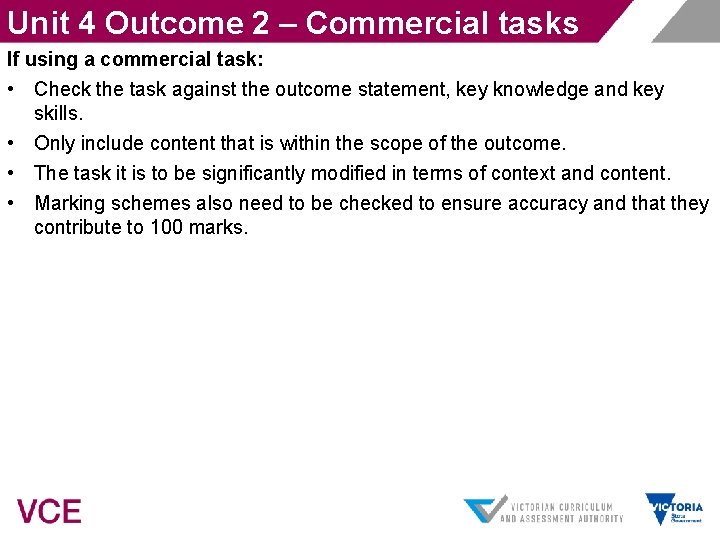
Unit 4 Outcome 2 – Commercial tasks If using a commercial task: • Check the task against the outcome statement, key knowledge and key skills. • Only include content that is within the scope of the outcome. • The task it is to be significantly modified in terms of context and content. • Marking schemes also need to be checked to ensure accuracy and that they contribute to 100 marks.
Phil Feain Curriculum Manager, Digital Technologies Victorian Curriculum and Assessment Authority Ph: (03) 9032 1724 feain. philip. a@edumail. vic. gov. au