
Unit 4 Classical Civilizations Lesson 6 Roman Civil




- Slides: 30
Unit 4 Classical Civilizations Lesson #6 Roman Civil Wars/Julius Caesar
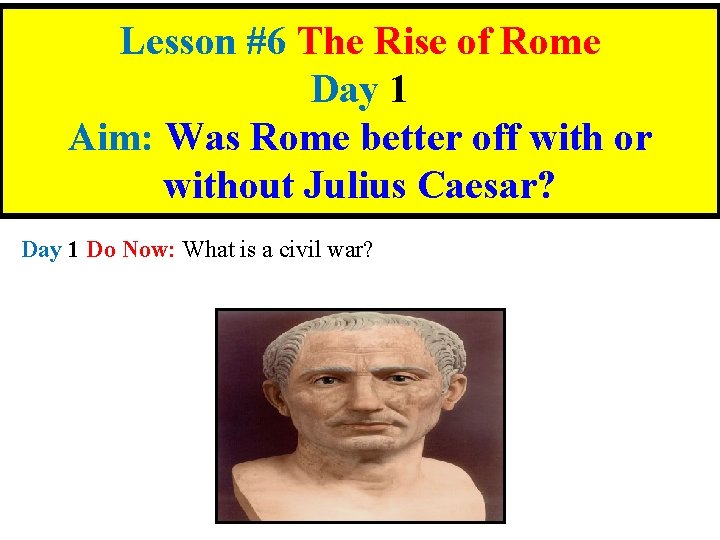
Lesson #6 The Rise of Rome Day 1 Aim: Was Rome better off with or without Julius Caesar? Day 1 Do Now: What is a civil war?
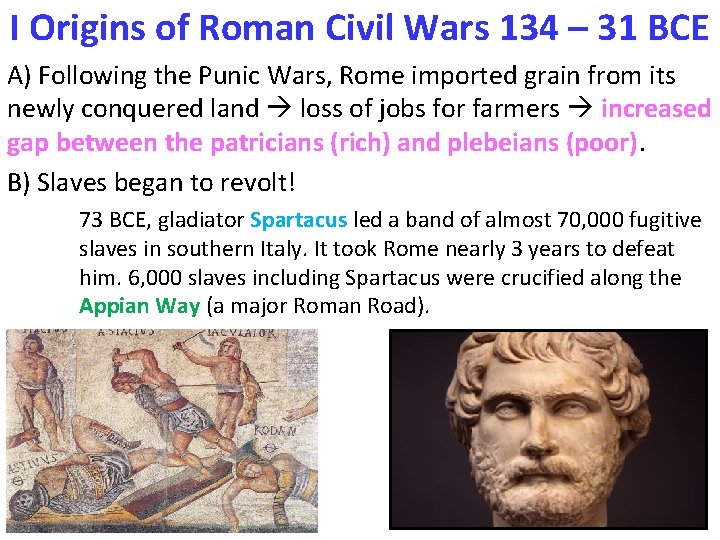
I Origins of Roman Civil Wars 134 – 31 BCE A) Following the Punic Wars, Rome imported grain from its newly conquered land loss of jobs for farmers increased gap between the patricians (rich) and plebeians (poor). B) Slaves began to revolt! 73 BCE, gladiator Spartacus led a band of almost 70, 000 fugitive slaves in southern Italy. It took Rome nearly 3 years to defeat him. 6, 000 slaves including Spartacus were crucified along the Appian Way (a major Roman Road).
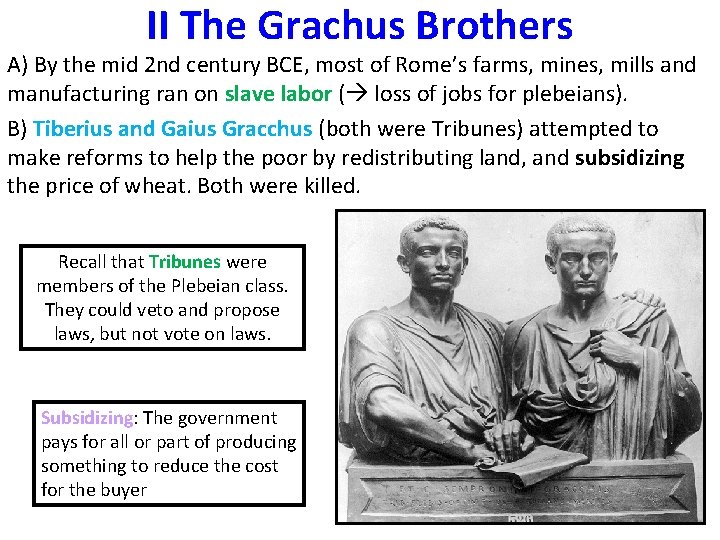
II The Grachus Brothers A) By the mid 2 nd century BCE, most of Rome’s farms, mines, mills and manufacturing ran on slave labor ( loss of jobs for plebeians). B) Tiberius and Gaius Gracchus (both were Tribunes) attempted to make reforms to help the poor by redistributing land, and subsidizing the price of wheat. Both were killed. Recall that Tribunes were members of the Plebeian class. They could veto and propose laws, but not vote on laws. Subsidizing: The government pays for all or part of producing something to reduce the cost for the buyer
III Sulla Remained Dictator for More than 6 Months 83 BCE General Sulla became the 1 st Roman general to use his army to seize the city of Rome. 82 BCE he appointed himself dictator. Dictators were supposed to be appointed by the Senate and only for up to 6 months- he remained dictator until 79 BCE! He seized property of the patricians and used it to bribe his soldiers for loyalty.
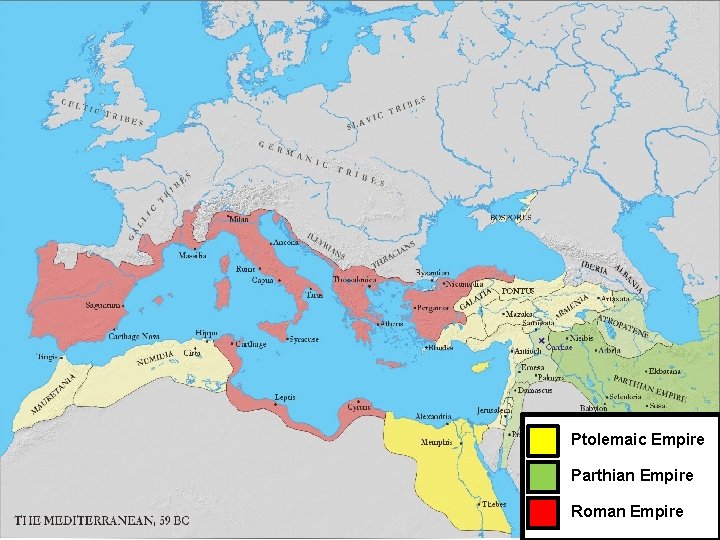
Ptolemaic Empire Parthian Empire Roman Empire
Activity Day 1 • Students will close read annotate “The Republic of Rome Part 3: Civil Wars 133 -46 B. C. ” answer differentiated text based questions. • Group will discuss answers to questions and choose one for closing discussion.
Closing Day 1 • Exit Slip Question: What were the causes and consequences of the Roman Civil Wars? (Mention Spartacus, the Gracchus brothers, and Sulla) • Homework: # 6 on the Unit 4 Outline
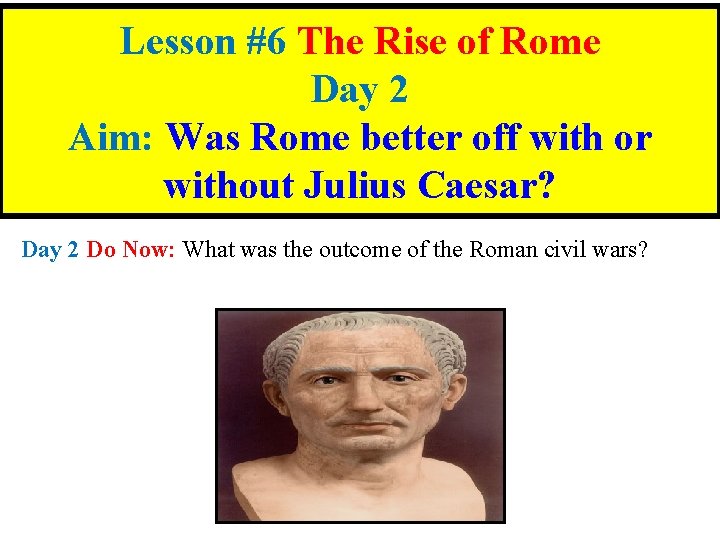
Lesson #6 The Rise of Rome Day 2 Aim: Was Rome better off with or without Julius Caesar? Day 2 Do Now: What was the outcome of the Roman civil wars?
IV Julius Caesar 100 – 44 BCE A) Julius Caesar rose within the Roman Republic from a quaestor 69 BCE to governor of Spain in 61 BCE. B) By 60 BCE Caesar, Crassus, and Pompey formed the First Triumvirate (a secret political alliance). Together, they helped Caesar be elected to consul in 59 BCE, and governor of Gaul the year after. C) 58 BCE Caesar conquered Gaul (France). Pompey feared he was becoming too powerful. 76 BCE, Caesar had been captured by pirates and held for ransom. Caesar was insulted the ransom was too low and insisted it be raised. After he was released, he hunted down the pirates and killed them.
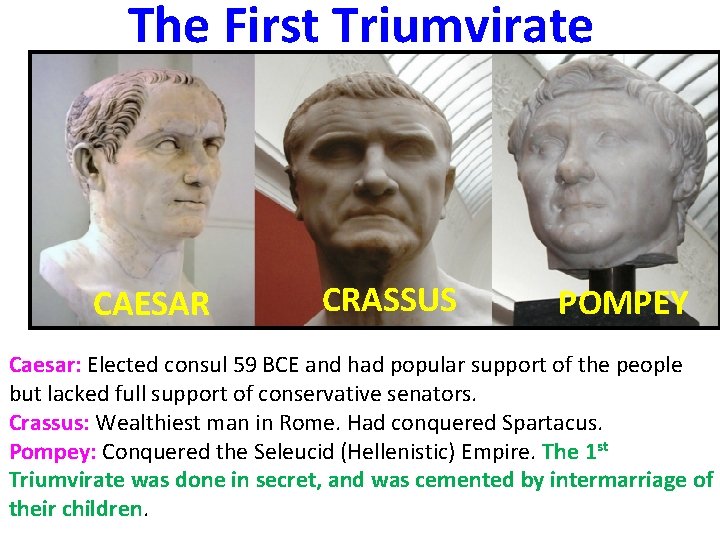
The First Triumvirate CAESAR CRASSUS POMPEY Caesar: Elected consul 59 BCE and had popular support of the people but lacked full support of conservative senators. Crassus: Wealthiest man in Rome. Had conquered Spartacus. Pompey: Conquered the Seleucid (Hellenistic) Empire. The 1 st Triumvirate was done in secret, and was cemented by intermarriage of their children.
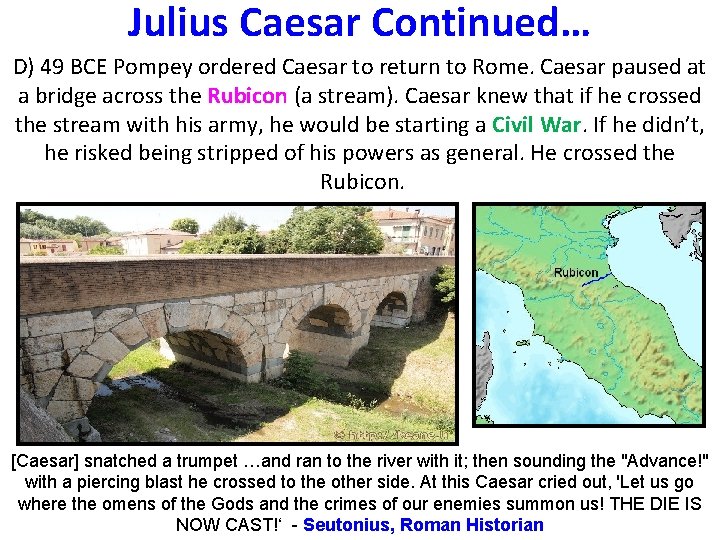
Julius Caesar Continued… D) 49 BCE Pompey ordered Caesar to return to Rome. Caesar paused at a bridge across the Rubicon (a stream). Caesar knew that if he crossed the stream with his army, he would be starting a Civil War. If he didn’t, he risked being stripped of his powers as general. He crossed the Rubicon. [Caesar] snatched a trumpet …and ran to the river with it; then sounding the "Advance!" with a piercing blast he crossed to the other side. At this Caesar cried out, 'Let us go where the omens of the Gods and the crimes of our enemies summon us! THE DIE IS NOW CAST!‘ - Seutonius, Roman Historian
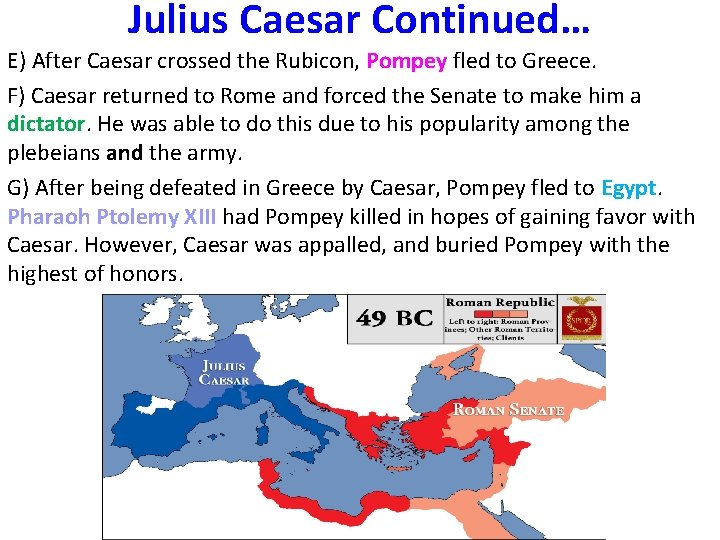
Julius Caesar Continued… E) After Caesar crossed the Rubicon, Pompey fled to Greece. F) Caesar returned to Rome and forced the Senate to make him a dictator. He was able to do this due to his popularity among the plebeians and the army. G) After being defeated in Greece by Caesar, Pompey fled to Egypt. Pharaoh Ptolemy XIII had Pompey killed in hopes of gaining favor with Caesar. However, Caesar was appalled, and buried Pompey with the highest of honors.
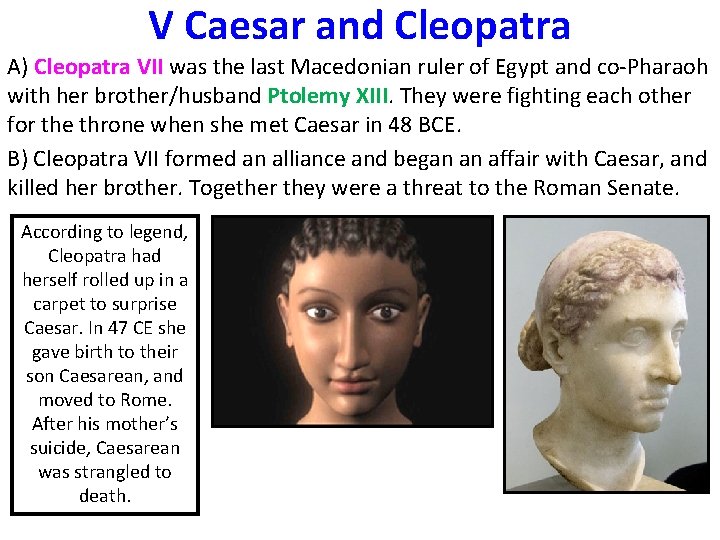
V Caesar and Cleopatra A) Cleopatra VII was the last Macedonian ruler of Egypt and co-Pharaoh with her brother/husband Ptolemy XIII. They were fighting each other for the throne when she met Caesar in 48 BCE. B) Cleopatra VII formed an alliance and began an affair with Caesar, and killed her brother. Together they were a threat to the Roman Senate. According to legend, Cleopatra had herself rolled up in a carpet to surprise Caesar. In 47 CE she gave birth to their son Caesarean, and moved to Rome. After his mother’s suicide, Caesarean was strangled to death.
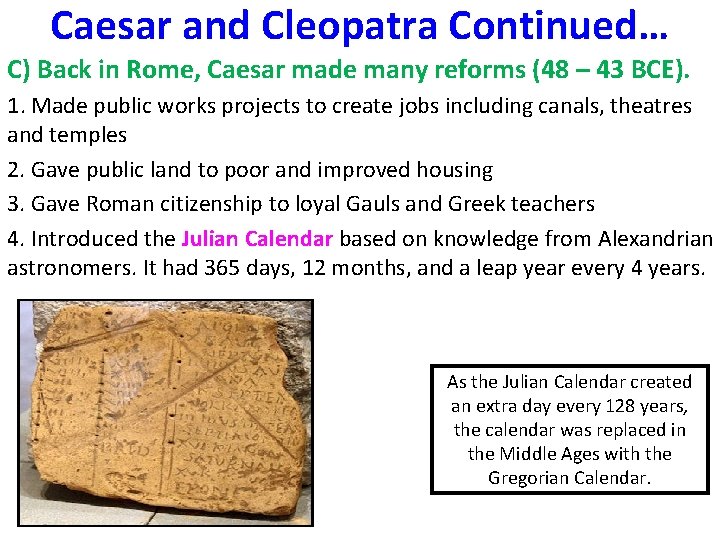
Caesar and Cleopatra Continued… C) Back in Rome, Caesar made many reforms (48 – 43 BCE). 1. Made public works projects to create jobs including canals, theatres and temples 2. Gave public land to poor and improved housing 3. Gave Roman citizenship to loyal Gauls and Greek teachers 4. Introduced the Julian Calendar based on knowledge from Alexandrian astronomers. It had 365 days, 12 months, and a leap year every 4 years. As the Julian Calendar created an extra day every 128 years, the calendar was replaced in the Middle Ages with the Gregorian Calendar.
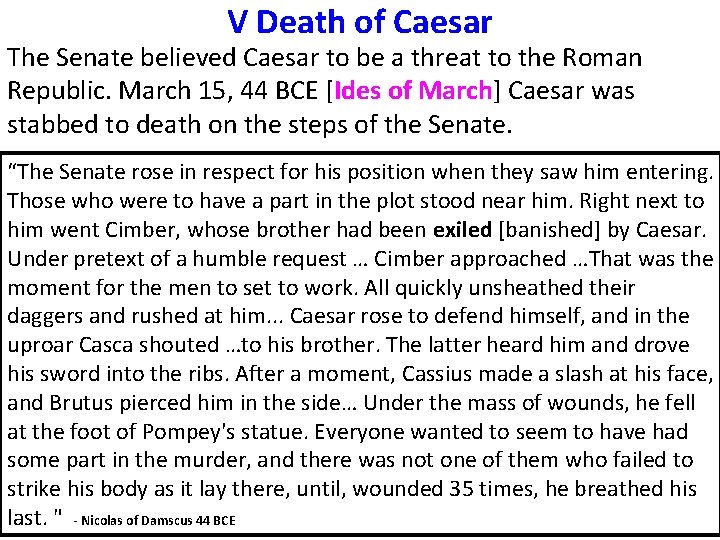
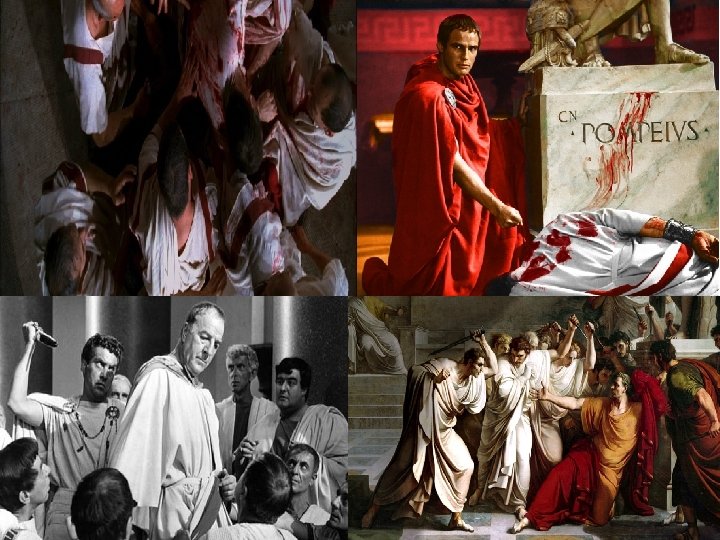
V Death of Caesar The Senate believed Caesar to be a threat to the Roman Republic. March 15, 44 BCE [Ides of March] Caesar was stabbed to death on the steps of the Senate. “The Senate rose in respect for his position when they saw him entering. Those who were to have a part in the plot stood near him. Right next to him went Cimber, whose brother had been exiled [banished] by Caesar. Under pretext of a humble request … Cimber approached …That was the moment for the men to set to work. All quickly unsheathed their daggers and rushed at him. . . Caesar rose to defend himself, and in the uproar Casca shouted …to his brother. The latter heard him and drove his sword into the ribs. After a moment, Cassius made a slash at his face, and Brutus pierced him in the side… Under the mass of wounds, he fell at the foot of Pompey's statue. Everyone wanted to seem to have had some part in the murder, and there was not one of them who failed to strike his body as it lay there, until, wounded 35 times, he breathed his last. " - Nicolas of Damscus 44 BCE
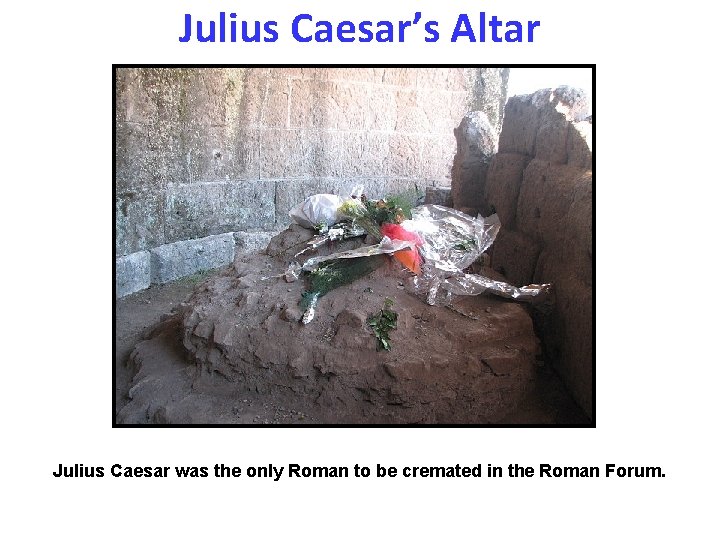
Julius Caesar’s Altar Julius Caesar was the only Roman to be cremated in the Roman Forum.
Activity Day 2 • Students will close read annotate “The Republic of Rome Part 4: Julius Caesar. ” answer differentiated text based questions. • Group will discuss answers to questions and choose one for closing discussion.
Closing Day 2 • Exit Slip Question: What allowed for the rise of Caesar to power? • Homework: # 6 on the Unit 4 Outline
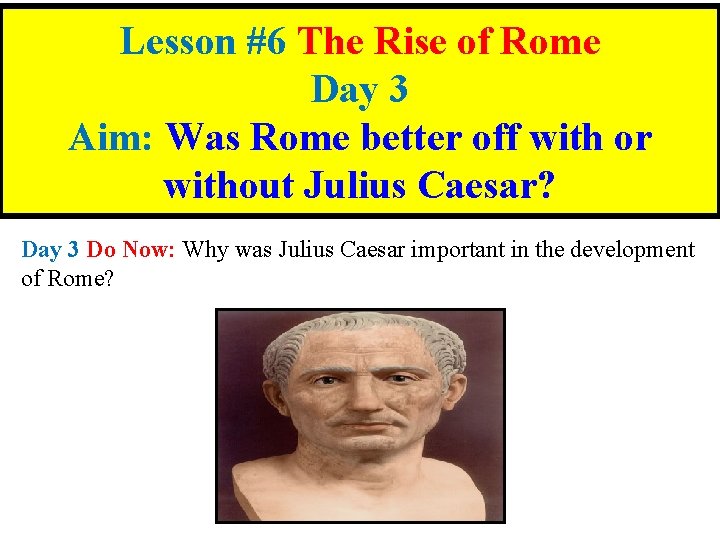
Lesson #6 The Rise of Rome Day 3 Aim: Was Rome better off with or without Julius Caesar? Day 3 Do Now: Why was Julius Caesar important in the development of Rome?
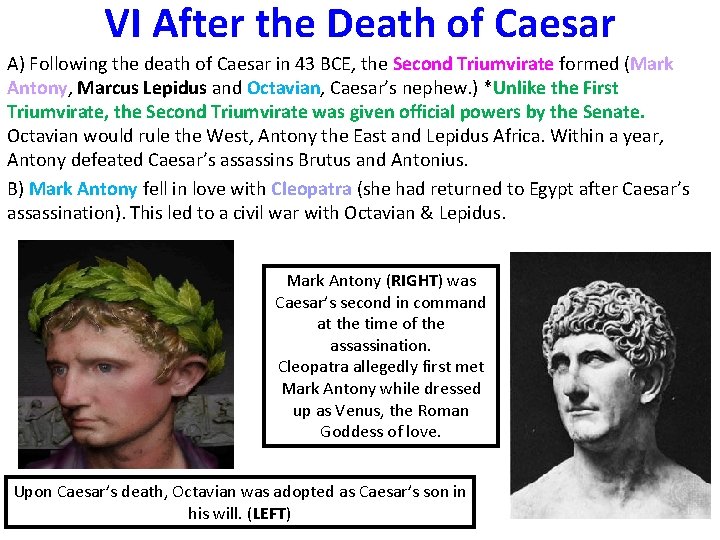
VI After the Death of Caesar A) Following the death of Caesar in 43 BCE, the Second Triumvirate formed (Mark Antony, Marcus Lepidus and Octavian, Caesar’s nephew. ) *Unlike the First Triumvirate, the Second Triumvirate was given official powers by the Senate. Octavian would rule the West, Antony the East and Lepidus Africa. Within a year, Antony defeated Caesar’s assassins Brutus and Antonius. B) Mark Antony fell in love with Cleopatra (she had returned to Egypt after Caesar’s assassination). This led to a civil war with Octavian & Lepidus. Mark Antony (RIGHT) was Caesar’s second in command at the time of the assassination. Cleopatra allegedly first met Mark Antony while dressed up as Venus, the Roman Goddess of love. Upon Caesar’s death, Octavian was adopted as Caesar’s son in his will. (LEFT)
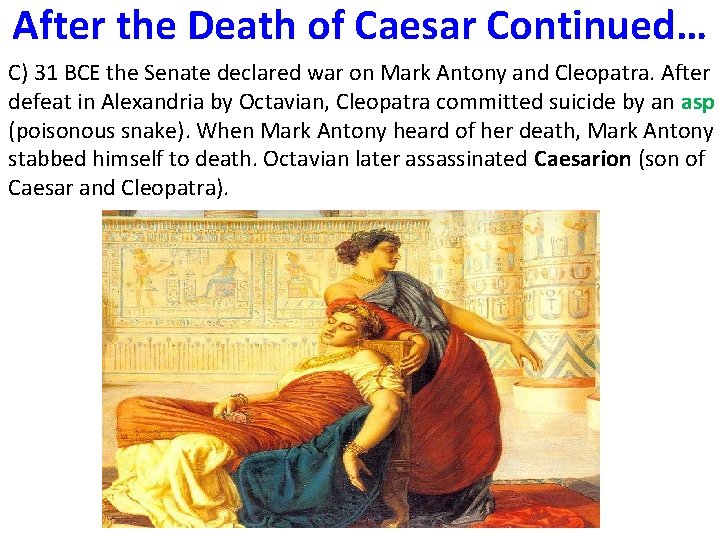
After the Death of Caesar Continued… C) 31 BCE the Senate declared war on Mark Antony and Cleopatra. After defeat in Alexandria by Octavian, Cleopatra committed suicide by an asp (poisonous snake). When Mark Antony heard of her death, Mark Antony stabbed himself to death. Octavian later assassinated Caesarion (son of Caesar and Cleopatra).
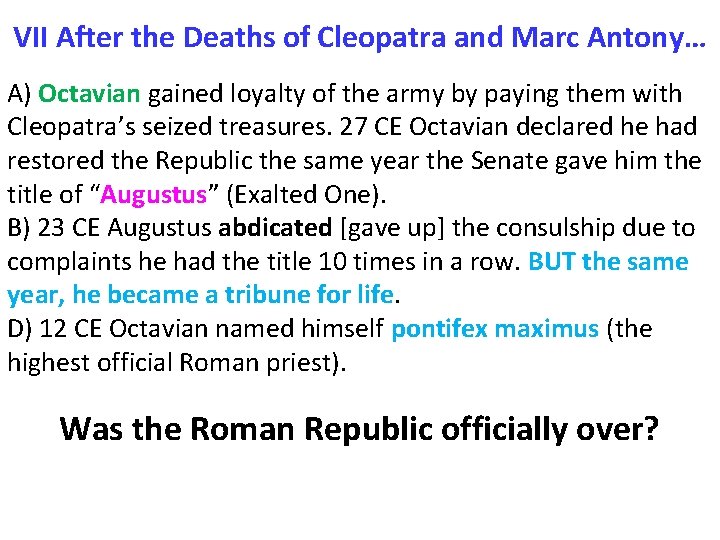
VII After the Deaths of Cleopatra and Marc Antony… A) Octavian gained loyalty of the army by paying them with Cleopatra’s seized treasures. 27 CE Octavian declared he had restored the Republic the same year the Senate gave him the title of “Augustus” (Exalted One). B) 23 CE Augustus abdicated [gave up] the consulship due to complaints he had the title 10 times in a row. BUT the same year, he became a tribune for life. D) 12 CE Octavian named himself pontifex maximus (the highest official Roman priest). Was the Roman Republic officially over?
Activity Day 3 • Students will close read annotate “Octavian-Augustus: The First Roman Emperor” answer differentiated text based questions. • Group will discuss answers to questions and choose one for closing discussion.
Closing Day 3 Exit Slip Question: Was Rome better off as a Republic or as an Empire? Explain. • Homework: # 6 on the Unit 4 Outline
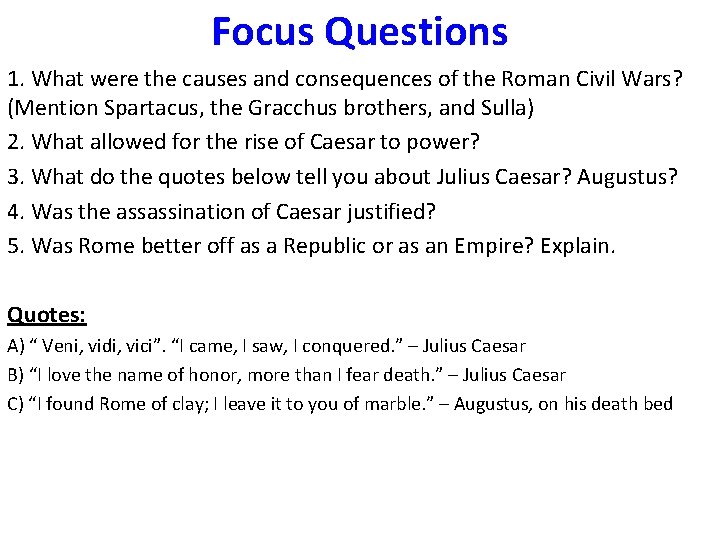
Focus Questions 1. What were the causes and consequences of the Roman Civil Wars? (Mention Spartacus, the Gracchus brothers, and Sulla) 2. What allowed for the rise of Caesar to power? 3. What do the quotes below tell you about Julius Caesar? Augustus? 4. Was the assassination of Caesar justified? 5. Was Rome better off as a Republic or as an Empire? Explain. Quotes: A) “ Veni, vidi, vici”. “I came, I saw, I conquered. ” – Julius Caesar B) “I love the name of honor, more than I fear death. ” – Julius Caesar C) “I found Rome of clay; I leave it to you of marble. ” – Augustus, on his death bed
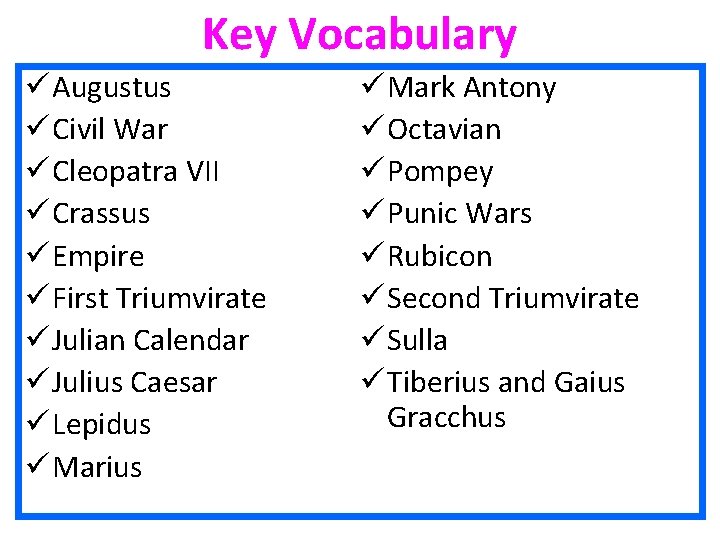
Key Vocabulary ü Augustus ü Civil War ü Cleopatra VII ü Crassus ü Empire ü First Triumvirate ü Julian Calendar ü Julius Caesar ü Lepidus ü Marius ü Mark Antony ü Octavian ü Pompey ü Punic Wars ü Rubicon ü Second Triumvirate ü Sulla ü Tiberius and Gaius Gracchus