
Unit 4 Circles Notes Circle A circle is
- Slides: 22
Unit 4: Circles Notes
Circle • A circle is the set of points in a plane equidistant from a given point, which is the center of the circle. All circles are similar.
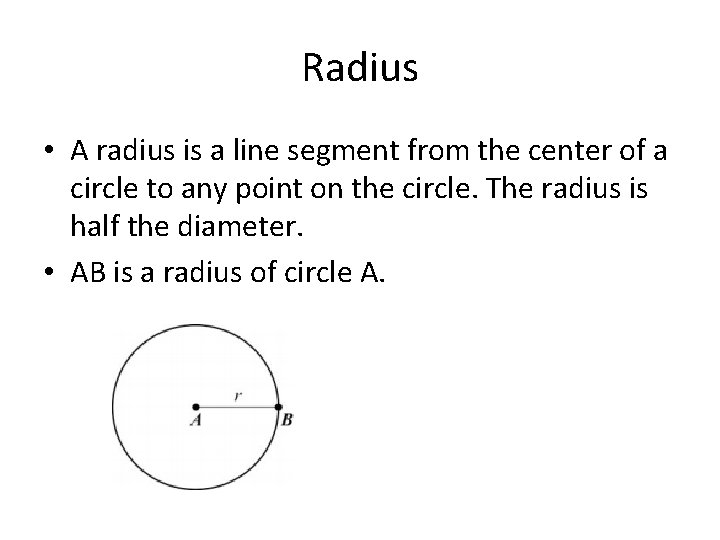
Radius • A radius is a line segment from the center of a circle to any point on the circle. The radius is half the diameter. • AB is a radius of circle A.
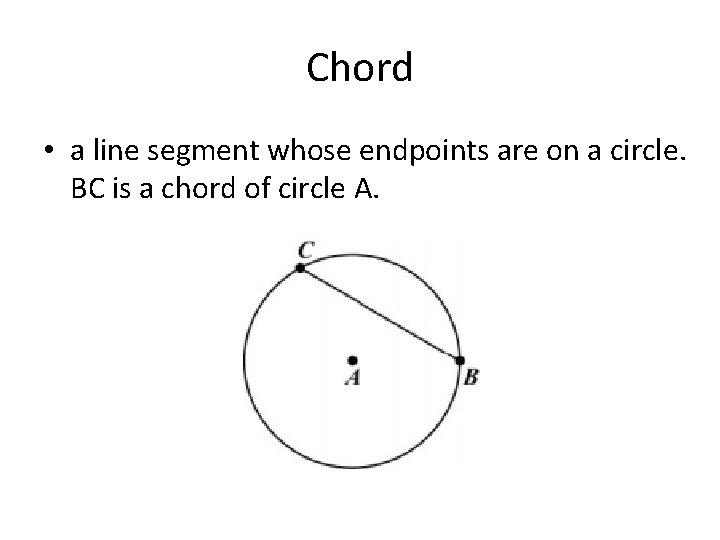
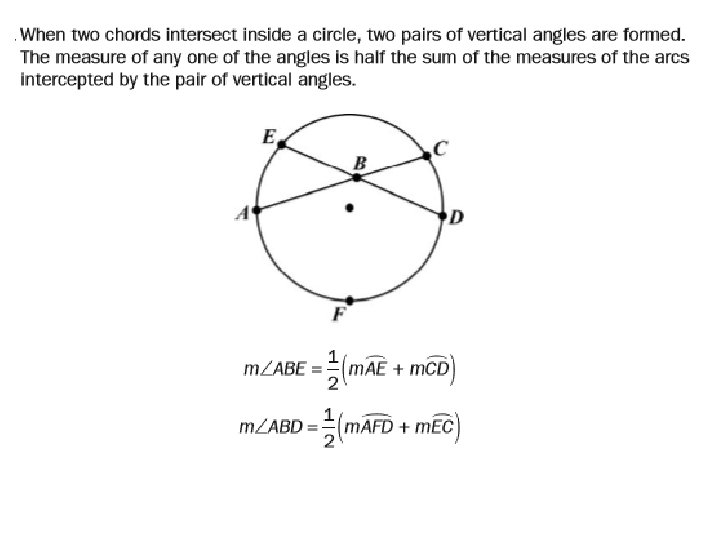
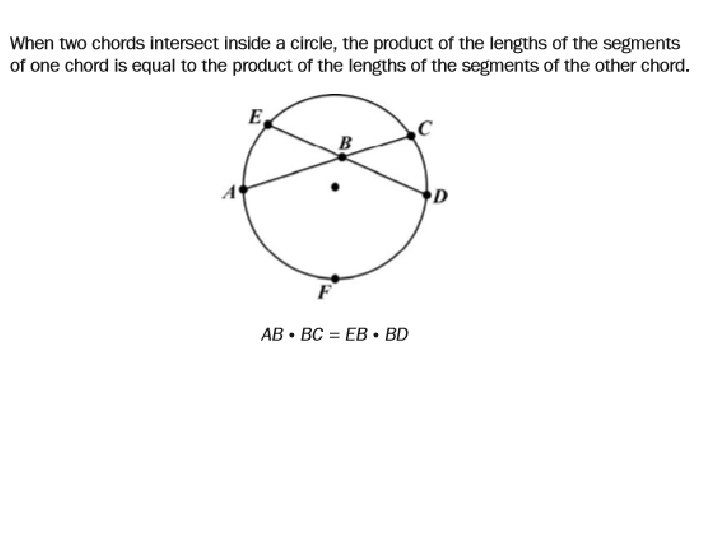
Chord • a line segment whose endpoints are on a circle. BC is a chord of circle A.
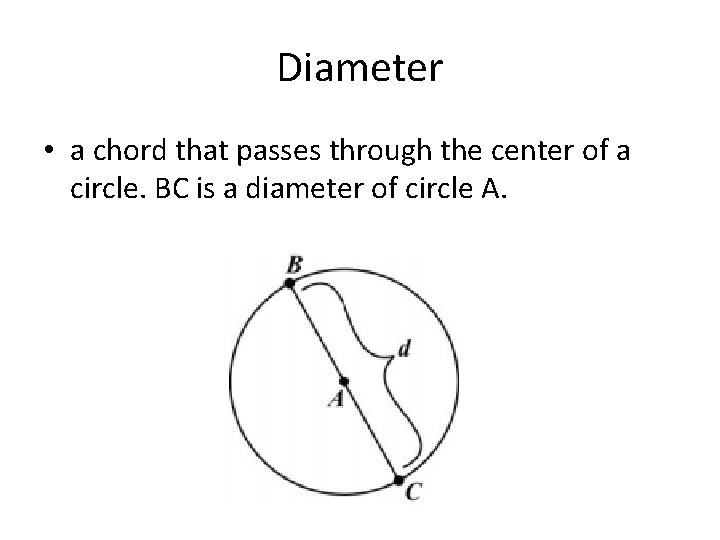
Diameter • a chord that passes through the center of a circle. BC is a diameter of circle A.
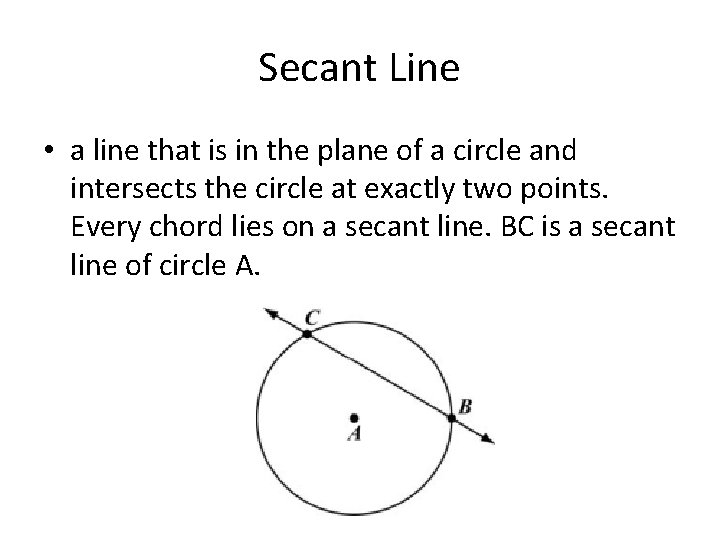
Secant Line • a line that is in the plane of a circle and intersects the circle at exactly two points. Every chord lies on a secant line. BC is a secant line of circle A.
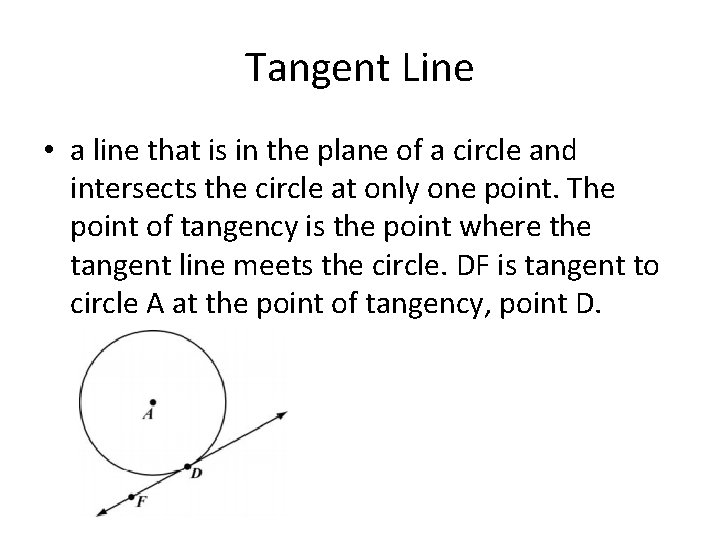
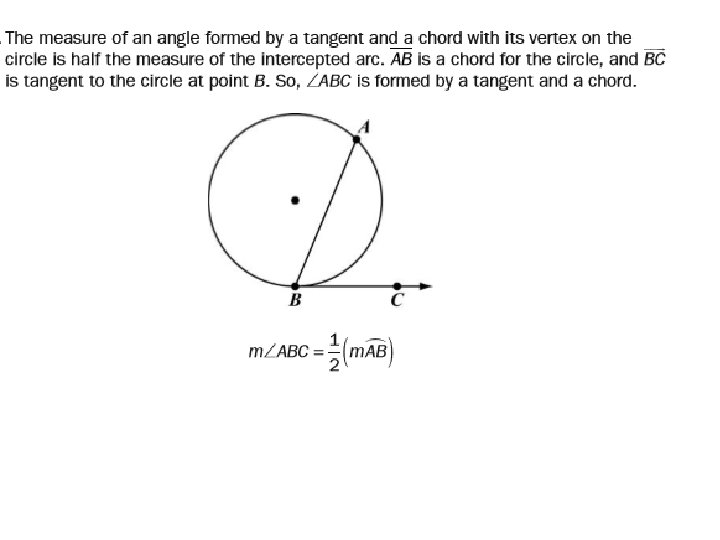
Tangent Line • a line that is in the plane of a circle and intersects the circle at only one point. The point of tangency is the point where the tangent line meets the circle. DF is tangent to circle A at the point of tangency, point D.
• An arc is a part of the circumference of a circle. • A minor arc has a measure less than 180°. Minor arcs are written using two points on a circle. • A semicircle is an arc that measures exactly 180°. Semicircles are written using three points on a circle. • A major arc has a measure greater than 180°. Major arcs are written with three points.
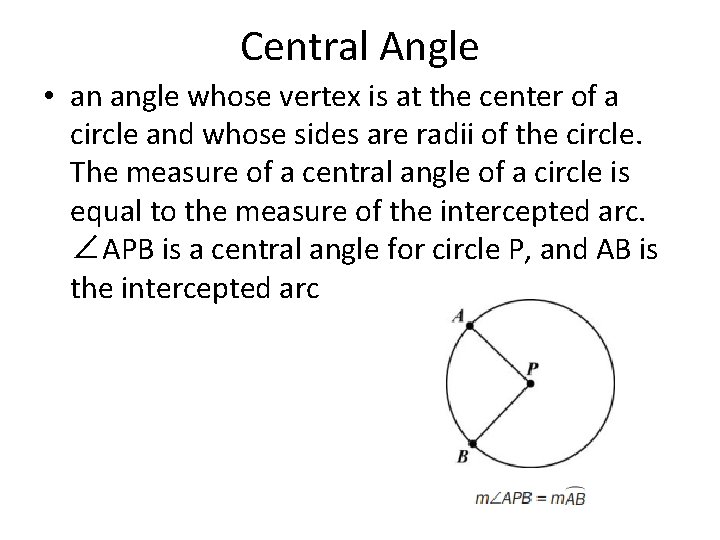
Central Angle • an angle whose vertex is at the center of a circle and whose sides are radii of the circle. The measure of a central angle of a circle is equal to the measure of the intercepted arc. ∠APB is a central angle for circle P, and AB is the intercepted arc
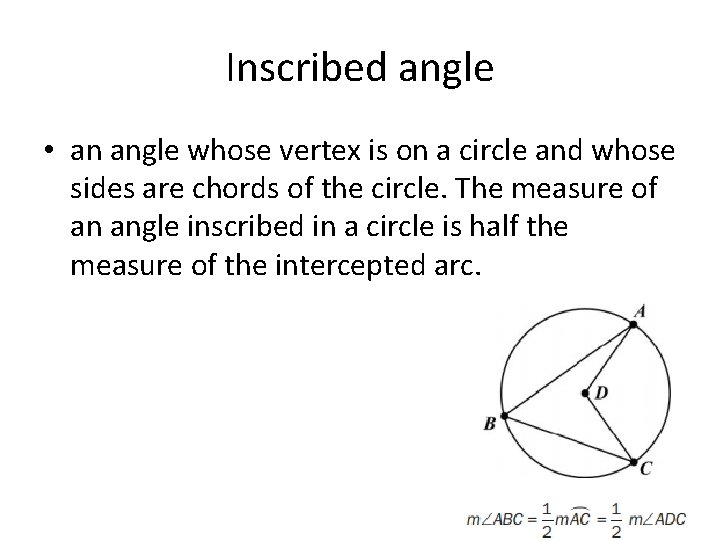
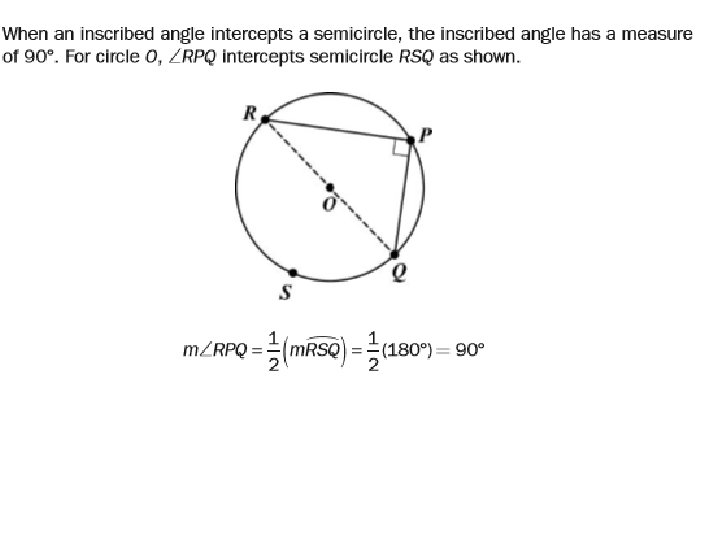
Inscribed angle • an angle whose vertex is on a circle and whose sides are chords of the circle. The measure of an angle inscribed in a circle is half the measure of the intercepted arc.
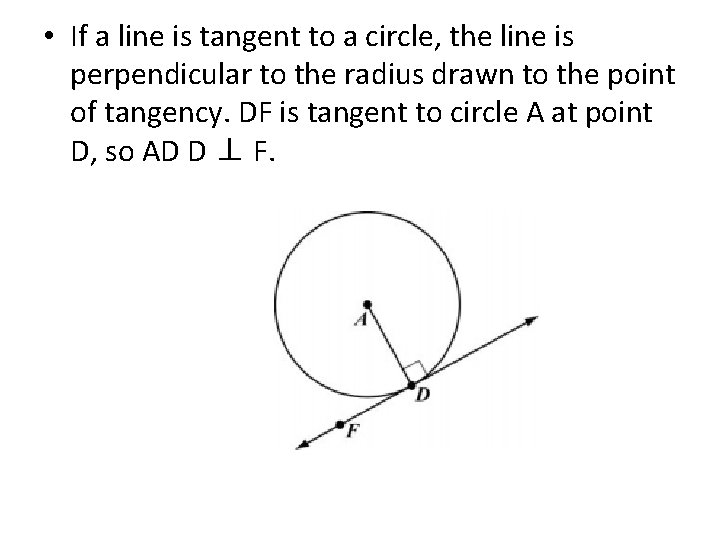
• If a line is tangent to a circle, the line is perpendicular to the radius drawn to the point of tangency. DF is tangent to circle A at point D, so AD D ⊥ F.
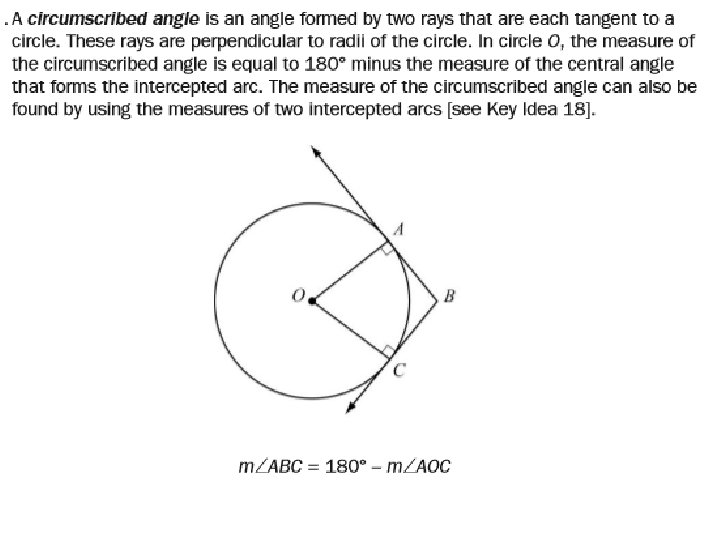
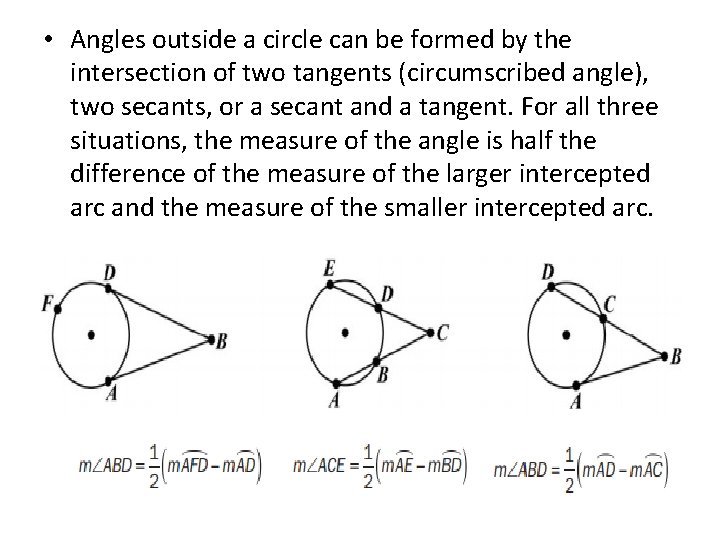
• Angles outside a circle can be formed by the intersection of two tangents (circumscribed angle), two secants, or a secant and a tangent. For all three situations, the measure of the angle is half the difference of the measure of the larger intercepted arc and the measure of the smaller intercepted arc.