
Unit 4 Cellular Energy Chapter 8 What is


- Slides: 45
Unit 4: Cellular Energy Chapter 8
What is Metabolism? Metabolism: All of the chemical reactions that occur within an organism. There are 2 Types of metabolic reactions: » Catabolic » Anabolic
Catabolic: Releases energy by breaking down larger molecules into smaller molecules. Breaking Down!
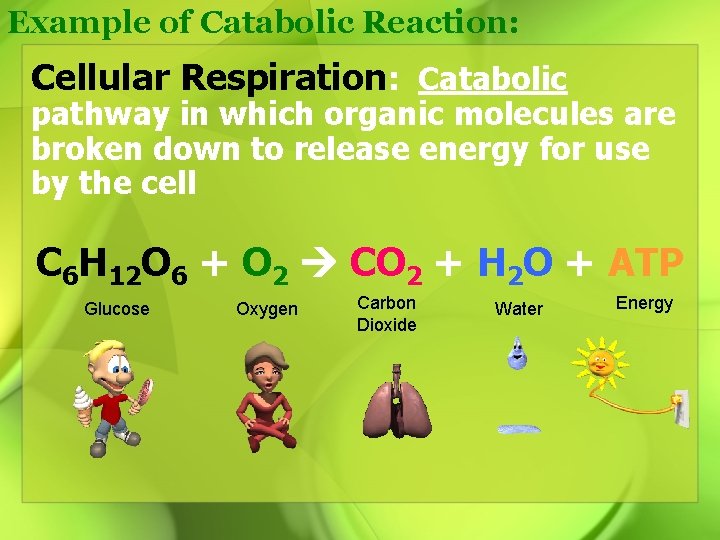
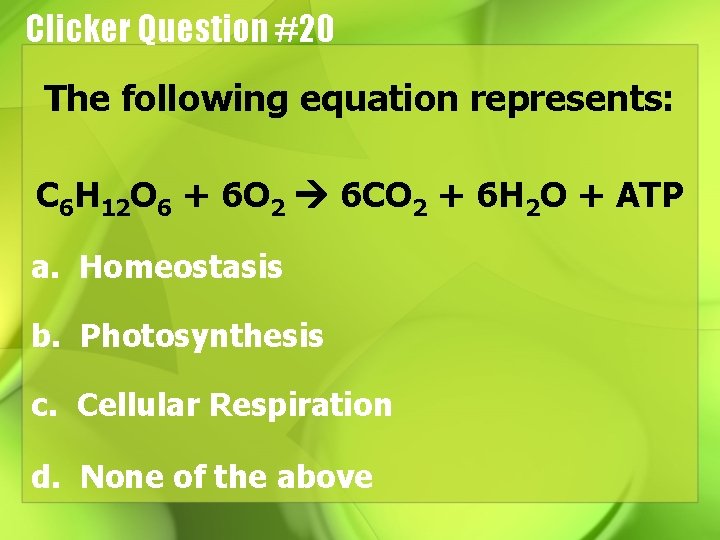
Example of Catabolic Reaction: Cellular Respiration: Catabolic pathway in which organic molecules are broken down to release energy for use by the cell C 6 H 12 O 6 + O 2 CO 2 + H 2 O + ATP Glucose Oxygen Carbon Dioxide Water Energy
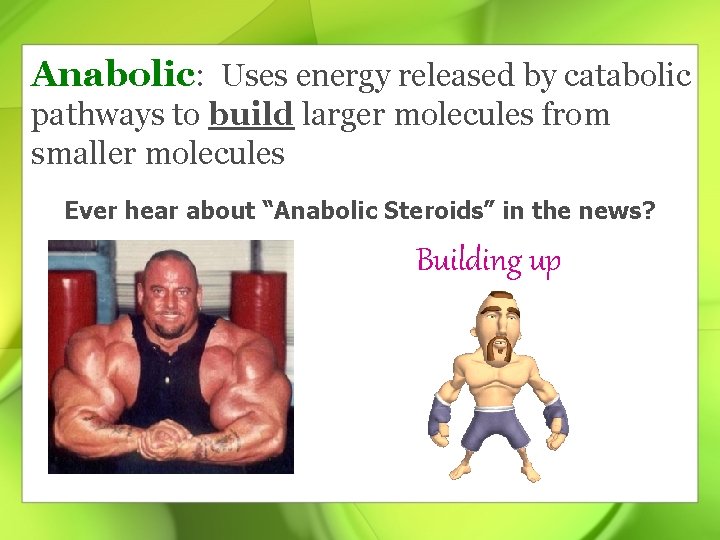
Anabolic: Uses energy released by catabolic pathways to build larger molecules from smaller molecules Ever hear about “Anabolic Steroids” in the news? Building up
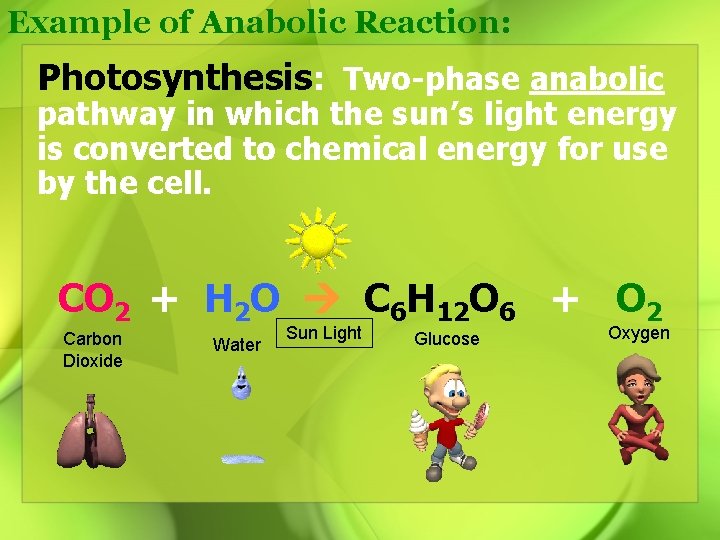
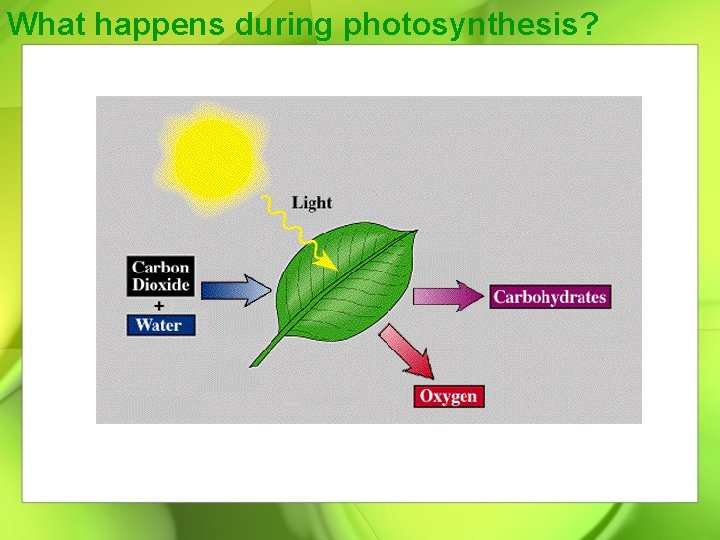
Example of Anabolic Reaction: Photosynthesis: Two-phase anabolic pathway in which the sun’s light energy is converted to chemical energy for use by the cell. CO 2 + H 2 O C 6 H 12 O 6 + O 2 Carbon Dioxide Water Sun Light Glucose Oxygen
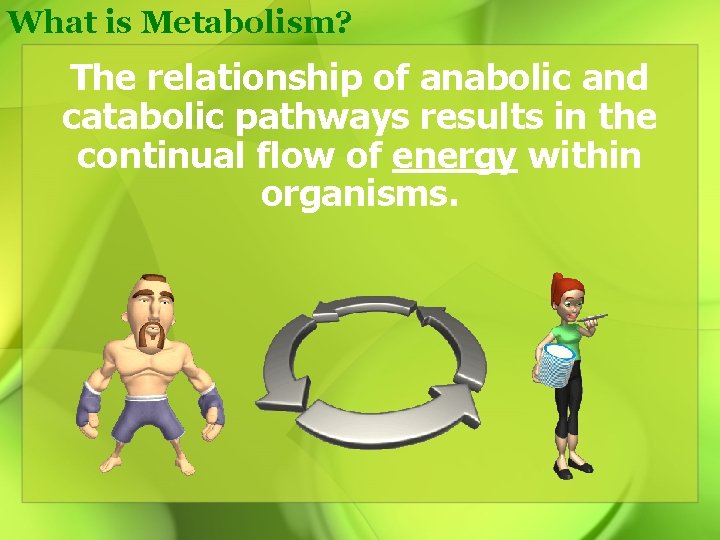
What is Metabolism? The relationship of anabolic and catabolic pathways results in the continual flow of energy within organisms.
Clicker Question #1 The building of materials is called: a. b. c. d. homeostasis anabolic catabolic ATP
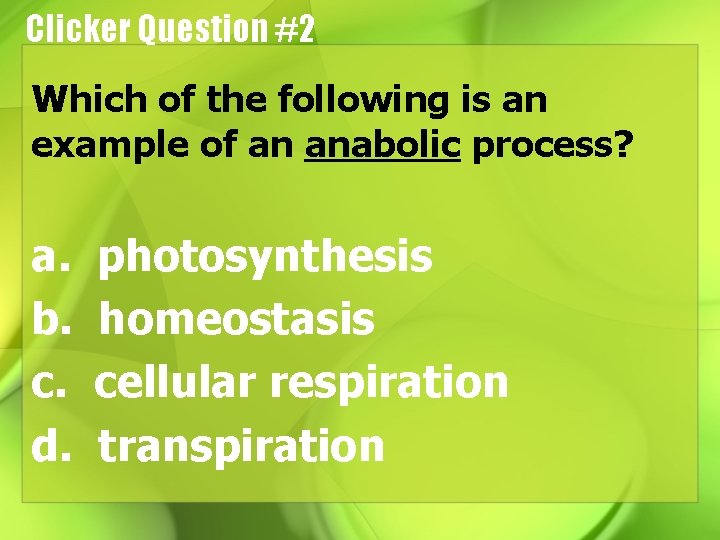
Clicker Question #2 Which of the following is an example of an anabolic process? a. b. c. d. photosynthesis homeostasis cellular respiration transpiration
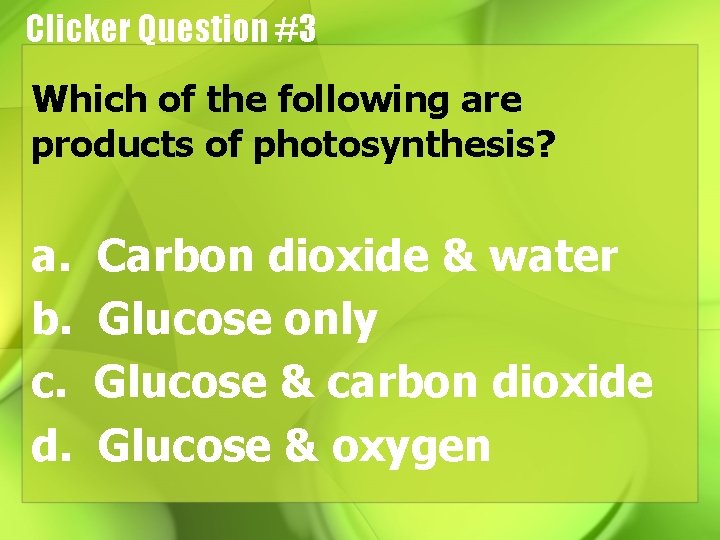
Clicker Question #3 Which of the following are products of photosynthesis? a. b. c. d. Carbon dioxide & water Glucose only Glucose & carbon dioxide Glucose & oxygen
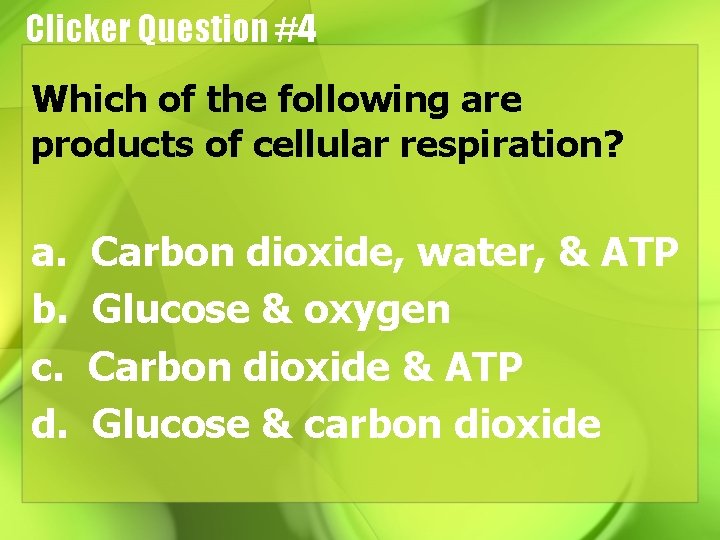
Clicker Question #4 Which of the following are products of cellular respiration? a. b. c. d. Carbon dioxide, water, & ATP Glucose & oxygen Carbon dioxide & ATP Glucose & carbon dioxide
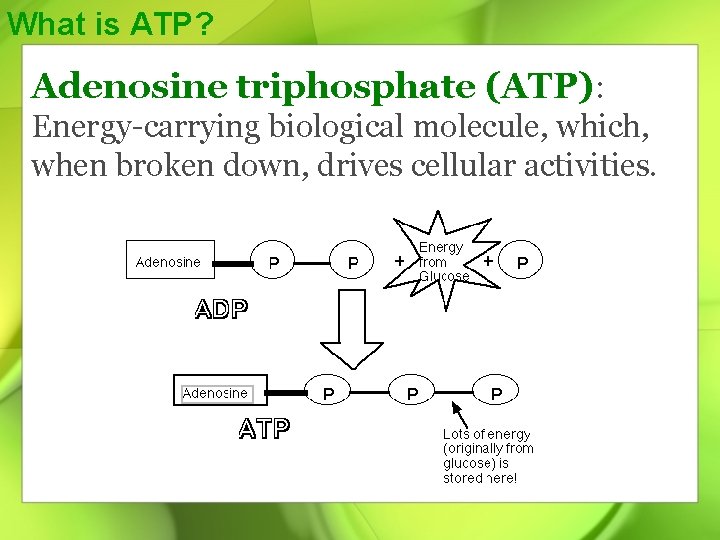
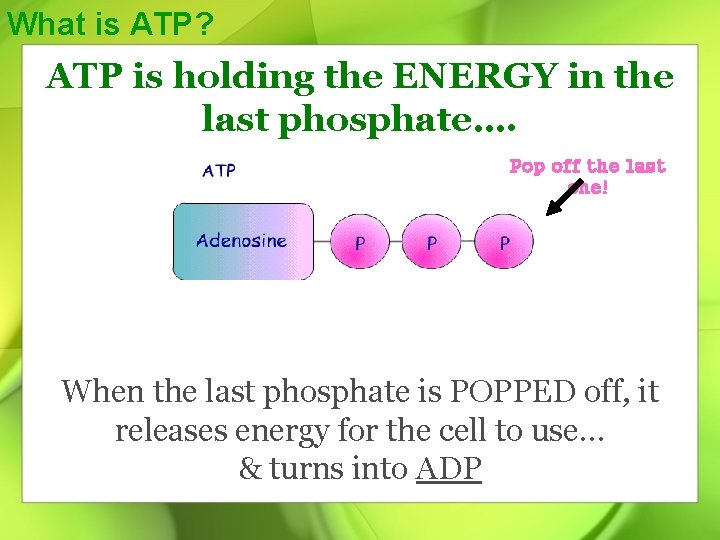
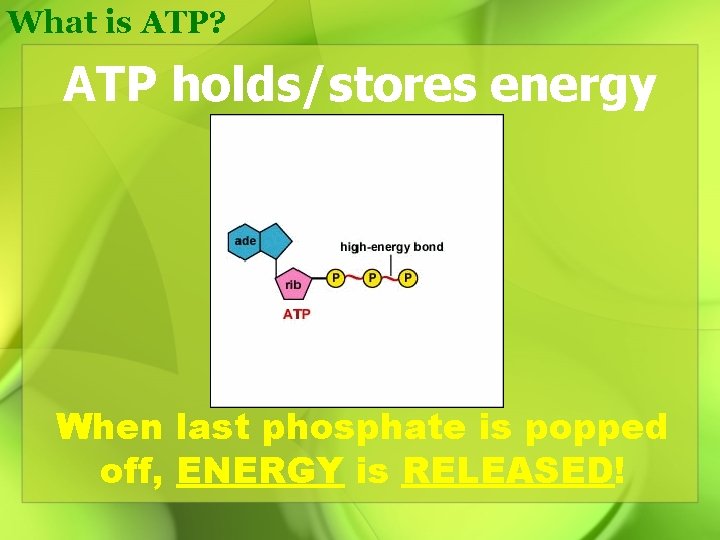
What is ATP? Adenosine triphosphate (ATP): Energy-carrying biological molecule, which, when broken down, drives cellular activities.
What is ATP? ATP is holding the ENERGY in the last phosphate…. Pop off the last one! When the last phosphate is POPPED off, it releases energy for the cell to use… & turns into ADP
What is ATP? ATP holds/stores energy When last phosphate is popped off, ENERGY is RELEASED!
Clicker Question #5 What does ATP do? a. b. c. d. Stores energy Gets rid of energy Maintains homeostasis Breaks down molecules
Clicker Question #6 How does ATP release energy? a. It just gives it away b. When the bond between the 2 nd & 3 rd phosphate is broken c. When the bond between the 1 st & 2 nd phosphate is broken d. It never releases energy
Clicker Question #7 Once the last phosphate is broken off and energy is released, what does ATP turn into? a. Glucose b. Carbon dioxide c. NADP+ d. ADP
Where does ATP come from?
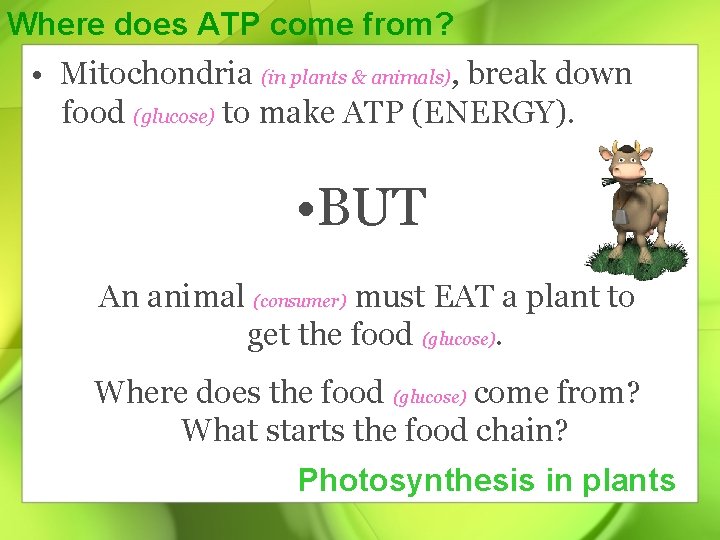
Where does ATP come from? • Mitochondria (in plants & animals), break down food (glucose) to make ATP (ENERGY). • BUT An animal (consumer) must EAT a plant to get the food (glucose). Where does the food (glucose) come from? What starts the food chain? Photosynthesis in plants
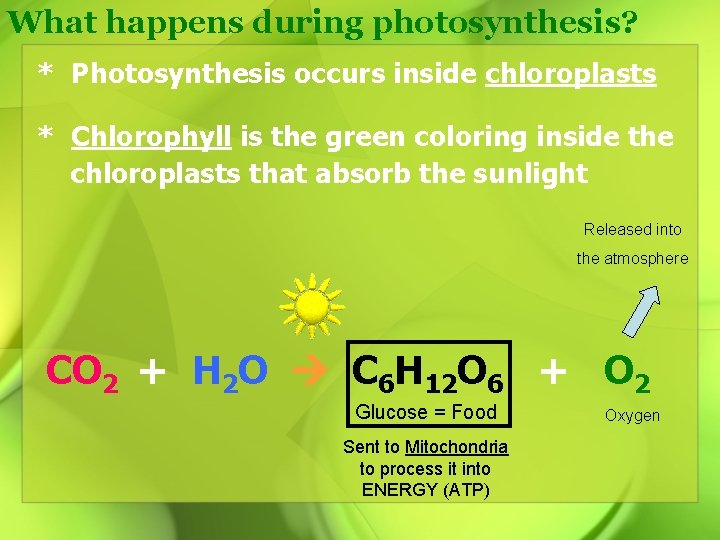
What happens during photosynthesis? * Photosynthesis occurs inside chloroplasts * Chlorophyll is the green coloring inside the chloroplasts that absorb the sunlight Released into the atmosphere CO 2 + H 2 O C 6 H 12 O 6 + O 2 Glucose = Food Sent to Mitochondria to process it into ENERGY (ATP) Oxygen
What happens during photosynthesis?
Photosynthesis Video
Clicker Question #8 Where does photosynthesis take place? a. Ribosomes b. Cell membrane c. Mitochondria d. Chloroplasts
Clicker Question #9 During photosynthesis, what is released into the atmosphere? a. Carbon dioxide b. Glucose c. Oxygen d. Water
Clicker Question #10 What is the main purpose for photosynthesis? a. To make carbon dioxide b. To make glucose c. To make oxygen d. To make water
Clicker Question #11 These are found in plants and are used to capture & absorb sunlight: a. Mitochondria b. Chlorophyll c. Ribosomes d. Cell Wall
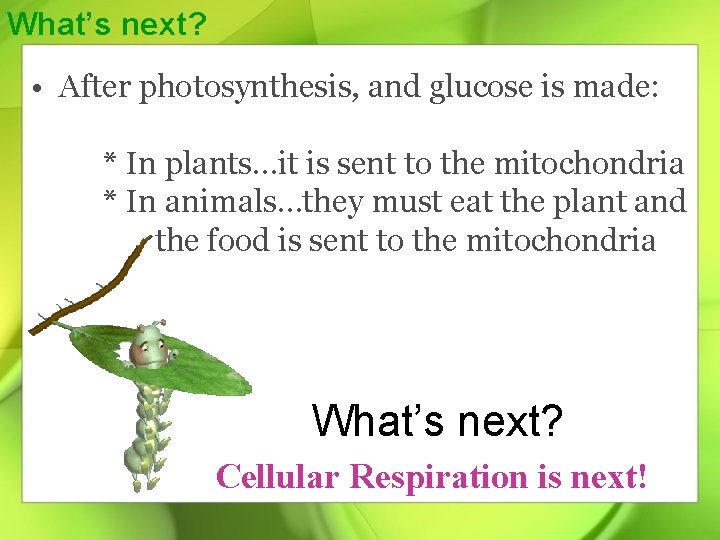
What’s next? • After photosynthesis, and glucose is made: * In plants…it is sent to the mitochondria * In animals…they must eat the plant and the food is sent to the mitochondria What’s next? Cellular Respiration is next!
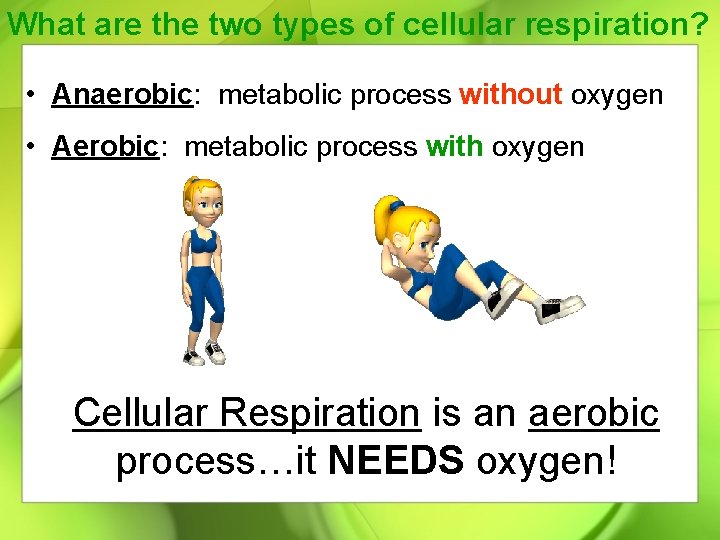
What are the two types of cellular respiration? • Anaerobic: metabolic process without oxygen • Aerobic: metabolic process with oxygen Cellular Respiration is an aerobic process…it NEEDS oxygen!
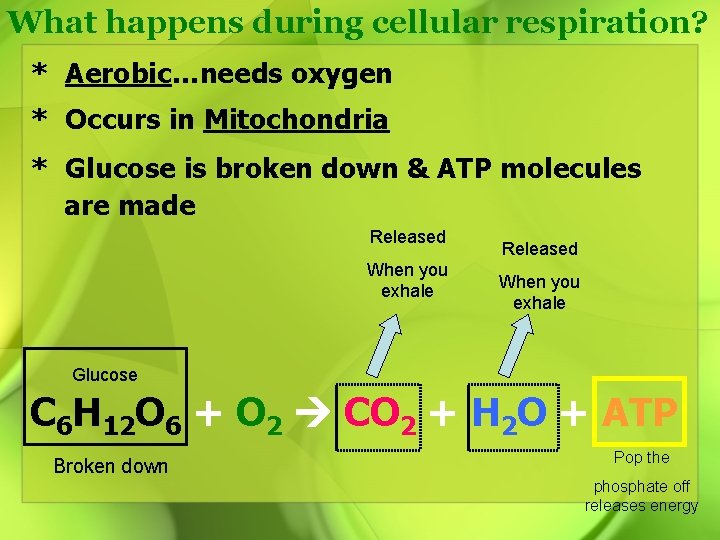
What happens during cellular respiration? * Aerobic…needs oxygen * Occurs in Mitochondria * Glucose is broken down & ATP molecules are made Released When you exhale Glucose C 6 H 12 O 6 + O 2 CO 2 + H 2 O + ATP Broken down Pop the phosphate off releases energy
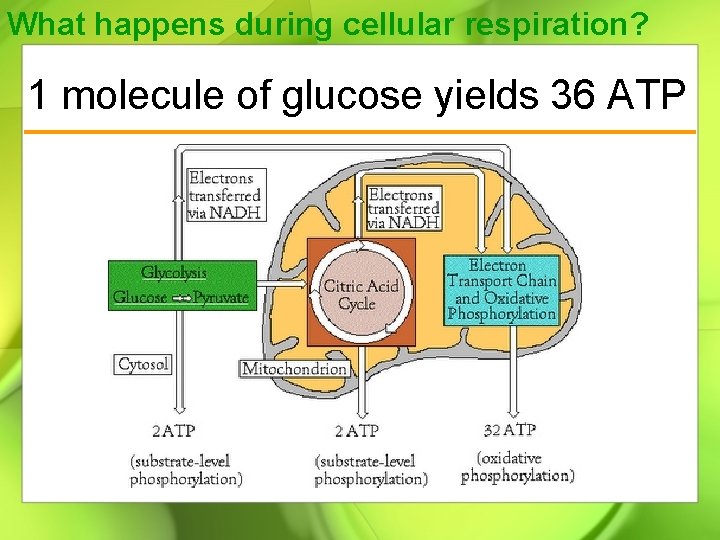
What happens during cellular respiration? 1 molecule of glucose yields 36 ATP
Cellular Respiration Video
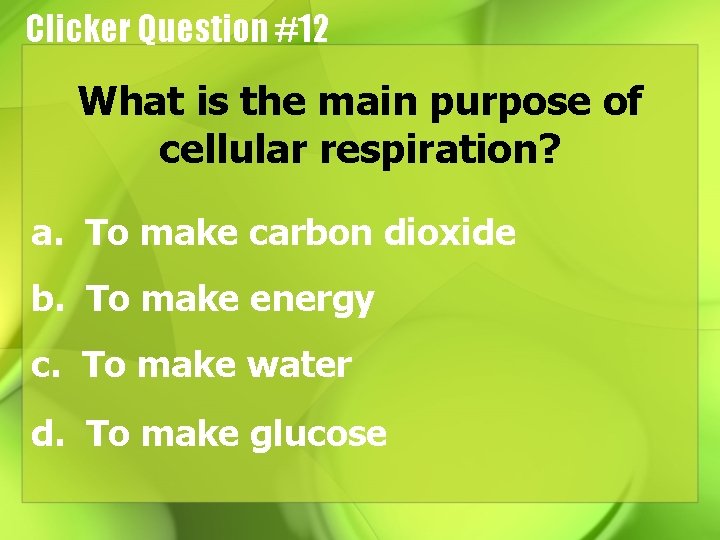
Clicker Question #12 What is the main purpose of cellular respiration? a. To make carbon dioxide b. To make energy c. To make water d. To make glucose
Clicker Question #13 What waste products are released during cellular respiration? a. Carbon dioxide & water b. Glucose & oxygen c. Carbon dioxide & glucose d. Carbon dioxide only
Clicker Question #14 How many ATP are made from 1 molecule of glucose? a. 2 b. 20 c. 26 d. 36
Clicker Question #15 Where does cellular respiration occur? a. Ribosomes b. Chloroplasts c. Mitochondria d. Chlorophyll
Clicker Question #16 What is aerobic? a. A process maintaining balance b. A process that requires oxygen c. A process that does not require oxygen d. A process that makes ATP
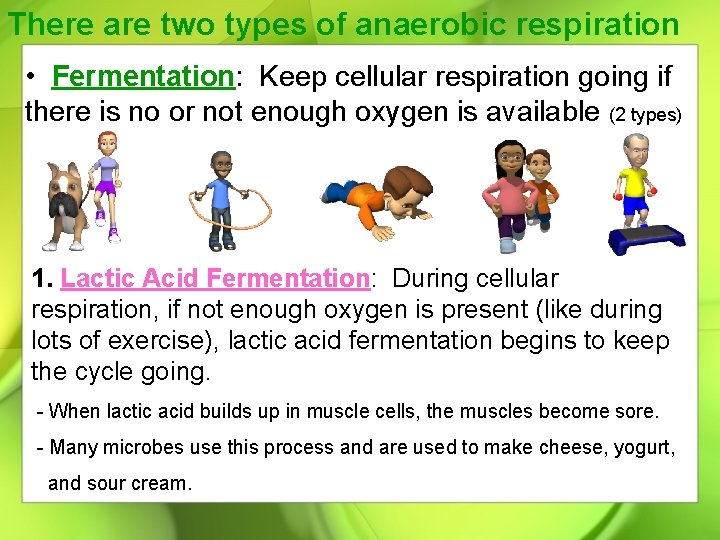
There are two types of anaerobic respiration • Fermentation: Keep cellular respiration going if there is no or not enough oxygen is available (2 types) 1. Lactic Acid Fermentation: During cellular respiration, if not enough oxygen is present (like during lots of exercise), lactic acid fermentation begins to keep the cycle going. - When lactic acid builds up in muscle cells, the muscles become sore. - Many microbes use this process and are used to make cheese, yogurt, and sour cream.
Lactic acid Video…silly but “on point”
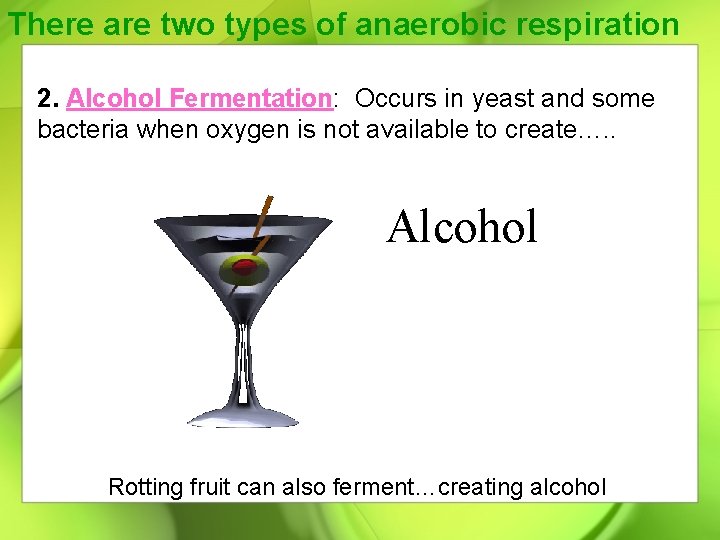
There are two types of anaerobic respiration 2. Alcohol Fermentation: Occurs in yeast and some bacteria when oxygen is not available to create…. . Alcohol Rotting fruit can also ferment…creating alcohol
Clicker Question #17 Lactic acid fermentation occurs when the body does not get enough: a. Protein b. Energy c. Oxygen d. Carbon Dioxide
Clicker Question #18 Lactic acid causes: a. Glucose to be the product b. Energy to be released c. The making of alcohol d. Muscle soreness
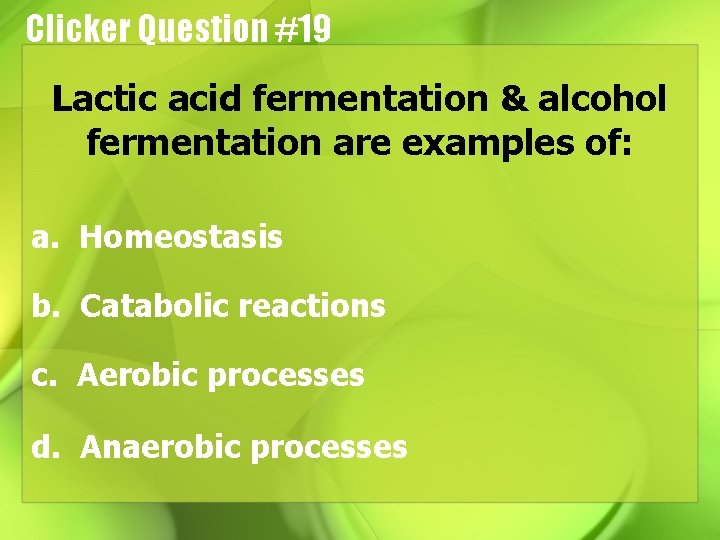
Clicker Question #19 Lactic acid fermentation & alcohol fermentation are examples of: a. Homeostasis b. Catabolic reactions c. Aerobic processes d. Anaerobic processes
Clicker Question #20 The following equation represents: C 6 H 12 O 6 + 6 O 2 6 CO 2 + 6 H 2 O + ATP a. Homeostasis b. Photosynthesis c. Cellular Respiration d. None of the above
The End
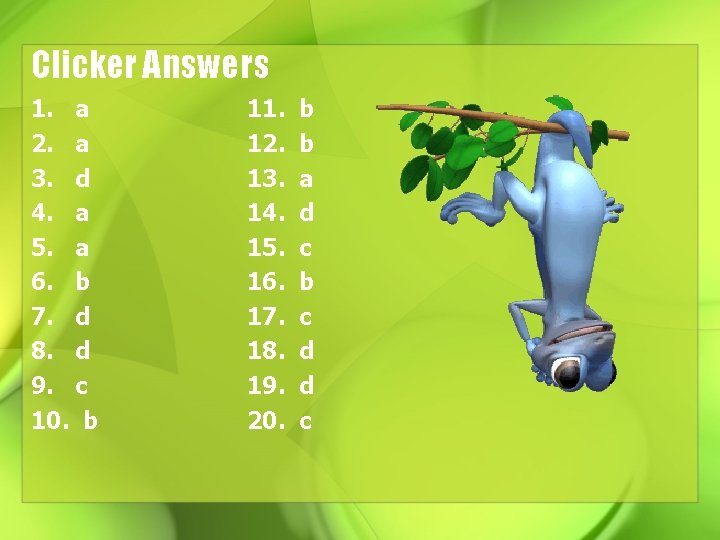
Clicker Answers 1. a 2. a 3. d 4. a 5. a 6. b 7. d 8. d 9. c 10. b 11. 12. 13. 14. 15. 16. 17. 18. 19. 20. b b a d c b c d d c