
Unit 4 Cell Division Topic Cell Cycle B
Unit 4: Cell Division Topic: Cell Cycle B. Ed (Hons) Secondary Semester: I Subject: Biology I (Minor) Course Title: General Biology Represented By: Ms Sidra Younis Department of Education (Planning and Development) Lahore College for Women University, Lahore
Growth �Growth, the increases in cell size and number that take place during the life history of an organism. �Growth is seldom random. Rather, it occurs according to a plan that eventually determines the size and shape of the individual. Growth may be restricted to special regions of the organism, such as the layers of cells that divide and increase in size near the tip of the plant shoot. Or the cells engaged in growth may be widely distributed throughout the body of the organism, as in the human embryo. In the latter case, the rates of cell division and of the increase in cell size differ in different parts. That the pattern of growth is predetermined and regular in plants and animals can be seen in the forms of adults.
Cont…. �In some organisms, however, notably the slime molds, no regular pattern of growth occurs, and a formless cytoplasmic mass is the result. �The rate of growth of various components of an organism may have important consequences in its ability to adapt to the environment and hence may play a role in evolution. For instance, an increase in the rate of growth of fleshy parts of the fish fin would provide an opportunity for the fish to adapt more easily to terrestrial locomotory life than could a fish without this modified fin. Without disproportionate growth of the fin ultimately resulting from random changes in the genetic material (mutations) the evolution of limbs through natural selection might have been impossible.
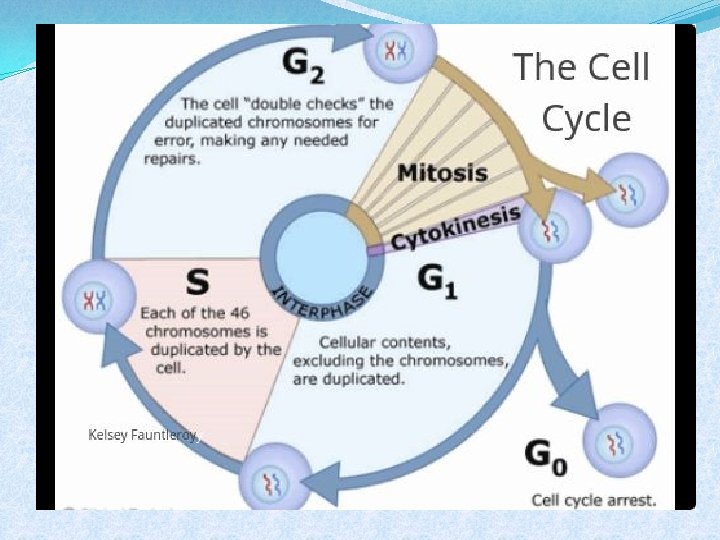
Cell Cycle �A cell cycle is a series of events that takes place in a cell as it grows and divides. A cell spends most of its time in what is called interphase, and during this time it grows, replicates its chromosomes, and prepares for cell division. The cell then leaves interphase, undergoes mitosis, and completes its division. The resulting cells, known as daughter cells, each enter their own interphase and begin a new round of the cell cycle.

Stages of Cell Cycle �Interphase: Interphase, which appears to the eye to be a resting stage between cell divisions, is actually a period of diverse activities. Those interphase activities are indispensible in making the next mitosis possible. Interphase generally lasts at least 12 to 24 hours in mammalian tissue. During this period, the cell is constantly synthesizing RNA, producing protein and growing in size. By studying molecular events in cells, scientists have determined that interphase can be divided into 4 steps: Gap 0 (G 0), Gap 1 (G 1), S (synthesis) phase, Gap 2 (G 2). �Gap 0 (G 0): There are times when a cell will leave the cycle and quit dividing. This may be a temporary resting period or more permanent. An example of the latter is a cell that has reached an end stage of development and will no longer divide (e. g. neuron).
Cont… �Gap 1 (G 1): Cells increase in size in Gap 1, produce RNA and synthesize protein. An important cell cycle control mechanism activated during this period (G 1 Checkpoint) ensures that everything is ready for DNA synthesis. �S Phase: To produce two similar daughter cells, the complete DNA instructions in the cell must be duplicated. DNA replication occurs during this S (synthesis) phase. �Gap 2 (G 2): During the gap between DNA synthesis and mitosis, the cell will continue to grow and produce new proteins. At the end of this gap is another control checkpoint (G 2 Checkpoint) to determine if the cell can now proceed to enter M (mitosis) and divide.
Cont… �Mitosis or M Phase: Cell growth and protein production stop at this stage in the cell cycle. All of the cell's energy is focused on the complex and orderly division into two similar daughter cells. Mitosis is much shorter than interphase, lasting perhaps only one to two hours. As in both G 1 and G 2, there is a Checkpoint in the middle of mitosis (Metaphase Checkpoint) that ensures the cell is ready to complete cell division.
- Slides: 8