
Unit 4 Carrier Transport Recombination and Generation Unit
Unit 4: Carrier Transport, Recombination, and Generation
Unit 4 is all about how charge carriers, electrons, and holes respond out of equilibrium under the normal operating conditions of a semiconductor device.
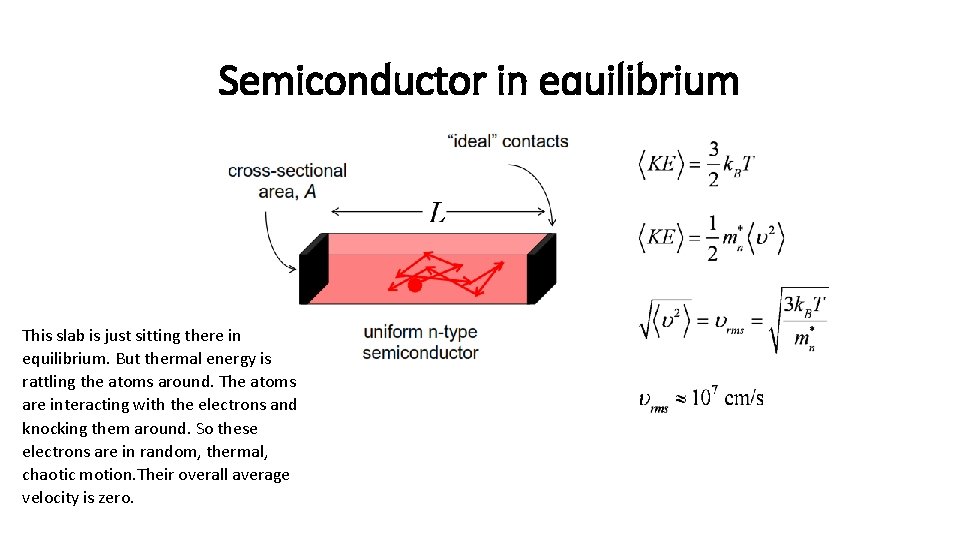
Semiconductor in equilibrium This slab is just sitting there in equilibrium. But thermal energy is rattling the atoms around. The atoms are interacting with the electrons and knocking them around. So these electrons are in random, thermal, chaotic motion. Their overall average velocity is zero.
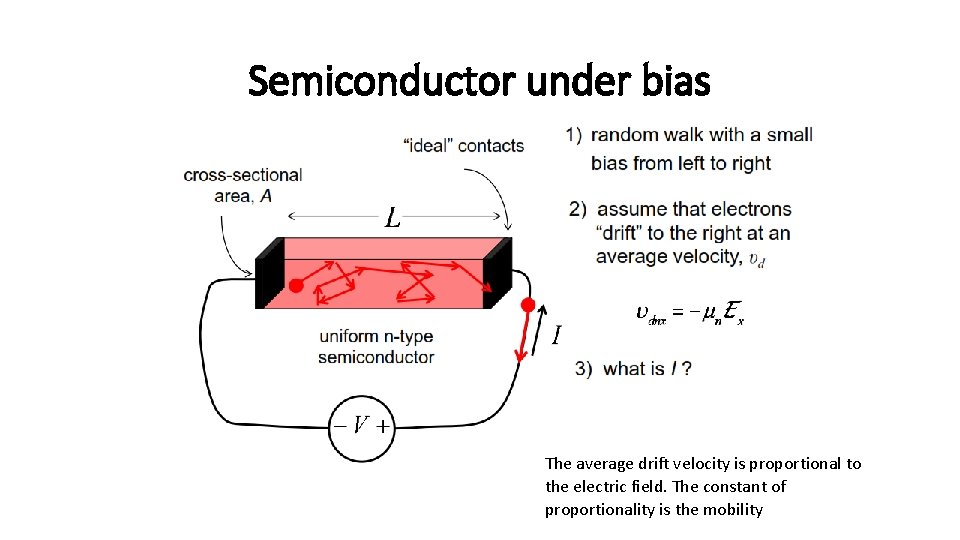
Semiconductor under bias The average drift velocity is proportional to the electric field. The constant of proportionality is the mobility

Drift current and drift velocity
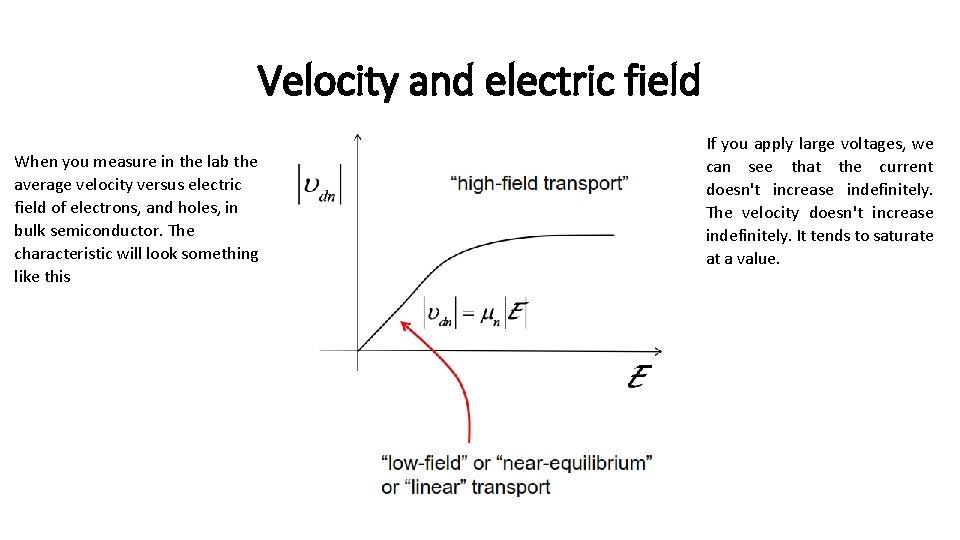
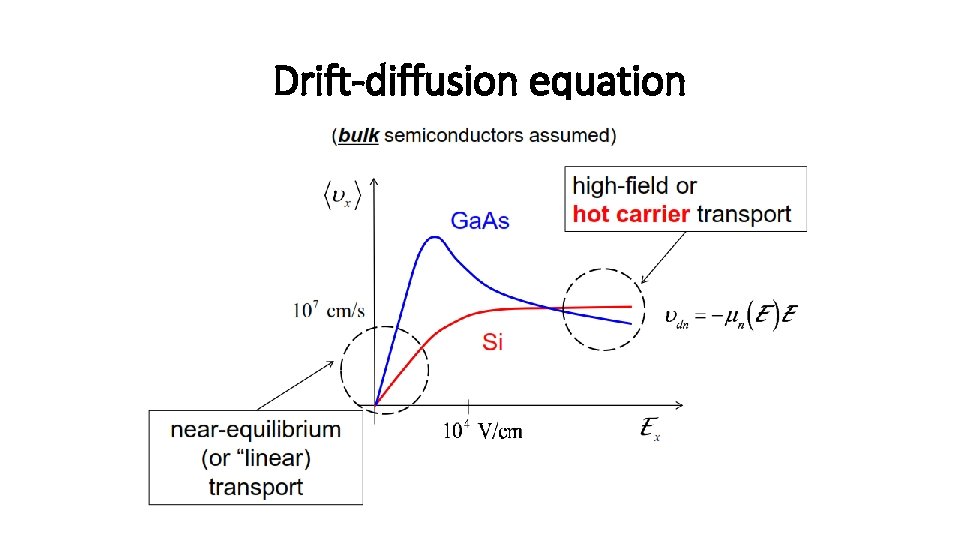
Velocity and electric field When you measure in the lab the average velocity versus electric field of electrons, and holes, in bulk semiconductor. The characteristic will look something like this If you apply large voltages, we can see that the current doesn't increase indefinitely. The velocity doesn't increase indefinitely. It tends to saturate at a value.
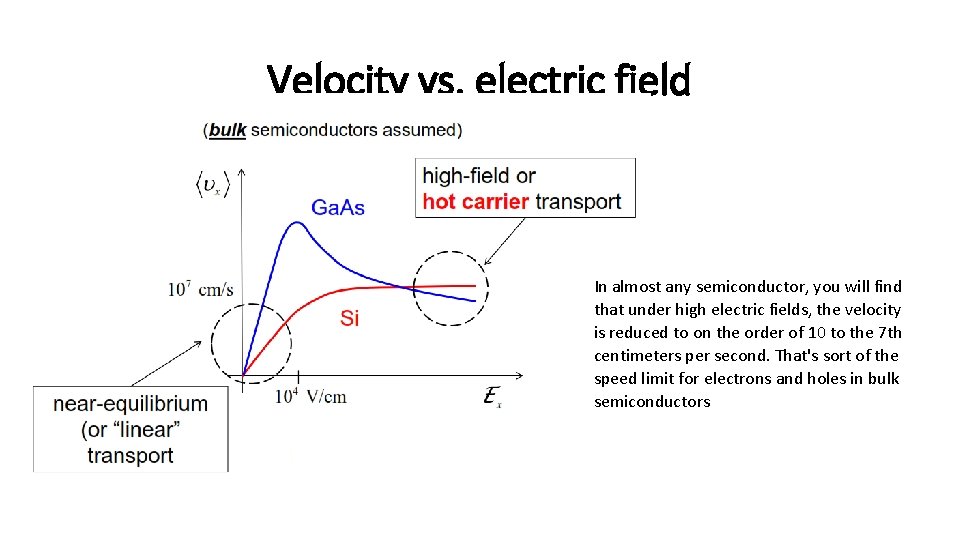
Velocity vs. electric field In almost any semiconductor, you will find that under high electric fields, the velocity is reduced to on the order of 10 to the 7 th centimeters per second. That's sort of the speed limit for electrons and holes in bulk semiconductors

Drift current
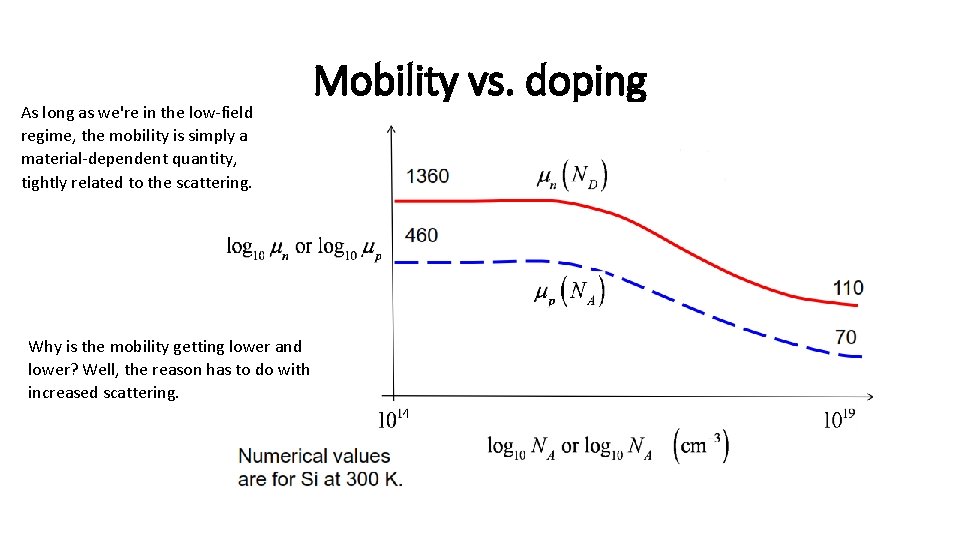
As long as we're in the low-field regime, the mobility is simply a material-dependent quantity, tightly related to the scattering. Why is the mobility getting lower and lower? Well, the reason has to do with increased scattering. Mobility vs. doping
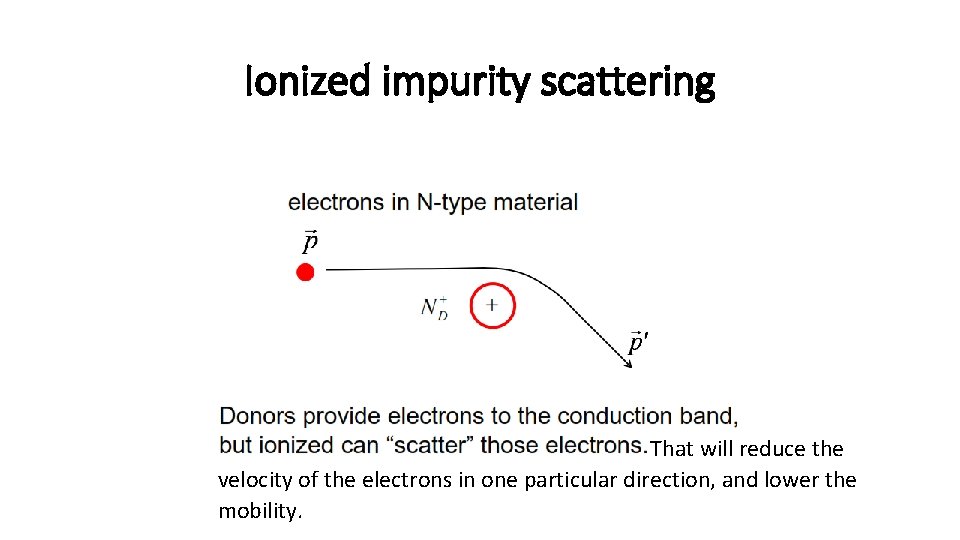
Ionized impurity scattering That will reduce the velocity of the electrons in one particular direction, and lower the mobility.
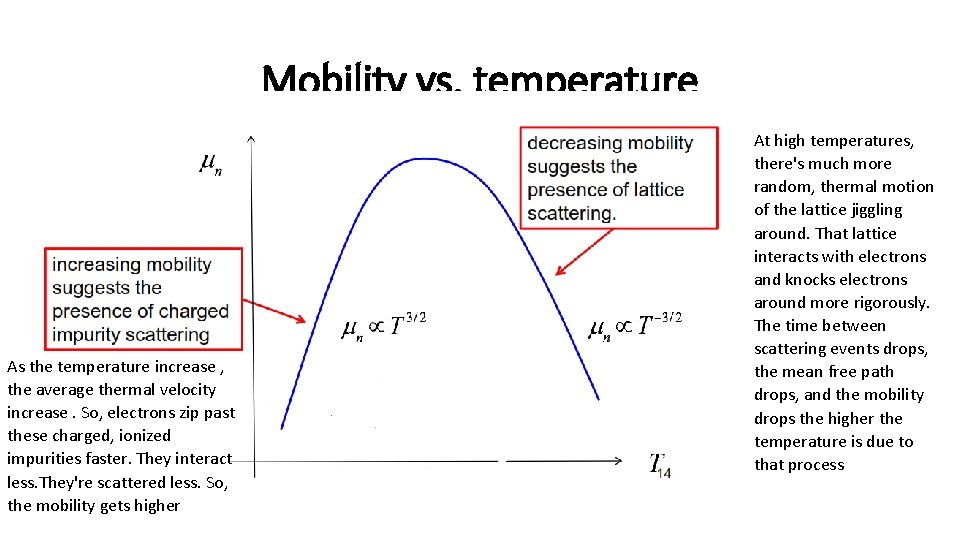
Mobility vs. temperature As the temperature increase , the average thermal velocity increase. So, electrons zip past these charged, ionized impurities faster. They interact less. They're scattered less. So, the mobility gets higher At high temperatures, there's much more random, thermal motion of the lattice jiggling around. That lattice interacts with electrons and knocks electrons around more rigorously. The time between scattering events drops, the mean free path drops, and the mobility drops the higher the temperature is due to that process
Comment If we're working with semiconductor devices, we will undoubtedly need to know the mobility. In order to understand what the mobility is or to look it up in a table, we need to know what the doping is and we need to know what the temperature is
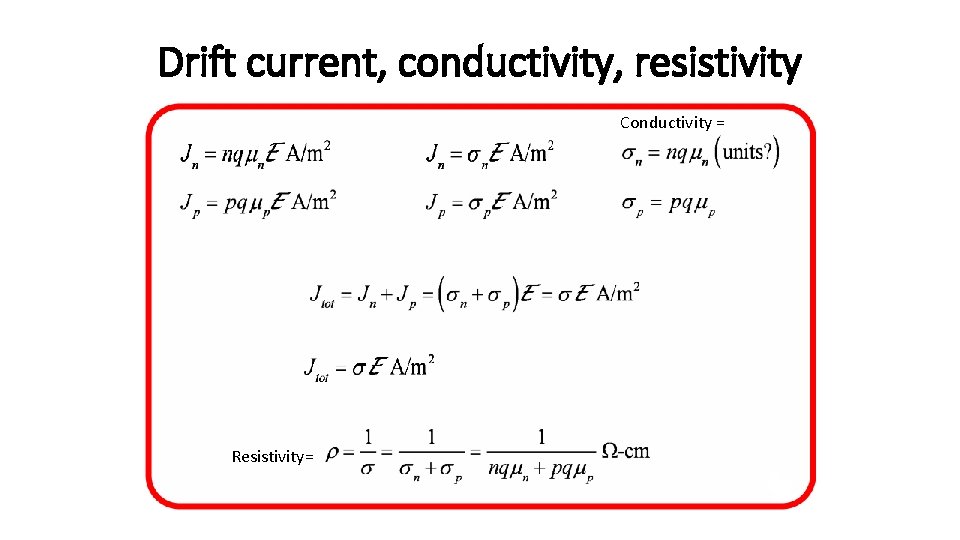
Drift current, conductivity, resistivity Conductivity = Resistivity=
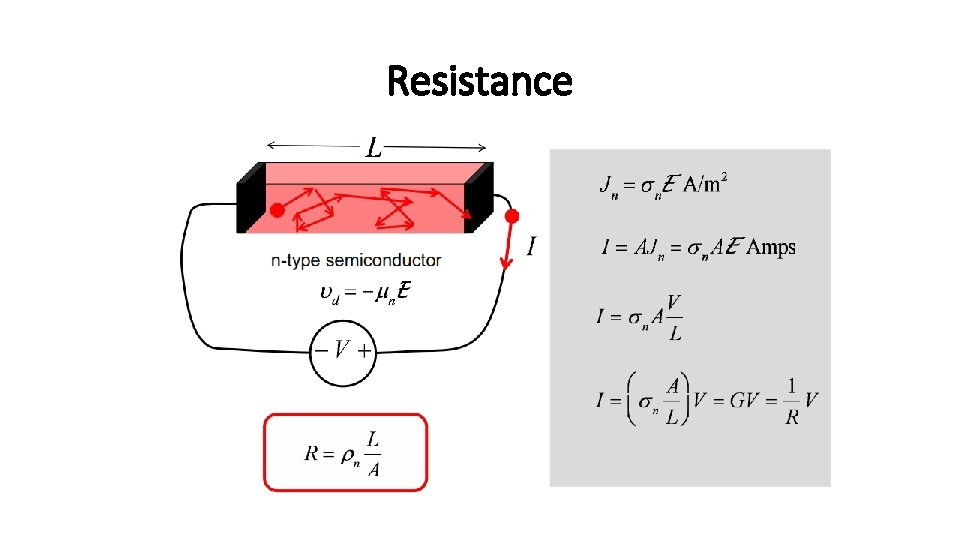
Resistance
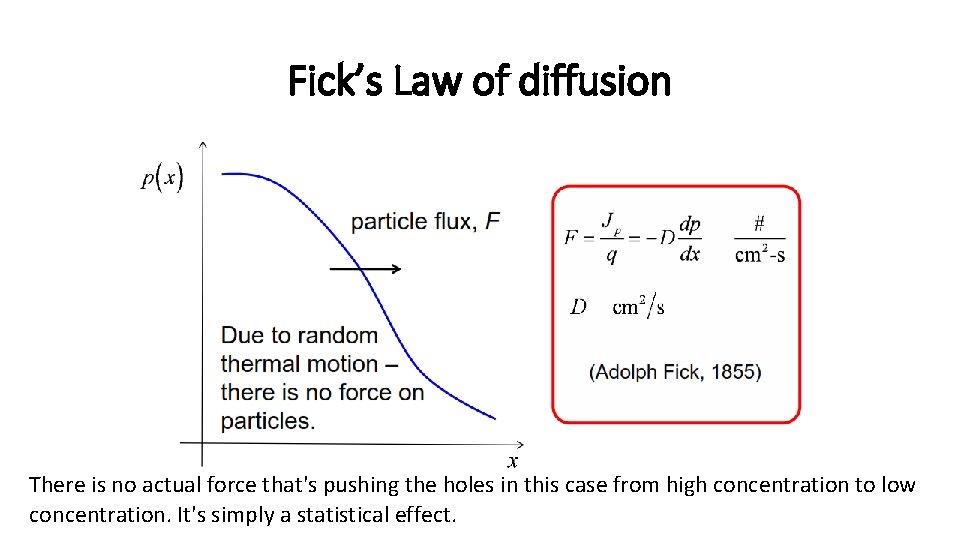
Fick’s Law of diffusion There is no actual force that's pushing the holes in this case from high concentration to low concentration. It's simply a statistical effect.
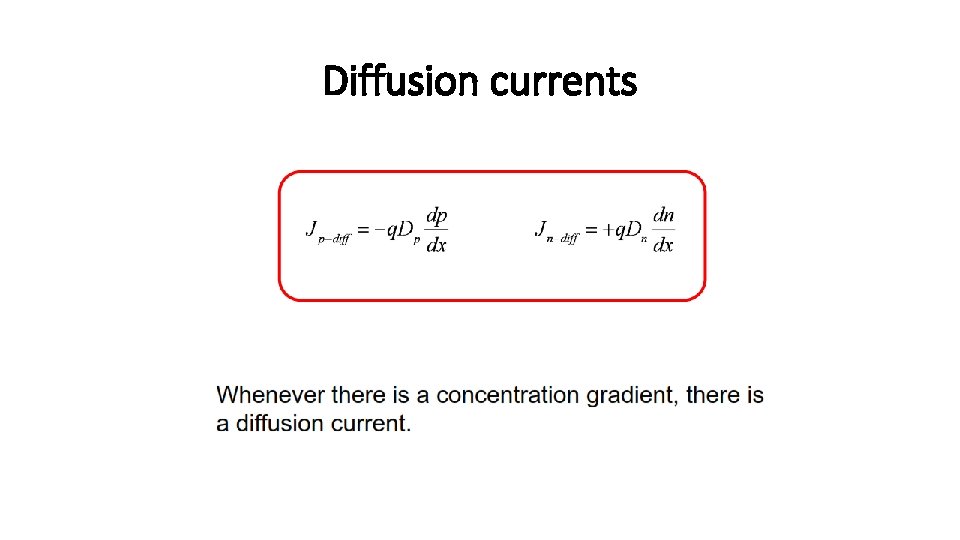
Diffusion currents
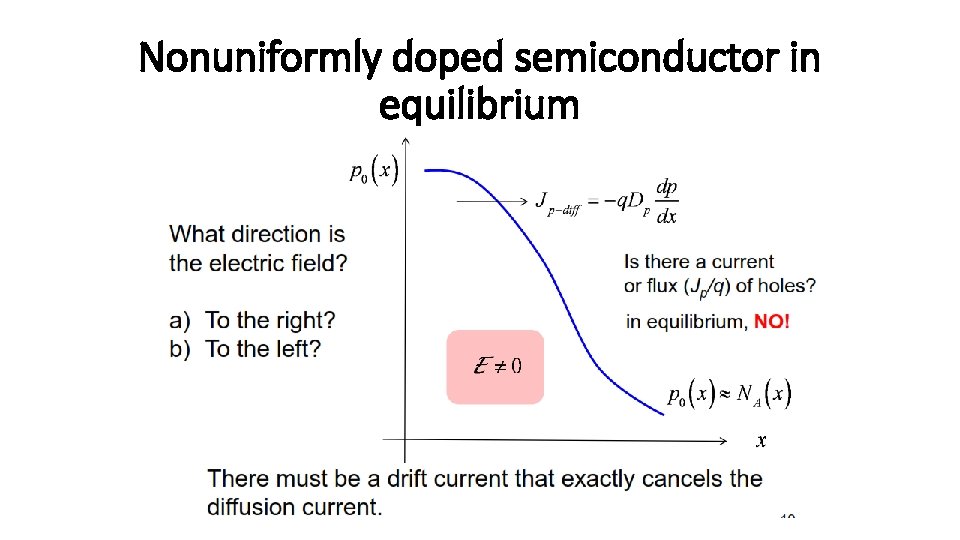
Nonuniformly doped semiconductor in equilibrium
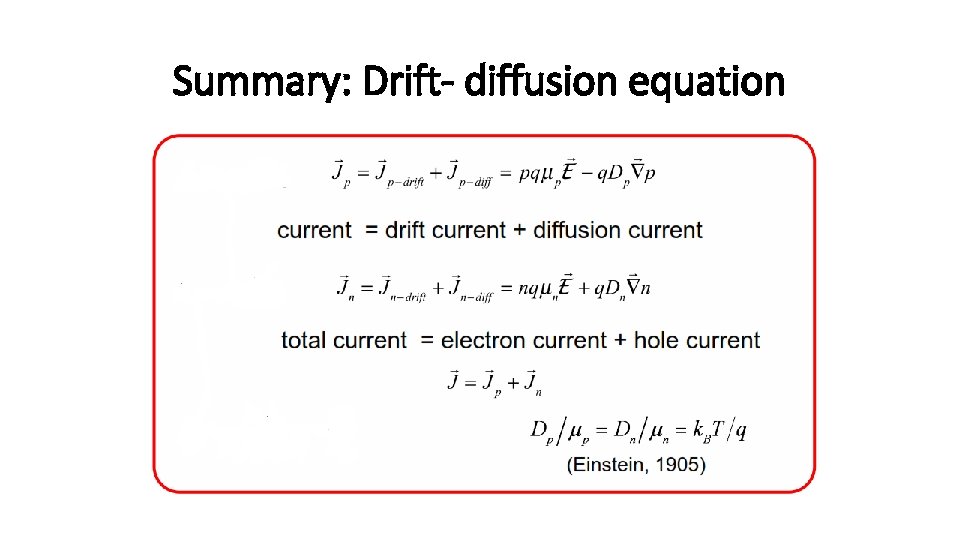
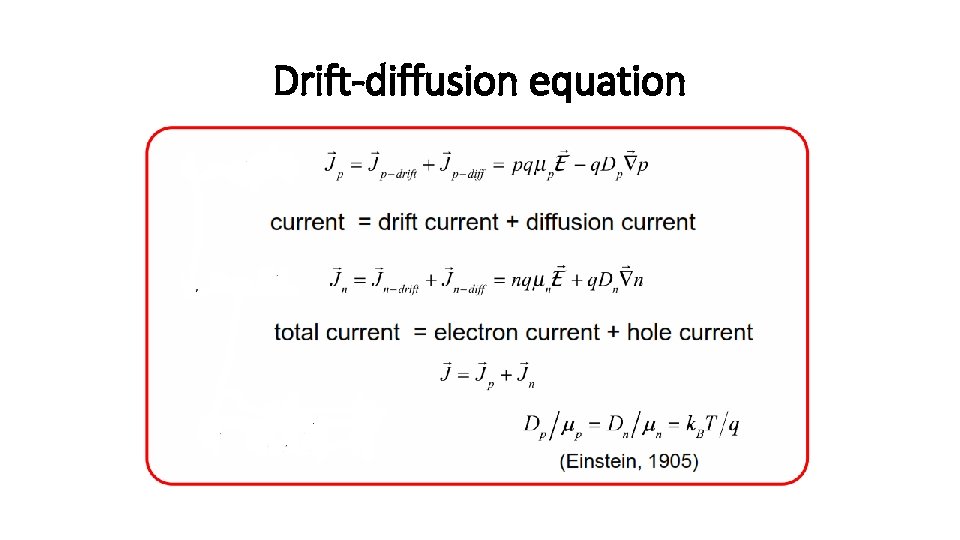
Summary: Drift- diffusion equation
Unit 4: Carrier Transport, Recombination, and Generation Lecture 4. 4: Carrier recombination

Equilibrium and non-equilibrium
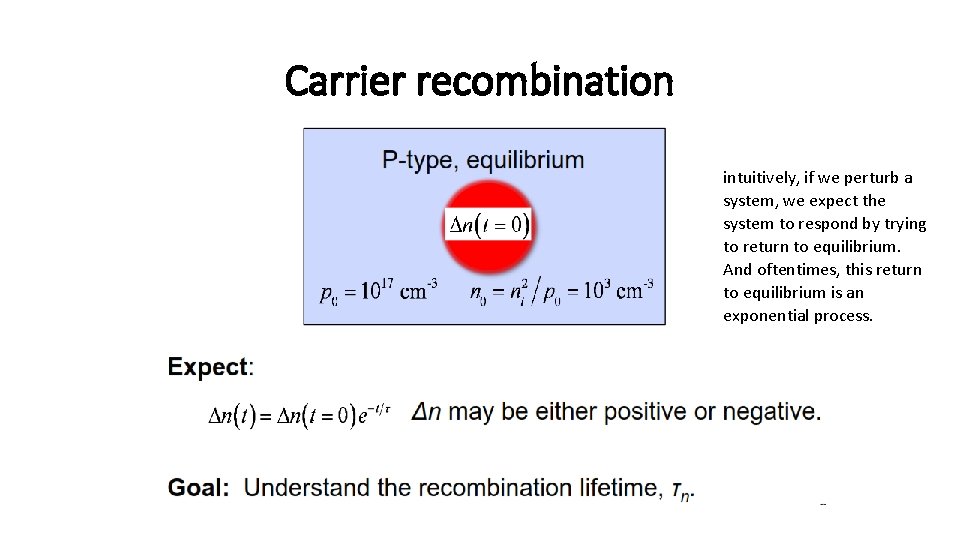
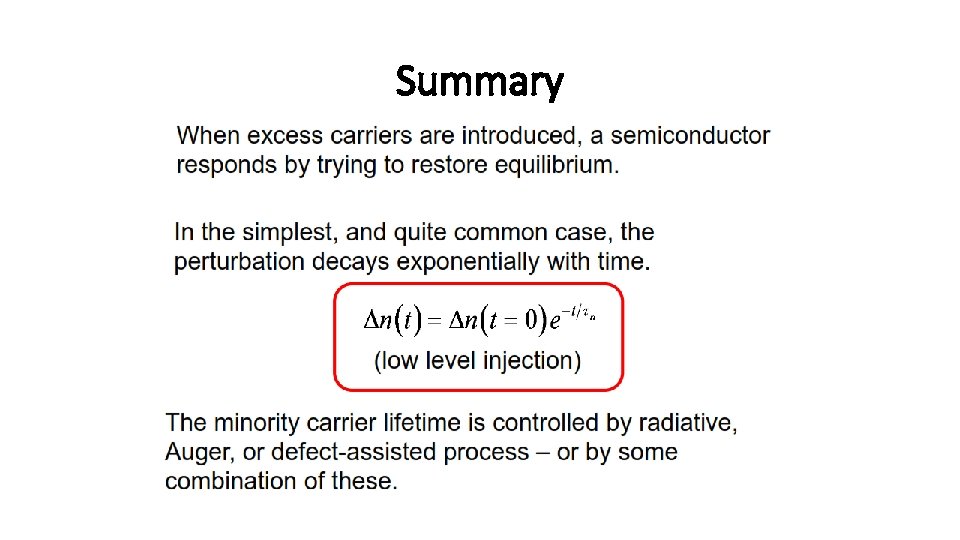
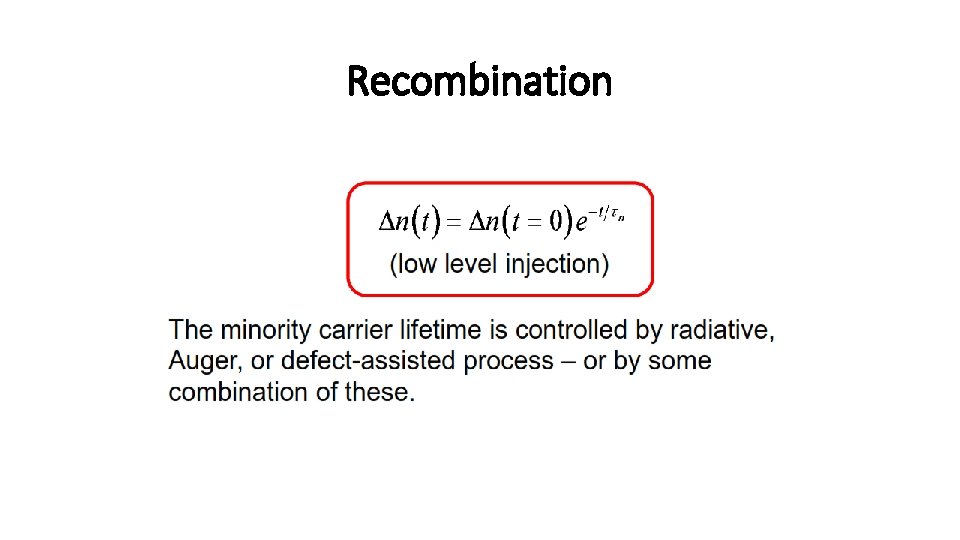
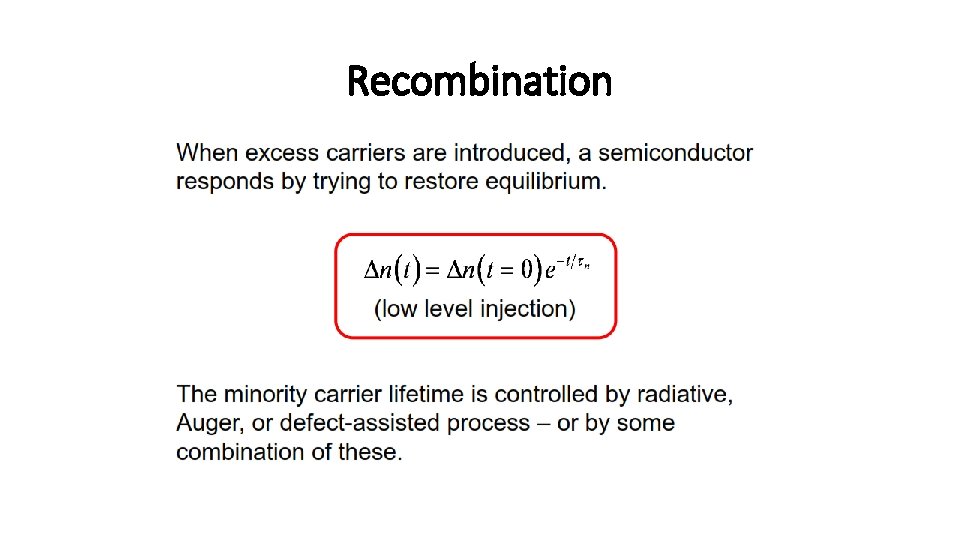
Carrier recombination intuitively, if we perturb a system, we expect the system to respond by trying to return to equilibrium. And oftentimes, this return to equilibrium is an exponential process.
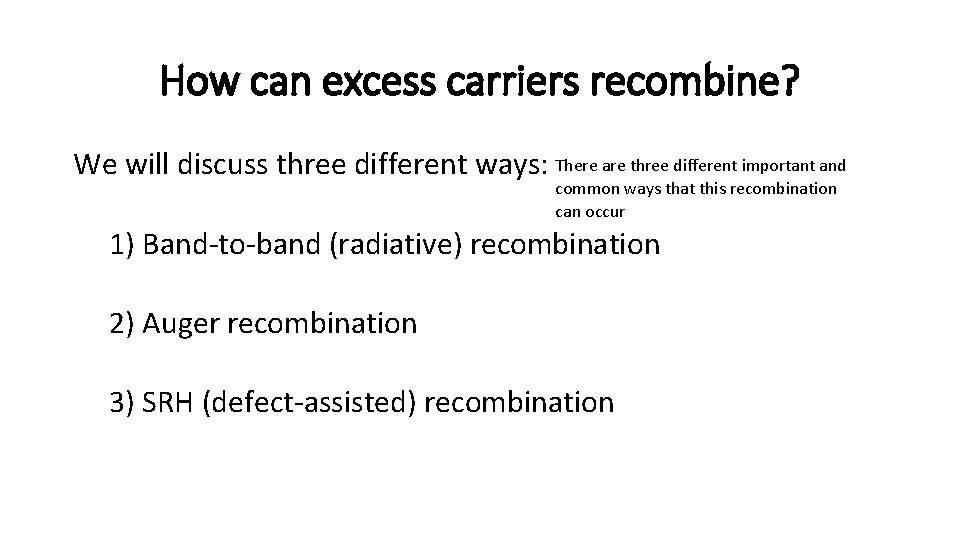
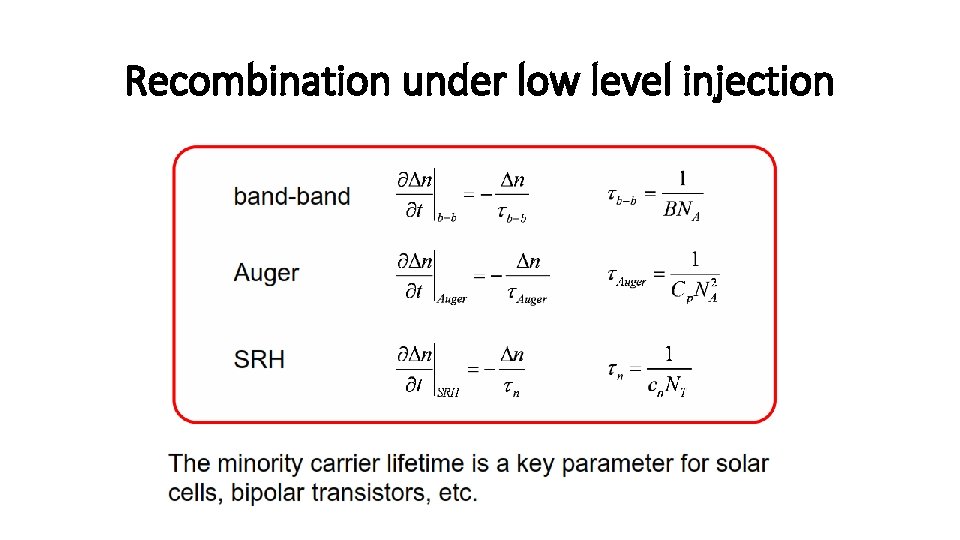
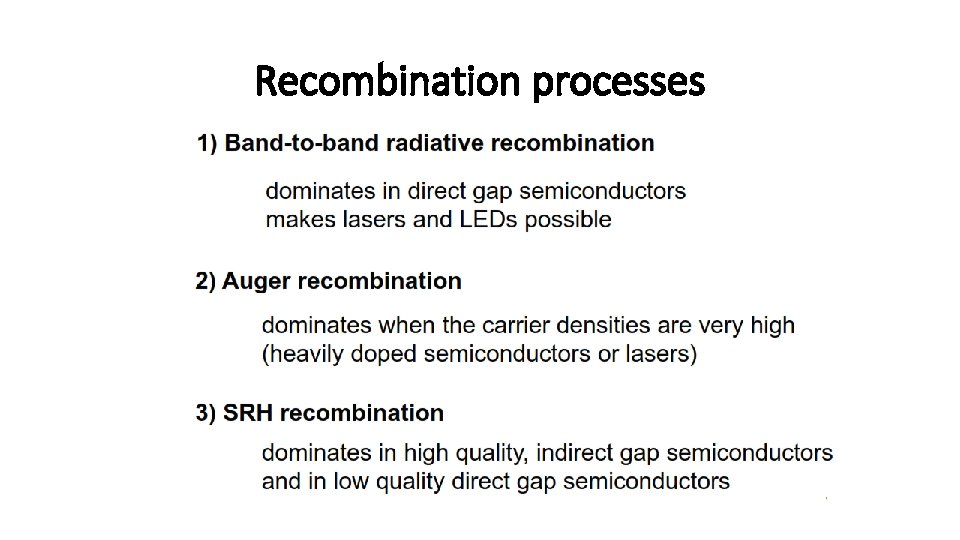
How can excess carriers recombine? We will discuss three different ways: There are three different important and common ways that this recombination can occur 1) Band-to-band (radiative) recombination 2) Auger recombination 3) SRH (defect-assisted) recombination
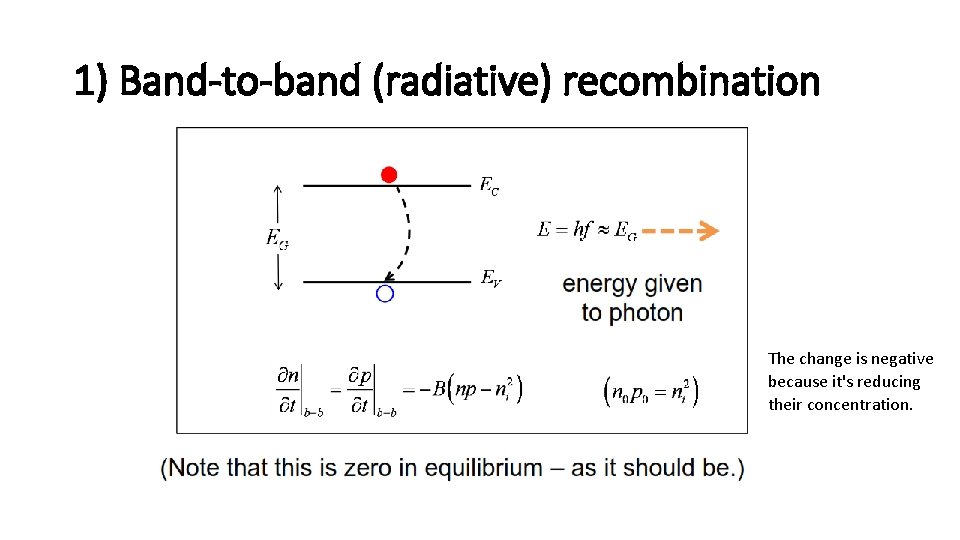
1) Band-to-band (radiative) recombination The change is negative because it's reducing their concentration.
Low level injection The term “low level injection” means that the excess carrier concentration is orders of magnitude smaller than the equilibrium majority carrier concentration but orders of magnitude larger that the equilibrium minority carrier concentration.
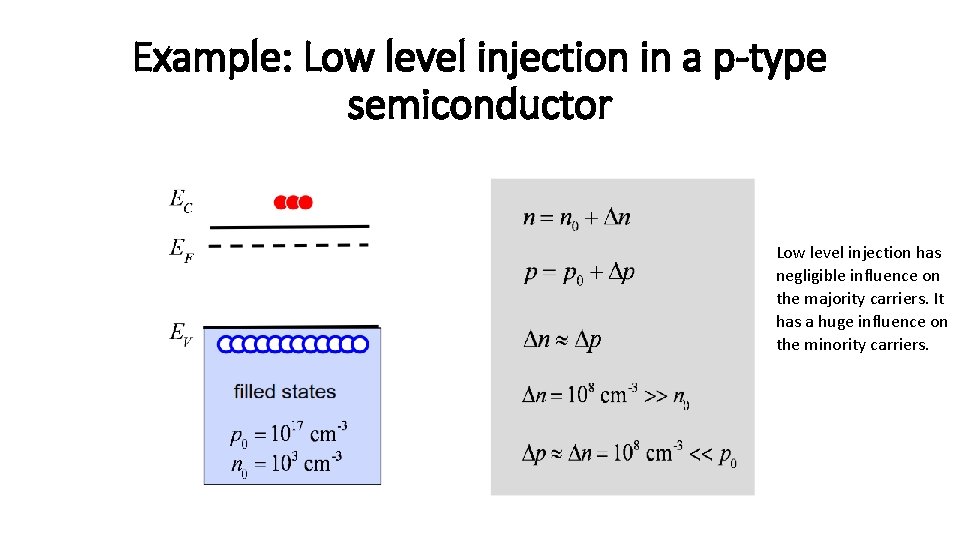
Example: Low level injection in a p-type semiconductor Low level injection has negligible influence on the majority carriers. It has a huge influence on the minority carriers.
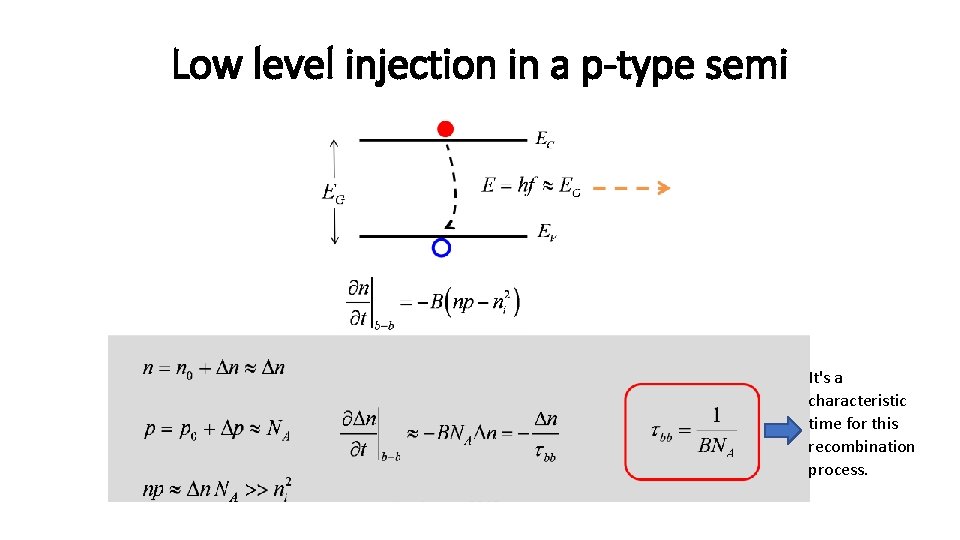
Low level injection in a p-type semi It's a characteristic time for this recombination process.
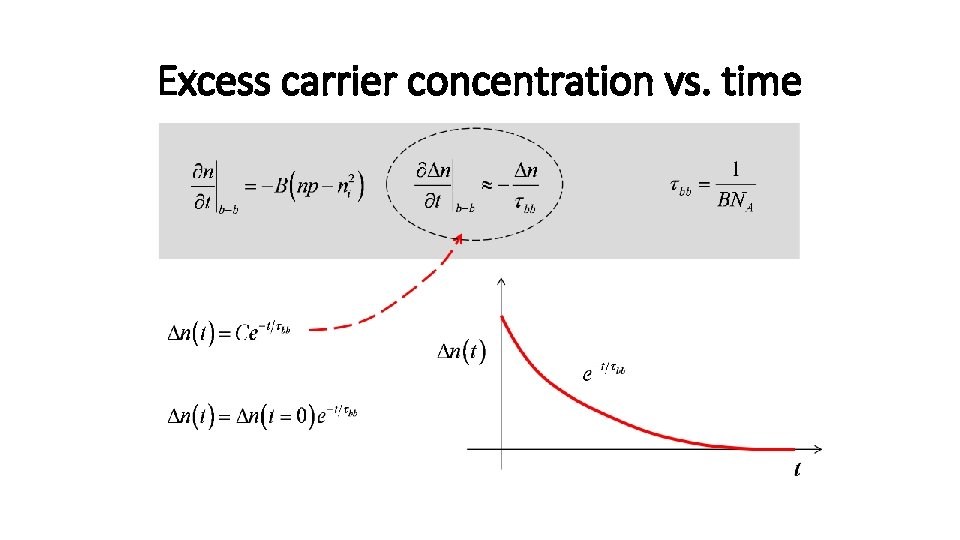
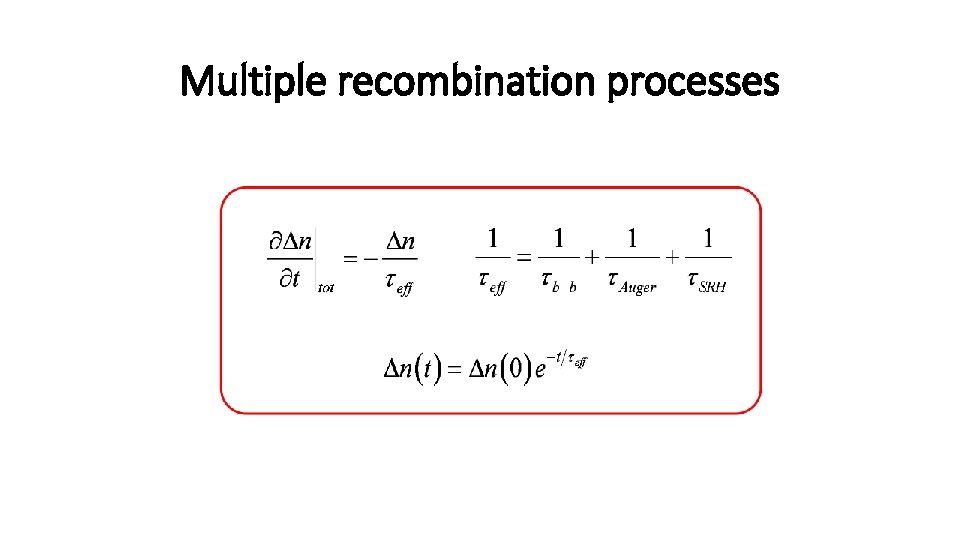
Excess carrier concentration vs. time
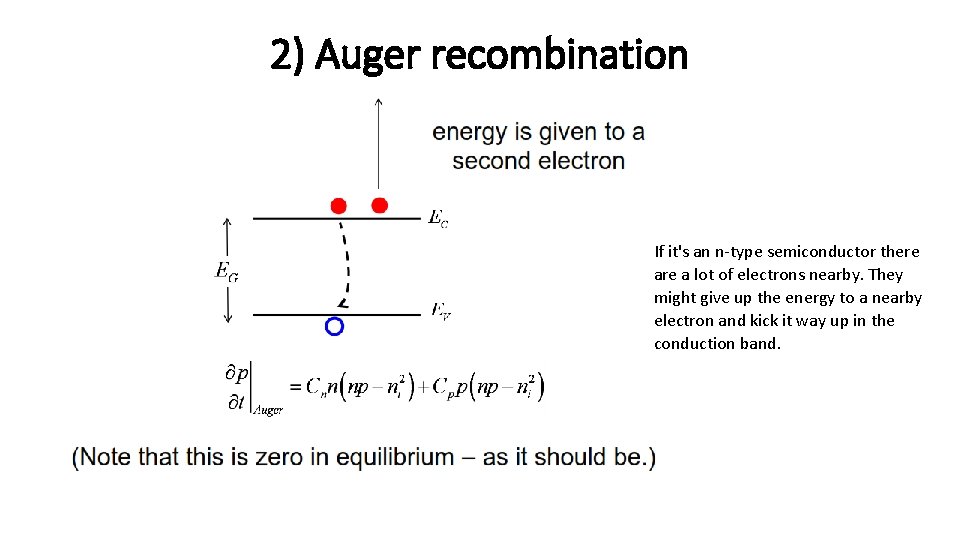
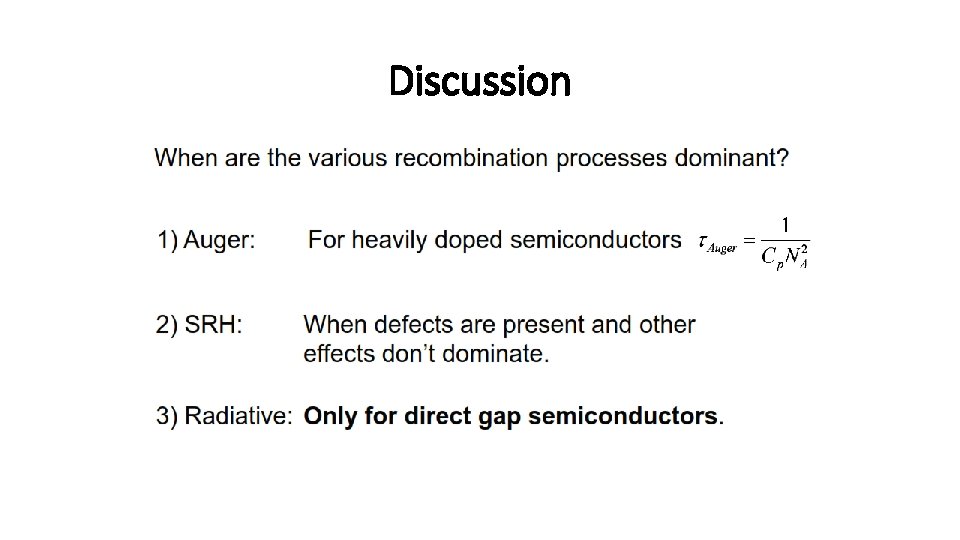
2) Auger recombination If it's an n-type semiconductor there a lot of electrons nearby. They might give up the energy to a nearby electron and kick it way up in the conduction band.
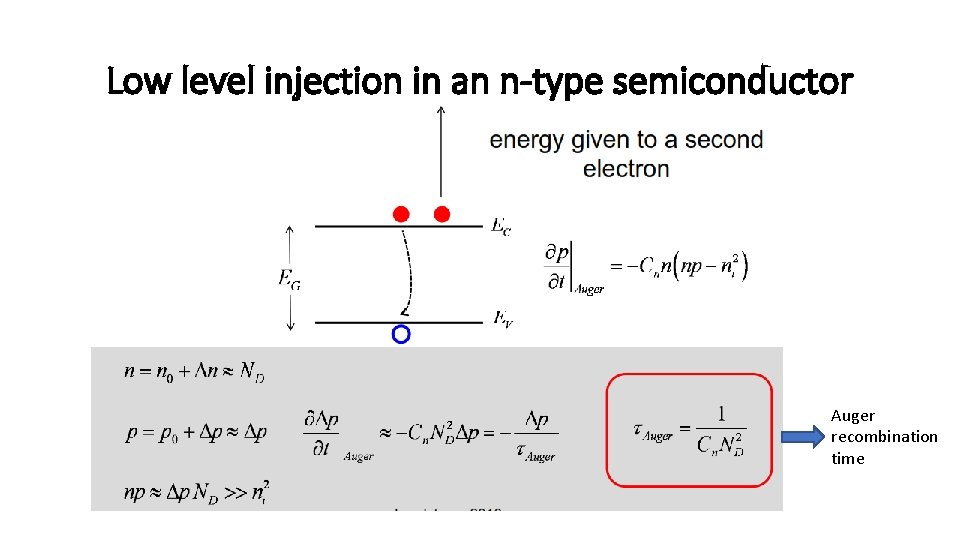
Low level injection in an n-type semiconductor Auger recombination time
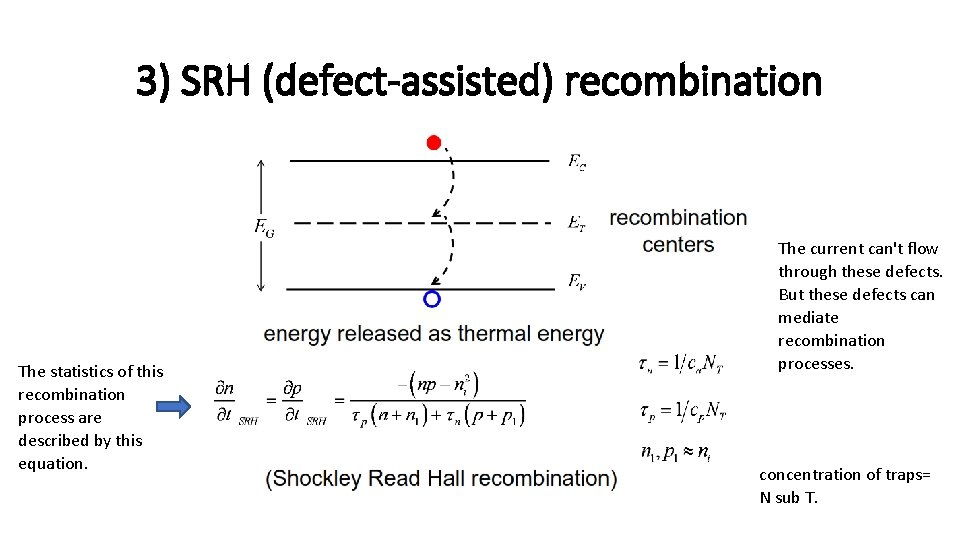
3) SRH (defect-assisted) recombination The statistics of this recombination process are described by this equation. The current can't flow through these defects. But these defects can mediate recombination processes. concentration of traps= N sub T.
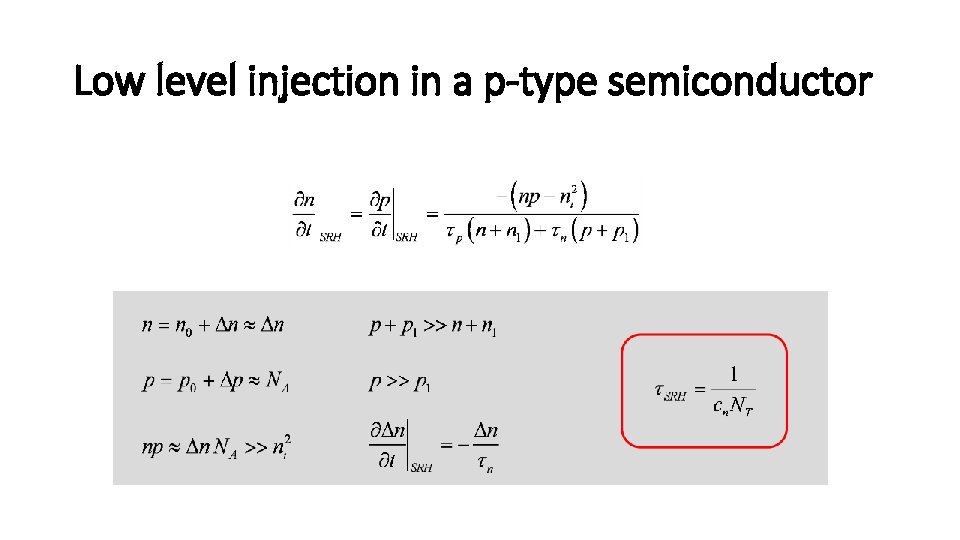
Low level injection in a p-type semiconductor
Recombination under low level injection
Multiple recombination processes
Discussion
BB recombination in direct gap semiconductors
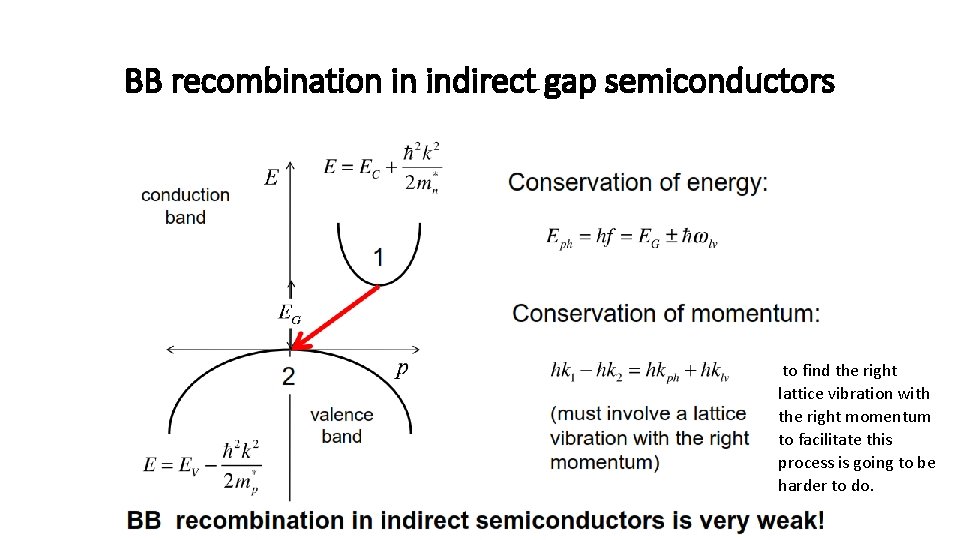
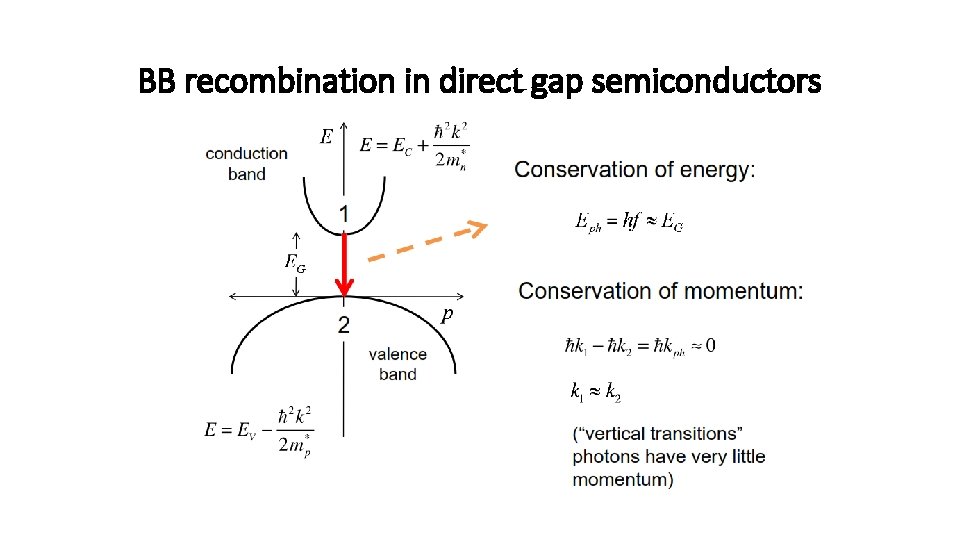
BB recombination in indirect gap semiconductors to find the right lattice vibration with the right momentum to facilitate this process is going to be harder to do.
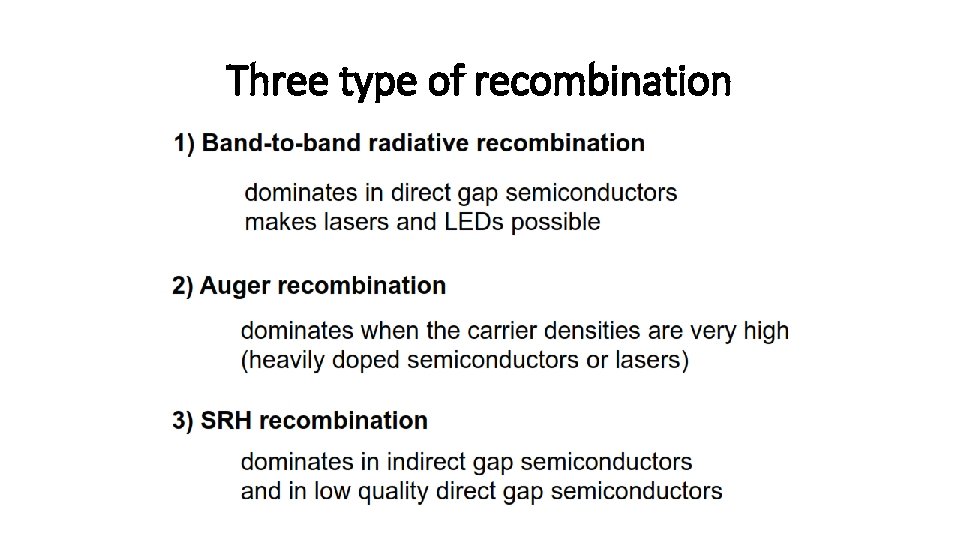
Three type of recombination
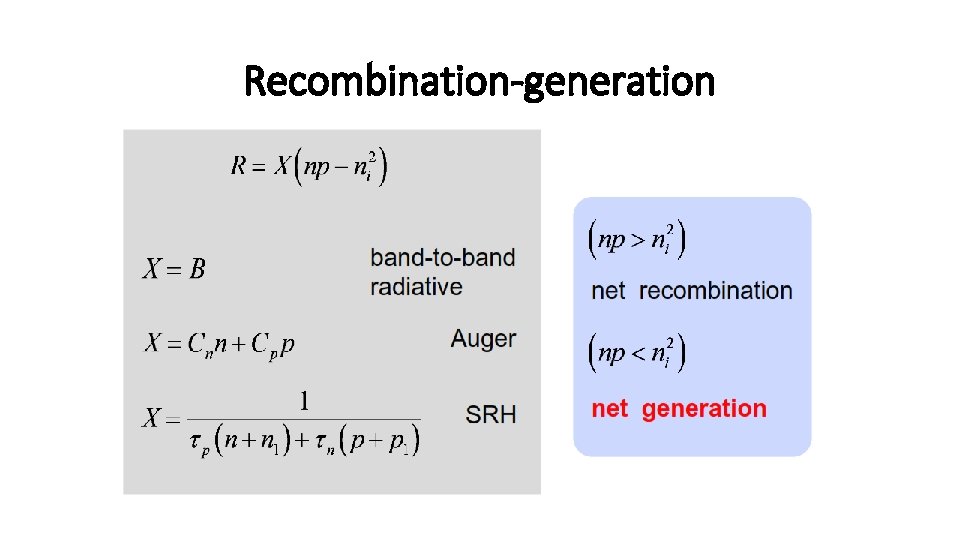
Recombination-generation
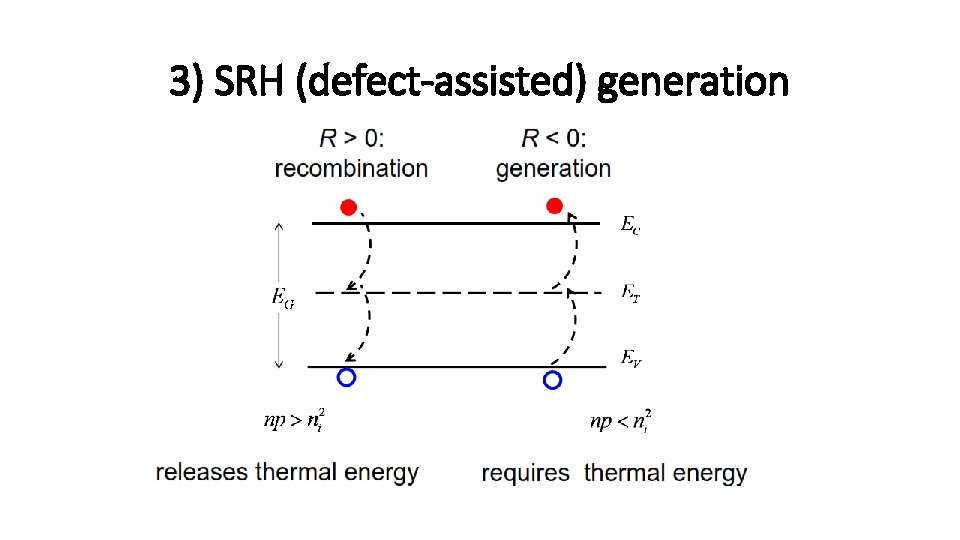
3) SRH (defect-assisted) generation
Summary
Unit 4: Carrier Transport, Recombination, and Generation Lecture 4. 5: Carrier generation
Recombination
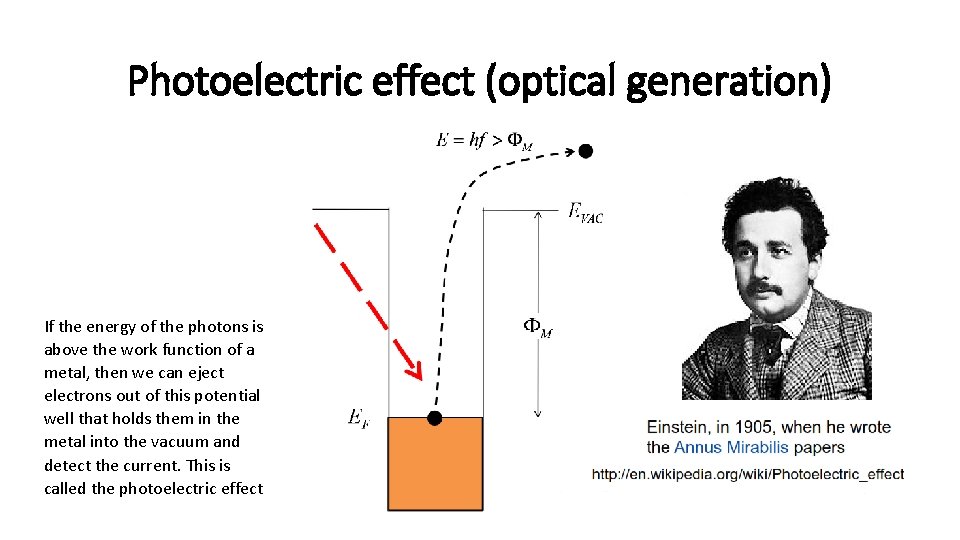
Photoelectric effect (optical generation) If the energy of the photons is above the work function of a metal, then we can eject electrons out of this potential well that holds them in the metal into the vacuum and detect the current. This is called the photoelectric effect
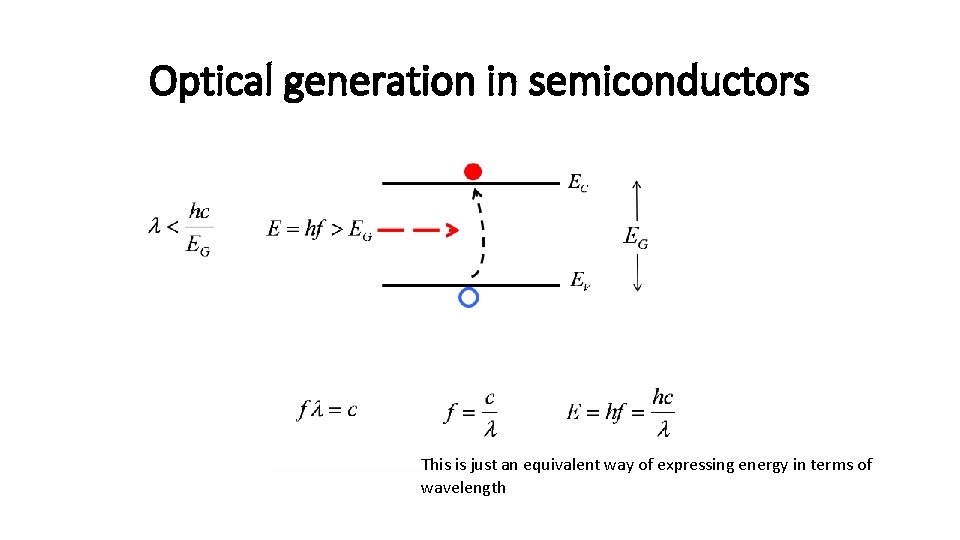
Optical generation in semiconductors This is just an equivalent way of expressing energy in terms of wavelength
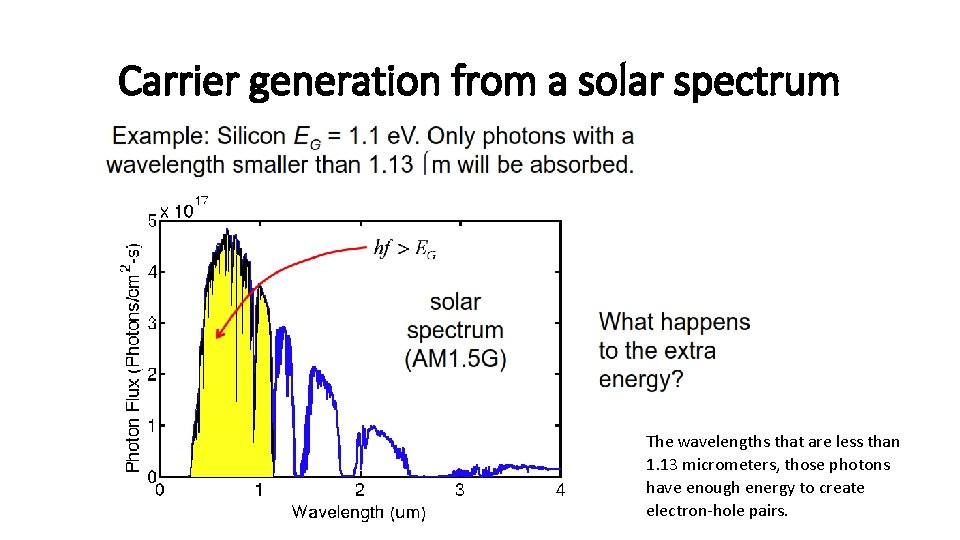
Carrier generation from a solar spectrum The wavelengths that are less than 1. 13 micrometers, those photons have enough energy to create electron-hole pairs.
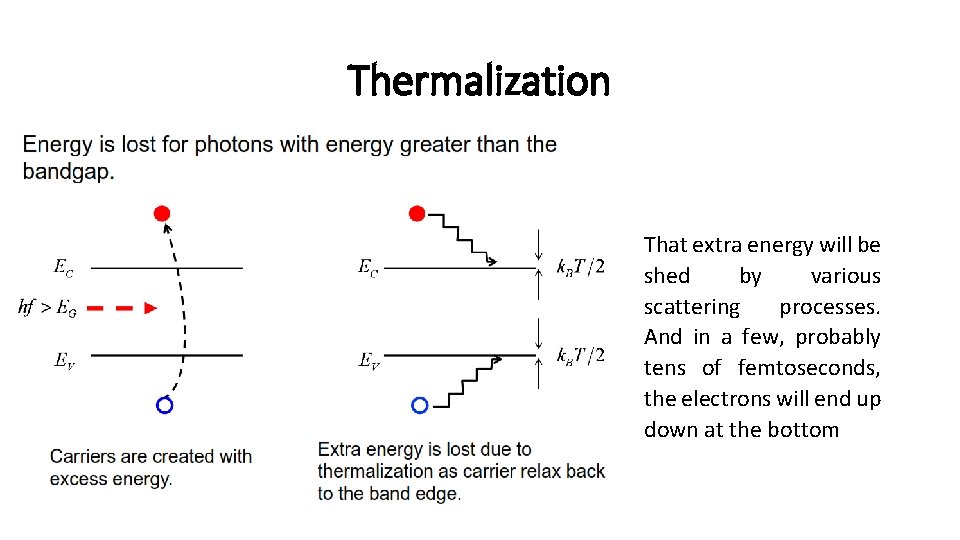
Thermalization That extra energy will be shed by various scattering processes. And in a few, probably tens of femtoseconds, the electrons will end up down at the bottom
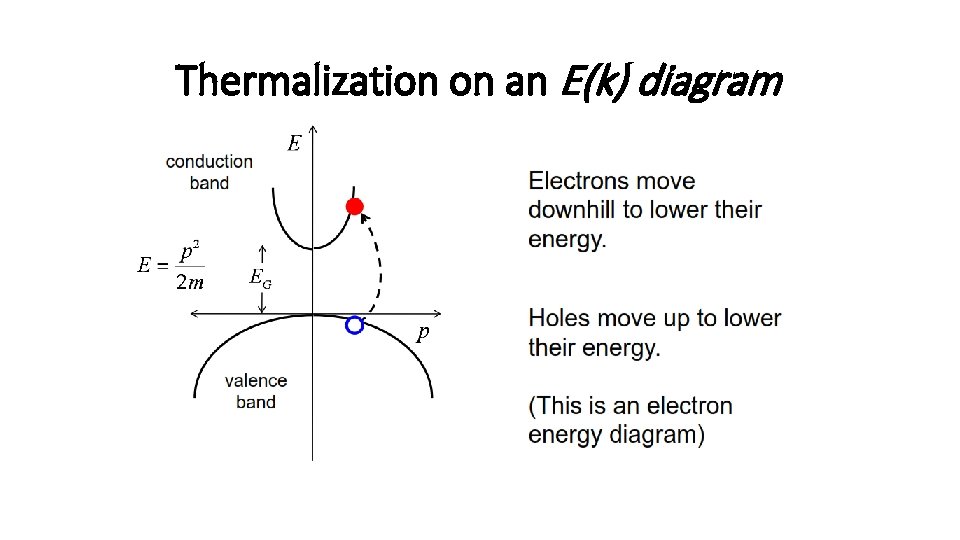
Thermalization on an E(k) diagram
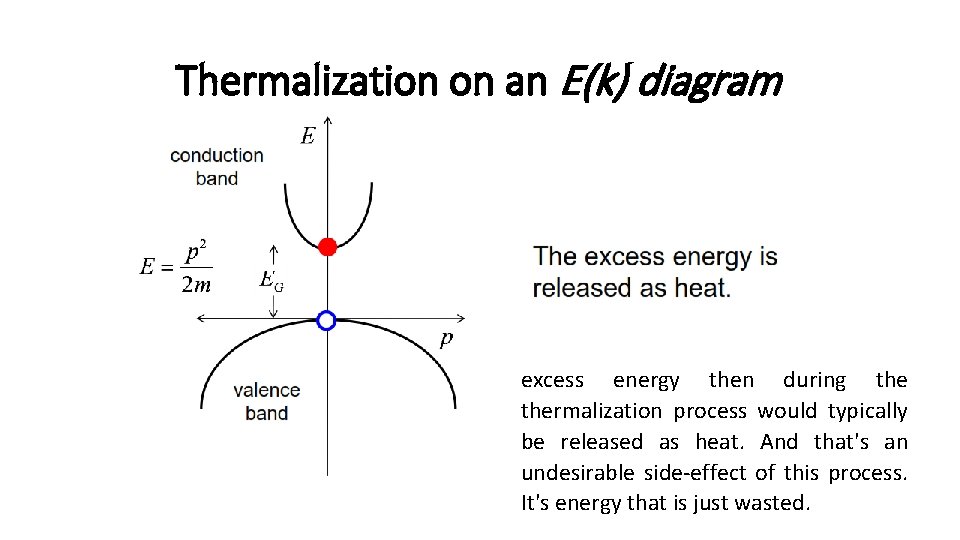
Thermalization on an E(k) diagram excess energy then during thermalization process would typically be released as heat. And that's an undesirable side-effect of this process. It's energy that is just wasted.
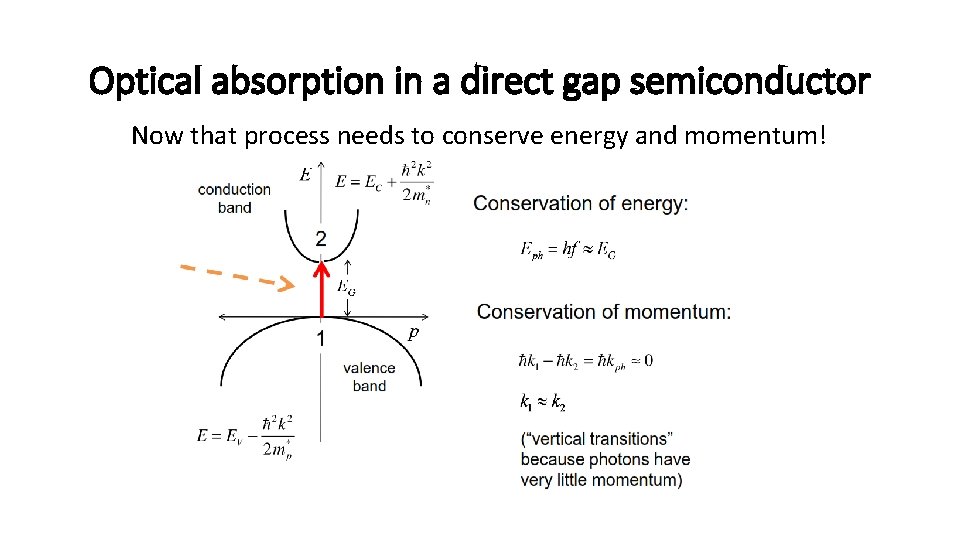
Optical absorption in a direct gap semiconductor Now that process needs to conserve energy and momentum!
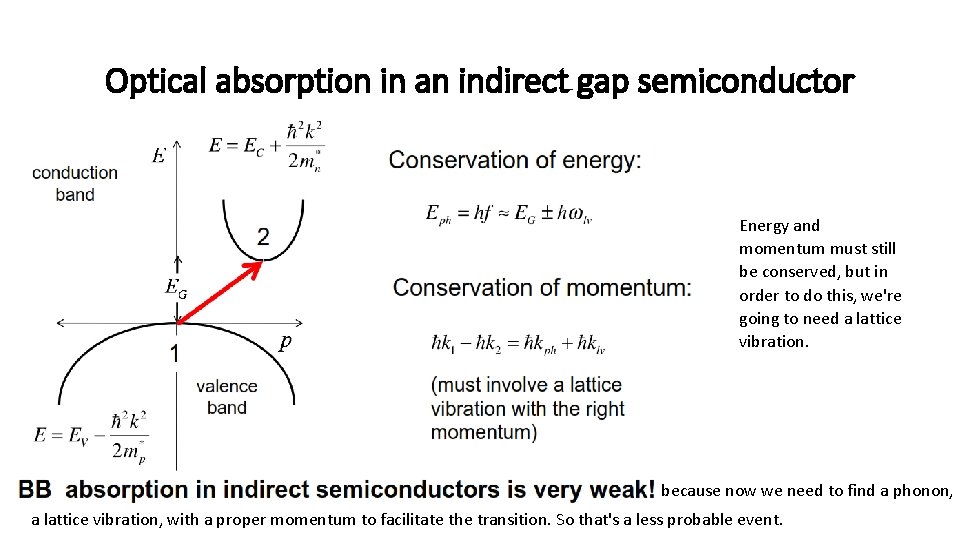
Optical absorption in an indirect gap semiconductor Energy and momentum must still be conserved, but in order to do this, we're going to need a lattice vibration. because now we need to find a phonon, a lattice vibration, with a proper momentum to facilitate the transition. So that's a less probable event.
Optical absorption vs. semiconductor thickness
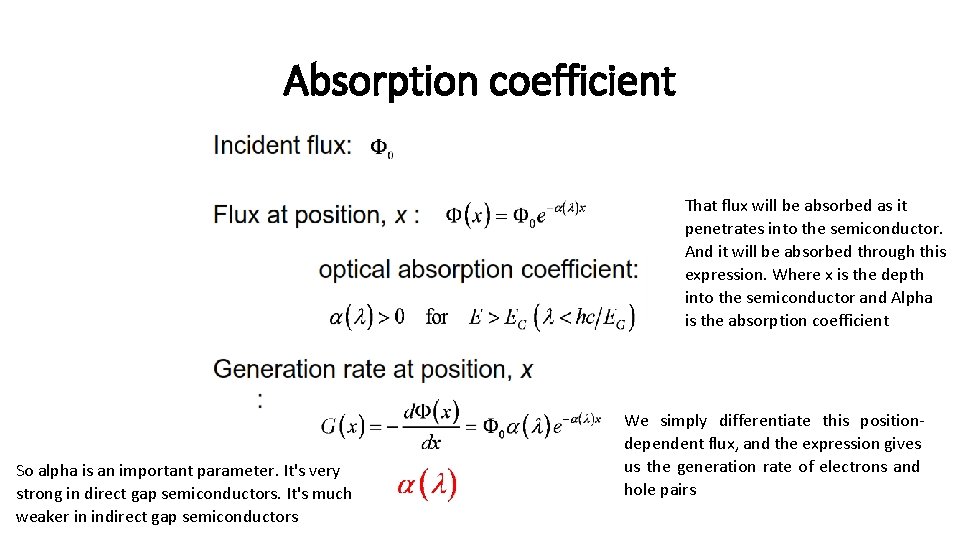
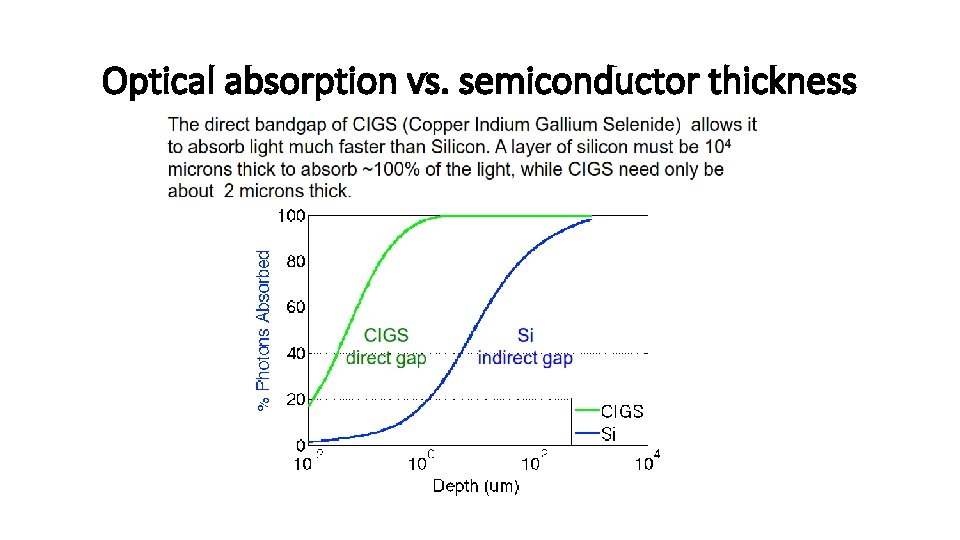
Absorption coefficient That flux will be absorbed as it penetrates into the semiconductor. And it will be absorbed through this expression. Where x is the depth into the semiconductor and Alpha is the absorption coefficient So alpha is an important parameter. It's very strong in direct gap semiconductors. It's much weaker in indirect gap semiconductors We simply differentiate this positiondependent flux, and the expression gives us the generation rate of electrons and hole pairs
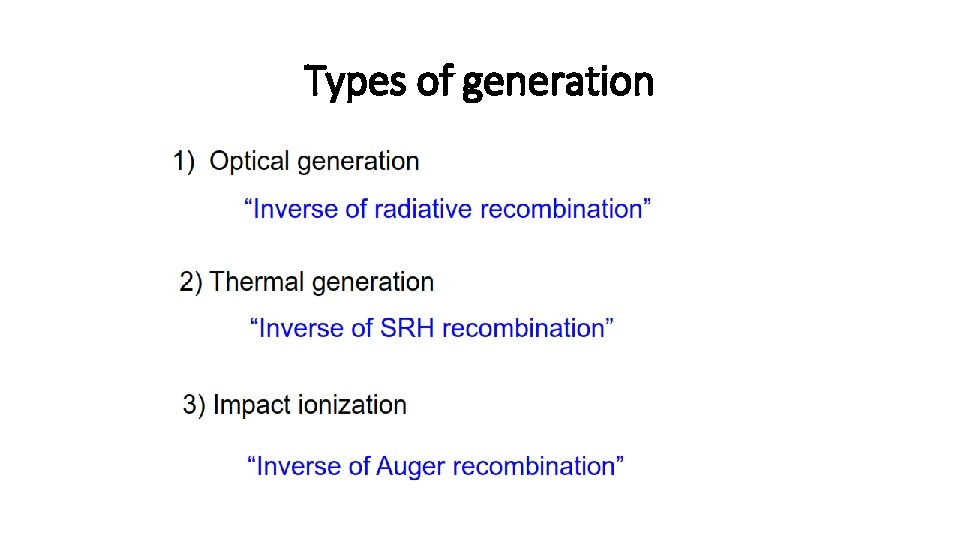
Types of generation
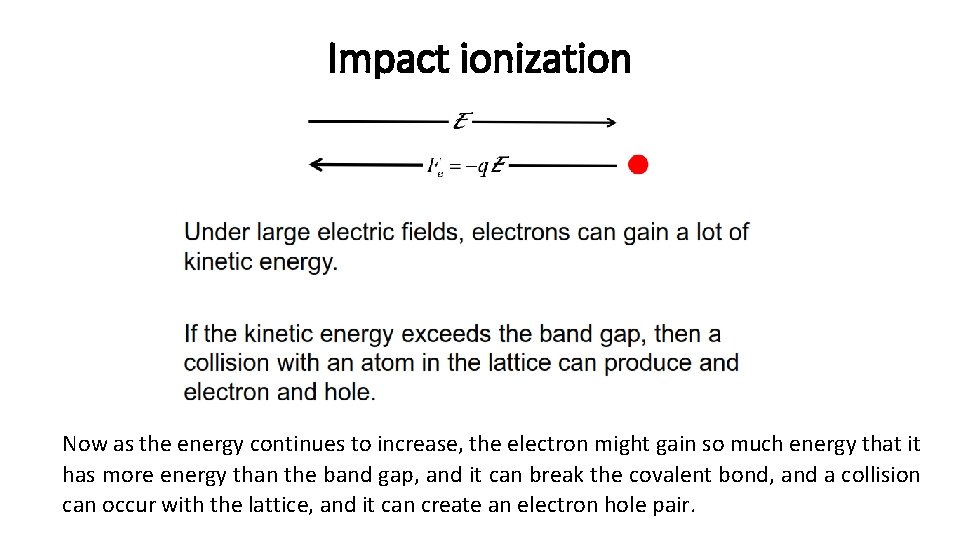
Impact ionization Now as the energy continues to increase, the electron might gain so much energy that it has more energy than the band gap, and it can break the covalent bond, and a collision can occur with the lattice, and it can create an electron hole pair.
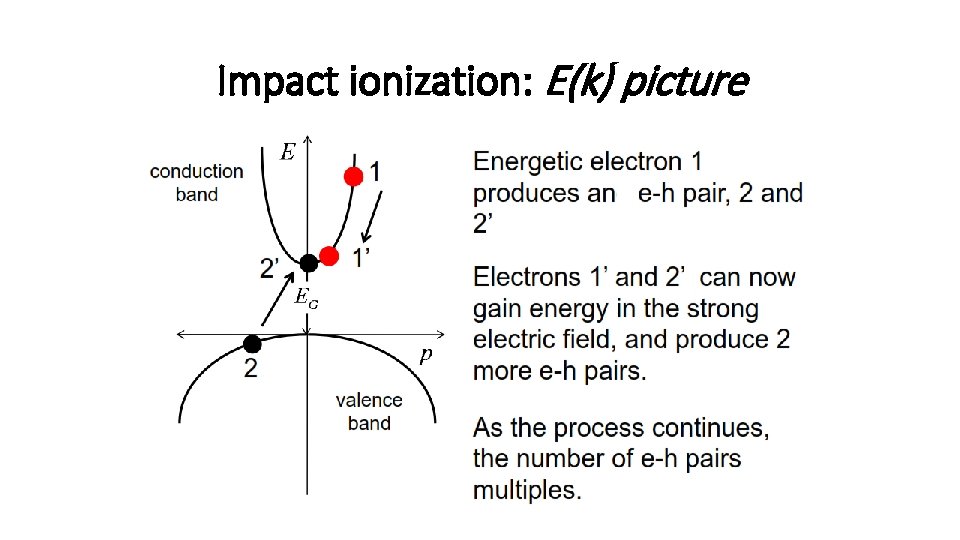
Impact ionization: E(k) picture
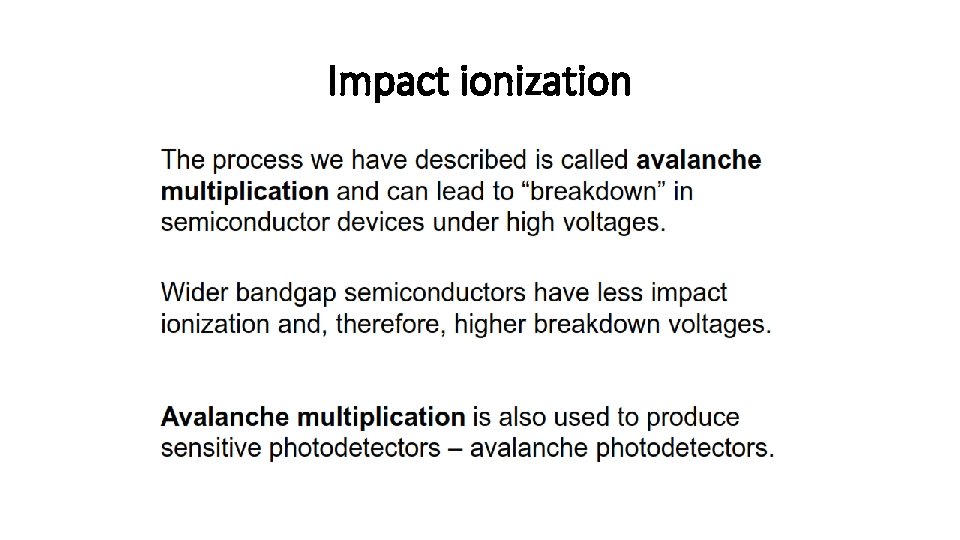
Impact ionization
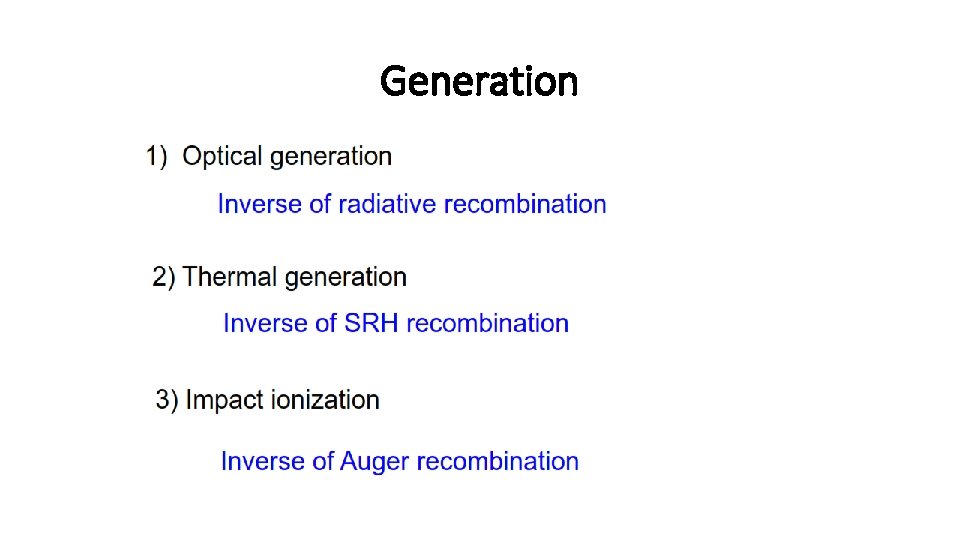
Generation
Unit 4: Carrier Transport, Recombination, and Generation Lecture 4. 6: Unit 4 Summery
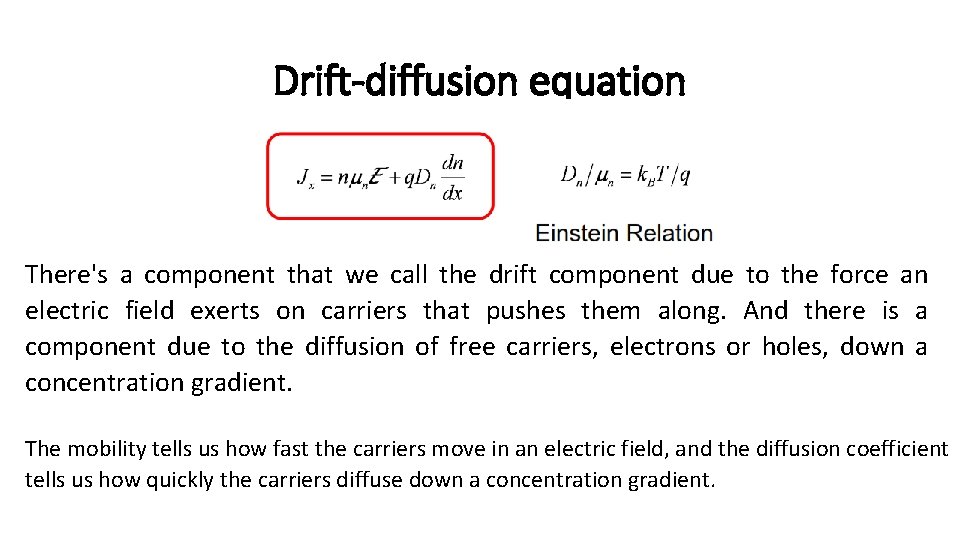
Drift-diffusion equation There's a component that we call the drift component due to the force an electric field exerts on carriers that pushes them along. And there is a component due to the diffusion of free carriers, electrons or holes, down a concentration gradient. The mobility tells us how fast the carriers move in an electric field, and the diffusion coefficient tells us how quickly the carriers diffuse down a concentration gradient.
Drift-diffusion equation
Drift-diffusion equation
Recombination
Recombination processes
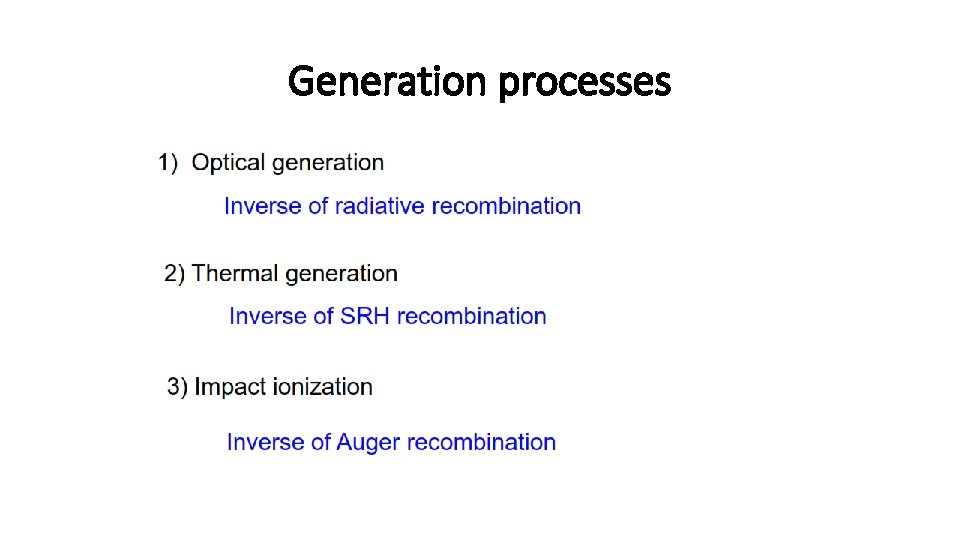
Generation processes
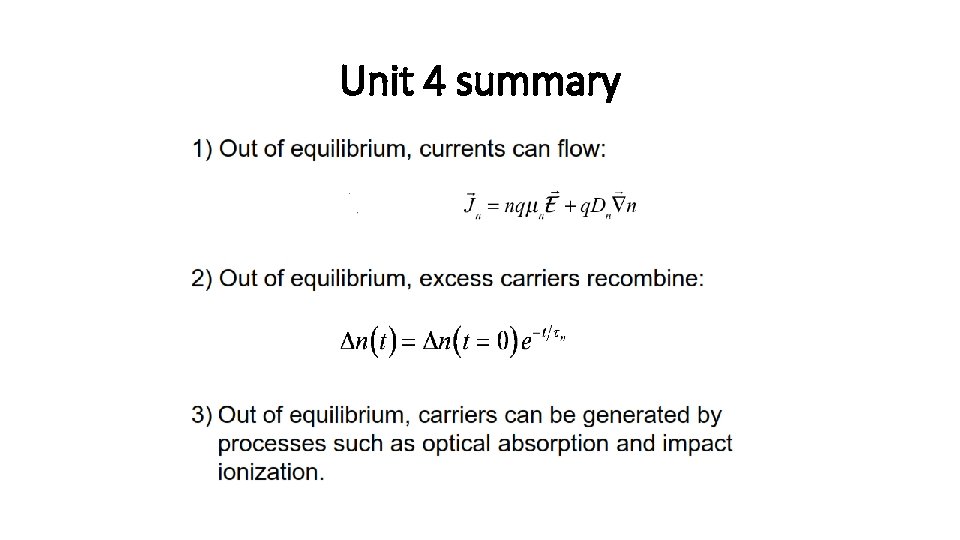
Unit 4 summary
- Slides: 65