
Unit 4 Careers in Tourism and Hospitality Skills


- Slides: 51
Unit 4 Careers in Tourism and Hospitality
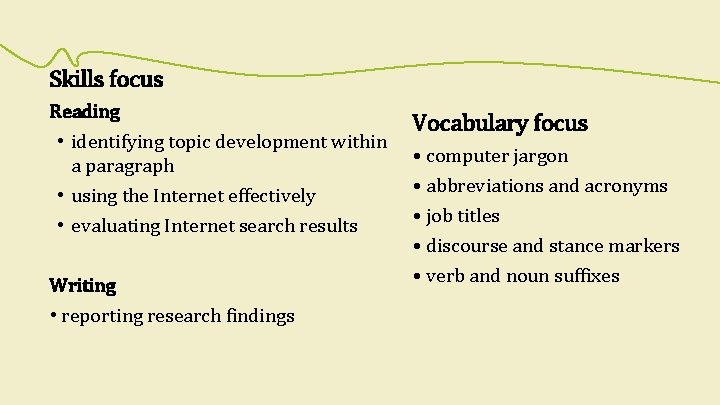
Skills focus Reading • identifying topic development within a paragraph • using the Internet effectively • evaluating Internet search results Writing • reporting research findings Vocabulary focus • computer jargon • abbreviations and acronyms • job titles • discourse and stance markers • verb and noun suffixes
4. 1 Vocabulary 4. 2 Reading 4. 3 Extending skills 4. 4 Extending skills
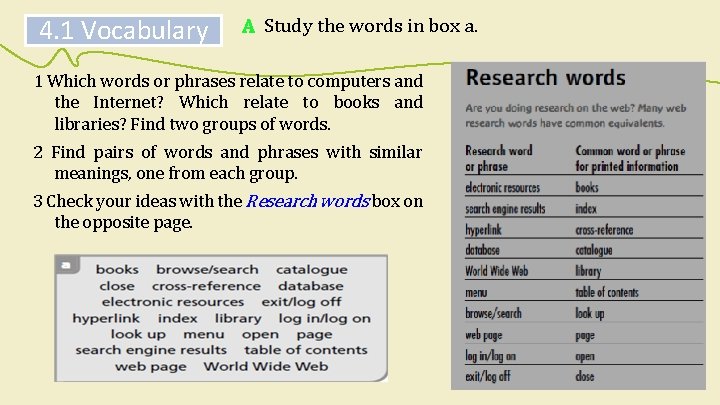
4. 1 Vocabulary A Study the words in box a. 1 Which words or phrases relate to computers and the Internet? Which relate to books and libraries? Find two groups of words. 2 Find pairs of words and phrases with similar meanings, one from each group. 3 Check your ideas with the Research words box on the opposite page.
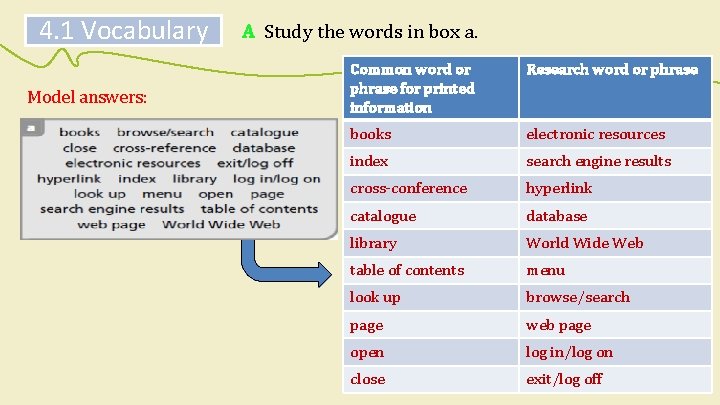
4. 1 Vocabulary Model answers: A Study the words in box a. Common word or phrase for printed information Research word or phrase books electronic resources index search engine results cross-conference hyperlink catalogue database library World Wide Web table of contents menu look up browse/search page web page open log in/log on close exit/log off
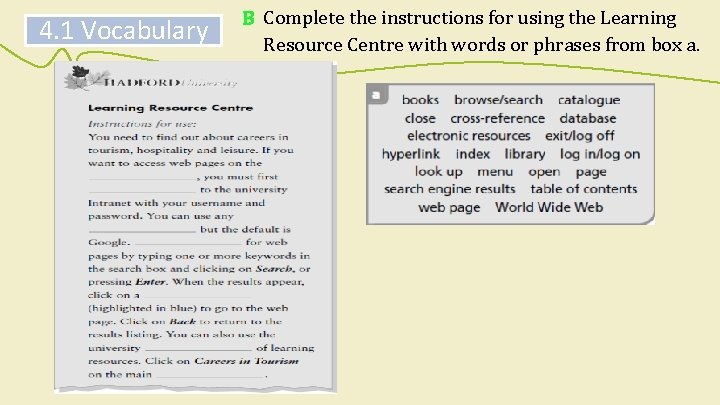
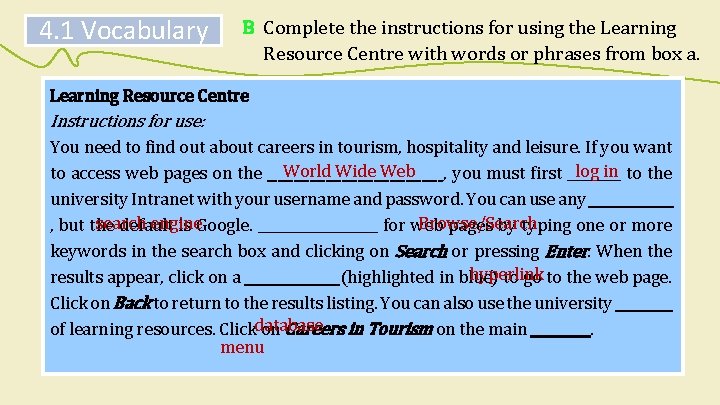
4. 1 Vocabulary B Complete the instructions for using the Learning Resource Centre with words or phrases from box a.
4. 1 Vocabulary B Complete the instructions for using the Learning Resource Centre with words or phrases from box a. Learning Resource Centre Instructions for use: You need to find out about careers in tourism, hospitality and leisure. If you want log in to the to access web pages on the World Wide Web , you must first ____ university Intranet with your username and password. You can use any search engine Browse/Search , but the default is Google. _________ for web pages by typing one or more keywords in the search box and clicking on Search or pressing Enter. When the hyperlink results appear, click on a (highlighted in blue) to go to the web page. Click on Back to return to the results listing. You can also use the university of learning resources. Clickdatabase on Careers in Tourism on the main. menu
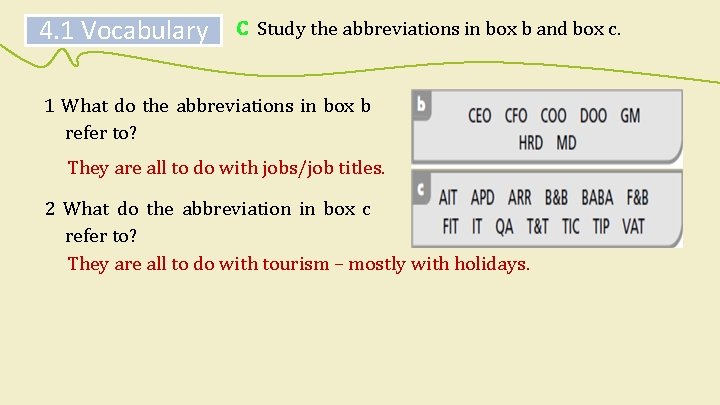
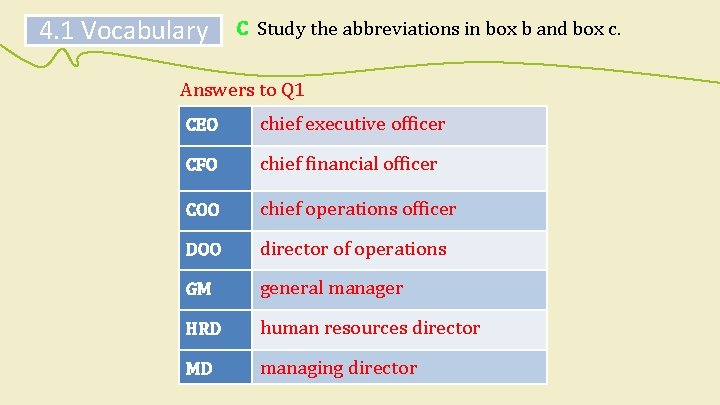
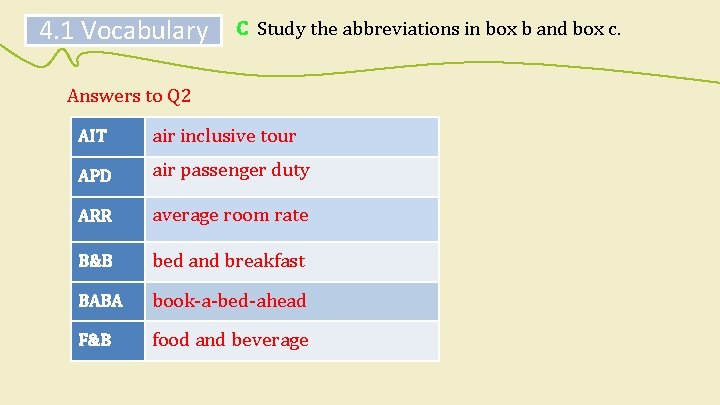
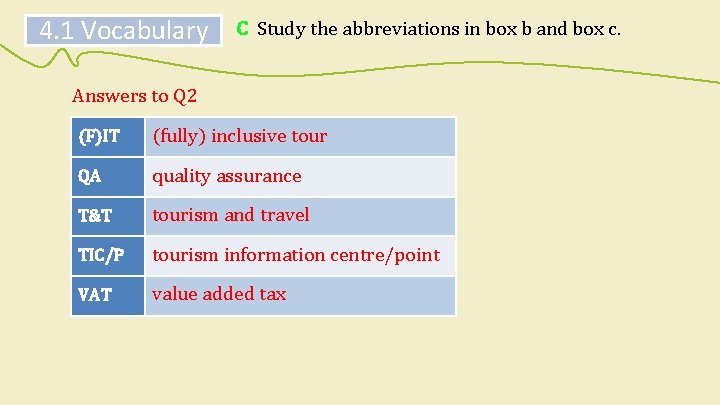
4. 1 Vocabulary C Study the abbreviations in box b and box c. 1 What do the abbreviations in box b refer to? They are all to do with jobs/job titles. 2 What do the abbreviation in box c refer to? They are all to do with tourism – mostly with holidays.
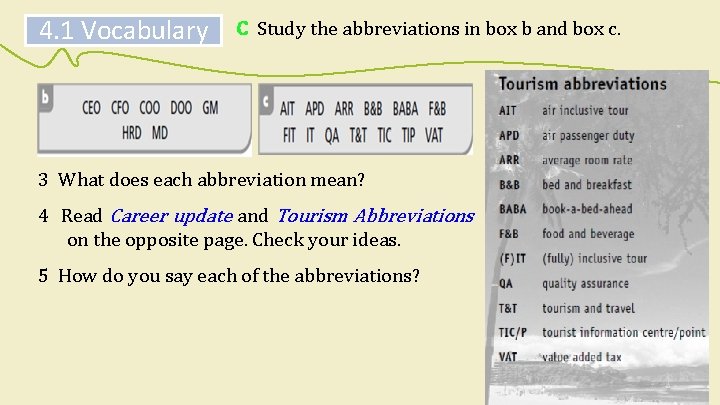
4. 1 Vocabulary C Study the abbreviations in box b and box c. 3 What does each abbreviation mean? 4 Read Career update and Tourism Abbreviations on the opposite page. Check your ideas. 5 How do you say each of the abbreviations?
4. 1 Vocabulary C Study the abbreviations in box b and box c. Answers to Q 1 CEO chief executive officer CFO chief financial officer COO chief operations officer DOO director of operations GM general manager HRD human resources director MD managing director
4. 1 Vocabulary C Study the abbreviations in box b and box c. Answers to Q 2 AIT air inclusive tour APD air passenger duty ARR average room rate B&B bed and breakfast BABA book-a-bed-ahead F&B food and beverage
4. 1 Vocabulary C Study the abbreviations in box b and box c. Answers to Q 2 (F)IT (fully) inclusive tour QA quality assurance T&T tourism and travel TIC/P tourism information centre/point VAT value added tax
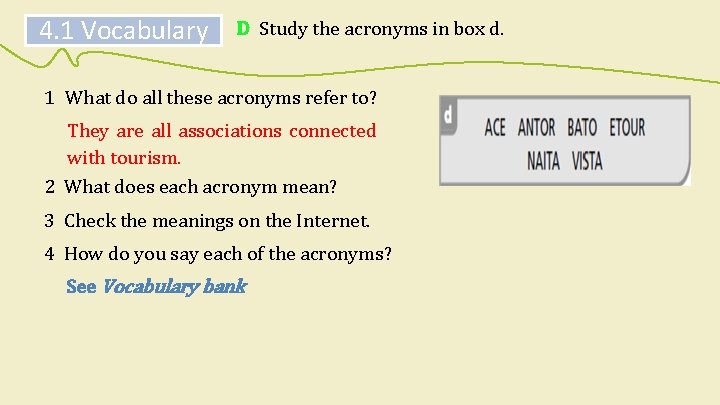
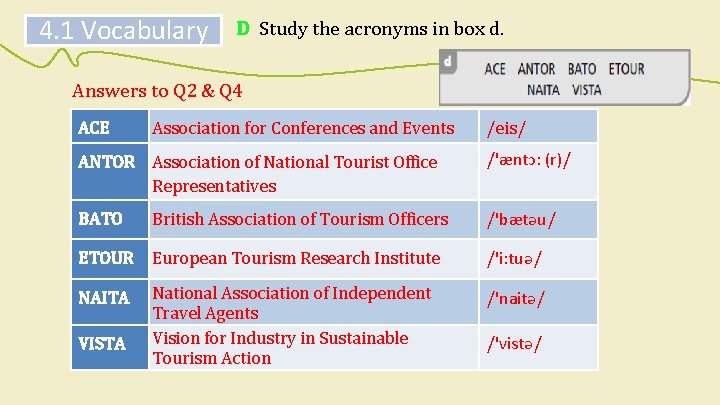
4. 1 Vocabulary D Study the acronyms in box d. 1 What do all these acronyms refer to? They are all associations connected with tourism. 2 What does each acronym mean? 3 Check the meanings on the Internet. 4 How do you say each of the acronyms? See Vocabulary bank
4. 1 Vocabulary D Study the acronyms in box d. Answers to Q 2 & Q 4 ACE Association for Conferences and Events /eis/ ANTOR Association of National Tourist Office Representatives /'æntɔ: (r)/ BATO British Association of Tourism Officers /'bætəu/ ETOUR European Tourism Research Institute /'i: tuə/ NAITA National Association of Independent Travel Agents Vision for Industry in Sustainable Tourism Action /'naitə/ VISTA /'vistə/
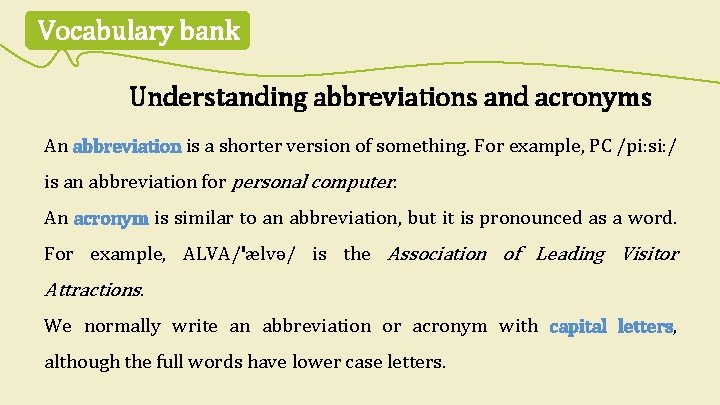
Vocabulary bank Understanding abbreviations and acronyms An abbreviation is a shorter version of something. For example, PC /pi: si: / is an abbreviation for personal computer. An acronym is similar to an abbreviation, but it is pronounced as a word. For example, ALVA/'ælvə/ is the Association of Leading Visitor Attractions. We normally write an abbreviation or acronym with capital letters, although the full words have lower case letters.
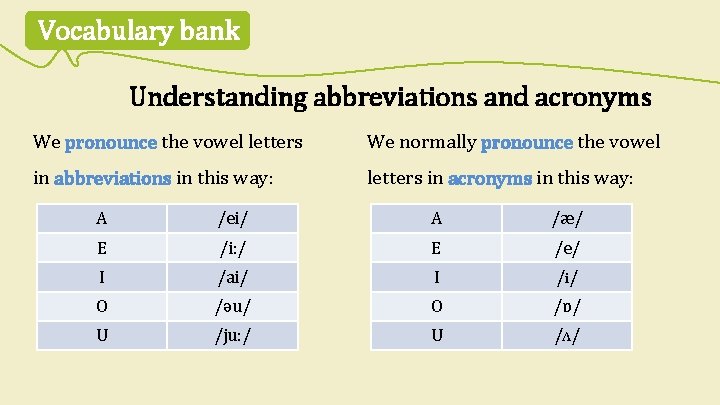
Vocabulary bank Understanding abbreviations and acronyms We pronounce the vowel letters We normally pronounce the vowel in abbreviations in this way: letters in acronyms in this way: A /ei/ A /æ/ E /i: / E /e/ I /ai/ I /i / O /əu/ O /ɒ/ U /ju: / U /ʌ/
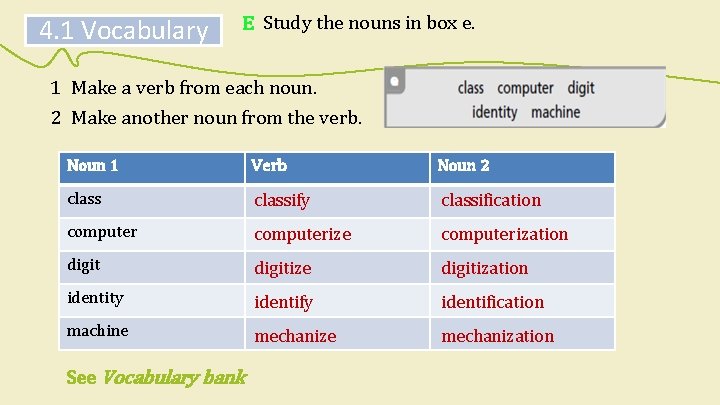
4. 1 Vocabulary E Study the nouns in box e. 1 Make a verb from each noun. 2 Make another noun from the verb. Noun 1 Verb Noun 2 classify classification computerize computerization digitize digitization identity identification machine mechanization See Vocabulary bank
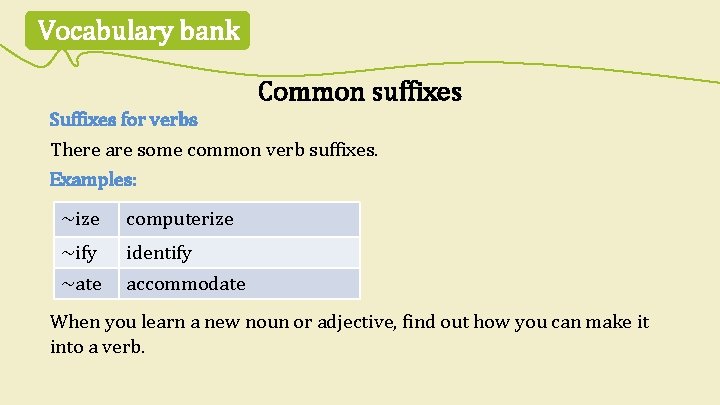
Vocabulary bank Common suffixes Suffixes for verbs There are some common verb suffixes. Examples: ~ize computerize ~ify identify ~ate accommodate When you learn a new noun or adjective, find out how you can make it into a verb.
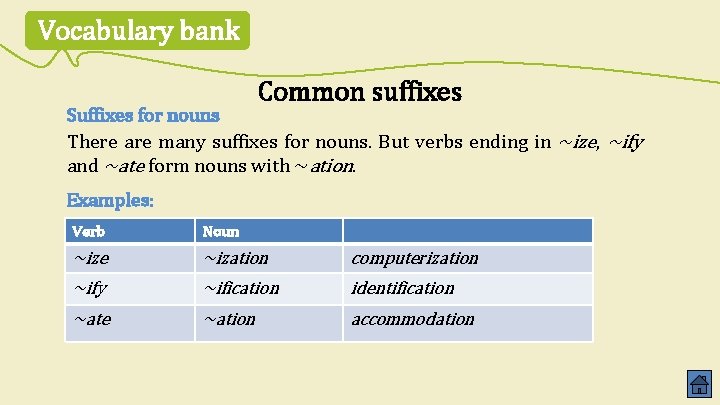
Vocabulary bank Common suffixes Suffixes for nouns There are many suffixes for nouns. But verbs ending in ~ize, ~ify and ~ate form nouns with ~ation. Examples: Verb Noun ~ize ~ization computerization ~ify ~ification identification ~ate ~ation accommodation
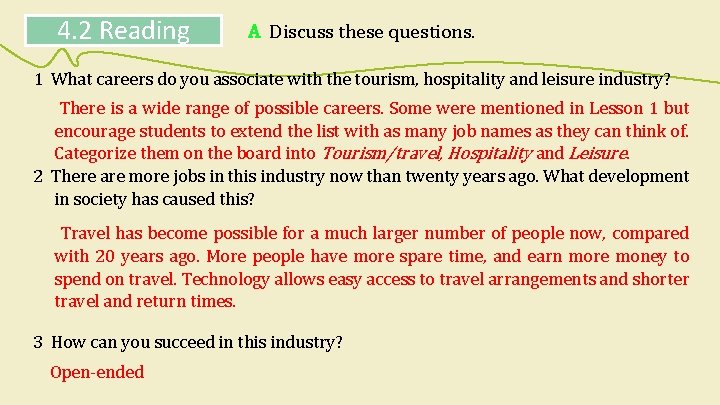
4. 2 Reading A Discuss these questions. 1 What careers do you associate with the tourism, hospitality and leisure industry? There is a wide range of possible careers. Some were mentioned in Lesson 1 but encourage students to extend the list with as many job names as they can think of. Categorize them on the board into Tourism/travel, Hospitality and Leisure. 2 There are more jobs in this industry now than twenty years ago. What development in society has caused this? Travel has become possible for a much larger number of people now, compared with 20 years ago. More people have more spare time, and earn more money to spend on travel. Technology allows easy access to travel arrangements and shorter travel and return times. 3 How can you succeed in this industry? Open-ended
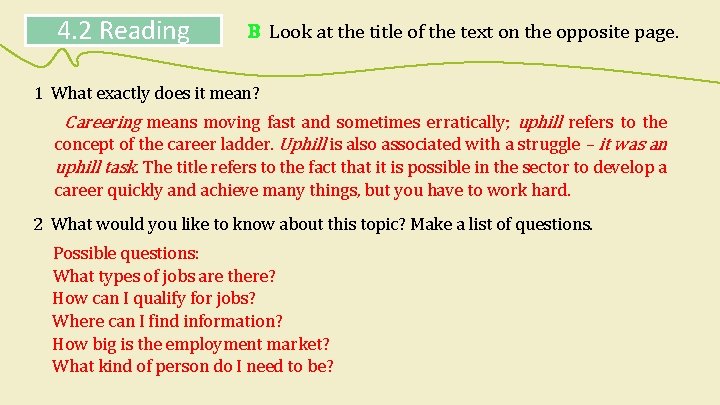
4. 2 Reading B Look at the title of the text on the opposite page. 1 What exactly does it mean? Careering means moving fast and sometimes erratically; uphill refers to the concept of the career ladder. Uphill is also associated with a struggle – it was an uphill task. The title refers to the fact that it is possible in the sector to develop a career quickly and achieve many things, but you have to work hard. 2 What would you like to know about this topic? Make a list of questions. Possible questions: What types of jobs are there? How can I qualify for jobs? Where can I find information? How big is the employment market? What kind of person do I need to be?
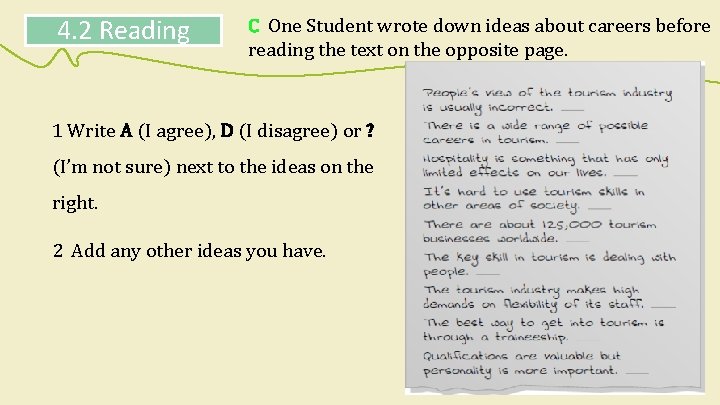
4. 2 Reading C One Student wrote down ideas about careers before reading the text on the opposite page. 1 Write A (I agree), D (I disagree) or ? (I’m not sure) next to the ideas on the right. 2 Add any other ideas you have.
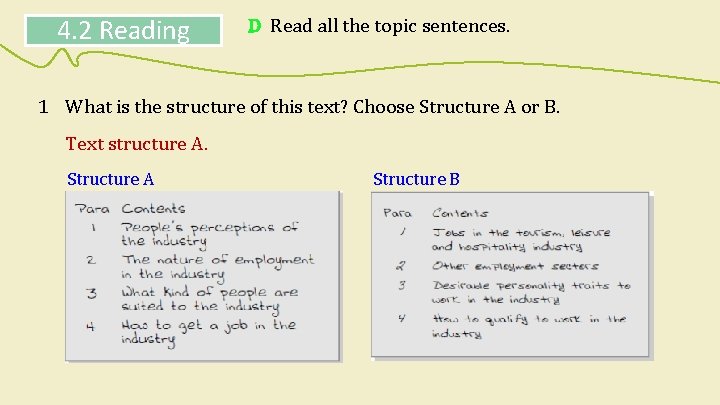
4. 2 Reading D Read all the topic sentences. 1 What is the structure of this text? Choose Structure A or B. Text structure A. Structure A Structure B
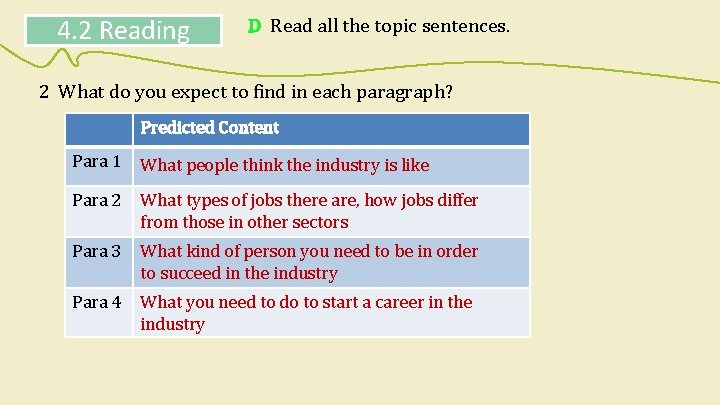
4. 2 Reading D Read all the topic sentences. 2 What do you expect to find in each paragraph? Predicted Content Para 1 What people think the industry is like Para 2 What types of jobs there are, how jobs differ from those in other sectors Para 3 What kind of person you need to be in order to succeed in the industry Para 4 What you need to do to start a career in the industry
4. 2 Reading E Read the text and check your predictions. Teaching tips: Set the reading. Students should make notes on the differences between their predictions and the text.
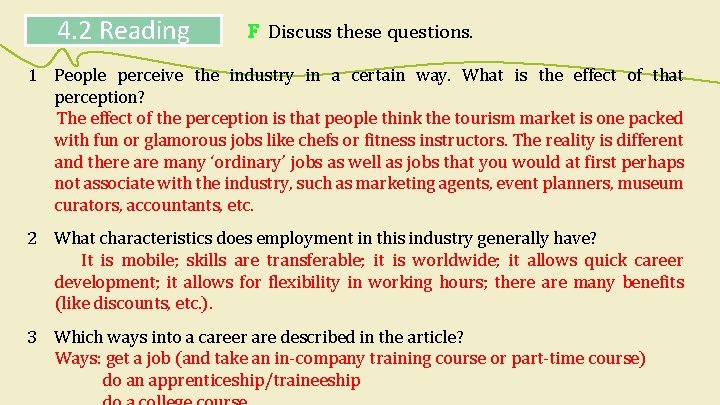
4. 2 Reading F Discuss these questions. 1 People perceive the industry in a certain way. What is the effect of that perception? The effect of the perception is that people think the tourism market is one packed with fun or glamorous jobs like chefs or fitness instructors. The reality is different and there are many ‘ordinary’ jobs as well as jobs that you would at first perhaps not associate with the industry, such as marketing agents, event planners, museum curators, accountants, etc. 2 What characteristics does employment in this industry generally have? It is mobile; skills are transferable; it is worldwide; it allows quick career development; it allows for flexibility in working hours; there are many benefits (like discounts, etc. ). 3 Which ways into a career are described in the article? Ways: get a job (and take an in-company training course or part-time course) do an apprenticeship/traineeship
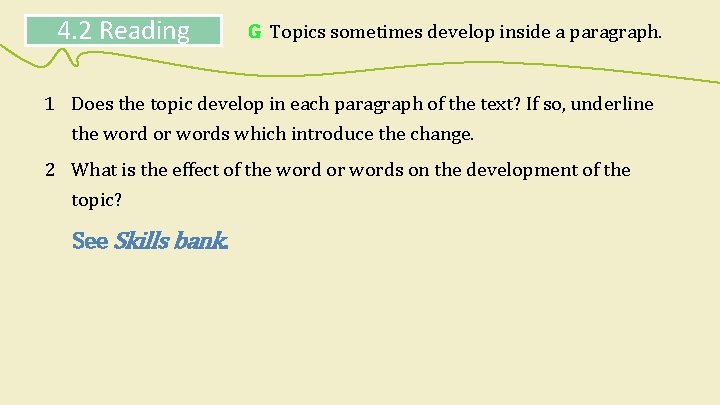
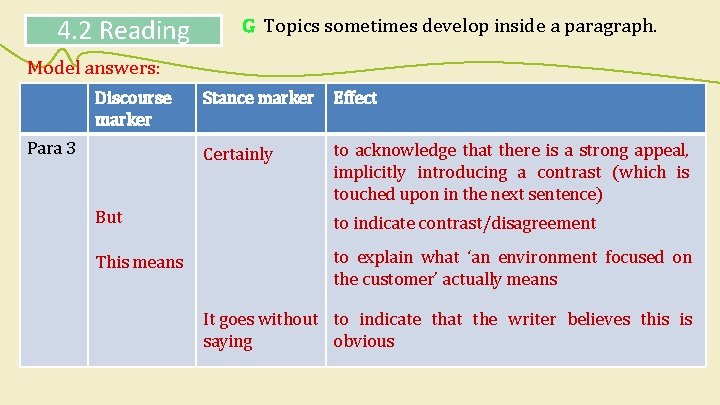
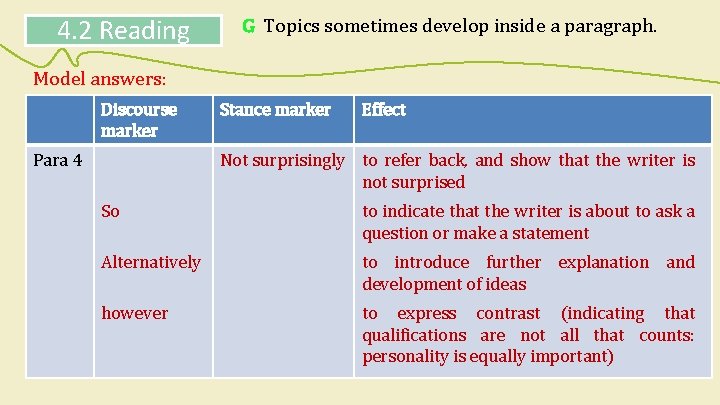
4. 2 Reading G Topics sometimes develop inside a paragraph. 1 Does the topic develop in each paragraph of the text? If so, underline the word or words which introduce the change. 2 What is the effect of the word or words on the development of the topic? See Skills bank.
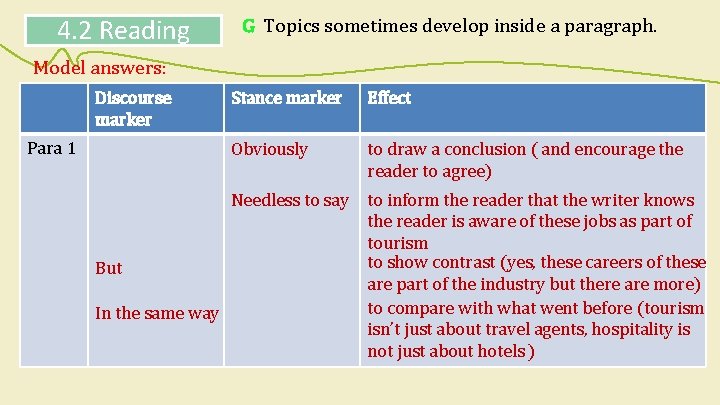
4. 2 Reading G Topics sometimes develop inside a paragraph. Model answers: Discourse marker Para 1 But In the same way Stance marker Effect Obviously to draw a conclusion ( and encourage the reader to agree) Needless to say to inform the reader that the writer knows the reader is aware of these jobs as part of tourism to show contrast (yes, these careers of these are part of the industry but there are more) to compare with what went before (tourism isn’t just about travel agents, hospitality is not just about hotels )
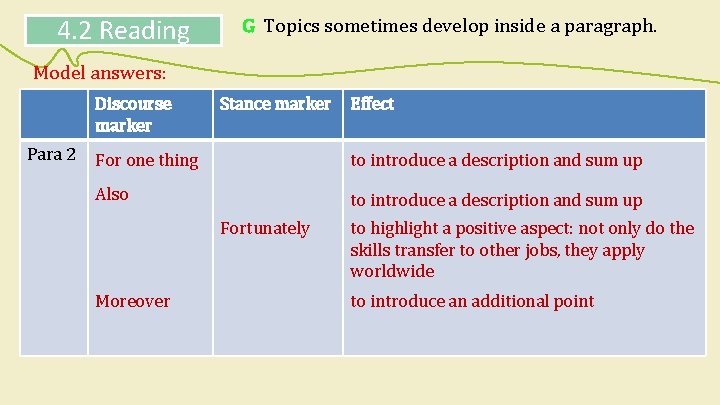
4. 2 Reading G Topics sometimes develop inside a paragraph. Model answers: Discourse marker Para 2 Stance marker Effect For one thing to introduce a description and sum up Also to introduce a description and sum up Fortunately Moreover to highlight a positive aspect: not only do the skills transfer to other jobs, they apply worldwide to introduce an additional point
4. 2 Reading G Topics sometimes develop inside a paragraph. Model answers: Discourse marker Para 3 Stance marker Effect Certainly to acknowledge that there is a strong appeal, implicitly introducing a contrast (which is touched upon in the next sentence) But to indicate contrast/disagreement This means to explain what ‘an environment focused on the customer’ actually means It goes without to indicate that the writer believes this is saying obvious
4. 2 Reading G Topics sometimes develop inside a paragraph. Model answers: Discourse marker Para 4 Stance marker Effect Not surprisingly to refer back, and show that the writer is not surprised So to indicate that the writer is about to ask a question or make a statement Alternatively to introduce further explanation and development of ideas however to express contrast (indicating that qualifications are not all that counts: personality is equally important)
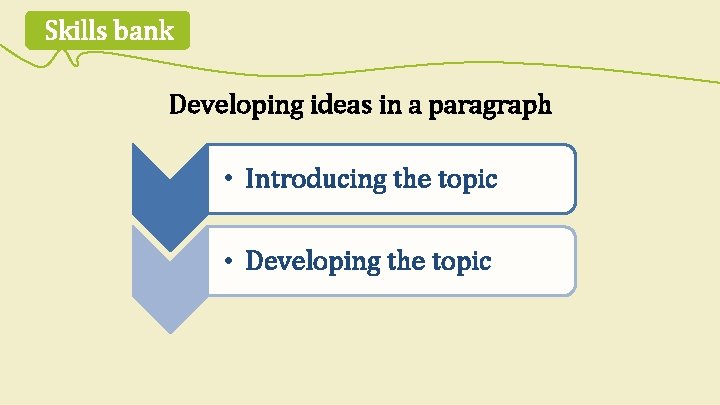
Skills bank Developing ideas in a paragraph • Introducing the topic • Developing the topic
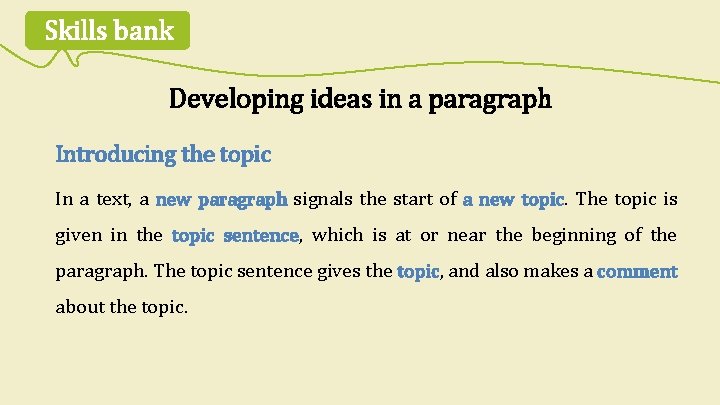
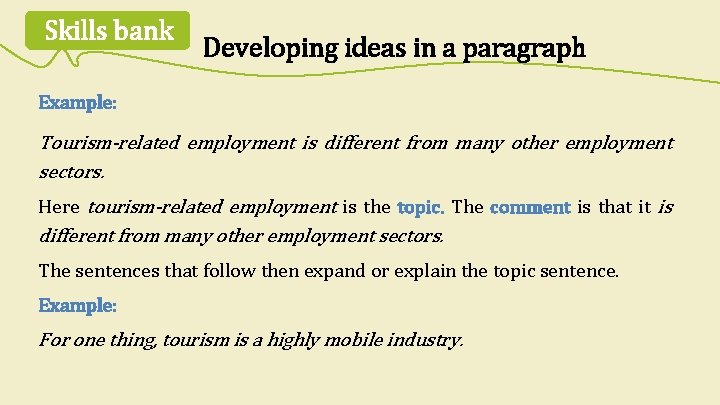
Skills bank Developing ideas in a paragraph Introducing the topic In a text, a new paragraph signals the start of a new topic. The topic is given in the topic sentence, which is at or near the beginning of the paragraph. The topic sentence gives the topic, and also makes a comment about the topic.
Skills bank Developing ideas in a paragraph Example: Tourism-related employment is different from many other employment sectors. Here tourism-related employment is the topic. The comment is that it is different from many other employment sectors. The sentences that follow then expand or explain the topic sentence. Example: For one thing, tourism is a highly mobile industry.
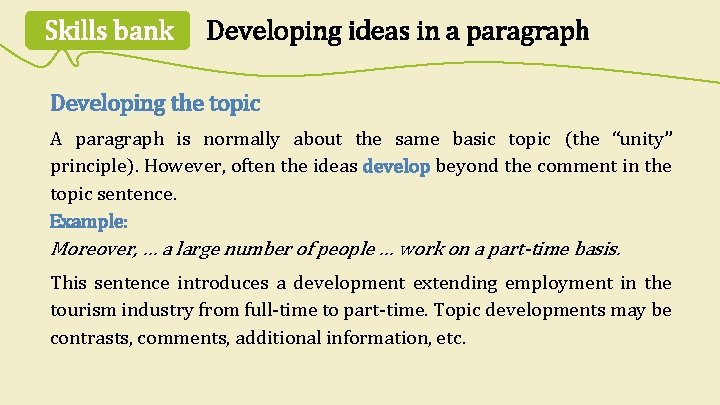
Skills bank Developing ideas in a paragraph Developing the topic A paragraph is normally about the same basic topic (the “unity” principle). However, often the ideas develop beyond the comment in the topic sentence. Example: Moreover, … a large number of people … work on a part-time basis. This sentence introduces a development extending employment in the tourism industry from full-time to part-time. Topic developments may be contrasts, comments, additional information, etc.
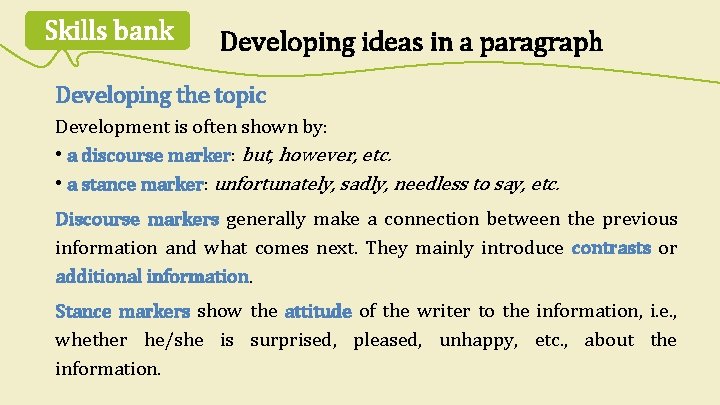
Skills bank Developing ideas in a paragraph Developing the topic Development is often shown by: • a discourse marker: but, however, etc. • a stance marker: unfortunately, sadly, needless to say, etc. Discourse markers generally make a connection between the previous information and what comes next. They mainly introduce contrasts or additional information. Stance markers show the attitude of the writer to the information, i. e. , whether he/she is surprised, pleased, unhappy, etc. , about the information.
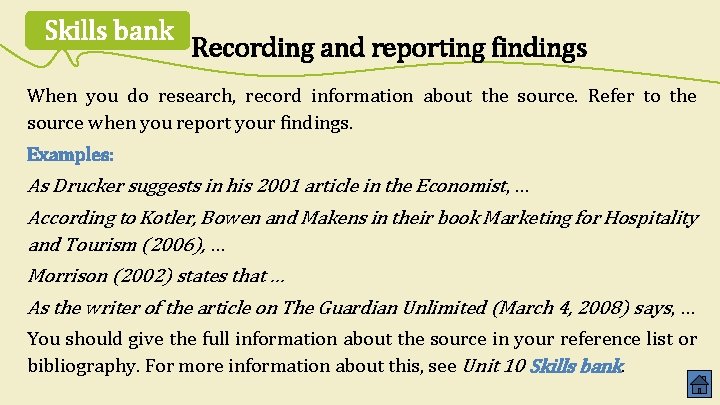
Skills bank Recording and reporting findings When you do research, record information about the source. Refer to the source when you report your findings. Examples: As Drucker suggests in his 2001 article in the Economist, … According to Kotler, Bowen and Makens in their book Marketing for Hospitality and Tourism (2006), … Morrison (2002) states that … As the writer of the article on The Guardian Unlimited (March 4, 2008) says , … You should give the full information about the source in your reference list or bibliography. For more information about this, see Unit 10 Skills bank.
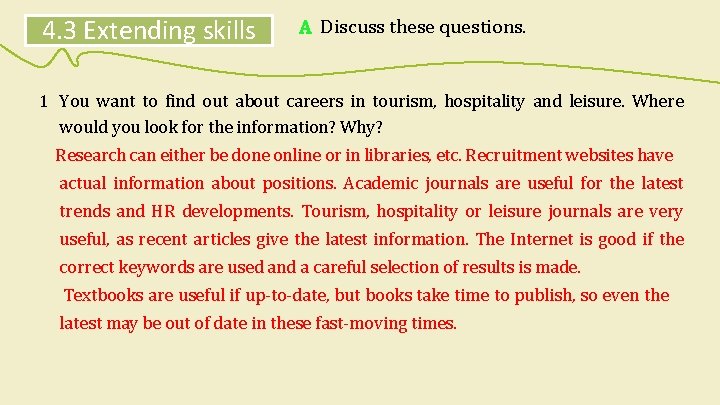
4. 3 Extending skills A Discuss these questions. 1 You want to find out about careers in tourism, hospitality and leisure. Where would you look for the information? Why? Research can either be done online or in libraries, etc. Recruitment websites have actual information about positions. Academic journals are useful for the latest trends and HR developments. Tourism, hospitality or leisure journals are very useful, as recent articles give the latest information. The Internet is good if the correct keywords are used and a careful selection of results is made. Textbooks are useful if up-to-date, but books take time to publish, so even the latest may be out of date in these fast-moving times.
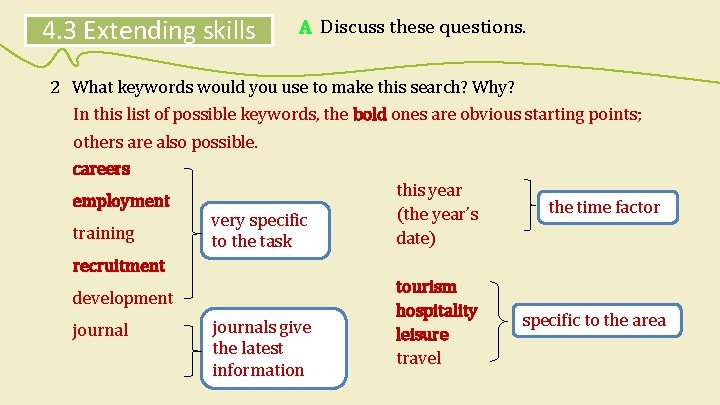
4. 3 Extending skills A Discuss these questions. 2 What keywords would you use to make this search? Why? In this list of possible keywords, the bold ones are obvious starting points; others are also possible. careers employment training very specific to the task this year (the year’s date) the time factor recruitment development journals give the latest information tourism hospitality leisure travel specific to the area
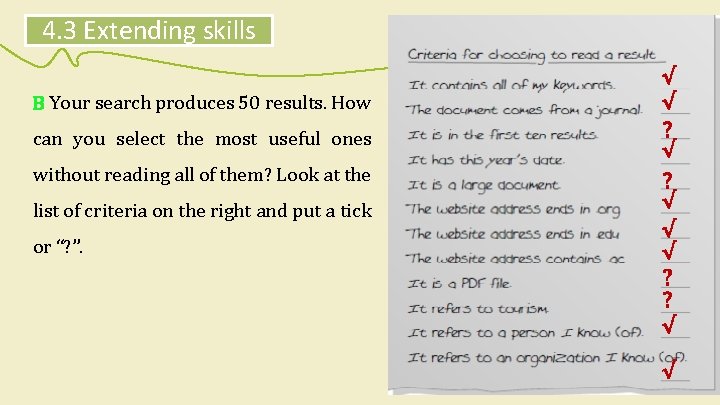
4. 3 Extending skills B Your search produces 50 results. How √ √ can you select the most useful ones ? without reading all of them? Look at the ? list of criteria on the right and put a tick or “? ”. √ √ ? ? √ √
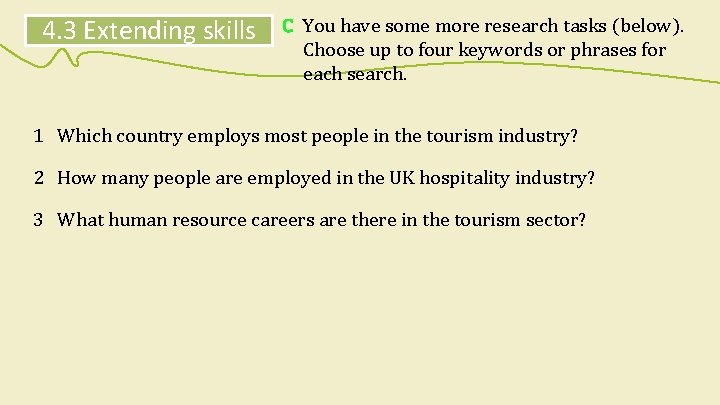
4. 3 Extending skills C You have some more research tasks (below). Choose up to four keywords or phrases for each search. 1 Which country employs most people in the tourism industry? 2 How many people are employed in the UK hospitality industry? 3 What human resource careers are there in the tourism sector?
4. 3 Extending skills D Go to a computer and try out your chosen keywords. Answers: 1 employment tourism country statistics will generate a few useful links to reports with either worldwide or country, or even region, specific data. Leaving out the word statistics leads to more generalist and regional results. Including WTTC or World Travel and Tourism Council will lead to this organization’s website, which contains a lot of statistical data. 2 Typing UK hospitality employment statistics leads to many useful sites. Leaving out statistics will lead to many recruitment agency sites that give useful information about types of jobs and employment in the industry. 3 HR tourism career management leads both to recruitment sites and to many educational sites (universities and colleges selling their programmes). Adding the word journal to these search criteria leads to many academic publications on HR and career development in the tourism sector.
4. 4 Extending skills A What information is contained in the results listings of a search engine? 1 Make a list 2 Check with the results listings on the opposite page. number of results keywords used time taken title of document type of document quotations from the text with keywords highlighted date web address/URL
4. 4 Extending skills B Scan the results listings. Answer these questions. 1 What keywords were entered? hospitality leisure tourism recruitment employment journal 2 Why was journal used as a keyword? Because journals give the most current/academic information.
4. 4 Extending skills C Answer these questions. 1 Which results contain abbreviations or acronyms? Acronyms/Abbreviations: Result 1: FAQs (Frequently Asked Questions) Results 2, 5, 9: Jo. HLSTE ( Journal of Hospitality, Leisure, Sport and Tourism Education) Result 4: REC (Recruitment and Employment Confederation) Result 7: HLSTN (Hospitality, Leisure, Sport and Tourism Network) Result 9: ILAM (Institute of Leisure and Amenity Management) 2 Where is each website address? At the end. 3 Where is the size of each document? At the end (if it is given), e. g. , 22 k.
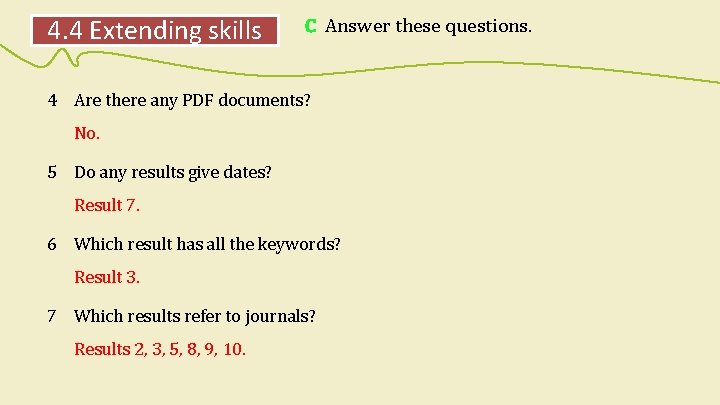
4. 4 Extending skills C Answer these questions. 4 Are there any PDF documents? No. 5 Do any results give dates? Result 7. 6 Which result has all the keywords? Result 3. 7 Which results refer to journals? Results 2, 3, 5, 8, 9, 10.
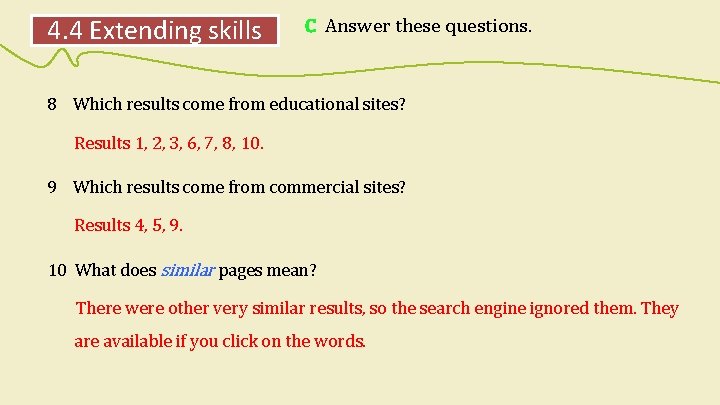
4. 4 Extending skills C Answer these questions. 8 Which results come from educational sites? Results 1, 2, 3, 6, 7, 8, 10. 9 Which results come from commercial sites? Results 4, 5, 9. 10 What does similar pages mean? There were other very similar results, so the search engine ignored them. They are available if you click on the words.
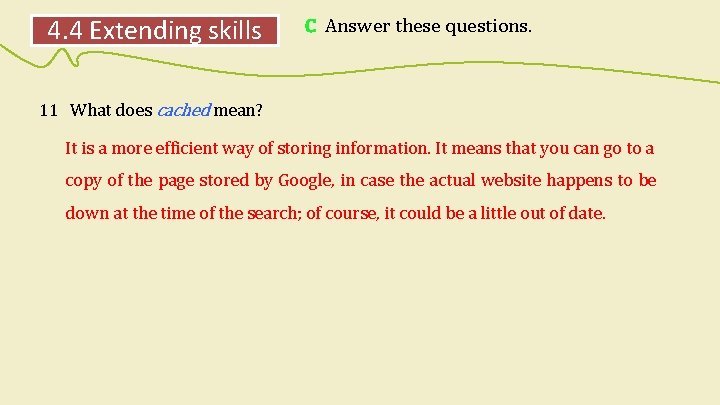
4. 4 Extending skills C Answer these questions. 11 What does cached mean? It is a more efficient way of storing information. It means that you can go to a copy of the page stored by Google, in case the actual website happens to be down at the time of the search; of course, it could be a little out of date.
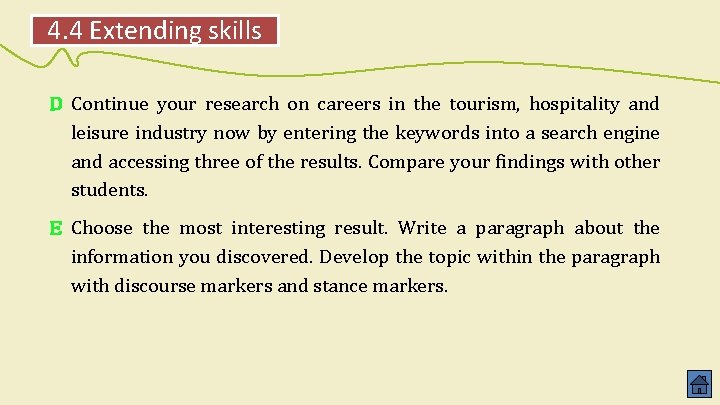
4. 4 Extending skills D Continue your research on careers in the tourism, hospitality and leisure industry now by entering the keywords into a search engine and accessing three of the results. Compare your findings with other students. E Choose the most interesting result. Write a paragraph about the information you discovered. Develop the topic within the paragraph with discourse markers and stance markers.