
Unit 4 Animals animal characteristics 1 Symmetry Body
Unit 4 Animals
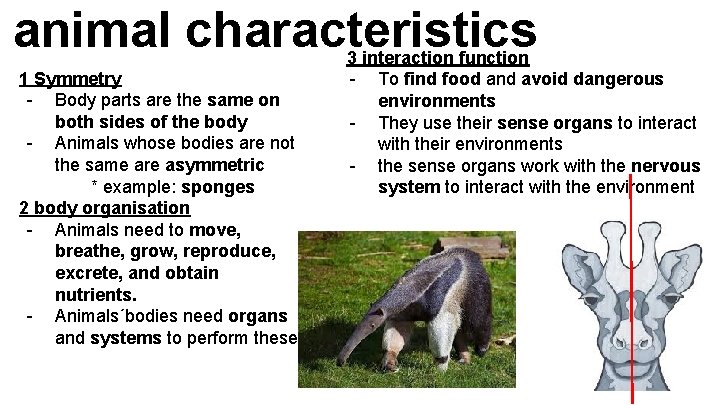
animal characteristics 1 Symmetry - Body parts are the same on both sides of the body - Animals whose bodies are not the same are asymmetric * example: sponges 2 body organisation - Animals need to move, breathe, grow, reproduce, excrete, and obtain nutrients. - Animals´bodies need organs and systems to perform these 3 interaction function - To find food and avoid dangerous environments - They use their sense organs to interact with their environments - the sense organs work with the nervous system to interact with the environment

classifying animals Vertebrates - hard internal skeleton - vertebral column *with head, trunk, and limbs - five groups *fish, amphibians, reptiles, birds, mammals Invertebrates - haven´t got internal skeleton or vertebral column - Some have a hard shell or exoskeleton - all invertebrates are oviparous *they lay eggs Has a vertebral column and hard internal skeleton
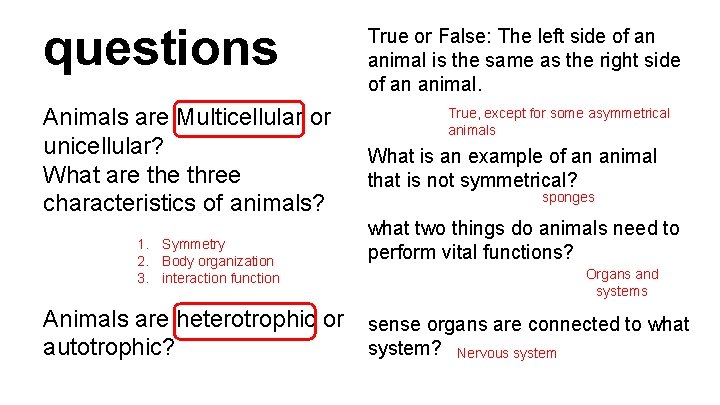
questions Animals are Multicellular or unicellular? What are three characteristics of animals? 1. Symmetry 2. Body organization 3. interaction function True or False: The left side of an animal is the same as the right side of an animal. True, except for some asymmetrical animals What is an example of an animal that is not symmetrical? sponges what two things do animals need to perform vital functions? Organs and systems Animals are heterotrophic or sense organs are connected to what system? Nervous system autotrophic?

vertebrates: Fish - Their bodies are important *fins to move them through the water *they can move up and down and side to side - how their bodies function *live in the water use gills to breathe *are oviparous - two types of fish *bony fish *cartilaginous fish Use fins to move
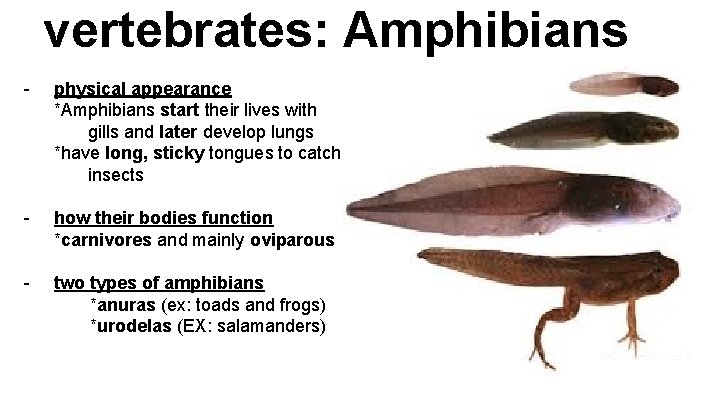
vertebrates: Amphibians - physical appearance *Amphibians start their lives with gills and later develop lungs *have long, sticky tongues to catch insects - how their bodies function *carnivores and mainly oviparous - two types of amphibians *anuras (ex: toads and frogs) *urodelas (EX: salamanders)
more questions What do invertebrates have that vertebrates do not? They haven´t got an internal skeleton. Some have an exoskeleton. True or False: All Vertebrates are oviparous. False. All invertebrates are oviparous True False: all fish have hard bony skeletons. False. Some have skeletons made of cartilage True or False: Amphibians can breathe with both gills and lungs. True Amphibians are oviparous or viviparous? Could be both but are mainly oviparous. Where do amphibians lay their eggs? They lay their eggs in humid areas or in water. What are examples of the two types of amphibians? What characteristics do they have? Anuras: toads and frogs. Can jump large distances. Back legs are longer than front legs. Urodelas: Salamanders. Four legs and a long tail.
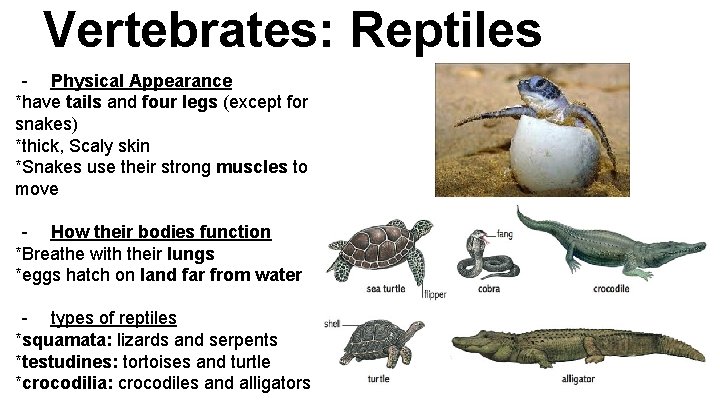
Vertebrates: Reptiles - Physical Appearance *have tails and four legs (except for snakes) *thick, Scaly skin *Snakes use their strong muscles to move - How their bodies function *Breathe with their lungs *eggs hatch on land far from water - types of reptiles *squamata: lizards and serpents *testudines: tortoises and turtle *crocodilia: crocodiles and alligators
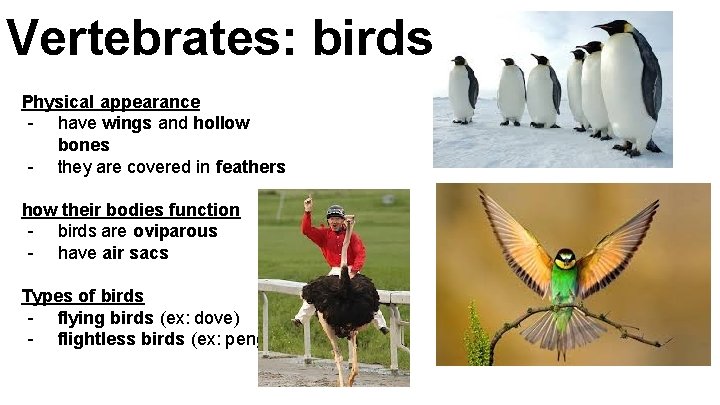
Vertebrates: birds Physical appearance - have wings and hollow bones - they are covered in feathers how their bodies function - birds are oviparous - have air sacs Types of birds - flying birds (ex: dove) - flightless birds (ex: penguin)
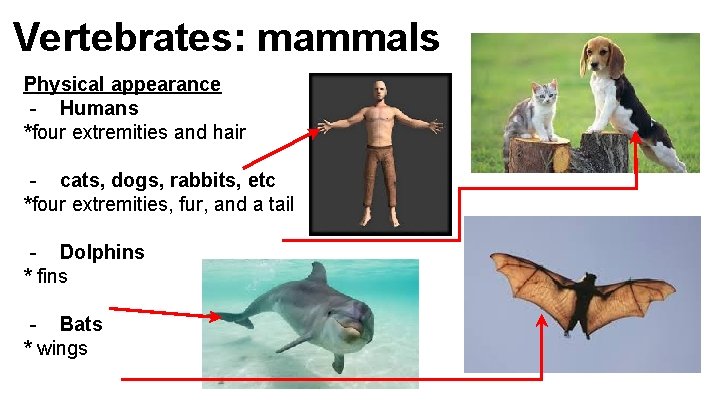
Vertebrates: mammals Physical appearance - Humans *four extremities and hair - cats, dogs, rabbits, etc *four extremities, fur, and a tail - Dolphins * fins - Bats * wings
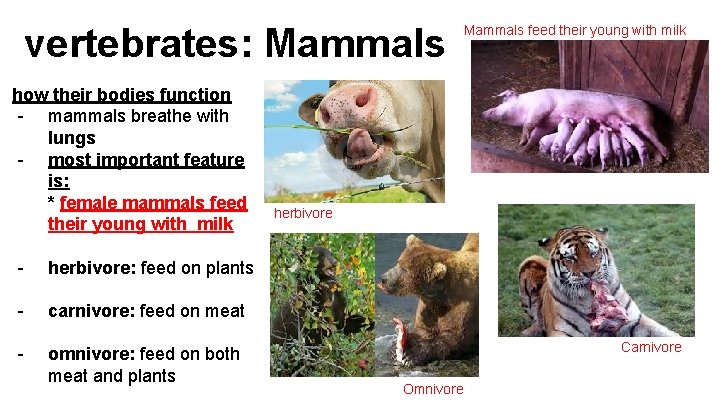
vertebrates: Mammals how their bodies function - mammals breathe with lungs - most important feature is: * female mammals feed their young with milk - herbivore: feed on plants - carnivore: feed on meat - omnivore: feed on both meat and plants Mammals feed their young with milk herbivore Carnivore Omnivore
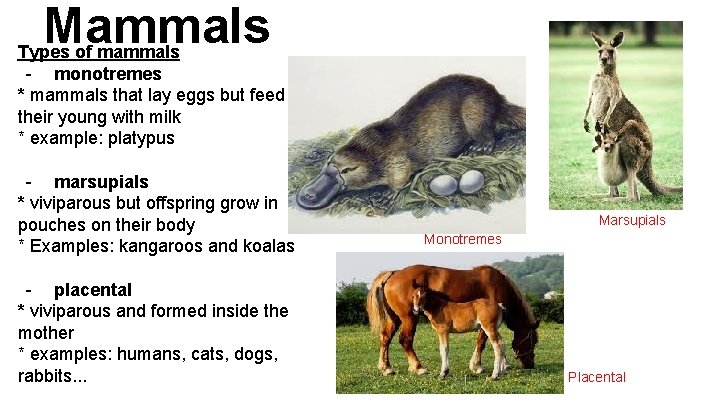
Mammals Types of mammals - monotremes * mammals that lay eggs but feed their young with milk * example: platypus - marsupials * viviparous but offspring grow in pouches on their body * Examples: kangaroos and koalas - placental * viviparous and formed inside the mother * examples: humans, cats, dogs, rabbits. . . Marsupials Monotremes Placental
more questions What are two functions of feathers on birds? 1. to help maintain temperature 2. help them fly Why do birds need the air sacs connected to their lungs? To increase their capacity and effectiveness. What are two examples of flightless birds? Penguins, Emus, and ostriches. what are two examples of the different bodies mammals can have? Humans have four limbs and hair. Cats have four limbs, a tail, and fur. Bats have wings and dolphins have fins What are three classifications of mammals depending on what they eat? Herbivores, omnivores, and carnivores. What are three types of mammals? Examples? Monotremes: platypus Marsupials: kangaroo and koala Placental: humans, bunnies, cats. . .
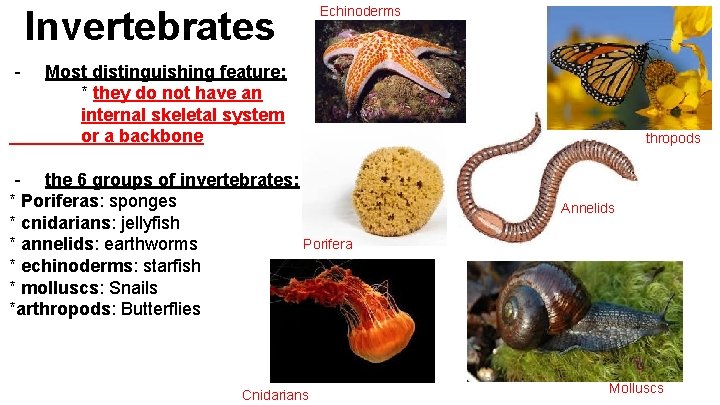
Invertebrates - Echinoderms Most distinguishing feature: * they do not have an internal skeletal system or a backbone - the 6 groups of invertebrates: * Poriferas: sponges * cnidarians: jellyfish Porifera * annelids: earthworms * echinoderms: starfish * molluscs: Snails *arthropods: Butterflies Cnidarians Arthropods Annelids Molluscs
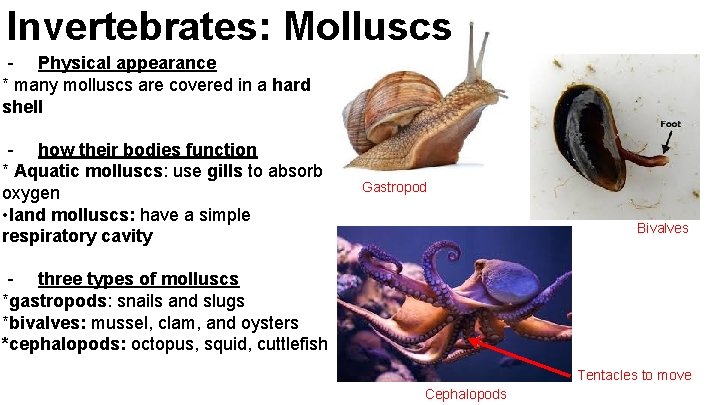
Invertebrates: Molluscs - Physical appearance * many molluscs are covered in a hard shell - how their bodies function * Aquatic molluscs: use gills to absorb oxygen • land molluscs: have a simple respiratory cavity Gastropod Bivalves - three types of molluscs *gastropods: snails and slugs *bivalves: mussel, clam, and oysters *cephalopods: octopus, squid, cuttlefish Tentacles to move Cephalopods
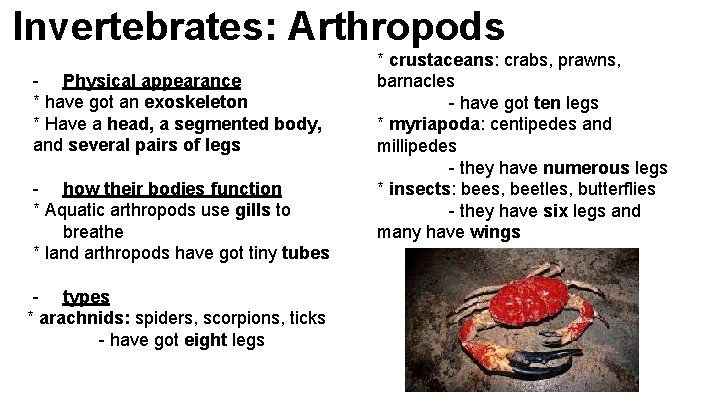
Invertebrates: Arthropods - Physical appearance * have got an exoskeleton * Have a head, a segmented body, and several pairs of legs - how their bodies function * Aquatic arthropods use gills to breathe * land arthropods have got tiny tubes - types * arachnids: spiders, scorpions, ticks - have got eight legs * crustaceans: crabs, prawns, barnacles - have got ten legs * myriapoda: centipedes and millipedes - they have numerous legs * insects: bees, beetles, butterflies - they have six legs and many have wings
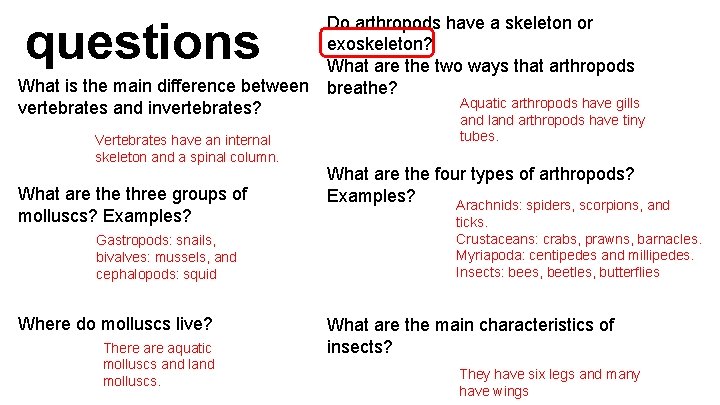
Do arthropods have a skeleton or exoskeleton? What are the two ways that arthropods What is the main difference between breathe? Aquatic arthropods have gills vertebrates and invertebrates? questions Vertebrates have an internal skeleton and a spinal column. What are three groups of molluscs? Examples? Gastropods: snails, bivalves: mussels, and cephalopods: squid Where do molluscs live? There aquatic molluscs and land molluscs. and land arthropods have tiny tubes. What are the four types of arthropods? Examples? Arachnids: spiders, scorpions, and ticks. Crustaceans: crabs, prawns, barnacles. Myriapoda: centipedes and millipedes. Insects: bees, beetles, butterflies What are the main characteristics of insects? They have six legs and many have wings
- Slides: 17