
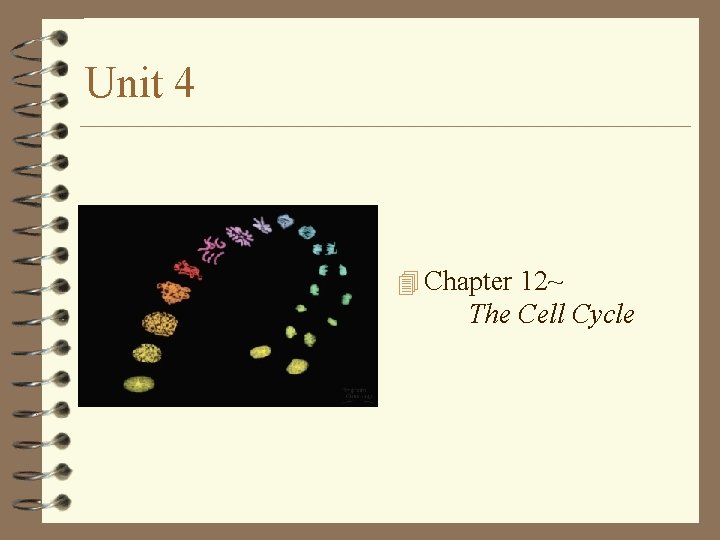
Unit 4 4 Chapter 12 The Cell Cycle
- Slides: 68
Unit 4 4 Chapter 12~ The Cell Cycle
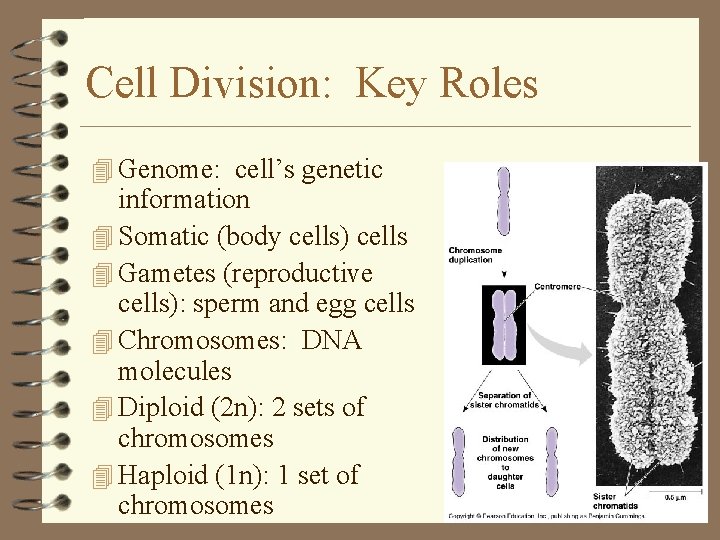
Cell Division: Key Roles 4 Genome: cell’s genetic information 4 Somatic (body cells) cells 4 Gametes (reproductive cells): sperm and egg cells 4 Chromosomes: DNA molecules 4 Diploid (2 n): 2 sets of chromosomes 4 Haploid (1 n): 1 set of chromosomes
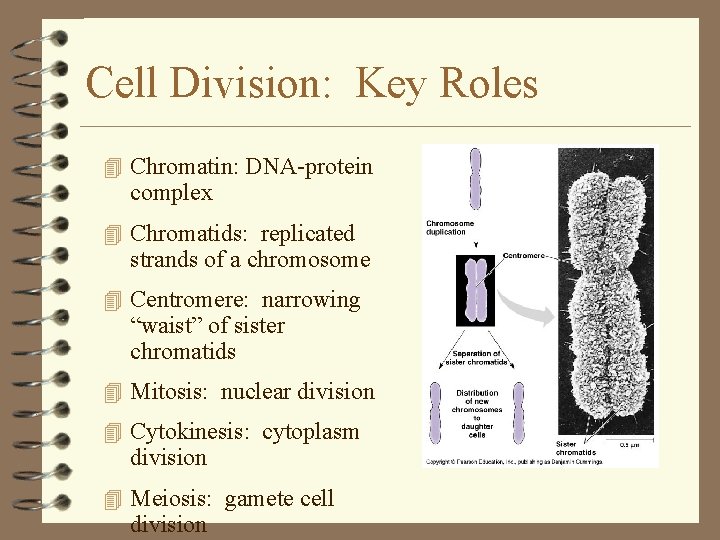
Cell Division: Key Roles 4 Chromatin: DNA-protein complex 4 Chromatids: replicated strands of a chromosome 4 Centromere: narrowing “waist” of sister chromatids 4 Mitosis: nuclear division 4 Cytokinesis: cytoplasm division 4 Meiosis: gamete cell division
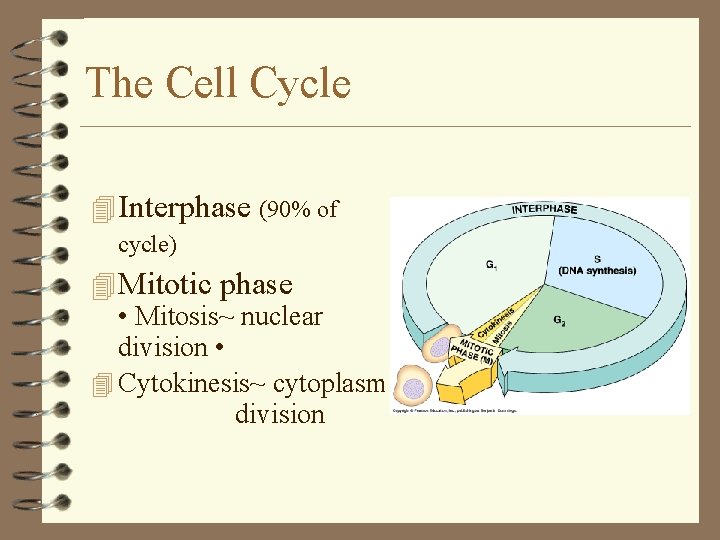
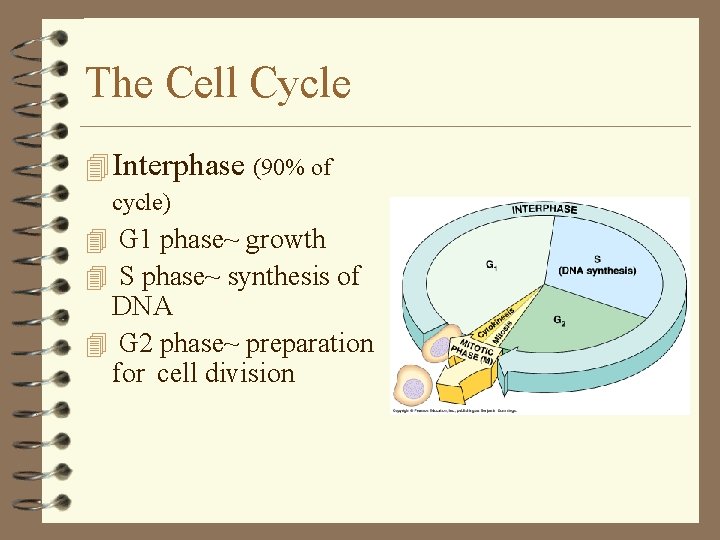
The Cell Cycle 4 Interphase (90% of cycle) 4 Mitotic phase • Mitosis~ nuclear division • 4 Cytokinesis~ cytoplasm division
The Cell Cycle 4 Interphase (90% of cycle) 4 G 1 phase~ growth 4 S phase~ synthesis of DNA 4 G 2 phase~ preparation for cell division
The Cell Cycle 4 G 1 Phase: Growth of cell excluding nucleus 4 S Phase: Synthesis of DNA; Chromosome number doubles to 92 – There are two copies of each chromosome (Sister Chromatids). 4 G 2 Phase: Growth of cell including all organelles, cytosol, etc. in preparation for division
The Cell Cycle 4 All cells go through Cell Division, most use Mitosis. 4 Cell differentiation occurs once the organism has grown sufficiently in size 4 Cells stop division with specific signals from the surroundings. 4 Cells unable to stop division are mutagenic; They cause Cancer
The Cell Cycle 4 Mitosis produces two identical daughter cells. 4 Each cell contains equal amounts of the cytosol, identical organelles and membrance structure. 4 Both daughter cells contain exact copies of all DNA; DNA is semiconservative which mean each daughter cell has one original and one copy in its double-helix DNA
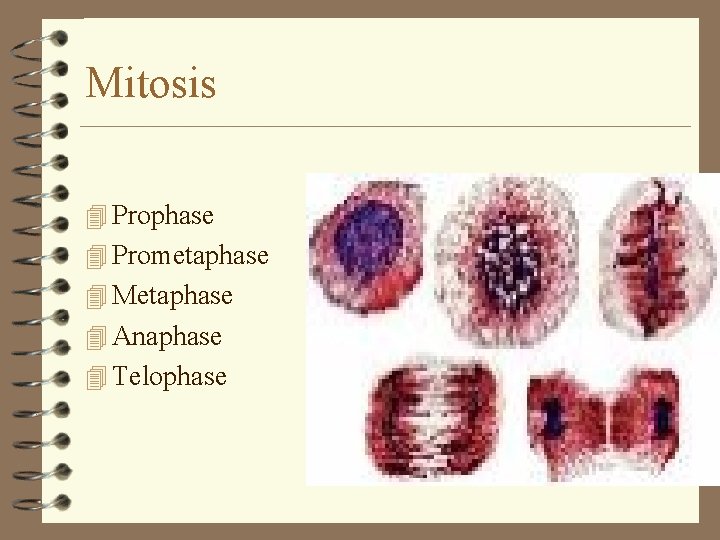
Mitosis 4 Prophase 4 Prometaphase 4 Metaphase 4 Anaphase 4 Telophase
Prophase 4 Chromatin fibers condense tightly 4 Chromosomes visible in a microscope 4 Nucleoli disappear 4 Sister chromatids match up and join together 4 Mitotic spindle forms – generated from the centrosomes and microtubles 4 Centrosomes move away from eachother, heading toward opposite ends of the nucleus
Prometaphase 4 Nuclear envelope fragments 4 Spindle can now enter the nucleus 4 Spindle interacts with chromosomes 4 Kinetochore develops which allows chromosomes to be moved back and forth 4 Non-kinetochore microtubles interact with each other forming additional support structure
Metaphase 4 Longest stage of Mitosis, lasting about 20 minutes 4 Centrosomes at opposite poles of the cell 4 Chromosomes align on the Metaphase plate, equidistant from the centrosomes 4 Kinetochores of sister chromatids attached to microtubules (spindle)
Anaphase 4 Shortest phase of Mitosis, lasting only minutes 4 Paired centromeres separate; sister chromatids liberated becoming chromosomes 4 Chromosomes move to opposite poles 4 Each pole now has a complete set of chromosomes 4 Cell elongates as microtubules lengthen
Telophase 4 Daughter nuclei form 4 Nuclear envelopes arise from the fragments of the original nuclear envelope 4 Chromatin becomes less coiled and is no longer visible through a microscope 4 Generation of two complete new nuclei completes mitosis
Cytokinesis 4 Cytoplasmic division: includes all organelles 4 Begins before Telophase ends – Both processes can occur simultaneously 4 Animals: cleavage furrow, it pinches the cell, creating two distinct cells 4 Plants: cell plate, similar to the cleavage furrow, it eventually grows into a cell wall
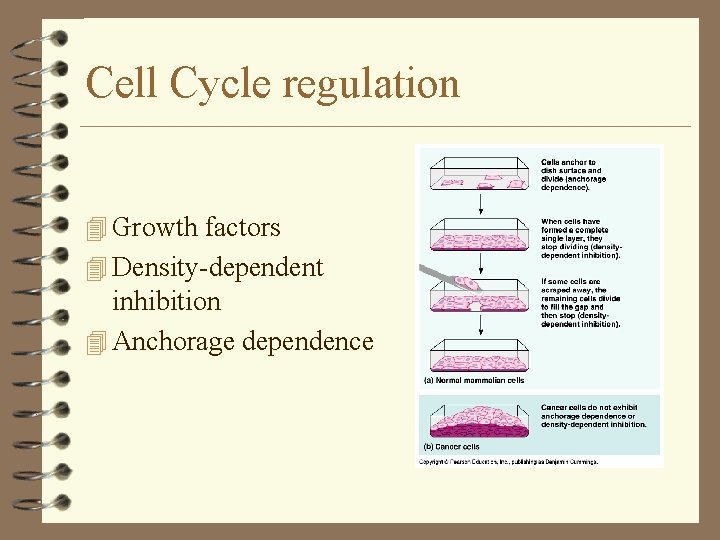
Cell Cycle regulation 4 Growth factors 4 Density-dependent inhibition 4 Anchorage dependence
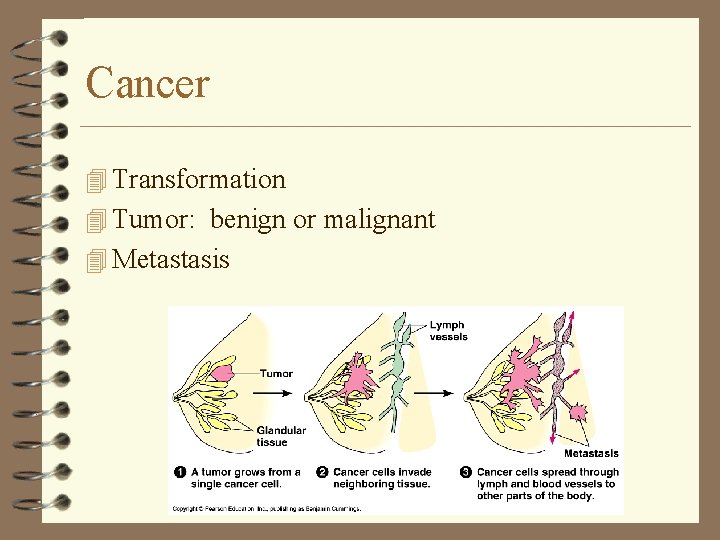
Cancer 4 Transformation 4 Tumor: benign or malignant 4 Metastasis
Lecture # 2 4 Chapter 13~ Meiosis and Sexual Life Cycles
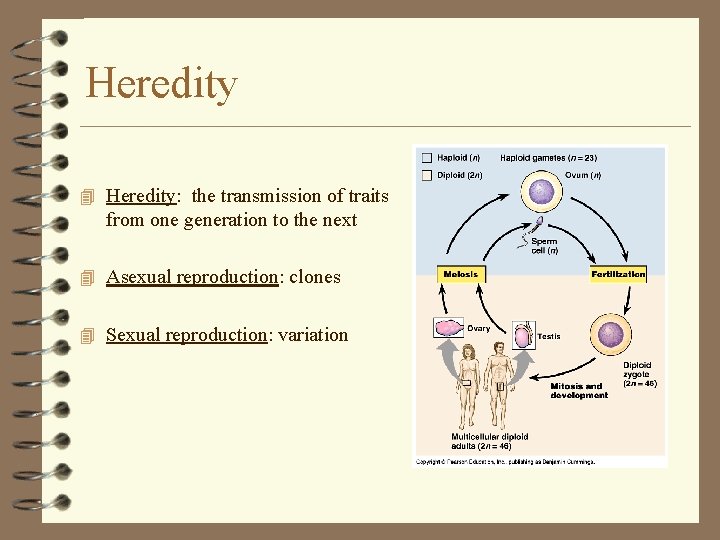
Heredity 4 Heredity: the transmission of traits from one generation to the next 4 Asexual reproduction: clones 4 Sexual reproduction: variation
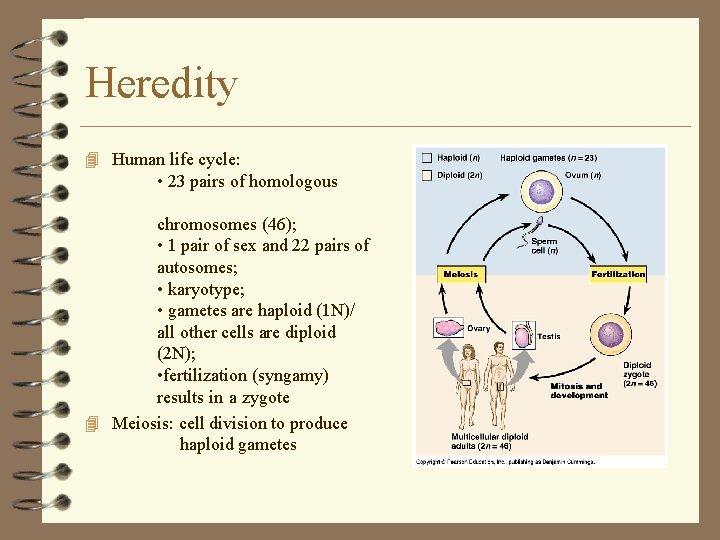
Heredity 4 Human life cycle: • 23 pairs of homologous chromosomes (46); • 1 pair of sex and 22 pairs of autosomes; • karyotype; • gametes are haploid (1 N)/ all other cells are diploid (2 N); • fertilization (syngamy) results in a zygote 4 Meiosis: cell division to produce haploid gametes
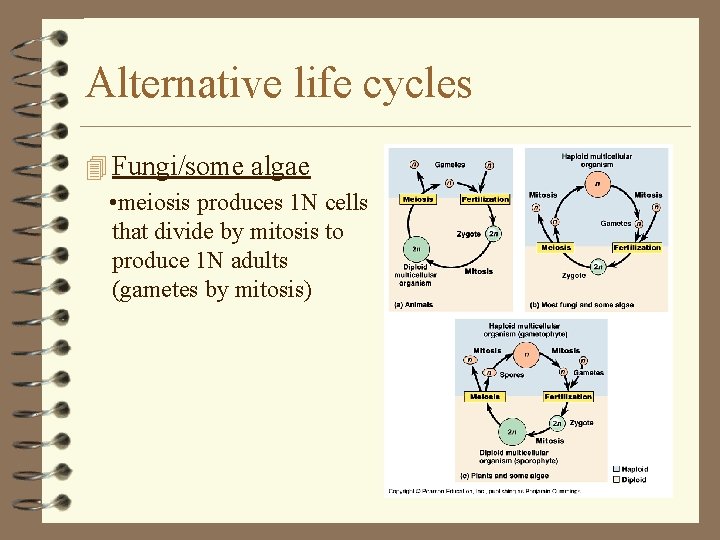
Alternative life cycles 4 Fungi/some algae • meiosis produces 1 N cells that divide by mitosis to produce 1 N adults (gametes by mitosis)
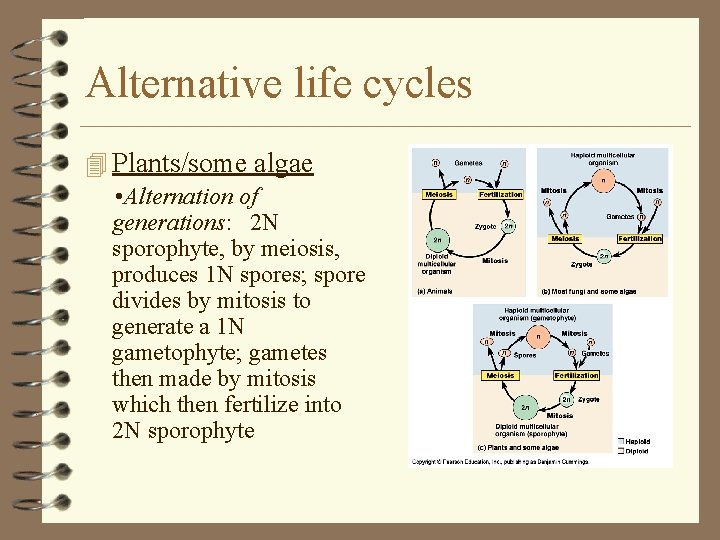
Alternative life cycles 4 Plants/some algae • Alternation of generations: 2 N sporophyte, by meiosis, produces 1 N spores; spore divides by mitosis to generate a 1 N gametophyte; gametes then made by mitosis which then fertilize into 2 N sporophyte
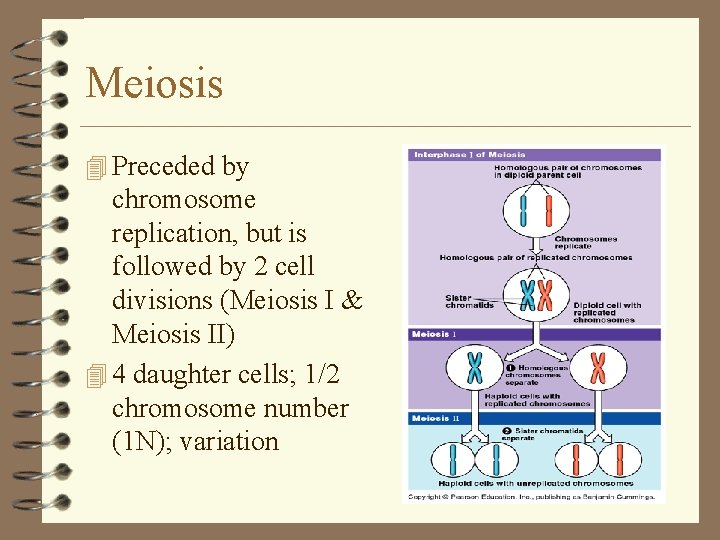
Meiosis 4 Preceded by chromosome replication, but is followed by 2 cell divisions (Meiosis I & Meiosis II) 4 4 daughter cells; 1/2 chromosome number (1 N); variation
Meiosis I 4 Meiosis I is very similar as Mitosis 4 Chromosomes are replicated prior to Meiosis I creating homologous chromosomes 4 Prophase I contains tetrads – Homologous chromosomes linked together 4 Prophase I is the only time that crossing over occurs because of the formation of a tetrad.
Meiosis I 4 Metaphase I tetrads line up on the Metaphase plate 4 Anaphase I separates the tetrad (homologous chromosomes), producing cells with 2 n chromosomes. 4 Telophase I and Cytokinesis I results in two complete cells.
Meiosis II 4 Chromosomes are not replicated between Meiosis I and Meiosis II 4 Meiosis II uses Prophase II, Prometaphase II, Metaphase II, Anaphase II, Telophase II and Cytokinesis II. 4 Meiosis II produces gamete cells, each with 1 n chromosomes
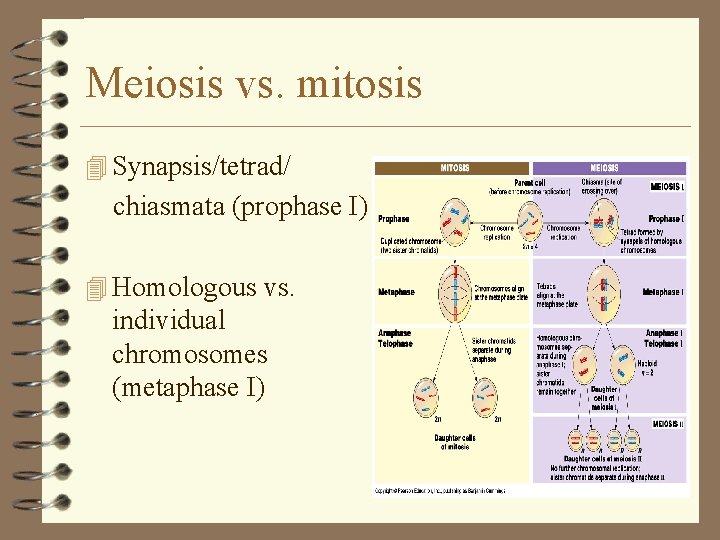
Meiosis vs. mitosis 4 Synapsis/tetrad/ chiasmata (prophase I) 4 Homologous vs. individual chromosomes (metaphase I)
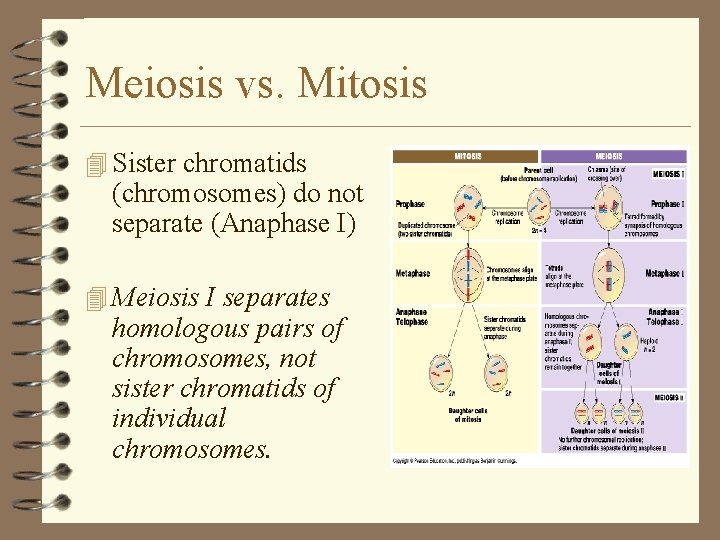
Meiosis vs. Mitosis 4 Sister chromatids (chromosomes) do not separate (Anaphase I) 4 Meiosis I separates homologous pairs of chromosomes, not sister chromatids of individual chromosomes.
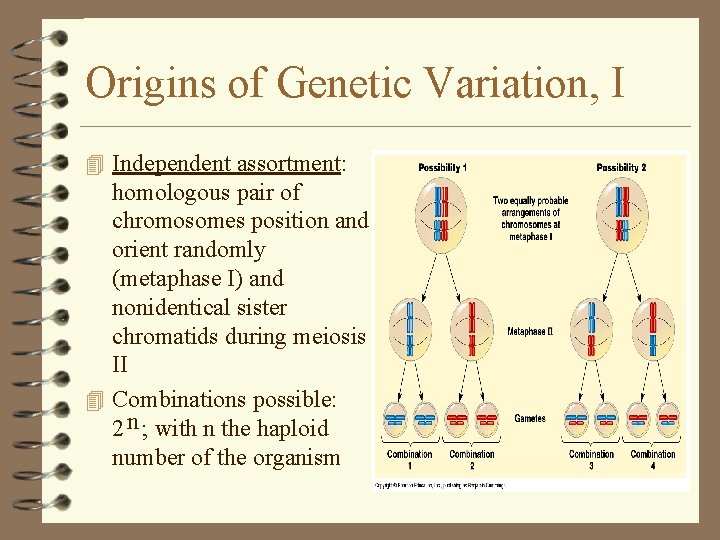
Origins of Genetic Variation, I 4 Independent assortment: homologous pair of chromosomes position and orient randomly (metaphase I) and nonidentical sister chromatids during meiosis II 4 Combinations possible: 2 n ; with n the haploid number of the organism
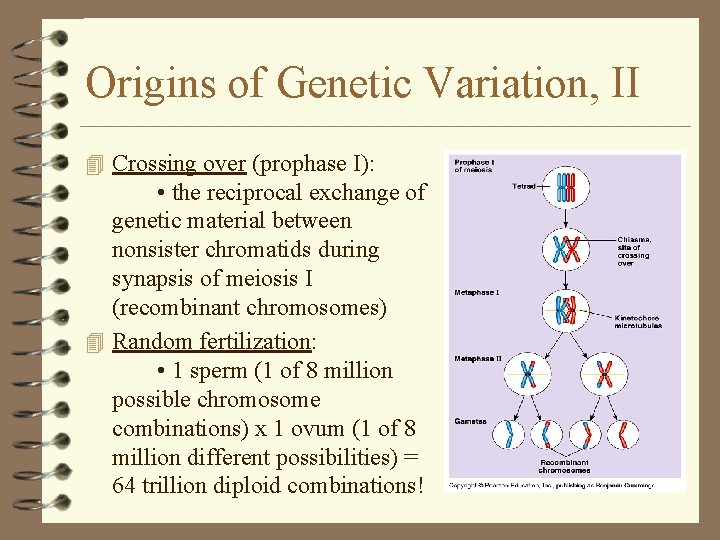
Origins of Genetic Variation, II 4 Crossing over (prophase I): • the reciprocal exchange of genetic material between nonsister chromatids during synapsis of meiosis I (recombinant chromosomes) 4 Random fertilization: • 1 sperm (1 of 8 million possible chromosome combinations) x 1 ovum (1 of 8 million different possibilities) = 64 trillion diploid combinations!
Add Meiotic Problems 4 Non-disjunction – Monosomy & Trisomy – Down Syndrome – Edward’s – Patau – Kleinfelter’s – Turner’s
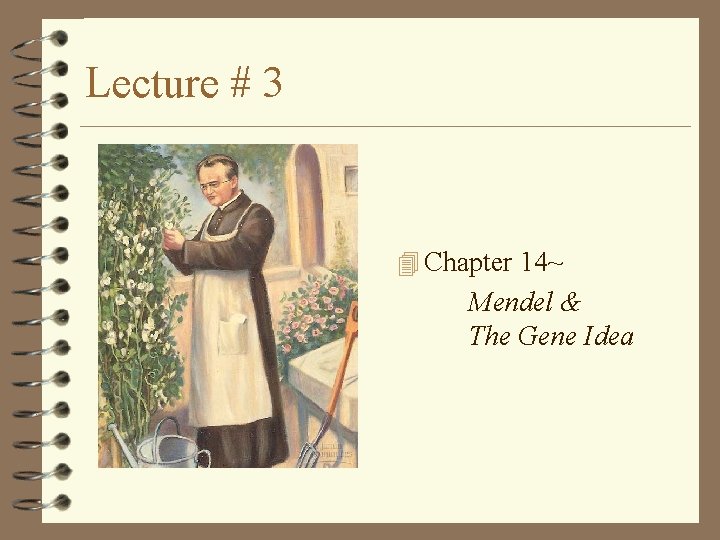
Lecture # 3 4 Chapter 14~ Mendel & The Gene Idea
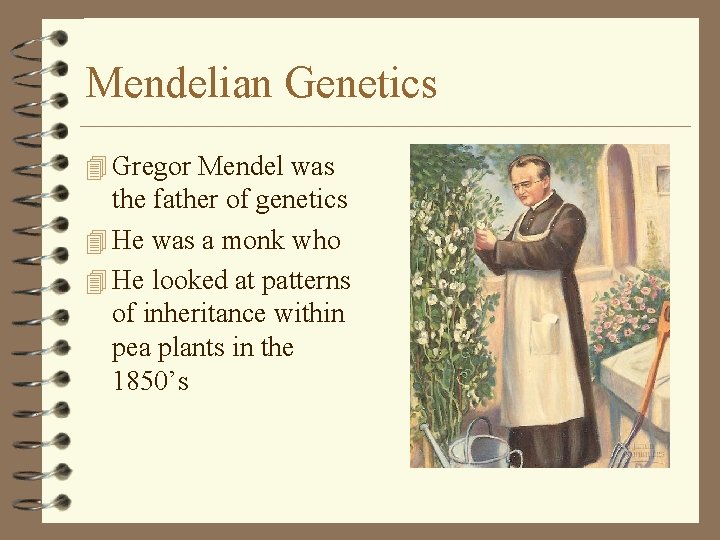
Mendelian Genetics 4 Gregor Mendel was the father of genetics 4 He was a monk who 4 He looked at patterns of inheritance within pea plants in the 1850’s
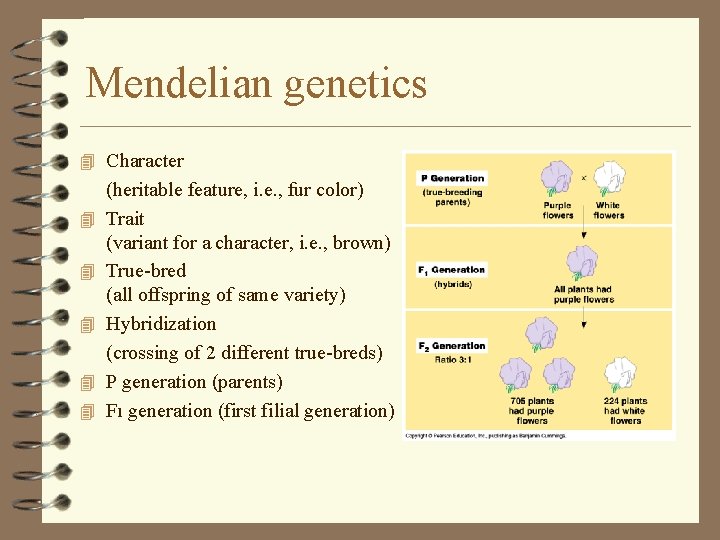
Mendelian genetics 4 Character 4 4 4 (heritable feature, i. e. , fur color) Trait (variant for a character, i. e. , brown) True-bred (all offspring of same variety) Hybridization (crossing of 2 different true-breds) P generation (parents) F 1 generation (first filial generation)
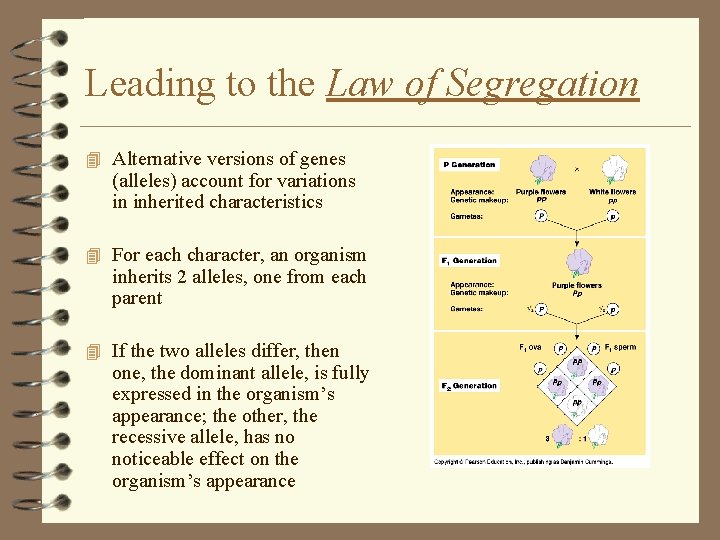
Leading to the Law of Segregation 4 Alternative versions of genes (alleles) account for variations in inherited characteristics 4 For each character, an organism inherits 2 alleles, one from each parent 4 If the two alleles differ, then one, the dominant allele, is fully expressed in the organism’s appearance; the other, the recessive allele, has no noticeable effect on the organism’s appearance
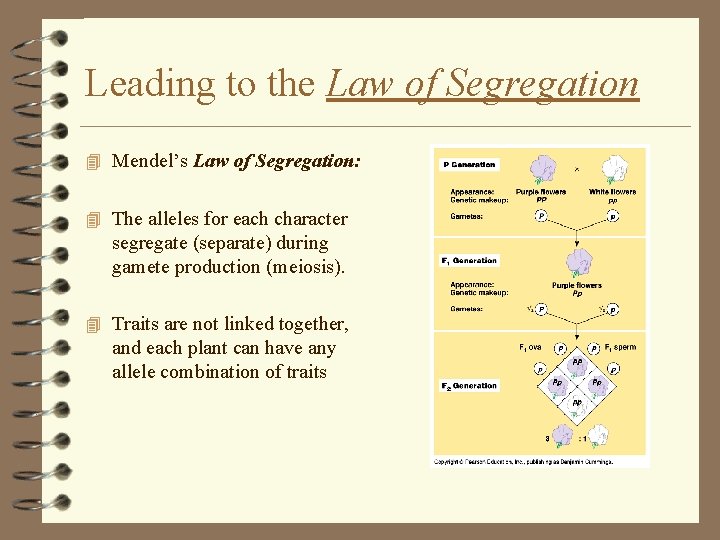
Leading to the Law of Segregation 4 Mendel’s Law of Segregation: 4 The alleles for each character segregate (separate) during gamete production (meiosis). 4 Traits are not linked together, and each plant can have any allele combination of traits
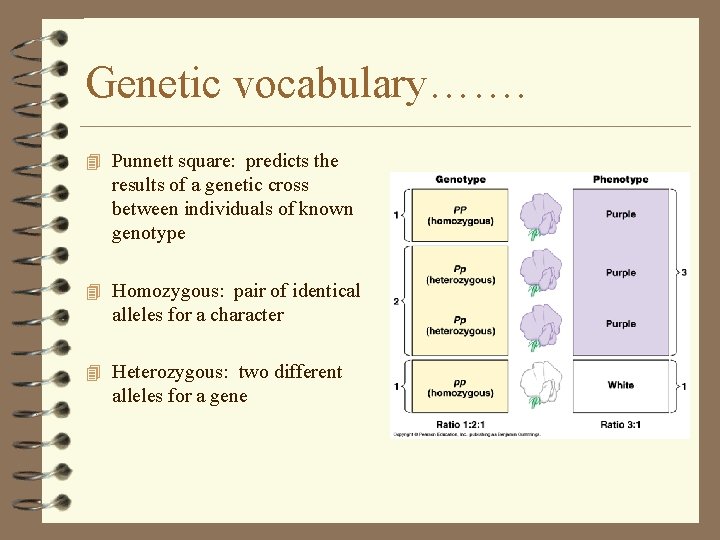
Genetic vocabulary……. 4 Punnett square: predicts the results of a genetic cross between individuals of known genotype 4 Homozygous: pair of identical alleles for a character 4 Heterozygous: two different alleles for a gene
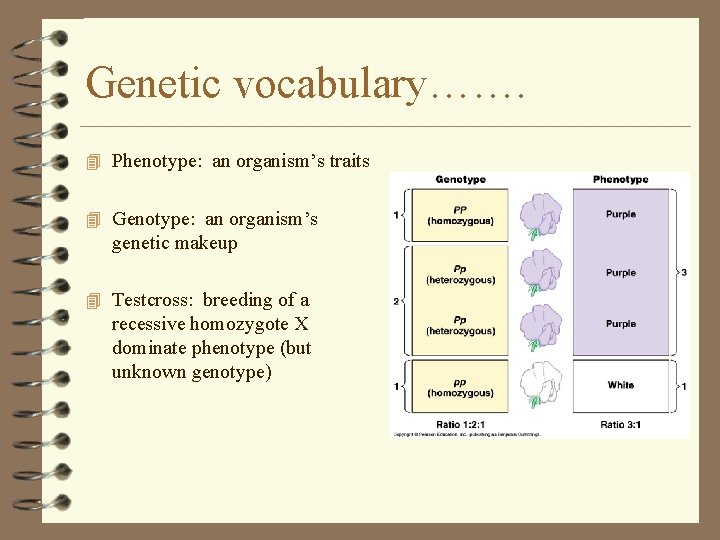
Genetic vocabulary……. 4 Phenotype: an organism’s traits 4 Genotype: an organism’s genetic makeup 4 Testcross: breeding of a recessive homozygote X dominate phenotype (but unknown genotype)
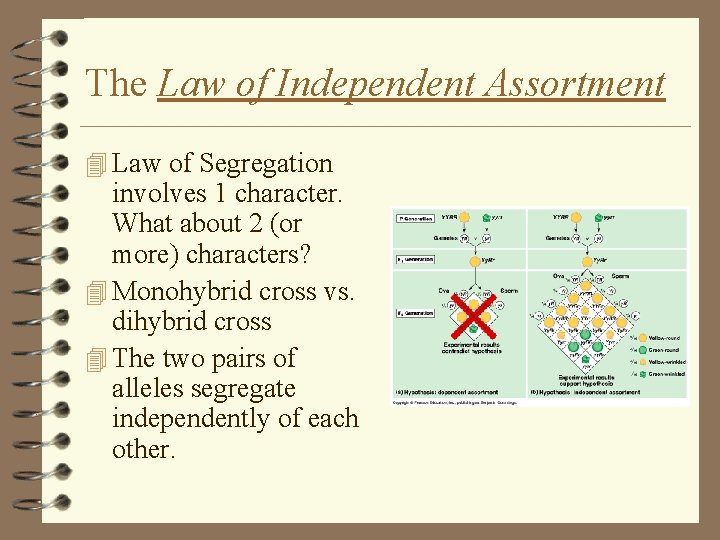
The Law of Independent Assortment 4 Law of Segregation involves 1 character. What about 2 (or more) characters? 4 Monohybrid cross vs. dihybrid cross 4 The two pairs of alleles segregate independently of each other.
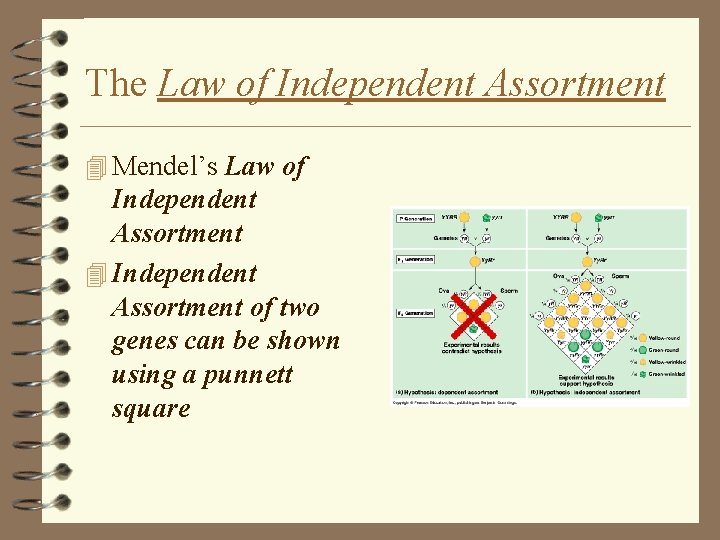
The Law of Independent Assortment 4 Mendel’s Law of Independent Assortment 4 Independent Assortment of two genes can be shown using a punnett square
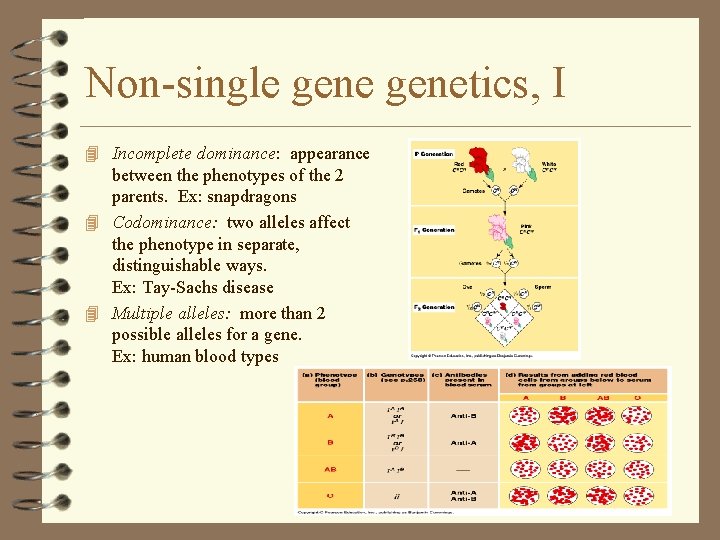
Non-single genetics, I 4 Incomplete dominance: appearance between the phenotypes of the 2 parents. Ex: snapdragons 4 Codominance: two alleles affect the phenotype in separate, distinguishable ways. Ex: Tay-Sachs disease 4 Multiple alleles: more than 2 possible alleles for a gene. Ex: human blood types
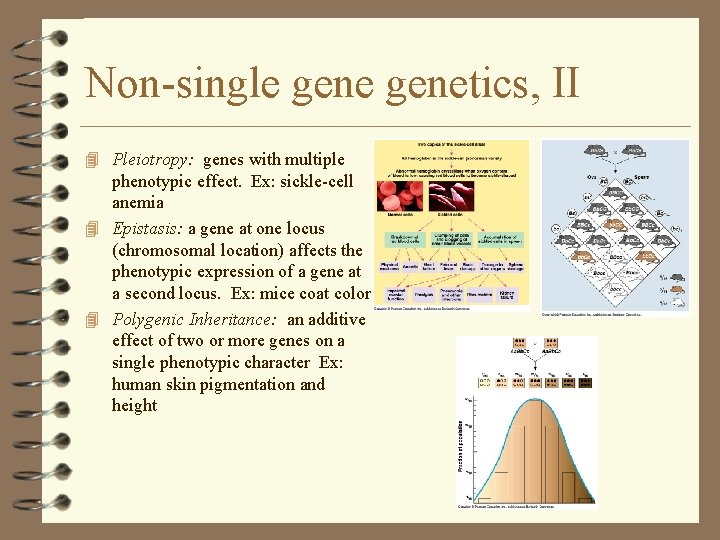
Non-single genetics, II 4 Pleiotropy: genes with multiple phenotypic effect. Ex: sickle-cell anemia 4 Epistasis: a gene at one locus (chromosomal location) affects the phenotypic expression of a gene at a second locus. Ex: mice coat color 4 Polygenic Inheritance: an additive effect of two or more genes on a single phenotypic character Ex: human skin pigmentation and height
Probability and Genetics 4 Probability can be used to solve genetic problems 4 Fertilization and the combination of alleles is a random event 4 Take the total number of that combination over the total number of all possible combinations
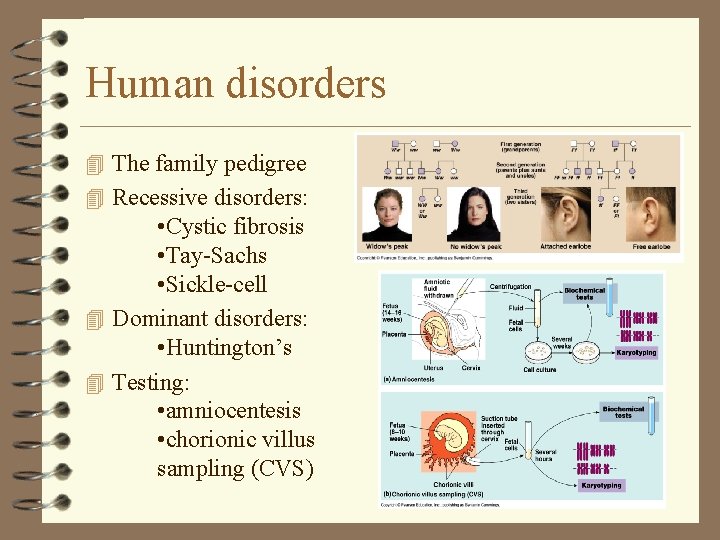
Human disorders 4 The family pedigree 4 Recessive disorders: • Cystic fibrosis • Tay-Sachs • Sickle-cell 4 Dominant disorders: • Huntington’s 4 Testing: • amniocentesis • chorionic villus sampling (CVS)
Lecture #4 4 Chapter 15~ The Chromosomal Basis of Inheritance
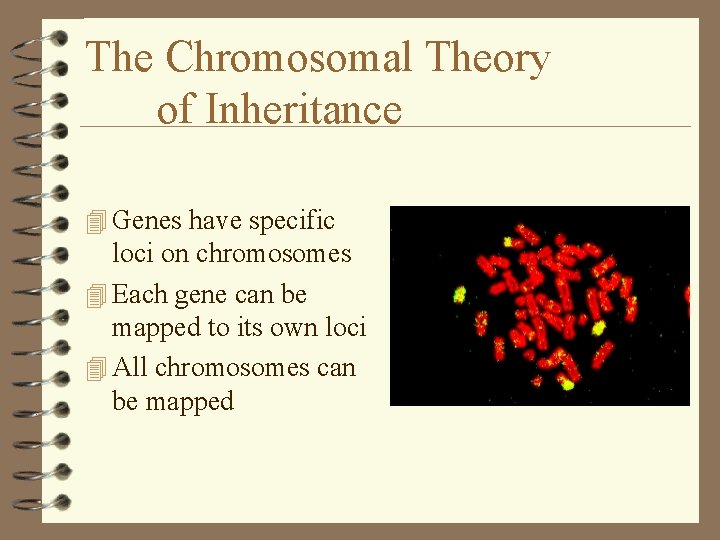
The Chromosomal Theory of Inheritance 4 Genes have specific loci on chromosomes 4 Each gene can be mapped to its own loci 4 All chromosomes can be mapped
Chromosomal Inheritance 4 Chromosomes undergo segregation and independent assortment 4 Genes should maintain the same placement on the chromosome despite crossing over and independent assortment 4 Each chromatid should contain the same genetic information (the same genes) as its sister chromatid
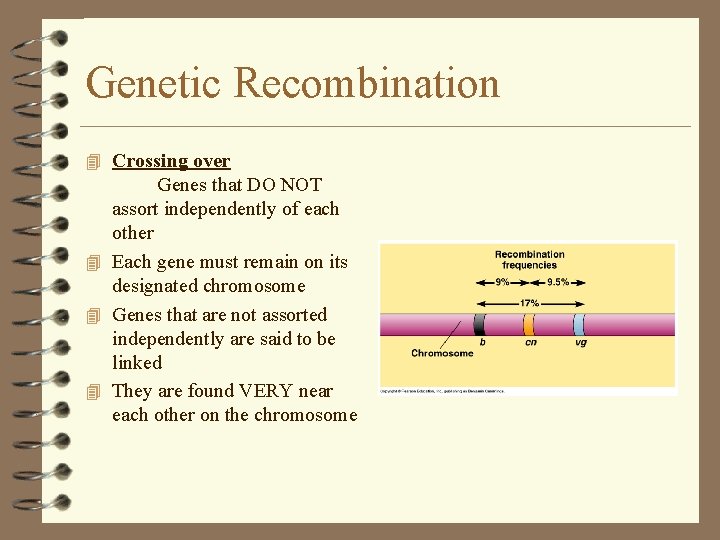
Genetic Recombination 4 Crossing over Genes that DO NOT assort independently of each other 4 Each gene must remain on its designated chromosome 4 Genes that are not assorted independently are said to be linked 4 They are found VERY near each other on the chromosome
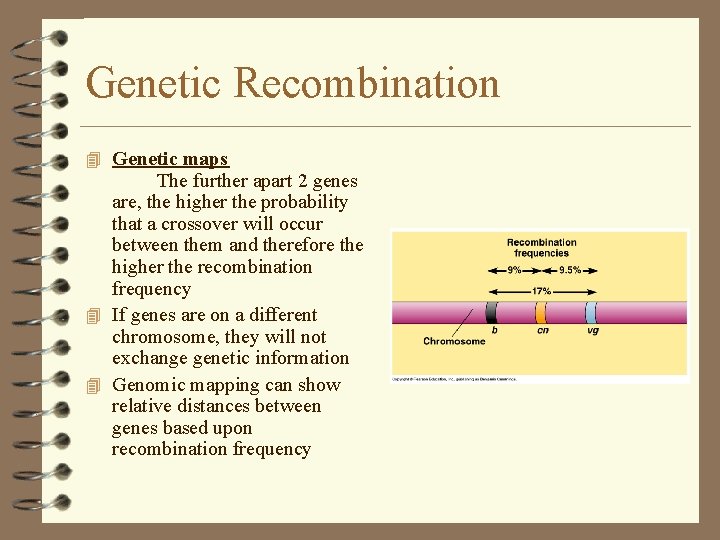
Genetic Recombination 4 Genetic maps The further apart 2 genes are, the higher the probability that a crossover will occur between them and therefore the higher the recombination frequency 4 If genes are on a different chromosome, they will not exchange genetic information 4 Genomic mapping can show relative distances between genes based upon recombination frequency
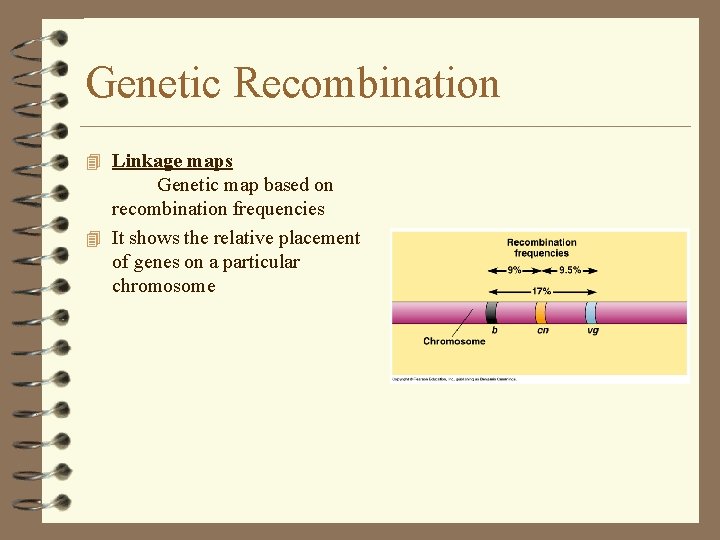
Genetic Recombination 4 Linkage maps Genetic map based on recombination frequencies 4 It shows the relative placement of genes on a particular chromosome
Genetics at Work 4 There are some significant experiments within the Genetic community 4 One of the most significant is the experiment involving Drosophilia melanogaster 4 Experiments involving this species of fly have shown a great deal about the genetic recombination and inheritance patters within multicellular organisms
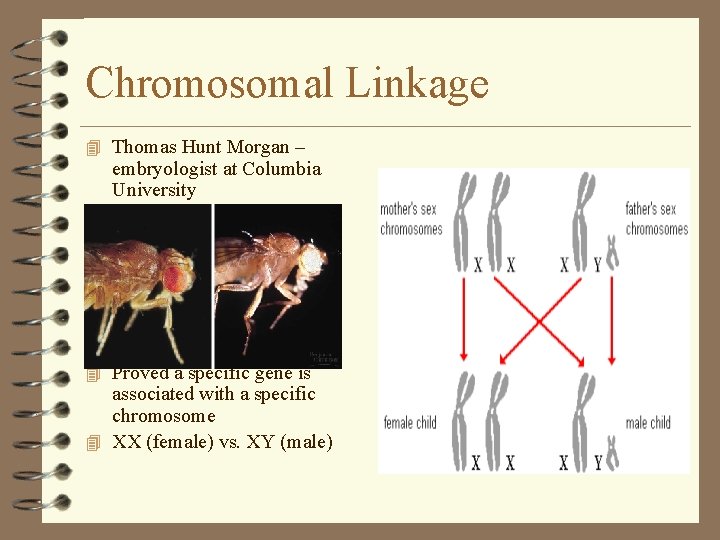
Chromosomal Linkage 4 Thomas Hunt Morgan – embryologist at Columbia University 4 Drosophilia melanogaster 4 Proved a specific gene is associated with a specific chromosome 4 XX (female) vs. XY (male)
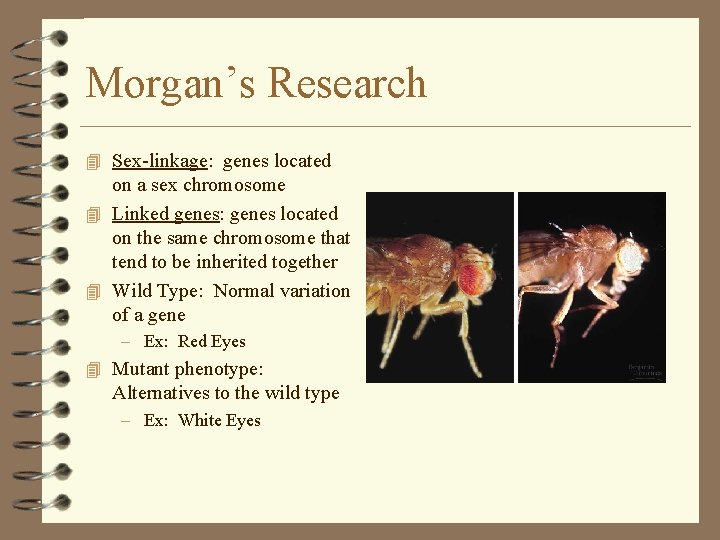
Morgan’s Research 4 Sex-linkage: genes located on a sex chromosome 4 Linked genes: genes located on the same chromosome that tend to be inherited together 4 Wild Type: Normal variation of a gene – Ex: Red Eyes 4 Mutant phenotype: Alternatives to the wild type – Ex: White Eyes
Morgan’s Research 4 After breeding fruit flies for about a year Morgan found 1 White eye male. 4 He mated the white eyed male with a wild type female, and found only red eyed flies suggesting the wild type is dominant. 4 A cross of the F 1 generation produced the expected 3: 1 results, except the only white eyed fly was male. 4 What does this indicate?
Morgan’s Research 4 This suggests that the white eyed trait is sex -linked. 4 Morgan was not only the first person to discover linkage, but also sex-linkage of traits. 4 Linked Genes are genes on the same chromosome that tend to be inherited together
Morgan’s Research 4 Genetic Recombination is produced by crossing over and independent assortment. – Offspring that have the same phenotype as the parent are called parental types – Offspring that have different phenotypes than their parents are called recombinants.
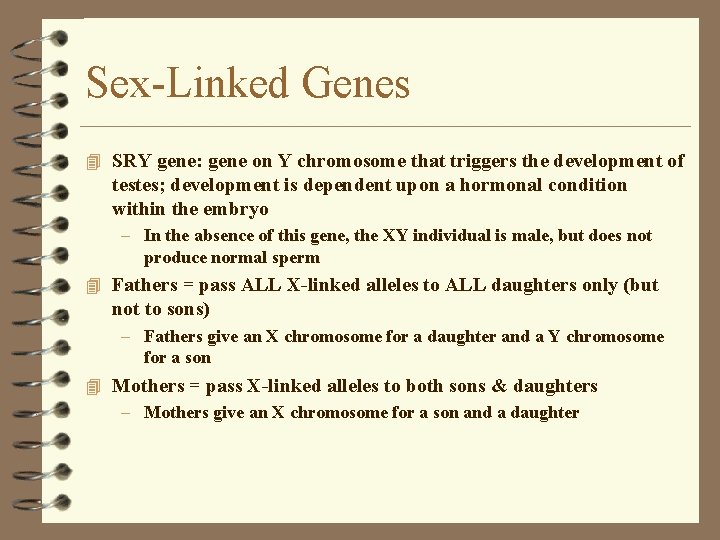
Sex-Linked Genes 4 SRY gene: gene on Y chromosome that triggers the development of testes; development is dependent upon a hormonal condition within the embryo – In the absence of this gene, the XY individual is male, but does not produce normal sperm 4 Fathers = pass ALL X-linked alleles to ALL daughters only (but not to sons) – Fathers give an X chromosome for a daughter and a Y chromosome for a son 4 Mothers = pass X-linked alleles to both sons & daughters – Mothers give an X chromosome for a son and a daughter
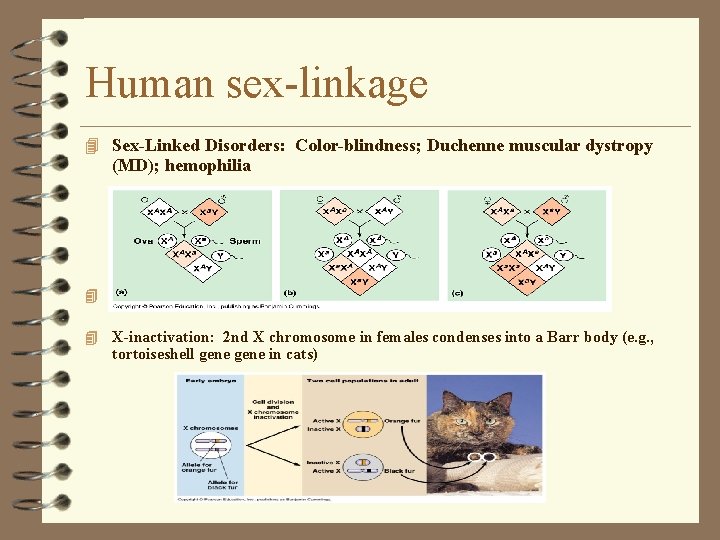
Human sex-linkage 4 Sex-Linked Disorders: Color-blindness; Duchenne muscular dystropy (MD); hemophilia 4 4 X-inactivation: 2 nd X chromosome in females condenses into a Barr body (e. g. , tortoiseshell gene in cats)
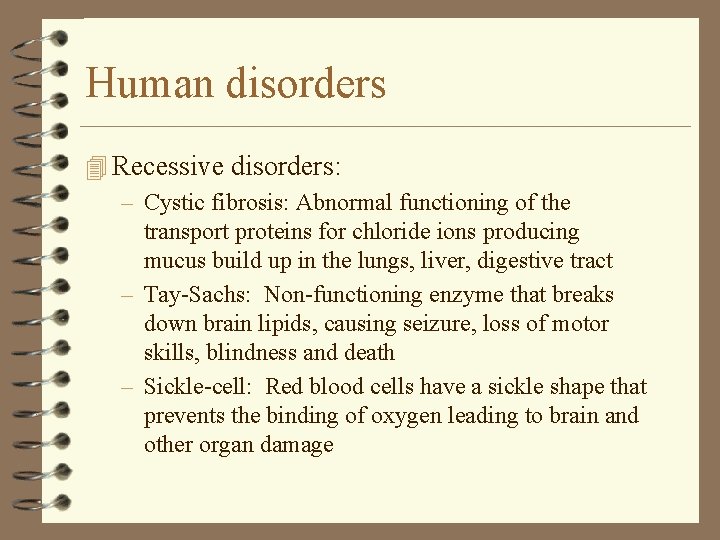
Human disorders 4 Recessive disorders: – Cystic fibrosis: Abnormal functioning of the transport proteins for chloride ions producing mucus build up in the lungs, liver, digestive tract – Tay-Sachs: Non-functioning enzyme that breaks down brain lipids, causing seizure, loss of motor skills, blindness and death – Sickle-cell: Red blood cells have a sickle shape that prevents the binding of oxygen leading to brain and other organ damage
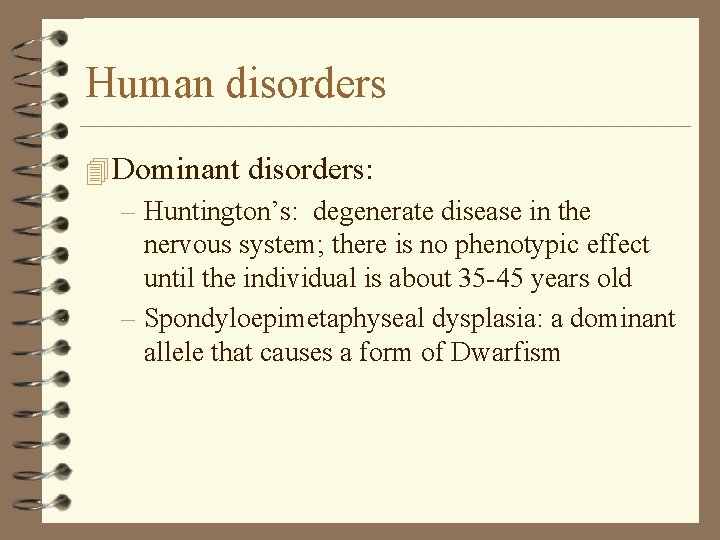
Human disorders 4 Dominant disorders: – Huntington’s: degenerate disease in the nervous system; there is no phenotypic effect until the individual is about 35 -45 years old – Spondyloepimetaphyseal dysplasia: a dominant allele that causes a form of Dwarfism
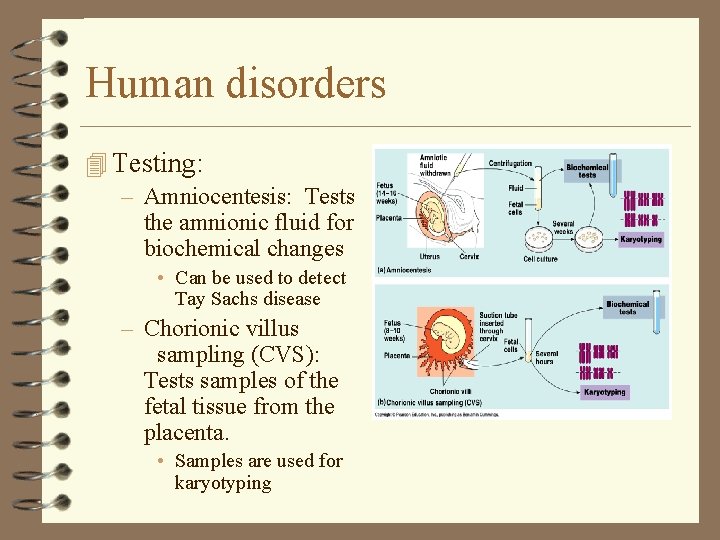
Human disorders 4 Testing: – Amniocentesis: Tests the amnionic fluid for biochemical changes • Can be used to detect Tay Sachs disease – Chorionic villus sampling (CVS): Tests samples of the fetal tissue from the placenta. • Samples are used for karyotyping
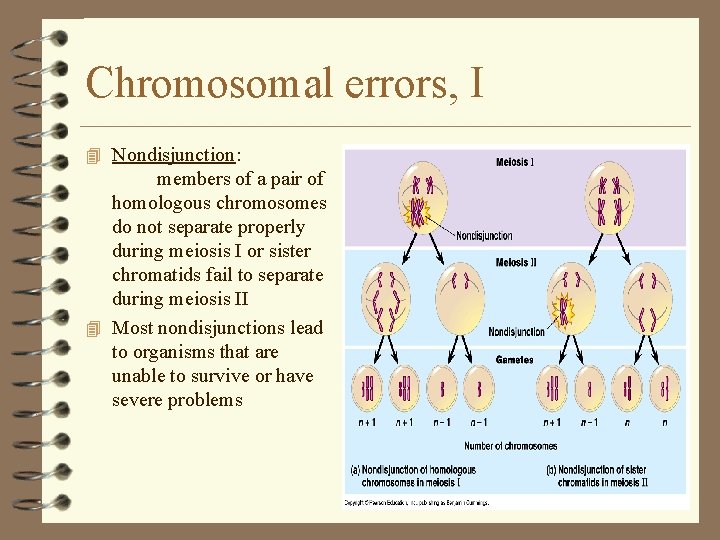
Chromosomal errors, I 4 Nondisjunction: members of a pair of homologous chromosomes do not separate properly during meiosis I or sister chromatids fail to separate during meiosis II 4 Most nondisjunctions lead to organisms that are unable to survive or have severe problems
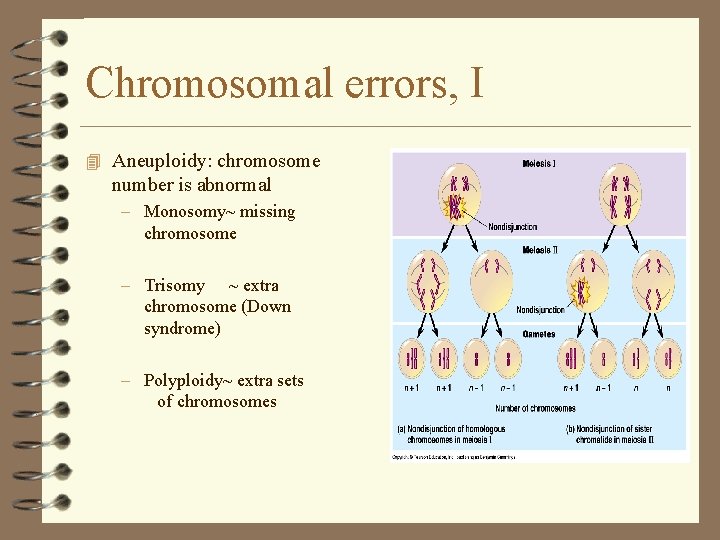
Chromosomal errors, I 4 Aneuploidy: chromosome number is abnormal – Monosomy~ missing chromosome – Trisomy ~ extra chromosome (Down syndrome) – Polyploidy~ extra sets of chromosomes
Chromosomal Errors in Humans 4 Down Syndrome is a trisomy of chromosome 21 characterized by distinct facial features, heart defects, and mental retardation 4 Klinefelter Syndrome is a trisomy of sex chromosomes XXY; feminine body characteristics such as breast enlargement, smaller testes and sterility
Chromosomal Errors in Humans 4 XYY; not characterized by a syndrome name, but tend to be taller than average 4 XXX; cannot be distinguished from normal genotypes except by karyotype 4 Turner Syndrome, an X monosomy, produces phenotypically females without mature sex organs, they also have short stature and are sterile
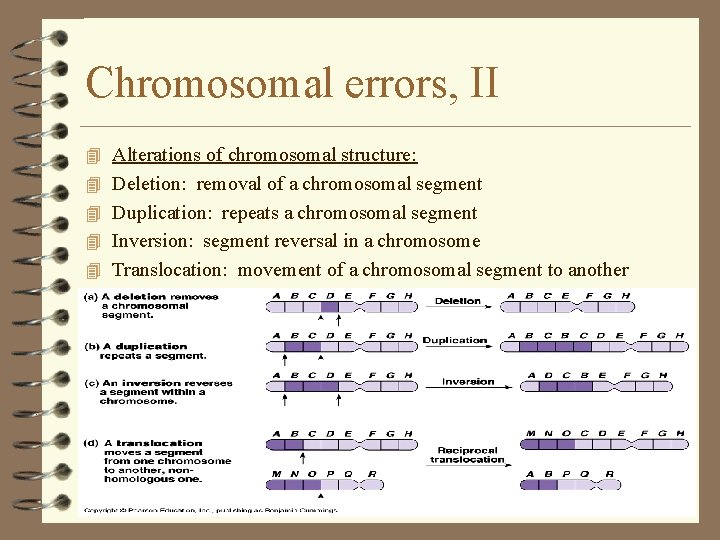
Chromosomal errors, II 4 Alterations of chromosomal structure: 4 Deletion: removal of a chromosomal segment 4 Duplication: repeats a chromosomal segment 4 Inversion: segment reversal in a chromosome 4 Translocation: movement of a chromosomal segment to another
Chromosomal errors, II 4 Changing human chromosomes in any way, can cause severe problems 4 Even if the chromosome number is normal, a deletion on a chromosome, even in the heterozygous state can cause severe physical and mental problems
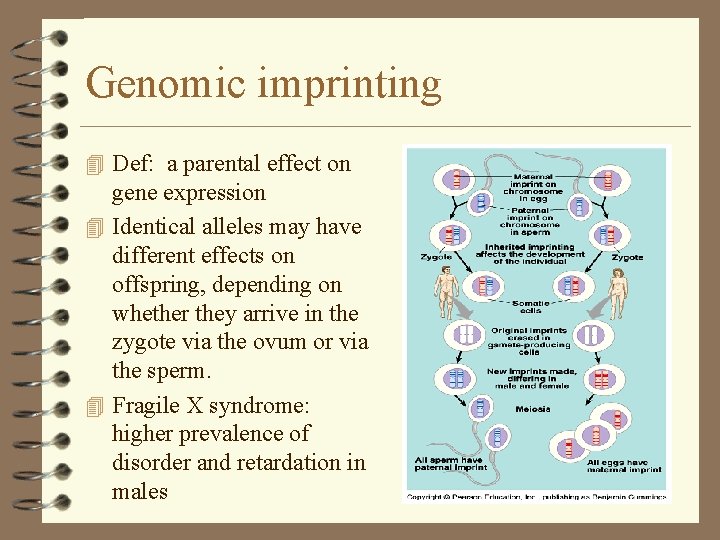
Genomic imprinting 4 Def: a parental effect on gene expression 4 Identical alleles may have different effects on offspring, depending on whether they arrive in the zygote via the ovum or via the sperm. 4 Fragile X syndrome: higher prevalence of disorder and retardation in males