
UNIT 4 2 METABOLISM OF FAT METABOLISM OF
UNIT 4. 2 METABOLISM OF FAT
METABOLISM OF FAT • The lipids of metabolic significance include synthesis and degradation of • triglycerides • phospholipids • steroids together with long chain fatty acids • glycerol and • ketone bodies • Oxidation of triglycerides takes place in the adipose tissue. • The complete degradation of fatty acid in the body leads to the oxidation to CO 2 and water
b) Metabolism of fatty acids The fatty acids components of the lipids entering the liver also have several different pathways 1. Oxidation to CO 2 with ATP production 2. Biosynthesis of cholesterol 3. Biosynthesis of lipids of plasma lipoproteins (Triglyceride and phospholipids) 4. Formation of free fatty acids 5. Formation of ketone bodies

a) Metabolism of Triglycerides • Triglycerides are first converted to fatty acids and glycerol mostly in adipose tissue. • The fatty acids are released into the plasma where they combine with serum albumin. • Long chain fatty acids are oxidized in liver, heart, kidney, muscle, lung, brain and adipose tissue. • Glycerol is utilized by liver, kidney, intestine and lactating mammary gland where the activating enzyme glycerokinase is present.
1. Oxidation of fatty acids to CO 2 with ATP production • Fatty acids are oxidized by β, α, and ω oxidation. βOxidation is the most important pathway for the production of energy. • The term β -oxidation means the oxidation takes place in the β -carbon in the fatty acid with the removal of 2 carbon atoms at a time from the carboxyl end of the molecule. • The saturated fatty acids containing even number and odd number of carbon atoms and the unsaturated fatty acids are oxidized by β -oxidation.
(a) β-Oxidation of saturated fatty acids • Saturated fatty acids are oxidized to acetyl-Co. A by β oxidation. • It takes place in mitochondria. • Five steps are involved and each step involves acy 1 -Co. A derivatives catalyzed by separate enzymes, utilizes NAD+ and FAD as coenzymes, and generates ATP. • Fatty acid oxidation is an aerobic process, requiring the presence of oxygen.
Step 1 Activation of Fatty Acids • Long chain fatty acids are first converted to an ‘active fatty acid’ or acyl Co. A in the cytosol • But activation of lower fatty acids occurs within the mitochondria. • Thiokinase is found both inside and outside the mitochondria. • Thiokinase Fatty acid+ATP+coenzyme A +Mg 2+→Acyl Co. A +AMP • The presence of inorganic pyrophosphatase ensures that activation goes to completion by facilitating the loss of the additional high-energy phosphate associated with pyrophosphate. • Two high energy phosphates are expended during the activation of each fatty acid molecule.
• (i)Transport of smallerfatty acids • Small fatty acids are able to penetrate the inner membrane off mitochondria and become oxidized within the mitochondria. • (ii) Transport of long-chainfatty acids • Long-chain fatty acid penetrate the inner mitochondrial membrane only as carnitine derivatives. • Carnitine acyl transferase I, -in outer mitochondrial membrane, converts long-chain acyl Co. A to acyl carnitine, -penetrate the inner membrane of mitochondria • Carnitine-acyl carnitine translocase -in mitochondria, catalyses the transfer the acylcarnitine into inner membrane. • Carnitine acyl transferase II- in the inner mitochondrial membrane, converts acyl carnitine to long-chain acyl Co. A and carnitine. • Acyl Co. A then undergoes further reactions of β-oxidation
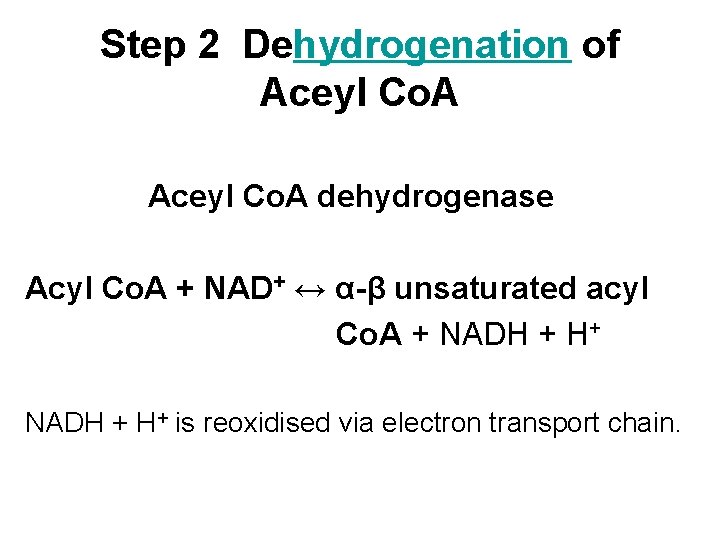
Step 2 Dehydrogenation of Aceyl Co. A dehydrogenase Acyl Co. A + NAD+ ↔ α-β unsaturated acyl Co. A + NADH + H+ is reoxidised via electron transport chain.
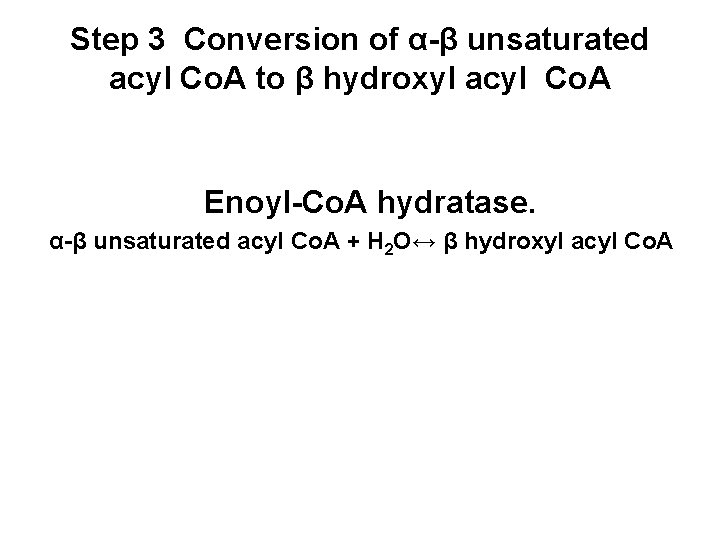
Step 3 Conversion of α-β unsaturated acyl Co. A to β hydroxyl acyl Co. A Enoyl-Co. A hydratase. α-β unsaturated acyl Co. A + H 2 O↔ β hydroxyl acyl Co. A

Step 4 Dehydrogenation at the β-carbon of β-hydroxyacyl Co. A β-hydroxyacyl-Co. A dehydrogenase β hydroxyl acyl Co. A +NAD+↔β-ketoacyl-Co. A+ NADH+H + The NADH+H+ formed is reoxidised via electron transport chain.
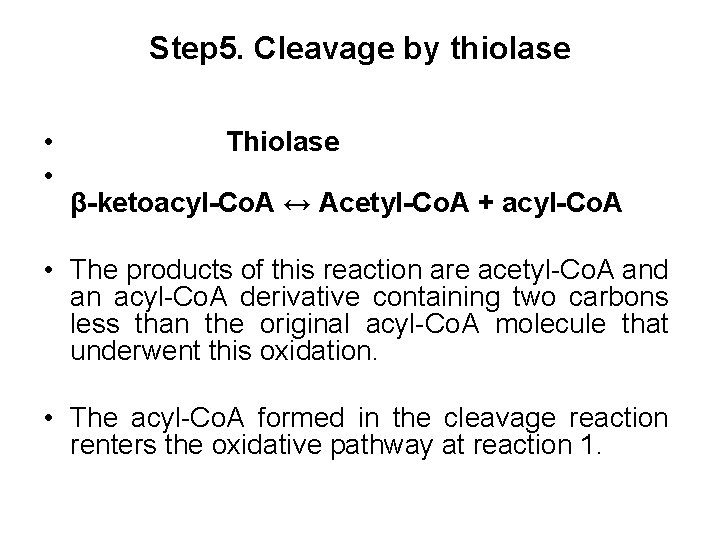
Step 5. Cleavage by thiolase • • Thiolase β-ketoacyl-Co. A ↔ Acetyl-Co. A + acyl-Co. A • The products of this reaction are acetyl-Co. A and an acyl-Co. A derivative containing two carbons less than the original acyl-Co. A molecule that underwent this oxidation. • The acyl-Co. A formed in the cleavage reaction renters the oxidative pathway at reaction 1.
A long chain fatty acid may be degraded completely to acetyl-Co. A (C 2 units). In the case of palmitic acid the reactions are repeated 7 times and 8 molecules of acetyl Co. A are formed. Since acetyl-Co. A can be oxidized to CO 2 and water via the citric acid cycle, the complete oxidation of fatty acids is achieved
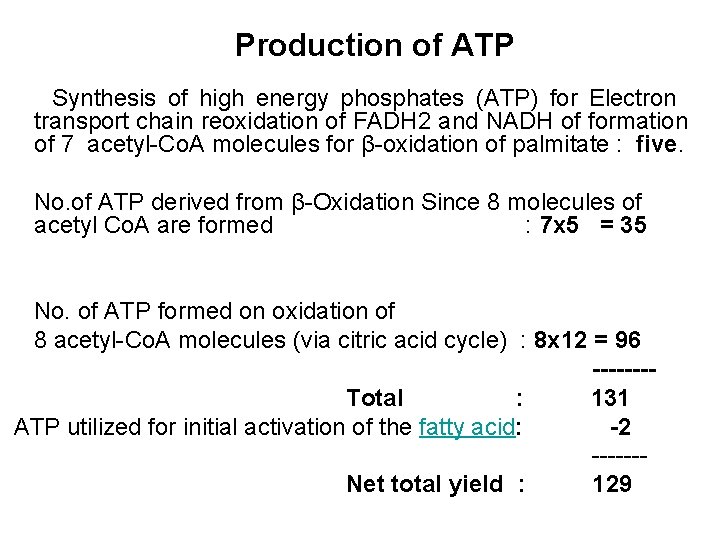
Production of ATP Synthesis of high energy phosphates (ATP) for Electron transport chain reoxidation of FADH 2 and NADH of formation of 7 acetyl-Co. A molecules for β-oxidation of palmitate : five. No. of ATP derived from β-Oxidation Since 8 molecules of acetyl Co. A are formed : 7 x 5 = 35 No. of ATP formed on oxidation of 8 acetyl-Co. A molecules (via citric acid cycle) : 8 x 12 = 96 -------Total : 131 ATP utilized for initial activation of the fatty acid: -2 ------Net total yield : 129
Calorific value per mole of palmitic acid: • The calorific value is 129 x 7. 6=980 K. cal/mole. • The calorific value per mole of combustion of palmitic acid is 2340 K. cal/mole. • The process captures as high-energy phosphate in the order of 41% of the total energy of combustion of the fatty acid.
(β)Oxidation of a fatty acid with an odd number of carbon atoms Fatty acids with an odd number of carbon atoms are oxidized by the pathway of β - oxidation, producing acetyl-Co. A until a three- carbon (propionyl-Co. A) residue remains. This compound is converted to succinyl-Co. A, a constituent of the citric acid cycle and metabolized. Propionyl-Co. A carboxylase Propionyl Co. A + CO 2 + H 2 O → D-methylmalonyl-Co. A
D-Methylmalonyl-Co. A is converted to its steroisomer, Lmethylmalonyl-Co. A, by methylmalonyl-co. A racemase before its final isomerization to succinyl-Co. A by the enzyme methylmalonyl-Co. A isomerase. Methylmalonyl-Co. A racemase D-Methylmalonyl-Co. A ↔ L- methylmalonyl-Co. A Methylmalonyl-Co. A isomerase L- methylmalonyl-Co. A ↔ Succinyl-Co. A Thus the propiony fatty acid l residue from an odd-chain fatty acid is the only part of a
c) Oxidation of unsaturted fatty acids • Oxidation of unsaturated fatty acids occurs by a modified beta- oxidation pathway. • 1. Initial reaction • The Co. A ester of these acids are degraded by the enzymes normally responsible for β - oxidation until either a Δ 3 -cis- acyl-Co. A compound or Δ 4 -Cis-acyl-Co. A compound is formed, depending upon the position of the double bonds. • 2. Reaction of Isomerase • The former compound is isomerized (Δ 3 cis-Δ 2 Acyl Co. A isomerase) to the corresponding Δ 2 -trans-Co. A stage of β - oxidation for subsequent hydration and oxidation.
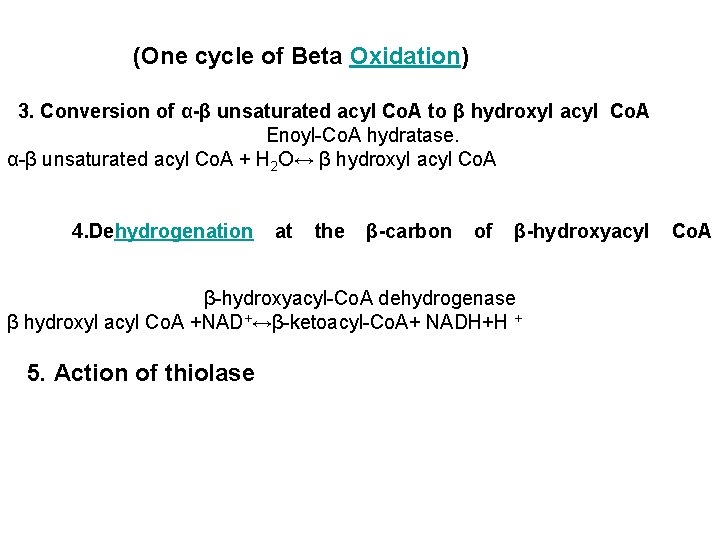
(One cycle of Beta Oxidation) 3. Conversion of α-β unsaturated acyl Co. A to β hydroxyl acyl Co. A Enoyl-Co. A hydratase. α-β unsaturated acyl Co. A + H 2 O↔ β hydroxyl acyl Co. A 4. Dehydrogenation at the β-carbon of β-hydroxyacyl-Co. A dehydrogenase β hydroxyl acyl Co. A +NAD+↔β-ketoacyl-Co. A+ NADH+H + 5. Action of thiolase Co. A
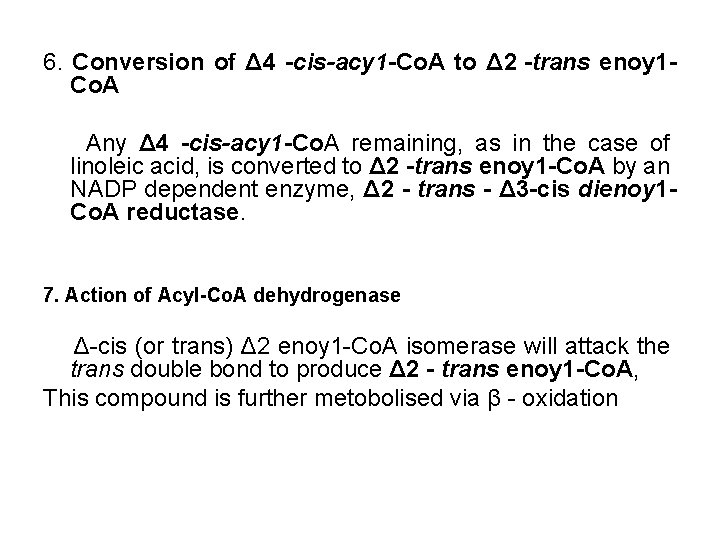
6. Conversion of Δ 4 -cis-acy 1 -Co. A to Δ 2 -trans enoy 1 Co. A Any Δ 4 -cis-acy 1 -Co. A remaining, as in the case of linoleic acid, is converted to Δ 2 -trans enoy 1 -Co. A by an NADP dependent enzyme, Δ 2 - trans - Δ 3 -cis dienoy 1 Co. A reductase. 7. Action of Acyl-Co. A dehydrogenase Δ-cis (or trans) Δ 2 enoy 1 -Co. A isomerase will attack the trans double bond to produce Δ 2 - trans enoy 1 -Co. A, This compound is further metobolised via β - oxidation
- Slides: 20