
Unit 4 2 1 Israel is Born Publicly

Unit 4. 2 1
Israel is Born • Publicly the Zionist leadership accept the Plan. • Though, they had hoped to expand the borders assigned to the Jewish state. • Arabs and the Arab Palestinians reject the plan and fighting breaks out between the Arab and Jewish residents almost immediately after the Adoption of the UN Plan.
Israel is Born • May 15 , 1948 British evacuate Palestine • Zionists Proclaim the State of Israel • Hostility from the Arab states leads neighboring Arab States (Egypt, Syria, Transjordan and Iraq) to invade Israel. • These Arab states thought they could take on the Israeli forces, but were mistaken because the Jewish state had been gearing up their army for some time now.
War of 1948 -1949 • In the course of the war, Zionists not only managed to hold all of the areas assigned to them by the UN • They seize part of the land designated for the Palestinian state as well. • The Palestinian Arab state envisioned by the UN Partition Plan was never established.
Results of the 1948 -1949 War • The Palestinian refugee problem really arises as result of this war. • 700, 000 Palestinians voluntarily flee their homes in the newly created state. • They did this to avoid the upcoming war and clear room for the invading Arab states. • The Arab states promised them they could go back and take control of the land once they push out the Jews.
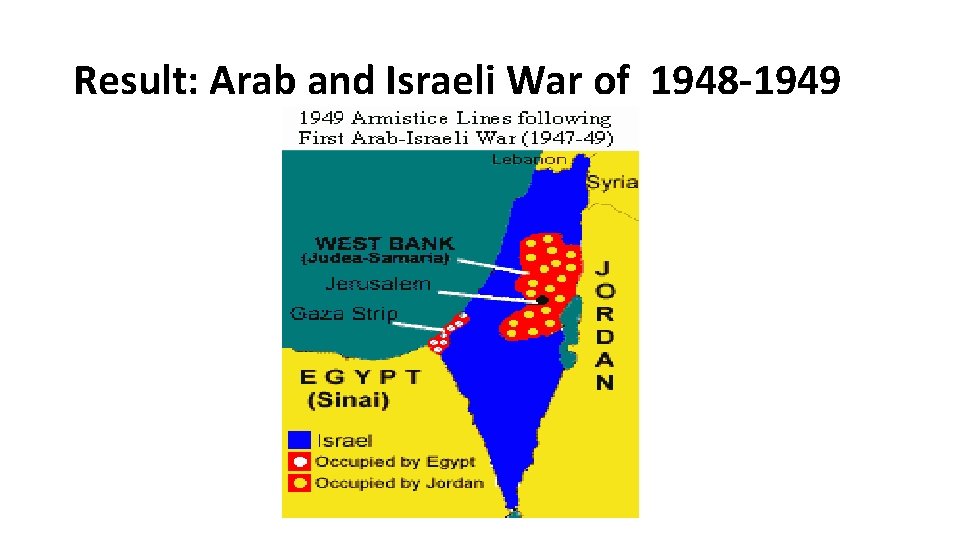
Result: Arab and Israeli War of 1948 -1949
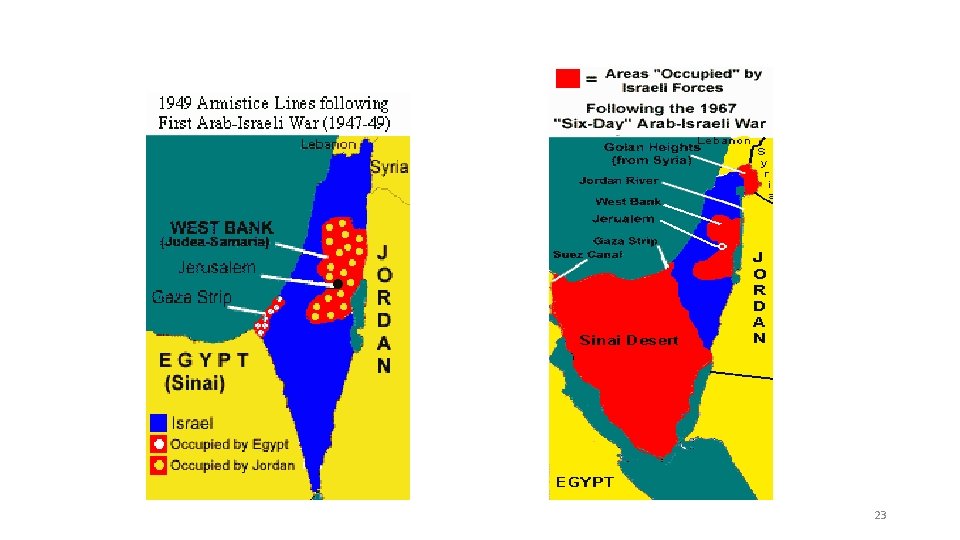
What is going on in the conflict after the First War of 1948 -1949? • The Country known as, Palestine was now divided into three parts. • The boundaries between them were the 1949 Armistice lines (The Green Lines) • The State of Israel encompassed over 77 percent of the territory.
Arab control in Israel • Jordan occupied East Jerusalem and the hill country of the West Bank. • Egypt took control of the coastal plain of the Gaza Strip.
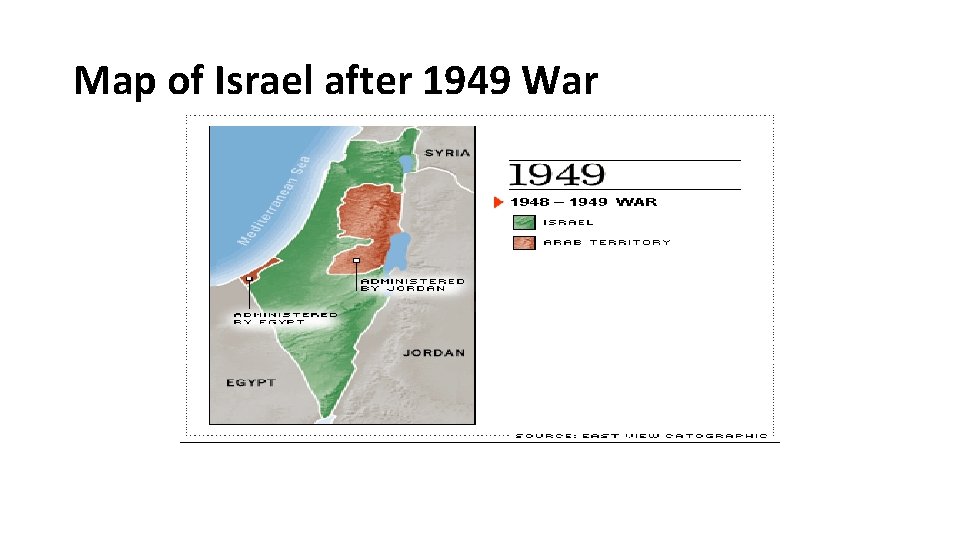
Map of Israel after 1949 War
The Conflict Continued • Although there was an Armistice between Israel and the Arab states, the conflict continued and the region remained imperiled by the prospect of another war. • The sense of the conflict was fueled by perceived historical and recent injustice to the Palestinian Arab cause a spiraling arms race, as countries built up their military resources and prepared for another showdown.
After the 1948 -1949 War • The Israelis have a lot more land took land that was going to be given to the Palestinians in the UN Partition Plan. • The Palestinians are forced to flee their homes and hundreds of thousands are now refugees forced to flee to neighboring Arab States. • Refugee Camps sprout up everywhere with animosity toward the Jewish State of Israel brewing within.
Important things to Consider in the Conflict • You start to see the Superpowers of the world emerge in the conflict. Why ? • Why has Israel been so successful in the conflict, thus far? • How do you think oil is going to play a part in this conflict?
More questions to consider • As the Conflict progresses why do think there is a Arab suspicion of the West and particularly of the US? • What’s going to happen to the thousands of misplaced Palestinian Refugees?
Beginning today we examine in detail these conflicts • The Suez Crisis “War of 1956” • The Six Day War of 1967 • The 1973 Yom Kippur War
Unit 4. 2 Guiding Questions Unit 4 Question: How do we resolve conflict? Unit 4. 2 Question: How was Israel able to survive despite the hostility of its neighbors? 1. Why was Israel able to win the wars of 1956, 1967, and 1973? 2. How significant was superpower involvement in Arab-Israeli conflicts? 3. How important was oil in changing the nature of the A-I conflict? 4. By the 1990 s, how far had the problems which existed between Israel and its neighbors been solved? 15
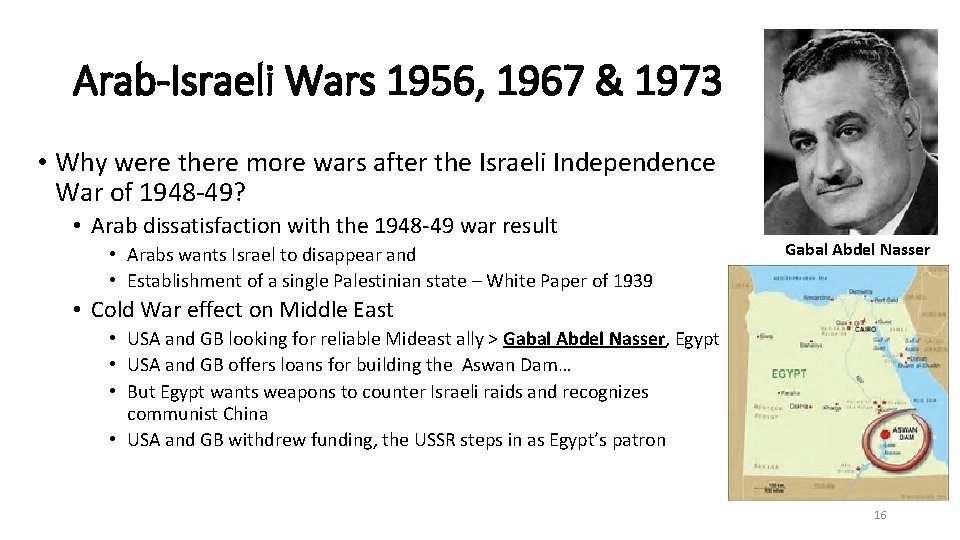
Arab-Israeli Wars 1956, 1967 & 1973 • Why were there more wars after the Israeli Independence War of 1948 -49? • Arab dissatisfaction with the 1948 -49 war result • Arabs wants Israel to disappear and • Establishment of a single Palestinian state – White Paper of 1939 Gabal Abdel Nasser • Cold War effect on Middle East • USA and GB looking for reliable Mideast ally > Gabal Abdel Nasser, Egypt • USA and GB offers loans for building the Aswan Dam… • But Egypt wants weapons to counter Israeli raids and recognizes communist China • USA and GB withdrew funding, the USSR steps in as Egypt’s patron 16
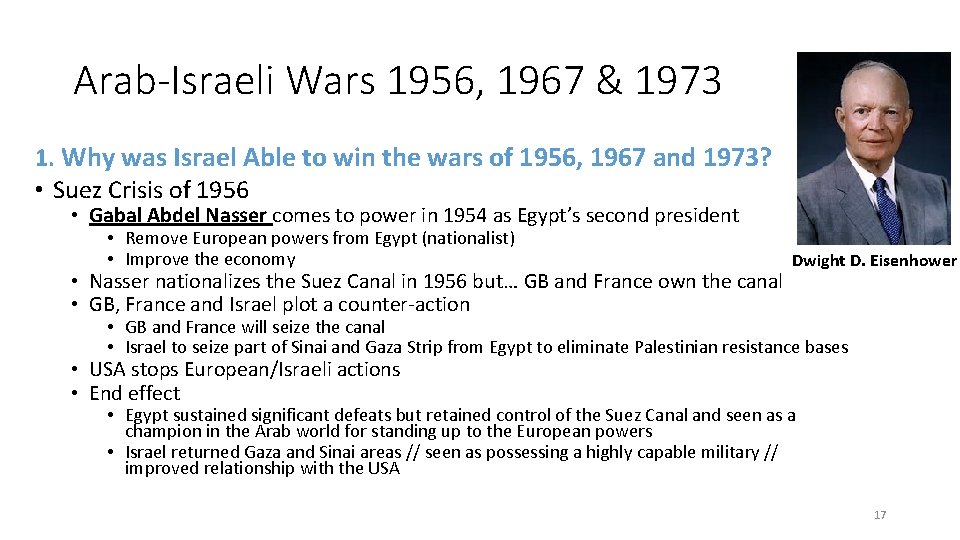
Arab-Israeli Wars 1956, 1967 & 1973 1. Why was Israel Able to win the wars of 1956, 1967 and 1973? • Suez Crisis of 1956 • Gabal Abdel Nasser comes to power in 1954 as Egypt’s second president • Remove European powers from Egypt (nationalist) • Improve the economy • Nasser nationalizes the Suez Canal in 1956 but… GB and France own the canal • GB, France and Israel plot a counter-action Dwight D. Eisenhower • GB and France will seize the canal • Israel to seize part of Sinai and Gaza Strip from Egypt to eliminate Palestinian resistance bases • USA stops European/Israeli actions • End effect • Egypt sustained significant defeats but retained control of the Suez Canal and seen as a champion in the Arab world for standing up to the European powers • Israel returned Gaza and Sinai areas // seen as possessing a highly capable military // improved relationship with the USA 17
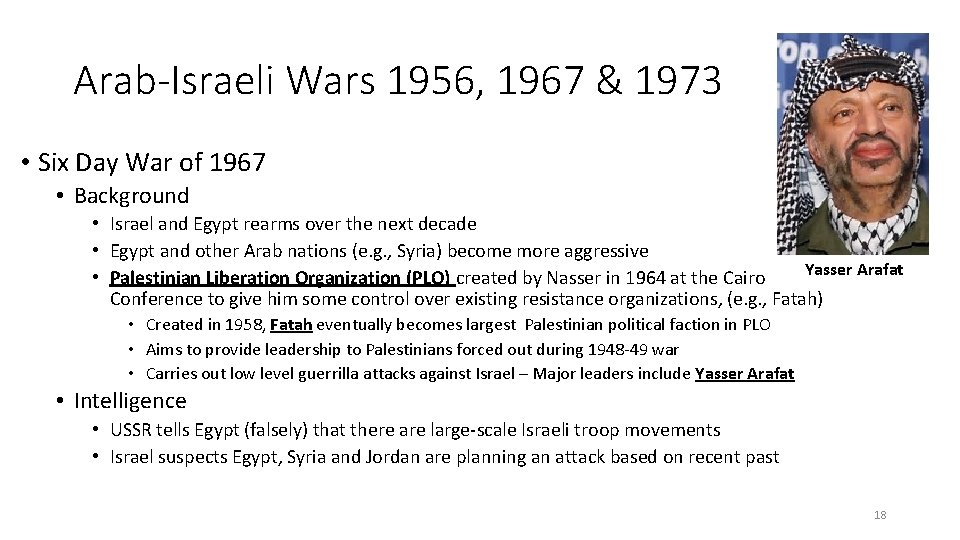
Arab-Israeli Wars 1956, 1967 & 1973 • Six Day War of 1967 • Background • Israel and Egypt rearms over the next decade • Egypt and other Arab nations (e. g. , Syria) become more aggressive Yasser Arafat • Palestinian Liberation Organization (PLO) created by Nasser in 1964 at the Cairo Conference to give him some control over existing resistance organizations, (e. g. , Fatah) • Created in 1958, Fatah eventually becomes largest Palestinian political faction in PLO • Aims to provide leadership to Palestinians forced out during 1948 -49 war • Carries out low level guerrilla attacks against Israel – Major leaders include Yasser Arafat • Intelligence • USSR tells Egypt (falsely) that there are large-scale Israeli troop movements • Israel suspects Egypt, Syria and Jordan are planning an attack based on recent past 18
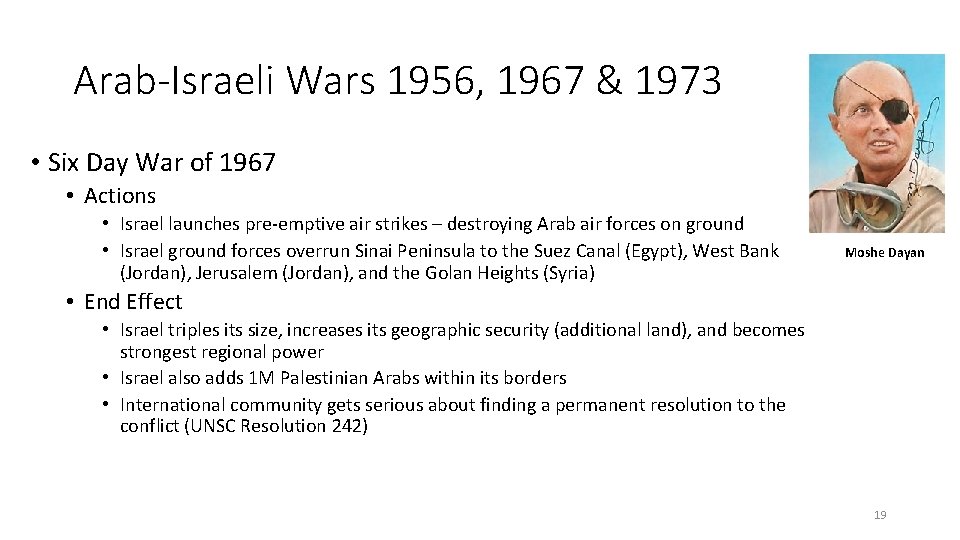
Arab-Israeli Wars 1956, 1967 & 1973 • Six Day War of 1967 • Actions • Israel launches pre-emptive air strikes – destroying Arab air forces on ground • Israel ground forces overrun Sinai Peninsula to the Suez Canal (Egypt), West Bank (Jordan), Jerusalem (Jordan), and the Golan Heights (Syria) Moshe Dayan • End Effect • Israel triples its size, increases its geographic security (additional land), and becomes strongest regional power • Israel also adds 1 M Palestinian Arabs within its borders • International community gets serious about finding a permanent resolution to the conflict (UNSC Resolution 242) 19
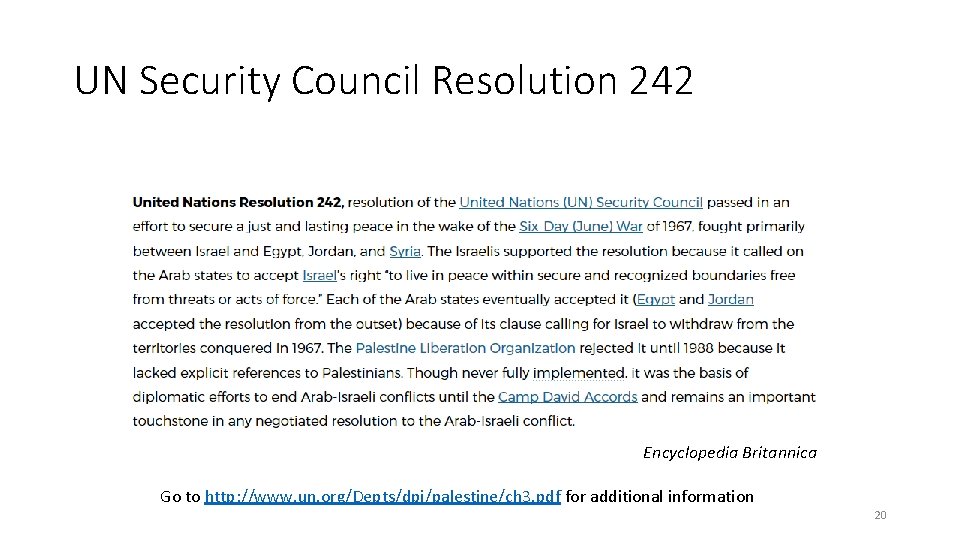
UN Security Council Resolution 242 Encyclopedia Britannica Go to http: //www. un. org/Depts/dpi/palestine/ch 3. pdf for additional information 20
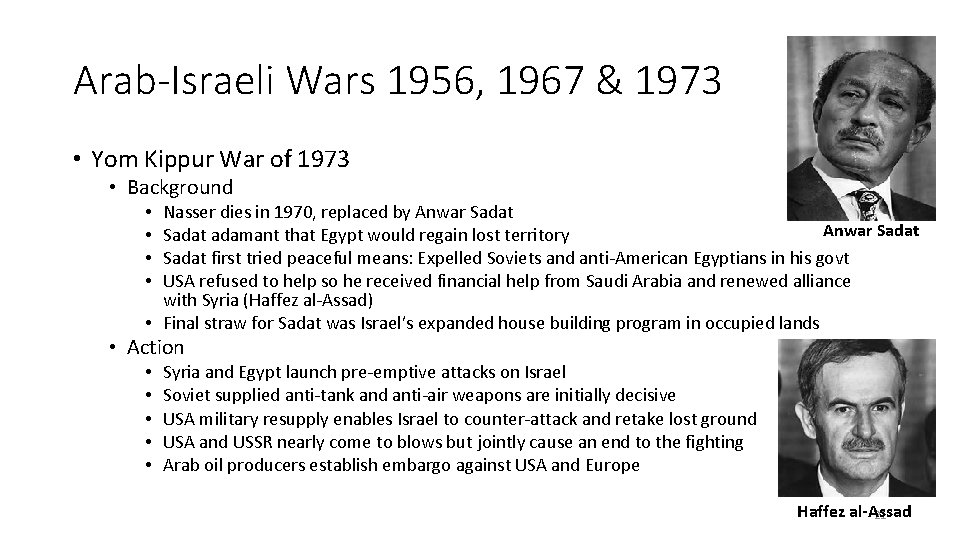
Arab-Israeli Wars 1956, 1967 & 1973 • Yom Kippur War of 1973 • Background Nasser dies in 1970, replaced by Anwar Sadat adamant that Egypt would regain lost territory Sadat first tried peaceful means: Expelled Soviets and anti-American Egyptians in his govt USA refused to help so he received financial help from Saudi Arabia and renewed alliance with Syria (Haffez al-Assad) • Final straw for Sadat was Israel’s expanded house building program in occupied lands • • • Action • • • Syria and Egypt launch pre-emptive attacks on Israel Soviet supplied anti-tank and anti-air weapons are initially decisive USA military resupply enables Israel to counter-attack and retake lost ground USA and USSR nearly come to blows but jointly cause an end to the fighting Arab oil producers establish embargo against USA and Europe Haffez al-Assad 21
Arab-Israeli Wars 1956, 1967 & 1973 • Yom Kippur War of 1973 • End Effect • Israel • Demonstrated again the military superiority of the Israelis • Egyptian-Syrian forces failed to keep their initial territorial gains (resulting in stalemate) • Arabs • • Israel proved to be militarily vulnerable Oil embargo is a powerful economic weapon > Severely damaged Western economies Closer relations develop between Egypt and USA Israel realizes there can be no lasting security without a diplomatic solution 22
23
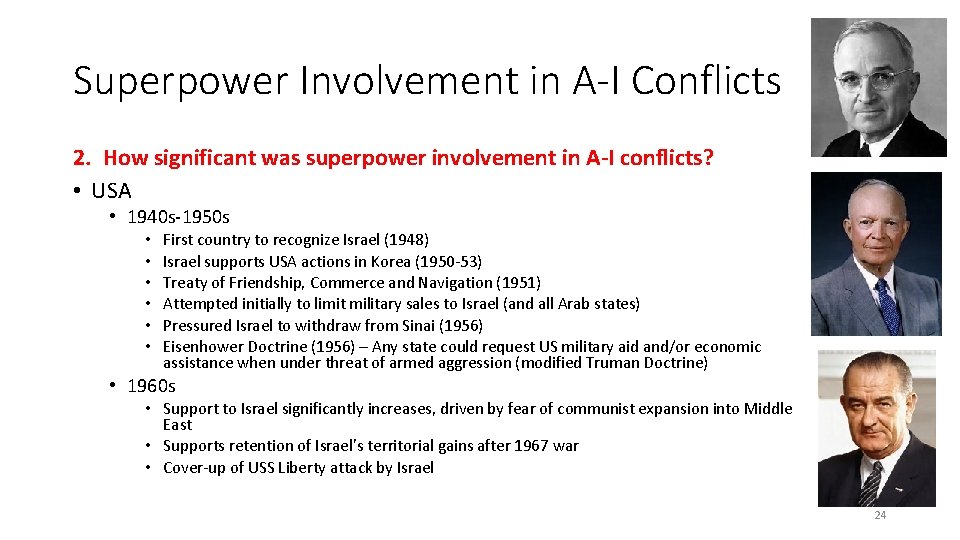
Superpower Involvement in A-I Conflicts 2. How significant was superpower involvement in A-I conflicts? • USA • 1940 s-1950 s • • • First country to recognize Israel (1948) Israel supports USA actions in Korea (1950 -53) Treaty of Friendship, Commerce and Navigation (1951) Attempted initially to limit military sales to Israel (and all Arab states) Pressured Israel to withdraw from Sinai (1956) Eisenhower Doctrine (1956) – Any state could request US military aid and/or economic assistance when under threat of armed aggression (modified Truman Doctrine) • 1960 s • Support to Israel significantly increases, driven by fear of communist expansion into Middle East • Supports retention of Israel’s territorial gains after 1967 war • Cover-up of USS Liberty attack by Israel 24
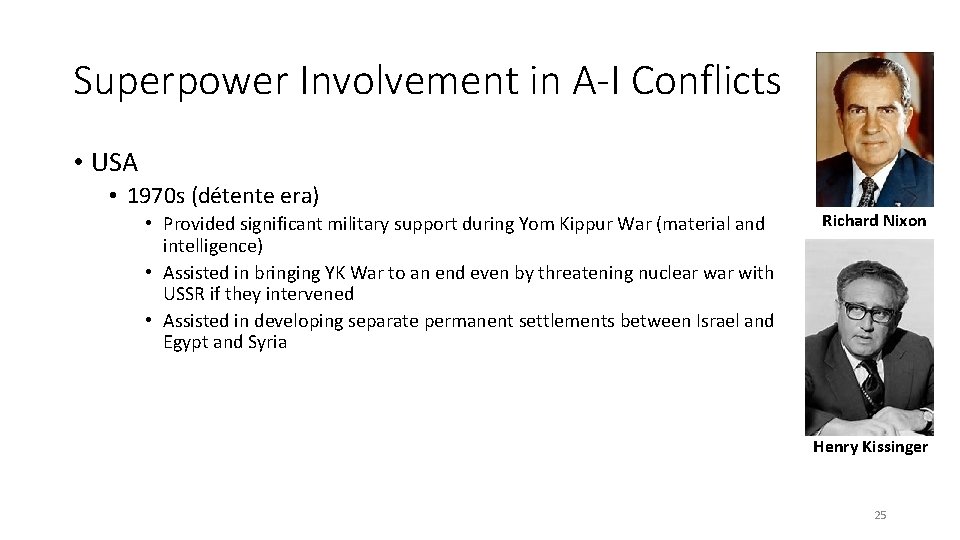
Superpower Involvement in A-I Conflicts • USA • 1970 s (détente era) • Provided significant military support during Yom Kippur War (material and intelligence) • Assisted in bringing YK War to an end even by threatening nuclear with USSR if they intervened • Assisted in developing separate permanent settlements between Israel and Egypt and Syria Richard Nixon Henry Kissinger 25
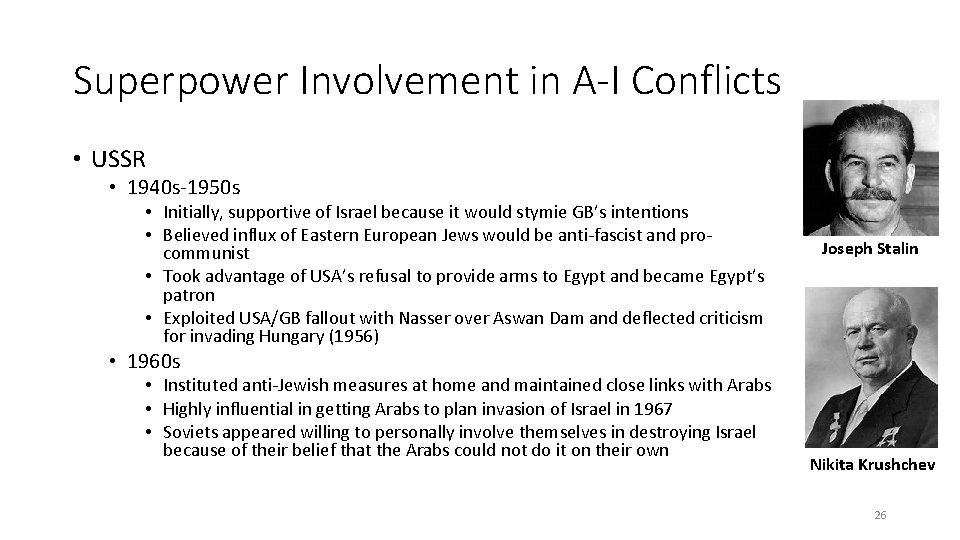
Superpower Involvement in A-I Conflicts • USSR • 1940 s-1950 s • Initially, supportive of Israel because it would stymie GB’s intentions • Believed influx of Eastern European Jews would be anti-fascist and procommunist • Took advantage of USA’s refusal to provide arms to Egypt and became Egypt’s patron • Exploited USA/GB fallout with Nasser over Aswan Dam and deflected criticism for invading Hungary (1956) Joseph Stalin • 1960 s • Instituted anti-Jewish measures at home and maintained close links with Arabs • Highly influential in getting Arabs to plan invasion of Israel in 1967 • Soviets appeared willing to personally involve themselves in destroying Israel because of their belief that the Arabs could not do it on their own Nikita Krushchev 26
Superpower Involvement in A-I Conflicts • USSR • 1970 s • Established a Treaty of Friendship (1971) - Supplied significant military equipment, including anti-tank and anti-air, for Yom Kippur War • Received permission to base its Mediterranean Sea and Air Fleet in Alexandria and Cairo (until 1976) 27
Unit 4. 2 Guiding Questions Unit 4 Question: How do we resolve conflict? Unit 4. 2 Question: How was Israel able to survive despite the hostility of its neighbors? 1. Why was Israel able to win the wars of 1956, 1967, and 1973? 2. How significant was superpower involvement in Arab-Israeli conflicts? 3. How important was oil in changing the nature of the A-I conflict? 4. By the 1990 s, how far had the problems which existed between Israel and its neighbors been solved? 28
Oil Impact on the Arab-Israeli Conflict 29
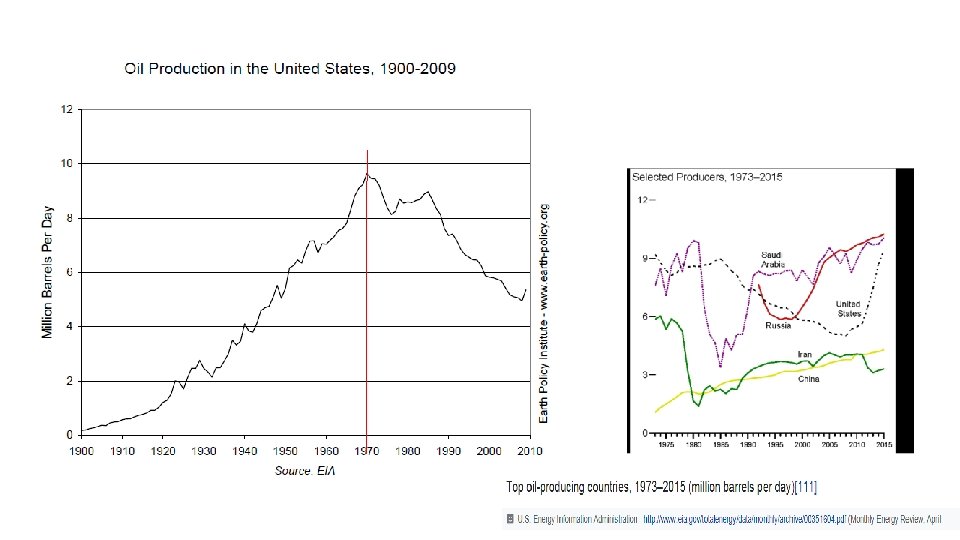
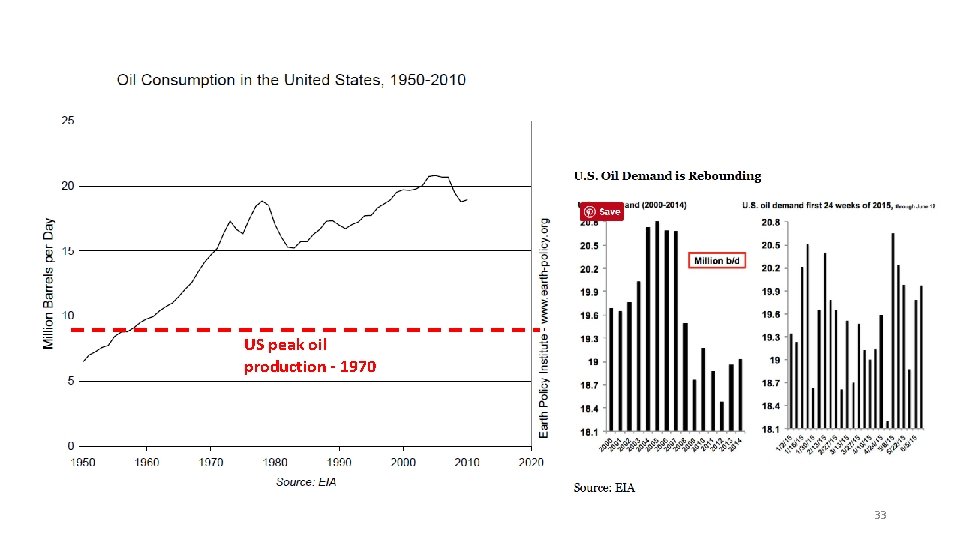
Oil Impact on the Arab-Israeli Conflict 3. How important was oil in changing the nature of the A-I conflict? • Background • By 1973, USA concern for Middle East peace is beyond a desire for settlement of territorial claims • USA‘s first concern is the “geopolitical importance of the Middle East to the defense of Europe… control of the oil, the space and the mass of the region by the USSR would carry with dominion over Western Europe [and affect the balance of world power] (Walt Rostow) • US oil production was not keeping up with consumption and now USA was dependent on Middle East oil (see graphs) • USA first impacted by oil market manipulation after Six Day War (1967) when Libya increased its price and nationalized Western assets 30
The Prize – Oil as a weapon – 9 min • https: //www. youtube. com/watch? v=Dkpqk. Kwhdk 8 31
32
US peak oil production - 1970 33
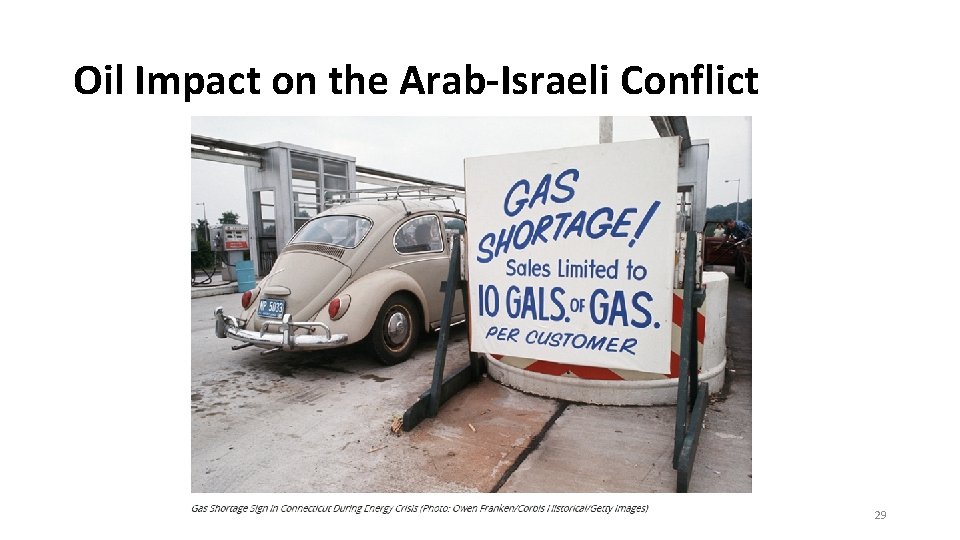
Oil Impact on the Arab-Israeli Conflict • Oil as a weapon • USA (President Nixon) initially dismissed ability of Arab states to use oil as weapon against other countries • As Yom Kippur War turned against the Egypt and Syria, the Arab oil producers (Saudi Arabia) increased oil prices by 70% and reduced supply to any country supporting Israel in the war • When USA doubled its aid to Israel, Saudis and fellow OPEC members implemented a complete embargo (Oct 1973 – Mar 1974) • Prices increased to the USA by 387% - causing a period of stagflation, rising unemployment, and a balance of payments crisis as import costs rose • Embargo was lifted when Israel agreed to withdraw from Suez Canal and part of Golan Heights 34
Oil Impact on the Arab-Israeli Conflict • Oil as a weapon, not quite as effective as hoped by Arabs • USA policy did not change significantly: Since 1967 Six Day War, USA wanted a peace deal between all parties in support of UNSCR 242 • USA policy was more concerned with the fear of Soviet influence in the region (Cold War) • Kissinger’s control of foreign policy was not affected by rise in oil prices, lobby groups or government agencies • But embargo gave Arabs excuse to nationalize more Western assets, causing concern another embargo could occur if Palestinian issues were not addressed 35
Oil Impact on the Arab-Israeli Conflict • Oil as a weapon, not quite as effective as hoped by Arabs • Causes the USA to pass legislation to make embargo less effective and USA less dependent on OPEC oil • Emergency Petroleum Act – Gas rationing and price controls • Project Independence – Make USA self-sufficient in oil by 1980 • Create Federal Energy Department • Fall in oil prices during the 1980 s • New sources of oil come on line – North Sea (GB and Norway), Mexico, and Alaska • Falling consumption in USA and Europe 36
- Slides: 36