
Unit 4 1 Unit 4 2 QUESTIONS YesNo


- Slides: 24
Unit 4 1
Unit 4 2
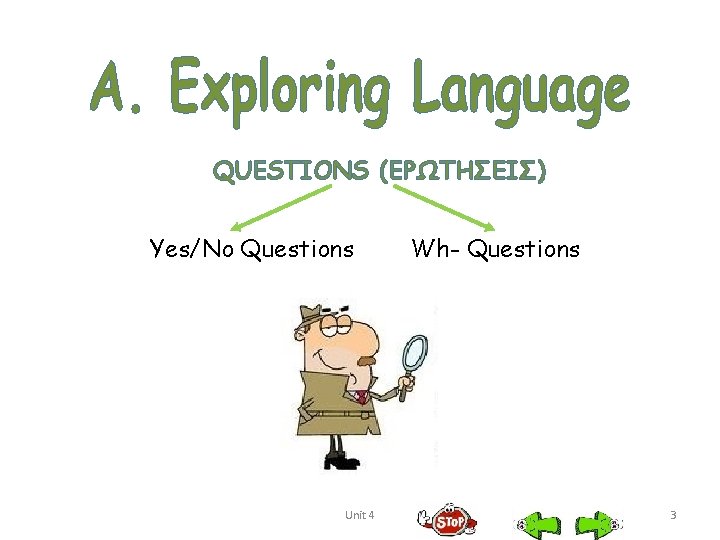
QUESTIONS (ΕΡΩΤΗΣΕΙΣ) Yes/No Questions Unit 4 Wh- Questions 3
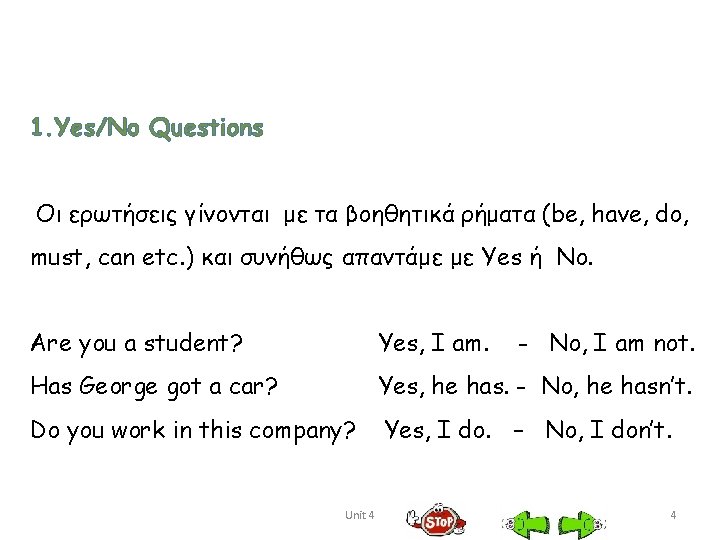
1. Yes/No Questions Οι ερωτήσεις γίνονται με τα βοηθητικά ρήματα (be, have, do, must, can etc. ) και συνήθως απαντάμε με Yes ή No. Are you a student? Yes, I am. Has George got a car? Yes, he has. - No, he hasn’t. Do you work in this company? Yes, I do. – No, I don’t. Unit 4 - No, I am not. 4
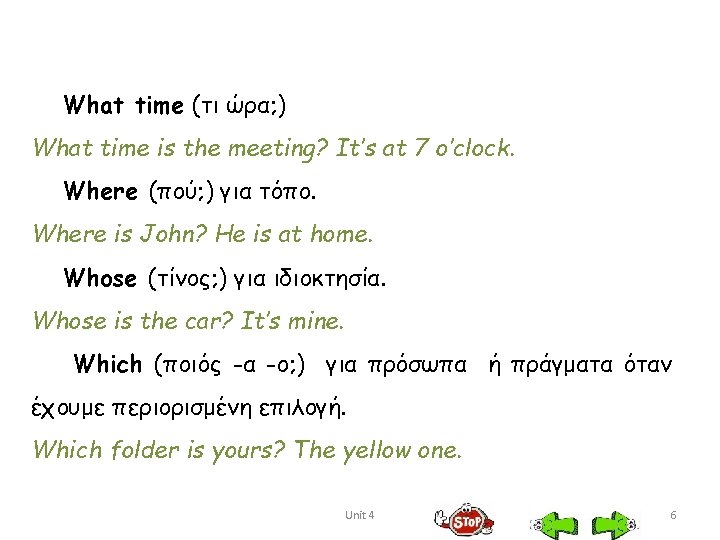
What time (τι ώρα; ) What time is the meeting? It’s at 7 o’clock. Where (πού; ) για τόπο. Where is John? He is at home. Whose (τίνος; ) για ιδιοκτησία. Whose is the car? It’s mine. Which (ποιός -α -ο; ) για πρόσωπα ή πράγματα όταν έχουμε περιορισμένη επιλογή. Which folder is yours? The yellow one. Unit 4 6
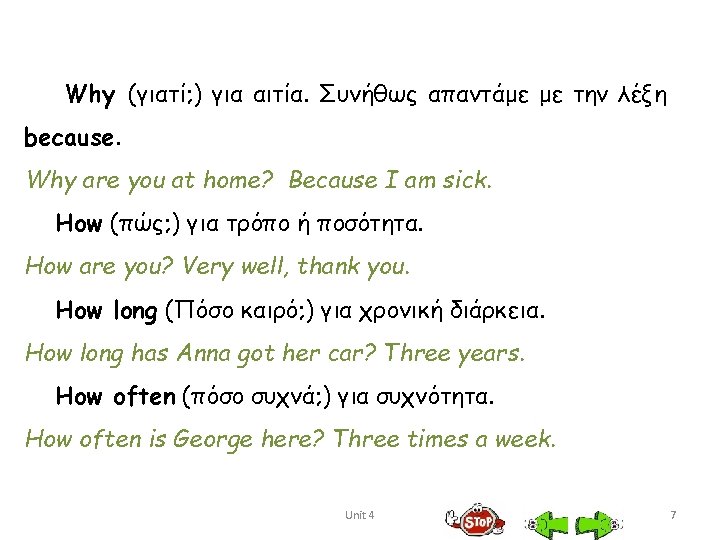
Why (γιατί; ) για αιτία. Συνήθως απαντάμε με την λέξη because. Why are you at home? Because I am sick. How (πώς; ) για τρόπο ή ποσότητα. How are you? Very well, thank you. How long (Πόσο καιρό; ) για χρονική διάρκεια. How long has Anna got her car? Three years. How often (πόσο συχνά; ) για συχνότητα. How often is George here? Three times a week. Unit 4 7
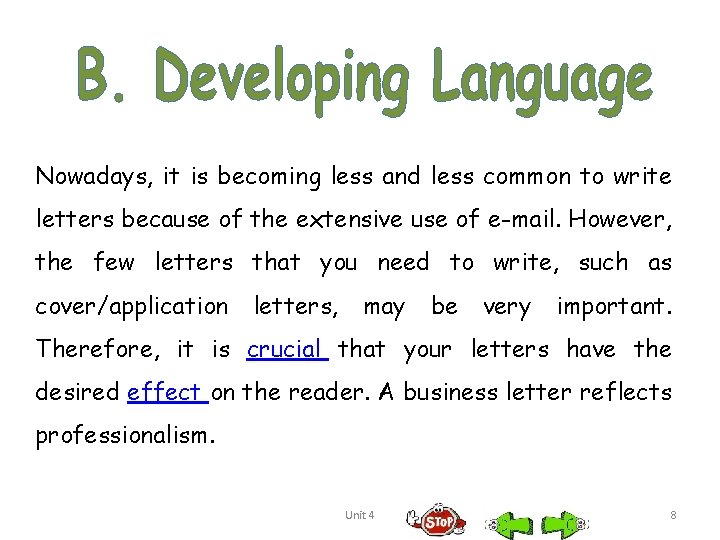
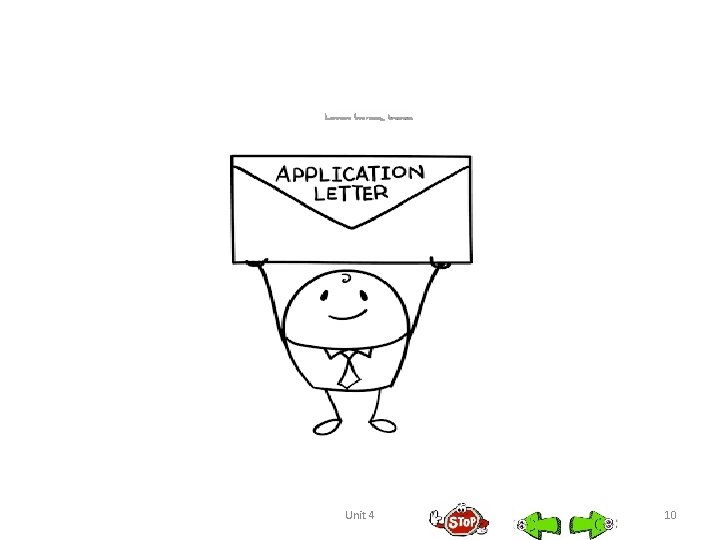
Nowadays, it is becoming less and less common to write letters because of the extensive use of e-mail. However, the few letters that you need to write, such as cover/application letters, may be very important. Therefore, it is crucial that your letters have the desired effect on the reader. A business letter reflects professionalism. Unit 4 8
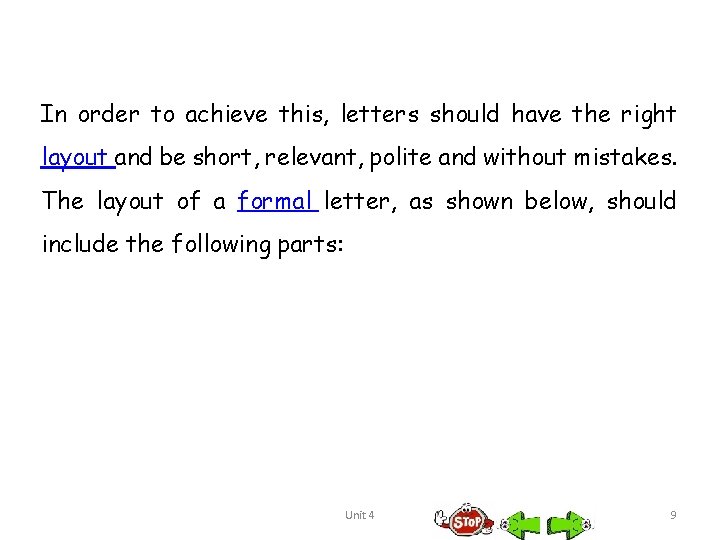
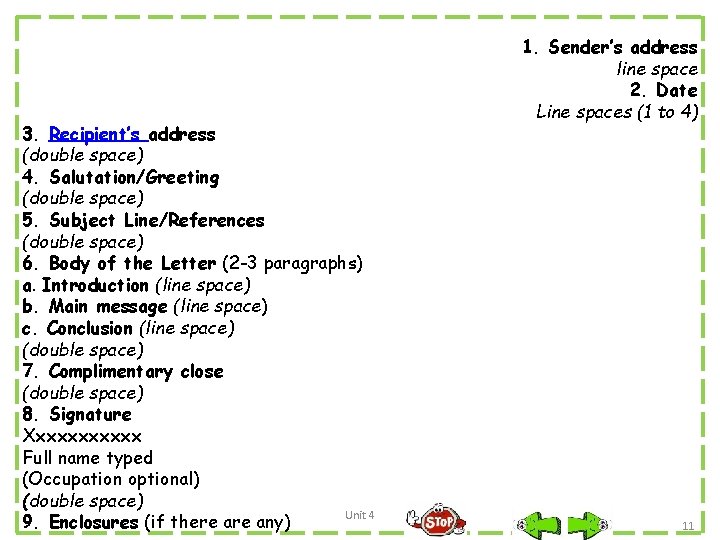
In order to achieve this, letters should have the right layout and be short, relevant, polite and without mistakes. The layout of a formal letter, as shown below, should include the following parts: Unit 4 9
Unit 4 10
3. Recipient’s address (double space) 4. Salutation/Greeting (double space) 5. Subject Line/References (double space) 6. Body of the Letter (2 -3 paragraphs) a. Introduction (line space) b. Main message (line space) c. Conclusion (line space) (double space) 7. Complimentary close (double space) 8. Signature Xxxxxx Full name typed (Occupation optional) (double space) Unit 4 9. Enclosures (if there any) 1. Sender’s address line space 2. Date Line spaces (1 to 4) 11
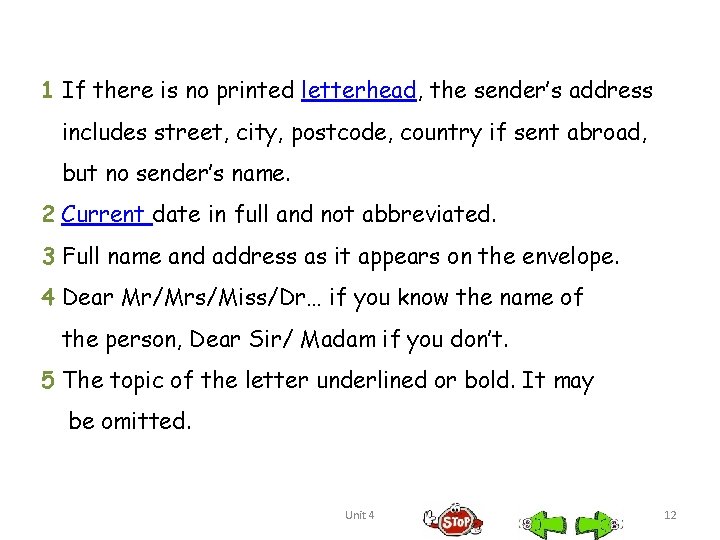
1 If there is no printed letterhead, the sender’s address includes street, city, postcode, country if sent abroad, but no sender’s name. 2 Current date in full and not abbreviated. 3 Full name and address as it appears on the envelope. 4 Dear Mr/Mrs/Miss/Dr… if you know the name of the person, Dear Sir/ Madam if you don’t. 5 The topic of the letter underlined or bold. It may be omitted. Unit 4 12
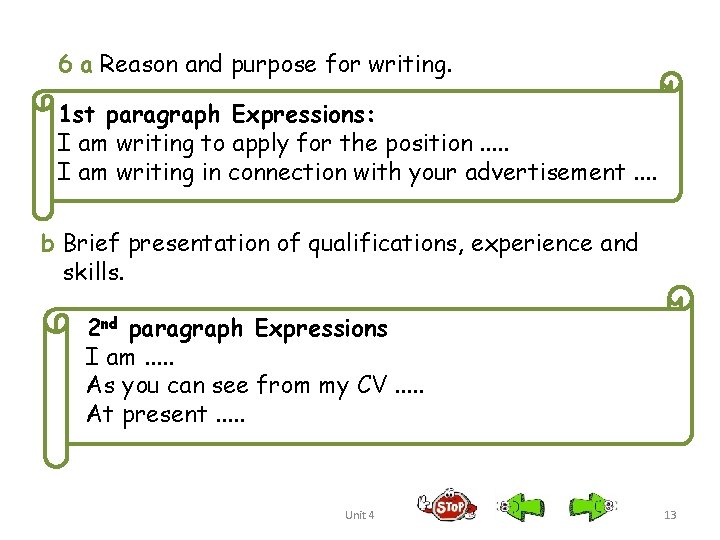
6 a Reason and purpose for writing. 1 st paragraph Expressions: I am writing to apply for the position. . . I am writing in connection with your advertisement. . b Brief presentation of qualifications, experience and skills. 2 nd paragraph Expressions I am. . . As you can see from my CV. . . At present. . . Unit 4 13
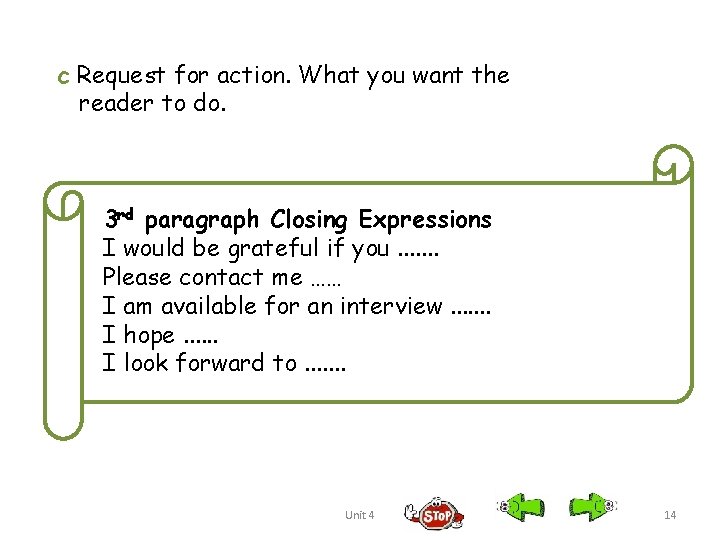
c Request for action. What you want the reader to do. 3 rd paragraph Closing Expressions I would be grateful if you. . . . Please contact me …… I am available for an interview. . . . I hope. . . I look forward to. . . . Unit 4 14
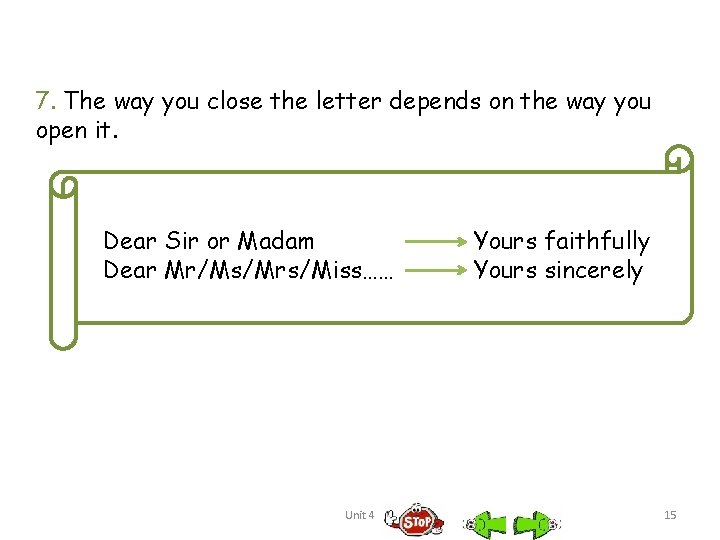
7. The way you close the letter depends on the way you open it. Dear Sir or Madam Dear Mr/Ms/Mrs/Miss…… Unit 4 Yours faithfully Yours sincerely 15
Unit 4 16
crucial = very important, basic Unit 4 17
effect=result, outcome Unit 4 18
layout= the way in which the parts of something are arranged Unit 4 19
formal ≠ informal Unit 4 20
recipient= the person who receives sth Unit 4 21
letterhead= a printed heading Unit 4 22
current = present, of today Unit 4 23
Back to top Unit 4 24