
Unit 33 INTRODUCTION TO TRIGONOMETRIC FUNCTIONS 1 IDENTIFYING
- Slides: 15
Unit 33 INTRODUCTION TO TRIGONOMETRIC FUNCTIONS 1
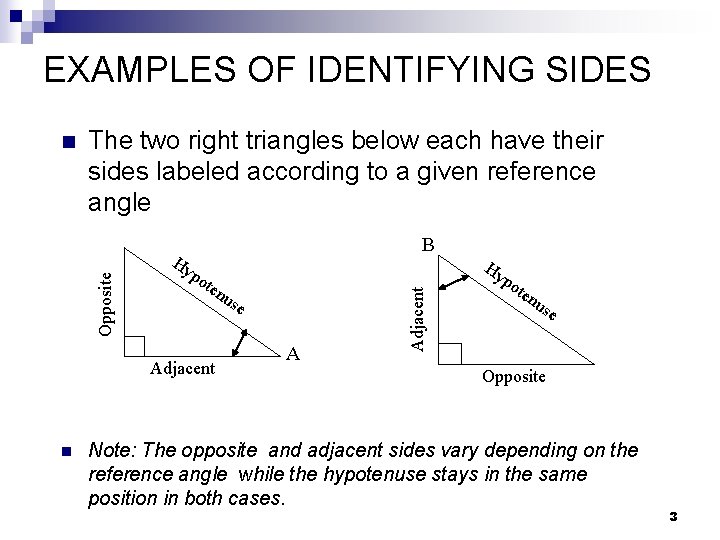
IDENTIFYING THE SIDES OF A RIGHT TRIANGLE n n n The sides of a right triangle are named the opposite side, adjacent side, and hypotenuse The hypotenuse is the longest side of a right triangle and is always opposite the right angle The positions of the opposite and adjacent sides depend on the reference angle The opposite side is opposite the reference angle The adjacent side is next to the reference angle 2
EXAMPLES OF IDENTIFYING SIDES The two right triangles below each have their sides labeled according to a given reference angle Hy B po ten Adjacent n us e A Adjacent Opposite n Hy po ten us e Opposite Note: The opposite and adjacent sides vary depending on the reference angle while the hypotenuse stays in the same position in both cases. 3
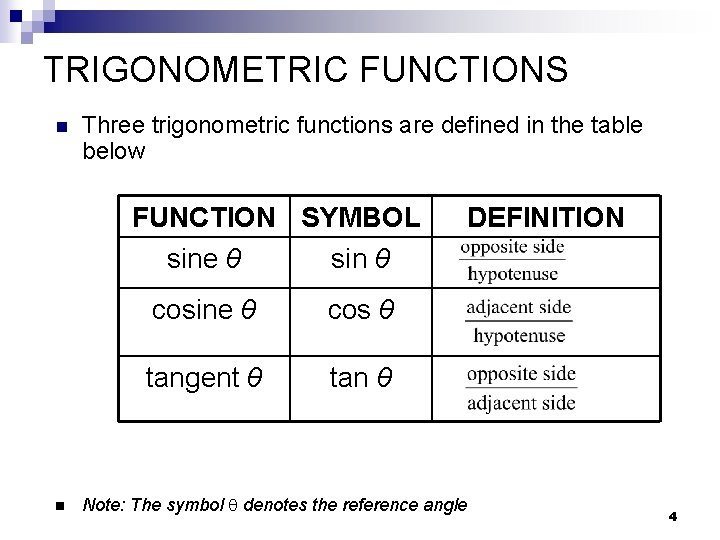
TRIGONOMETRIC FUNCTIONS n Three trigonometric functions are defined in the table below FUNCTION SYMBOL sine θ sin θ n cosine θ cos θ tangent θ tan θ Note: The symbol denotes the reference angle DEFINITION 4
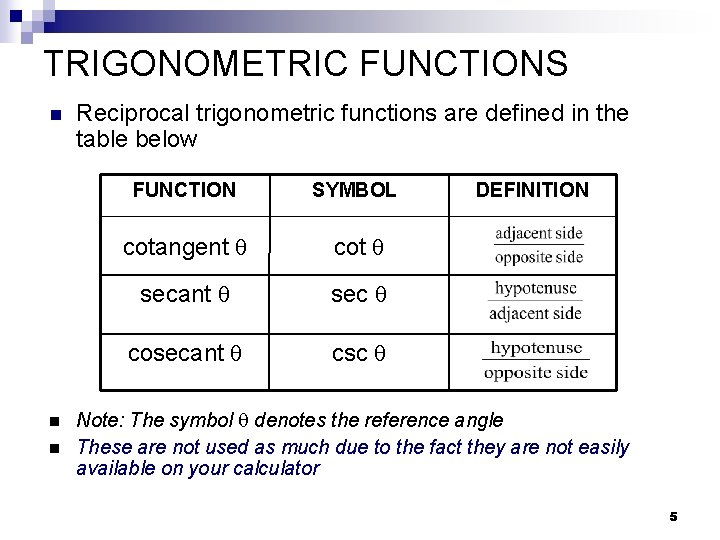
TRIGONOMETRIC FUNCTIONS n n n Reciprocal trigonometric functions are defined in the table below FUNCTION SYMBOL cotangent cot secant sec cosecant csc DEFINITION Note: The symbol denotes the reference angle These are not used as much due to the fact they are not easily available on your calculator 5
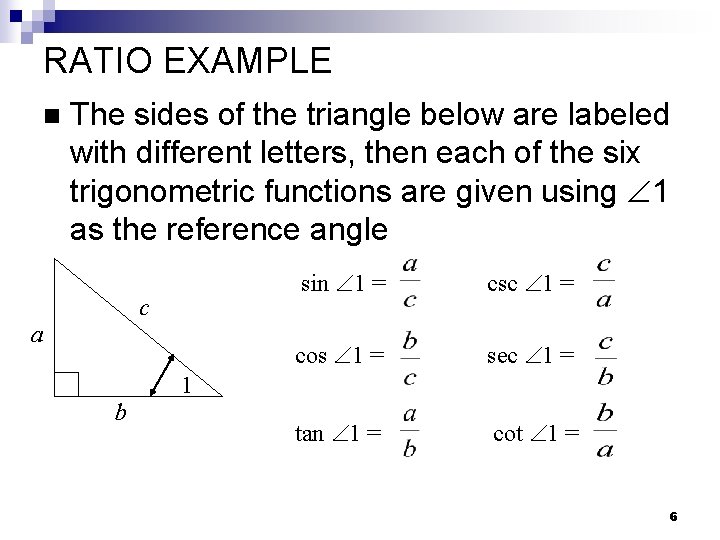
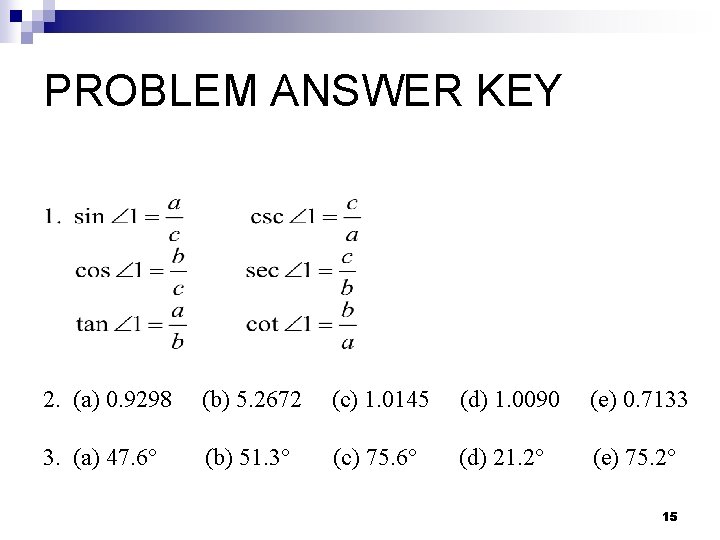
RATIO EXAMPLE n The sides of the triangle below are labeled with different letters, then each of the six trigonometric functions are given using 1 as the reference angle c a sin 1 = csc 1 = cos 1 = sec 1 = tan 1 = cot 1 = 1 b 6
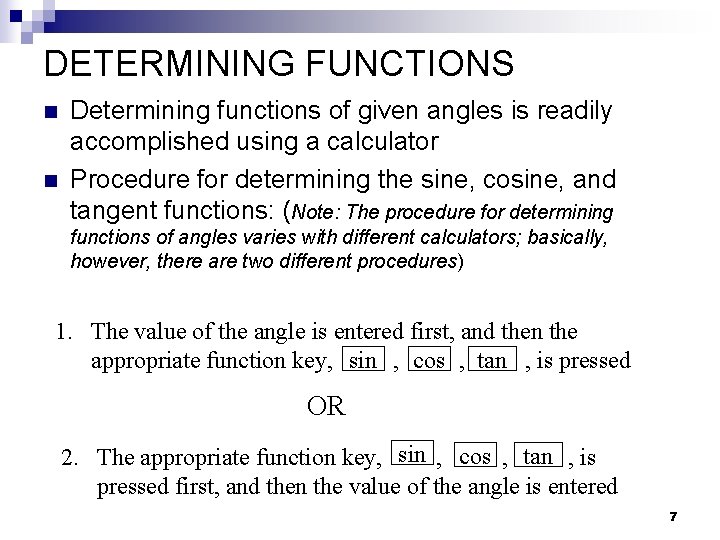
DETERMINING FUNCTIONS n n Determining functions of given angles is readily accomplished using a calculator Procedure for determining the sine, cosine, and tangent functions: (Note: The procedure for determining functions of angles varies with different calculators; basically, however, there are two different procedures) 1. The value of the angle is entered first, and then the appropriate function key, sin , cos , tan , is pressed OR 2. The appropriate function key, sin , cos , tan , is pressed first, and then the value of the angle is entered 7
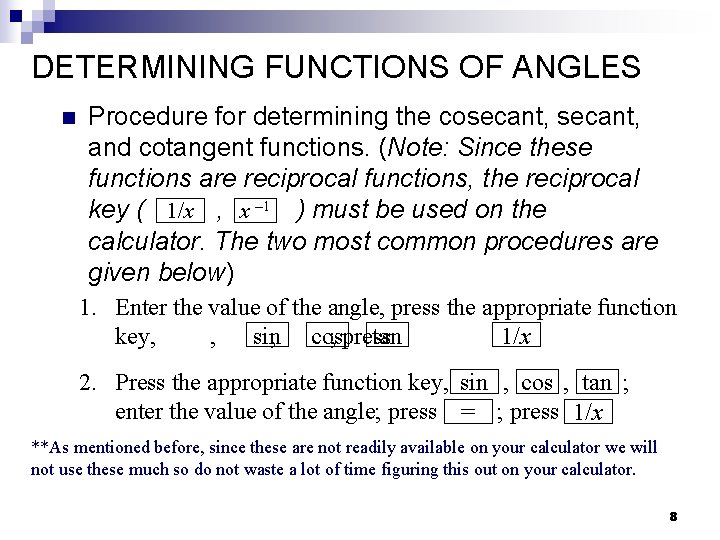
DETERMINING FUNCTIONS OF ANGLES n Procedure for determining the cosecant, and cotangent functions. (Note: Since these functions are reciprocal functions, the reciprocal key ( 1/x , x – 1 ) must be used on the calculator. The two most common procedures are given below) 1. Enter the value of the angle, press the appropriate function sin, cos tan 1/x key, , ; press 2. Press the appropriate function key, sin , cos , tan ; enter the value of the angle; press = ; press 1/x **As mentioned before, since these are not readily available on your calculator we will not use these much so do not waste a lot of time figuring this out on your calculator. 8
ANGLES OF GIVEN FUNCTIONS n n n Determining the angle of a given function is the inverse of determining the function of a given angle. When a certain function value is known, the angle can be found easily The term arc is often used as a prefix to any of the names of the trigonometric functions, such as arcsine, and arctangent. Such expressions are called inverse functions and they mean angles Arcsin is often written as sin– 1, arccos is written as cos– 1, and arctan is written as tan– 1 9
DETERMINING ANGLES n n n The procedure for determining angles of given functions varies somewhat with the make and model of calculator With most calculators, the inverse functions are shown as second functions [sin– 1], [cos– 1], and [tan– 1] of function keys sin , cos , and tan With some calculators, the function value is entered before the function key is pressed. With other calculators, the function key is pressed before the function value is entered 10
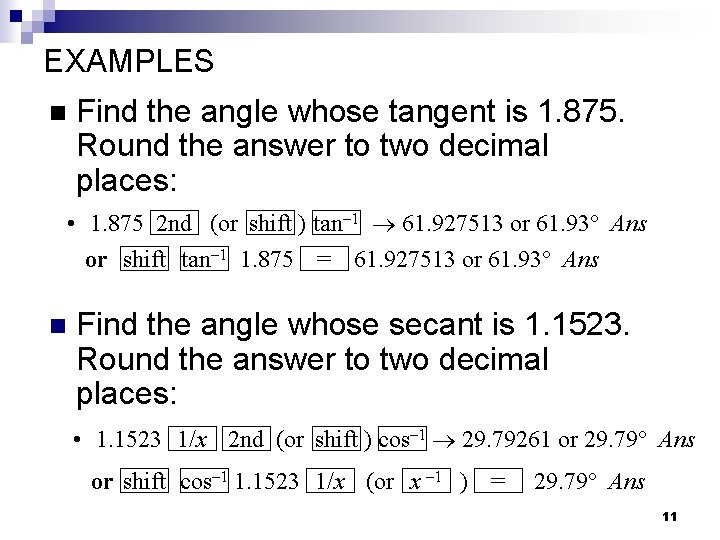
EXAMPLES n Find the angle whose tangent is 1. 875. Round the answer to two decimal places: • 1. 875 2 nd (or shift ) tan– 1 61. 927513 or 61. 93° Ans or shift tan– 1 1. 875 = 61. 927513 or 61. 93° Ans n Find the angle whose secant is 1. 1523. Round the answer to two decimal places: • 1. 1523 1/x 2 nd (or shift ) cos– 1 29. 79261 or 29. 79° Ans or shift cos– 1 1. 1523 1/x (or x – 1 ) = 29. 79° Ans 11
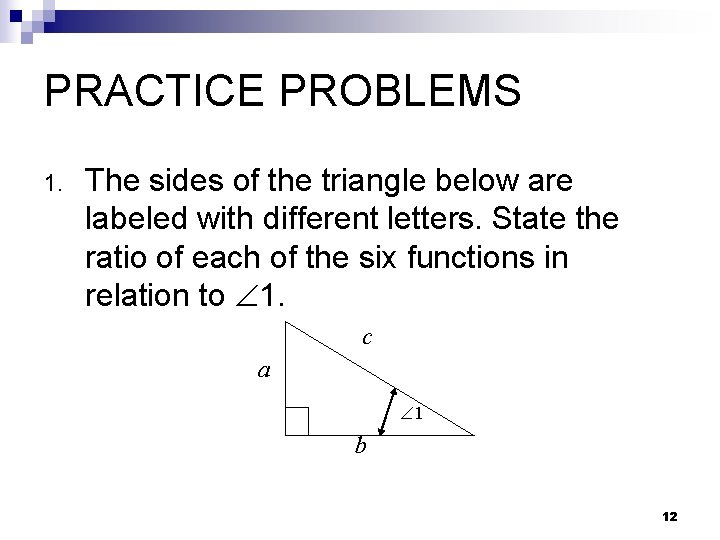
PRACTICE PROBLEMS 1. The sides of the triangle below are labeled with different letters. State the ratio of each of the six functions in relation to 1. c a 1 b 12
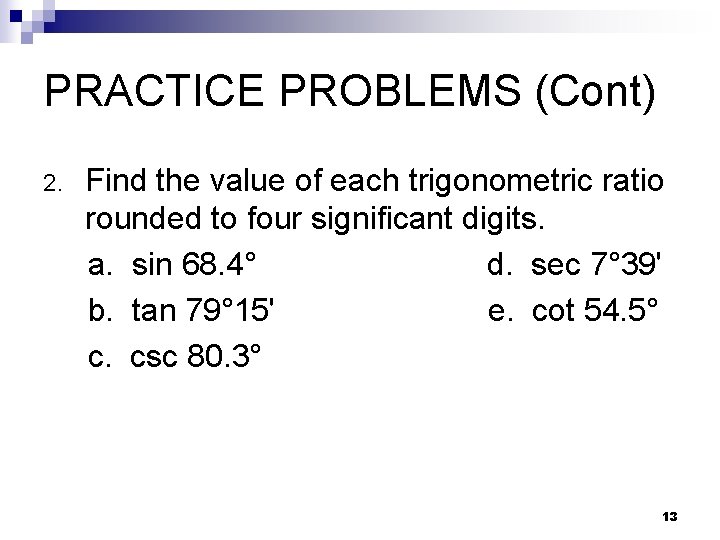
PRACTICE PROBLEMS (Cont) 2. Find the value of each trigonometric ratio rounded to four significant digits. a. sin 68. 4° d. sec 7° 39' b. tan 79° 15' e. cot 54. 5° c. csc 80. 3° 13
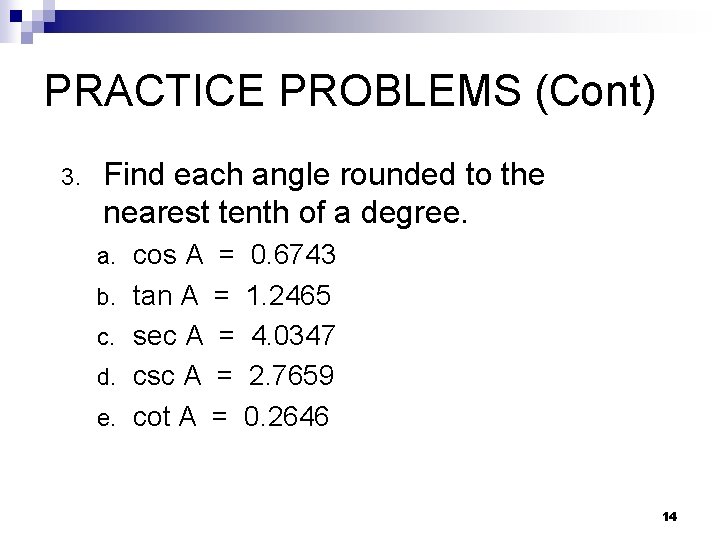
PRACTICE PROBLEMS (Cont) 3. Find each angle rounded to the nearest tenth of a degree. a. b. c. d. e. cos A tan A sec A csc A cot A = = = 0. 6743 1. 2465 4. 0347 2. 7659 0. 2646 14
PROBLEM ANSWER KEY 2. (a) 0. 9298 (b) 5. 2672 (c) 1. 0145 (d) 1. 0090 (e) 0. 7133 3. (a) 47. 6° (b) 51. 3° (c) 75. 6° (d) 21. 2° (e) 75. 2° 15