
Unit 31 GardeManger The gardemanger chef prepares a
- Slides: 24
Unit 31: Garde-Manger The garde-manger chef prepares a variety of pâtés, forcemeats, appetizers, salads, and cold foods American Culinary Federation: Culinary Fundamentals. © 2006, Pearson Education, Upper Saddle River, NJ 07458. All Rights Reserved.
American Culinary Federation: Culinary Fundamentals. © 2006, Pearson Education, Upper Saddle River, NJ 07458. All Rights Reserved.
Garde-Manger Has Several Meanings • • • “Keep to eat” Referred to as a storage area, pantry A place to cure meats An area of specialized foods Cold kitchen Responsible for all the decorative aspects of cold food presentation American Culinary Federation: Culinary Fundamentals. © 2006, Pearson Education, Upper Saddle River, NJ 07458. All Rights Reserved.
Forcemeats • An emulsion of fat and lean meat is basic component of a garde-manger preparation • Basis of pâté is used for • Galantines, terrines, roulades, sausages, quenelles American Culinary Federation: Culinary Fundamentals. © 2006, Pearson Education, Upper Saddle River, NJ 07458. All Rights Reserved.
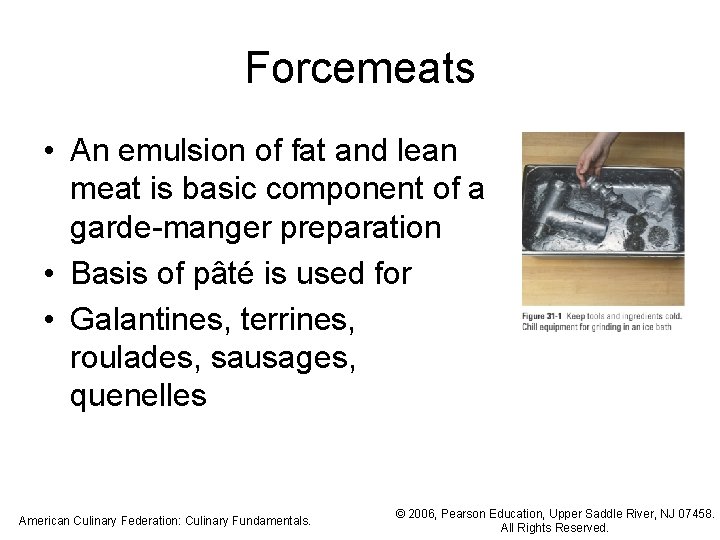
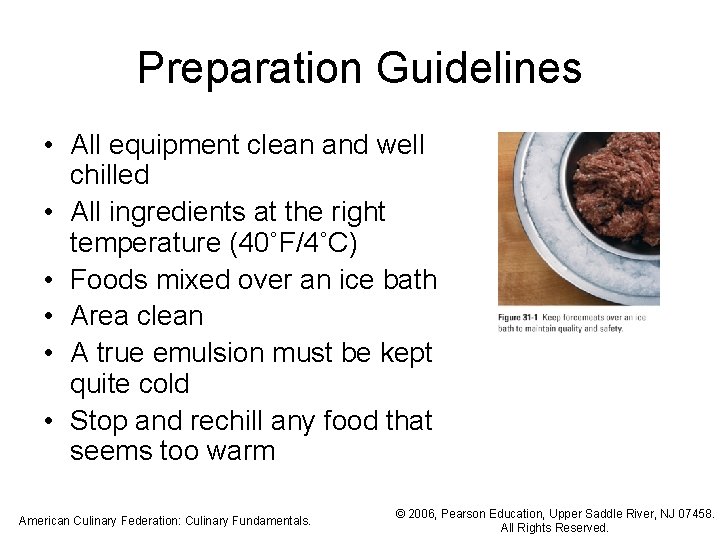
Preparation Guidelines • All equipment clean and well chilled • All ingredients at the right temperature (40˚F/4˚C) • Foods mixed over an ice bath • Area clean • A true emulsion must be kept quite cold • Stop and rechill any food that seems too warm American Culinary Federation: Culinary Fundamentals. © 2006, Pearson Education, Upper Saddle River, NJ 07458. All Rights Reserved.
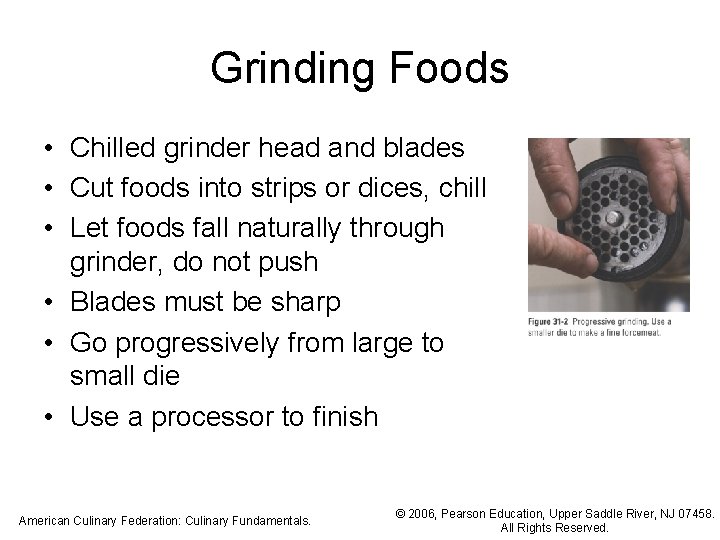
Grinding Foods • Chilled grinder head and blades • Cut foods into strips or dices, chill • Let foods fall naturally through grinder, do not push • Blades must be sharp • Go progressively from large to small die • Use a processor to finish American Culinary Federation: Culinary Fundamentals. © 2006, Pearson Education, Upper Saddle River, NJ 07458. All Rights Reserved.
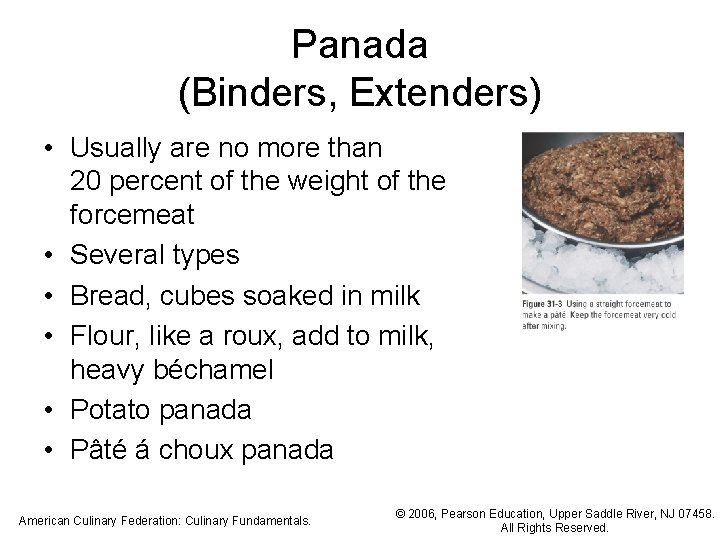
Panada (Binders, Extenders) • Usually are no more than 20 percent of the weight of the forcemeat • Several types • Bread, cubes soaked in milk • Flour, like a roux, add to milk, heavy béchamel • Potato panada • Pâté á choux panada American Culinary Federation: Culinary Fundamentals. © 2006, Pearson Education, Upper Saddle River, NJ 07458. All Rights Reserved.
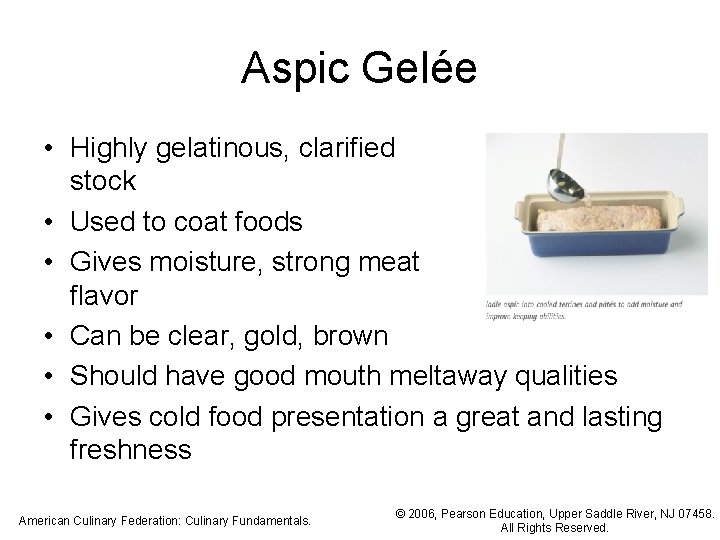
Aspic Gelée • Highly gelatinous, clarified stock • Used to coat foods • Gives moisture, strong meat flavor • Can be clear, gold, brown • Should have good mouth meltaway qualities • Gives cold food presentation a great and lasting freshness American Culinary Federation: Culinary Fundamentals. © 2006, Pearson Education, Upper Saddle River, NJ 07458. All Rights Reserved.
Pâté Dough • Strong dough to hold or encase a baking forcemeat • Can be made like pie dough • Made from herbed flours or vegetable flours • Can be decoratively molded American Culinary Federation: Culinary Fundamentals. © 2006, Pearson Education, Upper Saddle River, NJ 07458. All Rights Reserved.
Straight Forcemeat • A basic forcemeat is the foundation for sausages, pâtés, terrines, and gallantines • Must have chilled equipment (grinder and parts) • Holding containers • Processor and/or mixer American Culinary Federation: Culinary Fundamentals. © 2006, Pearson Education, Upper Saddle River, NJ 07458. All Rights Reserved.
Ingredients • • Dominant meat Pork fat, cut and chilled Binders (optional) Pork butt ( correct fat to lean) Seasoning and salt Garnishes Finishing ingredients (aspic) American Culinary Federation: Culinary Fundamentals. © 2006, Pearson Education, Upper Saddle River, NJ 07458. All Rights Reserved.
Preparation • • • All ingredients ready and chilled Add seasonings before grinding Large die first When ground, blend in a processor Add balance of seasonings Add panada, if called for Test it by cooking a small amount Fold in the garnish Forcemeat is ready American Culinary Federation: Culinary Fundamentals. © 2006, Pearson Education, Upper Saddle River, NJ 07458. All Rights Reserved.
Evaluating for Quality • Taste a small cooked portion • Dominant meat should be main flavor • Balance of flavors and ingredients should be enhancing • Mix should be palatable • Should retain shape after slicing • No gristle or sinew American Culinary Federation: Culinary Fundamentals. © 2006, Pearson Education, Upper Saddle River, NJ 07458. All Rights Reserved.
Testing a Forcemeat • Cooked by making a patty and sautéing it, or poaching it like a quenelle • Place a small amount into a bag and poach it in simmering water • Chill it then eat it • Correct the seasoning in the body of the mix and test it again American Culinary Federation: Culinary Fundamentals. © 2006, Pearson Education, Upper Saddle River, NJ 07458. All Rights Reserved.
Country-Style Forcemeat • Coarser then straight method • Usually made from pork, pork fat, and a percentage of liver • Grind meat through big die • Grind half the meat and liver again • Combine both halves together and mix the balance of ingredients American Culinary Federation: Culinary Fundamentals. © 2006, Pearson Education, Upper Saddle River, NJ 07458. All Rights Reserved.
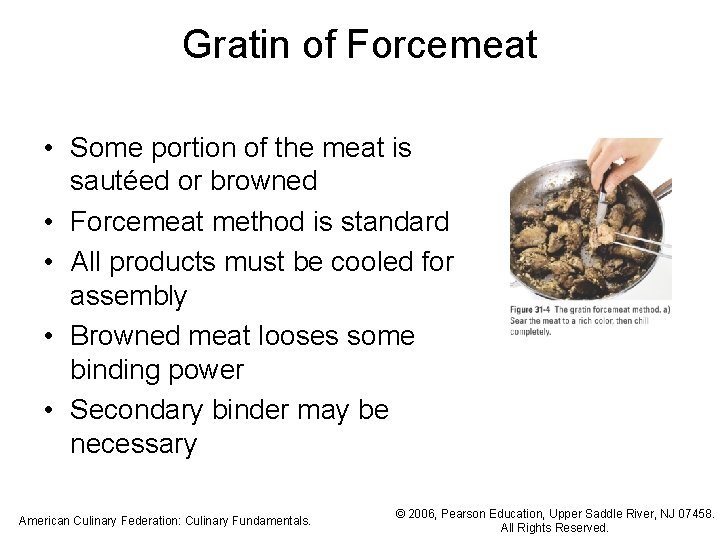
Gratin of Forcemeat • Some portion of the meat is sautéed or browned • Forcemeat method is standard • All products must be cooled for assembly • Browned meat looses some binding power • Secondary binder may be necessary American Culinary Federation: Culinary Fundamentals. © 2006, Pearson Education, Upper Saddle River, NJ 07458. All Rights Reserved.
Mousseline • • A forcemeat with a very light texture Typically made from fish and poultry Cream, eggs add a characteristic lightness Procedure is the same Ice bath, diced meat/fish Binder Chilled equipment American Culinary Federation: Culinary Fundamentals. © 2006, Pearson Education, Upper Saddle River, NJ 07458. All Rights Reserved.
Assembly • A processor will help make a smooth consistency • While processing, cream is drizzled in at the end • Very fast process, cream can separate, and meat can cook • Have everything ready American Culinary Federation: Culinary Fundamentals. © 2006, Pearson Education, Upper Saddle River, NJ 07458. All Rights Reserved.
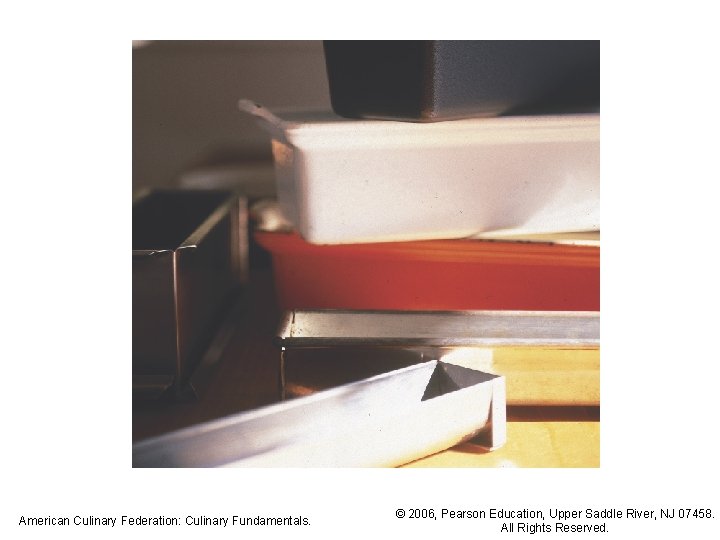
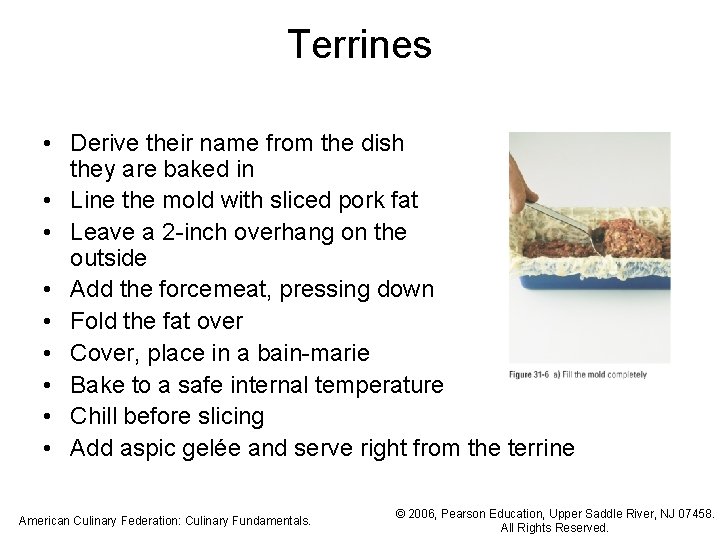
Terrines • Derive their name from the dish they are baked in • Line the mold with sliced pork fat • Leave a 2 -inch overhang on the outside • Add the forcemeat, pressing down • Fold the fat over • Cover, place in a bain-marie • Bake to a safe internal temperature • Chill before slicing • Add aspic gelée and serve right from the terrine American Culinary Federation: Culinary Fundamentals. © 2006, Pearson Education, Upper Saddle River, NJ 07458. All Rights Reserved.
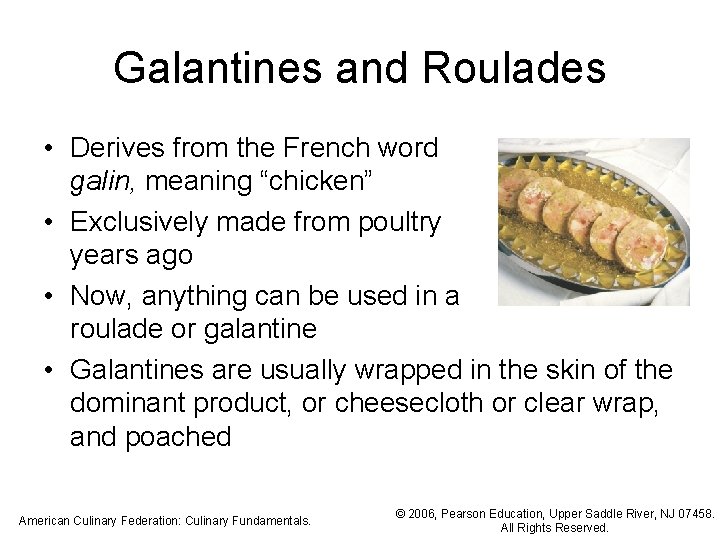
Galantines and Roulades • Derives from the French word galin, meaning “chicken” • Exclusively made from poultry years ago • Now, anything can be used in a roulade or galantine • Galantines are usually wrapped in the skin of the dominant product, or cheesecloth or clear wrap, and poached American Culinary Federation: Culinary Fundamentals. © 2006, Pearson Education, Upper Saddle River, NJ 07458. All Rights Reserved.
Construction • Skin the product, leaving skin intact, and remove the flesh from the bones; chill meat • Make a forcemeat and add any garnish • Lay out the skin, spread the forcemeat evenly (pastry bag is great) • Roll into a tight cylinder, wrap with cheesecloth, clear wrap, foil, or caul fat, or a combination • Poach at 170˚F, until done, submerged on a rack • Cool in the stock, rewrap and chill, hold until you need it American Culinary Federation: Culinary Fundamentals. © 2006, Pearson Education, Upper Saddle River, NJ 07458. All Rights Reserved.
Pâté en Croûte • • Choose the hinged pan and break it apart Spray with an aerosol lubricant (Canola) Prepare a forcemeat Prepare a dough, and cut the dough to line each end, the bottom and sides, and the top (four pieces) • Do not stretch, but roll it out evenly • Line the mold American Culinary Federation: Culinary Fundamentals. © 2006, Pearson Education, Upper Saddle River, NJ 07458. All Rights Reserved.
Pâté en Croûte (continued) • Wash the seams, then line the pastry with sheets of sliced pork fat • Using a pastry bag, fill the mold (alternate layers of garnish) • Put the top crust on with a wash • Cut vent holes, make a chimney with foil for the holes • Make a collar with the remaining dough, and line the hole. • Bake as directed, fill the mold with aspic, chill and slice American Culinary Federation: Culinary Fundamentals. © 2006, Pearson Education, Upper Saddle River, NJ 07458. All Rights Reserved.
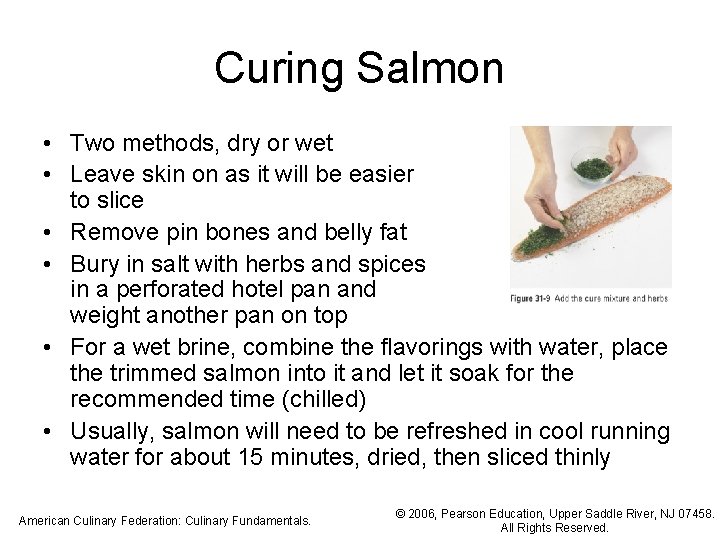
Curing Salmon • Two methods, dry or wet • Leave skin on as it will be easier to slice • Remove pin bones and belly fat • Bury in salt with herbs and spices in a perforated hotel pan and weight another pan on top • For a wet brine, combine the flavorings with water, place the trimmed salmon into it and let it soak for the recommended time (chilled) • Usually, salmon will need to be refreshed in cool running water for about 15 minutes, dried, then sliced thinly American Culinary Federation: Culinary Fundamentals. © 2006, Pearson Education, Upper Saddle River, NJ 07458. All Rights Reserved.