
Unit 3 Using a Multimeter Practice Experiments Introduction





- Slides: 49
Unit 3 Using a Multimeter Practice Experiments
Introduction • Electrical measuring tools to diagnose and repair electrical faults: – – Digital volt-ohmmeters Test lights Fused jumper leads Inductive amperage clamp
Voltage Exercises • Designed to explain use of DVOM in taking DC voltage measurements – Use of different ranges on the meter display – Voltage drops in series circuits across equal and unequal loads – Kirchoff’s voltage law—sum of series voltage drops equals the supply voltage
Voltage Exercises— Voltage Drop • Measured with a voltmeter • Potential difference between two points in a circuit • Sum of all voltage drops in a series circuit equals the supply voltage.
Voltage Exercises— Voltage Drop • To measure voltage drop: – – Set DVOM on the voltage range. Set function switch to “auto range volts DC. ” Connect black lead to COM. Connect red lead to V/Ω.
Voltage Exercises— Voltage Drop • Can be measured across: – Components – Connectors – Cables • Probing lead normally connected to circuit point where voltage needs to be checked
Current Exercises— Measuring Current • To measure current: – – Select “auto range amps DC. ” Connect red lead to A socket. Connect black lead to COM socket. Select appropriate range if using manual.
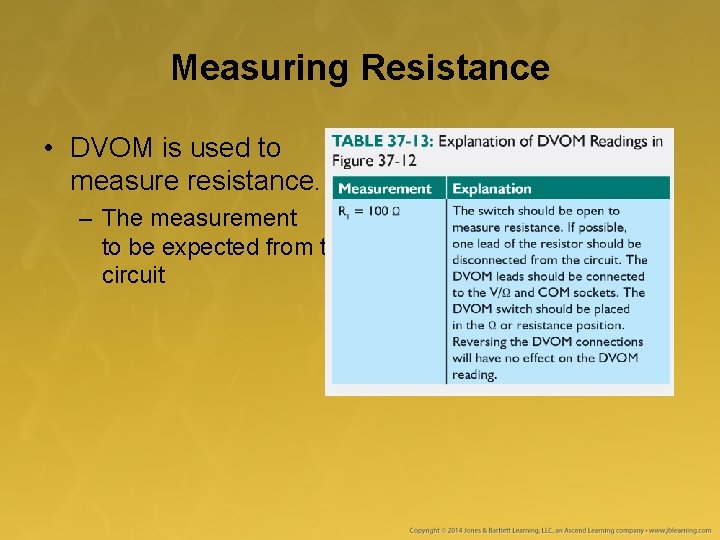
Measuring Resistance • DVOM is used to measure resistance. – The measurement to be expected from the circuit
Series Circuit Exercises (1 of 2) • Examples: – Demonstrate use of measuring voltage and current – Describe how current flows – Describe how voltage drop and current are affected by resistance
Series Circuit Exercises (2 of 2) • Current flow is the same in all parts of a good series circuit. • Sum of voltage drops across individual resistors is equal to supply voltage. • Resistor additions affect current flow and voltage drops.
Series Circuit Exercise 1 (1 of 2) • Measure voltage from series circuit. – To measure voltage drop: • Set DVOM on voltage range. • Connect black lead to COM. • Connect red lead to V/Ω.
Series Circuit Exercise 1 (2 of 2) • Can measure voltage drop across components, connectors, and cables • Current flow for accurate measurements • Can place leads in either direction
Series Circuit Exercise 2 • Measure voltage from series circuit. – To measure voltage drop: • Select “auto range volts DC. ” • Connect black lead to COM. • Connect red lead to V/Ω. • Current must be flowing for measurement.
Series Circuit Exercise 3 • Measure voltage from series circuit. – To measure voltage drop: • Select “auto range volts DC. ” • Connect black lead to COM. • Connect red lead to V/Ω. • Allow current flow for voltage drop measurement.
Series Circuit Exercise 4 • Measure voltage from series circuit. – – Select “auto range volts DC. ” Connect black lead to COM. Connect red lead to V/Ω. Allow current flow for voltage drop measurement.
Series Circuit Exercise 5 • To measure voltage drop: – – – Set DVOM on voltage range. Select “auto range volts DC. ” Connect black lead to COM. Connect red lead to V/Ω. Allow current flow for measurement.
Series Circuit Exercise 6 • To measure voltage drop: – Set DVOM to “DC amps. ” – Connect red lead to A socket. – Connect black lead to COM.
Parallel Circuit Exercises (1 of 3) • Exercises explain DVOM use in measuring volts, amps, and ohms in a parallel circuit. – Commonly used in electrical systems – Understanding relationship between voltage, amperage, and resistance helps diagnose electrical faults.
Parallel Circuit Exercises (2 of 3) • Examples demonstrate: – How to measure volts, amps, and ohms – How current flows and voltage drops in a parallel circuit
Parallel Circuit Exercises (3 of 3) • Laws for parallel circuits – Resistance goes down when more parallel paths are added. – Current flow from individual legs add up in parallel. – Voltage stays the same at all common inputs.
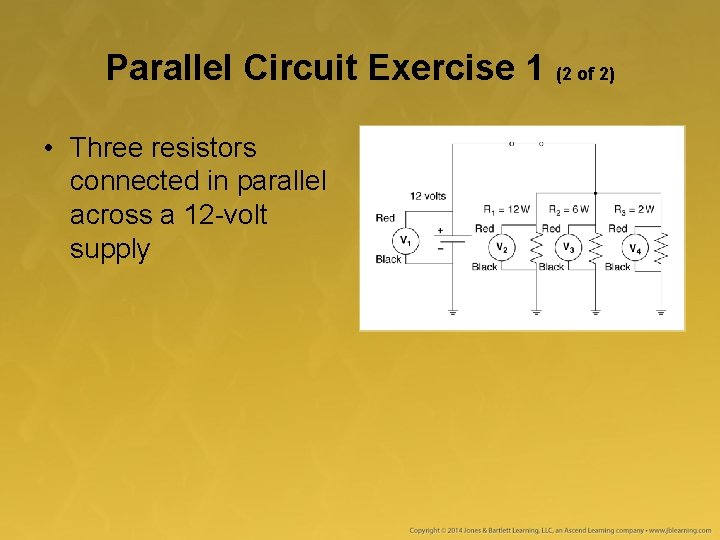
Parallel Circuit Exercise 1 (1 of 2) • Measure voltage from parallel circuits. – – – Set DVOM to measure voltage. Select “auto range volts DC. ” Connect black lead to COM. Connect red lead to V/Ω. Allow current flow for voltage drop measurement.
Parallel Circuit Exercise 1 (2 of 2) • Three resistors connected in parallel across a 12 -volt supply
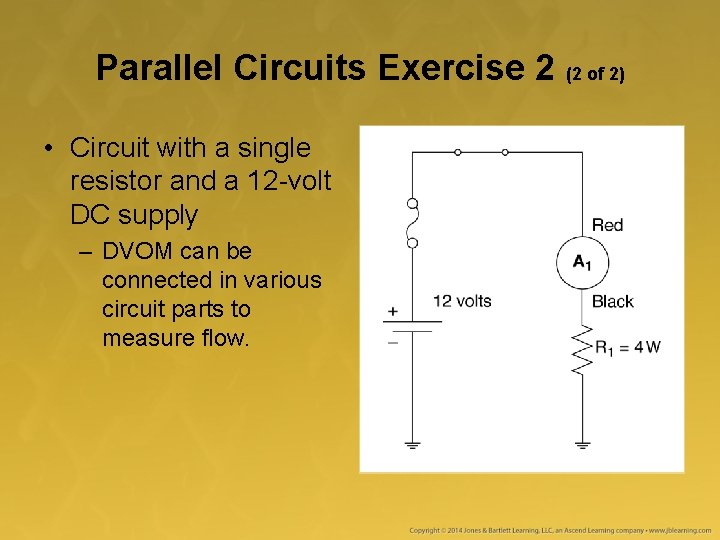
Parallel Circuit Exercise 2 (1 of 2) • To conduct this exercise: – Set DVOM to “DC amps. ” – Connect red lead to A socket. – Connect black lead to COM socket.
Parallel Circuits Exercise 2 (2 of 2) • Circuit with a single resistor and a 12 -volt DC supply – DVOM can be connected in various circuit parts to measure flow.
Parallel Circuits Exercise 3 (1 of 2) • To conduct this exercise: – Set DVOM to “DC amps. ” – Connect red lead to A socket. – Connect black lead to COM socket.
Parallel Circuits Exercise 3 (2 of 2) • Two resistors in parallel – Additional resistor in parallel causes an increase in circuit current flow, decrease in total circuit resistance.
Parallel Circuits Exercise 4 (1 of 2) • To conduct this exercise: – Set DVOM to “DC amps. ” – Connect red lead to A socket. – Connect black lead to COM socket.
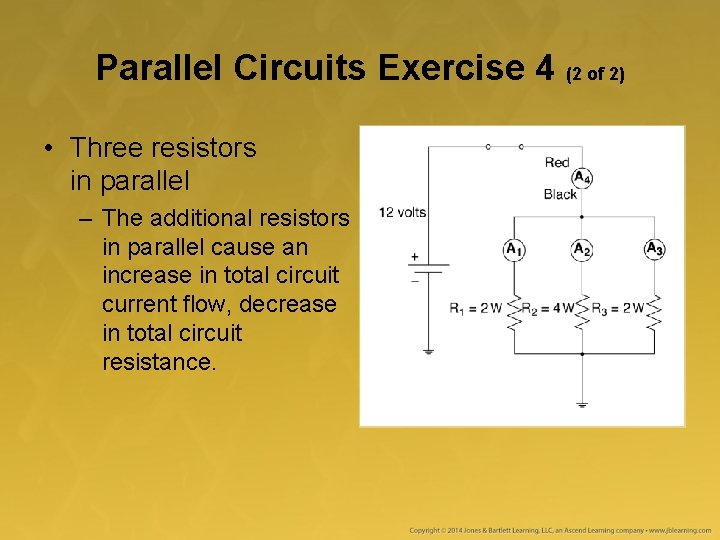
Parallel Circuits Exercise 4 (2 of 2) • Three resistors in parallel – The additional resistors in parallel cause an increase in total circuit current flow, decrease in total circuit resistance.
Parallel Circuits Exercise 5 (1 of 2) • To conduct this exercise: – Set DVOM to “DC amps. ” – Connect red lead to A socket. – Connect black lead to COM socket.
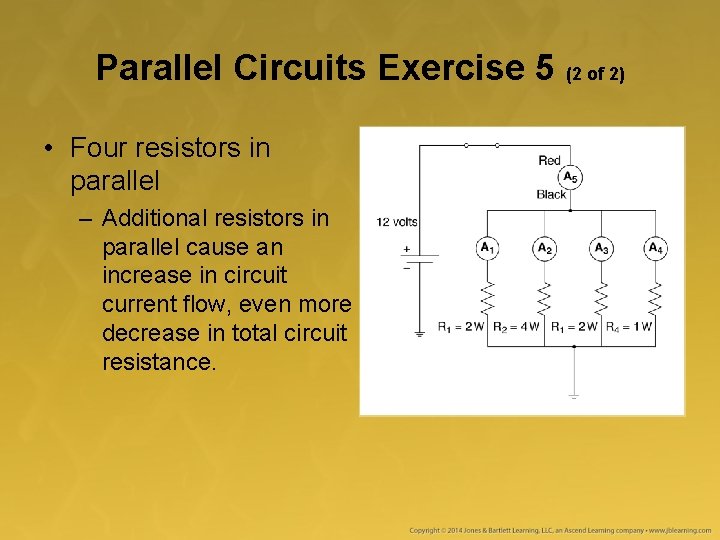
Parallel Circuits Exercise 5 (2 of 2) • Four resistors in parallel – Additional resistors in parallel cause an increase in circuit current flow, even more decrease in total circuit resistance.
Series-Parallel Circuit Exercise (1 of 6) • Exercises explain DVOM in measuring current and voltage in series-parallel circuits. – Found in dash light dimmer and similar circuits – Used when unwanted resistance shows up in parallel circuits
Series-Parallel Circuit Exercise (2 of 6) • Example demonstrates: – Measuring voltage and current – How current flow and voltage drop are affected by resistance • To analyze and calculate current flow and voltage drop, consider total resistance.
Series-Parallel Circuit Exercise (3 of 6) • Voltage drop across parallel branch is the same for all resistances in the branch. • Sum of current flow in each branch equals total parallel circuit current flow. • Exercises examine how resistor additions affect the circuit current and resistance.
Series-Parallel Circuit Exercise (4 of 6) • Voltage and current measurements taken from circuit formed by resistors: – – R 1 R 2 R 3 R 4
Series-Parallel Circuit Exercise (5 of 6) • To measure voltage drop: – – – Set DVOM on voltage range. Select “auto range volts DC. ” Connect black lead to COM. Connect red lead to V/Ω. Allow current flow for measurement.
Series-Parallel Circuit Exercise (6 of 6) • To measure current: – Set DVOM to read DC amps. – Connect red lead to A socket. – Connect black lead to COM socket.
Variable Resistors (1 of 2) • Exercises explain how DVOM measures voltage and amperage with a variable resistor and a potentiometer. • Understand relationship between voltage, resistance, and current as variable resistor is adjusted.
Variable Resistors (2 of 2) • Example demonstrates: – Measuring voltage and current – How current flows – How voltage drop and current are affected by potentiometer wiper
Variable Resistors Exercise (1 of 3) • Variable resistor used as a potentiometer – To measure voltage: • Select “auto range volts DC. ” • Connect red lead to V/Ω. • Connect black lead to COM.
Variable Resistors Exercise (2 of 3) • For current measurements: – – Select “auto range milliamps DC. ” Connect red lead to A socket. Connect black lead to COM socket. If manual, select appropriate range.
Variable Resistors Exercise (3 of 3) • Example: – Circuits with a 250 -Ω variable resistor as a voltage divider with a 12 -volt DC supply • Variable resistor continuously variable • Voltage V 1 a divider output from variable resistor VR 1
Capacitors (1 of 2) • Exercises: – Explain DVOM use in current and voltage in circuit with a capacitor connected in a series with a lamp – Show voltage and current change as the capacitor charges
Capacitors (2 of 2) • Examples demonstrate: – Measuring voltage and current – How current flow and voltage drop change as a capacitor charges • As capacitor charges, voltage drop increases and current flow decreases.
Capacitors Exercise (1 of 3) • Capacitor connected in a series with a lamp – For voltage measurement: • Select “auto range volts DC. ” • Connect red lead to V/Ω. • Connect black lead to COM.
Capacitors Exercise (2 of 3) • For current measurements: – Select “auto range milliamps DC. ” – Connect red lead to A socket. – Connect black lead to COM socket.
Capacitors Exercise (3 of 3) • Capacitor connected in series with a lamp with 12 -volt DC supply – DVOM measures voltage across capacitor and lamp when switched on.
Summary • The digital volt-ohmmeter (DVOM) or digital multimeter (DMM) is an electrical measurement tool used to diagnose and repair electrical faults. • To properly use a DVOM requires time and effort to learn the parts and how it works. • The DVOM can measure volts, ohms, and amps in a circuit.
Summary • An advanced DVOM measures frequency and temperature, and has a dedicated diode test capability. • A DVOM is the first tool used to take electrical measurements.
Credits • Unless otherwise indicated, all photographs and illustrations are under copyright of Jones & Bartlett Learning.