
Unit 3 The Muscular System Lab 1 Muscles
Unit 3: The Muscular System Lab 1: Muscles of the Axial Skeleton Jessica Radke-Snead, RD, MS Bio 241 Anatomy & Physiology
Getting Started • Begin developing your strategy for this unit – Organize your material (ie the study guide, lectures, labs) – Develop a system for processing this information • Start with the broad components – Muscles (categorize and group them) – Indicated origins and insertions (use your knowledge of the skeletal system to guide you) – Function (direction of fibers, type of joint) • Continue to build to your knowledge (not all-inclusive) – – – Histology Characteristics of the three types of muscle tissue Physiology of a muscle contraction Types of muscle contraction Characteristics of muscle contractions Muscle metabolism
Making Sense of the Muscles • Description Location Function – Use muscle origins and insertions to describe where the muscle is located AND what it does • Origin: attachment of one muscle tendon to the stationary bone • Insertion: attachment of the other muscle tendon to the moving bone • Action: the movement that occurs at the joint due to the muscle contraction

Practice Muscle: Origin: Insertion: Sternocleidomastoid Sternum and clavicle Mastoid process of temporal bone Function: 1. Bilaterally: flexion of neck, with tilting of head forward and downward (try this!) 2. Unilaterally: lateral flexion of neck, with rotation of head downward and to the side OPPOSITE of the contracting muscle (try this!)

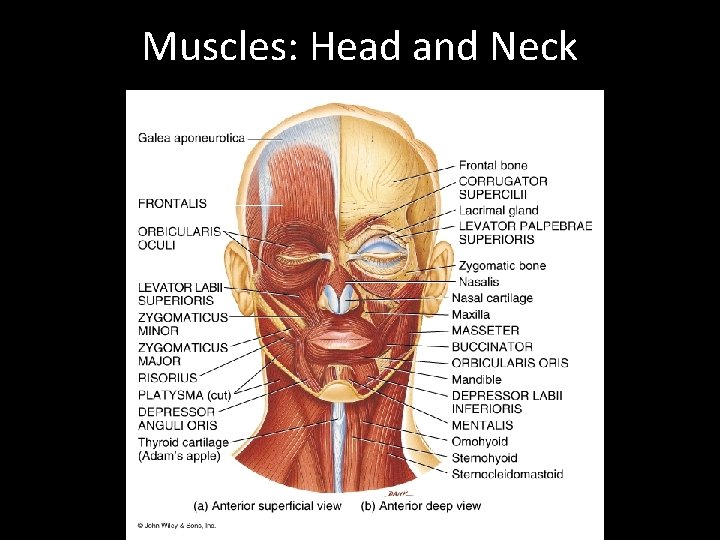
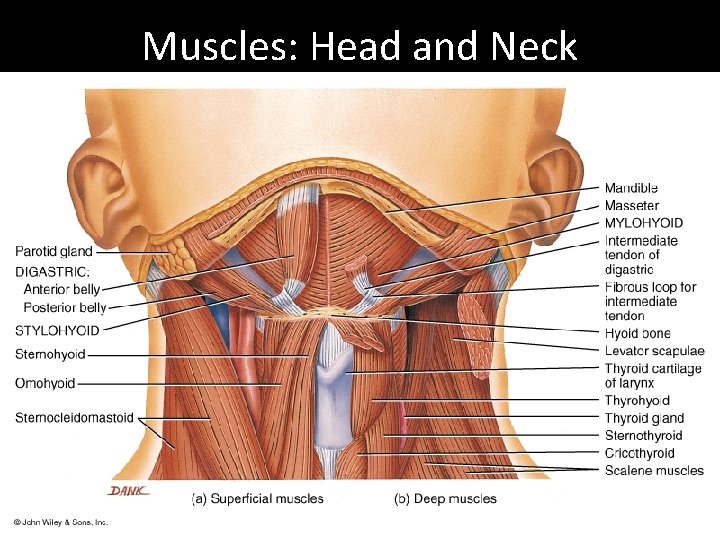
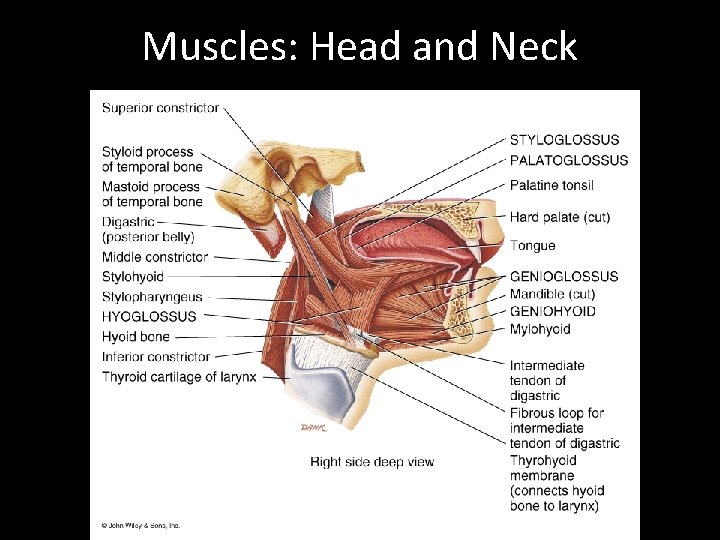
Muscles: Head and Neck • Movements related to – – Facial expression Eyeball Mandible, tongue and pharynx Head and neck • Origin/Insertion requirement – M, T & P: Masseter, genioglossus, stylohyoid, digastric, temporalis – Head and neck: Sternocleidomastoid • Cadaver requirement – Facial expression: Frontalis – Head and neck: Sternocleidomastoid, splenius capitis

Muscles: Head and Neck Masseter O: Maxilla and Zygomatic arch I: Angle and ramus of mandible Fx: and retracts mandible Sternocleidomastoid O: Sternum and clavicle I: Mastoid process Fx: flexion, rotation of neck
Muscles: Head and Neck
Muscles: Head and Neck
Muscles: Head and Neck
Muscles: Trunk • Muscles of – – Breathing Abdominal wall Back (deep) Pelvic floor and perineum • Origin/insertion requirement – Breathing: Diaphragm, internal and external intercostals – Abdominal wall: Rectus abdominis, internal and external obliques and transversus abdominis • Cadaver requirement – Breathing: Internal and external intercostals – Abdominal wall: Rectus abdominis, internal and external obliques and transversus abdominis – Back: Erector spinae (spinalis, longissimus, iliocostalis)
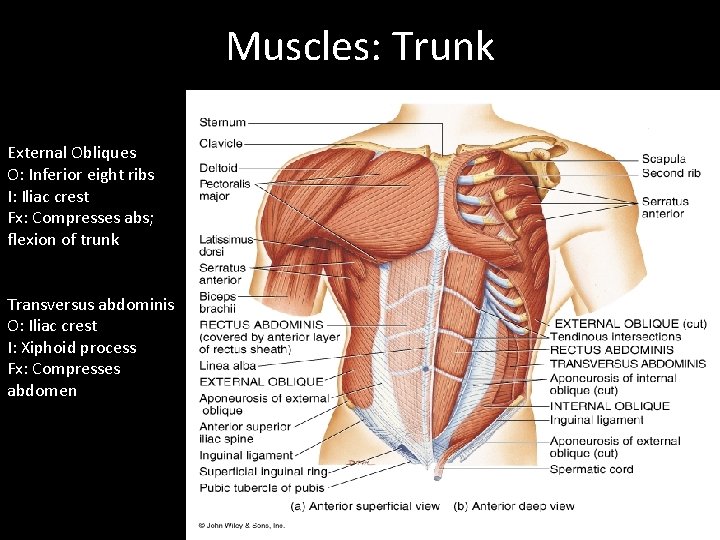
Muscles: Trunk External Obliques O: Inferior eight ribs I: Iliac crest Fx: Compresses abs; flexion of trunk Transversus abdominis O: Iliac crest I: Xiphoid process Fx: Compresses abdomen
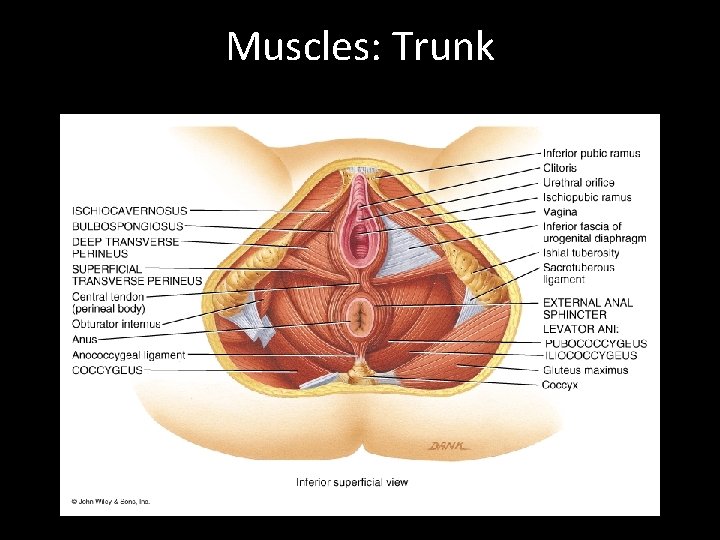
Muscles: Trunk
Lab Objectives • Exam 2 return/review – Please see me if you are struggling with course material • Lab 1: Be able to identify the location and function of each muscle, and origin/insertion if indicated • Lab 2: Cadavers will be used Wednesday – Preview and review Lab 2 muscles prior to this lab Please let me know if you need assistance—have fun!
- Slides: 13