
Unit 3 The English Colonies Lesson 2 New
- Slides: 9
Unit 3: The English Colonies Lesson 2: New England Colonies
2 LESSON 2 The New England Colonies Big Idea English colonists traveled to New England to gain religious freedom. Main Ideas The Pilgrims and Puritans came to America to avoid religious persecution. Religion and government were closely linked in the New England colonies. The New England economy was based on trade and farming. Education was important in the New England colonies. Copyright © by Houghton Mifflin Harcourt Publishing Company
Lesson 3 2 Pilgrims and Puritans Main Idea 1 The Pilgrims and Puritans came to America to avoid religious persecution. • Puritans wanted to purify, or reform, the Anglican Church. • Pilgrims wanted to separate from Anglican Church. • Some pilgrims left England to escape persecution. They became immigrants, people who leave the country of their birth to live in another country. continued… Copyright © by Houghton Mifflin Harcourt Publishing Company
The Pilgrims 4 Mayflower Compact • Left Netherlands in 1620 on the Mayflower • Signed the Mayflower Compact: legal contract agreeing to have fair laws • Arrived at Plymouth Rock in present-day Massachusetts in late 1620 Native Americans • Tisquantum, or Squanto, taught Pilgrims to fertilize soil. • Pilgrims celebrated first Thanksgiving with the Wampanoag Native Americans. Pilgrim Community • Most were farmers. • Family members worked together. • Women had more legal rights than they did in England. continued… Copyright © by Houghton Mifflin Harcourt Publishing Company
Lesson 5 2 Main Idea 1 (continued) The Puritans • Puritans were dissenters who disagreed with official opinions and church actions in England. • Many thousands left England in Great Migration from 1629 to 1640. • Puritan colonists led by John Winthrop went to Massachusetts to seek religious freedom. • Established Massachusetts Bay Colony. Copyright © by Houghton Mifflin Harcourt Publishing Company
Lesson 6 2 Religion and Government in New England Main Idea 2 Religion and government were closely linked in the New England colonies. • The colonists established a General Court that turned into a type of self-government. • Government leaders were also church members. • Dissenters were forced out of the colony. Religious Conflicts • Thomas Hooker and followers founded Connecticut to make government more democratic. • Roger Williams founded Providence and supported the separation of church and state. • Anne Hutchinson questioned teachings of religious leaders and was forced out of the colony. • In the 1690 s Salem held the largest number of witchcraft trials. Nineteen people were put to death. Copyright © by Houghton Mifflin Harcourt Publishing Company
Lesson 7 2 New England Economy Main Idea 3 The New England economy was based on trade and farming. Farming • Harsh climate and rocky soil meant few cash crops. • Most farming families grew crops and raised animals for their own use. • Little need for slaves Copyright © by Houghton Mifflin Harcourt Publishing Company Trade • Merchants traded goods locally, with other colonies, and overseas. • Fishing was one of region’s leading industries. • Shipbuilding was also an important industry. • Skilled trades like blacksmithing, weaving, and printing were in demand. Young boys trained under masters for years to learn trades.
Lesson 8 2 Education in the Colonies Main Idea 4 Education was important in the New England colonies. Public Education • Communities established town schools. • Students used New England Primer, which had stories from the Bible. • Availability of schooling varied in the colonies. • Most children stopped education after elementary grades. Copyright © by Houghton Mifflin Harcourt Publishing Company Higher Education • Important to colonists • John Harvard and the General Court founded Harvard College in 1636. • College of William and Mary founded in Virginia in 1693.
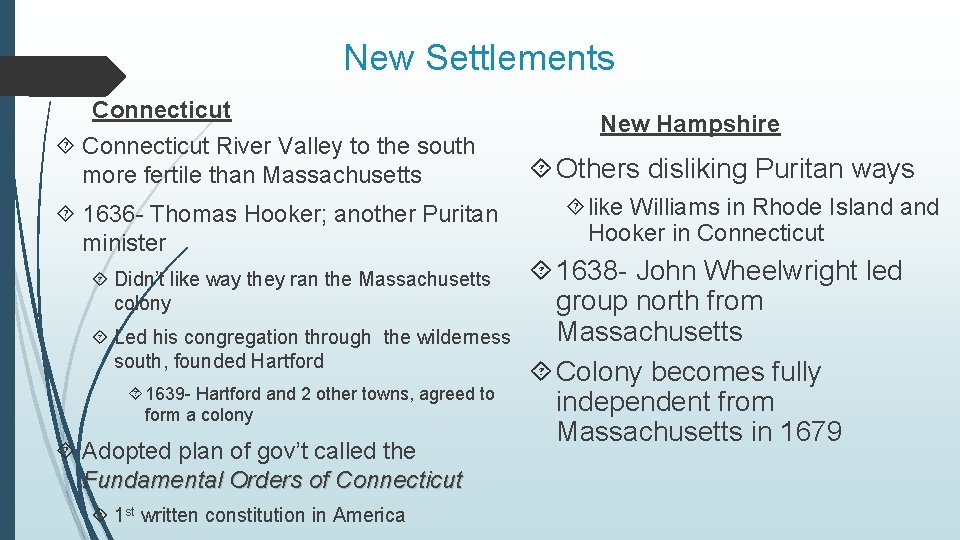
New Settlements Connecticut River Valley to the south more fertile than Massachusetts 1636 - Thomas Hooker; another Puritan minister Didn’t like way they ran the Massachusetts colony Led his congregation through the wilderness south, founded Hartford 1639 - Hartford and 2 other towns, agreed to form a colony Adopted plan of gov’t called the Fundamental Orders of Connecticut 1 st written constitution in America New Hampshire Others disliking Puritan ways like Williams in Rhode Island Hooker in Connecticut 1638 - John Wheelwright led group north from Massachusetts Colony becomes fully independent from Massachusetts in 1679