
Unit 3 The English Colonies Lesson 1 The
- Slides: 13
Unit 3: The English Colonies Lesson 1: The Southern Colonies
2 LESSON 1 The Southern Colonies Big Idea Despite a difficult beginning, the southern colonies soon flourished. Main Ideas Jamestown was the first permanent English settlement in America. Daily life in Virginia was challenging to the colonists. Religious freedom and economic opportunities were motives for founding other southern colonies, including Maryland, the Carolinas, and Georgia. Farming and slavery were important to the economies of the southern colonies. Copyright © by Houghton Mifflin Harcourt Publishing Company
The “Lost” Colony of Roanoke 1578 - Queen Elizabeth I issues 1587 - try again w/ 118 others charter to Sir Humphrey Gilbert to most knew nothing of setting up colonies start a colony Leader goes back for supplies only to return to Dies on the trip 1585 - his brother Sir Walter Raleigh continues charter w/ 100 men off coast of N. Carolina Named Roanoke… set up camp, fort, and agriculture Most settlers went back to England w/ Drake (visiting in 1586) a deserted island. No one knows or has ever found out what happened to “The Lost Colony” Discourages others from planning more English colonies
Lesson 4 1 Settlement in Jamestown Main Idea 1: Jamestown was the first permanent English settlement in America. • King James I allowed the London Company to settle in a region called Virginia. • The first colonists arrived in America on April 26, 1607. • They settled in Jamestown, the first permanent English settlement in America. • The colonists were not prepared to build and farm. Two-thirds died by their first winter. continued… Copyright © by Houghton Mifflin Harcourt Publishing Company
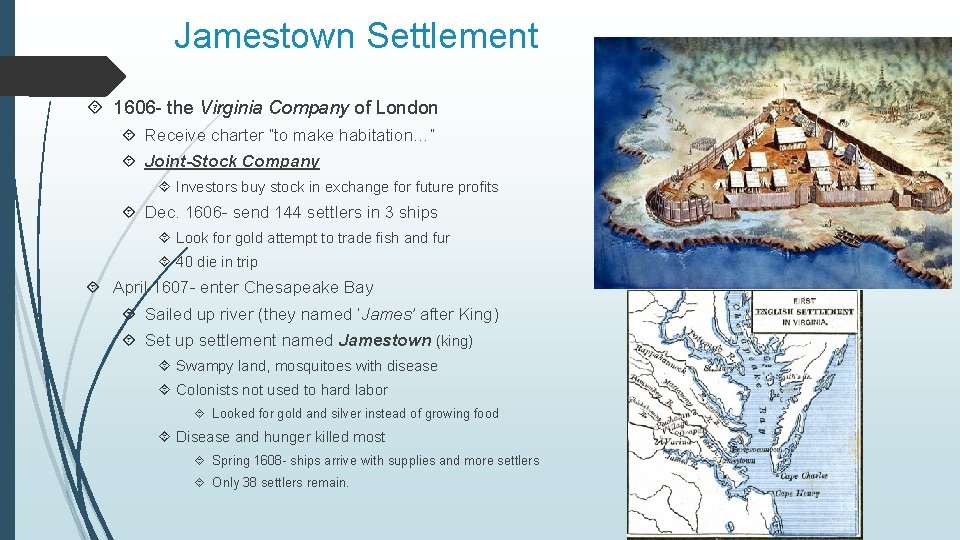
Jamestown Settlement 1606 - the Virginia Company of London Receive charter “to make habitation…” Joint-Stock Company Investors buy stock in exchange for future profits Dec. 1606 - send 144 settlers in 3 ships Look for gold attempt to trade fish and fur 40 die in trip April 1607 - enter Chesapeake Bay Sailed up river (they named ‘James’ after King) Set up settlement named Jamestown (king) Swampy land, mosquitoes with disease Colonists not used to hard labor Looked for gold and silver instead of growing food Disease and hunger killed most Spring 1608 - ships arrive with supplies and more settlers Only 38 settlers remain.
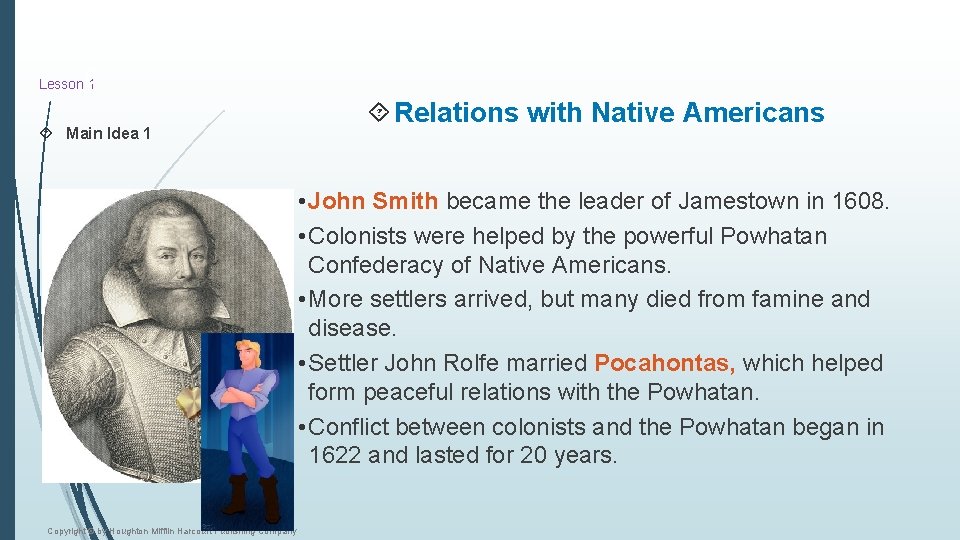
Lesson 6 1 Main Idea 1 Relations with Native Americans • John Smith became the leader of Jamestown in 1608. • Colonists were helped by the powerful Powhatan Confederacy of Native Americans. • More settlers arrived, but many died from famine and disease. • Settler John Rolfe married Pocahontas, which helped form peaceful relations with the Powhatan. • Conflict between colonists and the Powhatan began in 1622 and lasted for 20 years. Copyright © by Houghton Mifflin Harcourt Publishing Company
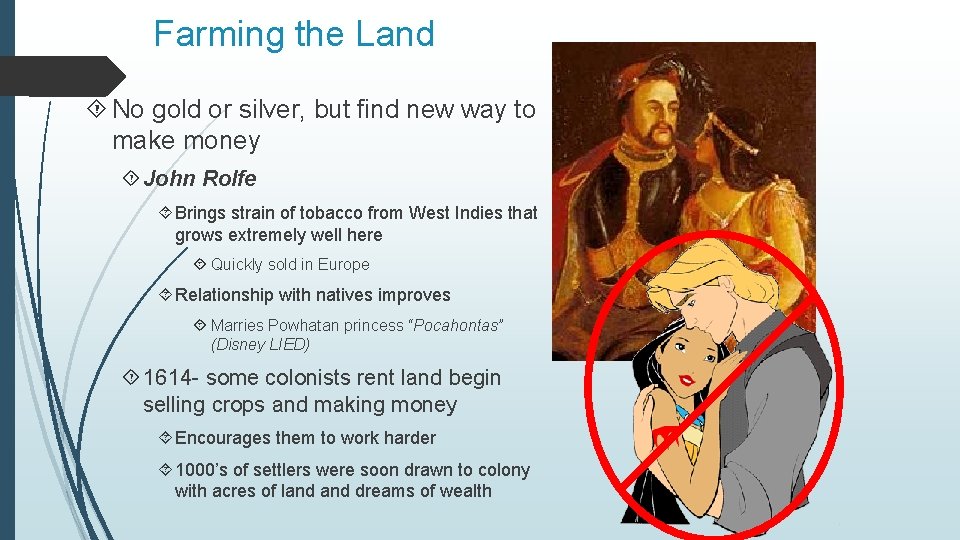
Farming the Land No gold or silver, but find new way to make money John Rolfe Brings strain of tobacco from West Indies that grows extremely well here Quickly sold in Europe Relationship with natives improves Marries Powhatan princess “Pocahontas” (Disney LIED) 1614 - some colonists rent land begin selling crops and making money Encourages them to work harder 1000’s of settlers were soon drawn to colony with acres of land dreams of wealth
New Arrivals in Jamestown 1619 - Virginia Company sends 90 women “Colony can never flourish till families be planted” Colonists who wanted one had to pay a fee (120 lbs. of tobacco) 1619 - Dutch ship arrives 20 Africans sold to planters to help in fields & as servants 1 st Africans came as indentured servants Became free, some even owned land By 1660’s slavery recognized by law
Lesson 9 1 Daily Life in Virginia Main Idea 2 Daily life in Virginia was challenging to the colonists. Headright System • Large farms, called plantations, were established by tobacco farmers. • Colonists who paid their way to Virginia received 50 acres of land 50 acres for each person they brought. Labor • Most workers were indentured servants, people who came to America for free by agreeing to work without pay for a set amount of time. • The first Africans were brought as slaves and servants in 1619. Increased work and the falling cost of slaves led colonists to use more slave labor. continued… Copyright © by Houghton Mifflin Harcourt Publishing Company
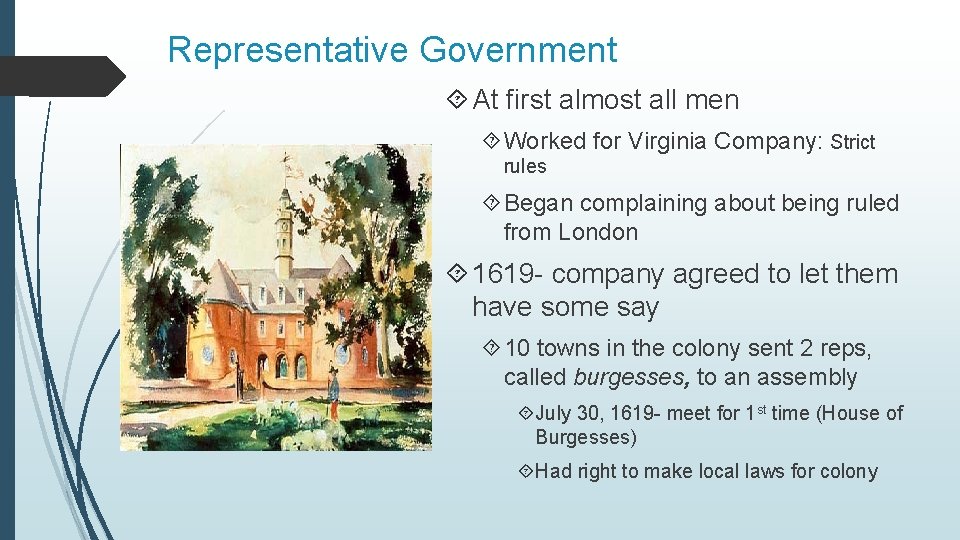
Representative Government At first almost all men Worked for Virginia Company: Strict rules Began complaining about being ruled from London 1619 - company agreed to let them have some say 10 towns in the colony sent 2 reps, called burgesses, to an assembly July 30, 1619 - meet for 1 st time (House of Burgesses) Had right to make local laws for colony
111 Lesson Main Idea 2 (continued) Women and Children • Most settlers in Virginia were men until 1620, when the Virginia Company allowed more women to move to the colony. • Women offered valuable skills: making soap and candles, sewing and mending clothes, and cooking. • Children also spent most of their time working. Copyright © by Houghton Mifflin Harcourt Publishing Company Bacon’s Rebellion • Colonial officials began to tax colonists. • Nathaniel Bacon led a rebellion against the governor’s policies in 1676.
121 Lesson Other Southern Colonies Main Idea 3 Religious freedom and economic opportunities were motives for founding other southern colonies, including Maryland, the Carolinas, and Georgia. The Carolinas • Carolina was founded south of Virginia in 1663. • It was divided into North and South Carolina in 1712. • Most colonists in North Carolina were farmers. • South Carolina had large plantations with many slaves. Copyright © by Houghton Mifflin Harcourt Publishing Company Maryland • Maryland was founded north of Virginia in 1632. • The colony was intended as a refuge for Catholics. • Colonists in Maryland raised corn, cattle, hogs, and, eventually, tobacco. • Protestants began moving to Maryland in the 1640 s, which prompted the colonial assembly to pass the Toleration Act of 1649. Georgia • Georgia was founded by James Oglethorpe as a refuge for debtors in 1733. • He wanted small farms, so he outlawed slavery and limited land grants. • Settlers grew unhappy, and Georgia became a royal colony. Large rice plantations, worked by many slaves, were created.
131 Lesson Economies of the Southern Colonies Main Idea 4 Farming and slavery were important to the economies of the southern colonies. • Economies of the South depended on agriculture. Cash crops were tobacco, rice, and indigo. • The labor intensive cash crops and the long growing season meant more labor was needed. • Enslaved Africans became the main source of labor. • The conditions of slavery were brutal. • Slave codes, or laws to control slaves, were passed. Copyright © by Houghton Mifflin Harcourt Publishing Company