
Unit 3 Sections B C D Petroleum An
Unit 3 – Sections B, C & D Petroleum: An Energy Source, A Building Material Source & Energy Alternative to Petroleum

HW 1 Read and take notes on B. 1 & B. 2 (starting on pg. 238)
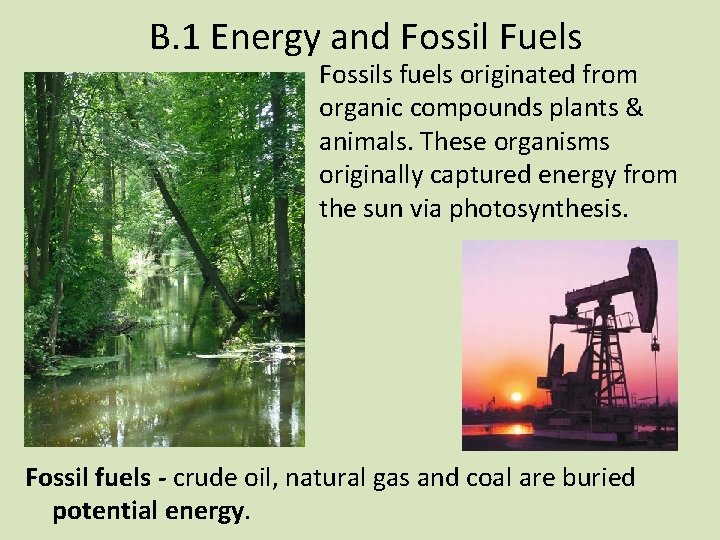
B. 1 Energy and Fossil Fuels Fossils fuels originated from organic compounds plants & animals. These organisms originally captured energy from the sun via photosynthesis. Fossil fuels - crude oil, natural gas and coal are buried potential energy.
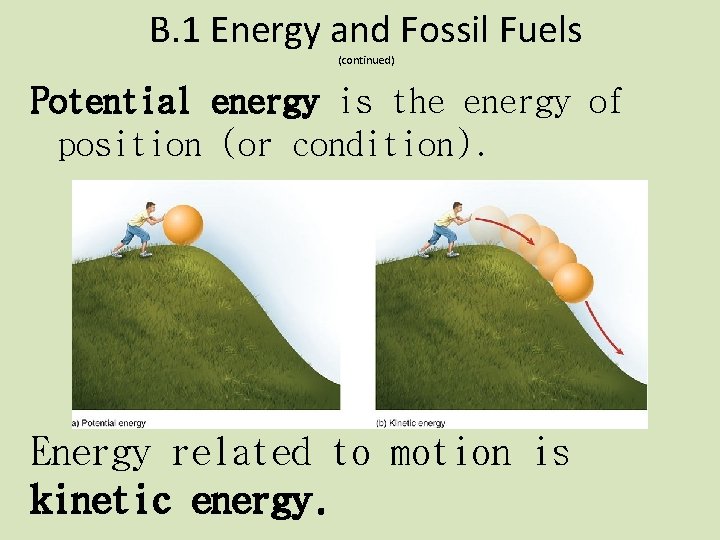
B. 1 Energy and Fossil Fuels (continued) Potential energy is the energy of position (or condition). Energy related to motion is kinetic energy.
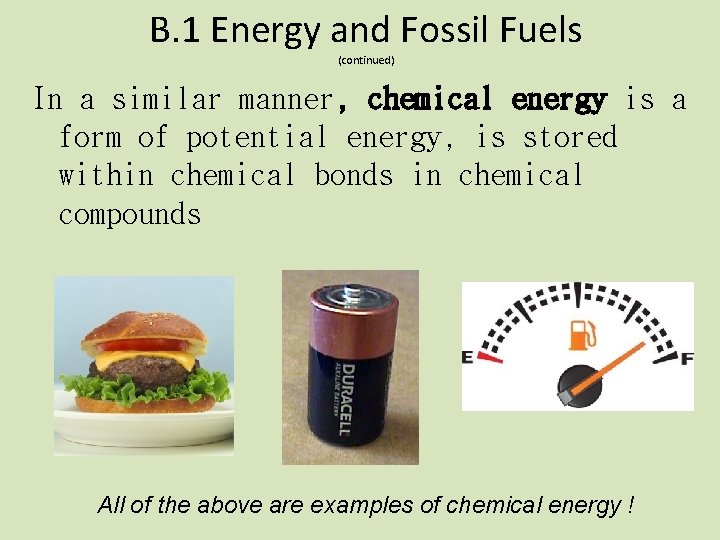
B. 1 Energy and Fossil Fuels (continued) In a similar manner, chemical energy is a form of potential energy, is stored within chemical bonds in chemical compounds All of the above are examples of chemical energy !
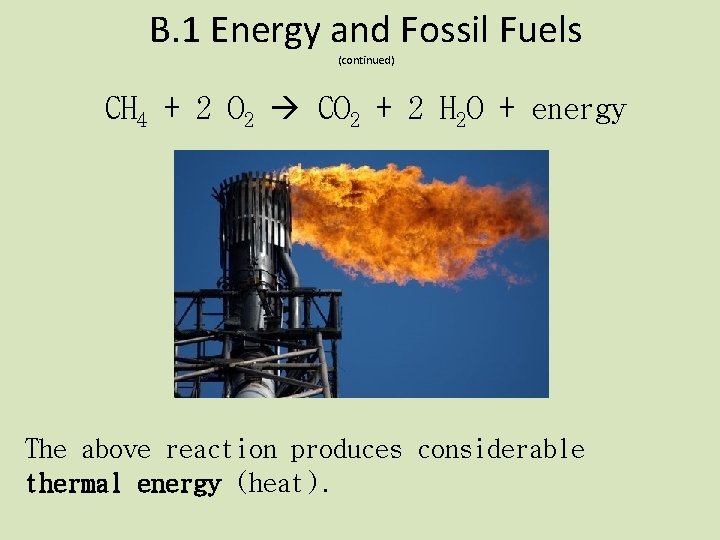
B. 1 Energy and Fossil Fuels (continued) CH 4 + 2 O 2 CO 2 + 2 H 2 O + energy The above reaction produces considerable thermal energy (heat).
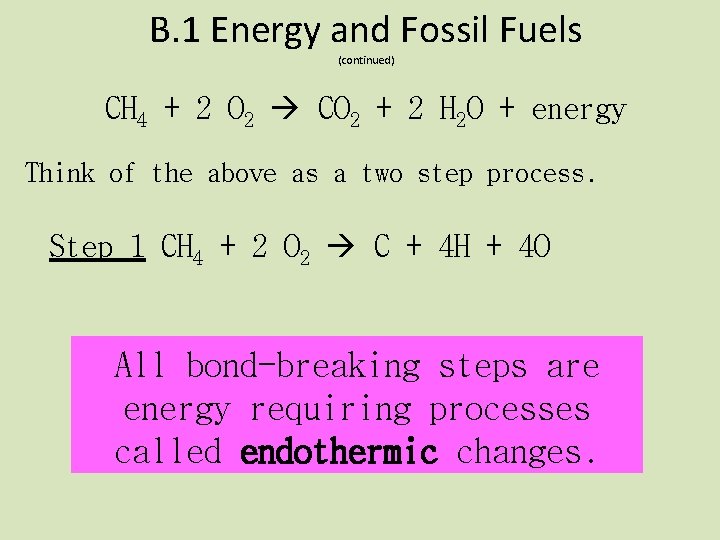
B. 1 Energy and Fossil Fuels (continued) CH 4 + 2 O 2 CO 2 + 2 H 2 O + energy Think of the above as a two step process. Step 1 CH 4 + 2 O 2 C + 4 H + 4 O All bond-breaking steps are energy requiring processes called endothermic changes.
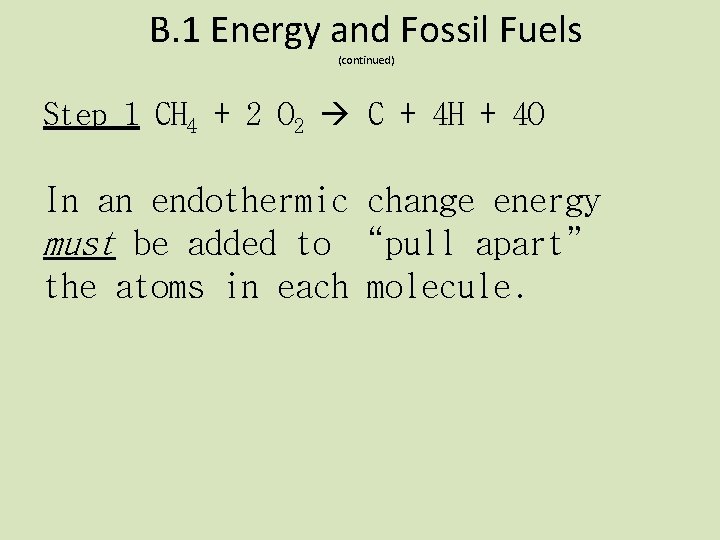
B. 1 Energy and Fossil Fuels (continued) Step 1 CH 4 + 2 O 2 C + 4 H + 4 O In an endothermic change energy must be added to “pull apart” the atoms in each molecule.
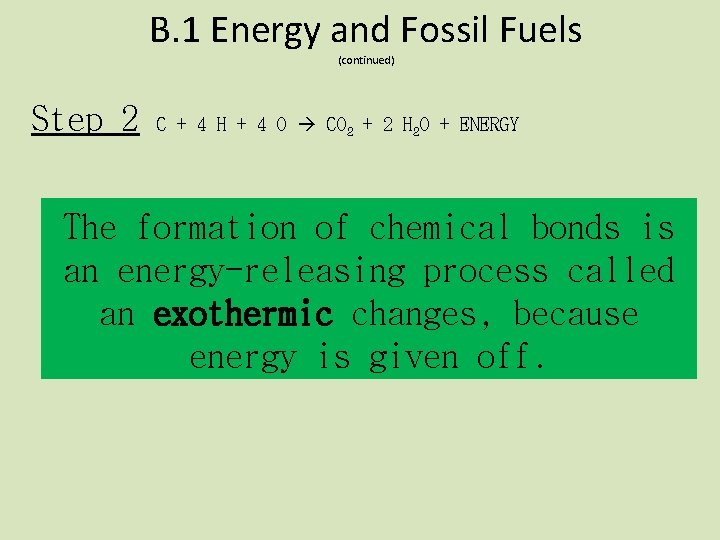
B. 1 Energy and Fossil Fuels (continued) Step 2 C + 4 H + 4 O CO 2 + 2 H 2 O + ENERGY The formation of chemical bonds is an energy-releasing process called an exothermic changes, because energy is given off.
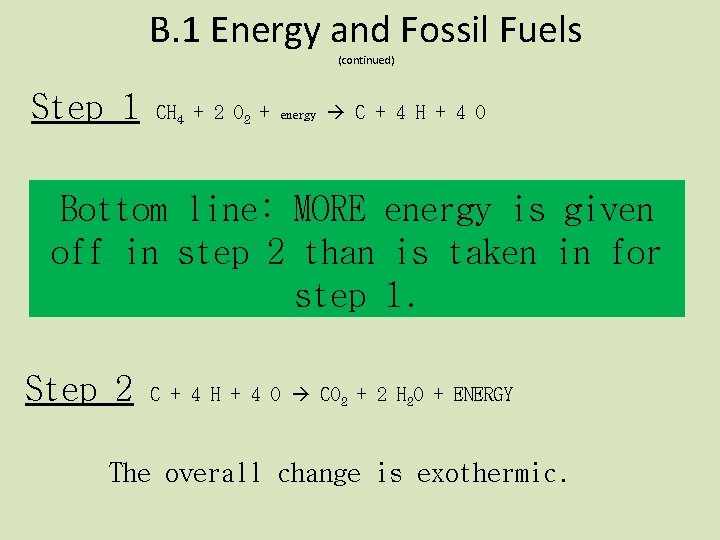
B. 1 Energy and Fossil Fuels (continued) Step 1 CH 4 + 2 O 2 + energy C + 4 H + 4 O Bottom line: MORE energy is given off in step 2 than is taken in for step 1. Step 2 C + 4 H + 4 O CO 2 + 2 H 2 O + ENERGY The overall change is exothermic.
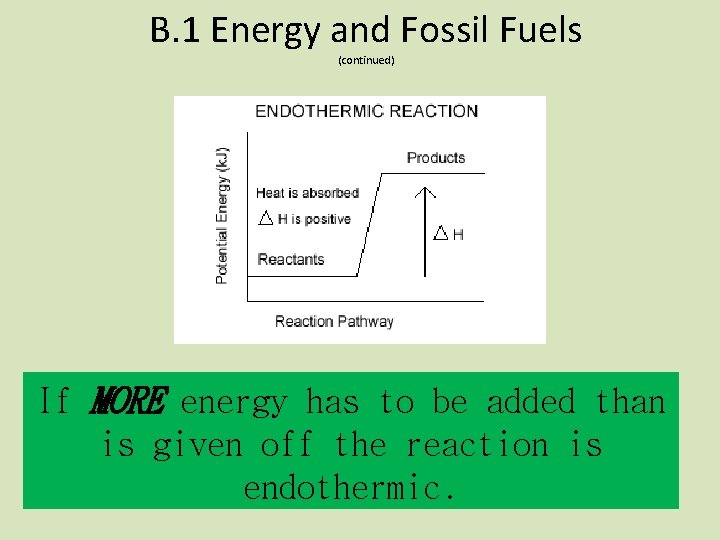
B. 1 Energy and Fossil Fuels (continued) If MORE energy has to be added than is given off the reaction is endothermic.
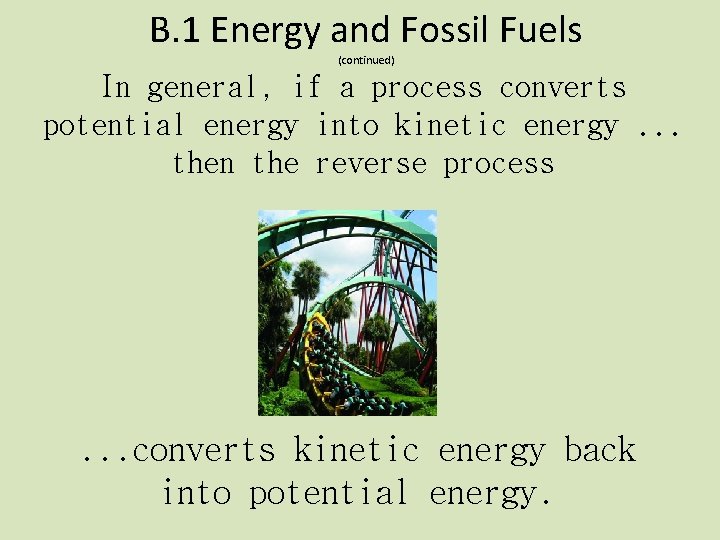
B. 1 Energy and Fossil Fuels (continued) In general, if a process converts potential energy into kinetic energy. . . then the reverse process . . . converts kinetic energy back into potential energy.
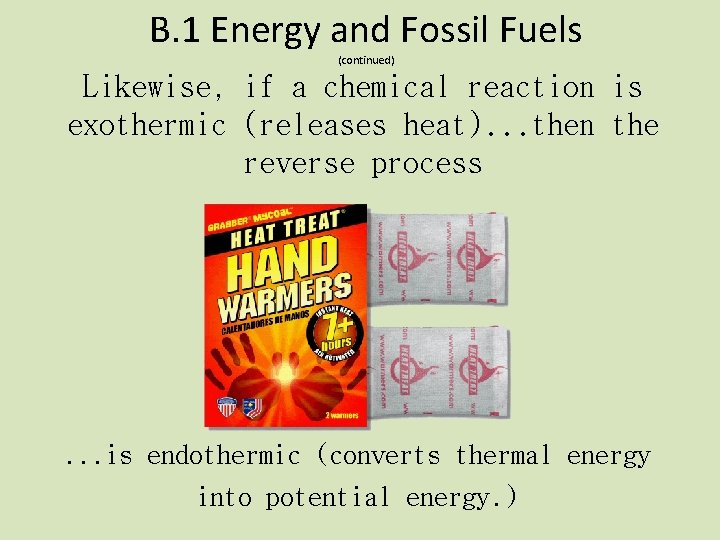
B. 1 Energy and Fossil Fuels (continued) Likewise, if a chemical reaction is exothermic (releases heat). . . then the reverse process . . . is endothermic (converts thermal energy into potential energy. )
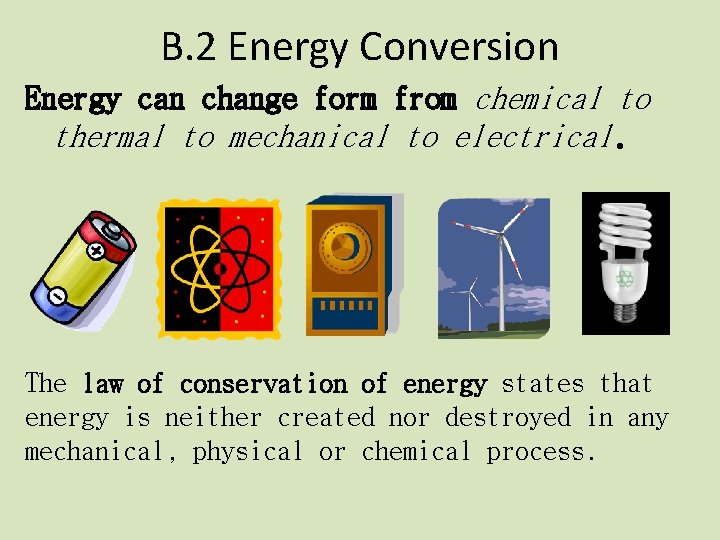
B. 2 Energy Conversion Energy can change form from chemical to thermal to mechanical to electrical. The law of conservation of energy states that energy is neither created nor destroyed in any mechanical, physical or chemical process.
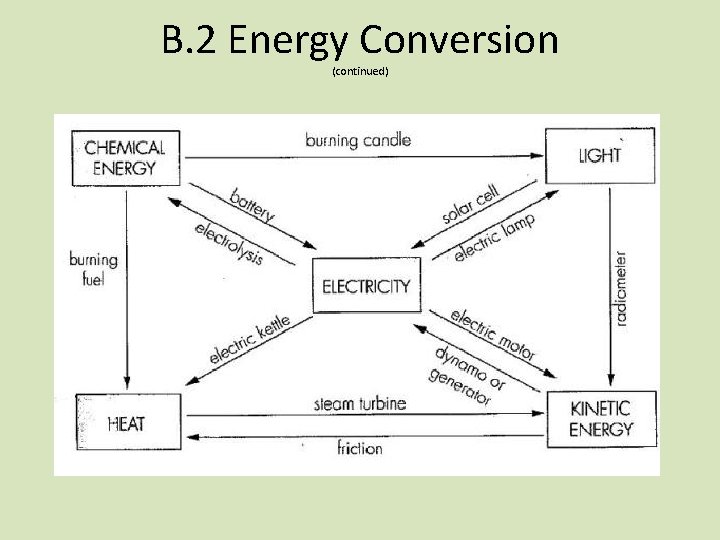
B. 2 Energy Conversion (continued)

HW 2 Notes from B. 4
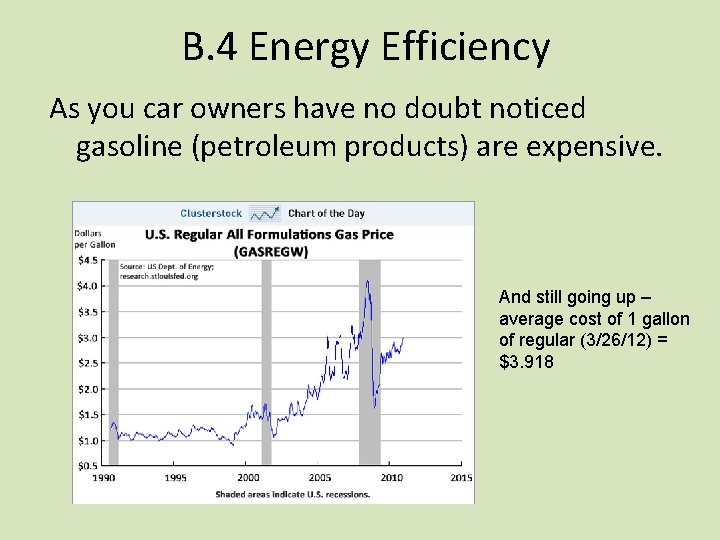
B. 4 Energy Efficiency As you car owners have no doubt noticed gasoline (petroleum products) are expensive. And still going up – average cost of 1 gallon of regular (3/26/12) = $3. 918
B. 4 Energy Efficiency (continued) Unfortunately devices which convert chemical energy thermal mechanical energy are typically less than 50% efficient
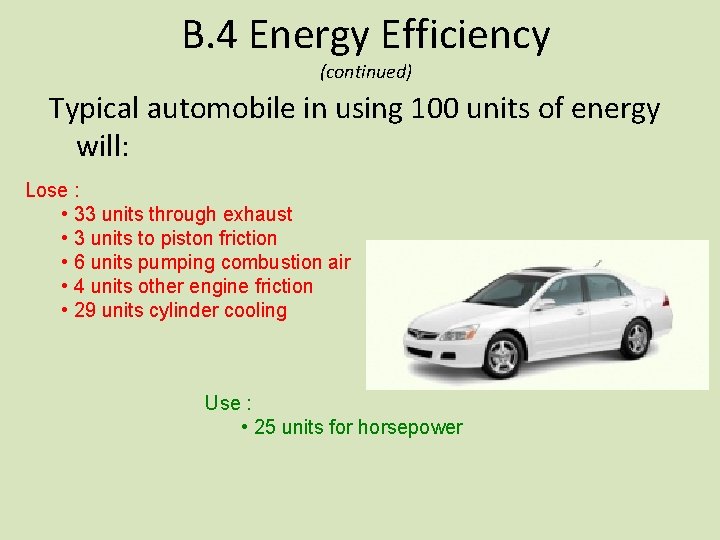
B. 4 Energy Efficiency (continued) Typical automobile in using 100 units of energy will: Lose : • 33 units through exhaust • 3 units to piston friction • 6 units pumping combustion air • 4 units other engine friction • 29 units cylinder cooling Use : • 25 units for horsepower

HW Before Class Work 2 Answer questions in B. 5 1 -4 on pg 245, making certain to show all work AND ESPECIALLY CONVERSION FACTORS
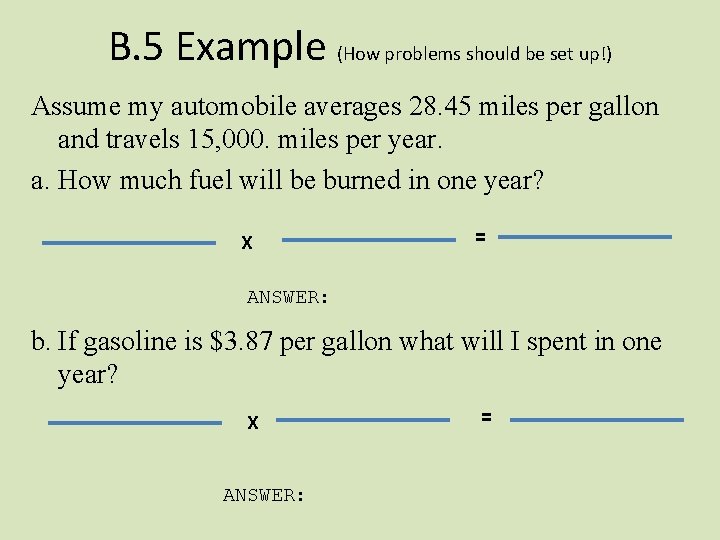
B. 5 Example (How problems should be set up!) Assume my automobile averages 28. 45 miles per gallon and travels 15, 000. miles per year. a. How much fuel will be burned in one year? X = ANSWER: b. If gasoline is $3. 87 per gallon what will I spent in one year? X ANSWER: =
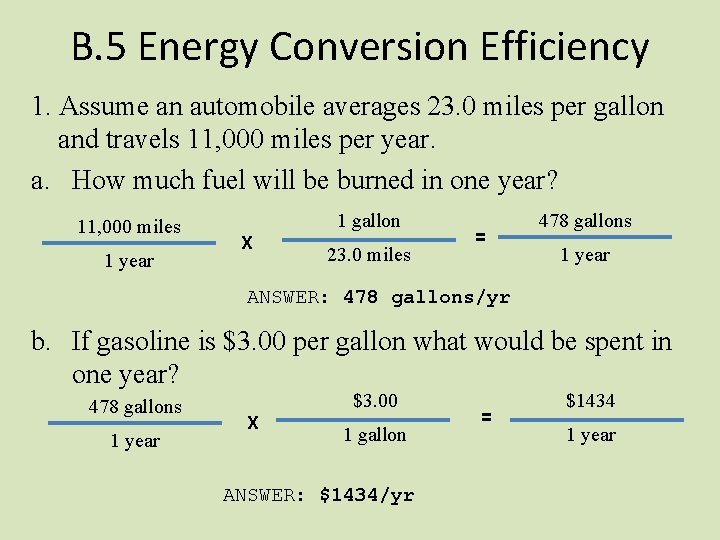
B. 5 Energy Conversion Efficiency 1. Assume an automobile averages 23. 0 miles per gallon and travels 11, 000 miles per year. a. How much fuel will be burned in one year? 11, 000 miles 1 year 1 gallon X 23. 0 miles = 478 gallons 1 year ANSWER: 478 gallons/yr b. If gasoline is $3. 00 per gallon what would be spent in one year? 478 gallons 1 year $3. 00 X 1 gallon ANSWER: $1434/yr = $1434 1 year
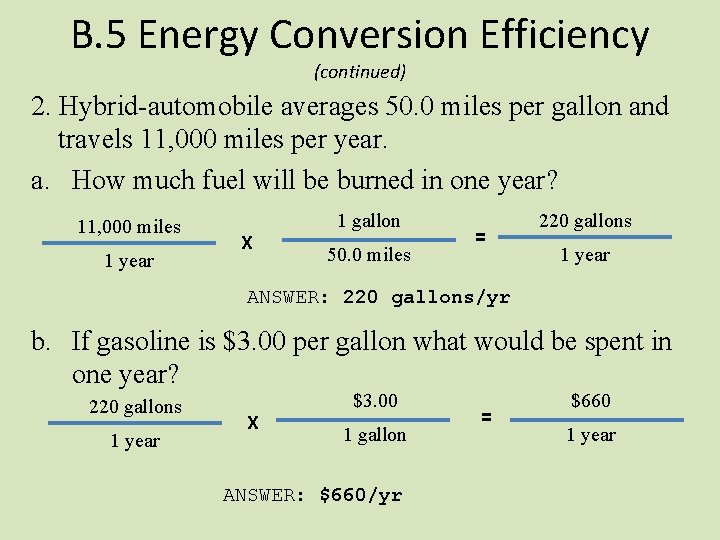
B. 5 Energy Conversion Efficiency (continued) 2. Hybrid-automobile averages 50. 0 miles per gallon and travels 11, 000 miles per year. a. How much fuel will be burned in one year? 11, 000 miles 1 year 1 gallon X 50. 0 miles = 220 gallons 1 year ANSWER: 220 gallons/yr b. If gasoline is $3. 00 per gallon what would be spent in one year? 220 gallons 1 year $3. 00 X 1 gallon ANSWER: $660/yr = $660 1 year
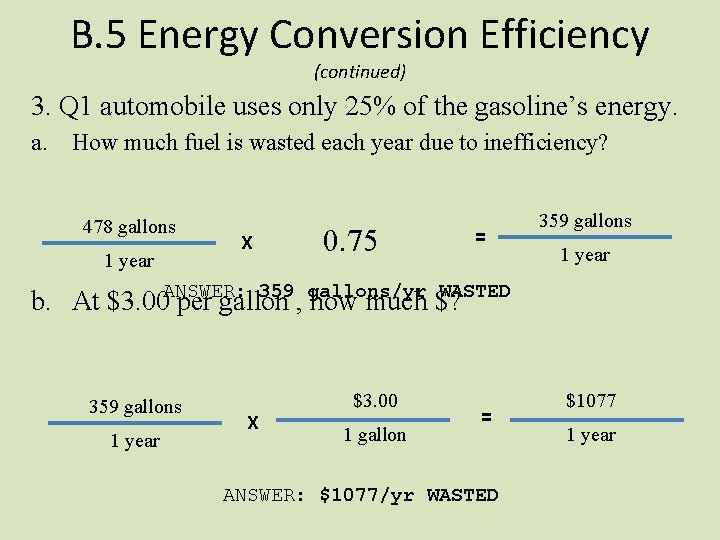
B. 5 Energy Conversion Efficiency (continued) 3. Q 1 automobile uses only 25% of the gasoline’s energy. a. How much fuel is wasted each year due to inefficiency? 478 gallons 1 year X 0. 75 = 359 gallons 1 year 359 gallons/yr WASTED b. At $3. 00 ANSWER: per gallon , how much $? 359 gallons 1 year $3. 00 X 1 gallon = ANSWER: $1077/yr WASTED $1077 1 year
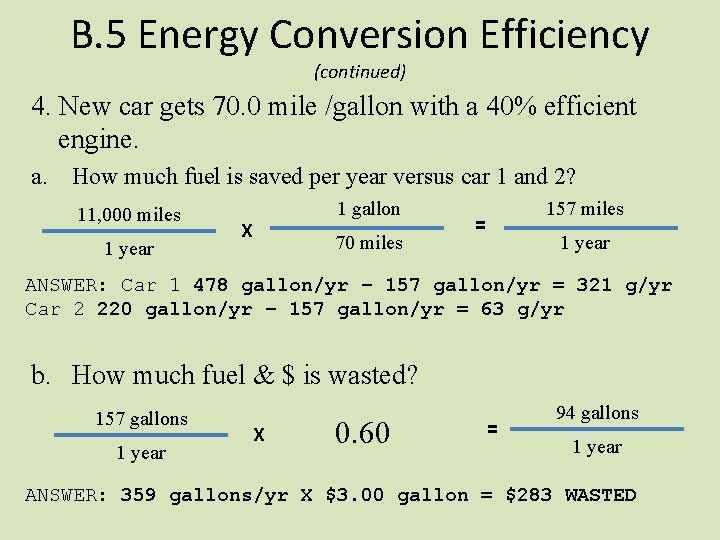
B. 5 Energy Conversion Efficiency (continued) 4. New car gets 70. 0 mile /gallon with a 40% efficient engine. a. How much fuel is saved per year versus car 1 and 2? 11, 000 miles 1 year 1 gallon X 70 miles 157 miles = 1 year ANSWER: Car 1 478 gallon/yr – 157 gallon/yr = 321 g/yr Car 2 220 gallon/yr – 157 gallon/yr = 63 g/yr b. How much fuel & $ is wasted? 157 gallons 1 year X 0. 60 = 94 gallons 1 year ANSWER: 359 gallons/yr X $3. 00 gallon = $283 WASTED
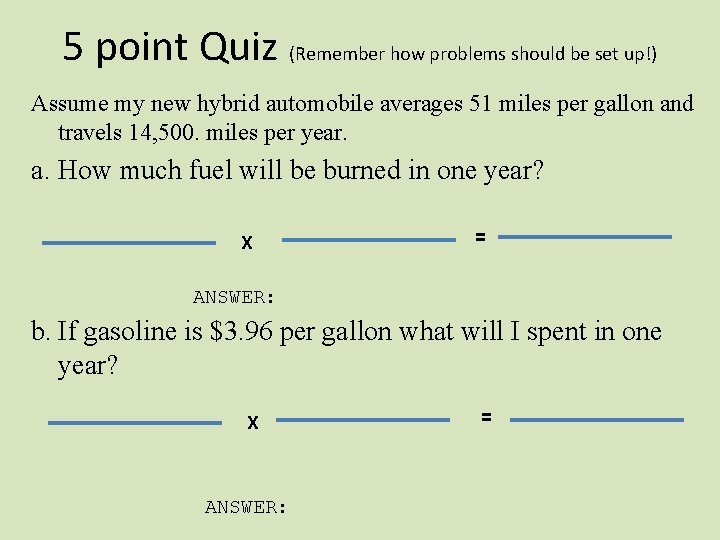
5 point Quiz (Remember how problems should be set up!) Assume my new hybrid automobile averages 51 miles per gallon and travels 14, 500. miles per year. a. How much fuel will be burned in one year? X = ANSWER: b. If gasoline is $3. 96 per gallon what will I spent in one year? X ANSWER: =
B. 6 Combustion Pre-read B. 6 – pg 248 -251
B. 6 Combustion (continued) Questions ? Characteristic property of material is the amount of heat it takes to raise the temperature of 1 g of material 1°C This is called the specific heat capacity of the material.

HW Read and take notes on B. 7 starting on pg. 251
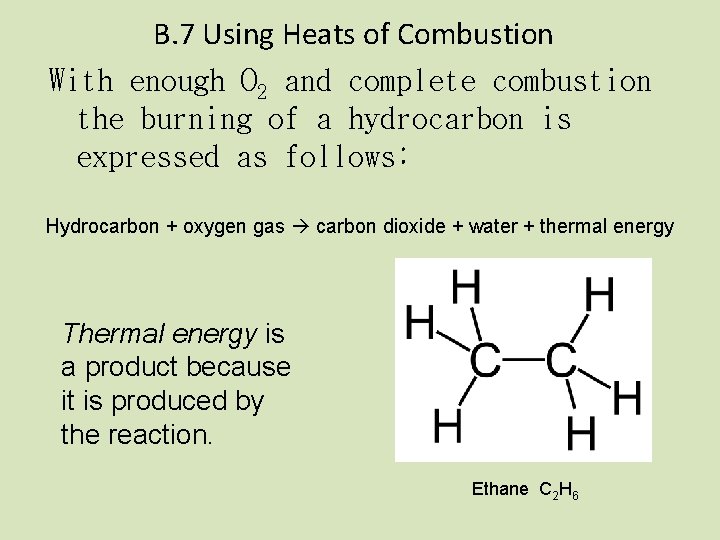
B. 7 Using Heats of Combustion With enough O 2 and complete combustion the burning of a hydrocarbon is expressed as follows: Hydrocarbon + oxygen gas carbon dioxide + water + thermal energy Thermal energy is a product because it is produced by the reaction. Ethane C 2 H 6
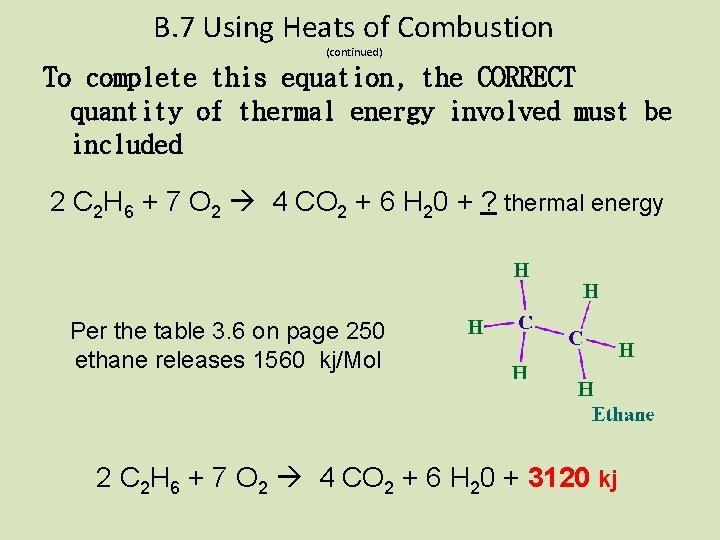
B. 7 Using Heats of Combustion (continued) To complete this equation, the CORRECT quantity of thermal energy involved must be included 2 C 2 H 6 + 7 O 2 4 CO 2 + 6 H 20 + ? thermal energy Per the table 3. 6 on page 250 ethane releases 1560 kj/Mol 2 C 2 H 6 + 7 O 2 4 CO 2 + 6 H 20 + 3120 kj
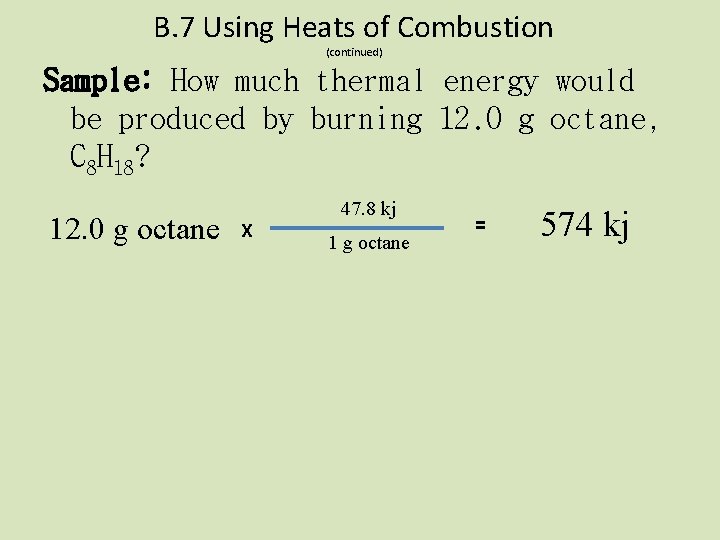
B. 7 Using Heats of Combustion (continued) Sample: How much thermal energy would be produced by burning 12. 0 g octane, C 8 H 18? 12. 0 g octane 47. 8 kj X 1 g octane = 574 kj
Classwork Class work B. 8 on pg 252 – Questions 1 a. -d. , 2 a. & 3 a. -d. - show work and especially conversion factors
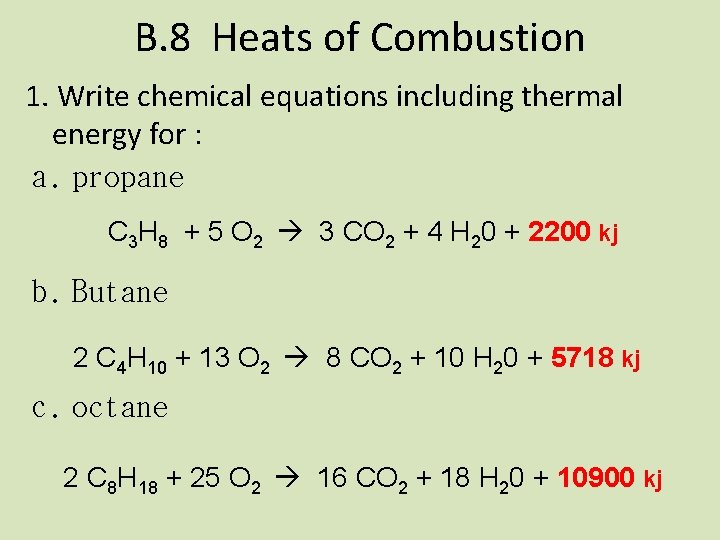
B. 8 Heats of Combustion 1. Write chemical equations including thermal energy for : a. propane C 3 H 8 + 5 O 2 3 CO 2 + 4 H 20 + 2200 kj b. Butane 2 C 4 H 10 + 13 O 2 8 CO 2 + 10 H 20 + 5718 kj c. octane 2 C 8 H 18 + 25 O 2 16 CO 2 + 18 H 20 + 10900 kj
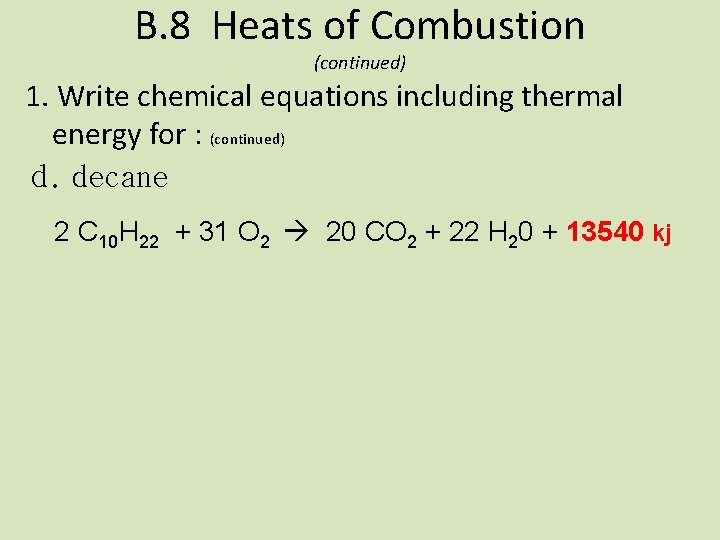
B. 8 Heats of Combustion (continued) 1. Write chemical equations including thermal energy for : (continued) d. decane 2 C 10 H 22 + 31 O 2 20 CO 2 + 22 H 20 + 13540 kj
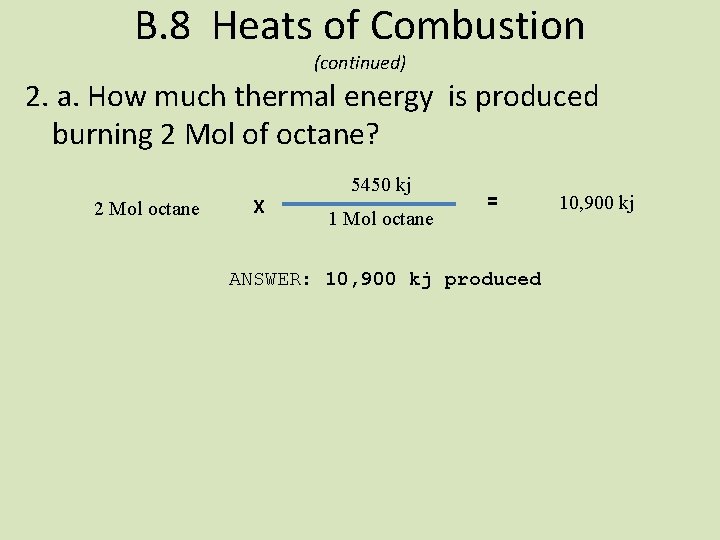
B. 8 Heats of Combustion (continued) 2. a. How much thermal energy is produced burning 2 Mol of octane? 5450 kj 2 Mol octane X 1 Mol octane = ANSWER: 10, 900 kj produced 10, 900 kj
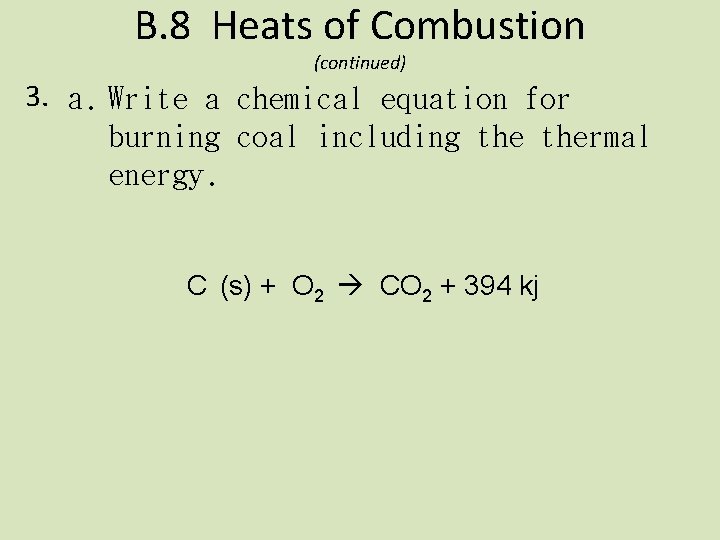
B. 8 Heats of Combustion (continued) 3. a. Write a chemical equation for burning coal including thermal energy. C (s) + O 2 CO 2 + 394 kj
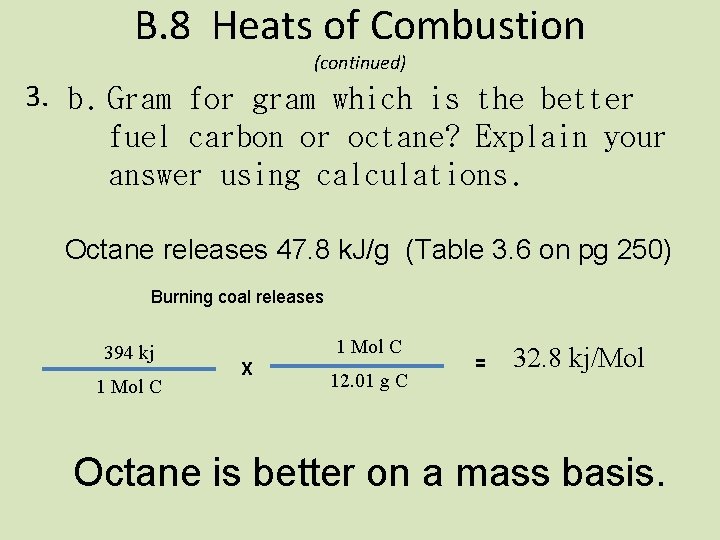
B. 8 Heats of Combustion (continued) 3. b. Gram for gram which is the better fuel carbon or octane? Explain your answer using calculations. Octane releases 47. 8 k. J/g (Table 3. 6 on pg 250) Burning coal releases 394 kj 1 Mol C X 12. 01 g C = 32. 8 kj/Mol Octane is better on a mass basis.
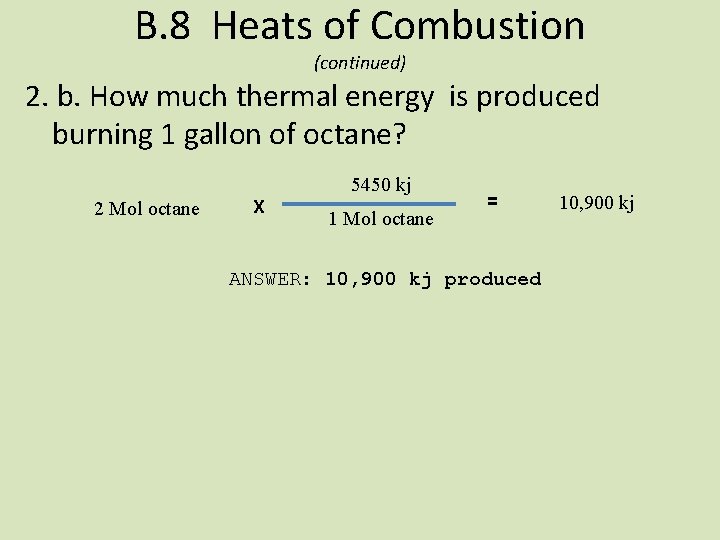
B. 8 Heats of Combustion (continued) 2. b. How much thermal energy is produced burning 1 gallon of octane? 5450 kj 2 Mol octane X 1 Mol octane = ANSWER: 10, 900 kj produced 10, 900 kj

Quiz Tomorrow on Section B Please be prepared
HW on C. 1 Notes on C. 1 Creating New Options: Petrochemicals pg 262
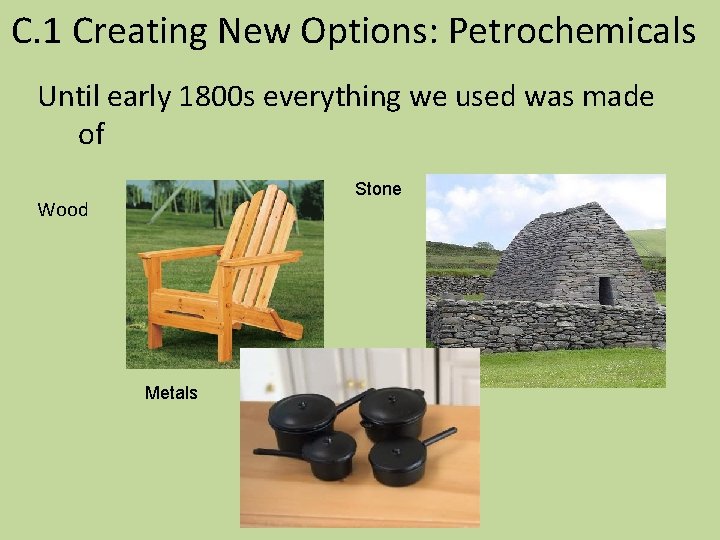
C. 1 Creating New Options: Petrochemicals Until early 1800 s everything we used was made of Stone Wood Metals
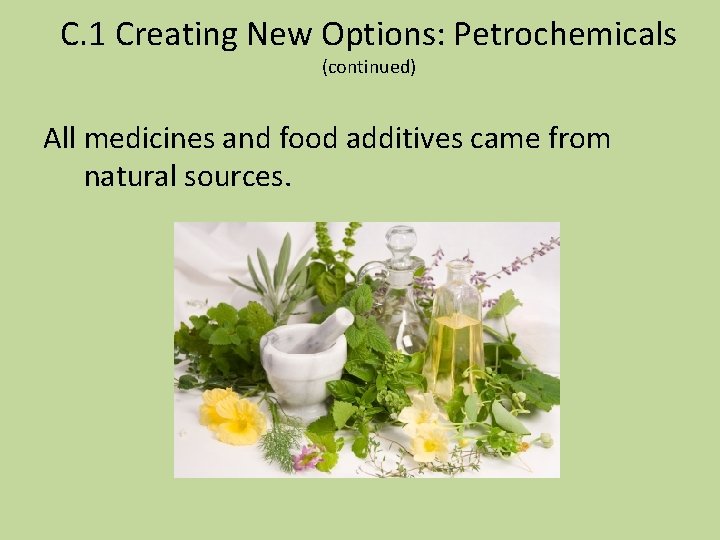
C. 1 Creating New Options: Petrochemicals (continued) All medicines and food additives came from natural sources.
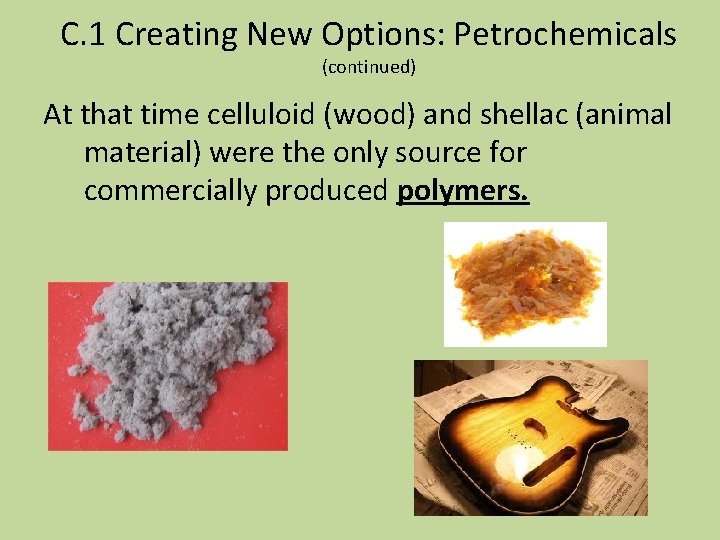
C. 1 Creating New Options: Petrochemicals (continued) At that time celluloid (wood) and shellac (animal material) were the only source for commercially produced polymers.
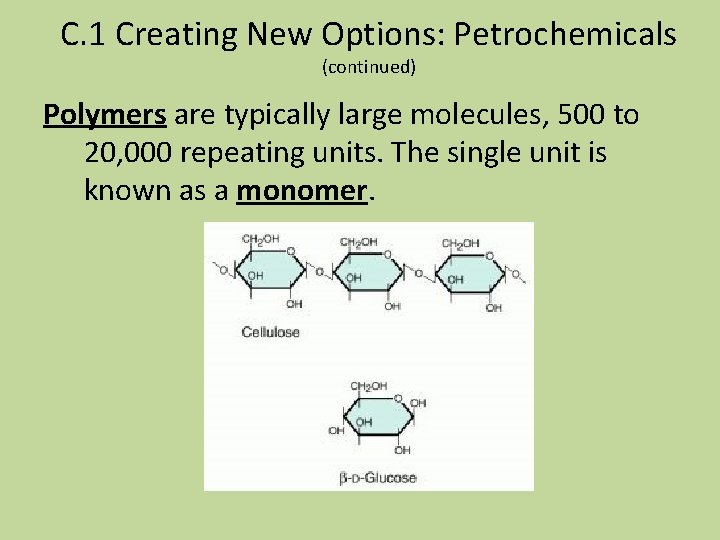
C. 1 Creating New Options: Petrochemicals (continued) Polymers are typically large molecules, 500 to 20, 000 repeating units. The single unit is known as a monomer.
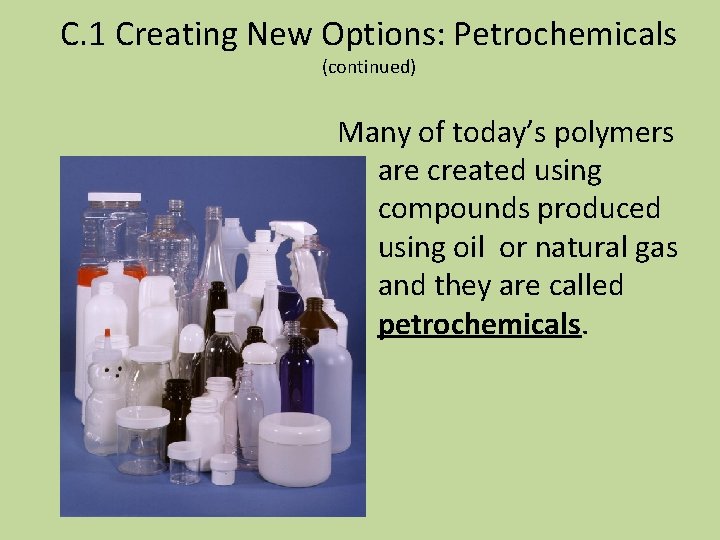
C. 1 Creating New Options: Petrochemicals (continued) Many of today’s polymers are created using compounds produced using oil or natural gas and they are called petrochemicals.
C. 1 Creating New Options: Petrochemicals (continued) Most petrochemicals serve as raw materials producing a wide range of polymers.
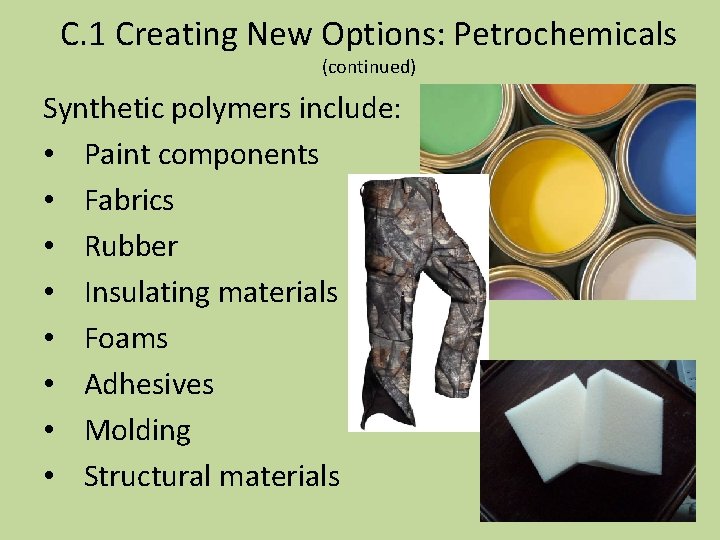
C. 1 Creating New Options: Petrochemicals (continued) Synthetic polymers include: • Paint components • Fabrics • Rubber • Insulating materials • Foams • Adhesives • Molding • Structural materials
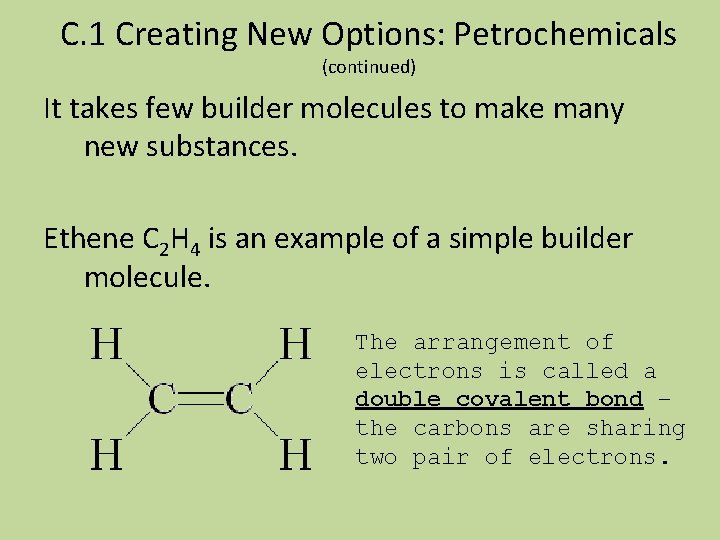
C. 1 Creating New Options: Petrochemicals (continued) It takes few builder molecules to make many new substances. Ethene C 2 H 4 is an example of a simple builder molecule. The arrangement of electrons is called a double covalent bond – the carbons are sharing two pair of electrons.
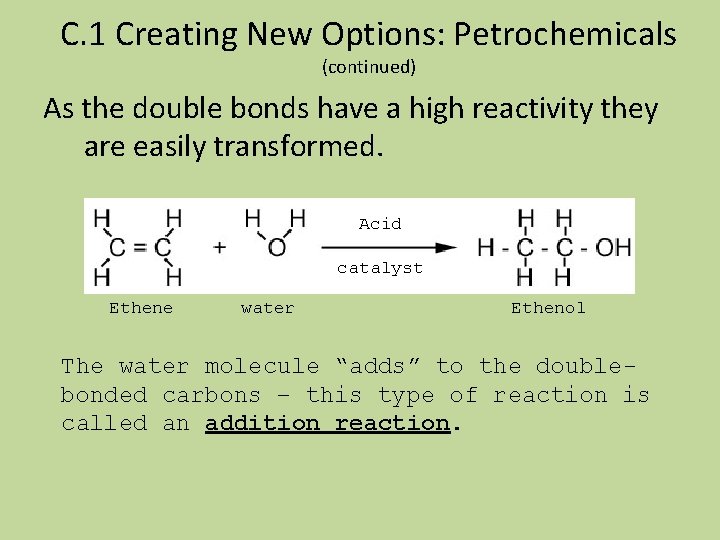
C. 1 Creating New Options: Petrochemicals (continued) As the double bonds have a high reactivity they are easily transformed. Acid catalyst Ethene water Ethenol The water molecule “adds” to the doublebonded carbons – this type of reaction is called an addition reaction.
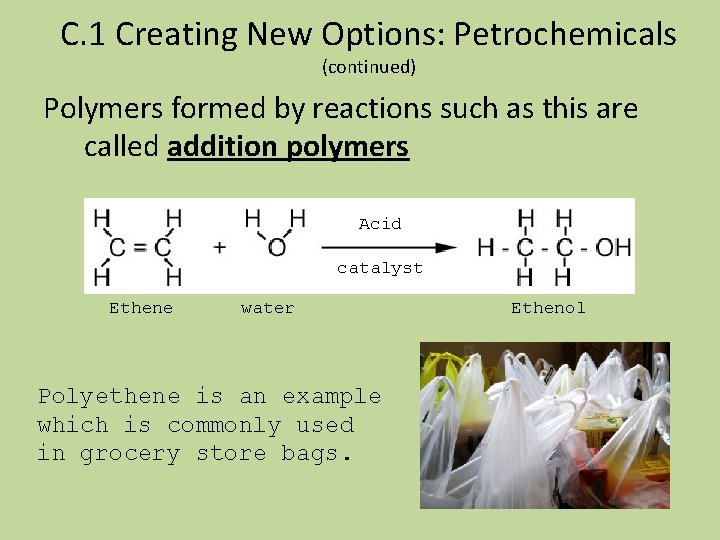
C. 1 Creating New Options: Petrochemicals (continued) Polymers formed by reactions such as this are called addition polymers Acid catalyst Ethene water Polyethene is an example which is commonly used in grocery store bags. Ethenol
HW Notes on section C. 2 Polymer Structure & Properties & C. 3 Beyond Alkanes on pgs 265267
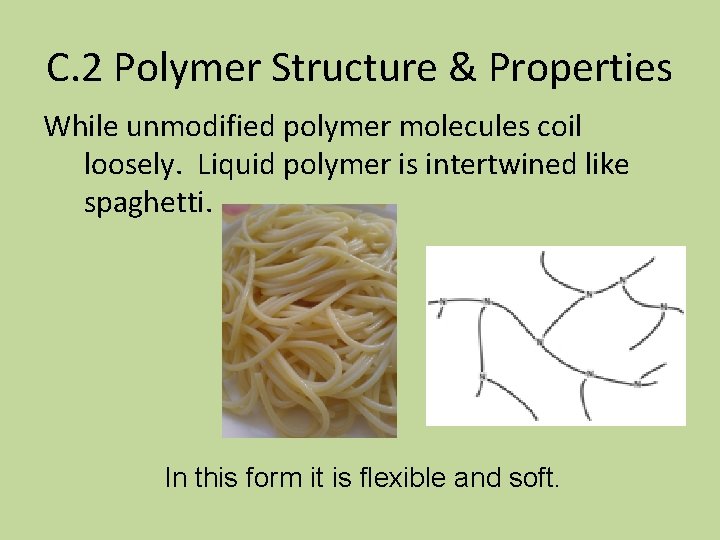
C. 2 Polymer Structure & Properties While unmodified polymer molecules coil loosely. Liquid polymer is intertwined like spaghetti. In this form it is flexible and soft.

C. 2 Polymer Structure & Properties (continued) For polymers, ductility means the ability to be drawn out into thin strands. While warm it is flexible – when cool more rigid.
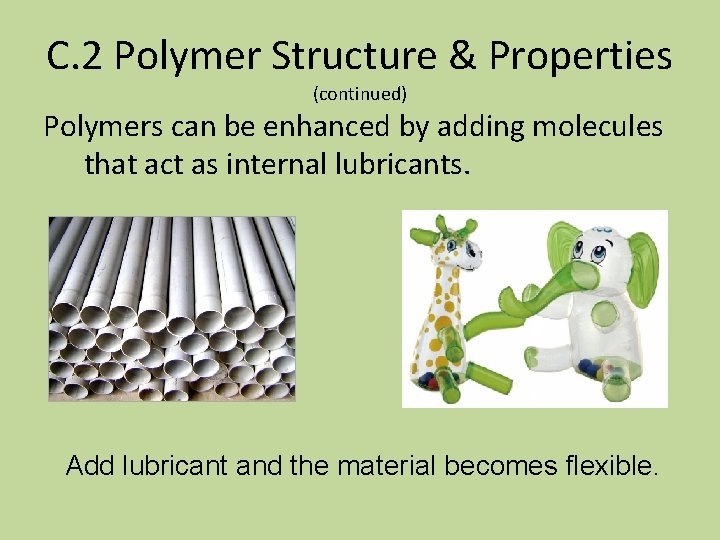
C. 2 Polymer Structure & Properties (continued) Polymers can be enhanced by adding molecules that act as internal lubricants. Add lubricant and the material becomes flexible.
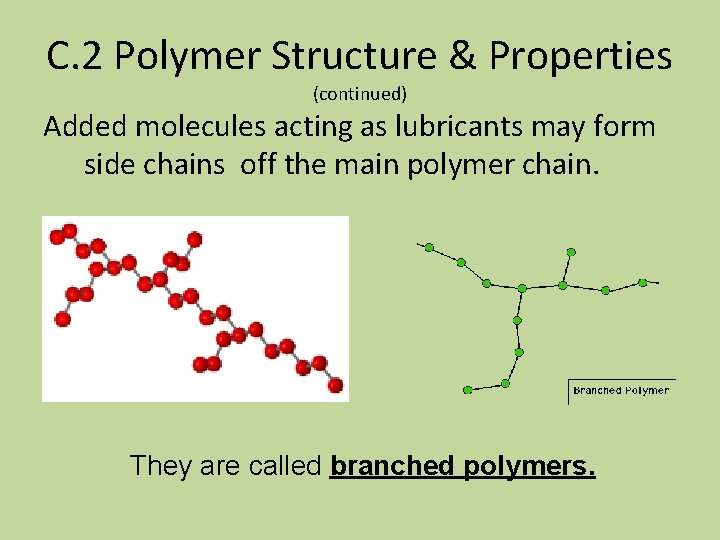
C. 2 Polymer Structure & Properties (continued) Added molecules acting as lubricants may form side chains off the main polymer chain. They are called branched polymers.
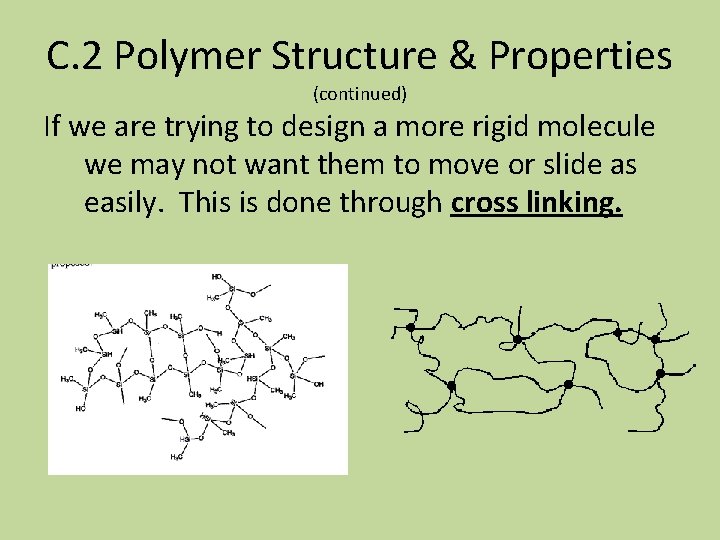
C. 2 Polymer Structure & Properties (continued) If we are trying to design a more rigid molecule we may not want them to move or slide as easily. This is done through cross linking.
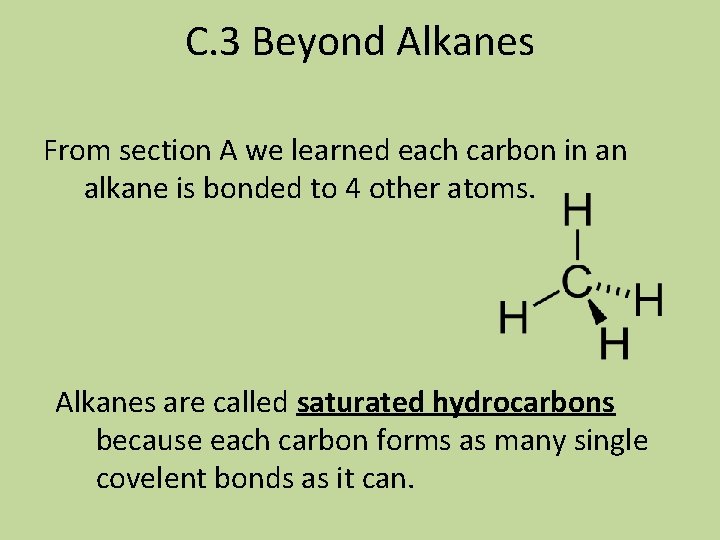
C. 3 Beyond Alkanes From section A we learned each carbon in an alkane is bonded to 4 other atoms. Alkanes are called saturated hydrocarbons because each carbon forms as many single covelent bonds as it can.
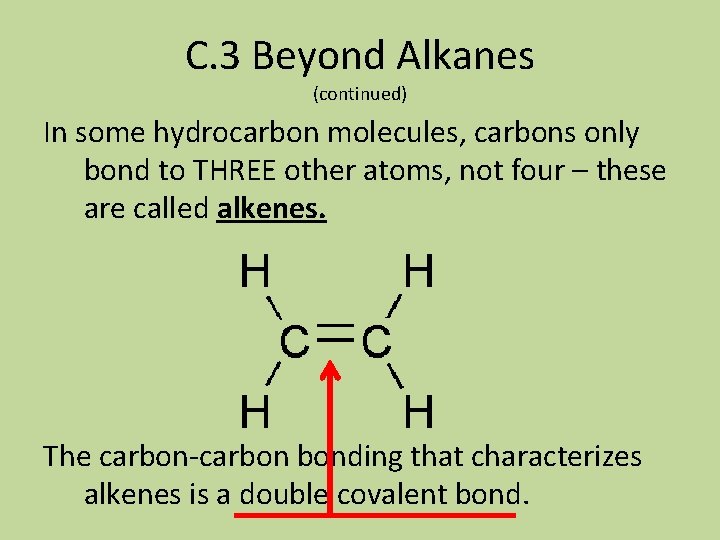
C. 3 Beyond Alkanes (continued) In some hydrocarbon molecules, carbons only bond to THREE other atoms, not four – these are called alkenes. The carbon-carbon bonding that characterizes alkenes is a double covalent bond.
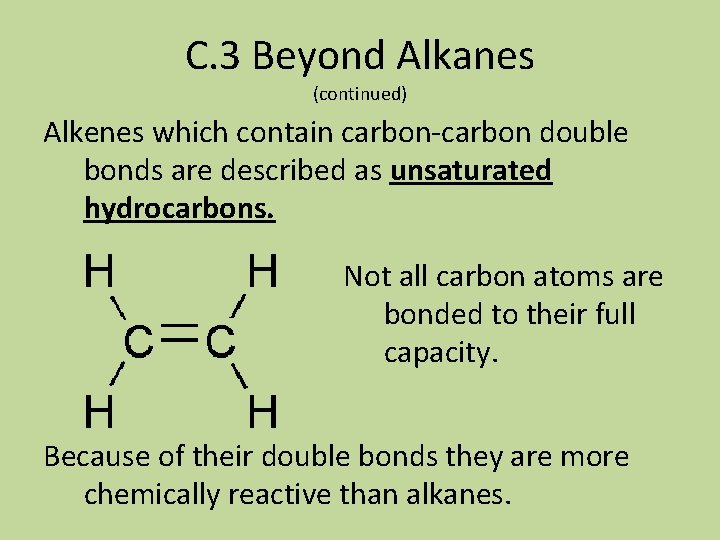
C. 3 Beyond Alkanes (continued) Alkenes which contain carbon-carbon double bonds are described as unsaturated hydrocarbons. Not all carbon atoms are bonded to their full capacity. Because of their double bonds they are more chemically reactive than alkanes.
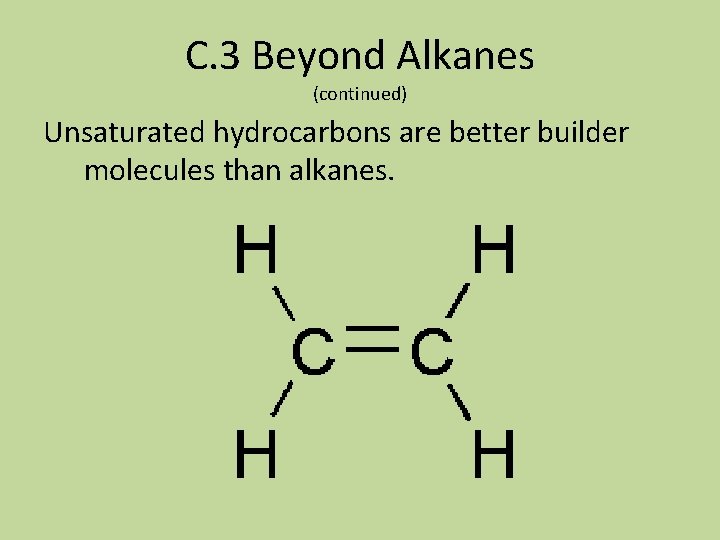
C. 3 Beyond Alkanes (continued) Unsaturated hydrocarbons are better builder molecules than alkanes.
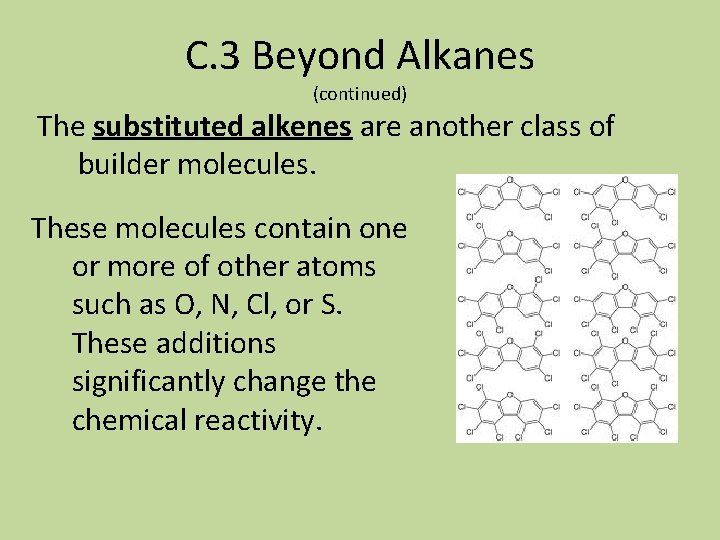
C. 3 Beyond Alkanes (continued) The substituted alkenes are another class of builder molecules. These molecules contain one or more of other atoms such as O, N, Cl, or S. These additions significantly change the chemical reactivity.
C. 4 The Builders (pg 267 -269) On a lined piece of paper answer questions: • 2 • 10 (nothing to write) • 11 • 3 (all) • 12 • 4 a • 13 (nothing to write) • 5 • 14 • 6 • 7 • 8 • 9
HW on C. 5 & C. 6 Notes on C. 5 More Builder Molecules pg 270 & C. 6 Builder Molecules Containing Oxygen pg 272
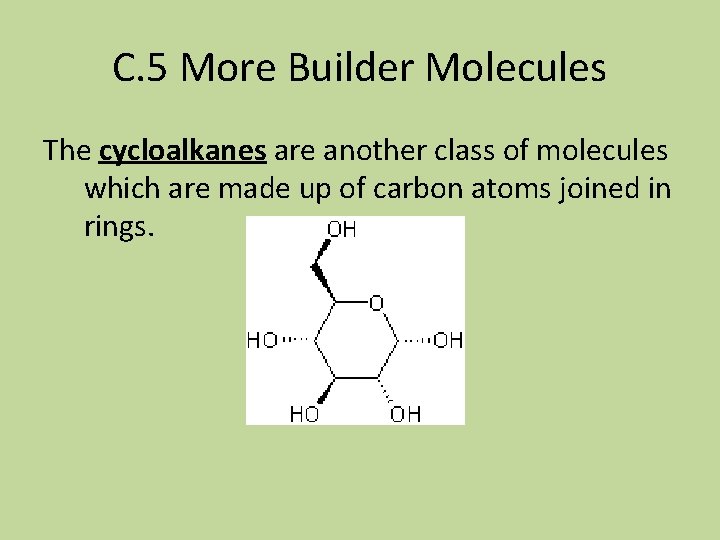
C. 5 More Builder Molecules The cycloalkanes are another class of molecules which are made up of carbon atoms joined in rings.
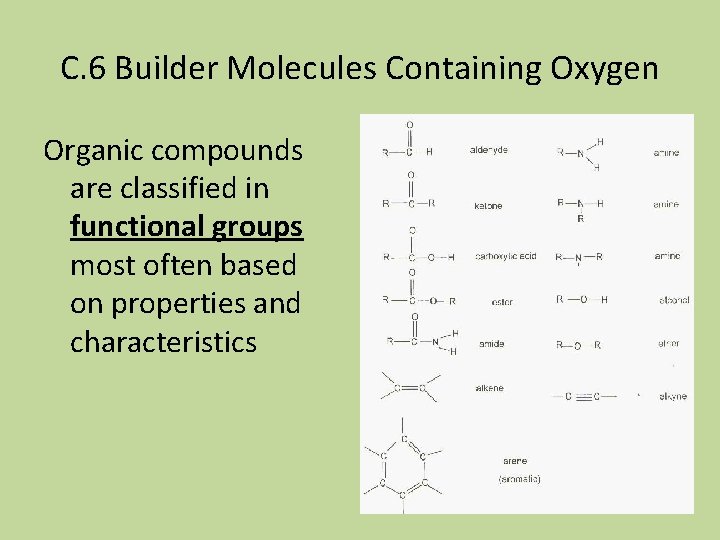
C. 6 Builder Molecules Containing Oxygen Organic compounds are classified in functional groups most often based on properties and characteristics
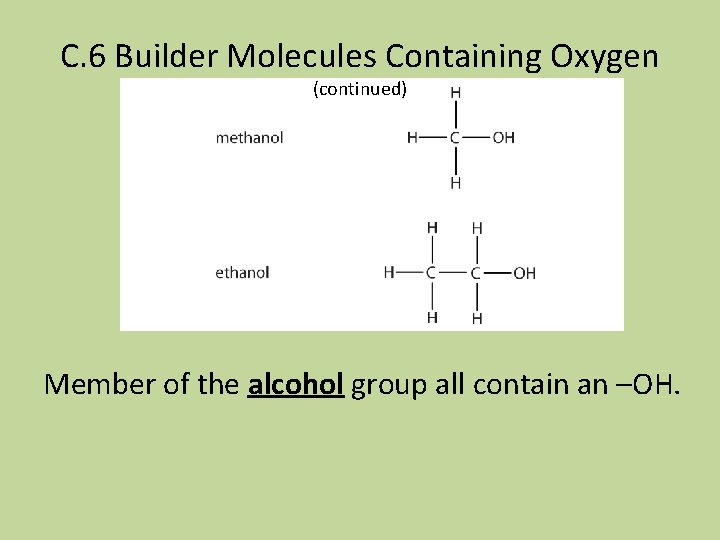
C. 6 Builder Molecules Containing Oxygen (continued) Member of the alcohol group all contain an –OH.
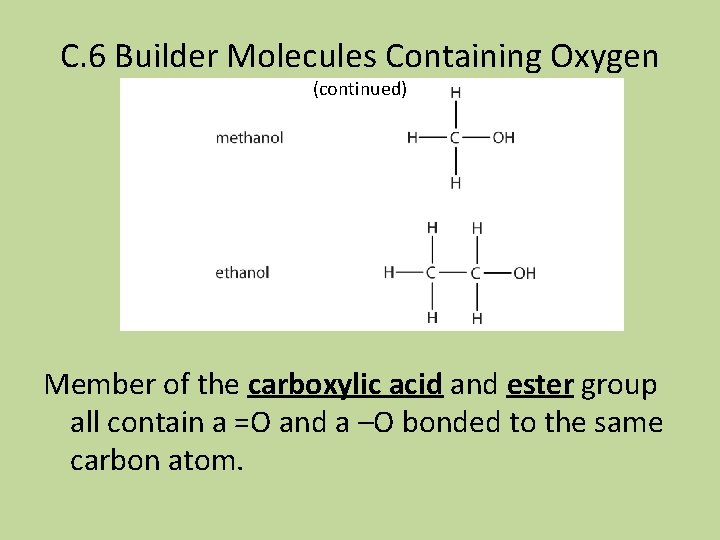
C. 6 Builder Molecules Containing Oxygen (continued) Member of the carboxylic acid and ester group all contain a =O and a –O bonded to the same carbon atom.

Section C Quiz Break

After Section C Quiz Notes on section D. 1 and preview D. 2 pgs 282 & 283
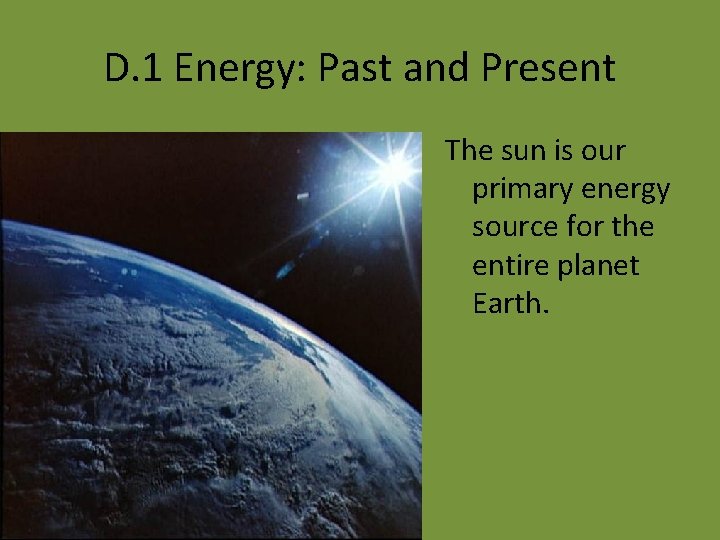
D. 1 Energy: Past and Present The sun is our primary energy source for the entire planet Earth.
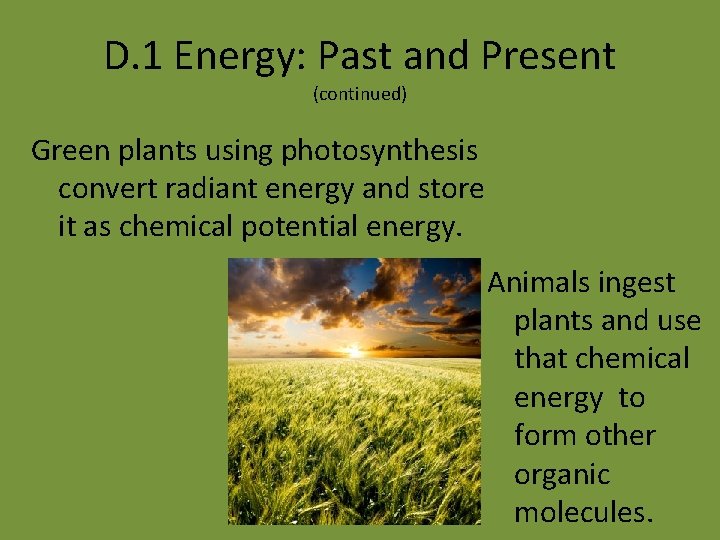
D. 1 Energy: Past and Present (continued) Green plants using photosynthesis convert radiant energy and store it as chemical potential energy. Animals ingest plants and use that chemical energy to form other organic molecules.
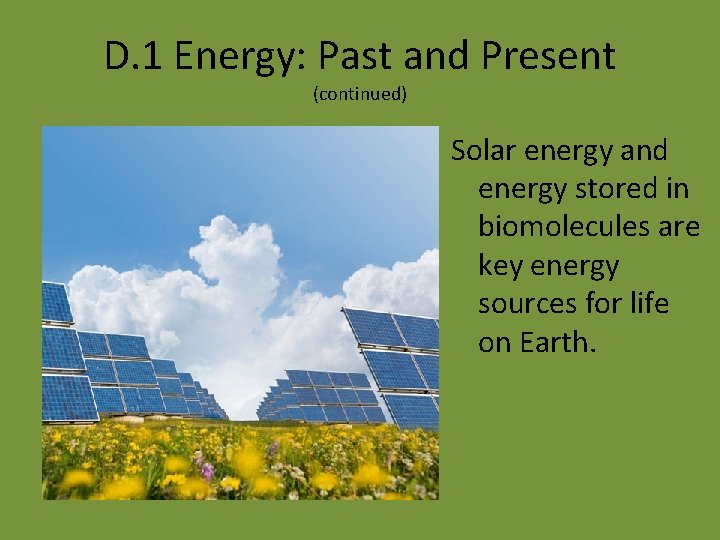
D. 1 Energy: Past and Present (continued) Solar energy and energy stored in biomolecules are key energy sources for life on Earth.
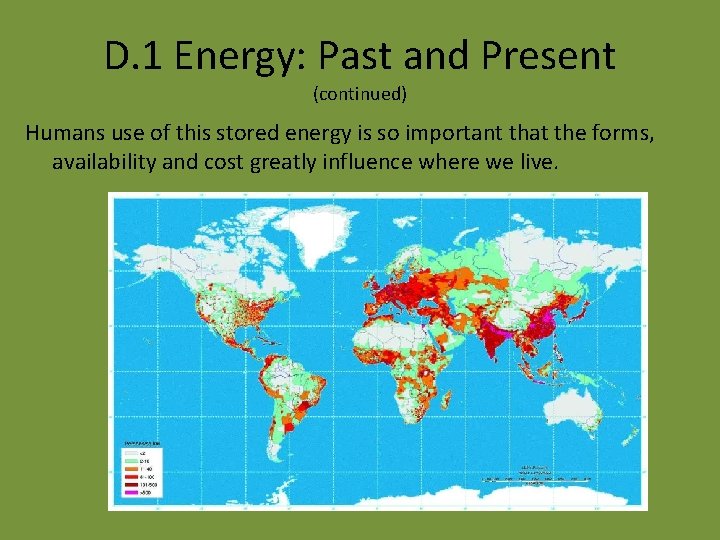
D. 1 Energy: Past and Present (continued) Humans use of this stored energy is so important that the forms, availability and cost greatly influence where we live.
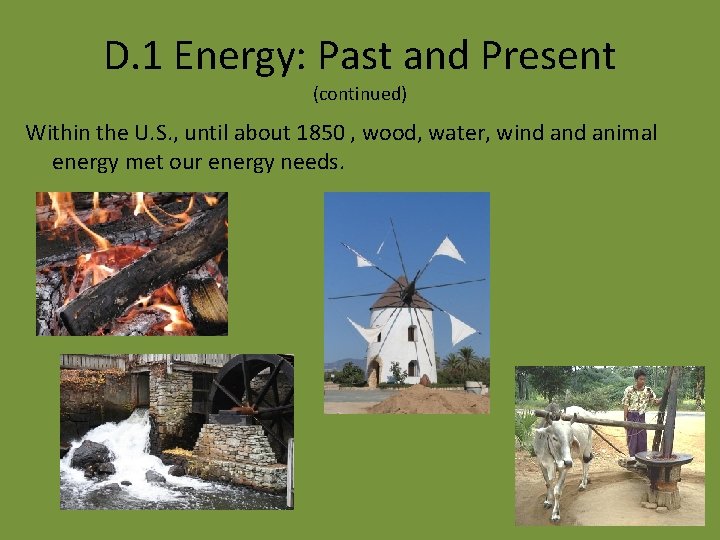
D. 1 Energy: Past and Present (continued) Within the U. S. , until about 1850 , wood, water, wind animal energy met our energy needs.
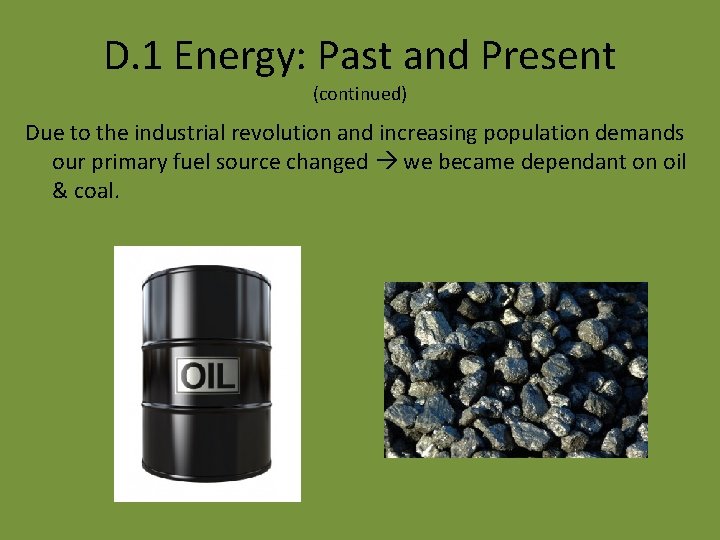
D. 1 Energy: Past and Present (continued) Due to the industrial revolution and increasing population demands our primary fuel source changed we became dependant on oil & coal.
D. 2 Fuel Sources over the Years Answer all questions 1 -4 on pg 283 -284, remember complete sentences for complete credit.
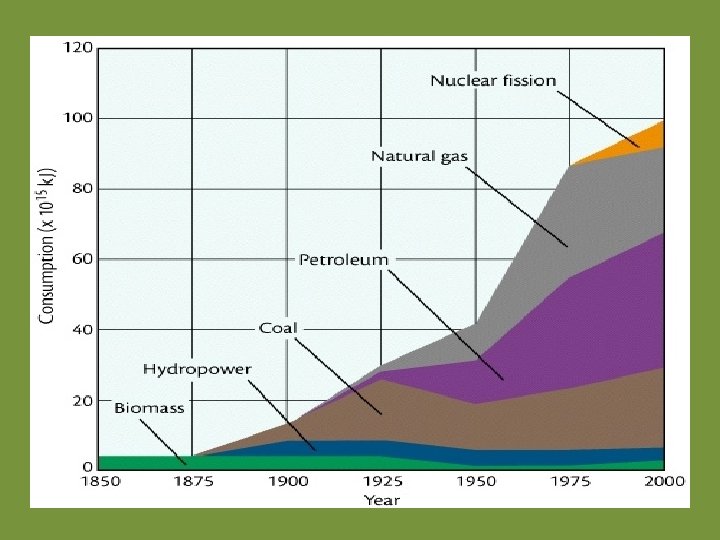
D. 2 Fuel Sources over the Years

HW Notes on D. 3 on pgs 284 -285.
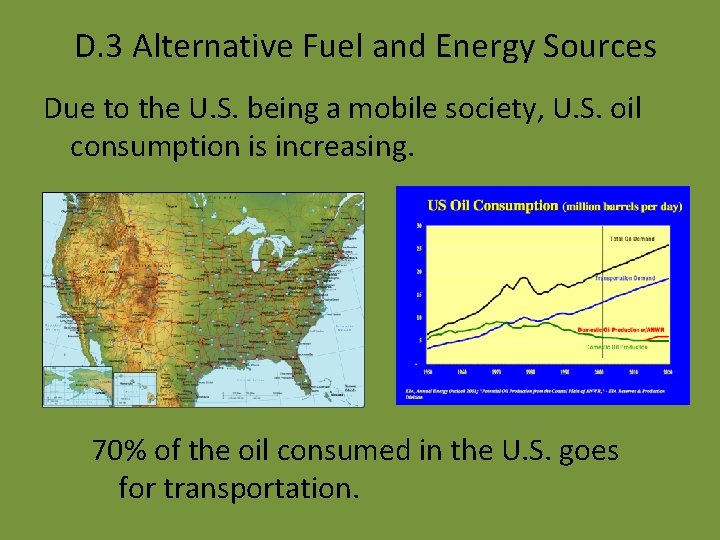
D. 3 Alternative Fuel and Energy Sources Due to the U. S. being a mobile society, U. S. oil consumption is increasing. 70% of the oil consumed in the U. S. goes for transportation.
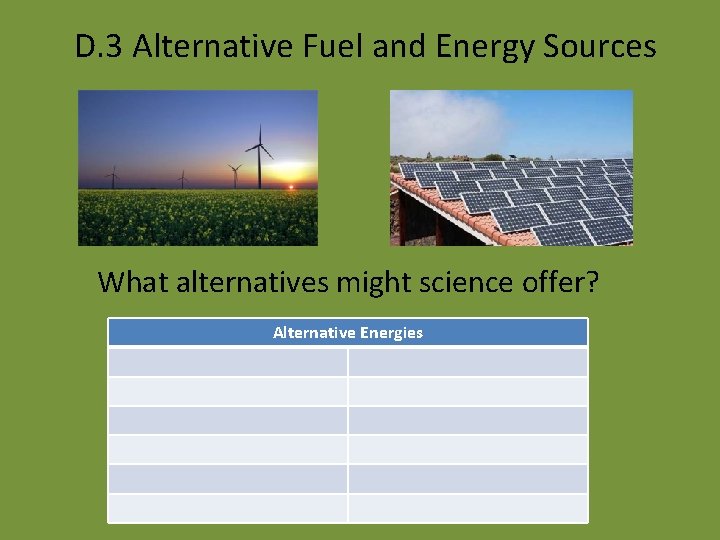
D. 3 Alternative Fuel and Energy Sources What alternatives might science offer? Alternative Energies
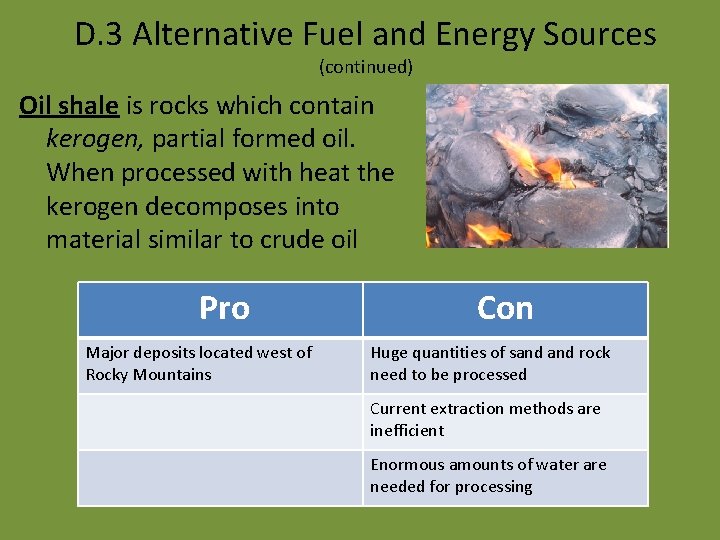
D. 3 Alternative Fuel and Energy Sources (continued) Oil shale is rocks which contain kerogen, partial formed oil. When processed with heat the kerogen decomposes into material similar to crude oil Pro Major deposits located west of Rocky Mountains Con Huge quantities of sand rock need to be processed Current extraction methods are inefficient Enormous amounts of water are needed for processing
D. 3 Alternative Fuel and Energy Sources (continued) Coal liquefaction is the technology of turning coal to a liquid fuel. Pro U. S. coal reserves are much greater than U. S. oil reserves. Con Current cost of mining and converting is far higher than simply producing the same amount of oil (COST TOO HIGH)
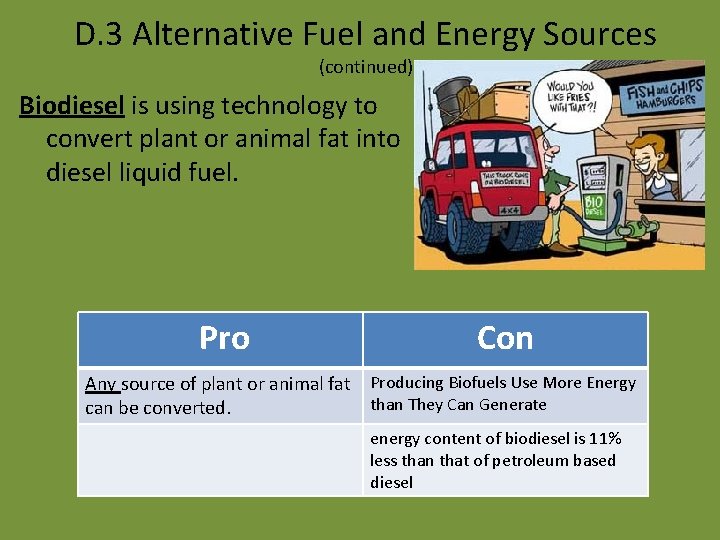
D. 3 Alternative Fuel and Energy Sources (continued) Biodiesel is using technology to convert plant or animal fat into diesel liquid fuel. Pro Con Any source of plant or animal fat Producing Biofuels Use More Energy than They Can Generate can be converted. energy content of biodiesel is 11% less than that of petroleum based diesel
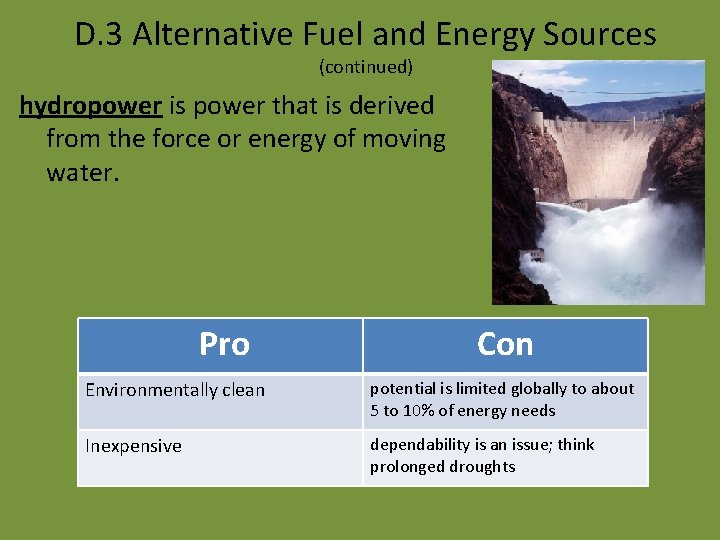
D. 3 Alternative Fuel and Energy Sources (continued) hydropower is power that is derived from the force or energy of moving water. Pro Con Environmentally clean potential is limited globally to about 5 to 10% of energy needs Inexpensive dependability is an issue; think prolonged droughts
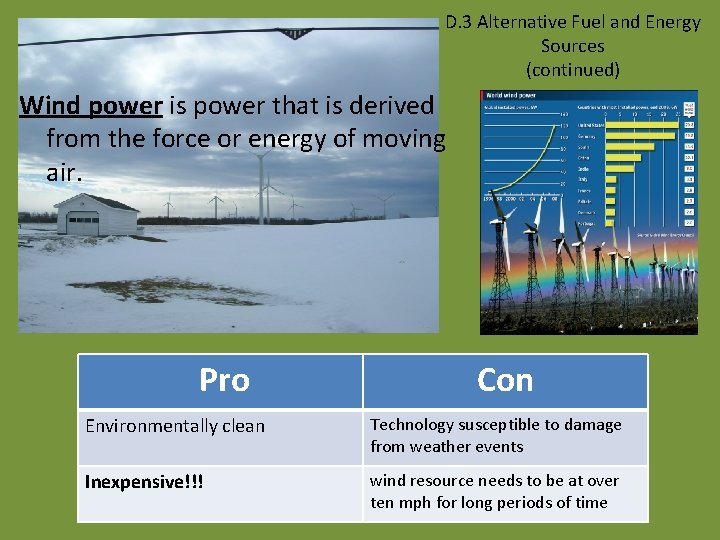
D. 3 Alternative Fuel and Energy Sources (continued) Wind power is power that is derived from the force or energy of moving air. Pro Con Environmentally clean Technology susceptible to damage from weather events Inexpensive!!! wind resource needs to be at over ten mph for long periods of time
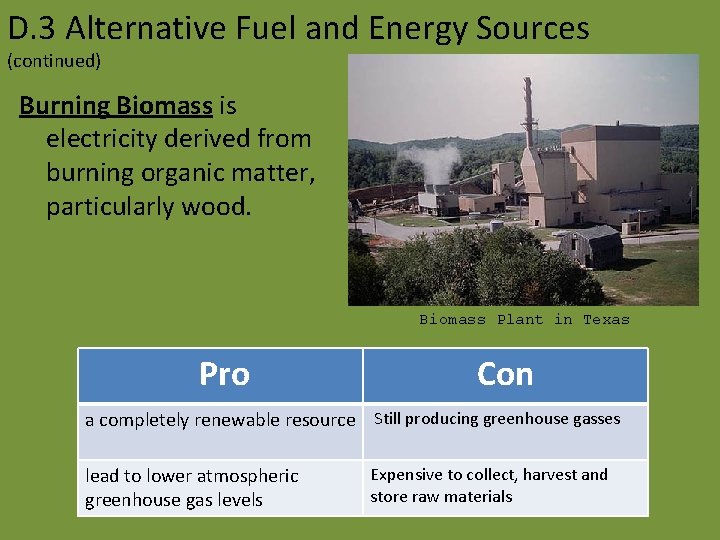
D. 3 Alternative Fuel and Energy Sources (continued) Burning Biomass is electricity derived from burning organic matter, particularly wood. Biomass Plant in Texas Pro Con a completely renewable resource Still producing greenhouse gasses lead to lower atmospheric greenhouse gas levels Expensive to collect, harvest and store raw materials
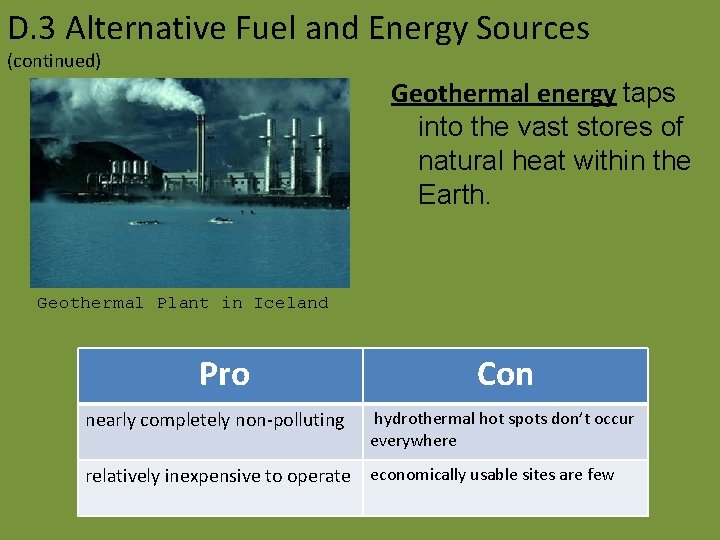
D. 3 Alternative Fuel and Energy Sources (continued) Geothermal energy taps into the vast stores of natural heat within the Earth. Geothermal Plant in Iceland Pro nearly completely non-polluting Con hydrothermal hot spots don’t occur everywhere relatively inexpensive to operate economically usable sites are few
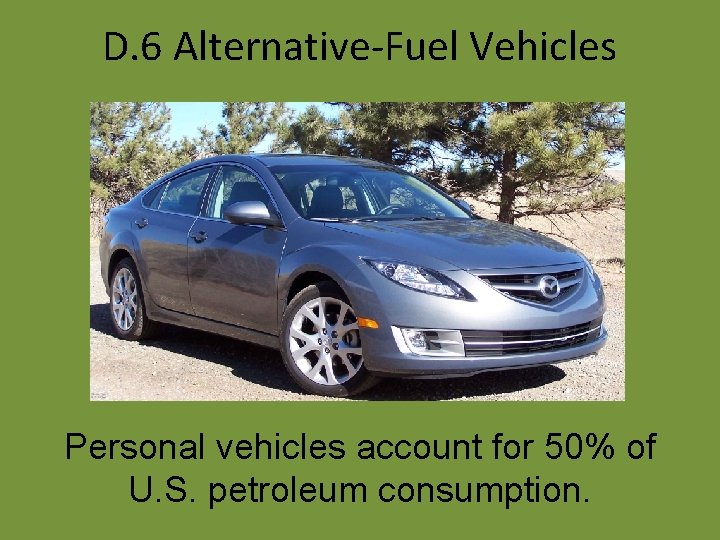
D. 6 Alternative-Fuel Vehicles Personal vehicles account for 50% of U. S. petroleum consumption.
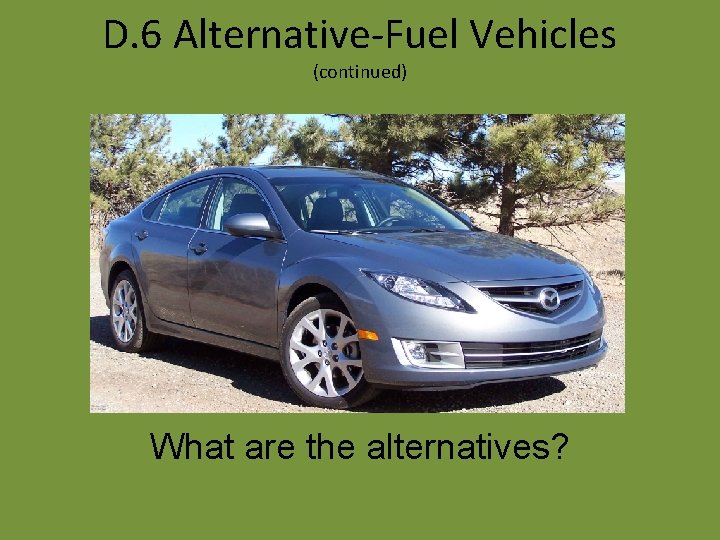
D. 6 Alternative-Fuel Vehicles (continued) What are the alternatives?
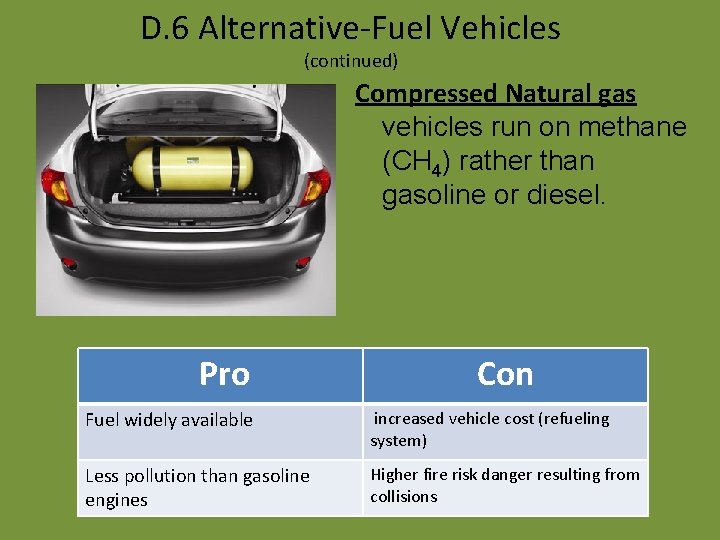
D. 6 Alternative-Fuel Vehicles (continued) Compressed Natural gas vehicles run on methane (CH 4) rather than gasoline or diesel. Pro Con Fuel widely available increased vehicle cost (refueling system) Less pollution than gasoline engines Higher fire risk danger resulting from collisions
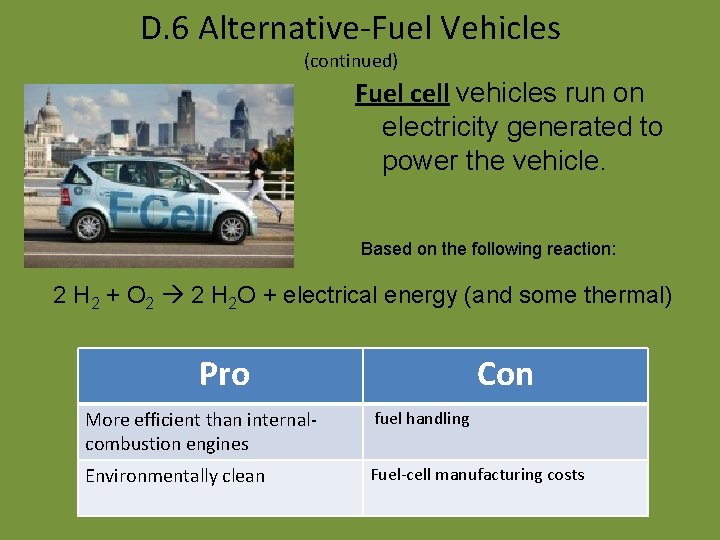
D. 6 Alternative-Fuel Vehicles (continued) Fuel cell vehicles run on electricity generated to power the vehicle. Based on the following reaction: 2 H 2 + O 2 2 H 2 O + electrical energy (and some thermal) Pro Con More efficient than internalcombustion engines fuel handling Environmentally clean Fuel-cell manufacturing costs
D. 6 Alternative-Fuel Vehicles (continued) Hybrid vehicles run on gasoline-burning engine as well as a batterypowered electric motor. Captures. . . Kinetic energy and stores it as chemical potential energy. Pro Greater mpg, typically over 40 & can travel more than 650 mile between fuel stop Con Still emit greenhouse gasses
D. 5 Biodiesel as a Petroleum Substitute Fun with numbers – questions 1 -3 on pg 288 , please show all your work

DONE – next stop test on sections B, C & D
- Slides: 95