
Unit 3 Review Nikol Shurhin Samantha Formica Scott


- Slides: 17
Unit 3 Review Nikol Shurhin, Samantha Formica, Scott Beck, Ruyee Frank
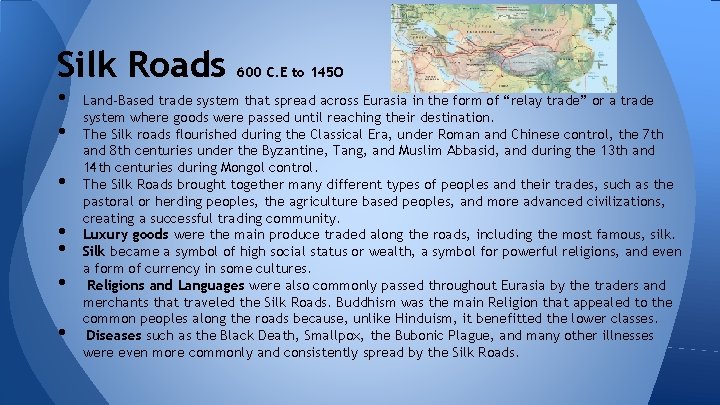
Silk Roads • • 600 C. E to 145 O Land-Based trade system that spread across Eurasia in the form of “relay trade” or a trade system where goods were passed until reaching their destination. The Silk roads flourished during the Classical Era, under Roman and Chinese control, the 7 th and 8 th centuries under the Byzantine, Tang, and Muslim Abbasid, and during the 13 th and 14 th centuries during Mongol control. The Silk Roads brought together many different types of peoples and their trades, such as the pastoral or herding peoples, the agriculture based peoples, and more advanced civilizations, creating a successful trading community. Luxury goods were the main produce traded along the roads, including the most famous, silk. Silk became a symbol of high social status or wealth, a symbol for powerful religions, and even a form of currency in some cultures. Religions and Languages were also commonly passed throughout Eurasia by the traders and merchants that traveled the Silk Roads. Buddhism was the main Religion that appealed to the common peoples along the roads because, unlike Hinduism, it benefitted the lower classes. Diseases such as the Black Death, Smallpox, the Bubonic Plague, and many other illnesses were even more commonly and consistently spread by the Silk Roads.
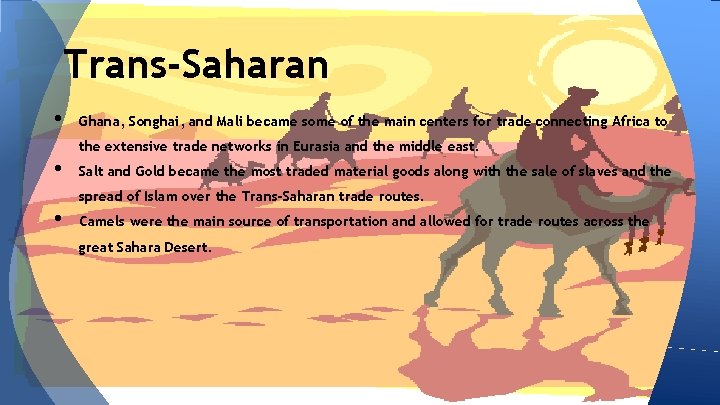
Trans-Saharan • Ghana, Songhai, and Mali became some of the main centers for trade connecting Africa to the extensive trade networks in Eurasia and the middle east. • Salt and Gold became the most traded material goods along with the sale of slaves and the spread of Islam over the Trans-Saharan trade routes. • Camels were the main source of transportation and allowed for trade routes across the great Sahara Desert.
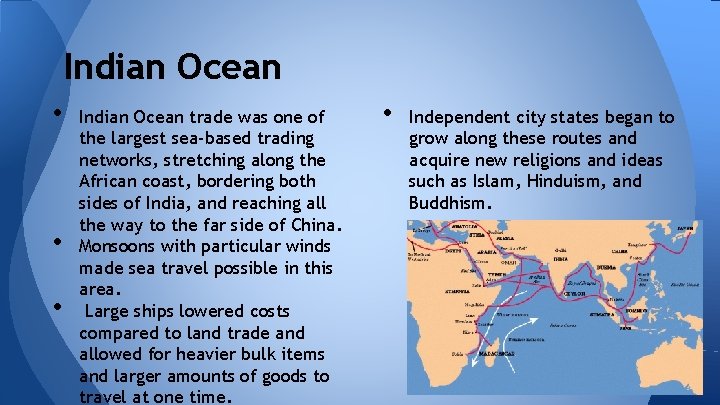
Indian Ocean • • • Indian Ocean trade was one of the largest sea-based trading networks, stretching along the African coast, bordering both sides of India, and reaching all the way to the far side of China. Monsoons with particular winds made sea travel possible in this area. Large ships lowered costs compared to land trade and allowed for heavier bulk items and larger amounts of goods to travel at one time. • Independent city states began to grow along these routes and acquire new religions and ideas such as Islam, Hinduism, and Buddhism.
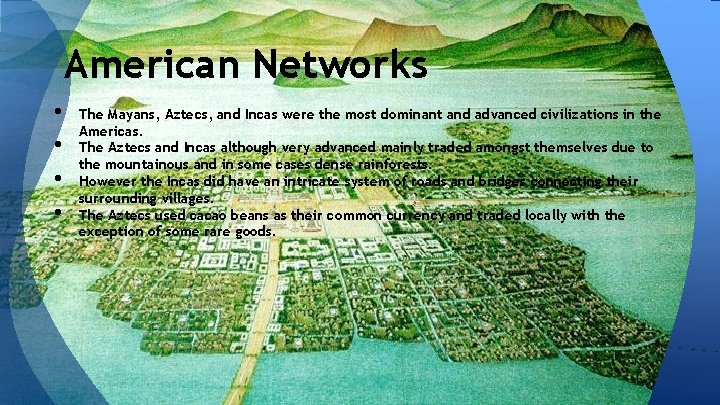
American Networks • • The Mayans, Aztecs, and Incas were the most dominant and advanced civilizations in the Americas. The Aztecs and Incas although very advanced mainly traded amongst themselves due to the mountainous and in some cases dense rainforests. However the Incas did have an intricate system of roads and bridges connecting their surrounding villages. The Aztecs used cacao beans as their common currency and traded locally with the exception of some rare goods.
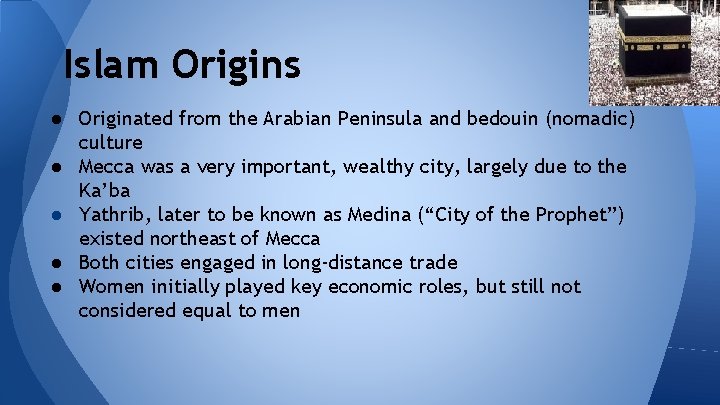
Islam Origins ● Originated from the Arabian Peninsula and bedouin (nomadic) culture ● Mecca was a very important, wealthy city, largely due to the Ka’ba ● Yathrib, later to be known as Medina (“City of the Prophet”) existed northeast of Mecca ● Both cities engaged in long-distance trade ● Women initially played key economic roles, but still not considered equal to men
Muhammad ● Born in Medina at around 570 C. E. ● Raised by father’s relatives because of both of his parents’ deaths ● In his early 20’s, he worked for Khadijah as a trader, who later became his wife ● He spent a large amount of time meditating, and in 610, he received his first revelation, all of which were written in Arabic and assembled into the Qur’an ● He gained many followers when he made his hijra (“flight to Medina”) and settled the disputes of the bedouin clans ● Ultimate victory for him when he gained a treaty to be able to return to Mecca, and he crushed the idols of the Ka’ba
Umayyad Empire ● After Muhammad’s death, a conflict arose between the Sunnis and Shi’ites about who should rule next and resulted in the Ridda Wars ● The Umayya clan took leadership and began an array of conquests throughout the Middle East and Northern Africa, and spread Islam with them (jihads) ● Caliphs strived to make a bureaucracy to connect their vast empire ● Women were not veiled during this time, and the Qur’an supported equality between men and women ● Downfall resulted from ineffective leaders, and the Abbasids took over after the Battle of the River Zab
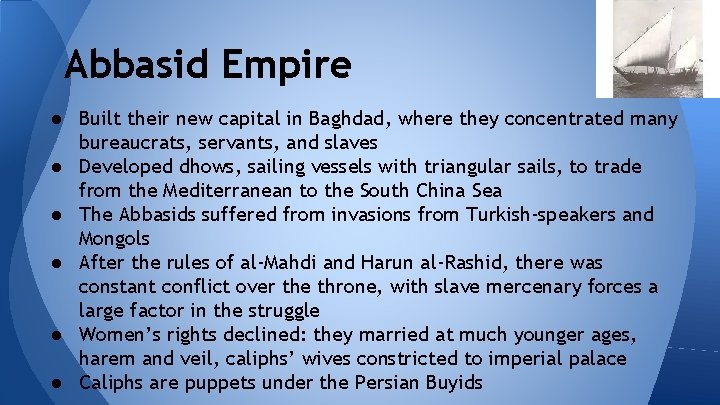
Abbasid Empire ● Built their new capital in Baghdad, where they concentrated many bureaucrats, servants, and slaves ● Developed dhows, sailing vessels with triangular sails, to trade from the Mediterranean to the South China Sea ● The Abbasids suffered from invasions from Turkish-speakers and Mongols ● After the rules of al-Mahdi and Harun al-Rashid, there was constant conflict over the throne, with slave mercenary forces a large factor in the struggle ● Women’s rights declined: they married at much younger ages, harem and veil, caliphs’ wives constricted to imperial palace ● Caliphs are puppets under the Persian Buyids
Abbasid Empire cont. ● After the Buyids, the Suljuk Turks took over, who had to deal with the Christian Crusades ● Throughout the Abbasid Empire in general, trade with Asia flourished, and essential and luxury goods were very available ● Persian literature and science advanced during the Abbasid era ● Muslim warriors, traders, and farmers spread to south Asia, in conjunction with Hindus, which resulted in Sufi mysticism blended with Hindu and Buddhist elements ● Baghdad was taken over by the Mongols, and was never able to be recovered by the Abbasids
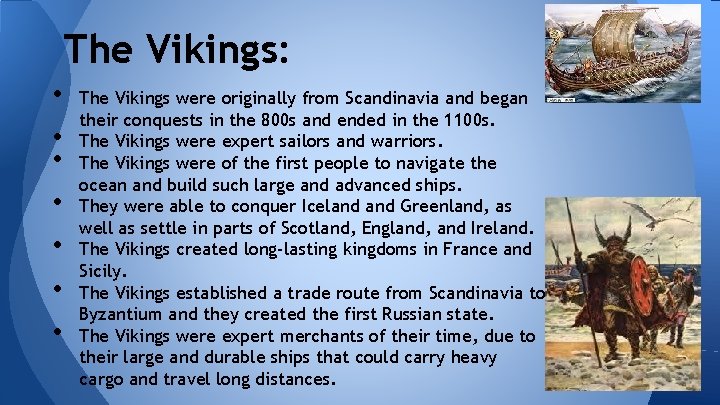
The Vikings: • • The Vikings were originally from Scandinavia and began their conquests in the 800 s and ended in the 1100 s. The Vikings were expert sailors and warriors. The Vikings were of the first people to navigate the ocean and build such large and advanced ships. They were able to conquer Iceland Greenland, as well as settle in parts of Scotland, England, and Ireland. The Vikings created long-lasting kingdoms in France and Sicily. The Vikings established a trade route from Scandinavia to Byzantium and they created the first Russian state. The Vikings were expert merchants of their time, due to their large and durable ships that could carry heavy cargo and travel long distances.
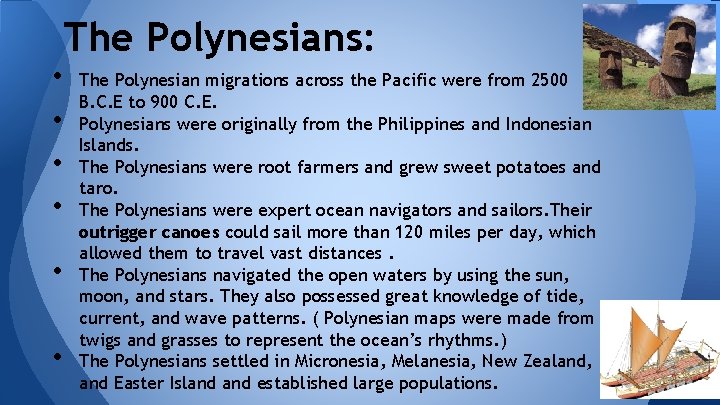
• • • The Polynesians: The Polynesian migrations across the Pacific were from 2500 B. C. E to 900 C. E. Polynesians were originally from the Philippines and Indonesian Islands. The Polynesians were root farmers and grew sweet potatoes and taro. The Polynesians were expert ocean navigators and sailors. Their outrigger canoes could sail more than 120 miles per day, which allowed them to travel vast distances. The Polynesians navigated the open waters by using the sun, moon, and stars. They also possessed great knowledge of tide, current, and wave patterns. ( Polynesian maps were made from twigs and grasses to represent the ocean’s rhythms. ) The Polynesians settled in Micronesia, Melanesia, New Zealand, and Easter Island established large populations.
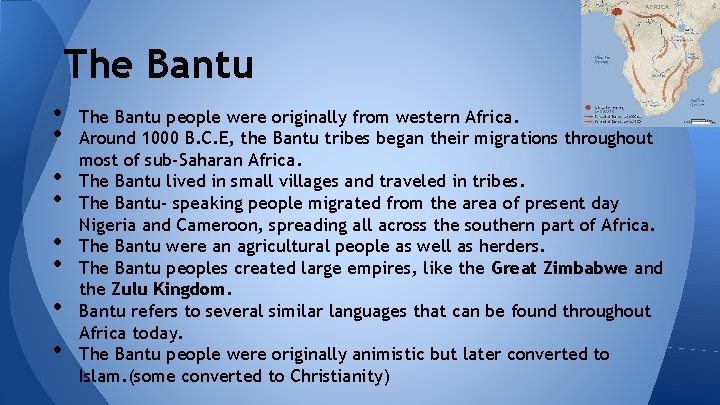
The Bantu • • The Bantu people were originally from western Africa. Around 1000 B. C. E, the Bantu tribes began their migrations throughout most of sub-Saharan Africa. The Bantu lived in small villages and traveled in tribes. The Bantu- speaking people migrated from the area of present day Nigeria and Cameroon, spreading all across the southern part of Africa. The Bantu were an agricultural people as well as herders. The Bantu peoples created large empires, like the Great Zimbabwe and the Zulu Kingdom. Bantu refers to several similar languages that can be found throughout Africa today. The Bantu people were originally animistic but later converted to Islam. (some converted to Christianity)
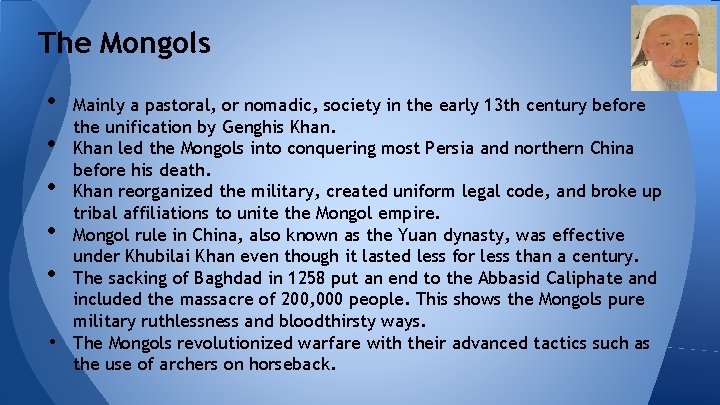
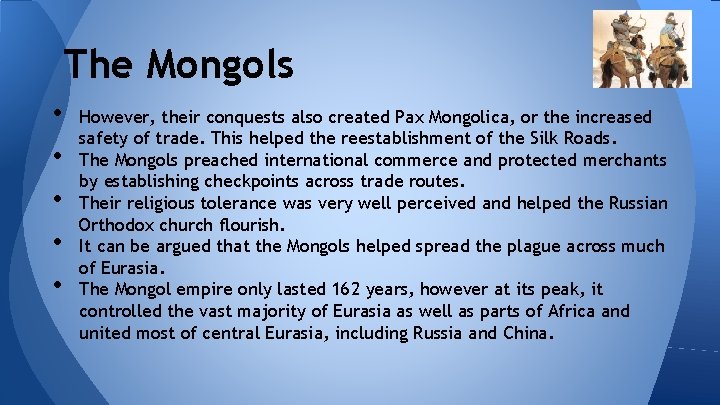
The Mongols • • • Mainly a pastoral, or nomadic, society in the early 13 th century before the unification by Genghis Khan led the Mongols into conquering most Persia and northern China before his death. Khan reorganized the military, created uniform legal code, and broke up tribal affiliations to unite the Mongol empire. Mongol rule in China, also known as the Yuan dynasty, was effective under Khubilai Khan even though it lasted less for less than a century. The sacking of Baghdad in 1258 put an end to the Abbasid Caliphate and included the massacre of 200, 000 people. This shows the Mongols pure military ruthlessness and bloodthirsty ways. • The Mongols revolutionized warfare with their advanced tactics such as the use of archers on horseback.
The Mongols • • • However, their conquests also created Pax Mongolica, or the increased safety of trade. This helped the reestablishment of the Silk Roads. The Mongols preached international commerce and protected merchants by establishing checkpoints across trade routes. Their religious tolerance was very well perceived and helped the Russian Orthodox church flourish. It can be argued that the Mongols helped spread the plague across much of Eurasia. The Mongol empire only lasted 162 years, however at its peak, it controlled the vast majority of Eurasia as well as parts of Africa and united most of central Eurasia, including Russia and China.
The End